Feeds:
Posts
Comments

Archive for the ‘Uncategorized’ Category

It doesn’t make  news if  police arrest  Robbers , militants ,  or  Terrorists   ! Here is a shocking news !

Why should  a group  of nine cardiologists  ,   arrested from a scientifically advanced country like Italy ?

A news clip from the Forbes November 11th 2012 .

Nine doctors were arrested .  . .  12 device and pharma companies have been banned form entering Italy.

Reason  : They indulged in  inappropriate coronary  interventions which has caused fatal injuries .

Do you think these  cardiologist are  at fault   ?

Read Full Post »

A young man with   VT  (LBBB morphology ) and  apparently normal heart by   echocardiogram  is  a  real  diagnostic challenge .
Here is a comparison  of  the two  closely mimicking  entities. RVOT VT and ARVD .
Please note -Micro reentry and triggered activity  are very closely related cellular evens. For all clinical reasons there is generally no purpose in differentiating the two.

*Please note -Micro reentry and triggered activity  mimic each other at the cellular level . For all clinical reasons there is generally no purpose in differentiating the two.

*RVOT- Right ventricular outflow tract. ARVD/ARVC -Arrhythmogenic  right ventricular dysplasia /cardiomyopathy

(Caution : RVOT vs ARVD  -In  the traditional medical teaching system , we are often taught to differentiate  two closely related  entities.Our brain also loves to look things in either black or white . Realise , medical science always brings  surprises . There can be significant overlaps between the very entities we want to differentiate.Bear that in mind)

Reference

1. Hoffmayer KS, Machado ON, Marcus GM, Electrocardiographic comparison of ventricular arrhythmias in patients with arrhythmogenic right ventricular cardiomyopathy and right ventricular outflow tract tachycardia. J Am Coll Cardiol. 2011 Aug 16;58(8):831-8.

2 .Ainsworth CD, Skanes AC, Klein GJ Differentiating arrhythmogenic right ventricular cardiomyopathy from right ventricular outflow tract ventricular tachycardia using multilead QRS duration and axis. Heart Rhythm. 2006 Apr;3(4):416-23.

T wave inversion in V1 TO V3 for diagnosing  RVOT VT .

3.Daniel P. Morin,  Andreas C. Mauer, Kathleen Gear, Usefulness of Precordial T-Wave Inversion to Distinguish Arrhythmogenic Right Ventricular Cardiomyopathy from Idiopathic Ventricular Tachycardia Arising from the Right Ventricular Outflow Tract .Am J Cardiol. 2010 June 15; 105(12): 1821–1824

Read Full Post »

For ruling out  acute coronary syndrome in   in  men less than 40 years , here is  30 second protocol !

All you require is an ECG and  some degree of common sense ! ( A flattish  T wave is acceptable )

Please note cardiac  enzymes are not required  to R/O ACS in this group !

Vancouver chest pain rule is  a glorified  clinical sense !

http://emed.wustl.edu/images/journal_club/2006/September_2006/Vancouver_Chest_Pain_Rule.pdf

http://onlinelibrary.wiley.com/doi/10.1111/j.1553-2712.2012.01399.x/abstract?systemMessage=Wiley+Online+Library+will+be+disrupted+on+25+August+from+13%3A00-15%3A00+BST+%2808%3A00-10%3A00+EDT%29+for+essential+maintenance

Read Full Post »

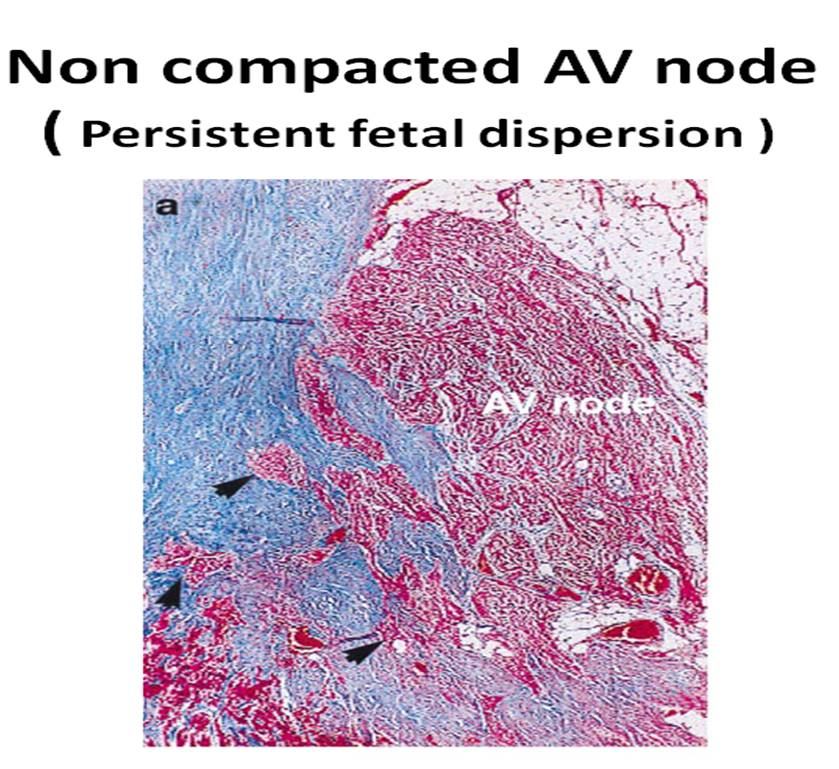
AV nodal tissue is a not compact structure as we would be believe  . But it is a fact ,  AV  node  do attempt  to compact after birth.

It is never complete.

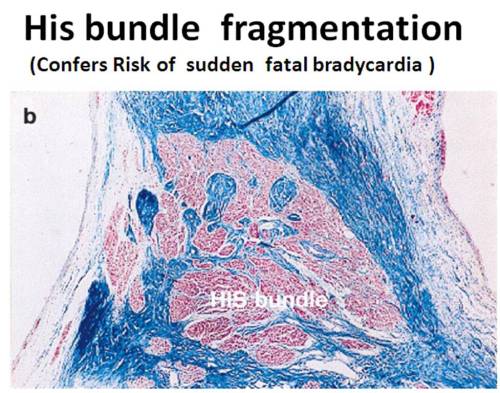
Note the islands of his bundle entrapped .   Image source : M. Paz Sua´rez-Mier J Am Coll Cardiol 1998;32:1885–90 From the Section of Histopathology, Institute of Toxicology and †Department of Pathology, La Paz Hospital, Madrid, Spain.

All specialised cells should coalesce  to form the compact zone .This fails to happen in many . Failure of AV nodal compaction  results  in islands of slow conducting cells in around AV node . Some of them can mutate  , and   acquire fast conducting properties as well . (Accessory pathway )

This failure of AV nodal compaction is termed as  persistent fetal dispersion of AV node .

In the his bundle  same phenomenon is called as his bundle  de-fragmentation .These abnormalities are noted in pathological  specimens  of  Pokkuri sudden death in Asians .

Unexplained sudden deaths and instant bradycardias and complete heart blocks are related to these dispersion of  AV nodal cells downstream . This also explains some of patients with infra hisian escape show junctional characteristics.

Many cardiac pathologists have observed this . Still  there is a  missing  link  .

References

M. Paz Sua´rez-Mier,Carlos Gamallo  J Am Coll Cardiol 1998;32:1885–90) Atrioventricular Node Fetal Dispersion and His Bundle Fragmentation  of the Cardiac Conduction System in Sudden Cardiac Death

Kirschner RH, Eckner FAO, Baron RC. The cardiac pathology of sudden,unexplained nocturnal death in Southeast Asian refugees. JAMA 1986;256:2700–5.

Hudson REB. The conducting system: anatomy, histology and pathology in acquired heart disease. In: Silver MD, editor. Cardiovascular Pathology. New York: Churchill Livingstone, 1991:1367– 427.

James TN. Normal variations and pathologic changes in structure of the cardiac conduction system and their functional significance. J Am Coll Cardiol 1985;5:71B– 8B.

James TN, Marshall TK. De Subitaneis Mortibus XVIII. Persistent fetal dispersion of the atrioventricular node and His bundle within the central  fibrous body. Circulation 1976;53:1026 –34.

Persistent Fetal Dispersion of the Atrioventricular Node  Association With the Wolff-Parkinson-White Syndrome Claude Brechenmacher, MD; Jean-Paul Fauchier, MD; Thomas N. James, MD Arch Intern Med. 1980;140(3):377-382.

Read Full Post »

Why Junctional rhythm has huge variation in P wave morphology ?

P waves in junctional rhythm can be

  1. Upright
  2. Iso-electric
  3. Inverted
  4. or  even absent

It depends upon the origin of junctional focus

  1. Site of  entry into RA
  2. Ability to capture inter -nodal pathways  and inter -atrial pathways ,
  3.  VA conduction velocity

Further ,the appearance and timing of P waves will be determined by the underlying structural heart disease also.

Final message

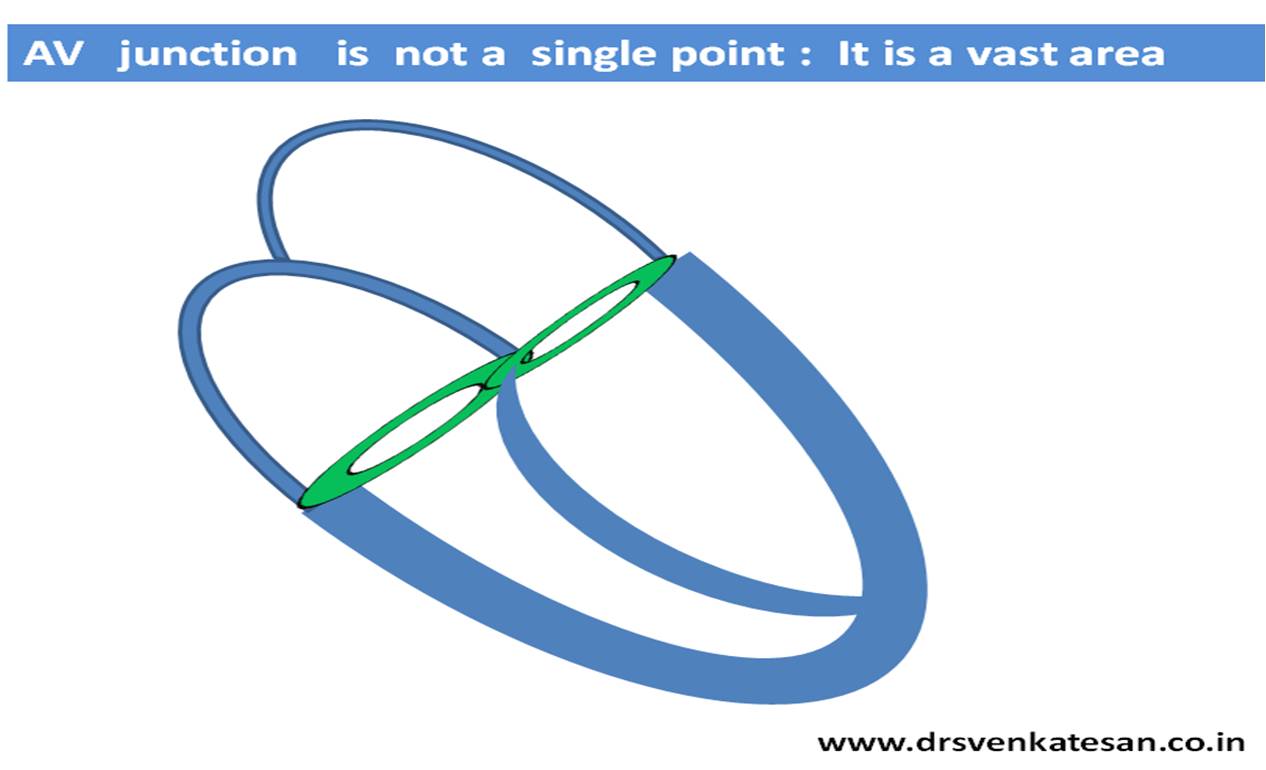
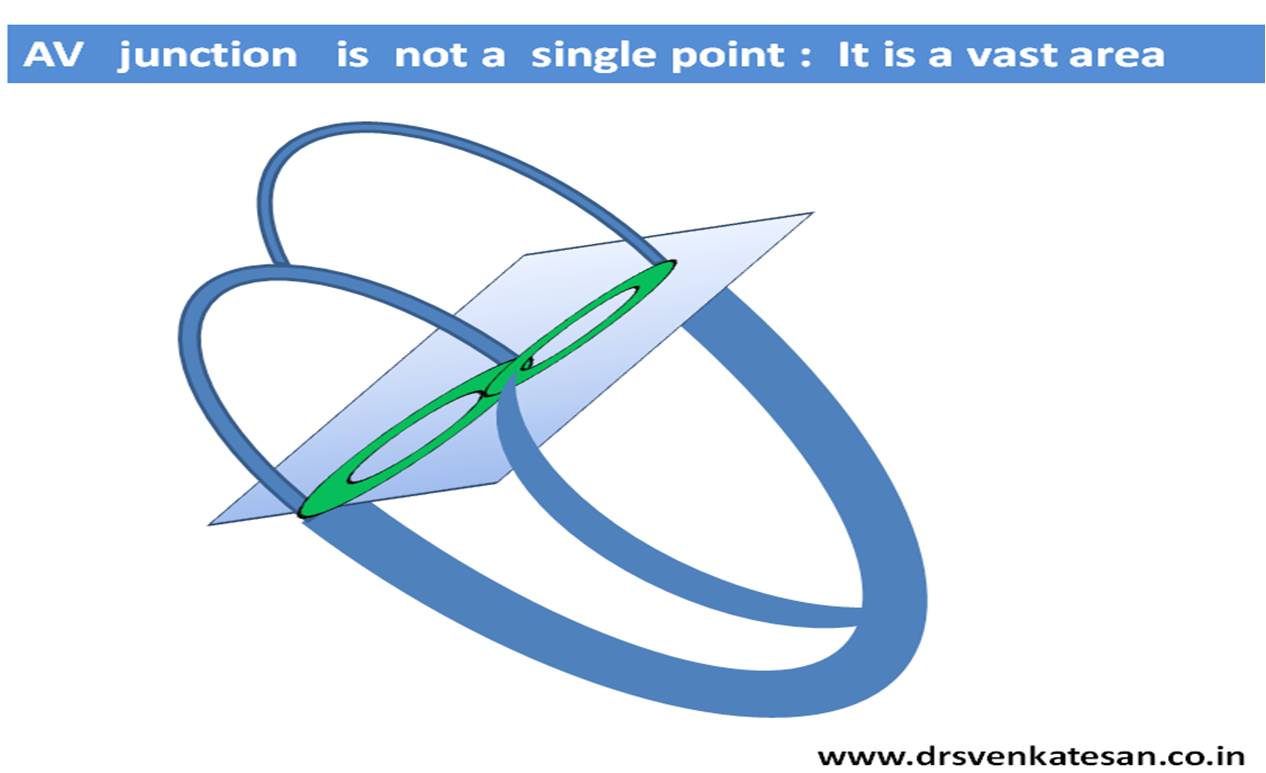
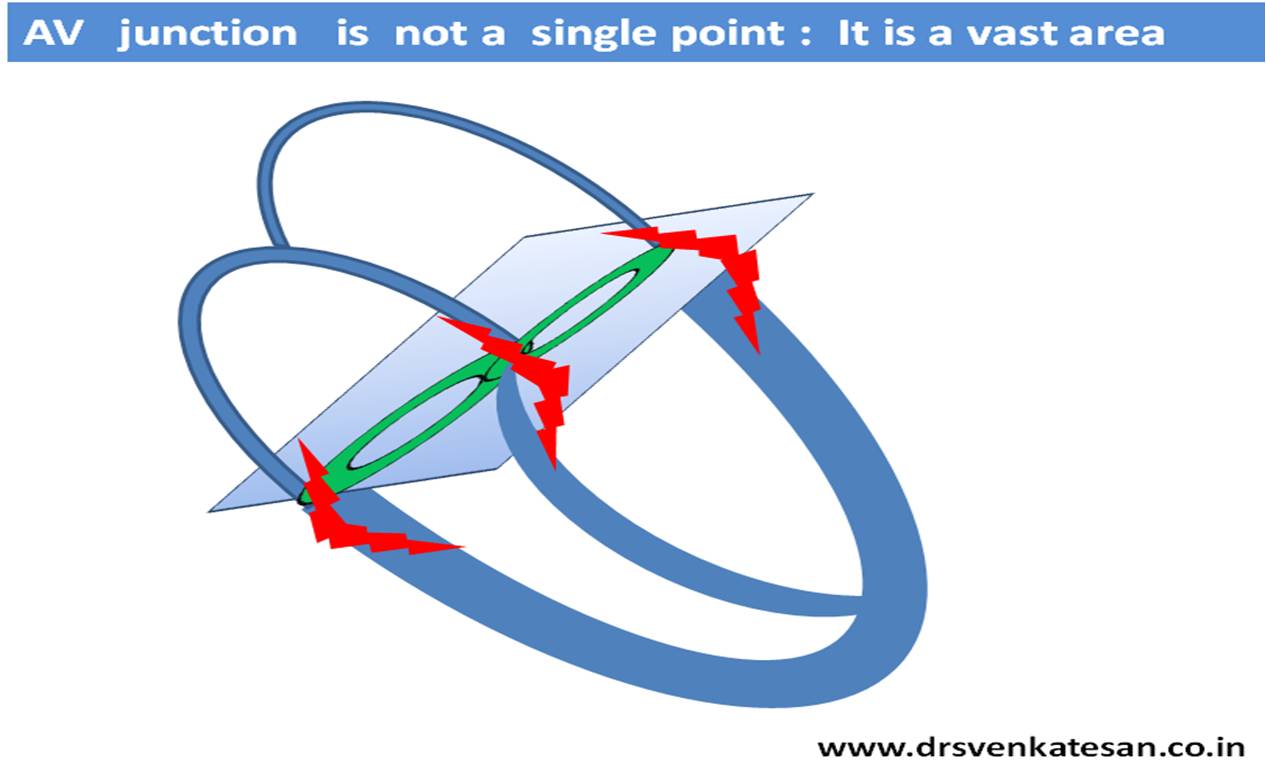
Medical  students  have  grown  up with the belief that  AV junction is a single  focused point .It is  true  in terms  of electrical circuitry  of  normal AV conduction .However  during pathological electrical disorders ( Which arise often because of structural disorder) it should be realised   the AV junction is a huge plane   .   Arrhythmia can occur anywhere from this plane .The entire plane  can become electrically active which may also  acquire the  ability to conduct bi-directionally .

Read Full Post »

Hypothyroidism is  a classical example of  generalised edema formation .  The mechanism of which is extensively studied  .Still we are  not clear  about  it .

Content of edema fluid

  • Mucopolysacharides -Hyalinorunic acid
  • Albumin

Mechanism

  • Albumin leak into interstitial and extra cellular space  due to capillary dysfunction.
  • Reduced lymph clearance – probably due to poor lymphatic tone  .

Why hypothyroid  edema  does not pit on pressure ?

For pitting to occur tissue should be compressed and retain the elasticity .This means  the fluid can escape into the cell when mechanically compressed and comes back when the  elasticity of skin  brings  it back to its original status. For this to occur the skin and subcutaneous matrix should be normal in texture.

In cardiac failure and renal  failure   edema is   primarily due to  altered hydrostatic forces and skin  is intrinsically normal .So  some amount of pitting  is retained . In hypothyroidsim and lymphedema  where there is  an intrinsic  pathology  of the  skin   pitting  is rare.

Why constriction and  cardiac tamponade are rare with hypothyroid pericardial effusion ?

Like the generalised slow response of hypothyroid individuals  the effusion is  also very slow forming and is rarely large so tamponade is rare .

The hypothyroid infiltrates which  collects within  the pericardial space it rarely infilitrates  the fibrinous pericardium (The thick outer shell ) .Unless fibrinous pericardium is inflamed or infiltrated constriction is exceedingly rare .Simple epicardial infiltration may cause some restrictive  physiology but not constriction .

Reference

Lancet. 1975 Mar 8;1(7906):564-6.Effusions into body cavities in hypothyroidism.  http://www.ncbi.nlm.nih.gov/pubmed/47029

Read Full Post »

Which is the “Numero uno”  cause  for  acute stent thrombosis  in real world  Cath labs ?

  1. Hypersensitivity  reaction  to metals
  2. Poor deployment of stent
  3. Inadequate  Anti-platelet  regimen
  4. Drug eluting stent

Answer :  2 .(Indisputably  correct )

It is estimated  at-least 4 out of 10 stents  we implant  is  sub-optimally  deployed .Only a fraction of them go for complication .Coronary endothelium silently  tolerates our  aggression .

How to  prevent this ?

  • Meticulous pre procedure analysis of lesion
  • Preparing the lesion if toughness is anticipated
  • Personal  mind application in stent size  selection
  • A slow , steady  non aggressive PCI
  • Liberal  pre and post dilatations
  • Judious use of IVUS and OCT ( Mind  you a  prolonged  IVUS procedure  can occasionally convert a good deployment into bad one !)
  • A  good quality anti-platelet regimen.

Read Full Post »

The primary determinant of pulmonary artery systolic pressure is . . . ?

  1. Pulmonary arterial tone
  2. Pulmonary venous pressure
  3. RV contractility
  4. Pulmonary blood flow

Answer : All of the above

But what is the relative contribution of each ?

I am  100 %  sure  ,  no  one can answer this question  correctly !

It is  true  , in some  pathological situations  one can  be  fairly certain about  cause of   elevated pulmonary arterial pressure .

When we confront a patient  with left heart disease  it is the transmission of  mean venous pressure .

Whatever be  our understanding ( Pre/Post capillary pulmonary hyper tension and the related stuff !  ), the one parameter that makes mystery contribution  to PA pressure is RV contractility !
In physiology  RV   generates  about 30mmhg systolic pressure that becomes the  pulmonary systolic  pressure .The  diastolic pressure  will be around 15 and mean around 20 . During exercise  contractility of both RV and LV increase .There has been documented PASP up to 50 mmhg in normal healthy adults during   exertion .

Here one can assume RV contractility is causing  a entity called transient Isolated  systolic  pulmonary arterial  hypertension.(ISPAH)

Consider a entirely different situation

A patient with COPD  with raised  PASP .  The right ventricle pressure has to equilibrate with PASP  during systole .For this to happen   it has to generate the 60mmhg .  If the RV fails  to augment it’s contractility for some reason ,  will the  ineffective RV contraction will  lower the  PASP  ? This is the perplexing question !

While the popular understanding is ,  RV dysfunction will under- estimate the severity of   pulmonary hypertension   . . . still  . . .  we are not sure whether RV dysfunction will  reduce the PASP   per-se  ( and  subsequently PA  diastolic pressure as well )

We often see a  good example  . A patient who develops tricuspid valve disease and RV  dysfunction get symptomatic relief  from  lung congestion .

Final message

The relationship between RV function and pulmonary artery pressure is a real enigma. Though hyper functioning  RV is expected to elevate PASP  and hypo functioning  RV would pull  it down  , the relationship  is not that simple. If only we decode this  mysteries   we can try  specific  RV negative inotropic  agents  as a  modality to treat pulmonary hypertension .

After thought

Total artificial hearts  are going to come in a big way in the coming decades .It  will specifically address this issue  ,  as RV and LV contractility  need to  be individually tuned to avoid pulmonary congestion.

Coming soon

While  RV function is critical for human survival  ,  Fontan  principle  simply says entire RV is dispensable . How ?

Read Full Post »

Ironically  , in medicine we need to peep into the  past for updating and scrutinizing current knowledge .   Here is free ticket for   a  retro journey   to  the  the Electro-physiology Laboratory of  the  University of Wisconsin-Milwaukee  .  This article  , which was published in 1990 ,    still  can explain many  intriguing   concepts  of VT succinctly .

Thanks to   circulation  for sharing this article free !

Akhtar M . Clinical spectrum of ventricular tachycardia. Circulation 1990;82:1561-73.

Read Full Post »

The principles of pre-discharge EST  

This concept came about 20 years ago (1980s) to risk stratify patients following  ACS to triage early coronary angiogram and revascualrisation. Generally patients are discharged by 5-7 days after an MI  (May be  3-5 days in some hospitals)  . Doing an exercise stress test  early within  2 weeks has not been very popular with many cardiologist even though it was recommended by many guidelines.The type of stress recommended  here  , is heart rate limited sub maximal 70% of  THR (Usually around  140 /mt )  is performed . This is due fear of precipitation another ACS.

Still,  there are definite  advantages for  pre-discharge EST .It help us  identify  high risk  subsets of  STEMI and reduce the  intermediate term mortality .More importantly it  gives  us an opportunity  to  exclude  inappropriate  revascualriations  even without an angiogram . (The well known coronary dogma  ie  if a post STEMI patient performs > 10  METS ,  his  heart carries little  risk  for  future events  still holds good  !)

With the advent of liberal usage of CAG and improved techniques of revascularistion ,  most  patients  directly undergo pre-discharge CAG rather than EST !

Further reading

Does any cardiologist have guts to do a pre- discharge EST after  a successful primary PCI ?

Read a related article in this blog .

Read Full Post »

« Newer Posts - Older Posts »