Feeds:
Posts
Comments

Angina is the classical clinical counterpart   of  myocardial Ischemia.

True  Ischemia , by electro- physiological rules  must elicit some sort of  ST segment shift .(Usually  ST depression rarely Elevation  )

But  . . .  we know Ischemia and ST depression do not always go together !  Dissociation can occur in both ways.

ST depression without angina is more prevalent  (often referred to as silent ischemia)  , while angina without ST depression is  less common but by no means rare .

We observe both these  phenomenon  during EST.  The  critical issue  here is ,  any pain without ST depression during a EST , the physician is likely to reject it as  non cardiac.

How wise  it is ,  to ignore such chest pain  ?

If a patient  complaints  true  compressive , squeezing  pain  it should be taken as angina  and EST should be  stopped and labelled as positive   even without  ECG changes .

According to the much   famed (De ) theory on ischemic cascade chest pain is supposed to come last. Time and again the rule of ischemic cascade  goes awry in the bed side. Clandestine angina without any ECG evidence be more important clinical entity than we realize.

                                      The argument against this ,  “If you start believing  patient’s  word  more than  ST depression  then the very purpose of EST documentation is lost  !

According to the now  de-famed theory on ischemic cascade ,  chest pain is supposed to come last. Time and again the rule of ischemic cascade  is found to go awry in the bed side .Clandestine angina without any ECG evidence be more important clinical entity than we realize.

Another clinical situation where we  encounter  ST segment  : Angina dissociation is ,  during balloon inflation of PTCA.

Two  explanations can be offered  for Angina in the absence of ECG changes .

1 .Cancellation of ST vectors  due to ischemia of two diagonally opposite areas of ischemia.

2. Electrical  blind spots  in 12 lead ECG. This  is especially common with LCX ischemia  where most of the electrical events are directed to back of the chest.Conventional leads can easily miss .
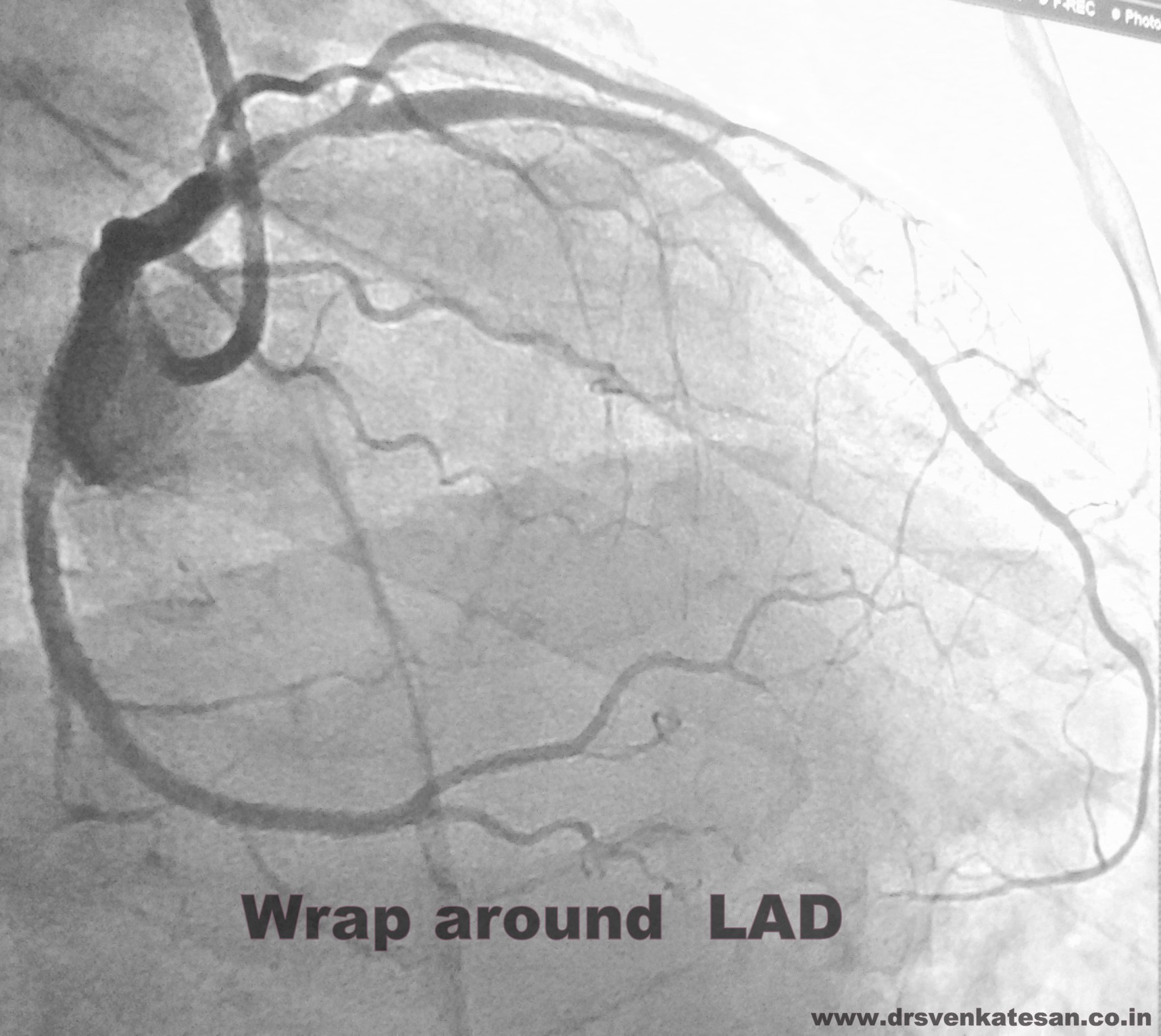
LAD is  graded into three types according to

Type 1  :  Falls short  of Apex

Type 2 :   Reach up to the LV apex

Type 3 : Wraps around LV apex and travels some distance in the posterior Inter-ventricular groove.

Clinical  Importance of Wrap around LAD

As the name implies , LAD   should descend only in anterior aspect  in about 15 %  population it can take a posterior descending course as well .

When LAD  wants to conquer more areas of heart is it a clinical advantage  ?

When LAD wraps around the LV apex,  anterior MI due to LAD occlusions can show changes in inferior leads. (Antero Inferior MI )

In ideal anatomic /Physiologic conditions  LAD  should nearly  meet the  PDA   to prevent any water shed  area.

There is usually a trade off between the  terminal LAD and  length of PDA ( whether it arises from LCX or RCA.)

There is some evidence to  suggest the site of ventricular rupture in anterior MI is related to the gap  in the LAD/PDA drainage zones.

Patients with Type  1 LAD  are at risk of   LV apical  ischemia if the  dominant LCX /RCA is  not supportive .

Final message

A long LAD is definitely a  hemo-dynamic  advantage   in physiology ,   Of course  it goes  without saying    . . .   when  it’s   likely  to get  obstructed it is always better to have a Type 1 !

The other day a patient developed acute left main occlusion within 20 minutes of a  what looked like a successful PCI. When the angiogram was analysed  there was a distinct possibility of left main dissection.

The common causes  for left main injury during PCI include

  1. The guide catheter can it self  injure the tender left main ostium  by  size mis-match
  2. The frequent adjustment of  guiding catheter to get a co -axial alignment caries a definite risk
  3. The guide catheter slipping and subsequent repositioning  with the guide wire precariously snaring the left main ostia is the single important cause for left main injury.

How to prevent left main injury ?

  • Optimal guide catheter size and shape is vital.
  • Smaller the size it is better .(6 F is ideal for most )
  • As for as possible minimal handling of guide catheter is adviced . (Hands always  on guiding catheter  approach  is to be discouraged )
  • Deeper  engagement of guide catheter  as far as  possible  without hemo-dynamic compromise.This will ensure  not only better support for guide wire and balloon ,  low chances for guide wire to injure the left main ostia
  • Tapering guiding catheters with  soft ends are ideal. ( Which are available I think !)
  • Finally  and most importantly keep  the PCI procedure as short as possible ,  come out quickly  . After all ,  we  play  the   dangerous    coronary  game  right  in the mouth of the mysterious   coronary  cave  ( of Alibaba ! ) called Left main !

Identifying the P wave is the key to decode  any  narrow QRS  tachycardia . Though the  the relationship to  p and  qrs is vita ,  many times it is  not  easy to  relate them.More easily one  may  get  a  clue to the mechanism by analysing   P wave timing .This is the basis of calling narrow qrs tachycardia as short RP and long RP.

Wonder   . . .  why  the  relation “P to R” became  “R to P” here !

Since  in the   common narrow qrs tachycardias  AVNRT/AVRT  ,  atria  activates  the atria  in a  retrograde manner , we look  for the relationship of qrs complex on subsequent P wave . Hence the interval between R to P become the focus.

In other words RP interval indicates retrograde  conduction property of AV tissue .

If it is slow the P wave will be well separated from QRS .

If it is fast it will be close to QRS complex .

If it is ultra fast as in some AVNRT ,it can fall within the qrs complex and completely invisible .

(The so called  r’ prime in classical AVNRT is nothing but a distorted p wave on the terminal qrs complex.)

Based on  RP interval  the following classification is used (List is incomplete)

Short RP Tachycardia

  • AVNRT (Slow-Fast )
  • AVRT

Long  RP tachycardia

  • Atypical AVNRT(Fast -slow)
  • Atrial tachycardia*
  • Sinus tachycardia*
  • SA nodal re-entry*
  • Some forms of AVRT

* Please note ,  here the P wave is not determined by the preceding qrs unlike other tachycardia in the list.

What is the  cut off point to call it is Short RP /Long RP ?

It is arbitrary . Following may help

If RP interval > PR interval it is long RP.

If the absolute RP interval is >  100  ms  with the heart rate of > 160 it would  generally  Indicate a long RP tachycardia .

The timing  of  retrograde P can be very complex than we believe  as the following factors heavily influence it.

  • The autonomic tone
  • Site of retrograde atrial  breakthrough point .
  • Atrial size ,
  • Atrial  refractionaries
  • Effect of drugs
  • Intact-ness of inter atrial conduction
  • Chances of the retrograde atrial activation capturing Internodal pathway

Final message

The P wave location in narrow qrs tachycardia is primarily determined by the retrograde VA  conduction and less  on the antegrade AV conduction  . Looking at the interval between R and P is a  quick way of getting the VA conduction in the bed side.

Once we get an  idea how the VA  circuit  conducts , we can narrow down the possibilities  in  Narrow qrs tachycardias !

Comming  soon

What determines the morphology of retrograde P waves in AVNRT/AVRT ?

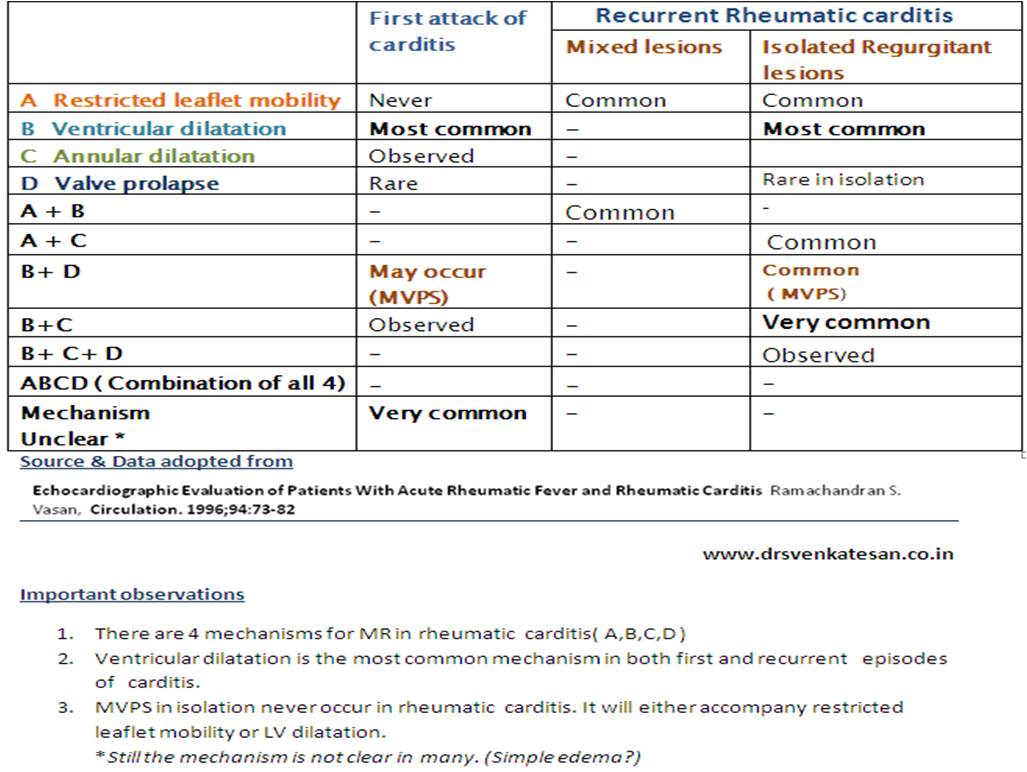
Rheumatic valvulits , Valvular inflammation and edema  is the traditional answer .A detailed Echocardiographic study from All India Institute of medical sciences New Delhi  ,India  which was published in circulation 1996 answers this question most authentically .

From a meticulous  Echocardiographic  study of about 70 patients  (with both first and recurrent episodes of carditis ) the following findings were observed.

After reading this article one should be able to answer variety of  questions in RHD  such as

  • How common is MVPS in RHD ?
  • How often MR dissapear with Aspirin etc ?
  • Echocardiographic correlates  for care -coombs murmur ?

Reference

http://circ.ahajournals.org/content/94/1/73/T5.expansion.html

It is estimated multi-vessel CAD occur in about  70 % of NSTEMI/UA.In high risk NSTEMI early invasive strategy is popular (Though it is not yet  an undisputed choice !) .Tackling the culprit artery and restoring the blood flow ,   providing immediate  relief from angina is the primary aim  . Myocardial salvage is a lesser aim !

The lesion that is immediately  responsible for  angina is referred to as culprit  lesion and artery .(Ideally may  be called as Angina related artery ARA .)

If we have  multiple culprit like  lesions  it is difficult to identify the target lesion. Inexperienced cardiologists  may not consider  this as an    issue !

The following features  may be helpful

  1. The tighter the stenosis , it is  more likely to be a culprit . (Of course , blind  belief on this rule  can result in huge errors ! )
  2. Eccentric lesions
  3. Thrombotic lesions
  4. Grafts /Post PCI lesions if present carry high chances of becoming culprits.
  5. ECG characteristics may  be use full (Global ST depression can not occur with isolated  RCA/LCX NSTEMI   .It  generally indicate LAD  lesion to be  the  culprit.
  6. Deep ST depression in V1 to V3 would indicate LCX a definite culprit .(It could even be a STEMI equivalent )
  7. Echo – Angio correlation can provide a useful clue in identifying the culprit. (Example : In a patient with Multi vessel CAD  , if there is severe resting wall motion defect in Infero -Lateral segments with relative sparing of septum   LCX lesion should be the culprit .)

Exceptions

  • It is not always easy to identify the culprit artery .There can be multiple active  plaques .
  • Diffuse inflammatory vessel are reported in few with NSTEMI
  • Occasionally there can be no  culprit lesion at all (No active plaques ) ,  as the rest angina may be related to excess demand like fever or anemia with  a stable non critical plaque.

Final message

The  delicate   exercise of identifying the angina related  artery is  important  for two reasons.

  1. We can not afford to   prolong the PCI procedure in the setting of ACS  as increased procedure time is clearly related to peri- procedural events.
  2. Secondly , stenting a wrong lesion   and persistence of angina after a  PCI  will take  away  the  hard earned credentials  of  cardiologists  instantaneously !

Reference

Read a related presentation

While their cardiology colleagues are extravagantly indulging in coronary arteries   ,It is heartening to note the pediatricians our country has  silently come out with the first India specific  criteria for Acute Rheumatic fever diagnosis and management.

It was long over due . . . three cheers to them !

* It is ironical  these guidelines came in 2008,many of us are aware about the  existence  such guidelines , still  every one is after PTMC  for a full blown mitral stenosis !

http://www.indianpediatrics.net/pdf/acute_rheumatic_fever.pdf

Highlights and Summary

  • WHO criteria  of 2001 is adopted
  • ASO titre positivity alone has less value  in the diagnosis .Hence the importance of which is down graded
  • Steroids  are mandatory in all grades of carditis for 12 weeks
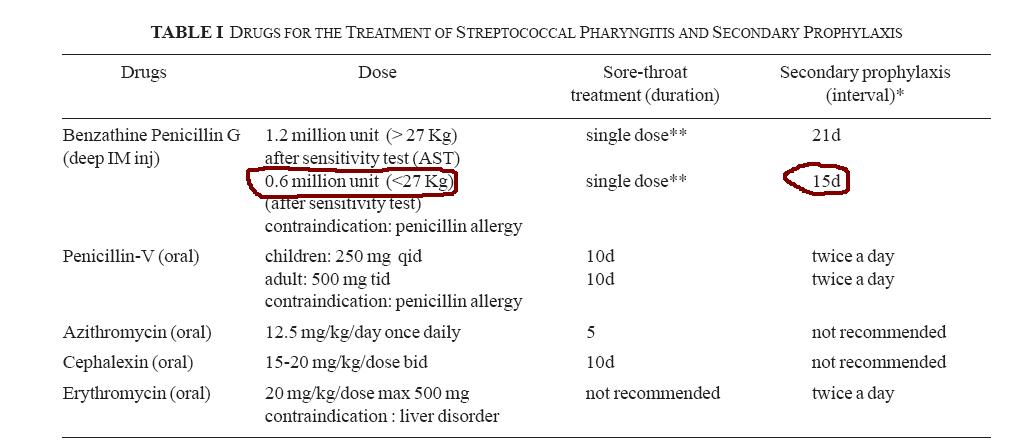
  • Benzathine  penicillin  should be administered weight  based and to be given  every 15 days in children less than 27 kg.

More high lights will be posted.

Secondary prophylaxis of  for Rheumatic fever

Note the Important advice regarding weight based penicillin prophylaxis.


//

What are  the blind spots of aorta in Tans thoracic  Echo ?

What are pseudo  dissection flops in aortic arch ?

How to differentiate true from false lumen ?

Can  TEE  also  miss any  segments  of  Aorta ?

How is  Aortic Intra mural hematoma differentiated form true dissection?

Spend a minimum of 30 minutes in this 14 page  article.  You will  be able to answer all these and much more The knowledge gained ,   would easily beat  a  day  long   crash course on   Echocardiogram   !

Please thank  the European society of cardiology for providing this article free of cost !

Reference

http://ehjcimaging.oxfordjournals.org/content/11/8/645.full.pdf+html

Tachycardia – Bradycardia syndrome is the hall mark of sinus node dysfunction.

  • The commonest tachycardia in sinus node dysfunction is Atrial fibrillation . Followed very closely by sinus tachycardia . In fact alteration between sinus tachycardia and sinus bradycardia without other pathological arrhythmia is rare . (Of course , we have a name for such an entity as inappropriate sinus tachycardia / bradycardia )
  • Atrial tachycardia occurs a distant 3rd
  • Ventricular tachycardia may be an exception (Please note , extreme bradycardias which lead to pause dependent VT is not directly related to sinus node disease )

The commonest bradycardia in SND is

  • Sinus bradycardia (This fact is undisputed unlike the tachycardia component of SND !)
  • Followed be sinus pause , SA blocks and sinus arrest .
  • AF with slow ventricular response ( Bradycardic AF) We are not sure about the rhythm here (Is it truly junctional /or conducted atrial ? )
  • Associated AV block can occur up to 20 % of patients .If AV block is present the true nature of SA node disease is masked and it’s function becomes almost irrelevant .

Stress related wall motion defect  is a well-known entity . It is referred to as Takotsubo cardiomyopathy .

These stress are often

  • Emotional
  • Neurological
  • General systemic stress

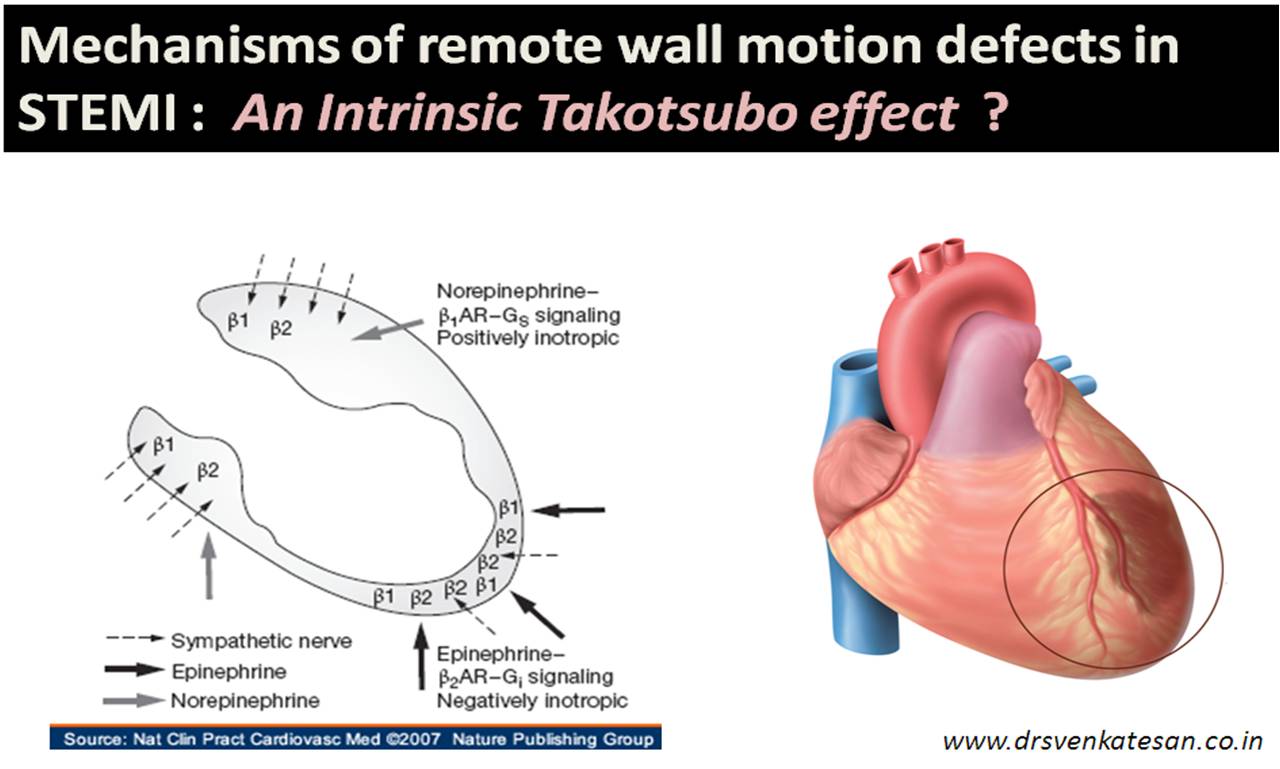
The culprit seems to be pooling of adrenaline and nor adrenaline in myocardium .These remote  neurogenic stress can cause significant wall motion defect due to adrenergic  downpour

The image depicts the wide variation in the density of beta receptors in heart.The stress of MI can result in varying degrees of wall motion defect .It is important to realise the wall motion defect in STEMI has two components .One is related to ischemia and other is due to excess catecholamines. This explains many of the unexplained remote wall motion defects during STEMI .This  may be referred to as Intrinsic Takosubo effect !

Then   . . . the following    questions arise

When systemic stress can have a profound  effect on myocardium , what   about local stress ?

Acute STEMI  is  a huge stress for the heart   . . .   isn’t  . If  so , can it   alter  the wall motion defect in adjacent  or remote myocardial segments  independent of ischemia ?

With the distribution  of adrenergic receptors  showing  huge variation ,  we do not know how an acutely ischemic heart  spills the adrenaline all over .  Is there a pattern to it  ?  or it happens at random ?  Further , the  response to  accumulated  catecholamines  is  not  going to be  uniform. This will explain why certain patients  go into ischemic  LVF  , very early in the course of STEMI  even before the myocardium is necrosed. It will  also explain  the  benefits that accrue in selected patients  who receive early IV beta  blockade  ( Which is  of course currently not popular after COMET study ! )

Final message

We  have seen at least  two patients  with severe  transient ballooning  wall  motion defect in LAD region  (LV apex)  with isolated RCA lesion and inferior Infarct .

The question raised is this 

Can  the  stress of  Inferior  STEMI   . . . result in  apical Takatsubo  like  effect ?

Reference

http://www.medscape.org/viewarticle/567069_4

http://www.takotsubo.com/