Feeds:
Posts
Comments

Hurricanes  are ocean’s  reaction to the climate change  especially  in subtropics.  When low pressure  zones  form over the ocean surface  the nidus for hurricane is sown .It   gradually intensifies to form deadly cyclones.The maximum damage is done when it  encounters the land . The following image  depicts how the hurricane Katrina caused havoc in the southern US coastline .
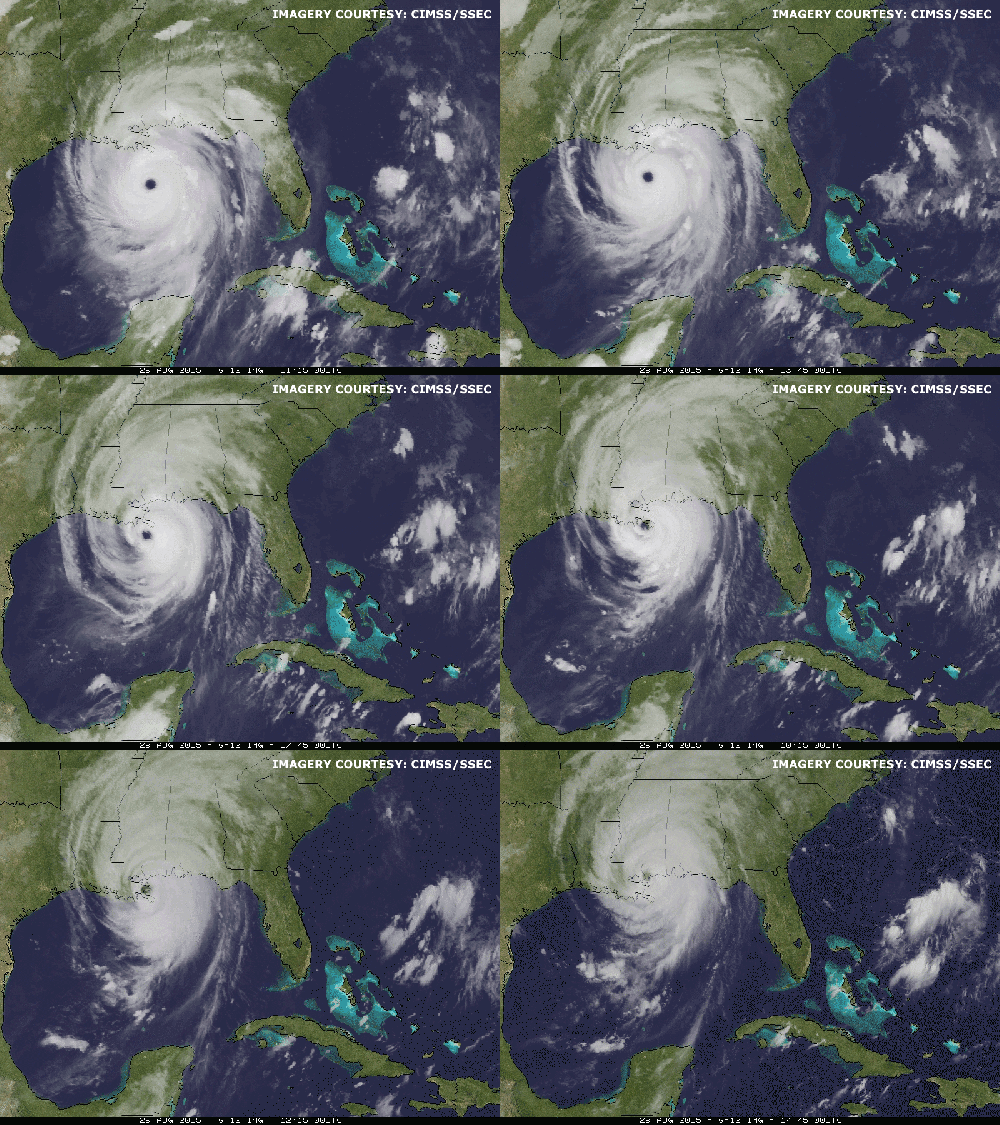
Hurricane katrina .Click to view animation


When the human blood stream is interrupted  by any pathological hurdle  it  gets  agitated . It encounters both turbulence as well as  a  slow flow phenomenon . Virchow taught us centuries ago  , slow flow , a vessel wall defect and  an abnormal blood combine to create a  clot. This is what happens in mitral stenosis . What appears as a mild turbulence  gathers momentum  and becomes a storm .The eye of the storm has the  least velocity and it  forms  the core of the future clot.
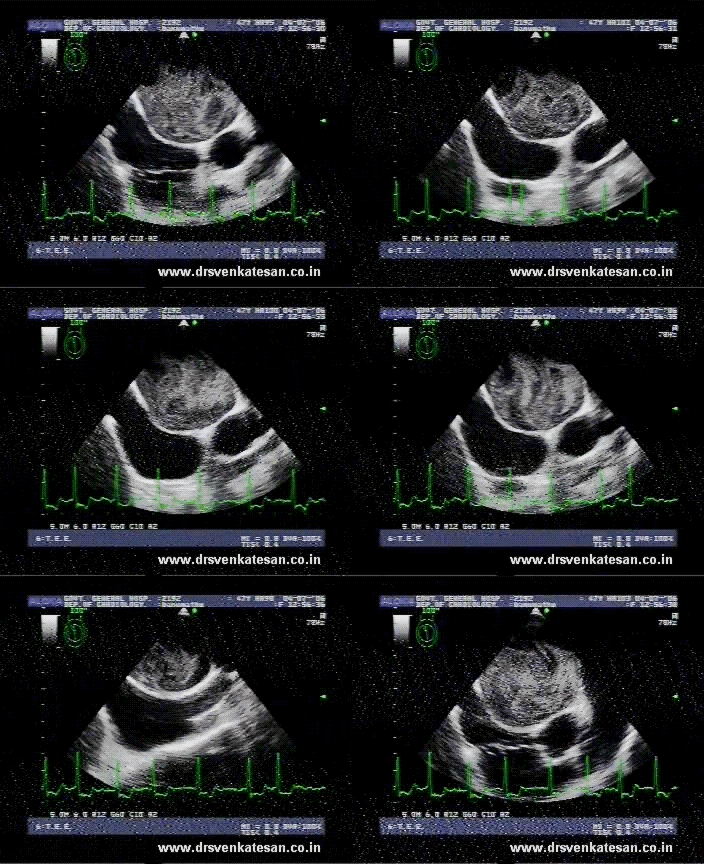
Left atrial strom visualised by TEE


What is left atrial jelly ?

A  pre- clot stage with impending clot formation may be referred to as a jelly . The exact  duration for  a contrast to get converted to clot is not known.It depends host of factors from hemodynamic and rheological factors. It  is  believed every clot   must be preceded by at least a brief period of auto contrast.

Is there a intrinsic  defect in blood in those patients who have spontaneous contrast ?

Yes , there has been  excess  fibrinogen  in these  patients. http://www.ncbi.nlm.nih.gov/pubmed/11744141

Can we dissolve  spontaneous  contrast ?

It  may be  possible with intensive anti coagulation. Ultrasonic dessication may be a modality that could be developed in future.

Is  the presence of  spontaneous echo contrast a contraindication to do PTMC/CMC ?

Some centers do believe so. Currently intensive anticogulation ,   meticulous preparation   with  special  precautions  during procedure will reduce embolic  manifestation.

Reference

Sudden cardiac death is the  most common cause of instant death.  We know , heart is  also  under massive neurological control . Still , heart can run for days even after brain dies ,   if respiration is supported.This implies ,  heart is independent  neurologically  !  what a paradox !  But this  independence of   brain  function after death makes the  human heart transplantation  possible.

Even  as we “wow” about this cardiac independence , we   witness  widespread deaths due to sudden neuro- cardiogenic  deaths .This makes medicine . . .  a wonderful puzzle  and  compels  us  to pursuit  the eternal    journey  of  knowledge !

When an area of brain fibrillates what will the heart do ?

When  the brain suddenly discharges  huge amount of electricity (Load shedding )  as in epilepsy or some other neurological  injury  , it  may  travel down  and make sure the heart also  shares  the electrical insult .Sudden deaths have been reported in many epileptic individuals and in  some forms of stroke .To distinguish   sudden brain deaths  from sudden cardiac death in such patients  is a very difficult task.

The message is ,  hypo-functioning  brain does not generally harm the heart (Men in coma live for years !) but , over -active brain can inflict major electrical damage to heart. This may  indirectly explain ,  how an  episode of  severe mental stress  could act  as a  trigger  for acute coronary  syndromes.

* We do not know , whether brain stem which has the cardiac high command  can fibrillate independent of cerebral  cortex .

Reference

Ictal asystole

Asystole during epilepsy could occur in significant numbers. As this  review   from France  reveals


The economics of  parenteral  anti-coagulation  took a paradigm shift more than a decade ago.  That was the arrival of low molecular weight heparin in the early 1990s.  The conventional regular heparin ( so called  unpurified /unfractionated )  was ridiculed   over the years. Lobbying   for LMWH was so strong  no one could  dare – stop this pseudo academic onslaught  flying high  with series of powerful articles  in major journals .

The major plus point  claimed for LMWH was   the convenience of administration  without any monitoring .

This convenience masked  some of the vital  truths  about these drugs

  • First and foremost ,  LMWH never proved it’s cost  effectiveness  and worthiness in a convincing manner.
  • Acute administration  by IV route was rarely practiced globally  which was used in all major trials.
  • The onset of action with subcutaneous route  always lagged behind in real ACS.
  • It would  seem ,  the  greatest advantage claimed by LMWH ( of not requiring monitoring  ) is the biggest suspect ,  as we would not know , whether the drug really reaches the peak action or not.

If  raw economics  brought these futile drug to the fore front  ,  the  only  possible way to stop this  redundant  drug was again by the  same  economics ! This , exactly  is happening  now . Suddenly , many  research  papers  are coming out   claiming  the superiority of good old heparin  over LMWH .

Thanks to recession , new  global health polices and politics .

This week’s NEJM restores  at- least some of the   stolen credit  to the regular  heparin after 10

long years !


http://www.nejm.org/doi/full/10.1056/NEJMoa1014475?query=TOC

Assumptions and bias

The above observation by the author  can be labeled as an  extreme form of bias against a wonder drug called LMWH.

It may be  argued  not all LMWH can be considered equal .Will the  outcome from the above trial  results be extrapolated to  enoxaparine  as well  ?What  is your gut feeling ? Gut is many times right than  hyped up RCTS !

In a large tertiary  hospital  where we work  , we have  never switched to the LMWH   in the  bygone  decade (  Both in critical care unit and post op unit )  .We have to withstand   a big  hue and cry and  were   even  humiliated for using regular heparin in our ICU . Now  . . . we  stand fully vindicated !

There are many such falsehoods  that  need to be  corrected in the medical literature. Sooner it happens , better for the humans  of  this planet . We should be glad  . . .things are moving in that direction.

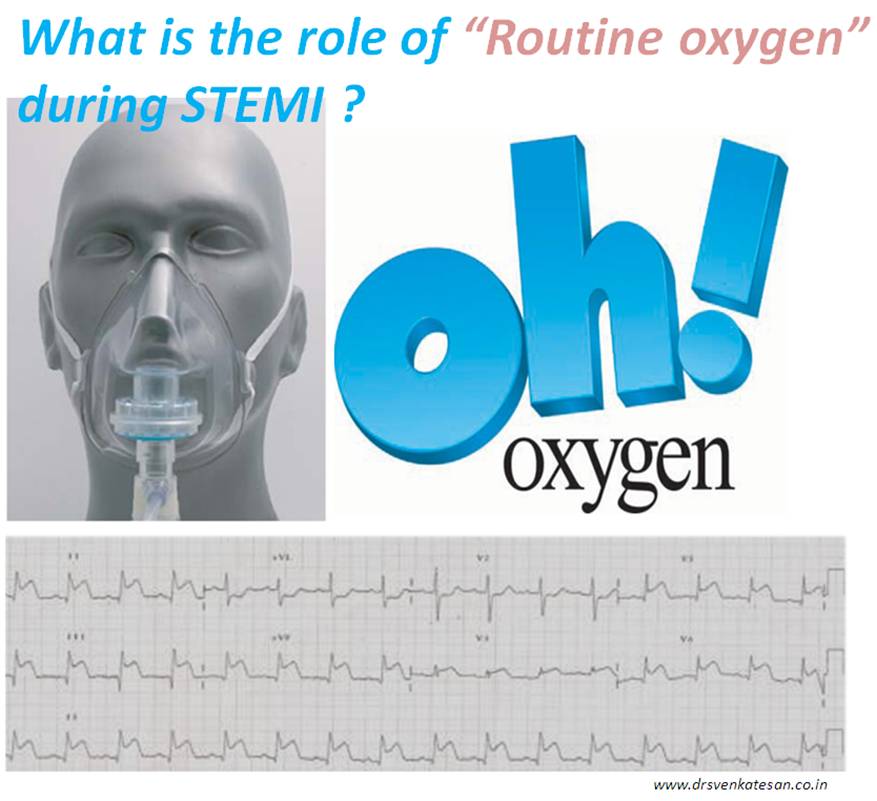
Oxygen has an ubiquitous place in any  critical care unit. If some body is labeled as  critically ill , it becomes mandatory  for a tube to  be inserted per nasal. It is more of a conditioned  reflex and  sort of a socio- medical necessity .The futility of oxygen administration in critically ill is most evident in the management of STEMI.

Inconvenient  questions

  1. Does the oxygen  we  supply ,  ever reach the disputed  site   myocardium             (From  the port of entry . . . namely the nose  )
  2. Does it improve  the myocardial salvage ?

There is generally no hypoxia associated with STEMI . Even if it is there , the  ischemic myocyte can not be oxygenated by increasing the systemic saturation as the problem is with the   delivery of oxygen due to defective supply.

What does the guidelines say regarding o2  ?

Read  yourself    http://circ.ahajournals.org/cgi/content/full/110/5/588

Final message

Routine oxygen administration  is  required  to create  the intensive care ambiance .

Oxygen administration  by default has no scientific role.

However,   it is generally not harmful . As long  a drug is  not harming the patients , inappropriate  therapy is   forgiven by modern medicine.

When  is oxygen really indicated in STEMI ?

  • Significant persistent  Hypoxia
  • Associated LVF
  • Any arrhythmia
  • COPD

Forbidden discussions  in academic forums

Oxygen  administration has  become  mandatory to generate revenue  for the cash starved  corporates .It  is a standard practice to charge these patients on hourly  basis  of o2 usage  in many hospitals.

An  unwanted , unexpected , unpleasant sound  is  often referred to as  noise

Human ears , are  not meant to  hear  only the  pleasant  sound . We live in a noisy world. It is believed every cell in the body has ( Auditory ?) sense  receptors. But , the noise is perceived  only at brain .It is  incidental our ears  are located  right beside the brain , adjacent to  parieto  -temporal cortex . The auditory nerve  has   its  nucleus  located dangerously close to vasomotor centers of  brain stem .

.

When  excess noise enters our ears it vibrates  the brain stem as well . Noise travels in the nervous system as electrical  impulse , so it is natural  for  to expect a  spill over to the  nearby  adrenergic  centers  .

A sudden explosion or a thunder will skip a few heart beats is it not ?  Similarly , when   we experience  pleasant  sound /  melody**   it  soothes   the nerves ,  this forms the basis of musical  therapy.

So  it is logical to conclude   , when the  nice  music  has a capacity to heal ,  unwanted  noise  is expected   to injure  our biological system.

** A rock fan under the influence of  drug  may feel a every nonsense  as melody . . . is a different  story !

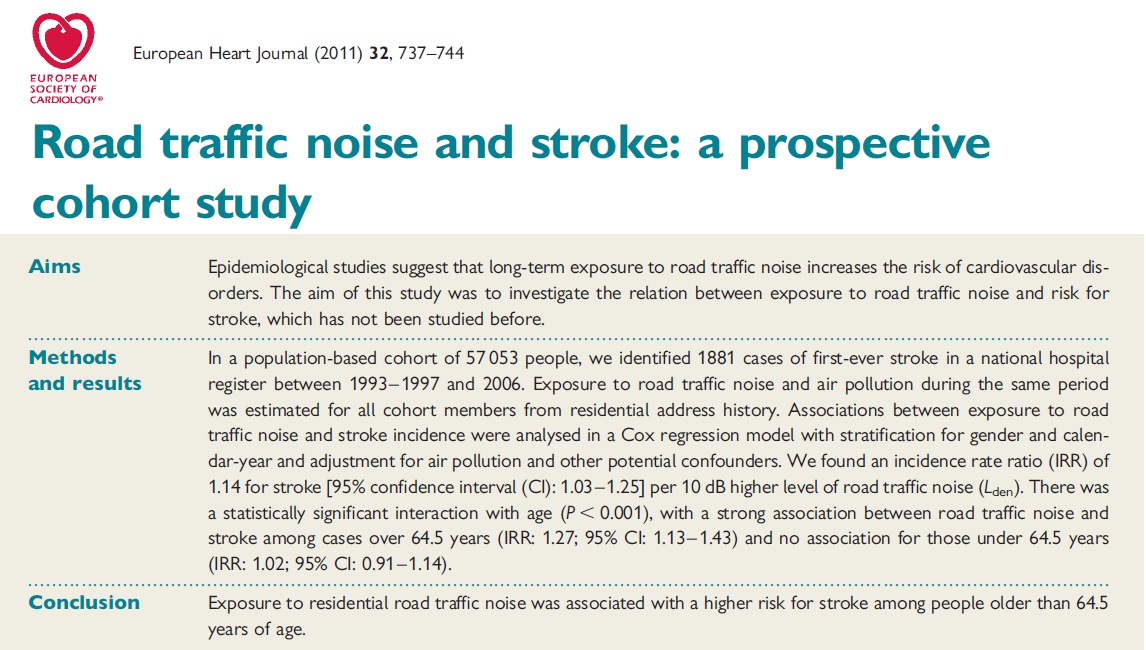
It is observed strokes and MI are more common in urban areas congested  with traffic chaos. Here is an article from European  Heart  journal   with  solid evidence on this topic.

Excess noise   could  result in  cerebral  or coronary arterial  spasm ,  thrombotic  occlusion or even a hemorrhage ?*

  • Noise  induced adrenergic trigger and spasm of blood vessel
  • Adrenergic  surge  and resultant hypertension

Associated  Phenomenon along with noise

  • Anger
  • Anxiety
  • Fear (A noise associated with a  missile attack  in the  war zone )
  • Relative  hypoxia , Air pollution in noisy  environment .

*A distinction must be made between   chronic noise  pollution  vs  Acute noise intoxication.

For  those who want  more depth in this  topic , I  was surprised to find  this  exclusive journal  that documents noise and human health .

Final message

Excessive noise  can have a detrimental effect in the nervous system . Since  cardiovascular system  is also under    neurological command  it  is  expected to  share the ill effects.

A comforting news for healthy men and women  . Noise per se  can not be termed  as a  coronary  risk factor . It can  (at worst ) be a  trigger  for an event  in individuals who have other major risk factors.


Human heart is a compact elastic organ .  We know elasticity is lost when it is stretched beyond a point.This is what happens in dilated  cardiomyopathy .When the heart muscle fibers stretch  too long from the baseline  it loses its ability to contract and relax   efficiently.In fact  , after a cut of point even if it comes the original length the elastic fibers are fractured and suffer from irreversible damage.

Among  the systolic vs diastolic dimension it is the diastolic dimension that becomes important in defining dilatation.

When do you say a ventricle is dilated?

  1. When the EDD (End diastolic dimension) > 60mm
  2. EDD > 56mm
  3. EDD > 10 % from baseline
  4. EDD > 25 %  from baseline

Any of the above can be right.

The normal human ventricle measures  between 35 to 55mm in diastole .

Currently accepted  definition for enlargement of heart is EDD  of 56 mm and above. Some believe  in a more strict criteria of 60mm.

Consider the following situation

A man with 35mm EDD   can increase 20mm ( ie 60 % )  from of his baseline  and still be  labeled as  normal LV  dimension ! . If the above patient  is  destined to develop dilated cardiomyopathy    his  heart  would  begin  its  final  journey  slowly but   surely ( from 35 mm  ! ) . So ,  according to current criteria  we can diagnose  DCM only after it travels the half way towards hell .   What a way to define DCM  ! Be cautious LV dimensions can fool  you  . . .

If the EF is low and symptoms develop early ,  one may recognise  the above  entity ( at least erroneously !) as non dilated cardiomyopathy or RCM.

If  the patient is relatively asymptomatic and   if we   overlook  the  baseline  LV parameters ,  we are likely  to miss  most of the early  DCMs

Final message

We need to stress the importance of baseline LV dimension in defining DCM  . It is proposed  from this  site ,  an increase of 25 %   and above from baseline  can be   included as an   additional  criteria  for  LV dilatation . This  could  help us understand   the early muscle dynamics in DCM.

Un-Answered questions

  1. How to diagnose  early DCM ?
  2. When does the EF begins to decline in DCM ?
  3. What is the relation between EDD and EF %?
  4. Is HF with preserved LV function ( previously called diastolic dysfunction ) is the earliest point in the natural history of  DCM
  5. Is there a overlap  between non dilated cardiomyopathy , RCM and early phase of DCM ?

SA node is  the ultimate   power  center  of heart located in the junction of SVC and right atrium .In normal physiology  it fires  at a rate of  60 -90 /minute   that  dictates  the  ventricular rate  .

SA node is a linear  spindle shaped structure with a length of  1.5cm . The P cells with unique mitochodria  are  responsible for pace making activity  . The ion responsible for pacemaker current is mainly  calcium  with the initial 25 % push given  by  sodium current as well .  These cells are predominately under vagal control.Even though  pace making activity  is normally restricted to the SA node  , the vagal innervation is such that  the pacemaker  has a  potential to shifts it’s activity  both functionally  geographically.

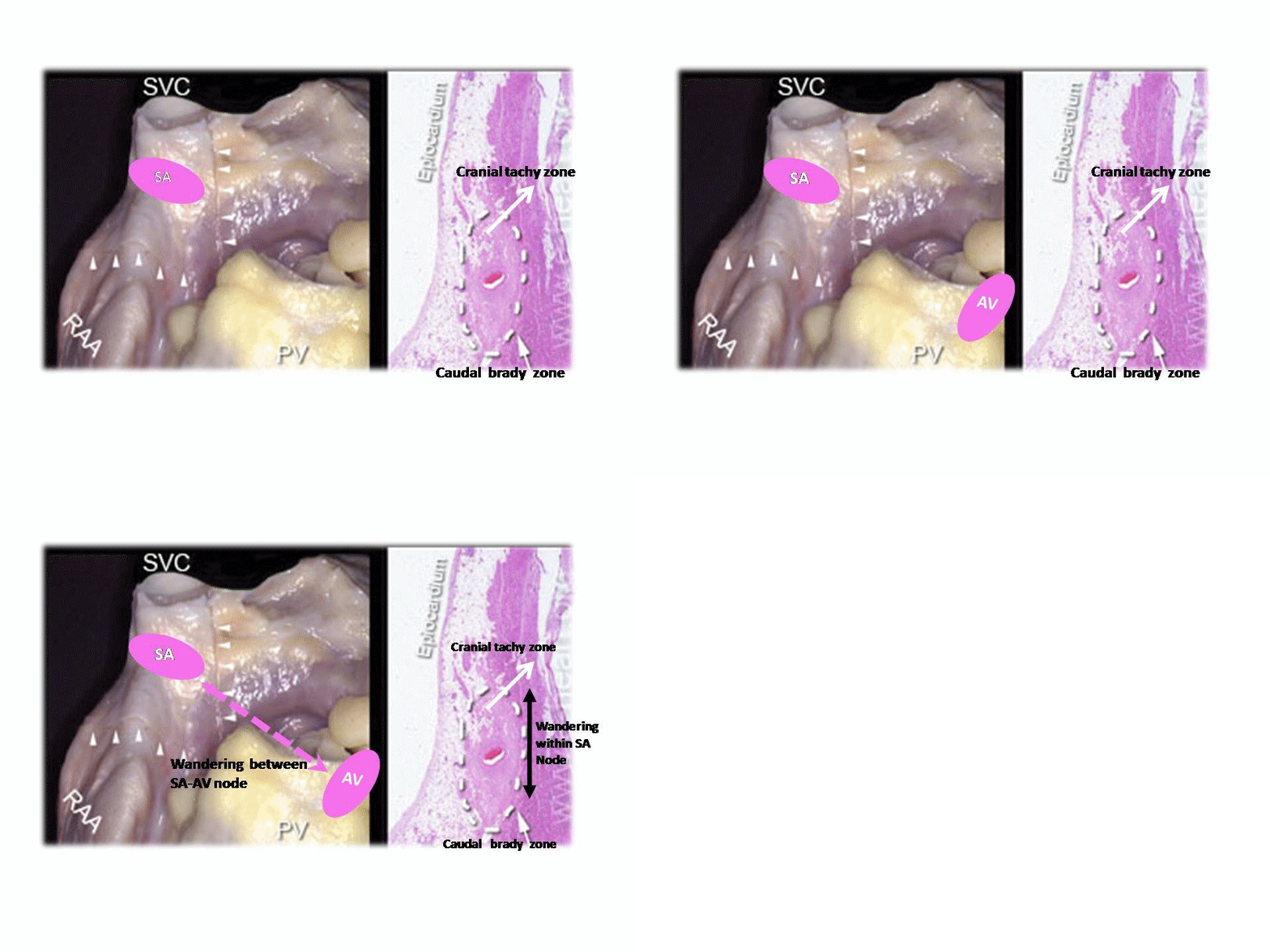
In fact , there is constant flux of pacemaker activity  with  the entire length of SA node.The  cranial   aspect  SA node has more fire  power than its caudal tip . It is possible Sinus tachycardia  and sinus  bradycardia could represent  minor changes in the firing focus in its cranio-caudal axis.Further the P cells of  sinus node can spill all over the atria and even up to AV node.

What is wandering  atrial pacemaker ?

This entity is poorly defined  in literature.  With pace making cells scattered all around  there is no surprise to note dynamic pacemaker  shifts  even in healthy people. This is  especially common in young athletes.

Wandering can occur

  • Within SA node ( Shift of focus of p cell firing .No visible changes in ECG )
  • Within SA node and atria
  • Between SA node and AV node. (Sino-Junctional rhythm )

Effect on ECG

  • Baseline bradycardia.
  • Changing P wave morphology
  • Change in PR intervals
  • Intermittent absent (Rather concealed  )  P wave if  is also possible
  • RR interval can also show minor variation.

Image Modifed from http://www.eheart.org

Clinical significance of  Wandering pacemaker(WAP )

  • A Benign condition generally has no clinical significance.
  • It is often an expression of  high vagal tone.
  • Usually transient.
  • Can be unmasked by beta or calcium blockers.
  • Severe forms of wandering  pace maker can be a marker of sinus node dysfunction  and  would need  further evaluation
  • In  the coronary care units it is  associated  with infero-posterior MI when the vagal fibers are  insulted.

Differential diagnosis .

  • Some times it  need to  be differentiated form ectopic atrial rhythm /Low atrial/Coronary sinus rhythm etc .
  • Sinus  slowing  followed by a  functional escape and  reemergence of sinus beat   can be a termed as a form of wandering  pacemaker

Final message

WAP : This attractive and  descriptive ECG entity  is   largely insignificant in clinical cardiology .

It should not be confused with more dangerous cardiac arrhythmia  like sinus pauses and arrest .

Diabetes is a systemic disease affecting  almost every cell  that metabolises  glucose .What begins  as  a minor  functional impairment  ,   worsens gradually and ultimately   end up in severe  structural changes.The basement membrane of  cells  face  the brunt of the attack .  (In the strict sense every cell has a basement  but it is well  developed only in kidneys ) . We also  know , diabetes  is able to inflict universal damage by targeting the vascular endothelial cells.

In the kidneys DM makes the  glomerulus  more porous causing protein leak*  and ultimately damages the tubules and end up in CRF. In the retina it excretes the  proteinaceous  material into the vital layers  and result in  retinopathy and progressive visual loss.

* Micro/Macro albuminuria

In fact , there is  a very close link between eyes  and the kidneys  Nephrologists   hesitate to make a diagnosis  of diabetic nephropathy without ocular  changes. The peripheral vascular disease and diabetic foot are  another expression of this microvascular  dysfunction.

What is the impact on cardiac micro-circulation ?

Whenever significant diabetic nephropathy is present there must be a significant cardiac micro- angiopathy as well.This is now  a fact than an assumption. We are not recognizing it rather  ! (If only we have a cardiac  creatinine we can easily identify diabetic myocardial protein leak !)

When kidneys lose protein , cardiac capillaries  lose proteins to interstitial   space  and result  in progressive  fibrotic reaction . We know  extravasaation   of high osmolar  proteins   can play havoc  in cardiac interstitium  !

Proteins are the particles of life   . . . but in wrong places  it can  transform into deadly  molecules  in a fraction of time !

Hence ,  the cardiac protein leak in diabetes can cause  any of the following clinico -pathologic entities.

  • A mild left ventricular  hypertrophy .
  • Increase global  cardiac  mass (Similar to bulky kidneys  seen in early diabetic nephropathy )
  • Simple diastolic dysfunction.
  • Severe restrictive features
  • NDCM (Non dilated cardiomyopathy )
  • Finally a DCM  like  transformation

How to recognize cardiac protein leak ?

  • Clinically it presents either as  angina or early heart failure symptoms ( not both usually ) .Diastolic dysfunction  in echo,  positive stress test , patchy thallium uptake abnormality  often with  features  of   syndrome X  is also recognised.
  • Many of the low flow or slow flow phenomenon  in coronary angiograms  might reflect micro-circulatory dysfunction .
  • This is recognised by prolonged TIMI frame counts  and  prolonged  coronary sinus filling and emptying time .

What about macro-vascular  complications  in diabetes ?  How is it different from micro-vascular complications ?

Though we expect a direct  link between  micro and macro  vascular complication ,   the later  appears  to a  patho-genetically  independent  process . This will be addressed later.

Read with caution . This  may either injure or cure your patient !

Click on the ECG to view what happend !


How does  verapamil  terminate a  VT  ?

Physicians  often  debate  vigorously before   labeling  a cardiac arrhythmia as ventricular , atrial junctional  , abberant or not etc etc .  But  for  an arrhythmia   it matters little  from what  chamber it is going to to originate . After all ,  any cell in the heart if excited can generate an arrhythmia .  The ion channel abnormality and the influx and efflux of ions  that determines how a drug is going to terminate an arrhythmia.

In fact , way back  in 1989 the Sicilian Gambit stressed this concept when classifying anti-arrhythmic drugs .This classification taught us  , even though there is a  huge list of  clinical cardiac arrhythmias  , from the therapeutic point of view there are only a handful of receptors  (scattered  all around ) to target  !

When we look at this angle , we realise  , many of  ventricular action potentials  have  important slow  calcium currents  similarly  junctional action  potentials do have some  sodium currents.  Calcium current  is present in every  myocardial cell  more so in the vicinity of AV junction.  Further , at times of ischemic or hemodyanmic stress these ion channels  may  take a different avatar altogether.Slow sodium channels and fast calcium channels etc !  (A wild imagination or is it a fact ?) Other important targets are potassium channels

Heart is a complex structure both macro and microscopically  .  In the three dimensional  histopathologic   interface between atrium  and ventricle (Especially in the  basal areas , outflow tracts  , around the AV grooves ) there  are  lot of sharing  and overlap of  different morphology  of cells . A high septal VT can behave  exactly like an SVT  which  includes the  tendency to get terminated by calcium channel blockers.

Amiodarone is a most popular  drug for VT termination ? Are we clear about the mechanism of it’s  action in terminating VT ?

It is  more of a perception and belief  that  class 3 action   may be   responsible for termination of VT by Amiodarone . In reality it is very difficult   to prove this point.  As Amiodarone  has all the  4 classes  action that includes beta and calcium blocking properties.. In fact ,  now  there is evidence  to  suggest   beta or calcium blocking action  may be more important in terminating  VT when  it is administered  IV  . (While  the class 3 action predominates in long term oral therapy )

A verapamil sensitive   VT may  successfully  be terminated by  Amiodarone  not by its  unique  action  instead it   may simply represent  its  calcium blocking  property.

Final message

Many  of the  VTs terminated by Amiodarone   could  also be verapamil sensitive . Since verapamil is never tried first we will never ever know the incidence of such phenomenon that gives pseudo credit  to Amiodarone

It may not be big crime to try injection verapamil in some of  the  stable ventricular tachycardias( As my fellow did ) especially  when we we know there is an entity called verapamil sensitive VT !


Q for the readers :

How many deaths are reported in cardiology  literature  regarding    fatality  following   verapamil  in   VT ?

I am trying to find  the answer the  data is very hard to come by !

Critical comments welcome.


Ever since Brugada found the unique pattern of ECG on right pre- cardial leads and its  association with  premature electrical death ,cardiac electro-physiology got a new impetus. Hundreds of articles(May be thousands !) on Brugada are  available . Many criterias  were proposed.  Brugada  and his colleagues should be credited for bringing  in such an interest in the  field of inherited ventricular arrhythmias.

On the down side ,  as we have a habit of  prematurely formulating criterias  ,  it brings  an artificial academic  barrier  Funnily , in medical  science  deviating   from a criteria (However hastily it  was  proposed  )   is a considered  big  offense Further . the hype surrounding  any new scientific  entity makes it difficult  for others  to overwrite  it .

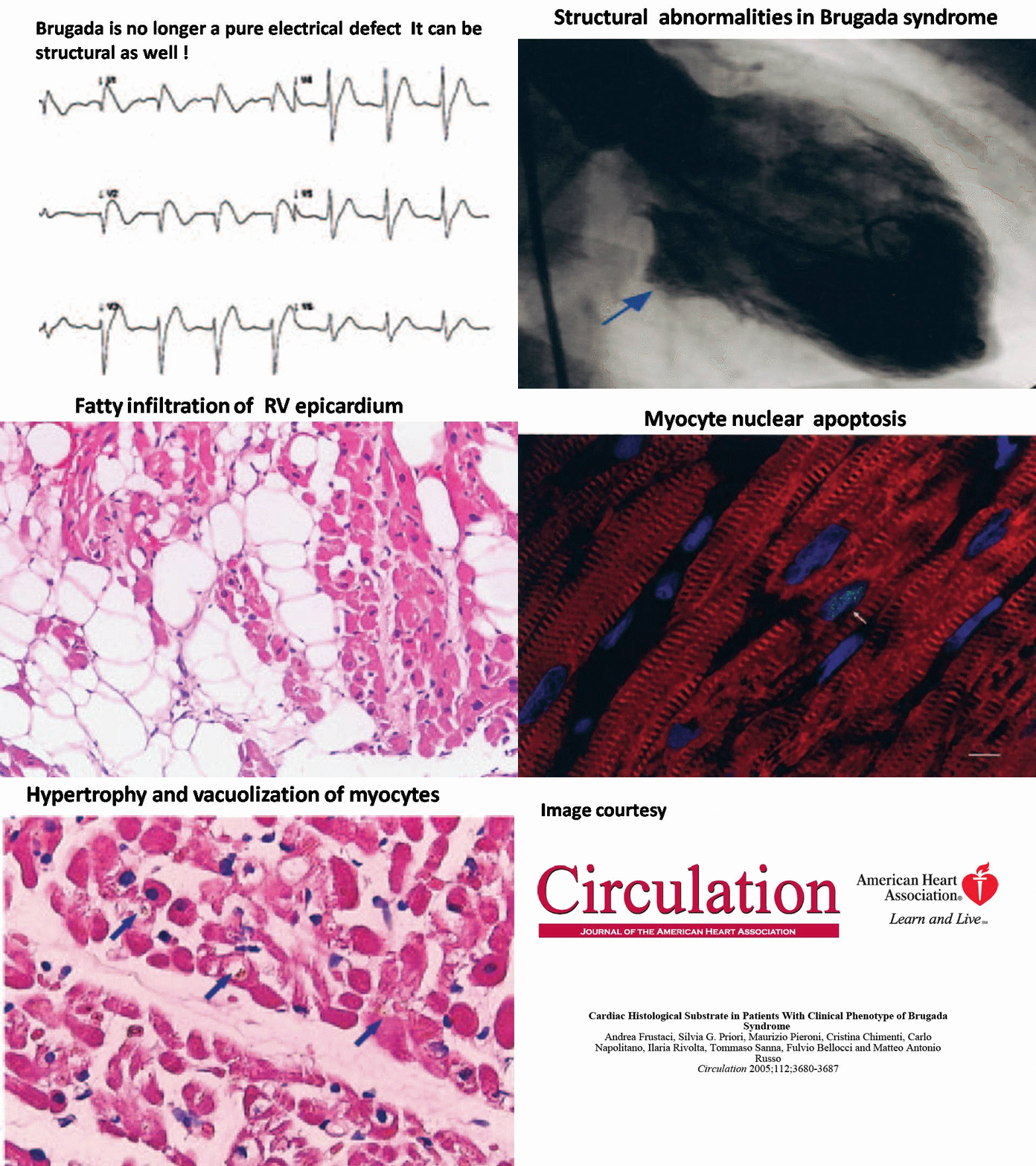
Brugada recognized a ECG pattern with  a genetic predisposition for VT and VF  . Now , we know there are many etiologies  with a similar pattern  of ECG . What Brugada did was ,  he  exposed the tip of Iceberg called inherited ventricular arrhythmia . But the essential criteria –  Absence of structural heart disease ,  to diagnose Brugada   was  always questionable.

(Please realize , presence  or  absence of structural  heart disease depends , more  on  how advanced  our  imaging modalities are . If you can map a virtual histology of RV epicardium one may detect some  microscopic abnormality in every case of Brugada. In human biological system , God  usually bonds  structure and function too  closely  and hence  functional  abnormality rarely occur  in isolation )

Brugada is  not  a new disease ,   it is  a  recognition  of a  pattern of ECG  related  to sudden deaths . Subsequently , we  realized any dispersion in repolarisation in RV epicardial surface  , the   risk of sudden death  is increased. From the days of  Brugada  we  have  come  a long way.

What is new in Brugada syndrome  ?

(Not exactly new . . .  it is  known  for many years )

Brugada is no more an exclusive  functional disorder of  sodium channels of RV  epicardium .It can have structural defect (known & unknown ) .It may  have infective , degenerative etiology as well .

How does these structural changes appear ?

Chronic sodium channel malfunction  can result in cell membrane defects which can augment   Idio-osmole   inside  the cell and result in  apoptosis   etc .

Which comes first ,  electrical or structural abnormality ?

It is an  another  chicken- egg tale  waiting to be decoded   within the RV epicardial cells

Can wall motion defect occur in Brugada ?

Early observations done in out hospital (MMC Chennai ) has found anterior  RV free wall motion defects. Tissue Doppler studies are  being undertaken.

Final Message

The  following paper  wonderfully documents  the structural and histo-pathological  changes in RV epicardium .  This  implies ,  our belief   about this  unique electrical  disorder  is  bound to take a beating  and  we  expect a major perception makeover regarding Brugada  in the years to come .

Probably the most important paper on Brugada syndrome was published in circulation in 2005

*http://circ.ahajournals.org/cgi/content/full/112/24/3680