Feeds:
Posts
Comments

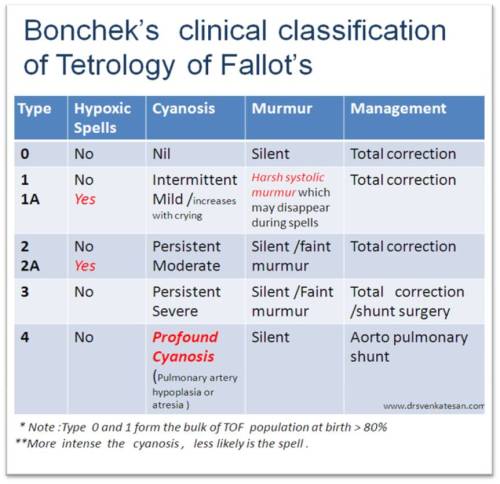
Tetrology of Fallot is the commonest cyanotic heart disease . In 1973 , working at Portland,  Oregon , Bonchek  and colleagues created this classic with intense clinical acumen , that defined the way   how we understood TOF   in infancy  . Such studies  have  become extinct in this fast paced cardiology academia !

With due tributes , here is a slightly modified version of Bonchek classification of  TOF in infancy .

Every cardiologist must read every line of this article  which came 37 years ago  !

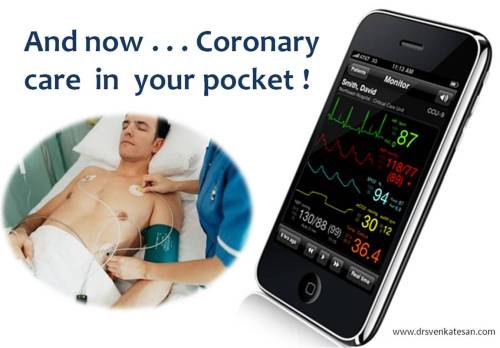
Welcome to the new era of “medical avatar “

Cardiologist’s ultimate dream  of  monitoring  their patients

Live ECG feed in your cell phone  !

Thanks to the American “scientific  pursuit” and the mankind  will be  the beneficiary !

Courtesy :

Airstrip technologies

What’s next ?

Remote DC shock and pacing  .

Watch out  . . . it is going to happen in next 5-10 years !

The commonest cause of syncope is the neuro-cardiogenic or vasovagal syncope .

The following is  the possible neural  circuit  of this syncope . In fact . it is a  “Neuro -vascular circuit”

The afferent* (Two components  are present  -Both trigger sympathetic signal )

  1. Sympathetic (Prodrome /Anxiety /fear )
  2. Cardiac mechano /stetch receptors  located mainly in LV .(Can be in Aorta/Carotid )

* In some cases sensors  and afferent can be same entities.

The centre – Medullary Nucleus ambiguous /Tractus solitarius

The efferent -Strong parasympathetic overshoot and sympathetic withdrawal

Parasympathetic excess lead to bradycardia primarily, while sympathetic  withdrawal lead to

hypotension

Syncope recovery

As patient recumbent posture ; LV gets filled and  LV mechanoreceptors are passified .

Final message

The exact pathophysiologic basis of this syncope  still  not elucidated.But one thing is clear , the syncope is due to sympatho- parasympatho signal mismatch( and sort of a rivalry reaction)  !In this neural game , heart’s behavior is all the more funny , it initiates the reflex  while  the brain stem  “Boomerangs” it back to heart and vascular system ,  with a vagal onslaught .

To call this  simply as vasovagal  is not proper , that is why neuro -cardiogenic syncope was used.

Ideal terminology  would be  to call it as  cardio -neuro -cardiac syncope   as the cardiac component form the afferent limb as well as the efferent (target organ )

Reference

Medicine is an art , evolving art to be precise .We need to use our sixth , if not , the  seventh sense !  constantly to  improve the quality of life our clients  -The human beings.

If only we learn to think right  . . . Always right . . . we can bring the heaven of health to the earth

This book  fascinates .

Click for a  preview in Google.com

Books.google.co.in

LVH is one of the commonest ECG abnormality . We know the hall mark  of LVH is increased QRS voltage .We also know , ECG is not a fool proof method to detect LVH .It has very good specificity , but little sensitivity , meaning that increase in  QRS voltage is  fairly accurate in predicting LVH  but absence of  which cannot exclude LVH.

Why Increased QRS voltage does not occur in many with LVH ?

Even though we think myocardial mass  is  the  sole determinant of QRS  voltage  , in reality  it   is determined by many other factors.

  • Distance between the ECG lead , and the myocardium is an important factor. In classical concentric LVH , the LV  cavity is not enlarged ,in fact it may shrink a little as the hypertrophy grow inwards and obliterate the LV cavity.(We do not know yet , how much of LVH grow out and how much  muscle grow in ! )
  • The blood volume within LV is a very good conductor of electricity.A good volumed LV may augment a QRS voltage.
  • This can be observed in some of the patients with DCM , where high voltage QRS  is recorded mimicking LVH.

But ,what really matters is the fine balance of blood volume and myocardial mass that determine the incidence and magnitude of LVH pattern in ECG.

QRS voltage as a tool to differentiate pathological from physiological  LVH

We know QRS current is generated from within the myocytes .If the myocytes  are  uniformly hypertrophy without altering the  basic mechanical and electrical architecture QRS complex will be amplified in a sm0oth manner and result in  classical high voltage  QRS  of LVH.

If the hypertrophy occurs in a disorganised fashion, where in myocardial fibres slips out of plane  with adjacent muscle bundles, the QRS  voltage may not increase and even be slurred or notched as we see in many cases of LVH with non specific intravascular conduction defects

The classical disarray of myocardial fibers that occur in HCM causes  pathological q waves.

* Other factors that determine LVH include bundle branch conduction delay or blocks which is not discussed here.(Ex: An incomplete LBBB can amplify the qrs without any LVH )

LVH with fibrosis

Fibrosis is not a standard feature of LVH. It occurs in few who are genetically predisposed , and  mediated by heightened sensitivity to circulating growth factors.

  • Fibrosis can have wide impact on the electrical as well as mechanical function of heart.
  • Fibrotic heart has a  potential to  blunt the  high voltage  QRS complex.
  • It  may even cause  pathological q waves .It predispose to ventricular arrhythmia
  • It prevents regression of LVH , even after the loading conditions corrected.

Other conditions that  attenuate LVH features in ECG

  • Diabetic hypertensive show less ECG voltage than isolated HT .
  • CKD patients often do not show ECG features of LVH inspite of LVH

Final message

Diagnosis  of  LVH by ECG is a  simple clinical exercise , but we realise now , the underlying mechanisms are too complex .

A simple question , ie  Why  every one  with LVH  do not increase  their  QRS voltage  ?  . . . exposes  our ignorance on the subject!

But one thing is clear, physiological LVH (Meaning LVH ,  purely due to loading conditions including SHT/Aortic stenosis)  more often result in high voltage , while  in true pathological LVH(infested with fibrosis ) the  increase in voltage is not consistent .

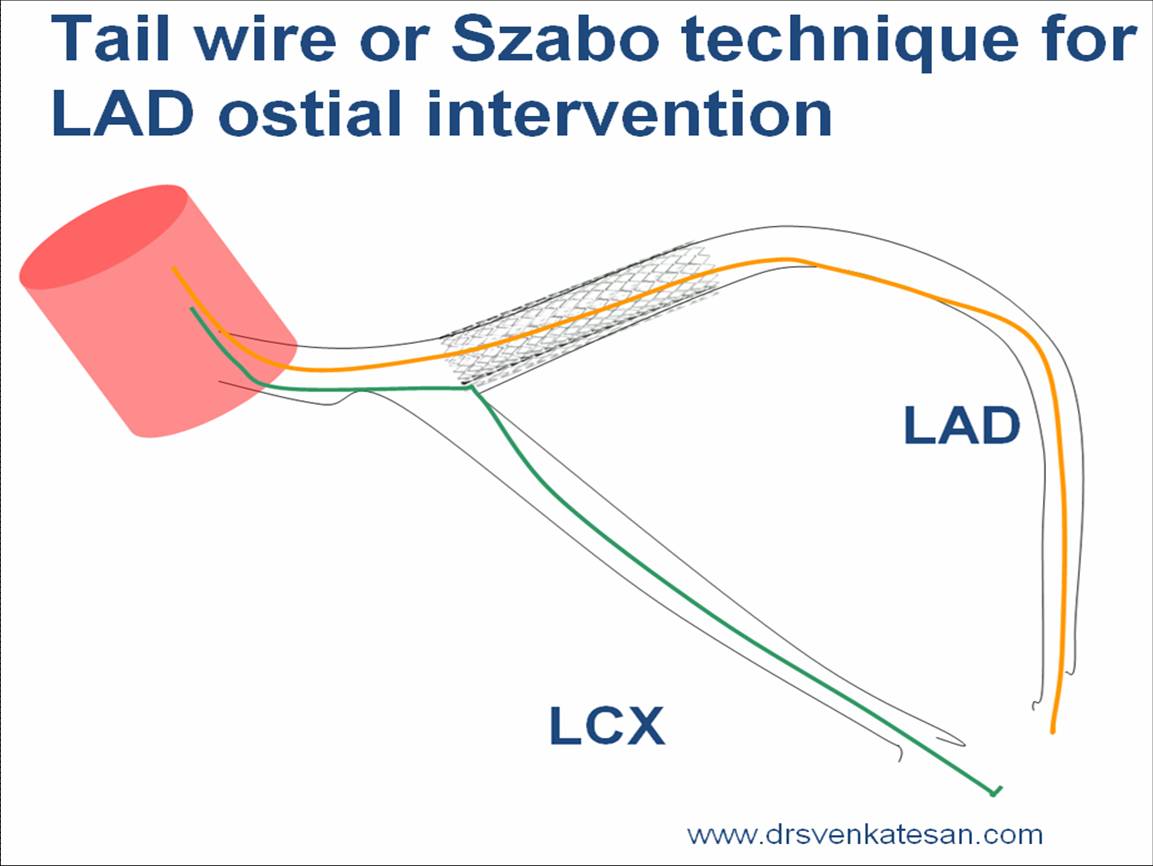
Bifurcation lesions and ostial lesions  continue to  challenge the expertise of   interventional cardiologists.

Variety of techniques have been described. Geo positioning of a ostial lesions ,  exactly on the rim of ostium  is required  . This is very difficult in  many patients  , as stent migration either into side branch or protrusion into the main branch is common. Both reduce  optimal  PCI outcome  .

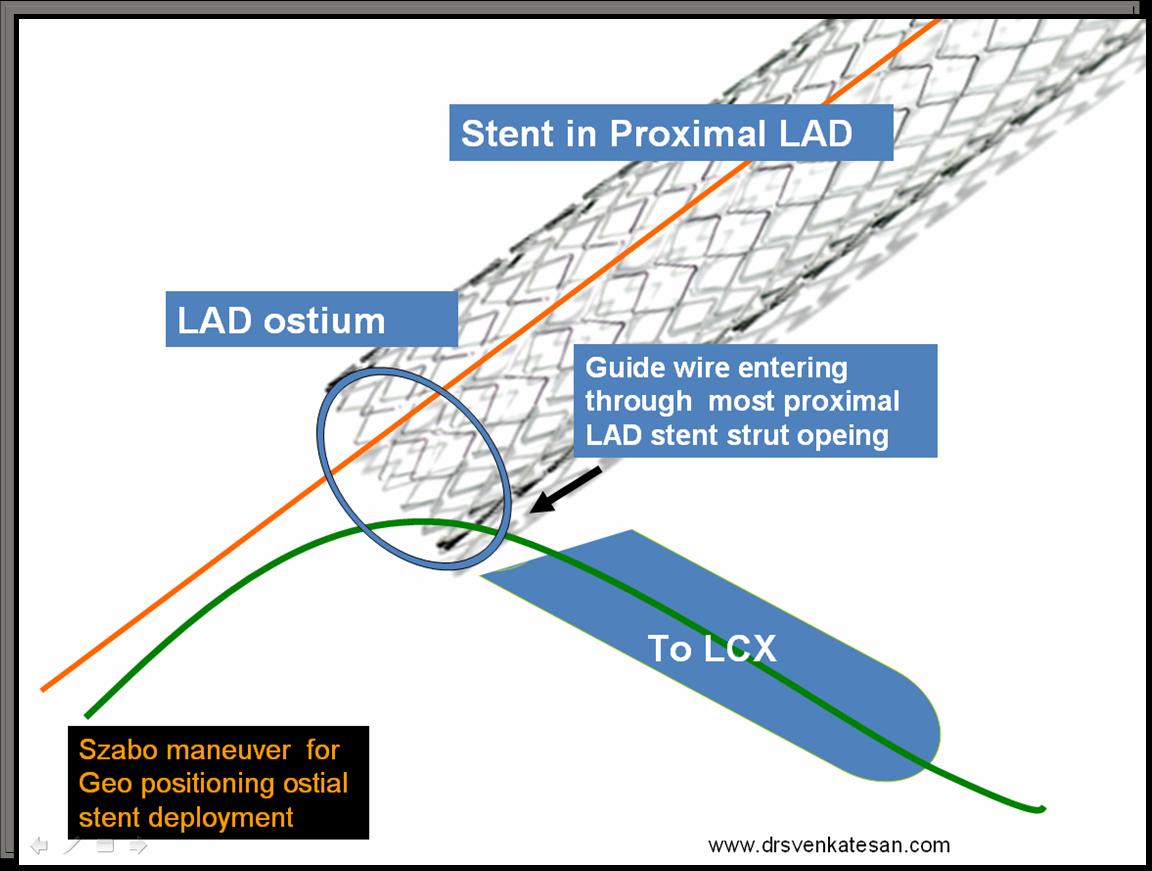
Here is a innovative  technique   described  first by  Szab0 in 2005 TCT conference .

Highlights of the technique

  • It is a twin guide  wire technique.
  • The Circumflex guide  wire  is threaded over the most proximal strut  of  balloon mounted  LAD stent .
  • The guidewire makes sure the LAD stent move beyond the LAD ostium .
  • Of course some technical limitation is  there, this seems to be a good option at least in some deserving  LAD ostial or LCX ostial lesions

Technical hitch

The balloon and stent is to be manhandled prior to deployment.  We are little awry to do it

The review article in the journal  Eurointervention

Japanese cardiovascular society publishes this journal  called as  “Circulation  journal” It has some great articles in every Issue .The Impact  factor is consistently rising.

Please do not get confused with AHA’s  “Circulation”

Learning (and of course unlearning! )  is a continuing process in the field of medicine. . We have exclusive  medical universities for various specialties . The popularity of  radial access for doing coronary interventions is progressing very fast and  the  femoral puncture technique  is expected soon to become   extinct !

Here comes a virtual on-line university for mastering radial artery interventions.

I wonder  , they issue a  Master’s degree  on the subject !

Thanks to Terumo for  initiating the concept .

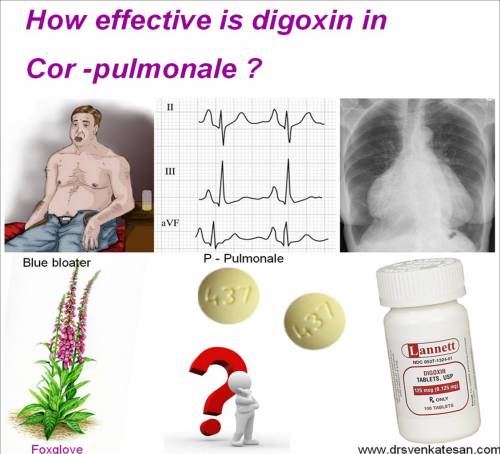
Digoxin is a wonder cardiology drug used for more than a century.We know the pioneering efforts  of  William withering  in detecting the potential  of the unknown  herb  Foxglove.

Mechanism of action

The beneficial effects of Digoxin is attributable  to

  • Positive inotropic  action
  • Vagal action

Digoxin blocks the sodium potassium ATPase in the  myocyte cell membrane .

This cause accumulation of NA + ions within the cells. The excess  Na , then   facilitates  the Na -Ca exchange port .

This pumps in more calcium   into the myocyte.

Increased  calcium means more forceful contraction and that is positive inotropism* .

* This is a  highly simplified version of   Digoxin’s action . It should  be remembered  simple availability of excess calcium can not guarantee  contractility,   as it requires adequate number  of receptors.
Digoxin  is used in which type of cardiac failure  ?

Digoxin is used for both for LV and  biventricular  failure .

Digoxins is still  often  in isolated RV failure  of any cause (Cor pumonale, PPH, Eisenmenger etc)


Digoxin and RV dysfunction

Digoxin  has a tendency  to  hit the atrial muscles  at random causing  multiple short circuiting (Micro reentry )   forming  a perfect nidus  for complex atrial arrhythmias  including MAT .The coexisting    hypoxia  (which is all the more common here )  aggravates the problem .

Inotropism of RV : Does it really exist ?

It is often quoted , RV is a passive pump. It does not mean inotrpism is an exclusive property of LV.

RV has to generate about 30mmhg to pump the blood into  the lungs.

In cor-pulmonale the RV works against an afterload of around 50-70 mmhg  , making  RV inotropism  much more important  concept.

Rate control in atrial fibrillation Digoxin lowers the heart rate by vago mimetic action ,  primarily in  AV node  and to a  certain  extent in SA node .Ventricular rate reduction  is the prime requirement  in the management  atrial fibrillation and this property  is still the crowing  glory of  Digoxin.

Though beta blockers and  verapamil  can be used as rate controlling agent ,  lack of negative  inotropism makes  digoxin    prevail   over , especially in severely dysfunctional  ventricle .

But , one disadvantage of Digoxin is , since it requires  a vagal traffic to mediate it ‘ s rate controlling effect , it  is less effective ,  when there is  high sympathetic activity as during exercise.

What is the action of digoxin on interventricular  septal contraction ?

Digoxin , simply does not know where it acts when administered in cor pulmonale  ! We believe in cor-pulmonale the maximum action would be the area of maximum dysfunction .This is purely  an assumption. In cor -pulmonale septum shifts it’s loyalty from LV to RV as the later is the distressed chamber.So , logic would be there  is a theoretical  compromise of LV function in  patients with cor -pulmonale. These factors make  the   inter ventricular  interaction and dependence a complex one.

Some believe  the improvement of sub clinical LV dysfunction in cor pulmonale may be more important factor in giving relief  to  the patient’s  symptom.

What are the other RV inotropes ?

Doubtamine has some RV inotropy  .This again may be due to a spill over effect from LV rather than a primary RV inotropism .

As such , there is no great breakthrough  in creating a powerful isolated RV  isolated RV inotropic dug.

Probably  the best way to  give relief to RV is to reduce the pulmonary artery pressure as invariably sever PAH  is the predominate  accompaniment

(Nitric oxide ,  Epo prostenol etc)

Final message

  • Digoxin , indeed has  some useful  role in cor- pulmonale .
  • But ,the benefits are more pronounced in late stages of RV failure.
  • Since the dose required to get an optimal RV inotropy is high the safety margin  is reduced.
  • Since there is a propensity   for complex atrial  arrhythmias  ,  it has to be used very cautiously in management  of   atrial fibrillation due to cor pulmonale .(Than in other forms of AF)
AV nodal reentrant tachycadia(AVNRT) is the commonest mechanism of SVT. It is divided into slow-fast, fast-slow, slow-slow , representing the two limbs of he circuit.

Slow -Slow circuit is  the rarest  type of AVNRT.  It should be appreciated  ,  the scientific validity of  slow-slow circuit is  applicable  only in relative terms . A virtually  similar antegrade and retrograde limbs with identical conduction velocity and refractory  properties  , can neither  initiate  nor  sustain an AVNRT.

Caveat in the definition of slow -slow AVNRT.

Even though ,  we call it   a  slow-slow  tachycardia , one of the limbs need to be faster than the other.  So , every slow -Slow AVNRT in reality will have  two types

  • Slow- Slow ( Still , faster than antegrade slow) mimic a slow-fast physiology
  • Slow( Faster than retograde slow )  -Slow closely mimic typical  fast slow .

Implication for electrophysiologists  and   points of contention for the ablationist !

  • In Slow -Slow AVNRT ablation we do not know exactly ,  which of the slow pathway is being ablated , unless we specifically  analyse  the post ablative  data.
  • Very often it is not done.Every one in the lab is happy , for breaking the tachycardia circuit. Only after the procedure is over , we may realise the tachycardia is not really killed as it finds an alternate highway to complete  the short circuiting of heart.
  • We need to  suspect this type of AVNRT   prior to the  procedure .Electrophysiologist  shall  spend little   more time and a wide area ablation done , in the vicinity  of coronary sinus ostium can be attempted. .

It is not a smart practice to advocate  wide area ablation as a routine protocol in all AVNRT

as it directly  increase the rate of complication >

Final message

A   hurriedly  done slow pathway ablation  which  may  temporarily terminate the AVNRT ,only to recur later as  the retrograde  slow pathway may again form  a substrate  .The area of slow conduction  acts as a turnaround gateway and capture  the  retrograde fast  pathway which  could be  available in plenty in the anterior aspects of AV node  .   (Note : The unablated  slow pathway  now  form the antegrade  circuit )