Feeds:
Posts
Comments
medical morality

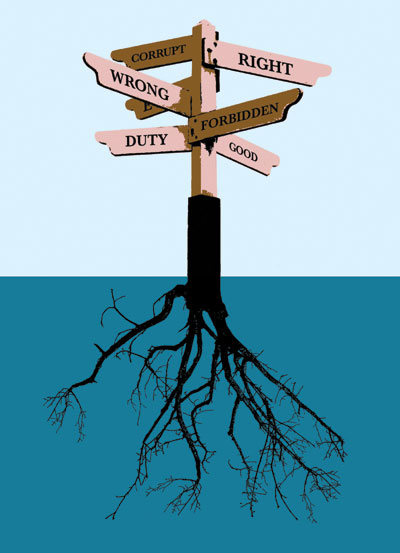
Tree of life : When professional morality suffers a mortality . . . human health becomes a causality !

Greatest threat to the future of  human health is  . . .

  • Not from  exotic  infectious agents , bird flu  or  mosquito  fevers
  • Not from  epidemic of cardio vascular disease
  • Not from  thousands of  published  diseases in ICD code
  • Not from  aging population and failing  vital  organs
  • Not from  lack of availability of life saving  drugs and devices
  • Not from  lack of  hospital beds.
  • Not from  good sanitation
  • Not from  hunger and poverty
  • Not from  lack of para medical workers
  • Not from  lack of health awareness and education

But from  . . .

  • The way  health care is administered in this planet .
  • The way  noble professionals are created .
  • The way  trivial health  issues prevail over  major  health crises  that  wallop the health budgets.
  • The way by which  medical morality is systematically destroyed
  • The way   “concept of  health” is  sold  as a  buyable  commodity by insurance companies.
  • The way  medical journals churns out  junk articles in the name of research.
  • The way corporates indulge in  delirious pursuit  to  increase  bed occupancy rate of their  patient  ware houses (Also called Hospitals)
  • The  way greedy drug companies aim to increase the per capita drug consumption of  ill informed  homo-sapiens  by discovering  pseudo  drugs for pseudo  illness
  • The way   health insurance policies are misused
  • The way  rich spend billions for reconstructive  cosmetic  surgery while the poor die for want of basic medicines !


Link to a wonderful  article  on moral education for our kids in medical school !

What happens to diastolic blood pressure in severe Aortic stenosis ?

Traditional answer: The diastolic BP remain unchanged. Only systolic BP falls as it is related to LV  stroke volume .(What we refer to as systolic decapitation of BP  )

Reasoning :Diastolic BP is related to peripheral vascular resistance , hence aortic stenosis has  little impact on diastolic BP .

 Further analysis

If we assume only the systolic blood pressure  is bound to decrease in  AS , at one  critical point of time*  systolic BP  should  approach  the diastolic pressure and pulse pressure should approach zero .This can not happen , hence at that point  diastolic pressure will also fall.

*What is that  point ?

No one really knows !

Correct answer

In severe aortic stenosis  both systolic and diastolic pressure falls , but the fall in systolic BP is more striking .

* Though it is customary for clinicians  to discuss them in isolation both systolic and diastolic  blood pressure are closely coupled parameters..In the absence of peripheral run off one of the  strong determinant of diastolic BP  is . . .  systolic BP !

Complex concepts

1. What happens in combined aortic stenosis and regurgitation ?

In  combined AS and AR   we get  pulsus bisferiens. implying  AR will  elevate the systolic blood pressure in spite of obstruction.

2.What happens in associated systemic Hypertension  and aortic stenosis . (Which is very common combo in elderly )

Since HT will increase the  aortic pressure , the LV-Aorta gradient tend to fall.

However ,this  does not happen always as if the original cause for HT was  dependent  more on the stroke volume rather than peripheral mechanisms .

3. Aortic stenosis with aortic  atherosclerosis .

A stiff aorta augments the percussion wave amplifying the symbolic BP and blunting the  classical anacrotic pulse of AS.

4.What happens to BP  during exercise in  severe AS ?

Exercise demands raise in systolic BP and temporary reduction in diastolic BP due to peripheral  vaso dilatation in exercising muscles.

If a fixed  crtical AS does not allow the systolic BP to raise  as required , diastolic continue to fall pulse pressure should still become wide .

Excercise testing is a tricky business in AS. Some have attempted it to assess the functional capacity.(Read below)

Reference


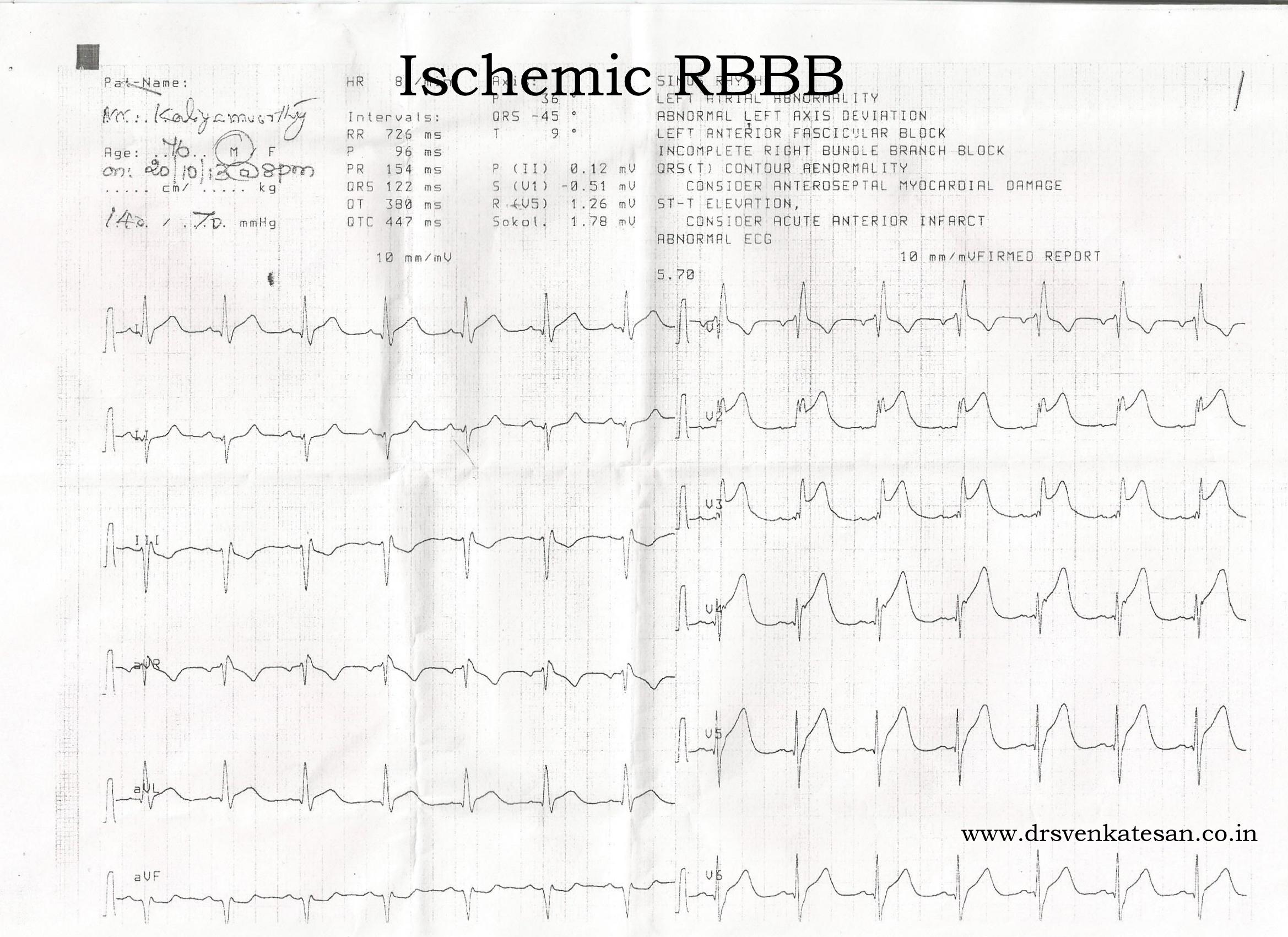
A 76 year old man with history of recent stroke presented with acute chest pain  and his ECG  showed ,

ischemic rbbb

It was diagnosed as Anterior STEMI .Since he had co-exciting renal dysfunction also he was not considered for thrombolysis (Primary PCI not feasible !)

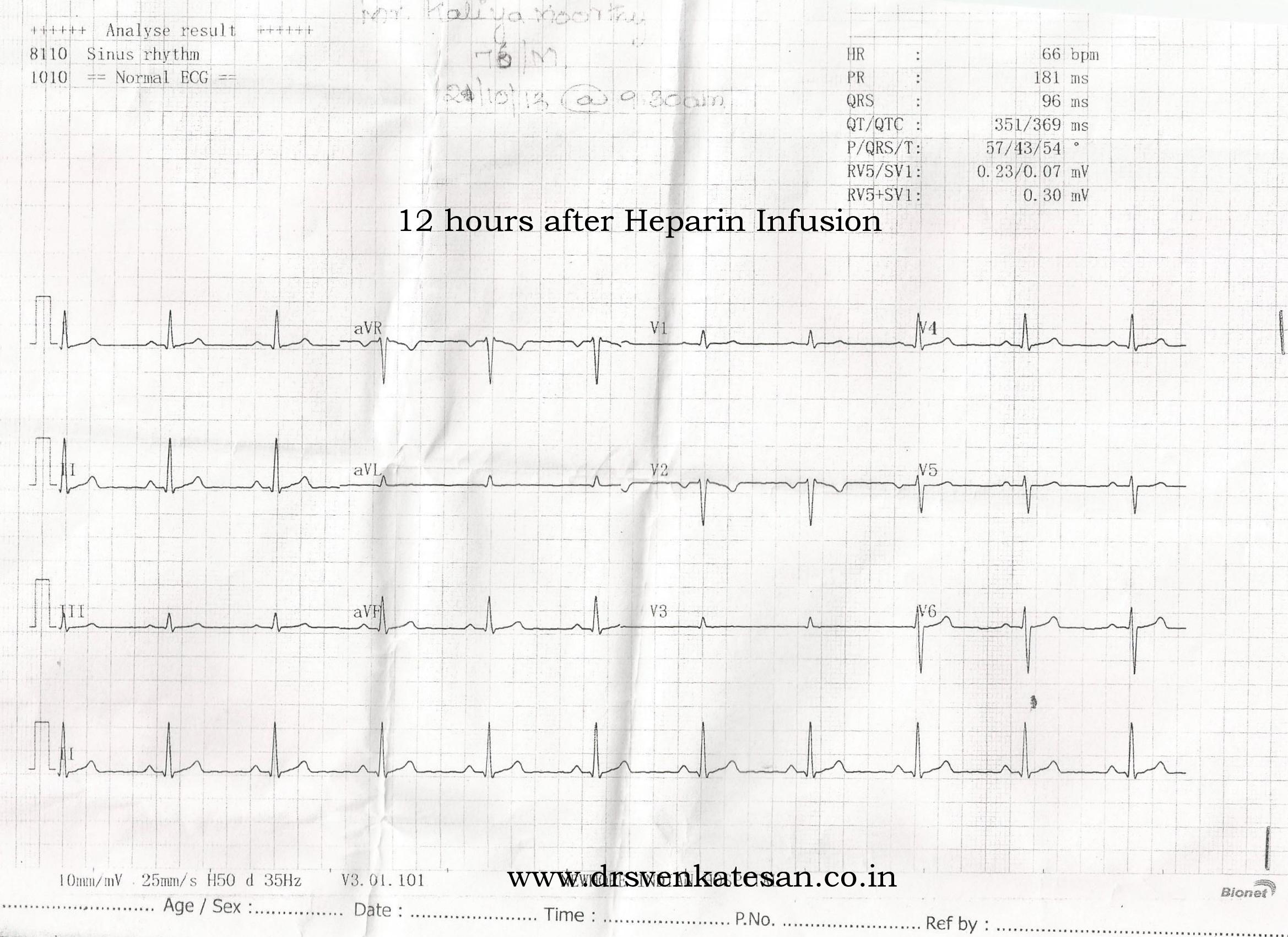
IV  Heparin bolus followed by infusion was started. Patient  had a comfortable night stay. The ECG taken on the morning  looked like this.


ischemic rbbb 001

Do you call this aborted STEMI or a simply an Ischemic RBBB ?

Transient RBBB due to Ischemia in  LAD territory(with septal compromise ) is very much possible during ACS. But , it is a rarely discussed entity unlike ischemic LBBB .

We know qRBBB  complicating anterior STEMI is much commoner than LBBB , still transient ischemic RBBB in non STEMI setting seems to be uncommon .Is it possible propensity for  Ischemic RBBB is different from necrotic RBBB ?


LV ejection fraction (EF) is the most commonly used  LV systolic functional index.Since , it is an  easily acquired parameter,  it’s popularity has zoomed among both learned and novice cardiology professionals .(Not withstanding the serious shortcomings!)

In one of the evening rounds  in my CCU , a young cardiology fellow told me about a  patient  with acute  anterior MI with ST elevation V1 to V5.

The patient  was lying supine with trunk up . HR was 110 . BP was  100 /70 There were few basal crackles .The patient was undergoing  lysis with streptokinase.

It was  suggested  to me by the  fellow  that  the patient is  going in for “Impending  cardiogenic shock since his EF is just 30%”

That prompted me to ask this question

How good is the EF  a measure  of size of MI during STEMI ?

EF during  STEMI  is highly variable parameter.The following are important con-founders in LV EF measurement during STEMI.


  • Acute ischemia induced LV dysfunction .(Ischemic stunning from  the watershed zone  significantly over estimate LV dysfunction)
  • Mitral regurgitation  if present will underestimate it
  • Effect of tachycardia and bradycardia can be significant
  • The posture of the patient and  measurement errors (A good Simpson score is rarely  possible in a sick patient )
  • Associated  hemo -dynamic drugs like NTG/Dopamine etc which alter  pre and after load   and changes the frank starling forces.

* Please recall  , LV EF is never included as a criteria to diagnose cardiogenic  shock, confirming the  flimsy  nature of this parameter during acute phase of STEMI !

Final message

The purpose of echocardiography during STEMI is to rapidly identify any mechanical complication , not to waste time in calculating EF.

EF is not a good indicator  to  quantify the extent of STEMI  or it’s prognosis. LVEF cannot be used  to risk stratify STEMI in the first  48 hours .One can expect  the true LV function  to prevail only  at discharge.

Ideally ,LV  function should be reevaluated by 2 weeks to get a fair idea of true myocardial function .By this time all  confounders will resolve.

Clinical implication

Since many of us are suffering from an academic obsession and blindly follow the scientific guidelines, a hurriedly diagnosed  “severe”  LV dysfunction post STEMI may land our  patients to  inappropriate intervention !


Learned physicians will agree, BP recording by classical auscultatory   method  is  not always an  easy task !

Such an important clinical sign is left to the whims and fancies of human ear’s ability to detect  of low pitched vibrations emanating from deep seated brachial artery .(5 phases of Korotkoff )

Since  Korotkoff sounds are low frequency sounds , it is best heard with bell of the stethoscope ? How many of us do it ?

There is little surprise , two BP  recordings  rarely  match even if it’s performed minutes  apart  !

korrotkoff sounds

While phase one is easily identified , the gap between phase 4 and 5 can be very  narrow and  differentiating  them is often an auditory illusion.

Korotkoff sounds is  subjected to severe tissue plane damping esepcailly in low flow states and obese arms.

So is there an alternative  method to measure diastolic BP ?

Most will agree , systolic BP can be  well measured by palpation ,

What about diastolic BP ?

In this technological era , it may appear foolish to depend on a tactile measurement . But as these articles suggest , it is worth a try!


diastolic blood pressure by palpation korrotkoff

In certain population  we know the kortokoff sounds are low quality .Auditory interference can be more than tactile sensation. In those hands ,Korotokoff  equivalents  can be felt by sensitive fingers.

After thought

How does automated BP recorders  sense systolic and  diastolic BP ?

Does it sense the sound or feel the vibrations.

Reference

measurement of diastolic blood pressure by palpation

Modern  day cardiac scientists have legally defined a significant coronary  lesion as > 70 % obstruction. Unfortunately this rule is applicable more in  academic forums not in cath labs.

While the guidelines seem to be clear in chronic coronary syndromes , in ACS  the interventional strategies based on  severity of lesion is  not  clearly defined.

Many times  in a  recannalised coronary artery following STEMI  (Either  spontaneous  or pharmacological )  even a 10-20  % lesion is stented .(Mind you ,  coronary erosion  that  trigger  pure thrombotic  STEMI  will be stented by most  of the  proud  young cardiologists of today !) The guidelines conveniently  ignore this area  allowing  the cardiac physicians  to  indulge in the coronary exotica !

Is this logical ?

Why do you need to stent a successfully lysed coronary  lesion with TIMI 3 flow. ?(We do know , many  young infarcts have pure thrombotic STEMI with zero % lesion   (In India 40% of young STEMI has near normal CAG  )

This situation arises by an ill conceived concept called pharmaco- invasive approach where routine coronary angiogram is advocated even after successful thrombolysis  in patient  who is asymptomatic and complete salvage of myocardium has been achieved  by pharmacological means .

* The only way to prevent this excess  is to ban the  pharmaco -Invasive approach for  asymptomatic and apparently successful thrombolysis .(Better still  even CAG should be banned ! for  the  simple reason an inappropriate CAG  begets an Inappropriate PCI !)

A Narrow  gap  separates  Ignorance and  knowledge !

Does the  PCI  makes the  ill-fated site  less vulnerable   for future events  . . .  when compared to   well  re-cannlised native coronary artery with negligible lesion ?

The funny side of  cardiac science  can be appreciated , when  somebody  is implanting a latest generation stent for 10-20 % lesion  just because it is associated with an ACS ,  another would astutely   study  the significance of 70-80% lesion  by FFR  in  an adjacent lab !


I used to tell my students ,the relationship between the heart and kidney  is so close , it is never justified for  the  two departments of Nephrology and Cardiology  are  physically away by two blocks in our institute .

Kidneys are vital to maintain the volume and pressure of body fluids and heart is responsible for keeping this fluid circulating.

In clinical setting  it is a well known secret ,most deaths in patients who are on dialysis is cardiac while  most  deaths in patients  with CHF are renal.

It remains a mystery  why kidneys were   ever considered as a circulatory organ  , when  our medical pundits de-compartmentalised  human organ systems !

CKD is pre-cardiac failure and CHF is pre-renal failure

The Heart /Kidney affair is so intimate in many  pathological situations both either succeed or fail  simultaneous or sequentially.

While CKD  results in and pressure and volume overload of heart , cardiac failure cause pressure and volume under load (pre-renal  factor) which worsen the renal function and aggravate cardiac function alter.

In essence,  it is vicious cycle of two  serial organs  performing  the vital circulatory function with body fluids playing a  role of diligent mediator.Whenever the kidney  fails heart  is stretched and stressed  to its Frank starling limits by the volume  as well as the accompanying HT load.

While text books link these two organ as simple cardio-renal syndrome it is not happening at the level of patient’s bed side.

Cardiologists and  Nephrologists must realise they need do work in tandem like  their  respective  departmental  organs  which accomplish this task easily !

To tackle this much  maligned  cardio-renal conundrum

Consider CKD as CHF equivalent  and CHF as CKD’s

I would recommend this concept to be infused  right in the third year medical school and  try de- compartmentelise  clinical  medicine.

Need of the hour : How to Moderate ACEI dosing in CKD

ACEI has been a major pharmacological   revolution in controlling and reversing the adverse events of cardiac failure . Some where along ,  a significant fear complex arose regarding the damage it could cause to kidneys.

Recently , we know the role of  ACEI in CKD made U turn(Like what  Beta  blockers did to CHF) .Now, it is presumed ACEI are indeed  safe in most CKD and may  even regress  CKD. Still this concept  has not been fully disseminated  into general physician domain.

Let cardiologist and Nephrologist sit together and sort out this issue.

I guess ,  ACEI controversy is  a sort of  ongoing ego clash  between Nephrologist and Cardiologist . Both like it , both make fuss about it ! In my observation , if  a cardiologist titrate it upwards  Nephrologist would  lower it  and reverse happens if cardiologist express caution about it ! Do you agree ?

Final message

Mankind has  accrued  great benefits  from stunning break throughs in modern medical science . . . but it has come  only at a huge  cost ! Medical knowledge has completely fragmented the physician mind-set .Every good therapeutic concept is  hanging aloof .It requires periodic de-fragmentation (As we do it to our PCs by anti-viral soft ware !)

To begin with , let us  consider   CKD and CHF as single sequential circulatory  entity !

Let us vouch to  create new generation medical professional  devoid of skewed  medical vision !

Reference

Guidelines for ACEI in CKD

NKF national kidnye foundation

https://www.kidney.org/professionals/kdoqi/guidelines_bp/guide_11.htm
acc aha  accf guidelines chf 2013

We know  streptokinase  is a non fibrin specific   agent that   results in systemic lytic state and hence more chance of bleeding.

TPA is fibrin specific  and it  will act only on fibrin  bound to clot , hence systemic bleeding risk should be less.

However , in real world , it is well  documented  stroke risk with TPA is consistently more than streptokinase .(It varies between .0.3-.5% with streptokinase , 0.7-to 1%  with TPA)

How do you explain this apparent  paradox ?

Possible explanations.

  1. The fibrin selectivity pf TPA is not absolute* .
  2. The lytic power of  TPA is more hence stroke is more likely.
  3. The FDP* released by TPA can trigger a systemic lytic state
  4. In the  post TPA protocol   heparin  is  mandatory and  this  contribute to stroke risk.

*What happens o fibrin degradation products (FDP) levels after TPA ?

FDP levels do increase after TPA  .This peaks at 1 hour after lysis.it Correlates well with risk of stroke.(Ho CH, Wang infarction.Thrombosis Research ).

Reference

This is an excellent review with analysis from 14 studies with total of 142 907 patients with thrombolysis

A meta  analysis of thrombolytic agents streptokinase vs tpa tnktpa  stroke risk fibrin slectivity

Ho CH, Wang SP Serial thrombolysis-related changes after thrombolytic therapy with TPA in patients with acute myocardial infarction.Thrombosis Research

Pharmaco Invasive approach (PIA)  is the new mantra in the management of ACS.It simply means the intention to do PCI   should always  be the  driving force in every STEMI patient , whether the Initial lysis is successful or failed .

This concept is exclusively created  for centers where there is no cath lab (This would include  hospitals  with  inactive labs ,  cardiologist  team  who lack required expertise !)

What to do after lysis ?

  • If  the initial lysis has failed  “Rush” them  for an emergency  PCI.
  • If  Initial lysis is successful  “Send”  them for PCI in a  less emergent manner.

Generally the  time window for PIA is 3-24 hours.  In failed lysis  technically it could be as early as 1 hour as that is the time to assess the efficacy of initial lysis. (Of-course the theoretical transfer  time to be added )

Why the 3 hour period for PIA ?

We know routine   facilitated-PCI(f-PCI)  with various combinations of  fibrinolytics  and 2b -3a antagonists is a failed concept. (FINNESS )

One of  the primary reason for f-PCI to fail is , the  very narrow time window  between drug and balloon which somehow  end up in more hazard  (Needle -Balloon window)  .

If they are very close the harm is likely to be more ,still they have to be closer if lysis has failed .(This is the reason many old studies had depressing results with even with the  concept  of rescue PCI !)

Lytic agents and PCI  even though we assume to compliment each other real world evidence indicate they share a love hate relationship .


Beware, PIA is one form of facilitated  PCI.

If we agree routine  f-PCI is a failed concept we are in for real trouble. PIA indeed may  masquerade as f-PCI  if  you combine lytic and PCI in sequential fashion in a hurry !

My point of view is is a  successfully lysed STEMI should not be rushed to cath lab .If  he  some how reach the  cath lab ultra fast manner , it behaves like a  f-PCI and he is going  to harmed more !  by the current evidence base  isn’t ?

If the  inital lysis was successful , with a  less complex anatomy, it is  possible your PCI  that is going make the lesion more vulnerable.

(The other  issue is tied with flawed human instinct. One can’t stop with CAG in a PIA* .Interventional  cardiologists rarely have the courage to leave a well recannalised IRA  without PCI.)

**Still , you need to facilitate the PCI in complex intervention in  true rescue situation.That’s were we require the collective wisdom.

Assumptions galore in ACS

We have difficulty in  identifying true success and failure of lysis .Vagueness with which we make decisions  in CCUs and cath labs  , is exemplified by the following facts. Post thrombolysis , 40%  patients with persistent ST elevation are asymptomatic and 30 % of all those with complete  ST regression , still have occluded IRA.

We are also uncertain when do  the muscle  truly  die after a STEMI ! It is 6 hours in some, 12 in many, 24h  in few , 36 h in a lucky ones .The role  of collaterals, intermittent patency , individual variation  resistance to myocardial hypoxia injury cannot be  be quantified .

Final message

  • The importance of Needle to Balloon  time (NBT) time in PIA  is to be strongly emphasized.
  • This time can vary between 1-24 hours .But practically it will start from 3 hours .
  • The irony is , we have conflicting  engagement with time in PIA. We have to  strive for both narrowing as well as intentionally  prolonging this time window .
  • It has to be narrowed in true rescue situations and   optimally prolonged (Or is it indefinitely ! ) in non rescue situations !

After thought

Can we do pharmaco-Invasive approach(PIA)  in PCI capable center ?

  • Even in PCI capable centre one may get struck in proceeding with anticipated primary PCI for various reasons . If delay is anticipated we  have to fall back on thrombolysis .This we call as  unscheduled  or bail out  phamaco Invasive strategy .
  • Intentional PIA   in a PCI capable hospital for all low risk MI is also a viable and option .Never think  primary lysis   for STEMI  even if we  have lab ready is serious medial crime . After all , pPCI has a very  marginal benefits in if any in all low risk STEMI!

  • Diabetes , smoking , hypertension , dyslipidemia are the  leading cause of cardiac morbidity and  mortality .
  • Now air pollution the(  passive atmospheric smoking !) is threatening to be a major risk factor .
  • In fact , it has become the  official  cardiac risk factor nominated by WHO !
  • 40 %  of all deaths due to air pollution is due to cardiac events .
  • The surprise element is indoor air pollution is equally injurious .

WHO bulletin  in March 2014

air pollution and cardivascular health

The WHO assessment found the majority of air pollution deaths were linked with cardiovascular diseases.

For deaths related to outdoor pollution, it found:

  • 40% – heart disease
  • 40% – stroke
  • 11% – chronic obstructive pulmonary disease (COPD)
  • 6% – lung cancer
  • 3% – acute lower respiratory infections in children

For deaths related to Indoor pollution, it found:

  • 34% – stroke
  • 26% – heart disease


Related article from this site

A-new-coronary-risk-factor-community-smoking