Feeds:
Posts
Comments

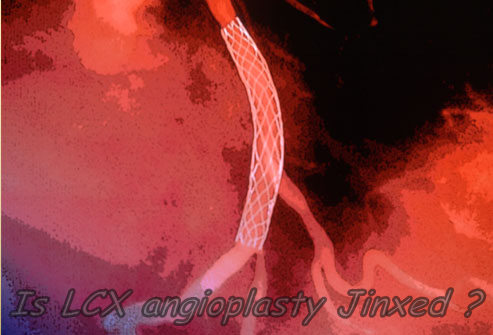
We frequently  hear  a comment  about  LCX angioplasty   being a  tricky intervention   . Even  many experienced cardiologists   do agree with this .

What could be the  apparent explanation for this seemingly important observation in cath lab ?

  1. The first and foremost is the anatomical  uniqueness of  origin and course of LCX. LAD is direct continuation of  left-main  , while LCX always  originate  with a  considerable angle at  it’s origin   . Further downstream  it flexes circum-ferentially over the lateral free wall of left ventricle .This  ensures  the  catheters and stents  we   maneuver often  traverse a hair pin bend  .
  2. The  endurance of  coronary stents are  put into biggest test during LCX angioplasty . While any mediocre metal stent can sit comfortably in LAD , LCX is different story altogether.(A flexible multi link  model  like that of Abbot Vision platform seems ideal . )
  3. The LCX wire crossing and exchange  is vested  with  potential  threat  to  the much important LAD circulation . Time and again , we have observed  ,  prolonged procedures  inside    LCX  some how compromise    the LAD  flow.
  4. Once the LCX is opened ( especially in  a CTO , ) there is a sort of   stealing  of LAD blood flow. We have witnessed this in  at least 2 patients , who developed  anterior  MI after opening up of LCX CTO. (Who  had a insignificant  LAD lesion )
  5. LAD may be widow maker artery ,  but it remains a fact  LCX   has much  more important role in regulating  mitral valve  papillary  muscle  . Even transient  ischemia  in  LCX territory can result in  lung congestion or even  flash pulmonary edema .This  is  fairly frequent during complex LCX angioplasty .
  6. The antero-lateral pap muscle is located in a critical location especially so in post infarct remodeled left ventricle  even minor degrees of ischemia can  create  a havoc .This is what   occurs during  flash  pulmonary edemas in LCX angioplasties.
  7. Spillover of thrombus from LCX to  LAD  can occur  during  aspiration  of   LCX  primary PCI
  8. Finally,   ECG  changes   are often blind in LCX territory . It remains an  Irony ,  we  do not monitor  the heart  with 12 leads during   sensitive procedure like a PCI.(The monitor leads easily miss LCX ischemia .This is hardly surprising,   as we know   LCX territory  has blind spots even with 12 lead ECG !)


Final message

It is  true LCX angioplasties can not be taken casually . One can not afford to have a prolonged procedure  within LCX.Whether dominant or not   LCX  delivers  blood supply  to more vital areas  of myocardium  that typically  includes lateral free wall and  mitral valve function .It is possible septal ischemia is  relatively well tolerated while free wall ischemia triggers an early mechanical deterioration .

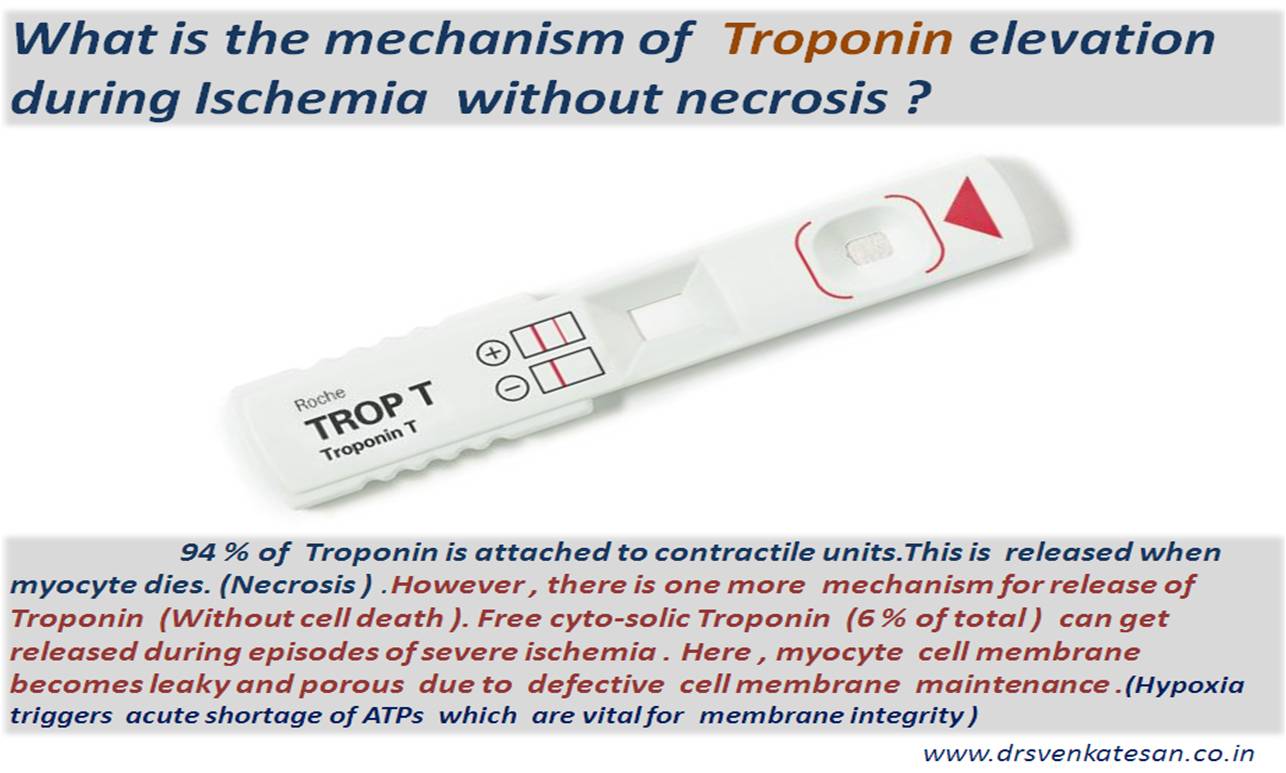
Does Troponin release during  Ischemia  ? (Without myocyte necrosis )

How often this happens ?   . Some believe , it is rare . Here is a possible explanation for it .I feel the mechanism is still not clear . It all depends upon the degree of ischemia.


It doesn’t make  news if  police arrest  Robbers , militants ,  or  Terrorists   ! Here is a shocking news !

Why should  a group  of nine cardiologists  ,   arrested from a scientifically advanced country like Italy ?

A news clip from the Forbes November 11th 2012 .

Nine doctors were arrested .  . .  12 device and pharma companies have been banned form entering Italy.

Reason  : They indulged in  inappropriate coronary  interventions which has caused fatal injuries .

Do you think these  cardiologist are  at fault   ?

I don’t know, any one has tried to differentiate the mechansims of dyspnea with reference to systolic and diastolic dysfunction .We have made some  observations  in certain group  of patients  during EST . I do not know how far one would agree  with this .

For  the same amount of  stress or work load persons with  systolic dysfunction  behave differently . However ,both will complete the activity but the onset and perception of dyspnea is slightly different in patients with predominant diastolic dysfunction.

Diastolic dyspnea (Dyspnea due to predominant diastolic dysfunction / HFPEF)

  • Delayed dyspnea .  It manifest  well after the exertion is completed.
  • It is more off a struggle to handle the venous return .The forward flow (Arterial circuit )  is relatively well toned and  tuned  and hence fatigue is rare .
  • Typically it has a prolonged recovery time .(? > 1-2 minutes )
  • Is it  less harmful  in terms of longevity ?  May be . . . since it is more related to physical  de-conditioning. Most of the physiological  episodes of dyspnea are probably  diastolic dysfunction  mediated .
  • Dyspnea that is triggered  in diastole is also dependent very much  on the  heart rate .If the heart rate fail to reach the baseline the recovery of dyspnea is also delayed
  • Some believe , physiological dyspnea should disappear within 30-60 seconds after termination of activity  .(Highly  arbitrary!)

The pressure volume loop in various forms of heart disease will determine the degree of myocardial stretch and the resultant dyspnea .Image source : http://www.1cro.com/medicalphysiology/chapter10/chap_10.htm

Systolic dyspnea (Dyspnea due to predominant systolic dysfunction )

  • Patients with primary systolic pump failure experience dyspnea very early into exercise  .
  • Much of dyspnea  occur during activity itself .
  • Exercising muscles show hypoxia  and hence  fatigue is conspicuous .
  • Recovery  of dyspnea is relatively immediate as the activity is stopped .Demand from exercising  muscle is  significantly dropped.
  • If the venous return is well handled by the ventricles the  recovery phase is more comfortable .

Summary

In primary diastolic dysfunction  ,the maximum stress  to ventricle occurs  when  the venous return peaks that usually happen in the exercising muscles , as they shed  vaso-dilatory  property  in post exertion phase .

Management Implication

 Fluid overload ,  Tachycardia   are more  related to diastolic dysfunction .(Beta blockers by prolonging  the diastole can , provide important relief of dyspnea in diastolic dysfunction (In HOCM patients   this action could be  more important that  the much hyped negative inotropism !)

Final message

Dyspnea is  a complex cortical  perception , influenced by filling pressure of heart, stretch receptor in lungs , respiratory and   exercise muscle . It is further impacted by number of biochemical parameters (Lactate/ O2 etc )

Of-course  , it could be a  far fetched  imagination to split dyspnea  mechanism with reference to cardiac cycle. Combinations  of both  systolic and diastolic dysfunction is the norm in many  cardiac conditions . However  , I believe  we need  more insight in the  pathogenesis of  this ,  “most important  symptom”   that emanate  from the heart .

Top 5 conditions that closely mimic and often mistaken for STEMI !

  1. Early repolarisation syndrome
  2. Left bundle branch block(LBBB)/ Left ventricular hypertrophy(LVH)
  3. Hyperkalemia
  4. Pericarditis
  5. Brugada syndrome

ERS

The repolarisation is due to  K + efflux . The  K channel porosity  is subjected to high degree of genetic  variations .If the repolarisation starts even by 10 milli- second earlier,  it would have early take off from descending  limb of R wave  and  the J point  ST segment appear elevated.

  • Common  in young  males . Especially in vago-tonic persons with relative baseline bradycardia
  • The ST elevation in ERS is often global .
  • Concavity is upwards .
  • ST elevation can be dynamic ( Further  confusing the picture ! )
  • On EST it  is expected to the  touch the baseline .
  • Benign entity in most . ( False alarm of STEMI is the major risk !)
  • There is some evidence ERS may confer a risk  of  primary VF ,  if they  experience a true STEMI  (Michel Haïssaguerre 2008  NEJM )

* STEMI in ERS :  The issue becomes too delicate ,  if  a  patient with ERS  develops  a true ACS .   ERS being a common ECG pattern in general population , it is not wise to label  every  chest pain in  ERS patient as benign . Suspicious  ones demand observation in step down units , at least !

LBBB

 “Any patient with  LBBB & chest pain . . . suspect  MI”  .

Unfortunately,  this rule is  too reverently followed by  physician community.  In fact ,  ACC/AHA guidelines  reinforced this behavior ,  as it  added a key word  in  their STEMI guidelines   “New onset”  or   “presumably new onset ”  LBBB is  an  indication for PCI/Thrombolysis    .( Physician presumption is a too delicate thread  to hang  our concepts !   )

               Every LBBB is new onset unless you have  a  documented proof otherwise  . . .   it seems to suggest !

Probably , this  is the reason many of the LBBBs are thrombolysed when they present to ER in an acute fashion . Of course , we can apply criteria of  Sgarbossa  to differentiate !  however flimsy it may appear . It  help us to exclude few benign LBBBs. Still ,  Sgarbossa will  struggle to  differentiate  an acute STEMI  in Chronic LBBB  from an  acute LBBB in  old AWMI .

Simply put . . . even old MIs  are at risk of  acute intervention if they have LBBB  and vague chest pain !

How to overcome this ?  Always rely on clinical  features  . If  STEMI is causing the LBBB ,  it  should be a large extensive one and you can not  expect the patient to be  comfortable .(Logic  would suggest necrosis of  large  parts of IVS is necessary to cause LBBB ) Chronic  LBBBs  are relatively comfortable  .

Of course , there  is one another  issue to comprehend  ie  transient ischemic LBBB .We do not know the true incidence  and long-term significance of this entity . Here , LBBB is  not due to necrosis of  the bundle but due to ischemia . (Almost impossible to differentiate it from  rate dependent LBBB  with  aberrancy  )

Role of enzymes and Echocardiogram in LBBB  and suspected STEMI .

You can always ask  for   Troponin  T / CPK MB .(They are helpful only  if 3 hours have elapsed , can we afford to wait ? ) . LBBB  due to STEMI  will  purge  a large quantum of cardiac enzymes from the infarcted zone . (So a marginal elevation is not going to help!)

Unfortunately,  LBBB  can induce wall motion defect in septum that may awkwardly simulate an ischemic wall motion. Even experts have erred in this . One clue  is,  the motion defects  can  not  extend   into anterior wall . It  is confined to septum ,the second clue  is a little delayed  post QRS  thickening of IVS (Septal beaking sign will vouch  for benign LBBB with fair degree of success  )

LVH

  • LVH can mimic a STEMI due to secondary ST/T changes . (Secondary to tall R wave )
  • LVH with incomplete LBBB  – A very common association that can further elevate ST segment in v1 to v3 .
  • Left ventricular hypertrophy  mimics old MI as poor R wave progression in V1 to  V3.
  • Contrary to our belief even Inferior  leads can  show q waves due to  inferior  septal hypertrophy.

Hyperkalemia.

With aging population and rampant  acute and chronic renal disorders it is becoming  a daily affair to get calls from medical units for ECG changes .We know  the rapidity of  efflux  potassium is responsible for ventricular re-polarisation .Phase 2, and 3 are K + exit zones. This is the same phase ST segment and T wave are inscribed.In hyperkalemia  K + accumulates inside the cell and keep  ST/T  segment  elevated .T wave also  becomes tall . It can mimic  both as hyper acute  STEMI .

Read a related article (Dialyisable current of Injury )

Pericarditis

  • ST elevation is not confined to an arterial territory
  • Can be global .(Regional ST elevation  does not exclude pericarditis)
  • ST elevation is concave upwards as in ERS

Link to Read regional pericarditis
Brugada syndrome

Brugada syndrome  is  an ECG -Clinical complex in which ST elevation in pre-cardial leads is associated with  ventricular arrhythmia. The defect lies in sodium channel . It reflects  a mis -match between RV and LV epicardial repolarisation forces .It keeps the RV epi-cardial current afloat and  the pre-cardial leads  facing the RV records ST elevation that  mimics  STEMI. It often  shows  a RBBB pattern and varying patterns of ST morphology  . The  ST segment is  also  subjected to dynamism  , due to change in autonomic tone and myocardial temperature  .(Febrile VTs)

After thoughts

Other close contenders for the top 5 slots

Myocarditis

Acute pulmonary embolism

Dissection of aorta

More

  • Acute stroke (Neurogenic ST elevation )
  • Stress cardiomyopathy (Takot Subo )
  • Acute abdominal conditions mimicking inferior STEMI.
  • Panic attacks /Anxiety states / chronic anti psychotic  medications which are known to elevate ST segments.
  • Contusion chest

(Cocaine hearts / Coronary arterial spasm / LV dyskinetic segments  and  LV aneurysms  were not nominees ! )
A young man with   VT  (LBBB morphology ) and  apparently normal heart by   echocardiogram  is  a  real  diagnostic challenge .
Here is a comparison  of  the two  closely mimicking  entities. RVOT VT and ARVD .
Please note -Micro reentry and triggered activity  are very closely related cellular evens. For all clinical reasons there is generally no purpose in differentiating the two.

*Please note -Micro reentry and triggered activity  mimic each other at the cellular level . For all clinical reasons there is generally no purpose in differentiating the two.

*RVOT- Right ventricular outflow tract. ARVD/ARVC -Arrhythmogenic  right ventricular dysplasia /cardiomyopathy

(Caution : RVOT vs ARVD  -In  the traditional medical teaching system , we are often taught to differentiate  two closely related  entities.Our brain also loves to look things in either black or white . Realise , medical science always brings  surprises . There can be significant overlaps between the very entities we want to differentiate.Bear that in mind)

Reference

1. Hoffmayer KS, Machado ON, Marcus GM, Electrocardiographic comparison of ventricular arrhythmias in patients with arrhythmogenic right ventricular cardiomyopathy and right ventricular outflow tract tachycardia. J Am Coll Cardiol. 2011 Aug 16;58(8):831-8.

2 .Ainsworth CD, Skanes AC, Klein GJ Differentiating arrhythmogenic right ventricular cardiomyopathy from right ventricular outflow tract ventricular tachycardia using multilead QRS duration and axis. Heart Rhythm. 2006 Apr;3(4):416-23.

T wave inversion in V1 TO V3 for diagnosing  RVOT VT .

3.Daniel P. Morin,  Andreas C. Mauer, Kathleen Gear, Usefulness of Precordial T-Wave Inversion to Distinguish Arrhythmogenic Right Ventricular Cardiomyopathy from Idiopathic Ventricular Tachycardia Arising from the Right Ventricular Outflow Tract .Am J Cardiol. 2010 June 15; 105(12): 1821–1824

A truth about half truths!

Arthur  Garson  explores further  .  Click on the Image to get a sample page from Amazon

Acute coronary syndrome is the number one cardiac emergency .In any coronary care unit there are vital differences  between men and women in terms of ACS presentation and outcome . Though there can be variation in ethnic , geographical   factors .The following is   an observation  from one of the Asia’s oldest  and  largest coronary care unit over a period of 40 years . (Madras medical college Chenna ,India )

There is  very significant gender advantage in the incidence of ACS. The male female ratio is consistently around  4: 1 .This Indicates for every day , men suffer from ACS  by four  fold more .This is a very hard data can not be ignored . Women present to the hospital much later than men .This may be due to increased tolerance of pain, social issues  waiting for their spouse to arrive etc

  • There is a  significant  difference in the pattern of ACS in men and women . Men present with STEMI  and women present with more of NSTEMI . In  NSTEMI  the gender ratio is dramatically equal 1 :1 .
  • Explosive chest pains are less common in women .
  • For some unknown reason  diabetes  afflicts  women with a  greater ferocity  !
  • Similarly  it appears  obesity and dyslipidemia has more significance in women
  • Sudden cardiac death and primary VF is many fold less common in women.
  • Mechanical complications like mitral regurgitation and ventricular septal rupture are several fold higher in women (Weak muscle low muscle mass ?)
  • Thrombolytic success is slightly lower in women than men .
  • The overall outcome in ACS is same as men .Some say women fare  worse  .This is important because while they are protected heavily against development of CAD once they develop it  the outcome seems  exempted  from the gender advantage .The reason for this is not clear

Final message

Women show their  unique way   in ACS  too ! Some   of them are  true  advantages  while  few are disadvantages .The mechanism for these differences  can not be entirely attributable to presence or absence of  estrogen . The hard fact is ,  women always score over men in the tolerance levels and  deal effectively stress situations .  It would appear Women’s body   easily nullify adrenergic triggers .

Reference

Reference less cardiology .

This was question thrown at me ,  in one of the  patient -physician meet .

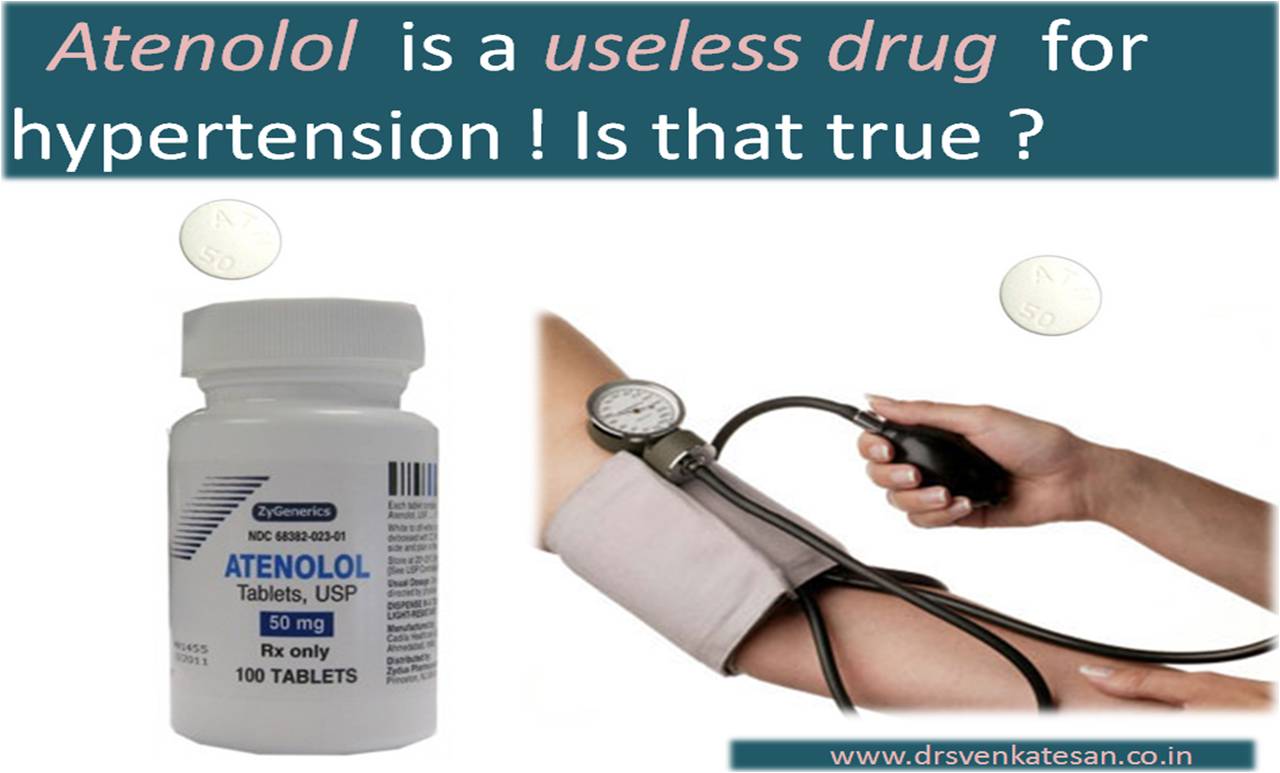
“I am a 58 year old business man . I am taking tab Atenolol 50mg for over  6  years .I am comfortable with that .My  BP hovers around 130 /80 mmhg .My heart rate is 64/mt . I have recently  moved to a popular city in south India  . Now , my cardiologist thinks Tablet Atenolol  for hypertension is useless  . . . what do you say sir ?

My answer went on like this  . . . causing much  displeasure  to my  colleagues !

Atenolol  is a  wonder drug for management of both hypertension and angina for more than 2 decades .  It is  still useful in majority of patients with HT .

The reason for  current generation of cardiac physicians   shunning  away  from this drug  is  largely  for  non academic reasons . A drug which is  in market for more than  a decade ,  generally becomes a generic one. Generic drugs are  like  orphan drugs !   and patients  who consume generics are inferior ones .This is how market economics want us to think .

Physicians are sincere followers of  science and science is not sacred ,  often times  . . .  it is the creation  of   corporate gimmicks .

Few small  studies ,  one major publication  , few guideline   from  influential    scientific bodies  , cocktail of   seminars  , symposiums   all that  is required to disseminate  a concept !

The second major reason is every physician wants to behave in unique way . He fears loosing  his prestige and  charm  if  he  continues the same drug prescribed by another physician  . Many patients also do not like to continue the same drug for long time  !

And now a few words for the cardiac scientists !

*The concept of central aortic pressure and beta blocker’s lack of control over it are all concocted .Beta blocker is most powerful agent to reduce the shearing stress in the walls of aorta . We know that and we believe in that and we prescribe it for aortic dissection to attenuate the intimal tear . Can it do this  . . . without lowering central aortic pressure ? Think for a moment !

Atenol and Metoprolol : The curious  companions .

Both being   closely related beta blockers ,  what makes  Atenolol  to be frowned  upon   and  still   Metoprolol  is  alive and kicking  !

 My final answer to your question !

Atenolol is still useful in the management  of HT. If your BP is well controlled ,  and you have no side effects,  there is absolutely no need to change  the drug   . . .  if  you are  insisted  , you may consider  changing  your doctor   . . . . . .  rather !

The  commonest  cause for death in massive pulmonary embolism is 

  1.  RV shock
  2.  Massive Hemoptysis
  3. Primary VF   originating  right ventricle
  4. Refractory Type 1 Respiratory failure

Answer : 1  .(RV shock , RV standstill and RV , RV stunning  is the unequivocal  cause for sudden death in pulmonary embolism . This RV shock occur very early .Once the patient survives the initial  RV scare (say 24-48 hours) usually do well if prompt thrombolysis and anti-coagulation is administered  )