Feeds:
Posts
Comments

Posts Tagged ‘acc aha’

Contrary to popular belief ,great things happen only rarely in medicine . It takes  only  few  months of  training  or  workshops ,  for a  wrong or inappropriate concept  to  percolate  our  brains !  But , it  would require,   decades  of  time , energy  and  efforts  ,  for  correcting  that  wrongly  assimilated concept  in medicine !

Interventional cardiologists are  among the  rare breed of physicians,   who always believe in evidence !  But ,  the quality of  the  evidence  is rarely questioned  !  30 years of PCI  & 20 years of stenting has failed  our  common senses ! Fortunately , today,  we have 135 pages of new evidence ( Not really new , old evidence interpreted with  sound logic !)

Hats off to ACC and associates for bringing out this much belated appropriateness guidelines for the interventional cardiologists.

ACCF/SCAI/STS/AATS/AHA/ASNC 2009 Appropriateness Criteria for Coronary Revascularization

A Report of the American College of Cardiology Foundation Appropriateness

Criteria Task Force, Society for Cardiovascular Angiography and Interventions,

Society of Thoracic Surgeons, American Association for Thoracic Surgery,

American Heart Association, and the American Society of Nuclear Cardiology

Endorsed by the American Society of Echocardiography, the Heart Failure Society of America, and the

Society of Cardiovascular Computed Tomography

Click here to get guidelines

http://circ.ahajournals.org/cgi/reprint/CIRCULATIONAHA.108.191768v1.pdf

If you don’t have time to read the entire document (135 pages  )

Just remember only one point

Common sense,  more  often  prevails  over  evidence ,  in medicine . Apply it  , frequently  in your patients .They will reep the benefits !
Read Full Post »

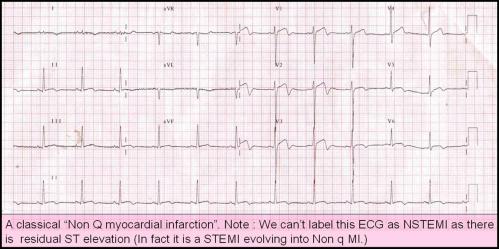
                                Acute coronary syndrome (ACS) is currently classified as STEMI and NSTEMI.This classification came into vogue  primarily to  triage patients for thrombolysis eligibility , as ST elevation is the  only criteria for thrombolysis.The  earlier term  non q MI  is largely used  to denote the  present day NSTEMI. In the past q  MI was referring to transmural MI non q MI  to non transmural  pathologically.(Of course , now we know  the relationship between q waves and transmurality is not good )

So when can we still use term non q MI ?

These terminologies of STEMI and NSTEMI are made on admission  at the emergency room.  ACS being a dynamic entity these  patients can  have rapidly changing  ST shifts , from depression to elevation and vice versa. Fresh T wave changes can also occur .Q waves  may or may not develop ,  depending upon the damage sustained to the myocardium and the efficacy of thrombolysis / PCI. So it should be emphasised here STEMI,  NSTEMI ,  q  MI ,  non q MI are the  descriptions of the  same group of patients in different time frames. The common mode of  evolution  of  STEMI  is  to q MI and NSTEMI  into non q MI. Cross overs can occur.


 The problem here is NSTEMI getting converted into STEMI  is quiet common and has no nomenclature issues . But  when   STEMI down grades  into NSTEMI  there is apparent  nomenclature incompatibility .This category of  patients have  no other labelling option other than “A STEMI evolving into non q MI”. Because one can’t label  STEMI  evolving into NSTEMI as  many of  them  will  have a residual ST elevation as well.

What is the final message ?

The term non q MI is still relevant and is used at discharge , in a patient with STEMI when he or she evolves without a q wave .In the setting of unstable angina , NSTEMI has largely replaced  the term  non q MI either on admission or at discharge.

Before I close

                 The important point to remember here  is NSTEMI getting converted into STEMI  is an adverse outcome and  in fact, it is  a complication and the patient should get an immediate  thrombolysis or PCI , while a STEMI getting converted into non Q MI is generally a  major therapeutic success.( Effective salvaging and preventing q waves )

//

Read Full Post »

« Newer Posts
