Feeds:
Posts
Comments

Posts Tagged ‘cabg’

                                Coronary artery  by pass graft surgery has become the most common cardiac surgery done world over ever since it was first introduced by Favalaro in 1969.The common indications  are, triple vessel disease and left main disease in any of the following situationsE.

Elective CABG(Non emergent)

1.Chronic stable angina

Either emergent or elective

1.Unstable angina

Emergency CABG*

1.Acute myocardial infarction.-Cardiogenic shock

2.Failed thrombolysis

3.Failed primary PCI

4.Complications during routine PCI(Cath lab crashes !  etc)

5.As an associate procedure after a  mechanical complication during MI (Septal rupture, Acute MR etc)

*In emergency situations even a single vessel disease would require a  CABG

Hybrid CABG

Combining CABG and PCI in the same patient is followed in very few centres .(Example LAD graft and RCA angioplasty)This is done in patients who have co morbid conditions who can not tolerate prolonged surgical times.Further there can be situations  one lesion is very ideal for PCI  while for other grafting is the only solution.

Controversial CABG

1.CABG as a primary revascularisation  in STEMI*

(Rarely done now , almost obsolete , primary PCI has almost replaced it  . . . but it is still  useful if performed within 6 hours of MI )

2.Incidentally detected CAD*  following routine coronary angiogram.

( *CABG for incidentally detected asymptomatic CAD is  increasing in many parts of world )

Inappropriate CABG

         If it’s triple vessel disese it must be CABG -CASS study (1980s)

                       Coronary artery surgery study (CASS) still has considerable influence among the  cardiology  community in the decision making process  for CABG , even though it is many decades old .There has been a phenomenal development in both medical as well as interventional techniques since  CASS . (Thrombolysis, Statins, ACEI, PCI  DES to name a few) .

                     When CASS study was done many decades ago,it was believed triple vessel disese constitute a  homogeneous population and  carry  the same clinical significance . For example a 90% proximal LAD , 50% RCA and 50% OM technically qualify for a CABG and unfortunately , some of them are  subjected to it even in  2008 !  Now we clearly know, it is not the number of diseased vessels  that is important, but it’s location, severity , LV function, presence or absence of diabetes . Finally , the presence of revascularisation eligible myocardium must be documented in all post MI patients . (Technically referred to viable & ischemic myocardium ).              

              Currently , with the  PCI  & medical management has grown so much, CABG should be reserved only for, critical triple vessel disese , with at least one proximally located lesion (Mostly  LAD  or Left main ), especially in diabetic individuals.
Read Full Post »


Chronic renal failure and CAD are common companions.Severe CAD  in patients with renal failure  pose an imposing task on the treating physicians.CABG  and kidney transplantation  both are major interventions.When a patient  requires both the decision making becomes much more difficult.

The possible  choices are

A. Do CABG first follow it with renal transplant .

B. Do  renal transplant first follow it with CABG.

C. Do CABG first  and  defer transplant &  advice life long dilaysis

D.Do  renal transplant and offer medical management / PCI for CAD if feasible.

E.Simultaneous CABG & renal transplant is a remote possibility .

F.In terminally ill , combined cardiac and renal transplantation is the ultimate option. (Possible in very few centres in the world)   

G.In severe co-morbid condtions avoid both and support life. Success is not in completing   the procdeures but in providing useful life !

Among the options the most prefered worldwide is option no 1. This has a caveat. If angina is dominant  CABG should precede transplant. If cardiac failure is dominant the issue need further scrutiny.

Given a situation ( DCM & End stage renal disese) , your patient could  undergo only one procedure,  which will you prefer ?

              This again is highly emprical but logic could still be applied. Never do  CABG with a sole  aim of improving severe LV dysfunction in ischemic DCM .It happens only in  journal articles & major clincal trials!.Of course mitral valve correction and LV reduction surgery might help.But in a patient with  renal failure prolonging the CABG on table time , with add on surgery is highly risky. So it would be logical to think intensively  for  postponement of  the CABG in a patient with class 4 cardiac failure and renal failure. Do only the transplant .

 What is the impact of end stage renal failure  on LV dysfunction ?

 End stage renal failure has a great adverse impact on LV function. Many times it is reversible.We will never ever know, if you do a CABG first on them. So always think twice or even thrice before voting  on this vital issue . Correction of renal impairment can improve the cardiac status dramatically in some.

Read Full Post »

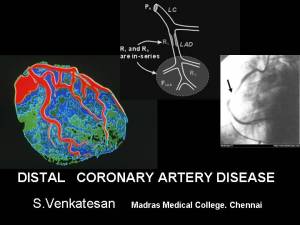
Coronary artery disese  predominantly  occur in the proximal segments of coronary artery.The fact that CAD is mainly a proximal disese , implies  that  clincal impact is likely to be more . But we now recognise distal coronary artery system is equally affected .But isolated distal CAD  is a not a common finding .We describe our analysis on the topic .

distal-cad-csi-2005

Click on the slide to download

Read Full Post »

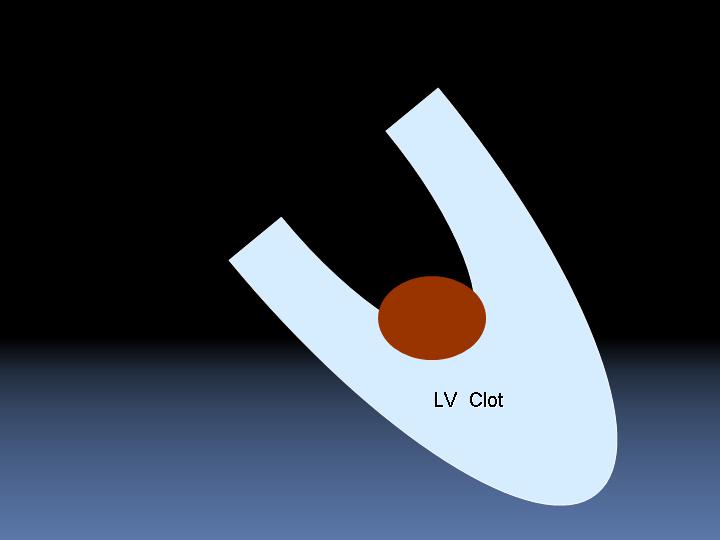
LV clot formation is one of the important complications of acute myocardial infarction. Preventing this is difficult and managing this problem is still more difficult.Some of these clots are linear and laminar along the shape of LV apex and carry less risk of dislodging.

 While mobile LV clots , even if it is small can cause a embolic episode. Most of these patients have a significant LV dysfunction and they are candidates for early CAG and revascularisation. Even If the coronary anatomy is very ideal for a PCI these patients are often sent for CABG and physical removal of LV clot . If  only ,we have an option to remove these LV clots by a catheter based modality, we can offer them a totally non surgical cure.

This is not impossible,  considering  we are in the era of percutaneous implantation of prosthetic valve in Aorta ! The only issue is potential embolism into carotids and periphery .A temporary distal protection at the level of aortic root will prevent that .

Device companies shall produce one such exclusive catheter system to remove LV clot.

Dr .S.Venkatesan, Madras medical college, Chennai,India

Read Full Post »

« Newer Posts