Feeds:
Posts
Comments

Posts Tagged ‘ep study’

A 32-year-old high-profile businessman was advised Holter monitoring for a few ectopic beats during routine screening ECG. The 72-hour extended Holter monitoring picked up a single short pause with a blocked P wave and reported as doubtful Mobitz type 2 AV block.
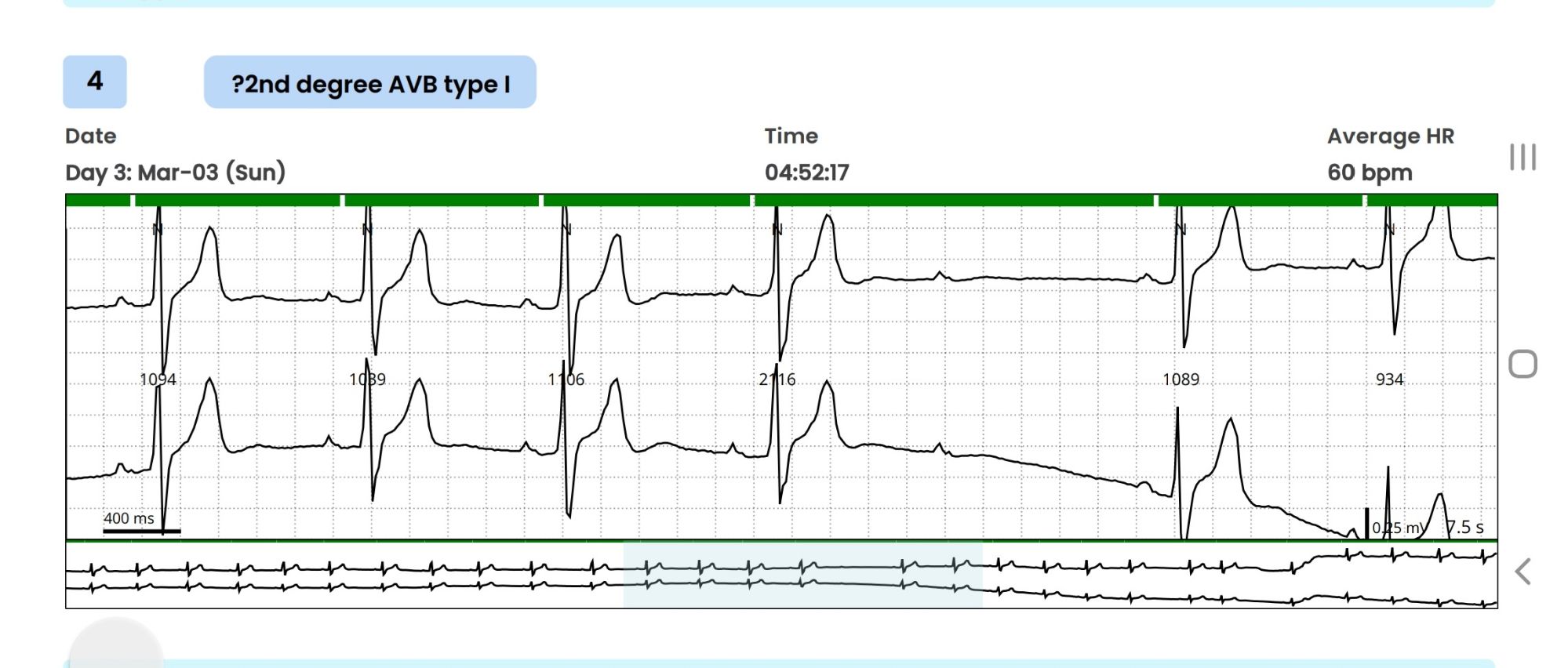
The cardiologist in-charge, told the patient that findings are significant, and he would need further investigation. He was referred to their associate center for an EP study. After hearing about the procedure ,the patient was freighted about inserting multiple catheters inside his heart.

This was the time he consulted me with Holter report. It was indeed a missed QRS after a well inscribed p wave , recorded at 4.57 AM, It is a 2nd degree AV block, may be Mobitz type 2, . What if ? It could still be be blocked atrial ectopic. (Pseudo AV block) Both preceding and following PR intervals seemed to be non varying . The following QRS was narrow. I don’t know, whether a single blocked P could by any way a concealed Wenke -Bach. I didn’t have calipers to measure the PR accurately though. The baseline heart rate was around a vago-genic 60/mt, that was comforting . He had his echocardiogram done already and was normal.

What does the guidelines say ?

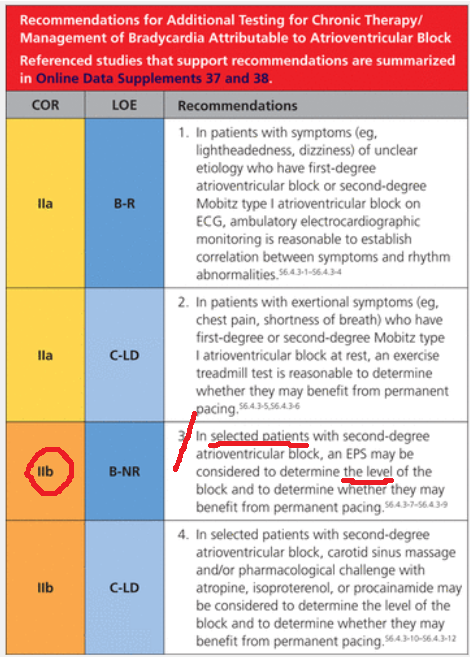
Guidelines are short of evidence , it was as vague as my thought process . It suggested EP study in selected patents with asymptomatic second degree AV block . My fellows tell, it is just 2B indication (To-be frank, 2-B indications should be called as a junk recommendation ) which would mean if you wish you can do a “potential harm”

I asked the patient two questions.

1.Does he have any symptoms like dizziness or syncope ?

Absolutely nil.

2.What is his functional capacity?

Excellent.

That’s great. Within a minute or so , I could confidently confirm, the non-seriousness of the Holter tracing. I asked him to forget everything, and sent him home, with reassurance, taking on myself a miniscule risk of missing a true AV block and its consequences. He thanked me profusely with so much gratitude. Every thing was hunky-dory , then , this thing happened. When he was above to leave the office, he came back. “Doctor, I forgot to tell, my father died suddenly at the age of 48 apparently by a heart attack” .I must admit, I was taken aback the moment he told this.

What an important past history, I failed to elicit earlier. As he left my room, I called my secretary to give a Suo-moto appointment to him 2 weeks later with a plan of TMT and possible CT -angiogram. Till late in the evening, this patient’s Holter recording ran in my mind. What was that reason for original VPDs that invited a Holter test and the subsequent documentation of Innocent appearing AV block ? Are they interconnected or inherited ? or Is it really Ischemic ones, that took his dad’s life?

The concern amplified, when I recalled about a review in EURO-PACE journal , that showed mutations of almost every structural sarcolemma proteins like Desmin and Desmoplakin can present with isolated electrical defects with or without LV dysfunction.(Brandão M, Desmoplakin Cardiomyopathy: Comprehensive Review of an Increasingly Recognized Entity. J Clin Med. 2023 )

Leaning on EP’s shoulder

That was enough for me to make a compelling call to my EP colleague, for a quick chat about this unique patient. We discussed for 15 minutes, right from Padua University paper to all the Brugada variants.(Ref 3) In the end, the basic doubts remained as before. However, the patient was advised for an EP study primarily to know the HV interval and the possibility of diffuse distal disease. The possible need for a MRI study to rule out silent arrhythmogenic intramural granulomas was also discussed. My EP friend poked me with more academic toxemia. He said a screening test called cardiac-arrhythmic genome analysis is available in certain European centers. Ref: Isbister, J.C., Semsarian, C. The role of the molecular autopsy in sudden cardiac death in young individuals. Nat Rev Cardiol 21, 215–216 (2024).

I said enough is enough , and requested for hanging up the chat.

Final message

AV blocks, even Mobitz type 2, can occur at normal times of heightened vagal tone.(Massie Block-Ref 1) But, if there is something unusual in the clinical history, be ready to investigate until the arrhythmia, or at least the anxiety disappears.

Reference
1.Massie B, Scheinman MM, Peters R, Desai J, Hirschfeld D, O’Young J. Clinical and electrophysiologic findings in patients with paroxysmal slowing of the sinus rate and apparent Mobitz type II atrioventricular block. Circulation. 1978 Aug;58(2):305-14. doi: 10.1161/01.cir.58.2.305. PMID: 668079.

2.ROTONDI, F., MARINO, L., LANZILLO, T., MANGANELLI, F., & ZEPPILLI, P. (2011). Prolonged Ventricular Pauses in an Asymptomatic Athlete with “Apparent Mobitz Type II Second-Degree Atrioventricular Block.” Pacing and Clinical Electrophysiology, 35(7), e210–e213.

3.Graziano F, Zorzi A, Cipriani A, De Lazzari M, Bauce B, Rigato I, Brunetti G, Pilichou K, Basso C, Perazzolo Marra M, Corrado D. The 2020 “Padua Criteria” for Diagnosis and Phenotype Characterization of Arrhythmogenic Cardiomyopathy in Clinical Practice. J Clin Med. 2022 Jan 5;11(1):279. doi: 10.3390/jcm11010279. PMID: 35012021; PMCID: PMC8746198.

Read Full Post »

Echocardiography is an imaging tool . Can it  be used as a non invasive  EP lab ?

Heart is an  electromechanical organ . For every mechanical activity there must be a electrical event preceding it . So, when we analyse the cardiac contraction and relaxation it indirectly provide us clues how the electrical activity spreads across the heart.

The concept of using echocardiography for diagnosing cardiac arrhythmias have never been popular for the simple reason we have a cheap and best modality : The ECG.  But, it  does not give us the temporal relationship with the cardiac contraction. When these two are combined it can be a really powerful tool to analyse many cardiac arrhythmia.

  • In fact ,  for every brady and tachyarrhythmia there has to be an unique pattern of IVS motion and mitral , tricuspid valve movement.
  • Almost all bradycadias can be diagnosed with echocardiogram by virtue of analysing the timing of  atrial vs  ventricular  contraction.
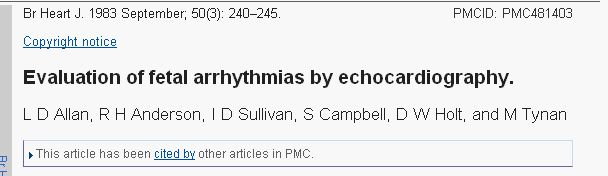
  • We know echocardiogaphy is the only modality available to diagnose fetal cadiac arrhythmias.* (How can  this modality becomes useless when the baby comes out of the mother’s womb  !)
  • Apart from this there is an  unique use for echocardiography to locate accessory pathway in WPW syndrome

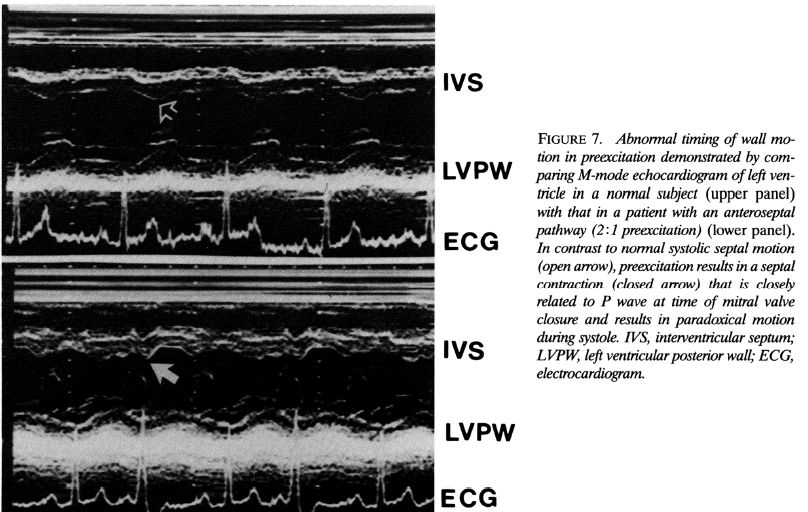
The premature contraction of LV can be seen in few as  an early systolic dip in IVS movement -Type B WPW.

Image courtesy :  Helmut F. Kuecherer Circulation 1992;85:130-142

Abnormal jerky movement of LVPW indicate left accessory pathway -Type A WPW

Newer modes of echo like tissue doppler will improve the phase analysis of tissue motion and may provide us accurate information about preexcitation

Final message

The future looks bright . Time is not  far off . . .  where ,  we shall  use ultrasound as an adjunct  EP  study .

Reference

*Fetal Echo  =  to  Fetal electro cardiogram

WPW syndrome

http://circ.ahajournals.org/cgi/reprint/85/1/130.pdf

http://content.onlinejacc.org/cgi/content/full/33/3/782

http://www.heartjnl.com/cgi/content/full/82/6/731

Read Full Post »

  • It is only rarely a journal of International caliber is published from India . IJEP is one such journal.
  • Cutting edge articles on Electrophysiological science  break here !
  • This is an online journal . No print issues . Enjoy, it is free !

Here is the  Link

Just sample an article  : A great review about cardiac arrhythmias in congenital heart diseases , Must read by  all cardiologists    http://www.ipej.org/0906/khairy.htm

Read Full Post »

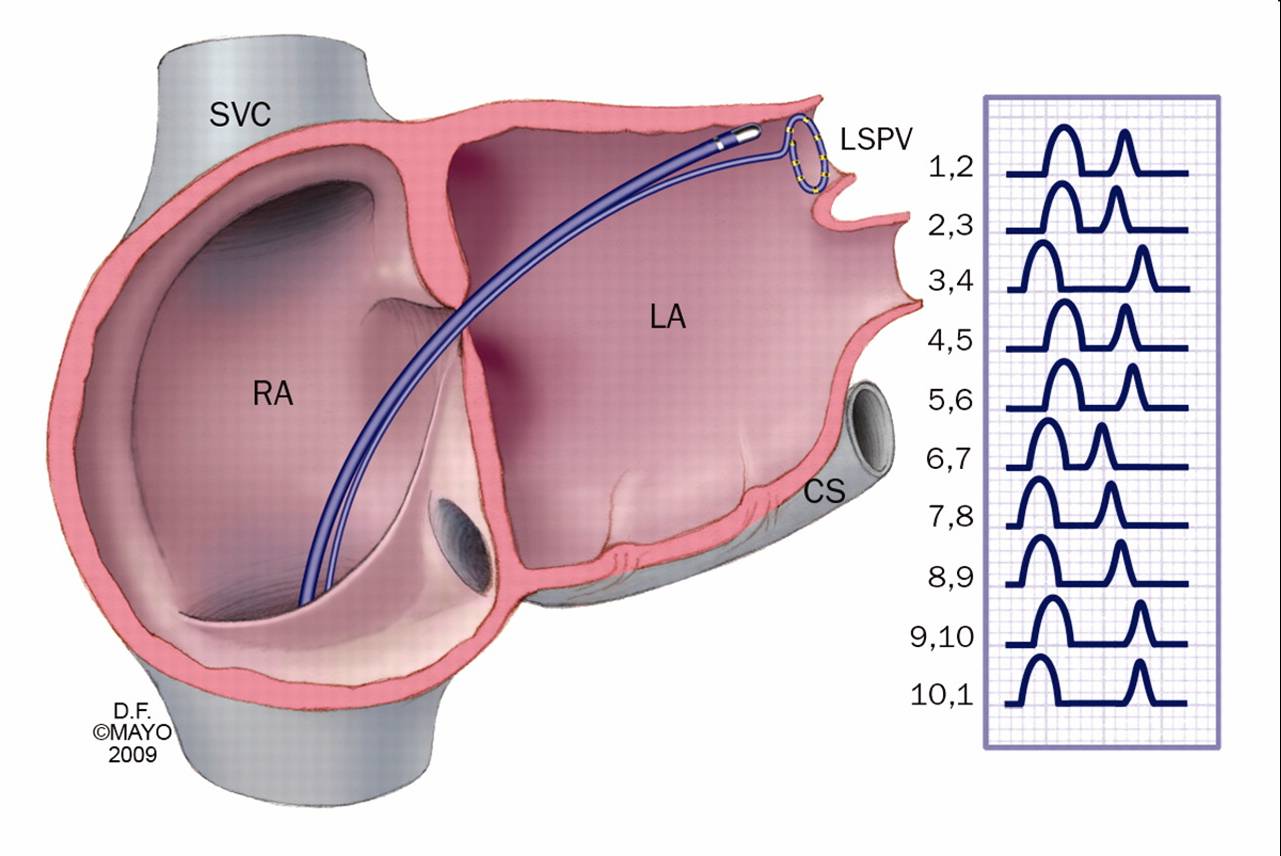
This is a real life experience of  a patient who underwent a electrophysiology study and   ablation   procedure for atrial fibrillation  .The blog describes  how the procedure became a nightmare .Written in a  most  readable fashion .  Interventional cardiologists need  not get hurt by this  narration  instead  they should  do a  reality check on the dangers  of  the some  of the  complex  procedures !

Adventures in Cardiology

Click over the  image to  read the real  time experience of   Pulmonary vein  ablation

Image courtesy Mayo clinic

The message from the above story  :

  • Atrial fibrillation is  one of the  relatively  benign  cardiac arrhythmia , that  can be treated  with   simple and effective  drugs . Now we have strong evidence to say rate control is equally , if not more effective than the rhythm control  modalities .
  • The RF  ablation  , which aims at rhythm control  is a too complex a procedure with  lots of expertise  technology  .
  • This should be  reserved  as a last resort  in an occasional patient who had exhausted all other  options .
  • Patients should  realise ,  the consent forms they sign  before any new and innovative  procedure is always  incomplete and  he may be the first person to experience  a new complication  hitherto unreported .
  • A cath lab is run by a team ,  you can’t  expect  the chief doctor to be on your  side always.   Many of the procedures  are  done by either experienced or inexperienced  fellows . That’s  only the  way medicine  can be practiced !
  • So beware all patients , many times, modern medicine is nothing but  experiments on live humans  !


Read Full Post »

Wide qrs tachycardia has a unique place in clinical electrocardiography .It is  a much fancied and glamorous entity for the simple reason , it continues to be the  cardiologist ever solved puzzle .For over three decades of research, clinical debates , symposiums , seminars have effectively failed to take away the uncertainties in decoding the wide  QRS  tachycardia . (Specifically ,  VT vs SVT with aberrancy)

Some wondered , should we really waste our efforts in differentiating the two . In emergencies it never matters , in fact one need  not attempt to do this often futile exercise !

Few dedicated criterias like Brugada etc have helped us .

While the difficulties in differentiating between VT and SVT with aberrancy remain over the decades .A less reported  , but more common issue is  confronting  us .

It is  the big question of  differentiating a  wide  QRS tachycardia from a narrow QRS  tachycardia

wide qrs tachycardia vt svt aberrancy

This  occurs  more often than we realise  ,because we define wide  QRS  tachycardia in a vague manner

  • Normal qrs width between Up to 80 / up to 100 ms acceptable  ?*
  • Narrow qrs tachycardia 80 ms?
  • Wide qrs tachycardia i> 120ms  ?
  • Definitely wide qrs >140msec

* The confusion is mainly because 20ms difference between limb leads and chest leads .

In reality one may not be able to all  tachycardia into narrow or wide .

There is big  overlap zone that need to be labeled a intermediate qrs tachycardia

If we can  triage the tachycardias into three instead of two it may help us arrive  fast  ,  to the  correct diagnosis

Narrow QRS tachycardia ( qrs 80ms)

  • Sinus
  • All svtS (avnrt etc)

Intermediate QRS tachycardia 90-120

  • Most of the SVT with  aberrancy  ( Except antidromic SVTs which are really to wide !)
  • Septal VTs*
  • Fascicular VTs*
  • VT in PPM and ICD /CRT patients **

*  Any VT that arise near the major conducting system of ventricle conduct  fast and hence qrs are relatively narrow.

**These are rare entities where  base line wide QRS getting narrower with the onset of VT . (Ref : http://europace.oxfordjournals.org/cgi/content/full/eun254v1)

Wide qrs tachycardia >120ms

  • Most of the genuine VT (Ischemic , myocardial origin)
  • Post MI VTs
  • SVT aberrancy especially AVRT
  • Any SVT with preexisting BBB
  • Marked electrolytic disorders

Unresolved questions

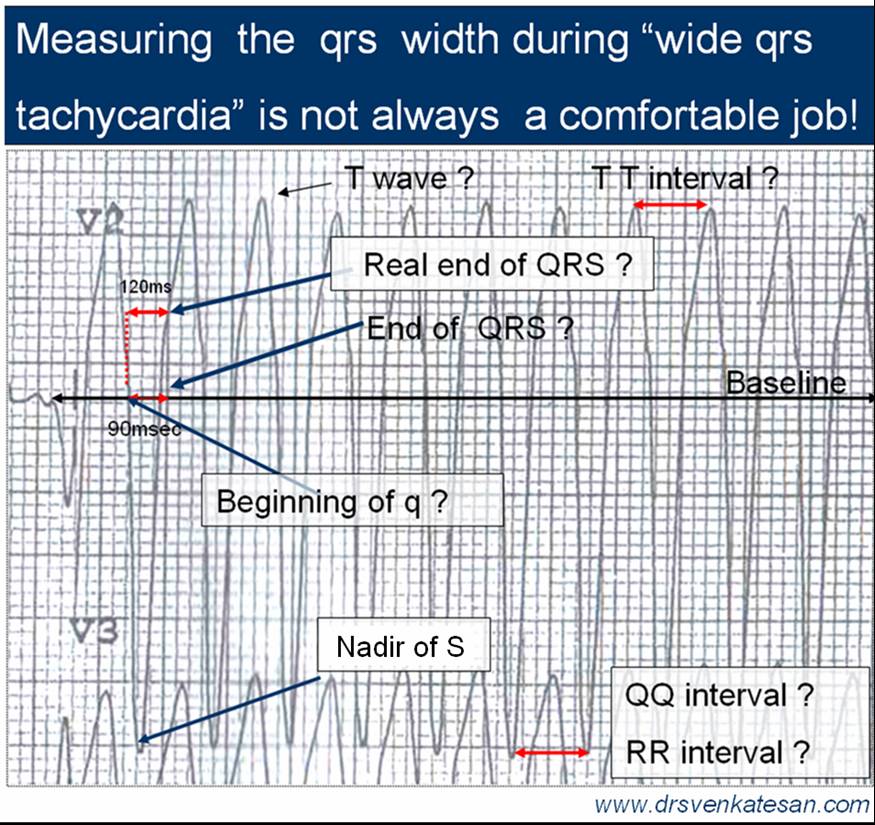
  • Which lead we should look for measuring the width of qrs ?
  • Should we take the narrowest qrs or widest qrs or should we take the average ?
  • Should we calculate how much the tachycardia has widened the qrs from the baseline  width of a given patient ?  Is it not possible , what is wide for some may be normal for another !
  • If  there is no isoelectric line  and ST segment  blends with qrs complex  how to mark end of qrs ?
  • If  limb leads show a narrow qrs and chest leads shows  wide qrs what is the significance  ?
  • In precardial leads  if one lead alone shows a narrow qrs , what is the significance ?
  • Can a narrow qrs VT conduct  with aberrancy and making it  really  wide ?

Final message

When we are  able to solve   complex electrophysiological  problems  , we must also realise  even   simple  tasks can be demanding in medicne ! It is proposed to create a  new  group “Intermediate QRS tachycardia “that can help solve the issue where we have difficulty in labeling these  tachycardias which fall  in the  greyzone .We can try &  apply the modern EP based VT criterias  to this group and find out the hidden truths !

Read Full Post »

                                         Ventricular  tachycardia is considered as a dangerous electrical rhythm abnormality .It can immediately degenrate into ventricular fibrillation and result in SCD in many.Ironically, it is also a fact , a patient with VT can  present silently  without any symptom  .Some VTs are slow and recurrent without much affecting The hemodyanmics.


In chronic recurrent, beningn VT (Some may consider it , ” height of  absurdity ” to call a VT beningn ! but it  is a reality , the term beningn denotes –  very remote chance of converting into VF) ” Is there any other therapeutic option other than convertng into sinus rhythm. “(  Read related topics)


The following paper was presented in the Annual scientific sessions of  Cardiological society of India,  Kochi , seven years ago in  2002


VENTRICULAR RATE CONTROL  IN  VENTRICULAR TACHYCARDIA 

S.Venkatesan,,. Madras Medical College. Chennai


                           Mangement of  hemodynamically  stable  recurrent   ventricular tachycardia  remains a  delicate clinical problem. Reverting to  sinus rhythm  is  considered as  the only aim  of  treating  VT.While rate control is accepted as a therapeutic  option  in atrial fibrillation,  it is not  so,  for  ventricular tachycardia.In this  context  we attempted to analyse  the effect of  Amiodarone on   ventricular  rate  in stable ventricular tachycardia  which fail to convert  to sinus rhythm.


                            The  study cohort consisted of 49 patients with stable VT  who were admitted in the coronary care unit  of  Govt. General Hospital  between 1998 to 2002.The criteria for inclusion   were systolic BP>100mmHg and absence of  hypoperfusion of vital organs  The mean age was 52 years (range 26-68)  with a male female ratio  of 4:1.   Of the study group 36 patients  were either reverted with  IV lignocaine , Amiodarone ( 150-300mg   bolus )  or  DC  cardioversion . 13  patients  who did not respond to   either of these   were  followed up  with  Amiodaroneinfusion(1000mg)  for 24 hours.  The baseline  diagnosis were old MI (6)) DCM (3)  Arrhythmogenic RV displasia(2). Idiopathic VT was diagnosed in  2 patients.All these patients had  VT  during  most part of  the   24 hour  follow up.


                         The pre Amiodarone mean  ventricular rate was  152  (124 –196).  Post amiadaorne (at 24hrs) mean ventricular rate was 128(88-142). The time taken for   50% heart  rate reduction was  6.6h (4-24h).  The average  systolic blood pressure  improved from  100   to  112mmhg . These patients were  discharged  in stable clinical status with oral Amiodarone and  were  referred for  EP study.


                          It is concluded that Amiodarone, apart from it’s cardioverting ability , has a distinct ventricular  rate controlling  effect  which  can be of therapeutic value in  at least certain subset of chronic recurrent VT.

Final message


Some of  the patients  with VT carry a very low risk of VF  and SCD .In these  patients , the only  other major  aim is to prevent tachycardiac cardiomyopathy  that can be done with drugs which  controls  the ventricular rate whenever  VT occurs !

Corrrecting the primary cause like cardiac failire , revascularisation ,detailed EP study  ,tachycardia mapping , followed by RF ablation and ICD implantation is  the state of the art approch in the management of VTs.But this small clinical observation was made to  impress rate control could also be an option  in patients  in whom these procedures are  contraindicated  or not  available . 


Read Full Post »