Feeds:
Posts
Comments

Posts Tagged ‘ethics in cardiology’

Poverty is the number one killer in this world . Malnutrition, infectious diseases  , poor maternal child and health are the leading killers. The life expectancy is short in many underdeveloped countries.

While the scenario  is dismal for most of the poor people in this world.

Can affulence be a risk factor for poor health ?

Yes. This seemingly awkward  answer is  many times true. The disease  acquired by affluence is labeled attractively as life style diseases . They are : Obesity, Diabetes mellitus, cardiovascular diseases, some forms of cancer etc .
coronary angiogram cardiology

How else can affluence affect the health of an individual ?

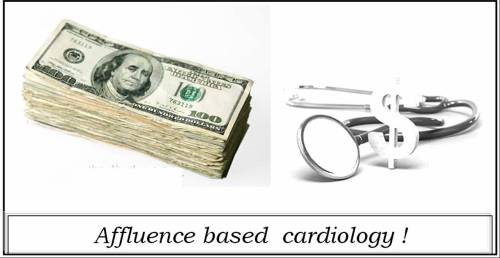
Apart from affluence being a risk factor ,  it  is a powerful  risk factor for getting  inappropriate  medicines,  procedures  &   surgeries  ,  hence  the resultant  adverse effects.

It is a  non-established fact , in  both  developed  and developing world , the single important  predictor of a given form of treatment  say  revascualrisation or  surgery  for CAD  is affordability to the treatment (Either  by insurance or  self payment) .Financial well being , interferes with applying  valid scientific principles on them . Applying  the  results of  the  land mark trials CAD trials ,   COURAGE  &  BARI 2D  are very difficult  for them , which argues for   simple , less costly , less glamorous medical therapy for CAD.

Example 1

A wealthy adult  male  who  lands  up for master health check up  in a big state of the art  hospital found to have a  borderline stress test , CAG reveals a single vessel distal RCA disease .He was given an  option of PCI , undergoes  it ,  and ends up in a complication and damages his entire  inferior myocardial  territory.

Had he been a poor uninsured  guy , he would have promptly be  labeled as stable CAD and would have been on  good medical therapy*  and his  myocardium could have been saved .

* PCI can never be an option  for him ,  courtesy : His wealth status !

Mind you , this is not an isolated  example, such  affordability  guided treatment modalities  are rampant in the society and has a potential to make  our rich and  affluent a major health risk target !

Final message

Being wealthy and affluent can also be a health risk factor. While the poor suffer from lack of health care the  rich many times suffer because of  too much health care ! (or  Is it care less ,  health care ?)

Coming Soon

How reccession  time  is a  boon  for human health  !

Read Full Post »

All is not well,  that ends well !

                                       Treatment guidelines in cardiology  practice  are periodically published by ACC/AHA/ESC.These guidelines  represent the current scientific practice. They are called some times as recommendations. Medical professionals tend to adhere to this guidelines whenever possible.They are not legally binding in most of the countries.In USA some states believe it, to be legally binding.


The problem with these guidelines  are , they are classified as class 1 ,class 2 , class 3 recommendations.


Class 1, A  drug , device  or a procedure  Is definitely useful and must be prescribed.

Class 3,   A  drug , device  or a procedure  Is not useful and should not be used .

Class 2*, A  drug , device  or a procedure  may be useful  or may be harmful , and hence may be used or may not be used . (Vaguest possible guideline!)

 *Altered to convey the meaning

What are the  guideline violations that can be sued in court of law  ?

A person with established  CAD who is not been prescribed a  statin (Cholesterol lowering drug)  can be sued straight away,  even if the patient has no adverse outcome due to the nonprescription of that drug. The issue here is , the doctor  has not prescribed  a drug which has  proven benefit .The law is clear on that .Most will  agree that,  the  doctor is at fault ,  and he  is never protected  even by their  colleagues .He  can’t defend his action.

What are the medical errors that can never* be sued in court of law !

But the same doctor who opens up a totally occluding coronary artery in an asymptomatic patient(CTO -chronic total occlusion) and lands up  in a complication and the  patient dies. This could be  major guideline violation as opening a CTO in an incidentally detected , asymptomatic patient is a class 3 recommendation. Neither the physician, patient , institution  nor  the regulatory authorities bother about this even though there is strong case for censure , in reality it never happens. Number  of  experts from leading hospitals do this procedure in live work shop all over the world with full media glare, It is an irony the same  experts are only  writing  in their  guidelines  that  these procedures should not be done inappropriately.

And this medical  error ( Should we call it a  crime if it is knowingly done ! )   keeps growing as the physician never feels guilty about it .

The message here is

 A physician of a state of the art hospital,  in a scientifically advanced  country  goes scott free and guilt free  even if he openly violate the scientific guidelines and do a inappropriate procedure that result in a patient death. Mean while a small time physician in a remote place in the same country can be taken to task  for not prescribing a officially  recommended drug (By standard guidelines) .He will be labelled unscientific and unethical even if his non prescription , had not caused any untoward health outcome .

In short , in today’s modern medical practice 

 Even a  ” Minor error of  ommision”   attracts guilt and perceived fear among the physicians. Meanwhile  many  of the ” Major errors of commission”  done by professionals are rarely frowned upon and thus these  mistakes continue to perpetuate !

*There should be a strong provision in medical law to address the issue of inappropriate procedures even if the procedure has not resulted any untoward effect to the patient.

Read Full Post »

Interventional cardiology as a speciality is in cross roads.

The number of coronary interventions (PCI) has increased exponentially world over. With increasing  Cath labs and growing  expertise ,  access to PCI has enormously increased  even in underdeveloped countries.  Meanwhile ,  public lack  specific technical information about the appropriateness  of these costly procedures. It is our duty to do self audit on this issue.  .

                           In this context,  the evaluation  following a PCI  should look beyond  lumen oriented  endpoints.  Many  land mark trials on DES report 3 months are 6 months angiographic outcome and better luminal appearance . Many   tend to worry  more about the status of the stent rather than the patient !  This is primarily because the device companies have repeatedly stressed the technical end points rather than clinical end points .

It is a  well recognised fact  that ,stented coronary artery never guarantees against future  coronary events (ACS) either within the stent or away from it .It is an explict fact that , a patient  after getting a coronary stent , especially a drug eluting stent carries a life long risk of acute stent obstruction and possibly SCD .This information is rarely passed on to the patient in  and hence they are not able to take “learned consent”

It is true ,  one gets  a gratifying feeling  when  opening up a obstructed artery , but we also need  to answer this simple question   What is it’s impact on  patient’s  life  ?

COURAGE & OAT trials have put a break on the  prevailing precondtioned behaviour in the labs, namely any obstruction must be relieved if  technically feasible .

One should recall  the Gruentzig’s legacy  . Whaterver,  we do inside  a  patient’s coronary artery must have some useful purpose . We should not use patient’s  coronary artery to show our expertise and skills !

Dr.S.Venkatesan, Madras Medical College, Chennai, India

Read Full Post »

« Newer Posts
