Feeds:
Posts
Comments

Posts Tagged ‘jacc’

                                     Hypertension is considered a major cardiovascular risk factor.Hypertension  can have multiple physiological and pathological effects on heart . The common response to  raised arterial pressure is the hypertrophy of the left ventricle ( LVH). This can increase the risk of heart failure in few ( Mainly diastolic failure)  It is a leading cause for stroke  and   less often a  coronary event.

What links Hypertension and  coronary artery disease

                                           Coronary artery disease is almost synonymous with atherosclerosis. There is no separate entity called hypertensive coronary artery disease. But HT can accelerate the process of atherosclerosis. It is widely understood, hypertension can cause  physical endothelial damage and functional impairment of endothelial function.The physical damage ie enothelial disruption , or erosion is a very uncommon phenomenon . So currently  there is sufficient clinical experience  HT is considered dangerous for coronary artery only if it is with the  company of diabetes and hyperlipidemia. (This will seem controversial as it is against the findings of iconic Framingham trial!)

What the medical community refers to hypertension , may not be really so inside  for the coronary arteries.

                                             The relationship between brachial cuff blood pressure and the intra coronary pressure has very little linear relationship. So one should recognise it is the intra coronary hypertension that has a immediate impact on the coronary events. Now only , we are beginning to understand the complexities  of the relationship between HT and CAD. If we analyse a series of individuals HT per se is not a very serious risk factor for CAD* , but it is a number one risk factor for stroke. 

Why HT in isolation  often result in stroke , rather than a MI ?

While HT  is notoriously common to result  intracerebral hemorrhage, the same HT  would not cause  intramyocardial bleeds . Why ?

What is protecting the myocardium against this complication ?

                                      The exact mechanism  is not clear.Acute surges of blood pressure can increase the risk of stroke many times  but  rarely precipitate  a coronary event(  But may cause a LVF) . The reasons could be the coronary endothelial shearing stress is less than the cerebral blood vessels.Both cerebral and coronary circulation has  auto regulatory mechanism . The coronary auto regulation is more robust in that it does not allow  intra coronary pressures to reach critical levels .There is no clinically relevant intra myocardial hemorrhage reported  even during malignant hypertension.

*But a  high intra coronary pressure can sometimes  result in spontaneous coronary dissection and plaque fissure .Lipid mediated injury is vey much facilitated in a high pressure environment.

Has Controlling blood pressure  to optimal levels  , reduced the overall CAD morbidity and mortality ?

                    The answer is yes, ( But not an emphatic yes ! ) Some studies had been equivocal. It is very difficult to say , how much benefit is attributable to BP reduction  per se  and   how much is attributable to indirect effect on atherosclerosis prevention.

Hypertension during ACS

                            High blood pressure during an episode of unstable angina or STEMI can increase the myocardial oxygen demand and worsen the ischemia. It requires optimal control with nitroglycerine ( Preferably ) or beta blocker and ACE inhibitors.Even though HT is commonly associated  with ACS,  one can not be sure the ACS is preciptated by HT. Many times the sympathetic surge during an ACS keeps the blood pressure high.It is a common experience the blood pressure suddenly dropping to normal or hypotensive levels once the pain and anxiety is controlled.

Hypertension during thrombolysis

                           High blood pressure is a relative contraindication for thrombolysis.It need to be emphasised here, It is the  the fear of stroke that make  it contraindicated .The heart can tolerate  thrombolytic agents delivered at high BP .In fact logically ,  hemodynamically and also  practically it is obseved , thrombolytic agents administered at relatively high blood pressure (140-160 systolic) has better thrombolysis than a patient who is lysed at 100mmhg.

                       The coronary pressure head which contain the thrombolytic agent (streptokinase and others ) need to have pressure jet effect on the thrombus.So the  mean coronary perfusion pressure becomes  a critical determinant of success of thrombolysis.

                            It is a paradox of sorts , very high blood pressures are a relative contraindication for thrombolysis and at the same time normal pressure patients fare less well to thrombolysis.

 Final  message

                        Hypertension continues to be a major cardiovascular risk factor.It has direct and indirect effects on the heart.Generally HT is more of a risk factor for stroke than CAD.A slightly high BP ( Just around the  upper limits of normal or just above it ) has a hemodynamic advantage during thrombolysis.(Class C evidence )

Read Full Post »

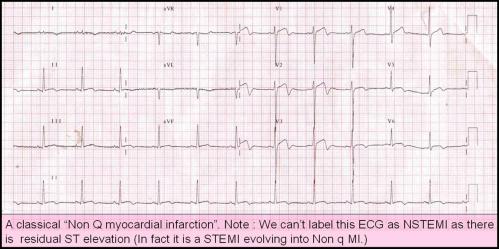
                                Acute coronary syndrome (ACS) is currently classified as STEMI and NSTEMI.This classification came into vogue  primarily to  triage patients for thrombolysis eligibility , as ST elevation is the  only criteria for thrombolysis.The  earlier term  non q MI  is largely used  to denote the  present day NSTEMI. In the past q  MI was referring to transmural MI non q MI  to non transmural  pathologically.(Of course , now we know  the relationship between q waves and transmurality is not good )

So when can we still use term non q MI ?

These terminologies of STEMI and NSTEMI are made on admission  at the emergency room.  ACS being a dynamic entity these  patients can  have rapidly changing  ST shifts , from depression to elevation and vice versa. Fresh T wave changes can also occur .Q waves  may or may not develop ,  depending upon the damage sustained to the myocardium and the efficacy of thrombolysis / PCI. So it should be emphasised here STEMI,  NSTEMI ,  q  MI ,  non q MI are the  descriptions of the  same group of patients in different time frames. The common mode of  evolution  of  STEMI  is  to q MI and NSTEMI  into non q MI. Cross overs can occur.


 The problem here is NSTEMI getting converted into STEMI  is quiet common and has no nomenclature issues . But  when   STEMI down grades  into NSTEMI  there is apparent  nomenclature incompatibility .This category of  patients have  no other labelling option other than “A STEMI evolving into non q MI”. Because one can’t label  STEMI  evolving into NSTEMI as  many of  them  will  have a residual ST elevation as well.

What is the final message ?

The term non q MI is still relevant and is used at discharge , in a patient with STEMI when he or she evolves without a q wave .In the setting of unstable angina , NSTEMI has largely replaced  the term  non q MI either on admission or at discharge.

Before I close

                 The important point to remember here  is NSTEMI getting converted into STEMI  is an adverse outcome and  in fact, it is  a complication and the patient should get an immediate  thrombolysis or PCI , while a STEMI getting converted into non Q MI is generally a  major therapeutic success.( Effective salvaging and preventing q waves )

//

Read Full Post »

Answer: Do  coronary angiogram  for all patients  who had suffered from an acute myocardial infarction* ( Forget about all those mulitpage ACC/AHA  guidelines !).

For an  interventional cardiologist ,  it is often  considered a crime to  follow a conservative  approach !

*Caution This one line guideline is not based on scientific fact  but reality based . Ideally one should identify  high risk subsets among the patients who had an AMI .Patients who had complications during the MI get immediate CAG. Others need  a focused LV function asessment ,  pre discharge  sub maximal excercise stress test or perfusion studies .But this concept has been  virtually replaced by pre discharge coronary angiogram for all ,  in many  of the centres in the world.

Read Full Post »

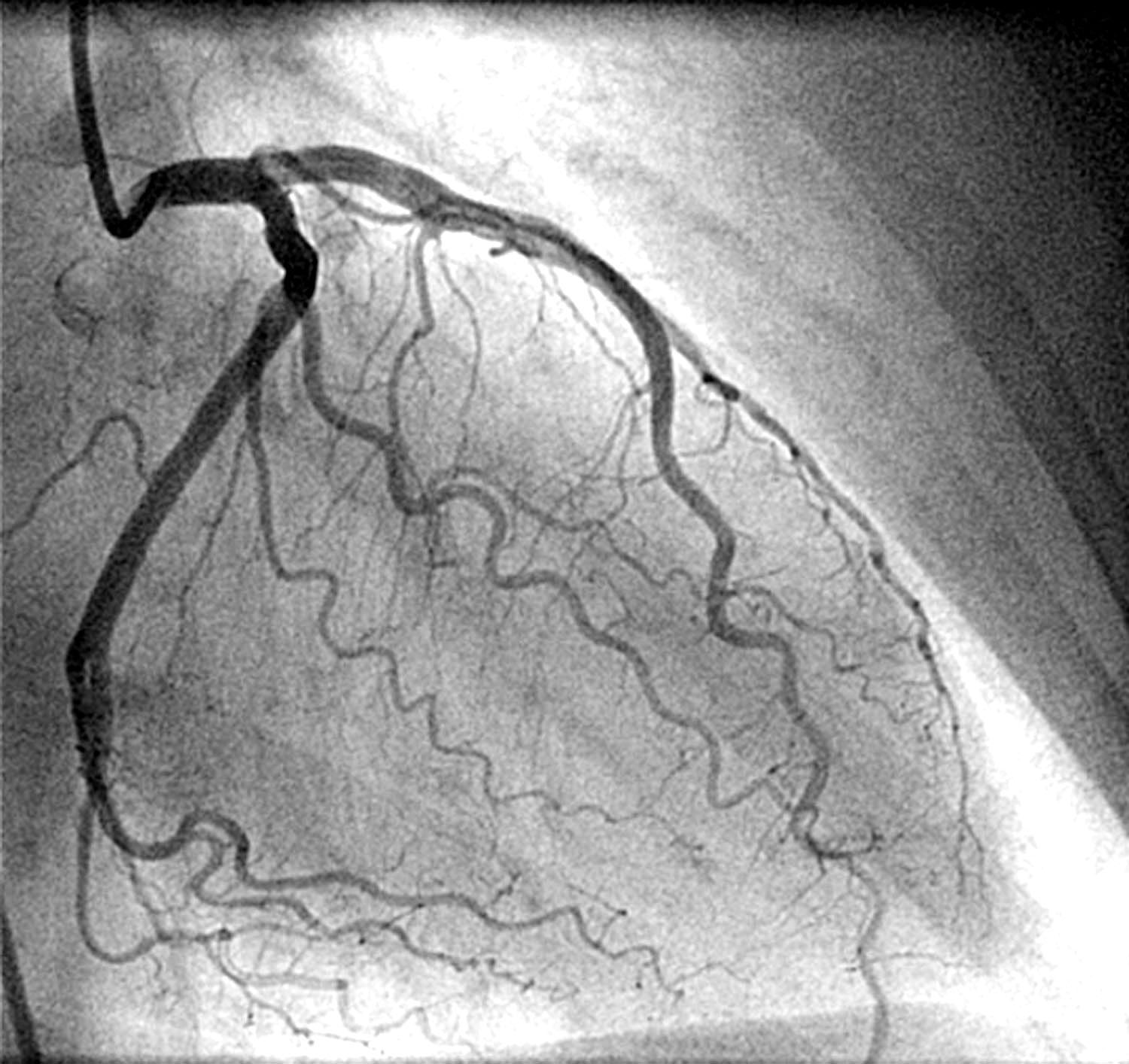
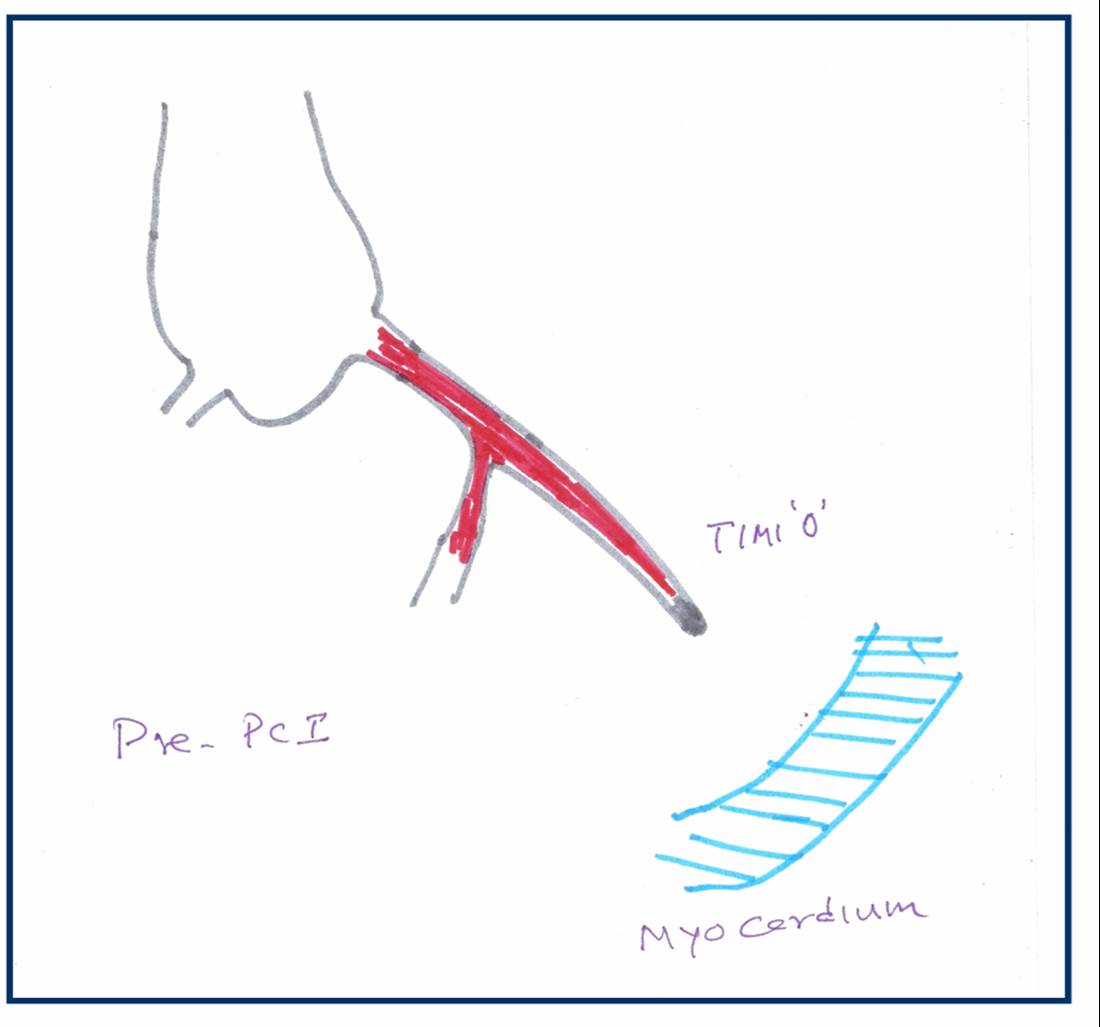
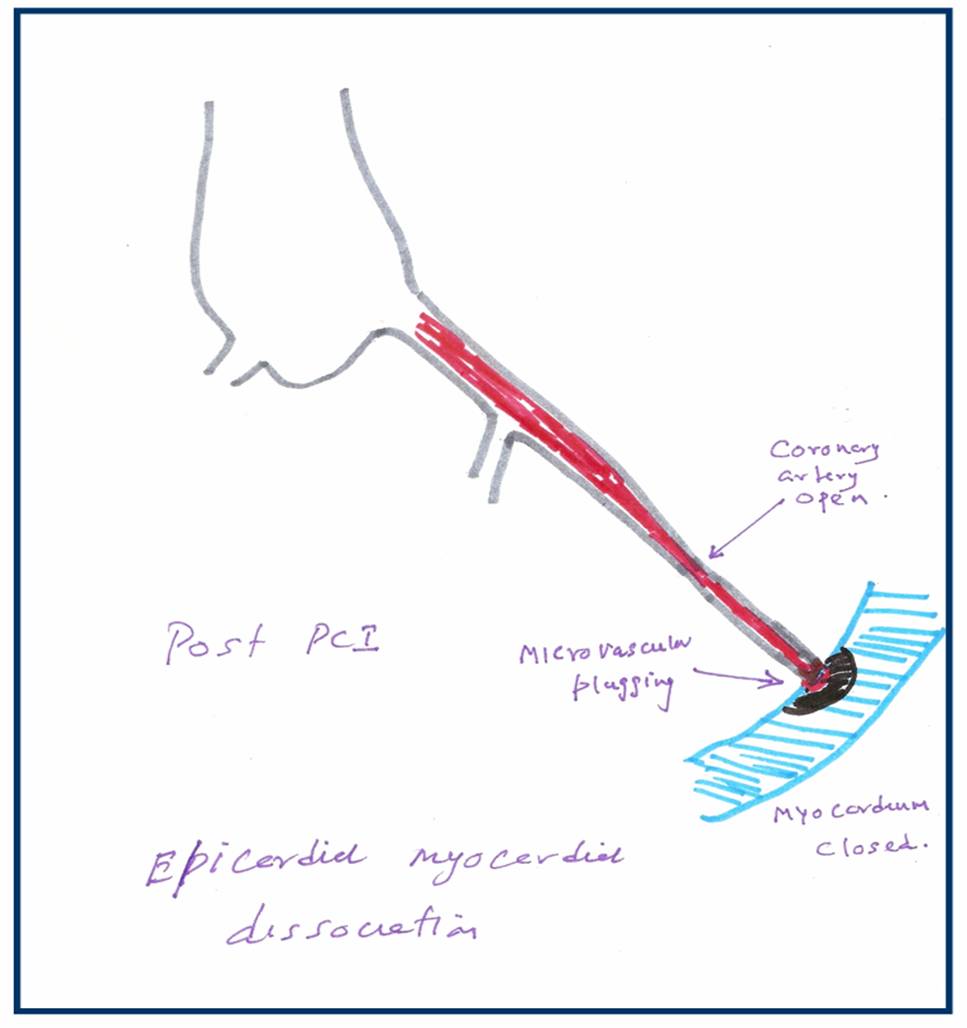
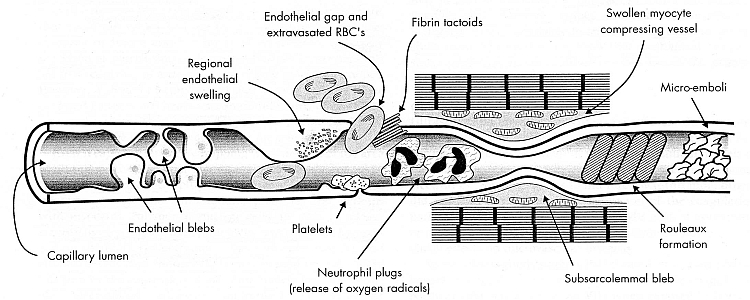
No reflow is the terminology used primarily in cath labs where, even  after a successful opening and stenting  of a coronary artery the coronary blood flow is not  restored to myocardium . The point to be emphazised here is blood do cross  successfully the site of  the obstruction but fails to enter the muscle segment  to which the coronary artery is supplying. So the paradoxical situation of artery  being open but the  myocardium is closed to receive  blood flow  happens . This is termed as no -reflow.  Actually it is a  misnomer , and  ideally it should be called “no flow” because  normal distal flow  does not  occur (After PCI)  in the first instance  to get interrupted  later on  and be labeled as  no re-flow.  .The only positive effect of PCI in these situation is blood flow would have improved by few centimeters ie till it reaches  but falls short of myocardium . In fact no reflow , can be termed as  glorified and concealed  terminology  for  PCI failure . It needs urgent action . No reflow is also called as myocardial epicardial dissociation.

Mechanism of no reflow.

Curious case of open coronary artery and closed myocardium !

Coronary  microvascular plugging  is mainly  due to thrombus and atheromatous debri , myocardial  edema , microvascular spasm may also contribute.

Where can it occur ?

  • First described in cath lab, especially following primary angioplasty.
  • It can very  well happen following thrombolysis in STEMI.
  • Can occur in venous grafts.

How do you recognise no reflow?

In cath lab it will be self evident from the check angiogram. Some times it is less obvious and may  require, myocardial  blush score, TIMI frame  count, contrast echocardiography, PET scan etc. In post MI a very simple method to recognise this entity could be the observation of persistent ST elevation in ECG .

Treatment.

Extremely difficult. Almost every coronary vasodilator has been tried.(Nitrates, nicorandil, calcium blockers, etc).Success is less than 30%.  High pressure flushing with saline inside the coronary artery is advocated by some.Others believe it’s dangerous to do it. So prevention is the key. Avoid doing PCI in complex, thrombotic lesions. Use thrombus suction device like export catheter(Medtronic). Distal protective devices are double edged devices , useful only in experienced hands.

Unanswered question

What is the size of the particle (thrombotic and atheromatous  debri)  the   coronary microcirculation safely handle and push it into the coronary venous circulation and the coronary sinus for disposal ?

If we can lyse the thrombus into micro particles by some mechanism and make it traverse the coronary circulation this complication of microvascular  plugging can be treated and prevented .

What is the final message ?

  • No reflow is relatively common condition during emergency PCI done for ACS patients
  • More common in complex thrombotic lesions.
  • Can also  occur in STEMI
  • Treatment is often vexing . In fact the treatment of this condition is so difficult , it can be termed  almost synonymously with “Failed PCI” if flow is not restored.
  • Successful treatment of no- reflow  means not momentry restoration of  myocardial flow  by mechanical and pharmacological modalities ,but to maintain sustained myocardial   perfusion. This we realise, as patients who have had a no reflow during  a PCI, do not perform as well in the follow up  .
  • So prevention is the key.

Read Full Post »

              Intra coronary thrombosis is the sine qua non of acute coronary syndrome ( Both STEMI and NSTEMI.) But thrombolysis is the specific therapy in STEMI and is contraindicated in NSTEMI/UA.
Why is this apparent paradox ? What is basic differnce between UA and AMI ?

In STEMI there is a sudden & total occlusion of a coronary artery usually by a thrombus with or without a plaque .The immediate aim is to open up the blood vessel . Every minute is important as myocardium undergoes  a continuous process ischemic necrosis. So thrombolysis (or more specifically fibrinolysis should be attempted immediately) .The other option is primary angioplasty,  which will not be discussed here.

The thrombus in STEMI  is RBC &  fibrin rich and often called a red clot. Number of fibrinolytic agents like streptokinase, Tissue palsminogen activator,(TPA) Reteplace, Tenekteplace etc have been tested and  form the cornerstone of STEMI management.The untoward effect of stroke  during  thrombolysis  is well recognised , but usully the risk benefit ratio favors thrombolyis in most situations except in very elderly and previous history of stroke or bleeding disorder.

Unstable angina is a  close companion of STEMI . Many times it precedes STEMI often called preinfarction angina. During this phase blood flow in the coronary artery  becomes sluggish gradually,and patients develop  angina at rest .But unlike STEMI there is never a total occlusion and myocardium  is viable but ischemic,  and emergency salvaging of myocardium is not a therapeutic aim but prevention of MI becomes an aim. It is a paradox of sorts ,  even though thrombus is present in  UA ,  It has been learnt by experience thrombolytic agents are not useful in preventing an MI .


Why  thrombolysis is not useful in UA ?

1.In unstable angina  mechanical obstruction in the form of plaque fissure/rupture is more common than completely occluding thrombus. So lysis becomes less important.

2. Even if the thrombus is present , it is often intra plaque  or intra lesional and the  luminal  projection of thrombus is reduced  and hence thromolytic agents have limited area to act.

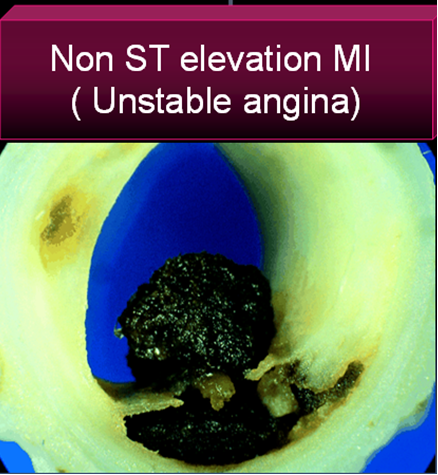
3.Further in UA/NSTEMI since it is a slow and gradual occlusion (Unlike sudden & total occlusion in STEMI) the platelets  get marginalised and trapped within the plaque .Hence in UA  thrombus is predominantly  white  . Often, a central platelet core  is  seen over which fibrin clot may also be  formed.

4.All available  thrombolytic agents act basically as a fibrinolytic agents,  and   so it finds   difficult to lyse the platelet rich clot.There is also a small risk of these agents lysing the fibrin cap and exposing underlying platelet  core and trigger a fresh thrombus.This has been documented in many trials( TIMI 3b to be specific) So if we thrombolyse in UA , there could be a risk of recurrent ACS episodes in the post thrombolytic phase.

5. UA is a semi emergency where  there is no race against time to salvage myocardium .Administering a  stroke prone thrombolytic agent tilts the risk benefit ratio against it.

6. Among UA, there is a significant group of secondary /perioperative UA   due to increased demand situations. Here there is absolutely no role for any thromolytic agents,  the  simple reason is , there is  no thrombus to get lysed. 

7.Many of the UA patient have multivessel CAD and might require surgical revascualarisation directly .


So fibrinolytic  agents are contraindicated in UA so what is the next step ?

The emergence of  intensive and aggressive platelet-lytic agents.

A combination of aspirin, clopidogrel, heparin, glycoprotien 2b 3a antagonist formed the major therapeutic protocol in these patients.Even though these are called antiplalet agents some of them  like 2b/3a antagonist eptifibatide, tirofiban, and many times even heparin has a potential to dissolve a thrombus. So technically one can call these agents  as thrombolytic agents.

What are the unresolved issues

                                       Even though clinical trials have convincingly shown thrombolytic agents  have no use in UA .There is a nagging belief  THAT  there could  be group of patients  with UA , still might benefit from thrombolysis as total occlusions have been documented  in some cases with UA.This is  especially true in peri-infarction unstable angina (Pre & post) as there is a fluctuation  between total and subtotal occlusions ) .But bed side recognition of this population is very difficult.

Many would consider this issue as redundant now,  since  most of  these patients  are taken up for emergency revascularisations

Read Full Post »

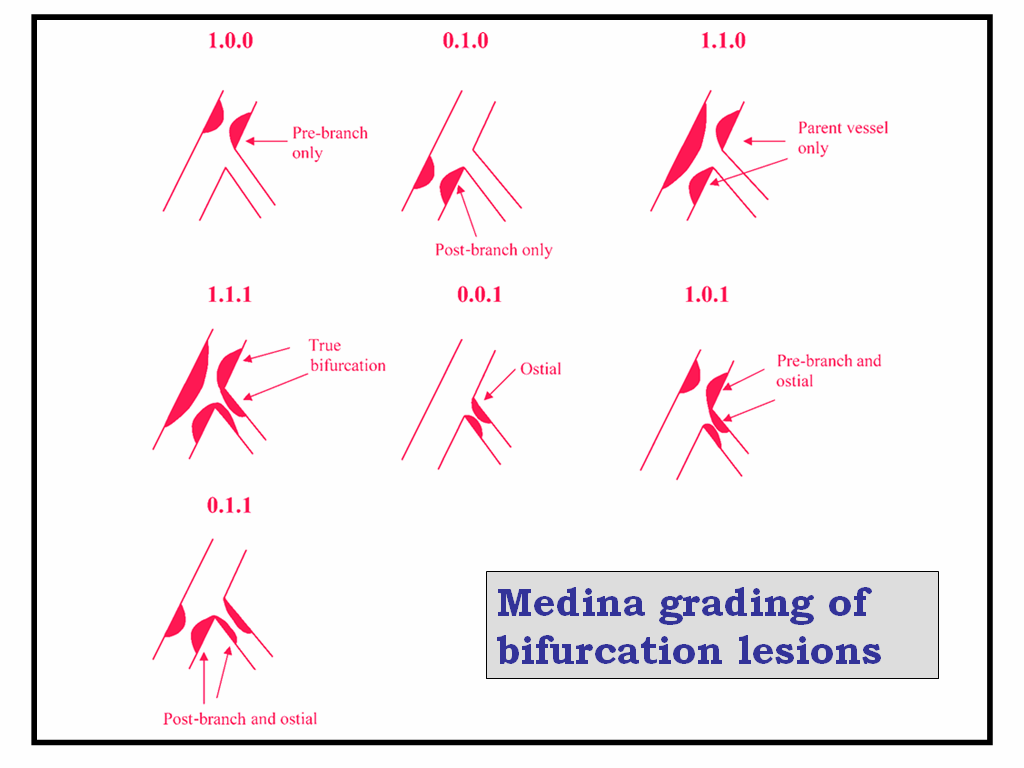
There are numerous complex grading for bifurcation lesions available.

The one proposed by Medina is simple and most useful.

In this grading three segments

  • Proximal main vessel
  • Distal main vessel
  • Branch vessel

Are given a code 0, and 1 if  lesion is present or absent .

This grading gives simple and fast method to label a bifurcatiuon lesion and to asssess the response to PCI. The only issue here is the individual  lesions are not graded , for example branch vessel ostium just involved about 20 % is not addressed . Further TIMI flow in these vessels may also be incorporated

How medina grading can be used to assess effectiveness of

angioplasty  ?

A patient with 1.1.1  after the treatment should revert back to 0.0.0.  if converted into 0.0.(.5) may indicate a residual side branch lesion  .5 shall indicate 50% residual lesion, .3 , 30% etc


What is the best management strategy for bifurcation lesions?

The topic has been discussed extensively for over a decade in various forums.

Though the lesions and intervention techniques  appear complex the basic concept is simple.

Following is the 8 point algorithm

1. Assess the bifurcation lesion accurately.

2. Apply the general rule and ask the first question whether PCI is neccessary at all ? if decided for PCI

3. Stent the main vessel.Protect the side branch.  

4. Dilate the side branch with a balloon.(KIss or through the struts) 

5. Very rarely,  if the side vessel is more significant and large  stent it and balloon the main vessel.

6. Use drug eluting stents with caution .

7. Resist the temptation of using two stents unless the situation demands and is absolutely required.

8. Never attempt to do bifurcation angioplasty during ACS as apart of primary angioplasty.( Unless you’re extremely competent, even then aim of primary PCI is to salvage myocarium quickly , not to provide TIMI 3 flow in non IRA vessel.)

Dr.S.Venkatesan.Madras medical college.Chennai.

Read Full Post »

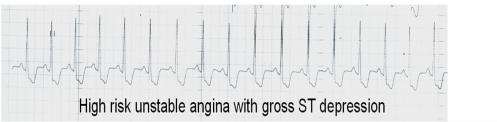
                                   ACS   is the  most common cardiac emergency .  Management of STEMI is relatively straight forward.  The  only decision that to be taken is the  modality of reperfusion. (Primary PCI   or thrombolysis.) There is no need to risk stratify  STEMI on arrival. All STEMI patients are considered high risk on admission. Whereas  NSTEMI consists of  a heterogeneous  population. They need to be   triaged into low intermediate  or high risk categorizes on arrival.There is two management  approaches for unstable angina .All high risk UA should enter early invasive strategy . And low risk and intermediate risk group will get early conservative management. 

                                       The principle of management of  UA differ from STEMI in a fundamental way , as there is no issue of myocardial salvage in UA .The primary aim is to provide relief from pain and prevent an MI. So in the strict sense there is no time window in unstable angina /NSTEMI.


                                       But it is generally considered 48 hours is the time limit for an early invasive approach.If the patient has crossed this time there is apparently no great difference in outcome for conservative and invasive approach. 

Read Full Post »

« Newer Posts