Feeds:
Posts
Comments

Posts Tagged ‘pulmonary hypertension’

Measurement of pulmonary vascular resistance (PVR) is traditionally done by cardiac catheterization. It remains the (un)disputed gold standard, despite numerous assumptions, errors in measurement, and lack of reproducibility.

PVR by Echocardiography

Recently, echocardiographic calculation of PVR gained importance. Resistance is pressure divided by flow. Pressure is measured by Doppler, flow is measured by the cross-sectional area of RVOT times the TVI. We can arrive at PVR quickly. As simple as that.

Still, many institutions and purists ( Who have huge trust in cath derived, Oxygen diluted data) ) won’t accept this as standard . They fail to realise echo methodology carries less limitation, if not similar limitations as in traditional cath method. However, a significant advantage is, it is more real -time, can be repeated any number of times, and documents a baseline PVR, and at least is useful for follow-up.

There are two formulas used.

1.Abbas Formula

PVR = (TRV / RVOT VTI) × 10 + 0.16

2.Haddad formula :

PVR= (TRV²/VTI_RVOT)

*TRV = Tricuspid Regurgitation Velocity (m/s)

*RVOT VTI = Right Ventricular Outflow Tract Velocity Time Integral (cm)

Comparing Abbas vs Haddad

The Abbas formula is better validated and widely used in clinical practice, as it was specifically designed to correlate with catheter-based pulmonary vascular resistance measurements. It provides reasonably accurate estimates, especially for screening pulmonary hypertension, though it tends to under-estimate PVR at higher values (>8–10 Wood units).

In contrast, the Haddad formula ) is simpler but less rigorously validated and is more commonly applied in research settings focused on right ventricular-pulmonary artery coupling rather than direct PVR estimation.

Haddad’s method may be less reliable in patients with significant tricuspid or pulmonary valve abnormalities. Therefore, Abbas remains the preferred formula for routine clinical application. There is still hope to improve Haddad equation.

How to improve upon Haddad equation* ?

The Haddad equation for estimating PVR (TRV²/RVOT VTI) lacks calibration and overlooks key hemodynamic variables. It can be improved by introducing empirically derived correction factors to correlate with catheter-based values. Incorporating right atrial pressure (RAP), RV functional indices like TAPSE or RV strain, and adjusting for heart rate or rhythm variability can enhance accuracy. Averaging VTI across multiple cardiac cycles could also stabilize measurements. Additionally, machine learning on large datasets and AI-enhanced model could outperform the current linear Haddad formula for non-invasive PVR estimation.

* This is a fresh area of study , young fellows should come forward to do.

Final message

As discussed earlier, Abbas remains the preferred formula. But, the real issue is cardiologists refusing to accept any Echo-derived PVR and incorporate it, in the day to day practice. We have accepted EF % as the gold standard for LV function in spite of some serious lacunae. PVR carries the same story. Cath-derived data, in all likelihood, is enjoying pseudo-sanctity. It is time we should embrace one of these Echo formulas regularly and make life simple for both ourselves and the patients (who are often tiny babies or children). I think it can be done without compromise on scientific purity.

Reference

1.Haddad F, Zamanian R, Beraud AS, Schnittger I, Feinstein J, Peterson T, Yang P, Doyle R, Rosenthal D. A novel non-invasive method of estimating pulmonary vascular resistance in patients with pulmonary arterial hypertension. J Am Soc Echocardiogr. 2009 May;22(5):523-9. doi: 10.1016/j.echo.2009.01.021. Erratum in: J Am Soc Echocardiogr. 2010 Apr;23(4):376. PMID: 19307098.

2.Abbas AE, Fortuin FD, Schiller NB, Appleton CP, Moreno CA, Lester SJ. A simple method for noninvasive estimation of pulmonary vascular resistance. J Am Coll Cardiol. 2003 Mar 19;41(6):1021-7. doi: 10.1016/s0735-1097(02)02973-x. PMID: 12651052.

Read Full Post »

PH is an important clinical cardio-pulmonary entity , which we confront day to day. Though the prevalence of PH in a community is just 1 % (25 times less than systemic hypertension) it deserves a special place as the diagnosis is more complex and outcome is often adverse.

The defining criteria , the classification, and grading of PH has always been a difficult and dynamic academic task .Right from WHO’s 1974 definition, we have 7 global symposiums , last one happened few months ago, in July 2024 in Barcelona.

We have made rapid strides in all aspects of PH right from molecular , genetic , imaging and therpeutics. Still, there is one important issue that has been overlooked for quiet some long. The concept of fitting PH in 5 groups based on etiology, though appear to simplify things, there is a significant flaw.

The overlaps in etiology

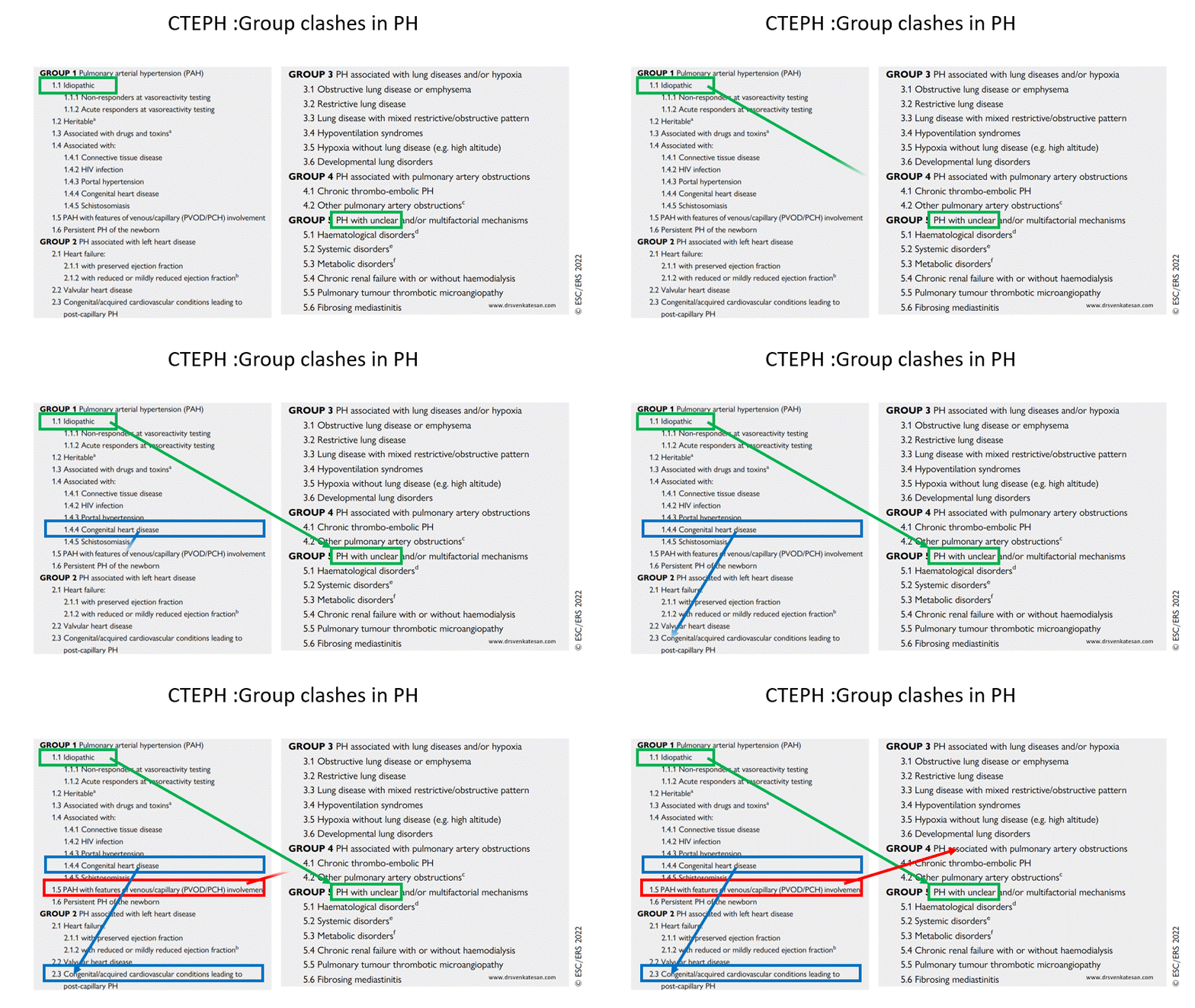
1.The group 1 contains the famous , (now obsolete entity of primary pulmonary hypertension) Idiopathic PH , meaning that we don’t know the cause of it or we have excluded all known causes. Meanwhile, group 5 also has set of conditions of PH of unknown or unclear etiology. So, a IPH of group one can migrate to either group 4 or group 5 or vice versa.

2.PH due to congenital heart disease can be in both Group 1 and 3

3.If you take PH due to some of the connective tissue order, I am sure, it can fall into any of the 5 groups

Suggestions for the next PH working group

It is desirable that the next working group should acknowledge existence of inter and intra group overlaps of PH in a more clear manner. Either we should take away the groupism or the current definition of group 5 need to be more elaborate . It says multi-factorial. Instead we can try to find what are the groups it is likely to have an overlap. Should we need another a sixth group ? GO-PH (Group overlapping PH)

There can also be a place for combined etiological-hemodyanmic classification . (Example : Group 1 .Pre capillary .Group 1 Intra-capillary as in PVOD) . CTEPH though essentially is a precap PH, the risk factors of CTEPH and HFpEF can be shared one, making it combined pre and post cap PH a distinct possibility. )

Final message

While the problem of groupism in PH exists, the issue of highest importance in PH is something different. This is more philosophical . We need to be very clear what we mean by Idiopathic. As physicians, we must realize how relative this terminology is . What is idiopathic in your hospital, (However big you are) may turn out to be a missed case of mixed connective tissue disorder or silent CTEPH detected only by V/Q scan or a dual energy CT or a rare case of PVOD by judiciously reading a pulmonary angiogram in a dedicated PH center.

*Also we must recall, statistically up to 80% of PH is due to left heart (This HFpEF stuff has jacked this incidence still more ) and lung disease. Our efforts and resources should be used judiciously for optimal diagnosis and management of common conditions first.

Read Full Post »

PH has always been an exciting academic topic in cardio-pulmonary medicine, for both clinicians and researchers. It is also one of the extensively studied hemodynamic parameter. The pressure in pulmonary circulation is intimately tied to the function of two critical organs. lungs , heart and various systemic factors. The fact that pulmonary circulation is essentially expansive & engulfed by the dynamics of lungs, makes PA pressure a continually variable parameter. Further ,the chest wall compliance, airway resistance , influence of pleural pressure fluctuations, make it difficult to estimate the normative pulmonary artery pressure and resistance even in rest.(Imagine during exercise !)

No surprise, our knowledge base about PH is under constant flux. The trouble starts with this query, What is the normal PA pressure ? After toying with various numbers we are currently hanging all our wisdom at a mean PA pressure > 20 mmhg as cut-off to define PH. However, we are able to grossly classify PH into various categories , pre/ post /combined etc. Here again, we have a guess work with two more cut offs.. For PCWP we have decided to choose 15mmhg over 12mmhg as upper limit of normal & PVR < 2 Wood units.

The second query in PH is still more contentious. What is the effect of exercise on PA pressure ? In our student days we were not allowed to bring exercise into the picture of pulmonary hypertension, in spite of the fact cardiac output increases up to 5 fold during peak exercise, Now, there is evidence to show exercise can increase PA pressure significantly, beyond the limits of current definition of PH. This is problematic for obvious reasons. Still, there has been considerable reluctance to accept exercise induced PH as a clinical problem by many of us .

*To be fair with our intellect, I think, we haven’t yet approved “Exercise induced systemic HT” as an entity officially. (Of course, hypertensive response during stress test is well known)

Seeds of New thinking

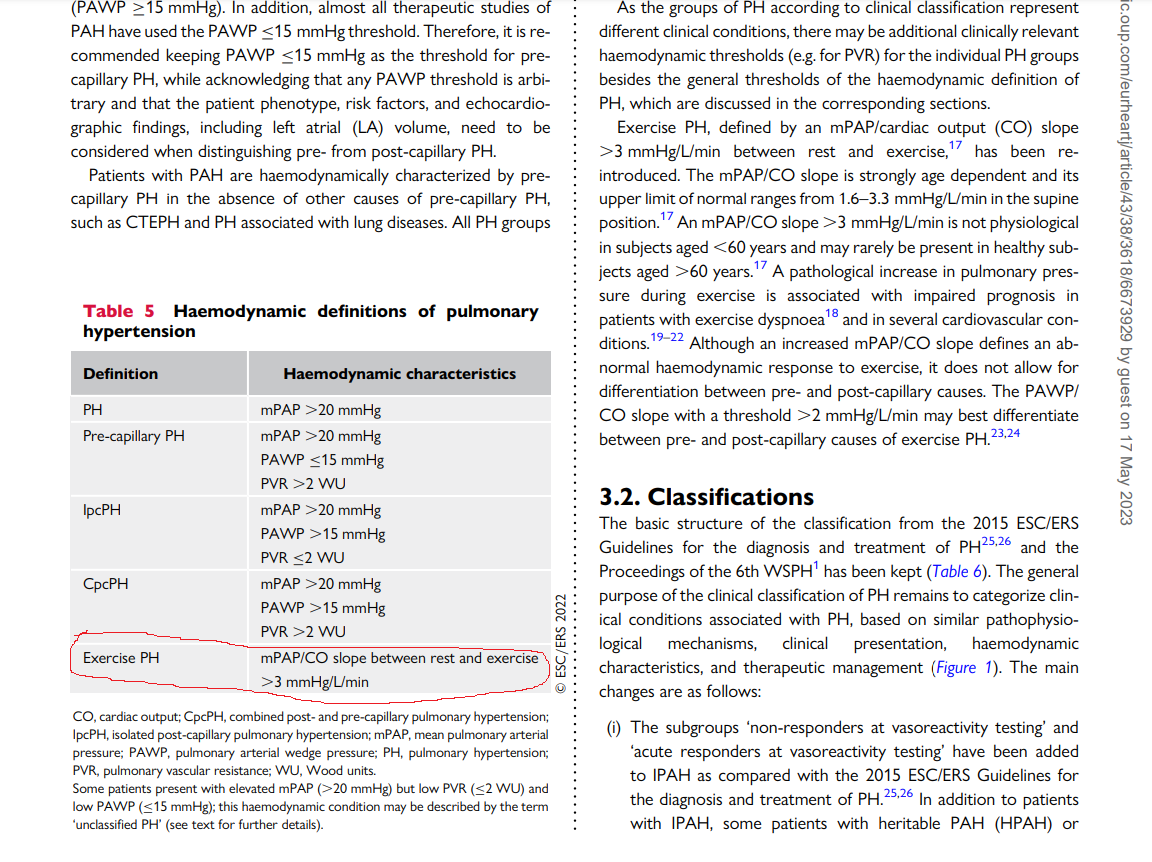
Thanks to current guidelines from ESC in 2022 .The exercise induced PH has come back with a bang and finds a place right behind the pre and post capillary PH. (See below ) I am sure, there must have been a vigorous debate before including this in the definition. We must appreciate the authors of two forgotten papers for the major shift in our understanding .(Ref 1 ,2)

European Heart Journal, Volume 43, Issue 38, 7 October 2022, Pages 3618–3731, https://doi.org/10.1093/eurheartj/ehac237

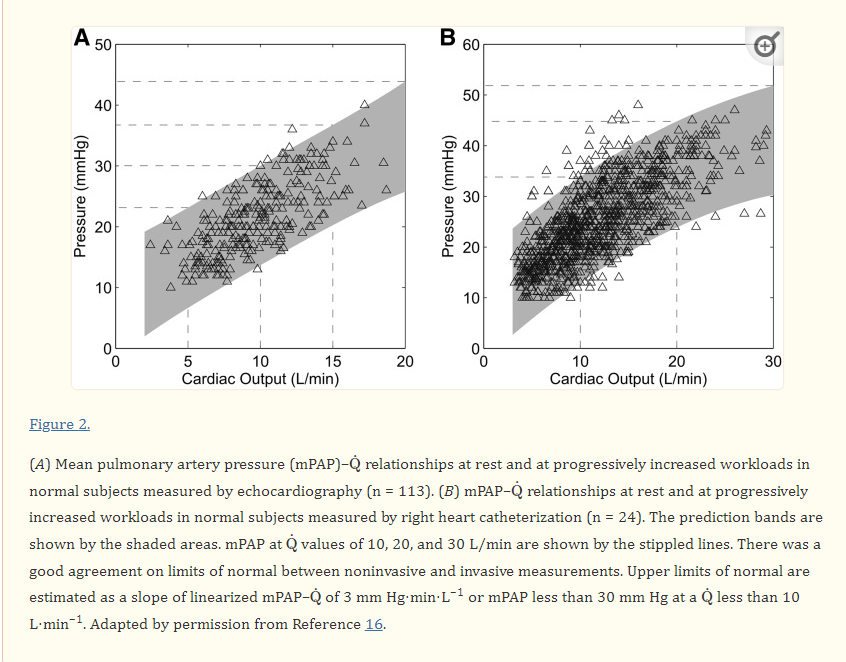
The secret of the slope : From where did it come ?

ePH is > 3mmhg /Litter/Minute is the definition of ePH

It is the rate of raise that matters not the absolute pressure. This slope was validified in by  Bossone E et al (Ref 2)

Some questions on ePH

1.How do you define ePH ?

Mind you, it is not an absolute number. It is the slope more than 3mmhg per litre of cardiac output. I agree to measure the slope > 3mmhg we need serial measurement and may be impractical .(Immediate post exercise echo is a close alternate )

2.Why we depend on slope rather than absolute value ?

This is because during heavy exercise PA pressure can raise even up to 30 or 40 crossing the boundaries of PH ..Only the rate of raise ie the slope can tell us whether it is appropriate or inappropriate.

3.Does ePH is really a clinical problem ?

Yes. it should be suspected in every unexplained dyspnea .(Beware of the anxiety it may elicit to the patient, so, go slow with your investigation first rule is to rule out Anemia and other common causes )

4.Can ePH occur over and above established causes of PH ?

Why not ? it is very well possible.(PH before and after six minute walk test will unmask this component)

5.Can we further classify ePH ? (Pre vs Post cap ePH)

Possible yes. ePH can be a marker of HFpEF if LVEDP is also correspondingly increased or else it will fall in to CETP or COPD.

6.Can COPD cause ePH ?

Yes, possible.

7.How does RV function confound ePH ?

This is ticky. Perfect RV-PA coupling and a good RV function is required to sustain ePH. A poorly contracting RV will make the whole concept of ePH and the defining criteria redundant. May be, we need to work for RV function corrected ePH . (This is a potential research topic for fellows)

8.Where do diastolic stress testing fit in diagnosing ePH ?

In one aspect ,DST which is screening test for silent HFpEF is an example for subtype of ePH.

Final message

The concept of ePH has entered once again into the cardio pulmonary clinical domain. Thanks to ESC 2002 team for listing this hitherto ignored disorder. Let us reiterate the importance of this concept in the clinical practice. It is worth considering some form of stress test to recognise this entity, in every patient who has unexplained dyspnoea.

Reference

1.Naeije R, Vanderpool R, Dhakal BP, Saggar R, Saggar R, Vachiery JL, Lewis GD. Exercise-induced pulmonary hypertension: physiological basis and methodological concerns. Am J Respir Crit Care Med. 2013 Mar 15;187(6):576-83. doi: 10.1164/rccm.201211-2090CI.

2.Bossone E, D’Andrea A, D’Alto M, Citro R, Argiento P, Ferrara F, Cittadini A, Rubenfire M, Naeije R. Echocardiography in pulmonary arterial hypertension: from diagnosis to prognosis. J Am Soc Echocardiogr 26:1–14. [PubMed]

Further reading

ESC 2016 guidelines on PH ;It is worth comparing he current guidelines with the last one published in 2016

European Heart Journal, Volume 37, Issue 1, 1 January 2016, Pages 67–119, https://doi.org/10.1093/eurheartj/ehv317

Read Full Post »

What is the incidence of Isolated systolic pulmonary arterial hypertension (ISPAH) and its Implication? We attempted to answer this question and found some interesting answers. It was published in the Indian heart journal  December 2007 Abstract issue. More than a decade gone. I think this issue is still largely misunderstood. Fellows may pursue this. One more parameter that can be explored is pulmonary artery pulse pressure and effect on progressive pulmonary vascular disease and PVR. Mean while  PAH definition and classification has changed many times, ISPAH definitely requires a place in the new scheme of things.

The abstract

ISOLATED SYSTOLIC PULMONARY ARTERIAL HYPERTENSION
S.Venkatesan ,G.Gnanavelu,V.Jaganathan , Madras Medical College. Chennai

Pulmonary circulation is a classical example of a low-pressure low impedance circulation. It is generally presumed high output states generally do not increase the systolic blood pressure in the pulmonary circulation. In systemic circulation, there can be divergence of systolic and diastolic blood pressure depending upon the cardiac output and peripheral vascular resistance. This has resulted in separate clinical entity -Isolated systolic hypertension.(ISH). It has been our observation many of the patients with PAH during echocardiographic and cath study were found to have an elevation of systolic pulmonary artery pressure(PAP) with normal diastolic PAP . In this context, this study was undertaken to specifically identify whether there is an entity of Isolated systolic PAH
( ISPAH ) and it’s the incidence in various clinical situations.
We analyzed the echocardiographic data of patients who were referred to our echo lab retrospectively. A total of 4000 echocardiograms over a period of 6 months were reviewed. Majority of these patients were referred for routine screening echo from our OPD. Data from patients who were assessed to have PAH were thoroughly scrutinised. They constituted shunt lesions, RHD,PPH, COPD, pregnancy, and patients with unexplained dyspnea for evaluation Those Patients who had both TR and PR jet were only considered for analysis .The Systolic PAP was estimated with TR jet and diastolic PAP with End diastolic PR Jet. ISPAH was diagnosed when the calculated systolic PAP was more than 30mmhg. And the diastolic PAP was less than 16mmhg  Antenatal women formed 2 % of the study population. A total 72 patients fulfilled the criteria of ISPAH Among the shunt lesions it was most common in large VSD( 4/10), followed by ASD(14/35) and PDA( 1/3) . In patients with RHD it was observed in 12%(15/110) , COPD 10%(15/150), in pregnancy and general population it was 5%(23/450). None of the patient with PPH had ISPAH.The mean Systolic PAP was 38mmhg(R 32- 74) The mean diastolic PAP was 14mmhg(R 8-15).The highest systolic PAP was 74mmhg recorded in patient with large VSD.
It is often presumed hyperkinetic states elevate systolic PAP and reactive elevates diastolic PAP .But it is clear from our study the rule is not that simple. Surprisingly many of the RHD patients had only the systolic PAP raised.It is important to recognize systolic PAP was very high in some of the shunt lesions. Taking this alone as an index of severe PAH is fraught with the risk of declining corrective surgeries in these patients.
Perhaps the most important observation from the study is the incidence of PAH in apparently healthy individuals, which is very significant as it could be the marker of continuously increasing chronic lung disorders due to the worsening environment of the 21st century.


A PowerPoint presentation of the paper is available with the author and may be requested.

Read Full Post »

A short systolic murmur over pulmonary area (ie Left second inter coastal space ) is listed among 6 other auscultatory  feature  of pulmonary arterial hypertension.Though it is an accepted sign  many would question  the existence of such a murmur or its relevance in PHT.

Why does it occur  ?

Acoustics  principle  tells us whenever  velocity of blood  flow exceeds a critical point(Raynolds number*) in a specific anatomical territory , a  turbulent zone is created  and  a murmur could be generated .This is why many physiological situations like pregnancy, anemia, and some benign outflow murmurs occur.


In pulmonary hypertension , three things are thought to contribute for the murmur generation

  1. Dilated pulmonary artery  promotes Raynauld turbulence
  2. Increased flow velocity (This is correlated with pulmonary artery acceleration time in Doppler)
  3. RV contractility  (A normally functioning   RV is required to generate the murmur .Once RV dysfunction sets the  murmur of pulmonary hypertension usually disappear , of course a TR murmur may appear and confuse the picture )

Reference

* Reynolds number is a way to predict under ideal conditions when turbulence will occur. The equation for Reynolds number is:

Reynolds number(Where v = mean velocity, D = vessel diameter, ρ = blood density, and η = blood viscosity )
Read Full Post »

The primary determinant of pulmonary artery systolic pressure is . . . ?

  1. Pulmonary arterial tone
  2. Pulmonary venous pressure
  3. RV contractility
  4. Pulmonary blood flow

Answer : All of the above

But what is the relative contribution of each ?

I am  100 %  sure  ,  no  one can answer this question  correctly !

It is  true  , in some  pathological situations  one can  be  fairly certain about  cause of   elevated pulmonary arterial pressure .

When we confront a patient  with left heart disease  it is the transmission of  mean venous pressure .

Whatever be  our understanding ( Pre/Post capillary pulmonary hyper tension and the related stuff !  ), the one parameter that makes mystery contribution  to PA pressure is RV contractility !

In physiology  RV   generates  about 30mmhg systolic pressure that becomes the  pulmonary systolic  pressure .The  diastolic pressure  will be around 15 and mean around 20 . During exercise  contractility of both RV and LV increase .There has been documented PASP up to 50 mmhg in normal healthy adults during   exertion .

Here one can assume RV contractility is causing  a entity called transient Isolated  systolic  pulmonary arterial  hypertension.(ISPAH)

Consider a entirely different situation

A patient with COPD  with raised  PASP .  The right ventricle pressure has to equilibrate with PASP  during systole .For this to happen   it has to generate the 60mmhg .  If the RV fails  to augment it’s contractility for some reason ,  will the  ineffective RV contraction will  lower the  PASP  ? This is the perplexing question !

While the popular understanding is ,  RV dysfunction will under- estimate the severity of   pulmonary hypertension   . . . still  . . .  we are not sure whether RV dysfunction will  reduce the PASP   per-se  ( and  subsequently PA  diastolic pressure as well )

We often see a  good example  . A patient who develops tricuspid valve disease and RV  dysfunction get symptomatic relief  from  lung congestion .

Final message

The relationship between RV function and pulmonary artery pressure is a real enigma. Though hyper functioning  RV is expected to elevate PASP  and hypo functioning  RV would pull  it down  , the relationship  is not that simple. If only we decode this  mysteries   we can try  specific  RV negative inotropic  agents  as a  modality to treat pulmonary hypertension .

After thought

Total artificial hearts  are going to come in a big way in the coming decades .It  will specifically address this issue  ,  as RV and LV contractility  need to  be individually tuned to avoid pulmonary congestion.

Coming soon

While  RV function is critical for human survival  ,  Fontan  principle  simply says entire RV is dispensable . How ?

Read Full Post »

Pulmonary  arterial hypertension (PAH ) is  an uncommon manifestation of dilated cardiomyopathy .While pulmonary venous hypertension of some degree is expected in most patients with DCM,  it is rare for these patients to go for severe arterial hypertension.

The reason for this may be the  natural history of DCM do not allow these patients to live that longer to manifest severe PAH.  Still ,  we encounter this problem  atleast in tertiary hospitals. Presence of moderate to severe PAH (> 50mm peak PAP) is a sinister sign in  DCM. They not only do badly , they also make  the transplant outcome dismal .

What causes this severe   PAH in DCM ?  The following observations are made in our institute .

Now we know , isolated  systolic dysfunction is  rarely associated with PAH  .It is the presence of  LV diastolic dysfunction (Often restrictive )  that raises the pulmonary pressures.  PAH of DCM is rarely progressive.

One important suggestion is the DCMs  which are associated with  severe  PAH may indeed represent  late stages of RCM , when the LV begin to dilate.

Associated mitral regurgitation   contributes  to PAH

Atrial fibrillation has a significant impact on elevating  pulmonary  venous and arterial  pressures in DCM.

Hypoxic PAH can occur in any medical situation  in susceptible population . DCM is no exception

For some reason  idiopathic DCM is more often result in PAH than ischemic DCM . (Is that possibel , some form of  idiopathic   PAH and DCM are etiologically  related ?)

Further , the positive inotropic agents when liberally used will worsen the diastolic  properties of LV.

Finally involvement of  right ventricle  in the cardiomyopathy  process can have an ameliorating effect on PAH.  A good RV function is essential to lift the PA systolic pressure. If RV failure is causing a low PAP , do not be happy .It simply means RV is going to  say  good bye  . . .  for the final  time !

How to manage PAH in DCM ?

There is no specific management strategy .

We do not know yet  whether Sildenafil ,  Bosentan, and Epoprostenol  have any role in this  form of  PAH. These are all basically vasodilators. It’s use in DCM is vested with a risk of  catastrophic hypotension . Of course ,  we do have a role for balanced vasodilators in cardiac failure .(As most of these patients would be already on adequate ACEI )

Presence of PAH should be considered as an independent indication for anticoagulants as in situ  pulmonary thrombus is common.

The effect of  cardiac resynchronisation therapy in reducing the PAH of DCM is not convincing.

Final message

PAH  in DCM is an unwelcome development. It makes the situation  tough .  The mechanisms are diverse  .Understanding the mechanism would help us deal  this problem better .  Conventional anti failure treatment may help  ,but  it is wiser to try  reserve drugs.

Read Full Post »

 Excercise physiology has been studied most extensively in the last century.The hemodynamic impact of excercise in various disorders of heart has been well established.
Dyspnea on exertion is the commonest symptom in clinical cardiology practice. It is well-known pulmonary stretch receptors located in pulmonary vasculature is one of the  major mechanism of dyspnea.

Excercise increases the cardiac output manyfold.Transporting  up to 10-12 litres of blood every minute across the lungs with a narrow pressure  head (about 10 mmhg ) is not an easy job . It needs lot of lung discipline .

It is surprising to note, there is little data on excercise induced pulmonary hypertension in the evaluation of patients with unexplained dyspnea.

We know, excercise increases the systemic blood pressure ,we  presume it should not raise the PAP (however severe the exertion is 1 )as pulmonary circulation  is a  high compliant low pressure system. 

Is our presumption correct ?

Exercise induced PAH can occur in both   health and disease 

In patients with preexisting disease

  • Stress induced LV dysfunction and resultant raise in LVEDP-PCWP-PAP .This is the most common mechanism in valvular and myocardial  disease.

Apparently healthy population

  • Excercise  induced PAH as a  marker for silent CAD .
  • Transient Hyperkinetic PAH* (Note :Here PCWP is usually normal )

This is similar  to hypertensive response to EST in systemic circulation.Existence  of this entity , is controversial, But this may reflect  reduced pulmonary vascular reserve  or reduced pulmonary nitric oxide secretion.

*The main difference here is the PAH is more often an  isolated systolic PAH. While LV dysfunction induced PAH is  a combined diastolic and systolic PAH .
How to assess excercise induced  PAH ?
It is not an easy job. Invasive catheter derived pressure measurements have been done ,but it is not practical .

The simplest way is to look for the TR /PR jet in echo in both pre and post excercise phase.

Final message

Excercise induced PAH is an inadequately studied entity in cardiology , in spite  it’s great significance .
This phenomenon is observed  in both diseased and normal heart.

The quantum of excercise induced PAH  is  widely variable depending upon the cardiac  status especially  LV function and the  functional integrity of pulmonary microvasculature .

Read Full Post »

PAH  is  the major determinant of surgical outcome of left to right shunts. In this  modern era of cardiac care  allowing a child  with   left to right shunt   to progress to a  stage of   Eisenmenger syndrome  is  considered  as a  huge medical failure . But  , this is still rampant in many of the developing countries .

Cardiologists are divided over the issue of  operability of Eisenmenger syndrome .The confusion is largely due to the conflicting data of outcome in these patients. While  there is strong   data  when  PVR exceeds  SVR  ,  the death is imminent in the post operative period .

What has complicated the issue is   there are  many case reports  where severe PAH patients have been successfully operated. Most would think it is a statistical exception and one can  not alter the traditional criteria based on few case reports.

But ,it remains an irony as on 2009 ,  we do not have a proper methodology to assess reversibility of PAH in Eisenmenger syndrome . Further ,  there is a  significant number of  patients with high PVR  , who continue to experience  an  unabated left to right shunting .  We do not have an answer  for either the mechanism of such shunts and  how to manage these patients.

Click over the slide  to view full  PPT  presentation in PDF format .

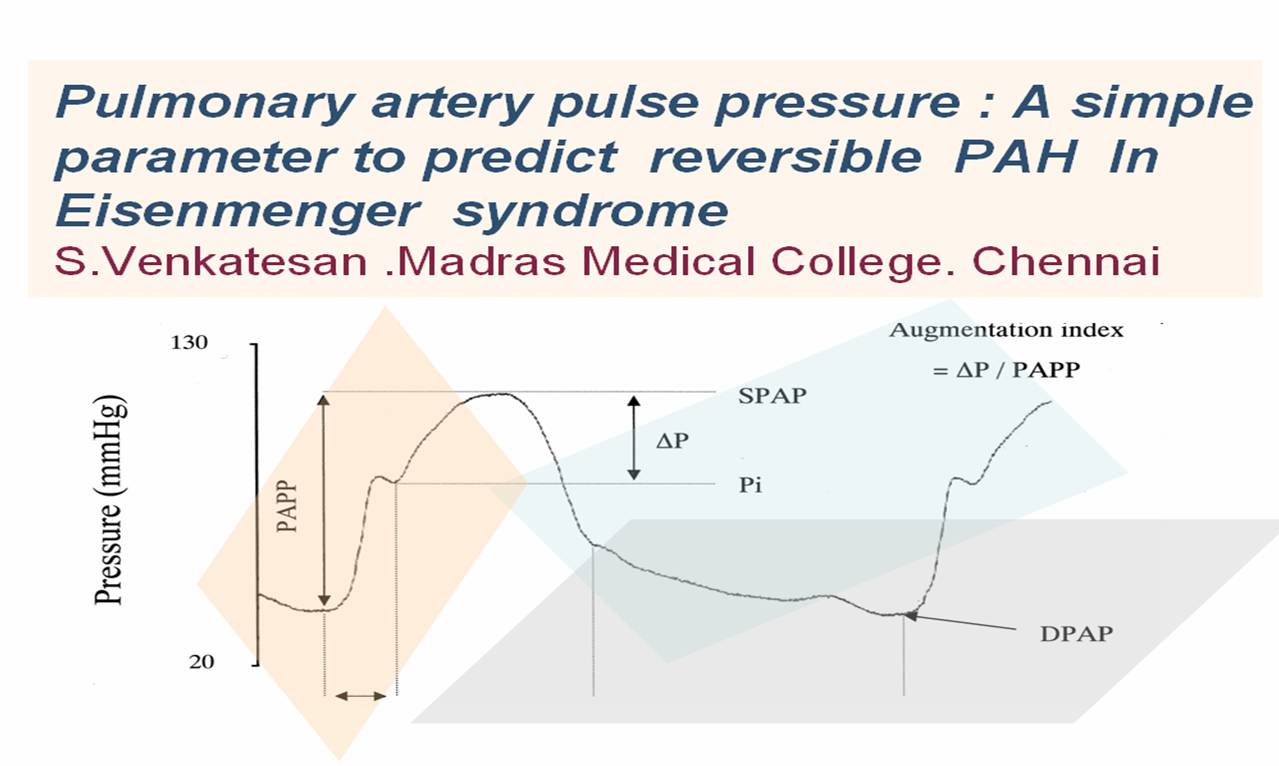
This short paper was presented in the Annual scientific sessions of cardiological society of India 2009 regarding the usefulness of a new parameter to assess reversibility of PAH. This may not be called as  a study rather a report of  our experience  in  five  patients  with eisenmenger syndrome

Download the full PPT presentation in PDF  format.

pulmonary artery pulse pressure

Read Full Post »

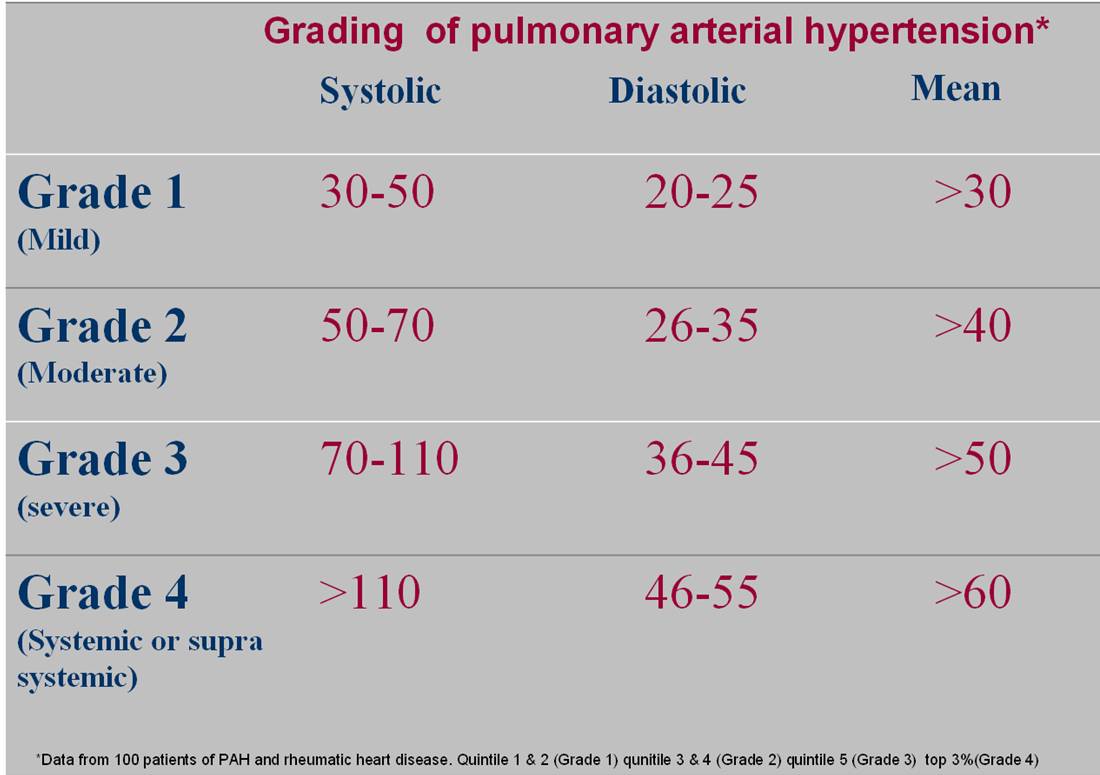
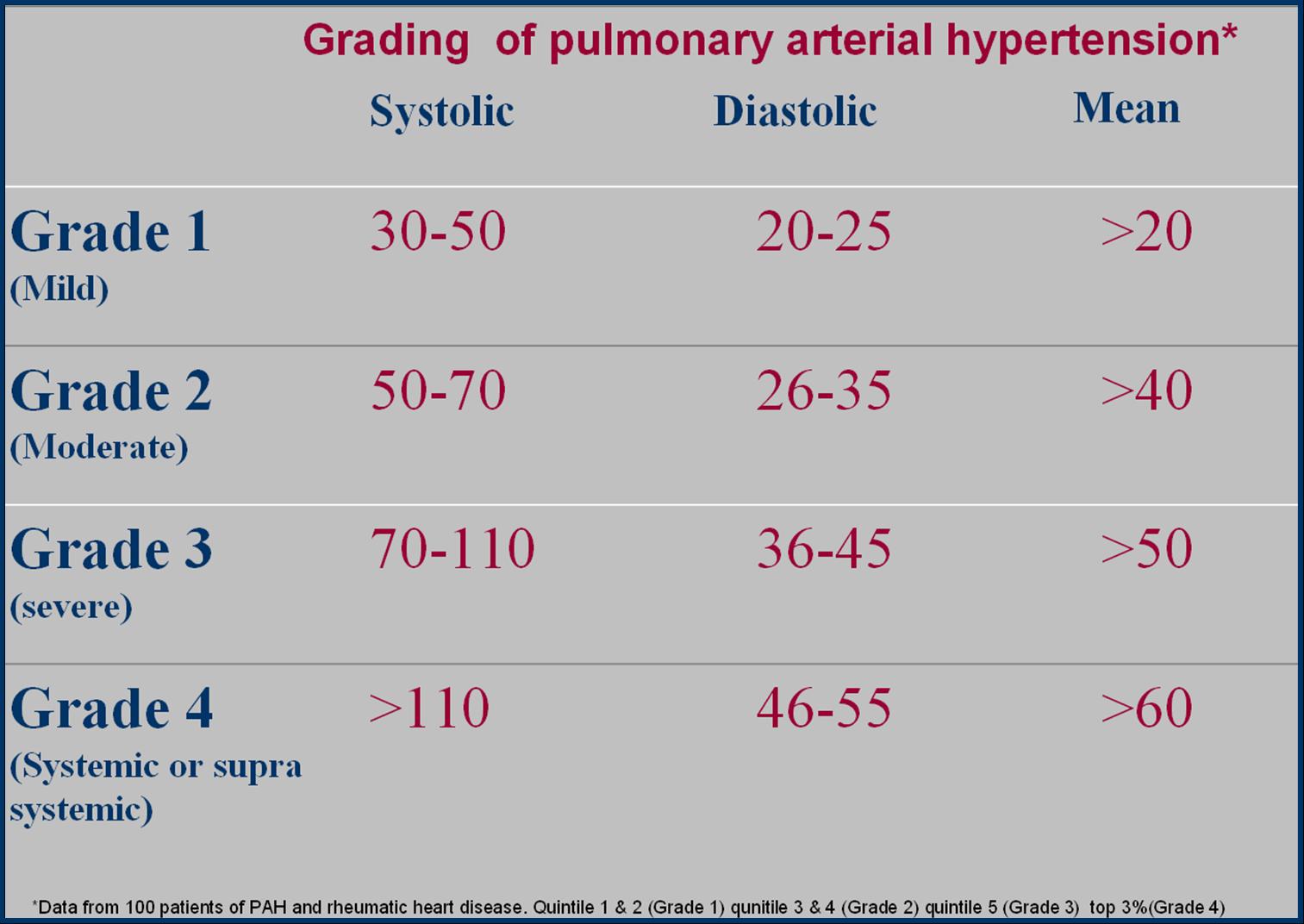
                                  Even as cardiology community is preoccupied with systemic hypertension & CAD  ,  pulmonary arterial hypertension(PAH) is a much neglected , still  an important clinical cardiac problem encountered . The irony is self evident , there are half a dozen methods to grade systemic hypertension not even a single stadardised grading available for pulmonary arterial hypertension. The WHO  working group defined pulmonary hypertension  few decades ago and was not clinically graded .The only grading available is based on  the pulmonary vascular biopsy changes (Heath Edwards) 

                                   Currently PAH management has gone through revolutionary changes. There is an urgent  need for grading  this entity .This will facilitate to  diagnose , manage and assess the efficacy of the currently available treatment.

                                Developing countries like ours have a great number of PAH due to rampant rheumatic heart disease.  A simple study was done in  100 patients with PAH .Bulk of the study population had RHD .Few had primary pulmonary  hypertension .Systolic , diastolic, and mean pressure was assessed by doppler echocardiographic analysis of tricuspid regurgitation (TR) and pulmonary regurgitaion(PR) jets. TR jet provided the systolic PA pressure , PR jet provided mean as well as diastolic PA pressure .TR jet was available in all patients. PR jet was available only in 60 patients .Hence the diastolic andmean PA pressure data has been extrapolated in some  and  was plotted in a scatter diagram. Five equal quintiles were divided. Patients in first  and 2nd quintiles were graded 1   and third  and 4th  quintile were  graded 2 ,  5 th  was graded 3 respectively. From this cut off points for  various grades of PAH were identified .The top 3% of patients  with highest PAP were graded as grade 4 and all of them had supra systemic PAH. 

The following grading is suggested for PAH* 

 *This is a preliminary  attempt to grade PAH. This could be applicable mainly in rheumatic heart disese and primary pulmonary hypertension .Further refining of methodology is  required.PAH grading may be little different in congenital left to right shunts.

Read Full Post »

Older Posts »