Feeds:
Posts
Comments

Posts Tagged ‘stemi’

A 55  year old man came with a BP of  1o0/70 with vague symptoms of back  pain to our ER.

Troponin T  was positive

Can we thrombolyse ?

There is a minimal ST elevation in inferior leads  but not amounting to  the required criteria 1 mm

Technically No , Academically yes , scientifically No , logically  yes

*I wont thromolyse but i will take him to cath lab maybe the modern answer

 What we did ?

We did neither !

Just observed in CCU with heparin infusion , Aspirin and clopidogrel .
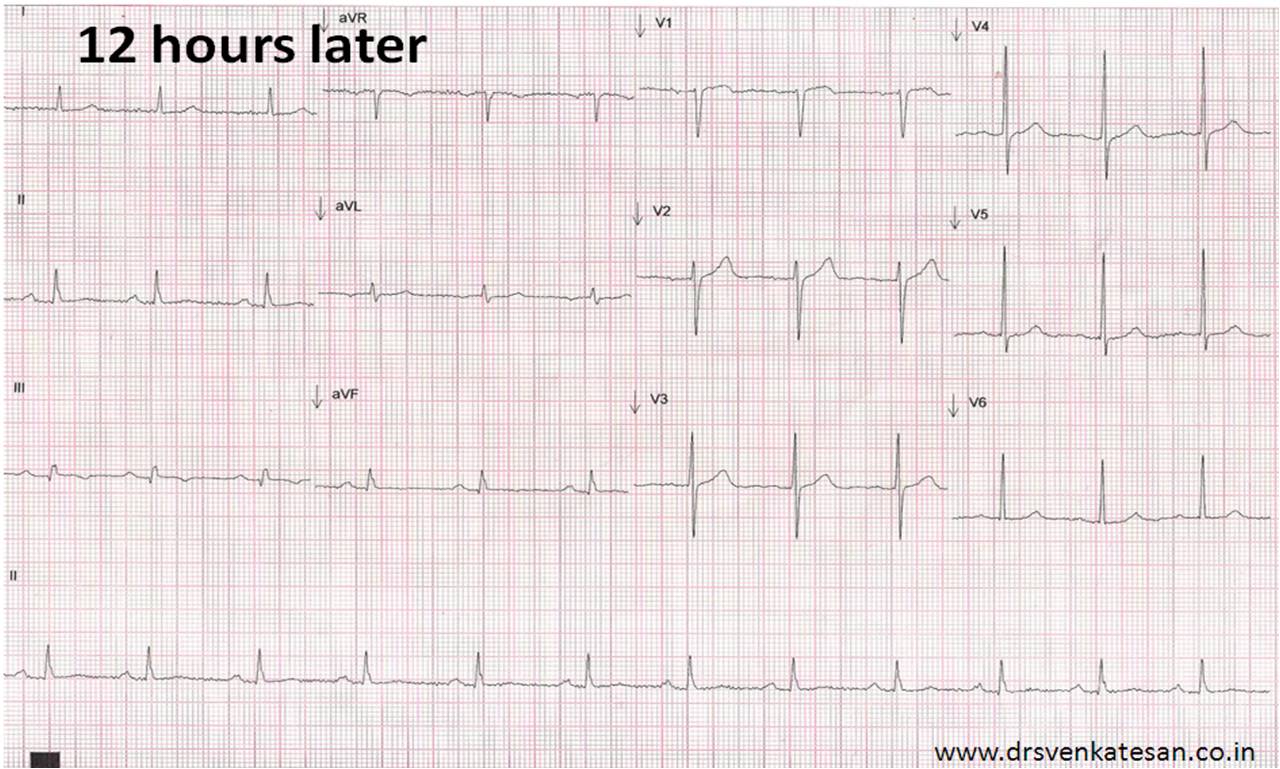
Note: The ECG becomes almost normal .The initial suggestion of inferior MI is stands questionable

Serial ECGs  were taken .
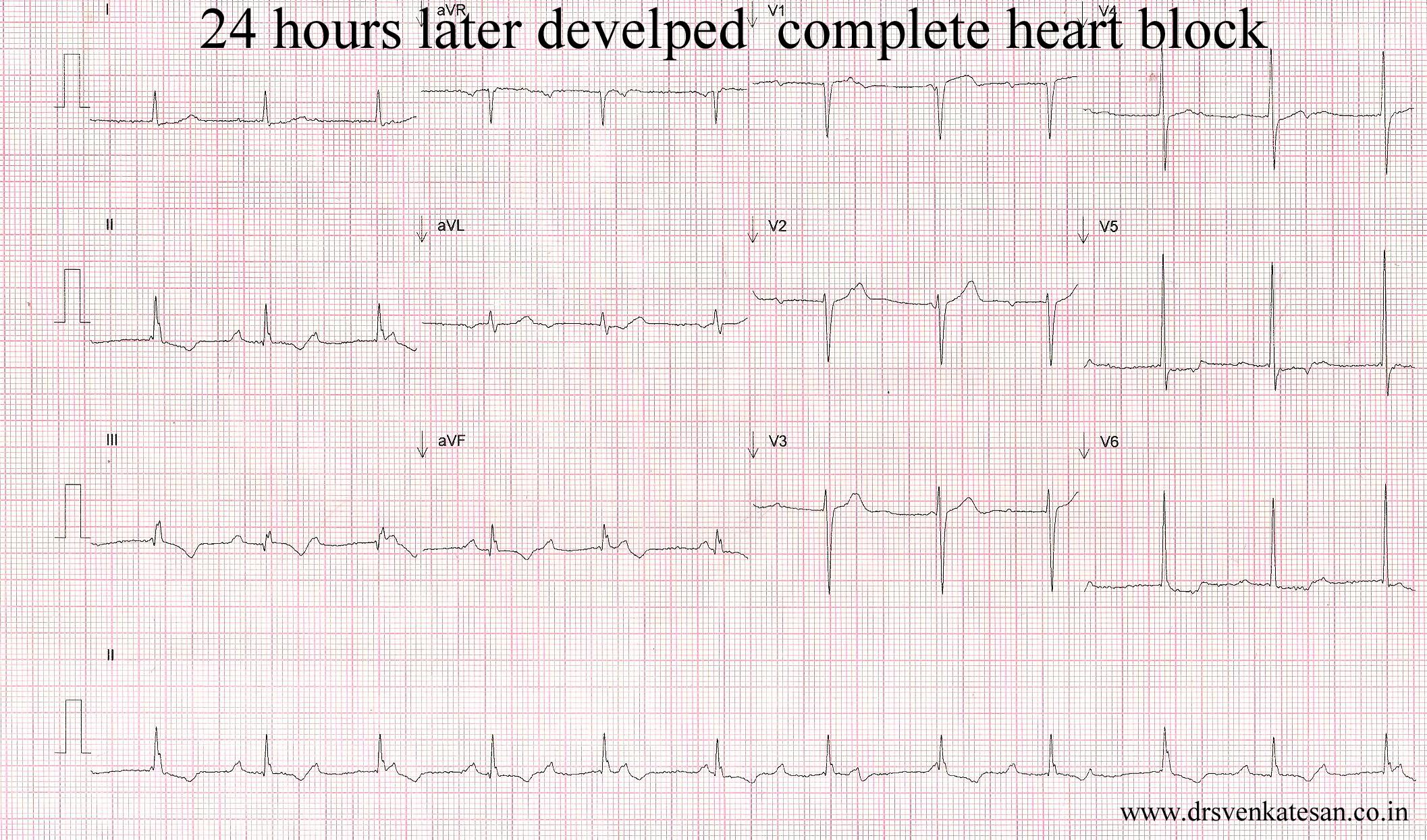
And now . . . after 24 hours a new complete heart block appear with classical evolved pattern of inferior MI.The most interesting feature is patient has been comfortable all along even as his posterior aspect of heart is experiencing terrible electrical earth quakes.

Is troponin Guided thrombolyis  an accepted  concept  ?

Yes ,  only in few situations like , posterior MI ,   LBBB  , pacemaker rhythm, re infarction .(Note , true posterior MI do not elevate the ST segment but depress it ) .

One may be surprised why we shouldn’t lyse a patient  whenever  troponin is elevated in acute coronary syndrome  (After all it denotes myocardial necrosis and infarct !)  The point here  is ,  troponin can raise in all forms of MI (NSTEMI, even in some cases of chronic stable angina )  Read in this link Why thrombolysis is contrindicated in UA/NSTEMI

The benefits of thrombolysis  is not proven in small and micro infarcts.  ECG  ST  eelvation   remain the  sole criteria for thromolysis for STEMI because  of  high degree of  correlation with total coronary occlusion .

In this era of rapid interventions the treatment concepts has blurred as we tend to do PCI and stenting  most cases of ACS including UA/Unstable angina

OK , what happened to this patient ?

Temporary pacer  was kept stand by with a sheath and catheter in situ.

Next day  morning  AV block disappeared .Patient was comfortable .

To our surprise , in the same  evening his ECG showed a complete heart block with AV dissociation . Still the heart rate was good . The demand temporary pacemaker didn’t take over .

On the third day , every conduction disturbance disappeared and  patient was sent to the wards. He is being discharged in a  stable condition with std drugs .there was  a minimal wall motion defect in infero-posterior segments with an ejection fraction of 50 % . He is  scheduled for coronary angiogram  2 weeks later.

What is the pathology ?

Pathologicallyit could be a small focal area of Infarct  incidenataly invloving the AV node .(This is alss refered to as vital area Infarct”  )It is hard to differentiate whether AV block is due to revrible ischemia or necrosis  , simple tissue edema ,  high vagal tone . or combination of above .If the block recovers it can be concluded necrosis is not the dominant theme.


Final message

STEMI presenting  primarily as heart block is less common .  When such a presentation occurs extra caution is required.

Many  of these patients  may not show a classical ST elevation  and hence do not permit us to thrombolyse   as per criteria.

It is  the  individual physician’s discretion to do so ( or not to do  ! ) . No body is going to fault. After  all  5 % of thrombolyis world over is for  benign early  repolarisation syndromes.

The above description is  an example of complicated inferior MI  . . .  still managed effectively by conventional methods.

Further reading

Why inferior MI is considered Inferior ?
 

Read Full Post »

A patient with  chest pain   is being rushed   into the ER  of  a medium sized cardiac facility in an urban county of India .The fellow briefs the senior consultant cardiologist about the arrival of  this  extensive anterior  STEMI  over phone.  The  consultant  enquires  about the “symptom to door time” and  was little concerned  when the fellow said ” it is only  2 hours sir”  .The fellow was amused with the consultant’s  reaction.

The consultant arrived in 15 minutes  and  began  the all important  discussion with the  patient  and his spouse  .(Meanwhile tablet clopidogrel and Aspirin was  loaded  per orally . Note : Heparin is not given yet )

Cardiologist : It is a  massive heart attack . One of your coronary artery  got  blocked suddenly , I have to remove the block at the earliest . There are  two ways of doing it .  One is fibrinolysis which lyses the clot .It can open up  your vessel  , though incompletely but would prevent myocardial damage  at the earliest .

The other one is PCI ,  which if performed rapidly  will completely  open up the vessel in question , what  we call TIMI 3 flow ,  But it has to be done within one hour.

Patient : Which is better doctor for me ?

Cardiologist : My cath lab  logistics  does not allow me to do a  PCI within the stipulated  time ,   still  I wish  to perform   a primary angioplasty  as i am not a believer  in thrombolysis !

So , even though you are  eligible for both modes of re- perfusion, in the strict sense doing a  PCI  which will  ultimately be  delayed  beyond the recommended time window  is technically contraindicated “

(Please  be notified : Currently , if the delay is during the procedure due to some technical issues after starting the procedure  or if the delay is at  the patient   level in arranging the required finance or insurance clearance it can be condoned without any ethical issues )

Patients spouse : Doctor please save my  husband . You  start  the fibrinolysis  every minute is risky isn’t doctor , and do the PCI once its ready doctor .

No . . . Fibrinolysis  does not combine well with PCI  in fact it will worsen the situation .   Thats what FINNESSE  study says . We can do only one of them . . . not both .

The patient and spouse (Terribly confused  by now )

Cardiologist:  By the way , what is  your insurance limit  sir ?

Patients spouse : Its 4 lakhs

Cardiologist : OK , that should be suffice  90 out of 100 times . Any way keep another lakh ready in case I need IABP.

Patient : My pain is worsening doctor at least relieve  my pain till this debate  is over !

(A patient’s relative  browses his  i phone  and argues  the  cardiologist   to administer streptokinase at the earliest . Suddenly  the patient family lobbies for fibrinolytic mode  empowered by the i phone guy )

One of them shouts “Please doctor you do something either take him inside cath lab or  start a fibrinolyitc therapy ”

How did the cardiologist  fight his way through ? ( He gulps a cup of coffee and  starts a fresh discussion)


Cardiologist : 
I am sorry , you have come too early  for PCI .  Guidelines do not allow me to choose PCI in the first hour  as our  anticipated delay for PCI is more than 3 hours . I wish you arrived after  the 3 hour window .

“Of course you are on time for thrombolysis”  which  unfortunately I am against !

Now, I am going to wait ( You may think it is a waste of time i call it as patient preparation time )  .This waiting period incidentally  allows us to cross  three  hour  time  window ,  then the issue of not lysing  does n’t creep in at all . A PCI done after 3 hours is not a race against time , while a PCI done early is like  a power play in cricket .

I do not know whether this delay which is happening  right now –  Intentional /Unintentional,  Scientific / unscientific reasons  would  damage your heart or not !

Since you have an extensive MI , I earnestly believe  with all my wisdom and knowledge, you will do well with primary PCI  even if  i do it  little late .  Please allow me to violate the standard criteria in the interest of your heart .

Cardiologist : I wonder , if you had arrived little late we wouldn’t be discussing this terrible conversation at all .Your myocardium  will also feel thrilled for getting a better mode of re-perfusion. You put me in an awkward situation by coming early !

Patient : But  . . . doctor every one  tells me ,  one should reach the hospital  after a heart attack  at the earliest  is it not ?   Please believe me doctor ,  I  made  extraordinary  efforts to  arrive early to your hospital , but you have put me on hold doctor !

Cardiologist :I agree  . . . but you won’t understand the modern jargons  in  interventional  cardiology ,  some times (Or is  it many times !) we will be doing the diagonally opposite to what  is   preached  in text books  .  Both intentional and unintentional delays are common  in the emergency cardiac  care . Do not bother about it   . . . science will take care of it !

Patient : You mean  . . . you are going to waste the golden hour in STEMI by simply arranging for cath lab staffs and machinery .

Cardiologist : You got the point right ! Just sit back enjoy the  flight !

Patient : Your wish is my wish doctor . Please handle with care doc !

* Please note this is an imaginary conversation ( Most often happens in silent mode !) in many of the cath labs which do not have 24 hour service. In a country  with  100 crore population like India ,  less than a dozen cathlabs  work round the clock . Guess  how often such a  situation would come in day to  day cardiology practice.


Read Full Post »

During   primary PCI , the weakest link  for a  cardiologist  is  , he is never sure whether  the  metal jacket  has covered the entire  disease segment with optimal apposition .  (Geographical miss is another issue !)

This is because  , even though the inflation pressure is  uniform  within the balloon ,  the required  apposition pressure is not the same .This is obvious as the lesion surface has a varying consistency and uneven surfaces . It is a  huge guess to quantitate the relative  contribution of thrombus and plaque  within  the 100 % occlusion  that has resulted in the STEMI. Hence  some areas may get over apposed and others lesser apposed. Further , the stent -vessel wall interface  in all likely hood enclose a   layer  of clot .This is almost certain  during complex primary PCI. One can imagine the sequel if this thrombus layer dissolves later ! (Edentulous stent )

It is surprising , why cardiologists has  so far not  thought  of a  self expanding stent  which  can snugly appose the vessel wall in this setting  . The   radial strength   from the  stored potential energy can be used up future use. This is most important  in first few days following STEMI  , when the coronary arterial lumen can vary depending  upon the

  • Vasomotor  tone .
  • presence of thrombus
  • Plaque   ploughing /milking  effect
  • Vascular remodeling

Cardiologists  deploy a stent  based on the morphology  on day zero of STEMI  .This may be  totally irrelevant  , since after a  few days    the lesion may change its morphology ,  thrombus may migrate , vascular  dimension may change. In such a  situation*  , a self expanding stent can tackle these issues very effectively by constantly adjusting  and fine tuning the luminal  diameter and  the apposition pressure . It  does not give any chance  for  thrombus to form  between the vessel wall and stent .

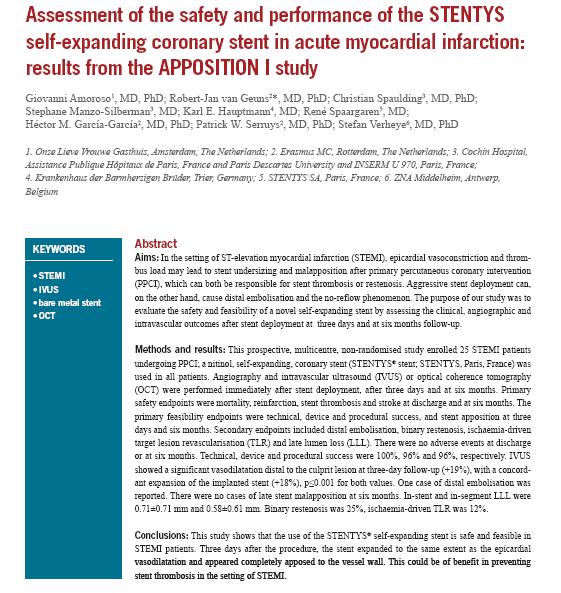
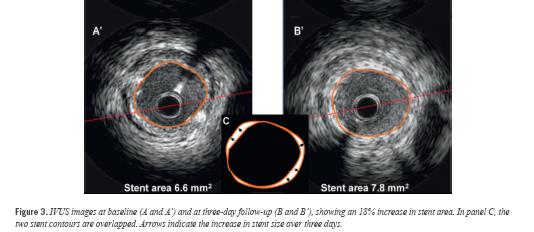
Here is a study that gives fresh insights regarding the role of self expanding stents during STEMI .

Note the “Auto adjusting”  of stent diameter  in the first few days after  the stent deployment, depending upon the luminal needs !

Animation

http://www.stentys.com/file_bdd/annexes/1284135580_video_stentys_en.swf

* Logically  during  primary PCI for  STEMI  ,  POBA and thrombus suction  may be the best option in many as all stent related complication is instantly eliminated .But it is a battered concept ,  most of the current day cardiologists would feel guilty to come out of  the cath lab  without a stent  in  primary PCI scenario  !

Final message

Self  expanding stents during primary PCI :  Is it a  perfect solution  for optimal stent apposition  ?

It seems so  . . . but  the track record of current cardiology devices never fulfilled the initial promises !

Read Full Post »

Can you diagnose inferior MI with poor R waves ?

No , you need  a “Q ” that’s  for sure !   Do not diagnose inferior MI without a  q wave  . ( The luxury of diagnosing MI without q waves  is available  only for LAD region )

Any axis deviation ( even 30 degrees) from  base line  can alter the inferior lead qrs morphology to a great extent. R wave amplitude is  primarily determined by the  initial septal depolarisation .  So if the  inferior septum is intact  it will never allow to inscribe a q wave  . Further ,  limb leads are bi polar leads and they are   sum-mated  potential  reflected along the entire  bottom half of the  torso . Hence it is not  reliable to attribute  significance  to presence or absence of  r wave (Unlike  chest leads).

The lung and diaphragm  exert  not only electrical insulation but   also mechanical  alteration of septal profile with phases  of respiration.

Counter point

Not really  . . .  you do not need a  Q   waves  to diagnose inferior MI  ,  electrically  diminutive R  is same as  “Q”

There is  an alternate way of  reasoning  too  . R wave is muscle , We diagnose LVH with tall  R waves so muscle loss should be equivalent to R wave loss .We have innumerable examples where  low voltage R waves are  recorded in inferior leads after a well documented inferior MI.

How do you diagnose old inferior MI by ECG ?

  1. Near normal ECG with degeneration of q waves and regeneration* of  R waves
  2. Residual T wave inversion
  3. Simple low voltage inferior leads
  4. Slurred or notched qrs  complex in 2 3 AVF
  5. Rarely with atrial abnormalities and AV nodal prolongations

The concept of regenerated R is well established . And it brings to the age-old debate of R with live muscle Q is dead muscle

Regeneration is salvaged muscle (Natural salvage , awakening from hibernation etc)

How good is Echocardiogram in diagnosing old Inferior MIs ?

Surprisingly , echocardiography do not help much either .Technically inferior transmural MI  is expected to  leave  a residual wall motion defect.  But many times it do not. Many non q inferior MI (Is there such an entity ?)  do look perfectly normal by echo .

The primary reason  for this is ,  infero-posterior surface is anatomically remote and it makes  wall motion analysis difficult .Newer tissue motion analysis (Velocity vector imaging)  could aid us better.

Some times a trivial or mild  mitral regurgitation is the only sign of   old inferior MI  as  the pap  muscle  lags behind in it’s  functional recovery  while  free posterior wall is  fully salvaged and contracting well .

Final message

It needs  that extra bit of   of  knowledge to  expose  our ignorance.

Even in this  maddening   scientific  era  we have valid  reasons to  go back to fundamentals  of  R wave and Q  wave genesis in MI ,  where clarity  is lacking .

Read Full Post »

Preamble

The much published TRANSFER -AMI study  has few important queries to ponder about.It was supposed to test the role of routine PCI following  thrombolysis. In other words it compared  rescue only strategy with routine strategy.The caveat is , even among  failed thrombolysis, the   rescue strategy has not convincingly proven superior to medical management  (if the time is lapsed ) as much of the damage is done .

In essence , Acute MI is  more about time management than drug or cath lab management

  1. Why the 67 % of  standard therapy cohort underwent PCI. Technically , you are supposed to transfer for rescue only if there is a  failed thrombolysis ?That is the standard approach , if  most of the cases are any way land up in cath lab , then you are trying to compare two similar groups .
  2. Why the rate of   failed thrombolyis with TNK-TPA in both arms not disclosed ?
  3. How can a 92% of study population be in class 1 Killip still considered to be high risk group ?
  4. Why the recurrent ischemia  was very vaguely  defined and still included and clubbed with primary end point along with deaths. If only recurrent ischemia was removed from primary end point . . .this study will straight away land in a regret bin.
  5. Why there were 6 additional deaths at 30 days  in routine early  PCI group ,  What was he cause of death ? Mind you these deaths have happened in a 92 %  Killip class  one cohort . Is it  not important ? The trend looks vitally   significant .We can not afford take refuge under a false  statistical roof .
  6. How many patients died or  developed MI  because of the early PCI in-spite of having  successful thrombolysis.This again could be vital . Complications during intervention  for a failed thrombolysis may be acceptable. While ,complications , when we try to  improve upon the already  successful thrombolysis is simply not acceptable .

Will the investigators share their experience ?

Finally

Why the title of the paper says it is about “Routine angioplasty” and  the conclusion emphasizes  it is indeed   “high risk subsets ofangioplasty” (While the study itself involves a 92 %  least risk Killip class 1 ) .  Why this double dose of confusion ?  (Is it deliberate  ! Which i think is unlikely )

NEJM please take note of this  . . .

All that glitters  are  not natural glitter . . .some are made to glitter !

Read Full Post »

NSTEMI is a  common clinical problems in CCU.

When we say  NSTEMI it can mean any of the following

  • NSTEMI with ST depression
  • NSTEMI with T  wave Inversion
  • NSTEMI with Biphasic T wave
  • NSTEMI with normal ECG
  • The irony   called STEMI evolving as  NSTEMI**

By default most of  us think ,  if it is NSTEMI  . . . there  must be ST depression. This thinking is  not logical but traditional. Still,   ST depression may be the  common presentation. NSTEMI with ST depression  has much worse outcome than other forms.

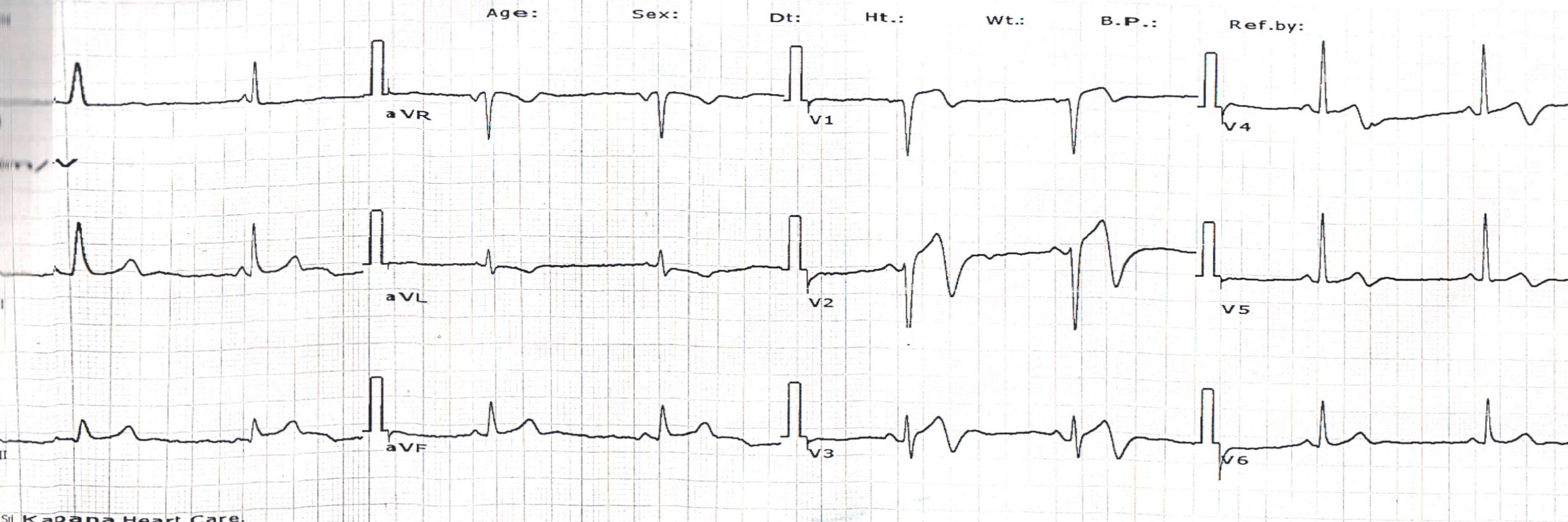
The following ECG is from a 45 year old man with a vague mid sternal  chest pain for 48 hours.

The unusual type of NSTEMI with Bi-phasic T waves

His echo showed wall motion defect in LCX territory .A diagnosis of NSTEMI was made.The predominant finding was biphasic T waves .

**One may wonder  why can’t we call this ECG as a  Classical STEMI ?

There is a 2mm  ST elevation ,  with a infarct as well  ? But , the point  here  is there is no business for T waves to get bi-phasic or inverted in the early hours  of  a  classical STEMI .

This  exactly has happened here. Hence we can not call  the above event as  STEMI . Instead it  is ,  STEMI   evolving into NSTEMI . So  a combination of  features of STEMI/NSTEMI occur together. The best description for above  entity is  STEMI in transition to Non Q MI

Read the related article in my site  Is the terminology of Non Q MI still relevant or obsolete ?

Read Full Post »

T waves attract less  attention in STEMI ,except for the  fact   tall T waves  implies   hyper acute phase of  STEMI.

What is the duration of hyper acute phase ?

  1. Few seconds
  2. Few minutes
  3. An hour
  4. Few hours
  5. Any of the above

Answer

No one exactly knows  .It can  be highly variable .  So , 5  could be  the correct answer .  

 * Most importantly  hyper acute phase  need not occur in all patients with STEMI as suggested in experimental models.

Some  observations in T wave behavior in STEMI

Mechanism of hyper acute  T waves

It is the pottsium channel dynamics.Transient intracellular hyperkalemia  is thought to be responsible.

T wave as marker of  reperfusion

Inverted T wave in precordial leads are a good marker of IRA patency  especially in LAD

Slowly evolving STEMI

This is relatively  new concept . STEMI with a prolonged hyper acute phase  ,  ie ,  T waves ” dilly dallying”  for hours or even few days have been recognised. (This was  refered  to pre-infarction angina in the past )

This sort of T wave behavior makes it difficult to diagnose STEMI.Enzymes will help , still  thrombolytic guidelines  demand us to wait till ST elevation to occur. This is  unfortunate .But as physicians we are  justified to thrombolyse tall T waves with a clinical ACS .The other simple solution is to shift the patient to cath lab to find what exactly is happening in the LAD ! 

Now , what is new about  T waves in STEMI ?

It is  the localizing value  in LAD infarct

A tall persistent  hyper acute T wave  helps us to localise a LAD lesion .This paper from Netherlands ,  clearly  confirms this observation. The study was done from a primary PCI cohort,   a perfect setting to assess the  T wave behavior  in the early minutes /hours of  STEMI .

Other mysteries about T waves in STEMI

Does hyperacute T waves  occur in infero-posterior STEMI ?

I would believe it is very rare .Our CCU has not seen any tall T waves in inferior lead. Further analysis of the  data from the  above study could answer this question .

How often a  hyperacute T waves transform into NSTEMI ?

This again is not clear.Most of the hyper acute T will evolve as STEMI .But  , nothing prevents it to evolve as NSTEMI a well . After all , a hyper acute T   MI can  spontaneously lyse in a lucky few , ( Who has that critical  mass of natural  circulating TPA )  .If  these natural lytic forces are only partially successful , it may evolve into de nova NSTEMI.

Bi-phasic T waves in ACS.

A benign looking T waves with terminal negativity in precordial leads  can some times be a deadly marker of critical LAD disease.This has been notorious to cause deaths in young men which often correlates with the widow maker lesion in LAD.

What is a slowly evolving STEMI ?

Prolonged tall T wave phase  possibly   indicate , the myocardium is relatively resistant to hypoxic damage .

The most bizarre aspect in our understanding about ACS pathophysiology  is the concept of  time window , based on which , all our  ACS therapeutics revolve !

Does all myocardial   cells  have a same ischemic shelf  life ?  Can some patients  be  blessed with  resistant myocardial cells   when confronted with hypoxia or ischemia ?

                                 It is well-known  , in some hearts ,  the  muscles go for necrosis within  30 minutes of  ischemia,  while some hearts can not be infarcted even after 24 hours of occlusion .So , slowly evolving STEMI is a feature of  myocardial ischemic resistance .This is not  a new phenomenon as we have extensively studied about the concept   ischemic preconditioning .

We wonder there is something more to it . . .  the quantum of preconditioning  can be inherited .Further  , we are grossly ignorant about  the molecular secrets of  non ischemic metabolic  preconditioning  .

Final message

                         T waves attract less  attention in STEMI . Cardiologists are often tuned to look only the ST segment , after all ,  ACS  itself is classified based on  the behavior of this segment.(STEMI/NSTEMI) . We need to recognise ,there is a significant subset of ACS   affecting exclusively T waves.  Shall we call T elevation  MI ? ( TEMI )

Do not ignore T waves in STEMI. It has more hidden electrophysiological  treasures that  is waiting to be explored .

Read Full Post »

Cleveland clinic is a leading centre for cardiac care .Major technological breakthrough occurs from this institute than any other place. Thousands of articles come out every year. Some articles , get global attention and make  a huge impact. These are usually related to a new hi- tech modality like CRT devices or percutaneous aortic valve deployment etc ,etc.

                                                Some articles , which are very important  may not get the due  attention . Journal editorial boards often  have a scorecard called impact factor .That is ,   how  a  journal  is  impacting the practice habits of  medical professionals . Ideally we need to have to grade individual   articles with impact factor .Many articles may not have any significant  impact  however good the impact factor of the journal.

Here is an article,  which excellently depicts the principles of management of ACS.  It was published in 2003 JACC,  by Steven Nissen  from Cleveland,  Ohio .It deserves more attention . Every cardiologist , involved in ACS management should read this, especially the interventionist.

Link to article placed her with courtesey of JACC

Read Full Post »

Acute coronary syndrome  is primarily a disease of blood vessel , which perfuses  the heart.  It can even be a disorder of blood, often called vulnerable blood which predispose  for intra- coronary thrombus .

Mind you  , heart is an innocent bystander ! to the onslaught of  coronary atherosclerosis !

Hence , we  often use two terminologies .

CAD : Pure vascular (Coronary )  disease without  any structural and functional impairment of heart  ( No Angina, No myocardial damage ) Most of the asymptomatic plaques  , non flow limiting  lesions, incidentally detected by the modern coronary imaging gadgets  fall in this category.

When does  CAD becomes CAHD ?

CAHD : Coronary artery heart disease .Here not only the coronary artery is diseased , but it has it’s mission fulfilled   ie target organ either damaged structurally (STEMI, NSTEMI ) or functionally (EST positive , Chronic stable angina CSA )

Does the heart does any wrong to suffer from Acute coronary  syndrome  ?

No, it is simply not .The fault lies in one or more  of the following   .Generally at-least two these factors are enough to impede blood flow )  . They  combine to produce an ACS.

  • Blood defect
  • Vessel wall defect
  • Slowing of flow (Stasis)

This is called as Virchow’s triad   suggested over 100 years ago . Still valid in the era of per cutaneous  aortic valve implantation.

* The concept of de-linking  disorders of  coronary  vascular disease  from myocardial disease  is vital  in understanding the implications of current modalities of treatment. 

Even though we PCIs target the culprit ie blood vessel , it need to  realised , we  always fall short of real target . . .namely the heart . In coronary interventions  the catheters and wires roam around superficially over the heart  and they never even touch the heart .This is the reason PCIs are struggling to prove it’s  worthiness over medical therapy in many CAHD patients , which can reach deep  into the vessel, heart  and even every individual cells of heart.

Many (or . . . is it most ?)  Interventional  cardiologists have a bad  reputation for ” failing to look  look beyond the lesion” .  It is estimated  a vast  number  of cathlabs  and CABG theaters worldwide  are engaged in futile  attempt to restore coronary artery patency after a target organ damage is done .This is akin to building flyovers  to dead and closed highways .

Salvaging a coronary  artery and reliving a coronary obstruction is an entirely unrelated and futile  exercise to  a patient who has a problem  primarily in  musculature .

The much debated concept of  documenting  myocardial viability  , before revascularisation  died a premature death as the concept  by itself , was not viable commercially . (Viability studies   , tend to tie down the hands of device industry further , some  interventional   cardiologists began to see this concept  as an  interference to their freedom to adventure  )

Of-course , now  we have  other parameters  phenomenon  like  FFR estimation by Doppler , epicardial  -myocardial dissociation, slow  flow , no re-flow are  gaining importance.

Final message

ACS is primarily a disease of blood vessel but it’s impact is huge on heart. We need to look beyond the lesion .Restoring  a blood vessel  patency  to an ailing organ (Heart ) is not synonymous with total  cardiac intervention  and protection . There is lot more to cardiac physiology other than it’s blood flow. Heart muscle is a too complex organ to be controlled by few balloons and wires  which beat around the bush.

Read Full Post »

This article is in response to the prevalent belief  about  primary PCI for STEMI   endorsed by world cardiology forums. (Caution: A highly personalized version)

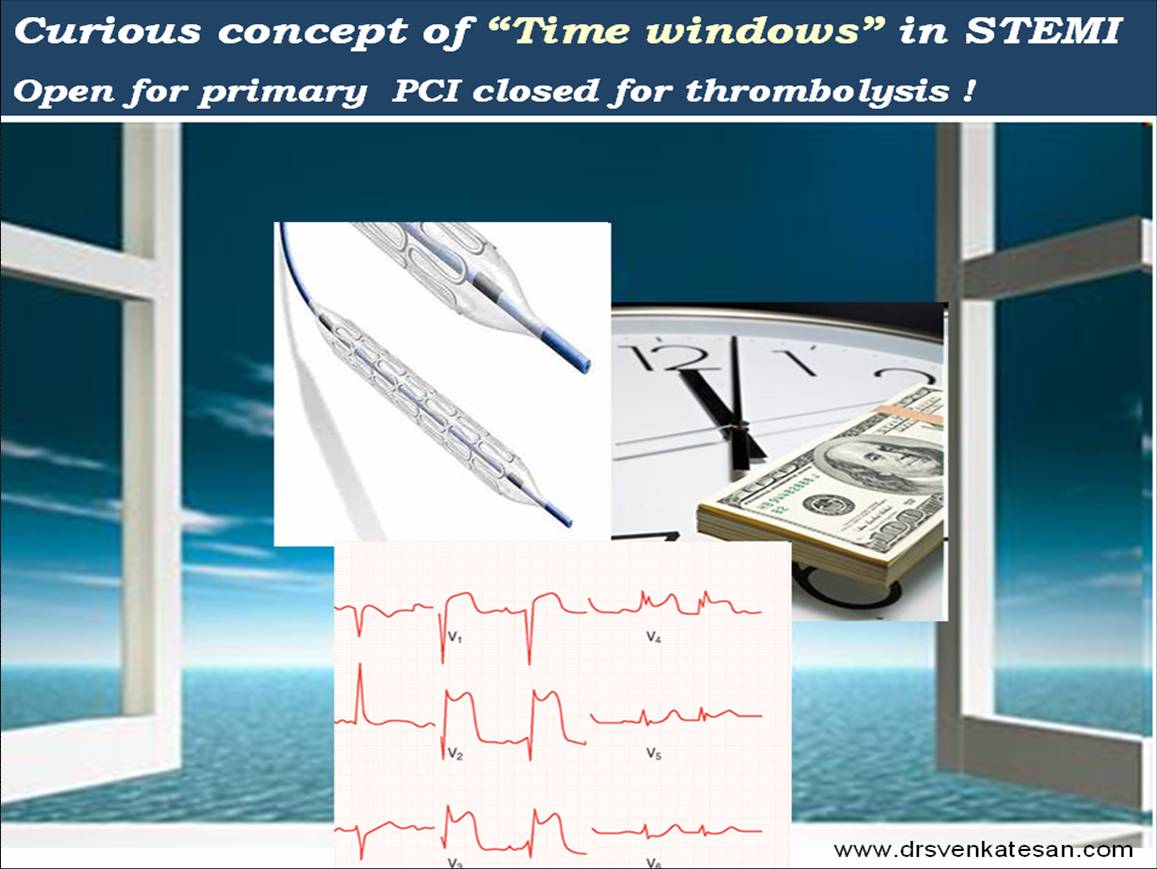
Time window in STEMI

  • Is the window half-opened  or half closed ?
  • Is it open at all ?
  • Or ,does it open only for primary PCI  ,and tend to close down  bluntly for thrombolysis

Modern medicine   grew faster than our thoughts .We have witnessed the audacity of advising  arm-chair treatment  for MI  till later half of   last century . Now we are talking about  air dropping of patients   over the  cath lab  roofs  for primary PCI.

Still ,we have not conquered the STEMI. While ,  we have learnt to “defy  deathin many patients  with cardiogenic shock , we continue to lose patients(“Invite death “)  in  some innocuous forms  of ACS due to procedural  complications  and inappropriate ( rather ignorant !) case selection.

Note : The ignorance  is not in   individual physician mind ,   it is prevalent in the whole cardiology knowledge pool.

The  crux of the issue for modern medicine is ,  how to reduce risk  in patients who are at  high risk and how not to convert a low risk patient into a high risk patient by the frightening medical gadgets.

In other  words ,  arm chair treatment for STEMI was  not (Still it is not !) a dustbin management . It has a potential to save  70 lives  out of 100. What many would  consider it as  ,  nothing but  the natural history of MI .

Medical management of STEMI is ridiculous !

That’s what a section of  cardiologists try to project by distorting the already flawed evidence base in cardiology. Some think it is equal  to no treatment. Here we fail to realise, even doing none has potential to save 70 lifes out of 100 in STEMI who reach the hospital.

Out of the  remaining , 10 lives   are saved by aspirin heparin (ISIS 2) and the concept of coronary  care . Another  7  lives are saved by thrombolysis (GUSTO,GISSI) . PCI  is shown to save saves one more life (PAMI).The remaining 6-7 % will die in CCU  irrespective of what we do .

Of course , now medical management has vastly improved since those days  .  A  thrombolysed ,  heparinsed ,  aspirinised ,  stanised  with adequately antagonized   adrenergic ,  angiotensin system   and   a proper coronary care ( That takes care electrical  short-circuiting  of heart)   will score  over interventional approach in vast majority of STEMI patients.

Now comes the real challenge . . .

When those 70 patients who are likely to survive  , “even a arm-chair treatment“, and the 20 other patients  who will  do a wonderful recovery with CCU care ,  enter  the cath lab  some times in wee hours of morning  . . .what happens  ?

What are the chances  of   a patient  who would otherwise be saved by an arm-chair treatment be  killed by vagaries of  cath lab  violence  ?(With due apologies ,statistics reveal  for every competent cath-lab   there are at least  10  incompetent  ones  world over !)

In the parlance of criminology , a hard core criminal may escape from  legal or illegal shoot out  but an innocent should  not die in cross fire , similarly ,  a cardiogenic shock patient with recurrent  VF  is  afford to lose his  life , but it is  a major medical crime to  lose a simple branch vessel  STEMI (PDA,OM,RCA )  to die in the cath lab,  whom in all probability  would have survived  the arm chair treatment.

Why this pessimistic view against primary PCI  ?

Yes, because  it  has potential to save  many lives  !

Time and again ,  we have  witnessed  lose of   many lifes  in many  popular hospitals in  India ,  where a   low risk MI  was  immediately  converted  to a high risk MI  after an primary  PCI with number of complications .

I strongly believe I have saved 100s of patients  with  low risk MIs by not  doing  for primary  PCI in the last  two decades.

*The argument that PCI confers better LV function and longterm  beneficial effect is also not very convincing for low risk MIs .This will be addressed separately

The demise of comparative efficacy research.

Primary PCI is superior to thrombolysis  : It is agreed , it may be  fact in academic sense .

Experience has taught us , academics rarely succeeds in the bed side.

“superiority studies can never be equated  with comparable efficacy”

Only the  questions remain . . .

  • Where  is comparative efficacy  studies in STEMI ?(Read NEJM article )
  • Why we have not developed a risk based model  when formulating guidelines for   primary PCI ?
  • Is primary PCI for a PDA /D1/OM infarct worth same as PCI for left main ?
  • Is high volume center guarantee  best outcomes ?

Who is preventing comparative efficacy studies ?

Primary PCI : Still  struggling !

This study from the archives  of internal medicine tells   us , we are still scratching  the tips  of  iceberg (Iceberg  ? or Is it something else ?)  of  primary  PCI

Even a  pessimistic approach can be  more scientific  than a optimistic  !

When WHO can be influenzed and make a pseudo emergency pandemic  and pharma companies  make a quick 10 billion bucks  ,  Realise how easy  it is  for the   smaller ,  mainstream cardiology literature  to be  hijacked and contaminated .

Final message

Why we reverently follow the time window for thrombolysis,  while  we rarely apply it for PCI ?   This is  triumph of glamor over truth . The open artery hypothesis remains   in a  hypothetical state with no solid proof  for over 2o years since it was proposed.

Apply your mind in every  patient , do a conscious decision  to either thrombolyse  ,  PCI or none . All the three are  equally powerful approaches in tackling a STEMI , depending upon the time they present .Remember , the third modality of therapy comes free of cost !

Never think ,   just because  some one  has  an access to a sophisticated cath lab 24/7   , has a iberty to overlook the  concept of time window  !

Remember  you can’t  resuscitate   dead myocytes , however advanced your enthusiasm and   interventions are !

Realise , common sense is the most uncommon sense in this hyped up human infested planet.

Read Full Post »

« Newer Posts - Older Posts »