Feeds:
Posts
Comments

Archive for the ‘cardiac surgery’ Category

Aortic stenosis is the commonest valvular heart disease  in elderly. Severe aortic stenosis  requires early  aortic valve replacement . Severity of aortic stenosis is  best assessed by   echocardiogram. ( Cath studies are rarely indicated  now) Mean Doppler gradient across  the aortic valve (dPm) is the widely used  parameter to assess severity.Americans believe  in  a cut off value of  40mmhg  while  Europeans  want it  to be at  50 mmhg . Obviously, these  numbers 40/50   become  vital  as it determines the  critical decision of replacing the  aortic valve which carries up to 4-10 % mortality.

Even as we realize ,   Doppler gradients are so important , we also need to  know ,  how fragile  ( and  vulnerable  ! )  are the Doppler equations ,  especially when it is critically dependent on the angle , flow,  heart rate  , the LV  contractile  force  and associated MR etc. These errors are over and above the  the  technical simplification of Bernoulli equation  which ignores many accessories like viscous  friction ,  proximal velocity etc  .Mind you  . . .with this battered Doppler modality we make a critical operative decision !

Here comes  the ace . . . Shall we  term it as  as negligence  in clinical echocardiography ?

Apart from  the above factors  ,  a single  important  critical determinant of  pressure gradient across AV is the mean pressure in the Aorta itself .  The mean  LVOT gradient = LV cavity pressure -Systemic blood pressure.Echo derived gradient tells us only the pressure difference across the valve.It does not reveal how much is contributed by raise in LV cavity pressure and how much is contributed by the change in systemic pressure.

How many  cardiologists would  measure the simultaneous  blood pressure while recording LVOT  gradient in AS ?  ( To be precise it should be measured in the same cycle  )

If  Aortic mean pressure is high  as in systemic hypertension  LV pressure must raise considerably higher . The contractile capacity of LV is tested here. A hypertrophied LV  easily achieves this.  If the LV fails to elevate it’s intra -cavitory   pressure sufficiently high the LVOT gradient may never reach  the 40 /50 mmhg range  that is required to label  aortic stenosis as  severe.

Many hypertensive patients exactly experience  this situation . The left ventricle of  many  of the hypertensive patients  fail this stress test  and result in low gradient AS.  Note , this happens in spite of   having  normal EF.

The link between systemic hypertension and aortic stenosis is a complex one. The after load becomes double here.There is a strong vascular valvular interaction. The following effects  are seen.

The effect of SHT on AS

It is well known HT  initiates the Aortic stenotic  process by damaging the valve and  also  result in progression.

Transient elevation of systolic pressure  can result in increase aortic orifice , and a fall in gradient.

The effect of  AS on SHT

Once the AS becomes severe , the systolic blood pressure may be reduced. (This not a rule ) If the mechanism of HT is increased  vascular  tone (Which often is the case ) systolic BP will remain high .

Effect of AVR

Surprisingly ,  many times the blood pressure normalises after AVR.The mechanism is not known.

Role of Anti HT drugs.

Fixed vasodilators are thought to be contraindicated as sudden fall in systolic blood pressure against a fixed obstruction is detrimental.  ACEI may be tried cautiously.(SCOPE AS study )

Reference

The following are the excellent article on the topics .All provided free by the  “Heart” Journal
t


Final message

In the evaluation of  Aortic stenosis   ignorance continue to prevail over our  knowledge. The Gorlin’s  the  Hakki’s, and the Hatle’s formulas  have made the  calculation of aortic valve area  look like a   child’s  game  (Which is not !)

Referring  all patients  with a  mean gradient > 50mmhg to the surgeon for AVR (or now a  TAVI)   may be the  easiest option  for the cardiologists  (but definitely not an intelligent one ). Even  as we struggle to decode the intricacies of isolated  AS  ,  one can guess  the complexity  when SHT adds on to AS .

Understanding the hemo-dynamics in  AS in association with prevailing blood pressure is vital.  It is a more scientific way of doing  echocardiography . Every cardiologist should give their input as they encounter hypertensive patients with AS.

It  would appear  ,  an AS patient developing HT at a  later  age  and a HT patient developing AS later are two different poles in the hemodynamic spectrum.
Read Full Post »

Coronary collateral circulation is probably the most poorly understood circulation than any other.This  is ignorance at it’s best ,  in spite of the life saving potential  of this circulation. A popular  (mis )perception is  coronary collaterals  can support only  resting blood flow and it would  struggle  to compensate at times of exertion. This is based on few case studies and not based on large , authentic scientific data.

Does this reasoning mean  , coronary  collaterals   can never / ever be complete  ?

If we believe so   . . .we are grossly underestimating the power of  nature .(In fact , mankind  was humiliated by the nature  time and again !)

Lessons  from  a unique patient we have  encountered.

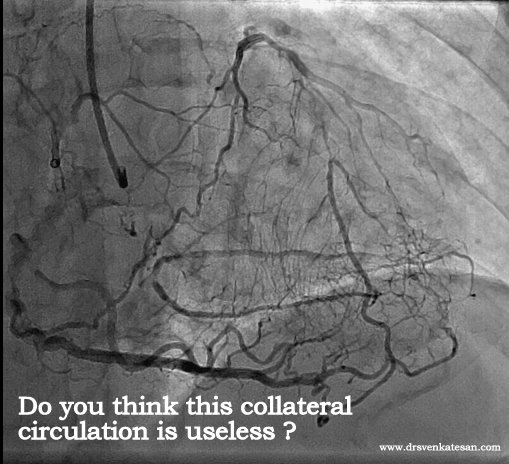
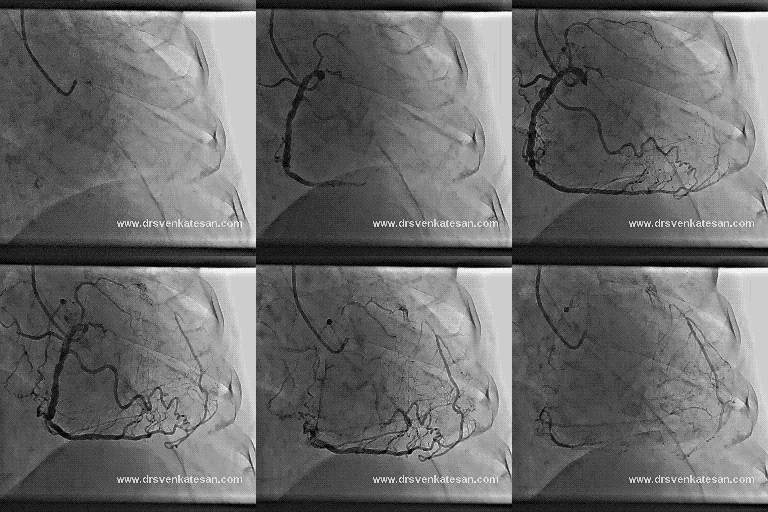
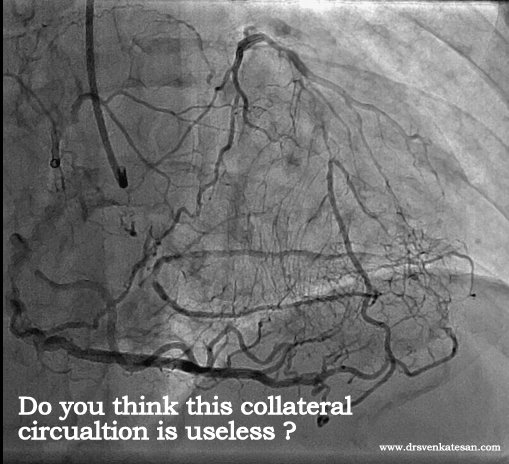
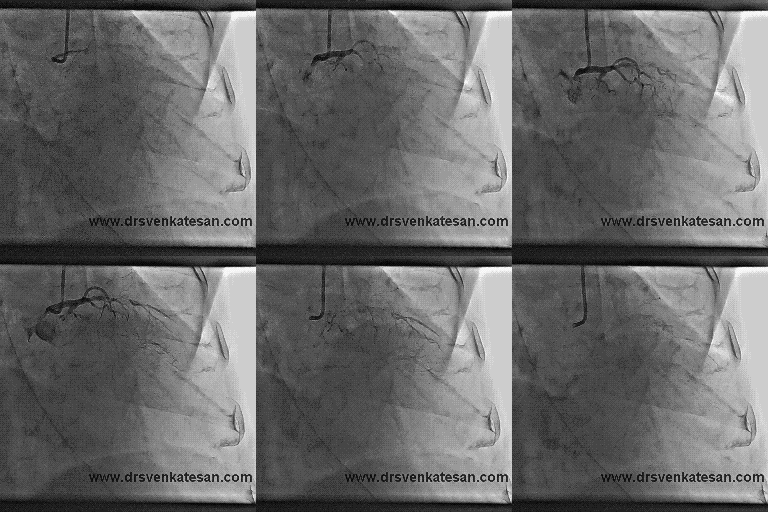
Here is an example of total LAD/LCX  occlusion with good collateral  from  RCA. He was having  stable  angina on medical  management . This patient  was not only  asymptomatic and was also negative for exercise  stress test at moderate work load .


There was an  intense debate about the management  when this angiogram was presented in the cath meeting .


  • Most of the cardiologists believed so !  But they had no answers why his stress test was negative.
  • The other argument for CABG was one can not allow a patient with a functionally single coronary  artery (RCA) However good is the collateral circulation.This at least  has some logic. not the first one !
  • One more suggestion was to quantitate  and map the real extent of ischemia by PET scanning and then decide about revascularisation.
  • One critical opinion was , since he was doing well with medical management what was the need to do coronary  angiogram at all ?

Any answers  . . .

He  ultimately went on to receive CABG (By popular opinion ) , but the point here is the collaterals were  good enough to support exertion.We have  documented quiet a few similar patients with collateral circulation supporting exercise.

What  happened to the collaterals  and (of course ) the patient after surgery ?

I will post you the  curious story soon   . . .

Final message

Coronary  collateral circulation , if well developed  can provide hemo-dynamically useful support even at times of exertion *

* The existing literature  is  biased against this concept. It generalizes all grades of collaterals into a single   entity. It is better  if we  spend more time to understand the nuances of coronary collateral circulation .

This is the  message from our observation. Do not ever believe whatever is published as facts in scientific literature. Observe, analyse , create your own inference ,  and concepts. Mainstream cardiologists would brand it unscientific  , Simply ignore it . Many times it is rewarding  to our patients.

Read Full Post »

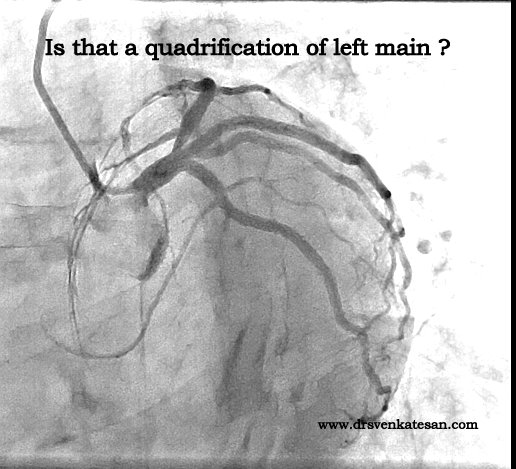
Left main divides into two. Some times into three . Very rarely into 4

Look  at this angiogram ,  This looks  like  a quadrification, if not quadrification equivalent

Clinical implication

A 4 way division invariably means the OM and diagonal or going to be diminutive.These people are expected to have favorable coronary hemodynamics during ACS , and  left main lesions are  less likely  to  occur

Reference

This article is from Singapore medical Journal

Read Full Post »

Prosthetic valve implantation has revolutionized the management of  valvular heart disease . The original concept valve  was a ball in a cage valve  , still considered as a  fascinating discovery.  It was conceived by the young Dr Starr and made by Engineer Edwards  .This was followed   by long hours of arguments,  debates and  experiments that ran into many months . The  silent corridors of  Oregon hospital Portland USA remain the only witness  to their hard work and motivation.  At last,  it happened , the first human valve was implanted in the year 1960. Since then . . . for nearly  50 years these valves  have done a seminal  job for the mankind.

With the advent of  disc valve and bi-leaflet valve in the  later decades of 20th century , we had to say a reluctant good-bye to this valve.

There is a  lingering question among many of the current generation cardiologists and surgeons why this valve became extinct ?

Starr and Edwards with their child !

We in India , are witnessing these old warrior inside the heart functioning for more than 30 years.From my institute of Madras medical college  which probably has inserted more Starr Edwards valve than any other  during the 1970s and 80s by Prof . Sadasivan , Solomon victor , and Vasudevan and others .

It is still a mystery why this valve lost its popularity and ultimately died a premature death.The modern hemodynamic  men  working from a theoretical labs thought  this valve was  hemodynamically  inferior. These Inferior valves worked  like a  power horse  inside the hearts  the poor Indian laborers  for over 30 years.

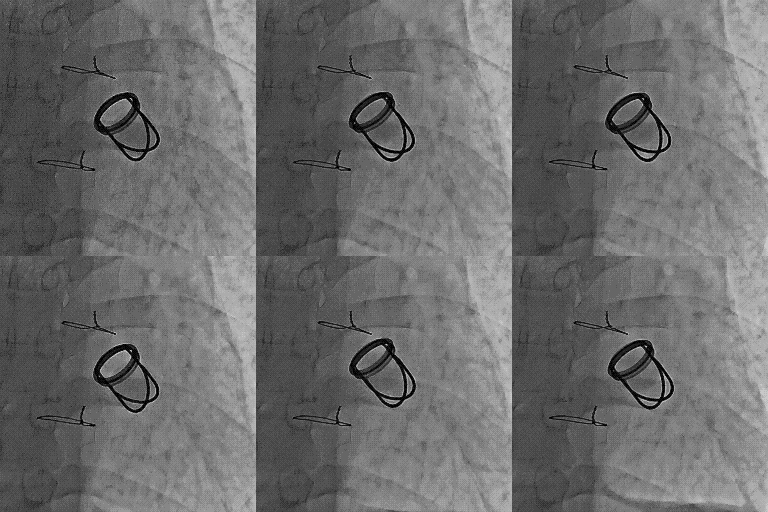
A Starr Edwards valve rocking inside the heart in mitral position

The cage which gives  a radial support* mimic  sub valvular apparatus, which none of the other valves can provide.

* Mitral  apparatus has 5 major  components. Annulus, leaflets, chordae, pap muscle, LV free wall.None of the artificial valves has all these components.  Though , we would love to have all of them technically it is simply not possible.  The metal cage of Starr Edwards  valve partially satisfies this  , as  it acts as a virtual sub valvular apparatus.Even though the cage has no contact with LV free wall, the mechano hydrolic  transduction of  LV forces to the annulus  is possible .

Further , the good hemodyanmics of this valve indicate , the cage ensures co axial blood  flow  across the mitral inflow throughout diastole. .Unlike the bi-leaflet valve ,  where the direction of  blood flow is determined by the quantum of leaflet excursion  in every beat . In bileaflet valves  each leaflet has independent determinants of valve  motion . In Starr Edwards valve the ball is the leaflet . In contrast to bi-leaflet valve , the contact area  of the  ball and the blood in Starr Edwards  is a smooth affair  and  ball makes sure  the LV forces are equally transmitted to it’s surface .

The superiority of bi-leaflet valves and disc valves  (Over ball and cage ) were  never proven convincingly in a randomized fashion . The other factor which pulled down this valve’s popularity was the supposedly high profile nature of this valve. LVOT tend to get narrowed in few undersized hearts.  This  can not be an  excuse , as no consistent  efforts were made to miniaturize this valve which is  distinctly possible.

Sudden deaths from  Starr Edwards valve  .

  • Almost unheard in our population.
  • The major reason  for the long durability of this valve is due to the  lack of  any metallic moving points .
  • Absence of hinge  in this  valve  confers  a huge mechanical  advantage with  no stress points.
  • A globe / or a ball  has  the universal hemodynamic advantage. This shape makes it difficult for thrombotic focus to stick and grow.

Final message

Science is considered as sacred as our religion Patients believe in us. We believe in science. A  good  durable valve  was  dumped from this world  for no good reason. If commerce is the  the main issue ( as many still believe it to be ! )  history will never  forgive those people who were  behind the murder of this innocent device.

Cardiologists and Cardio thoracic surgeons are equally culpable  for the pre- mature exit of this valve from human domain.  Why didn’t they protest ?  We  can get some solace  ,  if  only we can impress upon  the current valve manufacturers  to  give a fresh lease of life to this valve .

http://www.heartlungcirc.org/article/S1443-9506%2810%2900076-4/abstract

Read Full Post »

We know,  electrical deaths constitute the bulk of sudden cardiac deaths in MI.  Mechanical deaths due to pump failure, muscle rupture , valve leak , also cause significant deaths   .(Surprisingly many of the mechanical deaths   may also   fulfill  the sudden death criteria !)

Free wall rupture is  invariably a fatal event. Papillary  muscle trunk  rupture  leads to severe LVF and unless intervened sure to result in fatality.

The ones who tear their interventricular septum  are some what blessed ! Here ,  the rupture does not result in instant death as there is  no loss of blood ,   instead , there is an  volume over load of right ventricle  followed by the  left ventricle  after a  few beats. Hypotension is the  rule. Even though this is a major complication there is something about  VSR which makes it unique.

Sudden giving way of IVS has  a decompressing effect on the ailing left ventricle.This many times  bring a  temporary relief to LV and if the patient survives the first few hour he is likely to stabilise  further . In fact , sudden deaths within 24hours after the onset of VSR is an exception.This defect always gives the cardiologists and surgeon some time to plan the management. We need to use this time judiciously.

The natural history is delicate . Five themes are possible

  1. Very unstable Instant death( Fortunately a  rare theme )
  2. Unstable – Deteriorating further
  3. Unstable to Stable * fit for discharge even without surgery
  4. Stable from the onset and  continue to be stable* .
  5. Stable to Unstable (Probably the most common theme )

* Pleasant themes occasionally witnessed !)

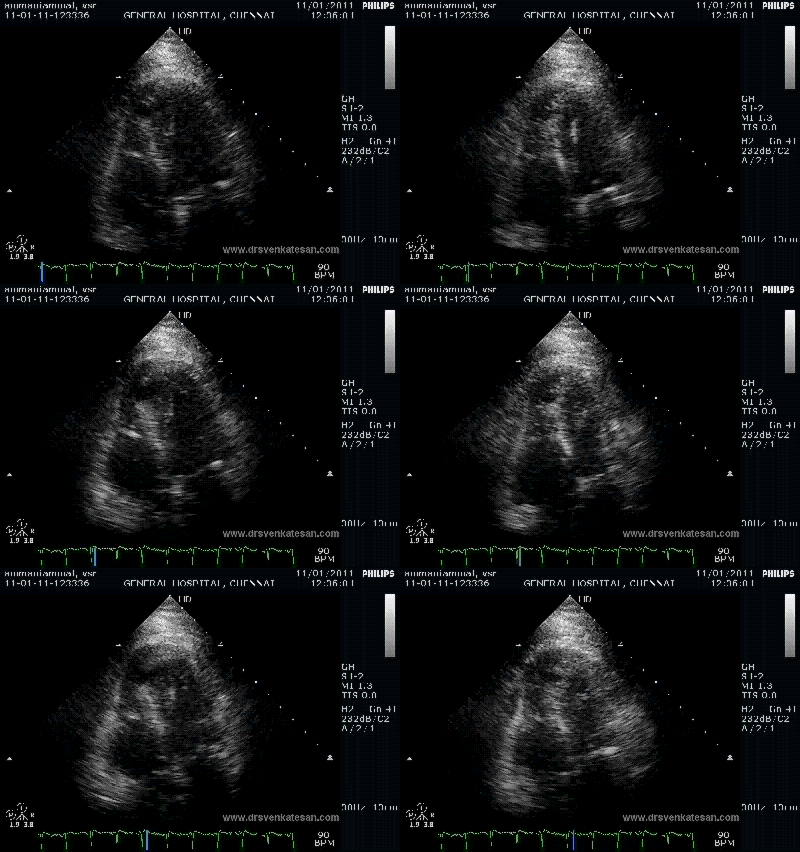
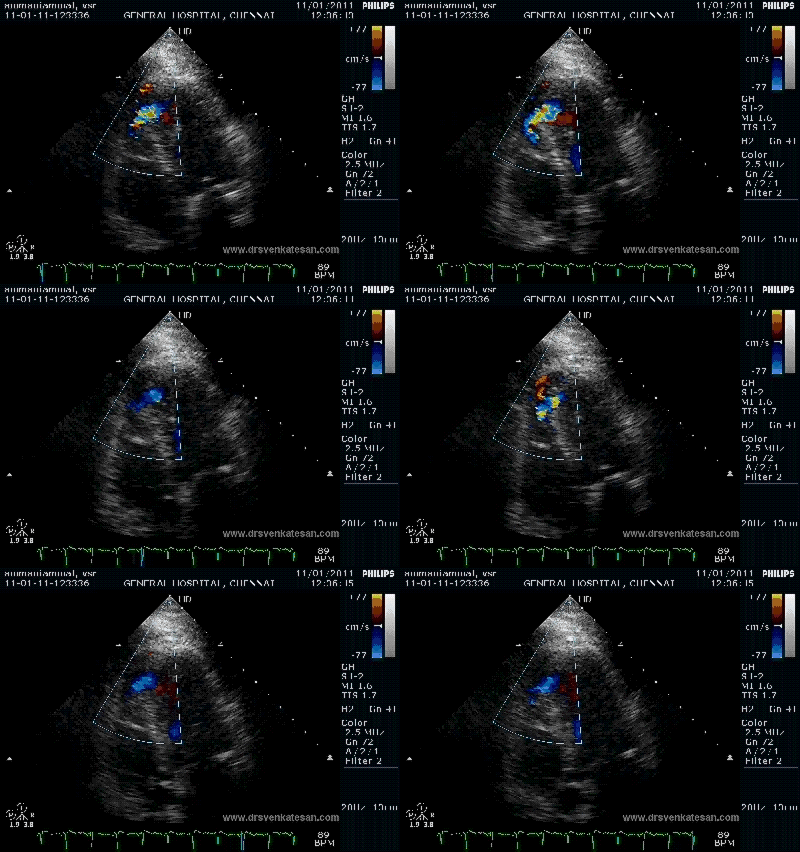
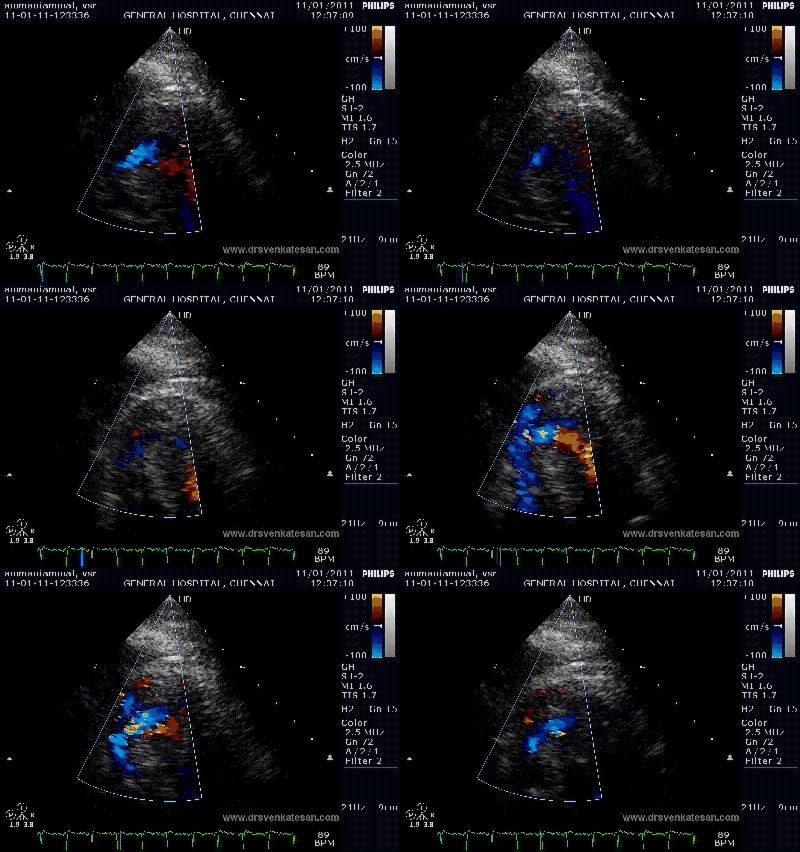
Here is 55 year old women came with extensive anterior MI with lower septal rupture.(She belonged to type 3 of the above scheme)

)

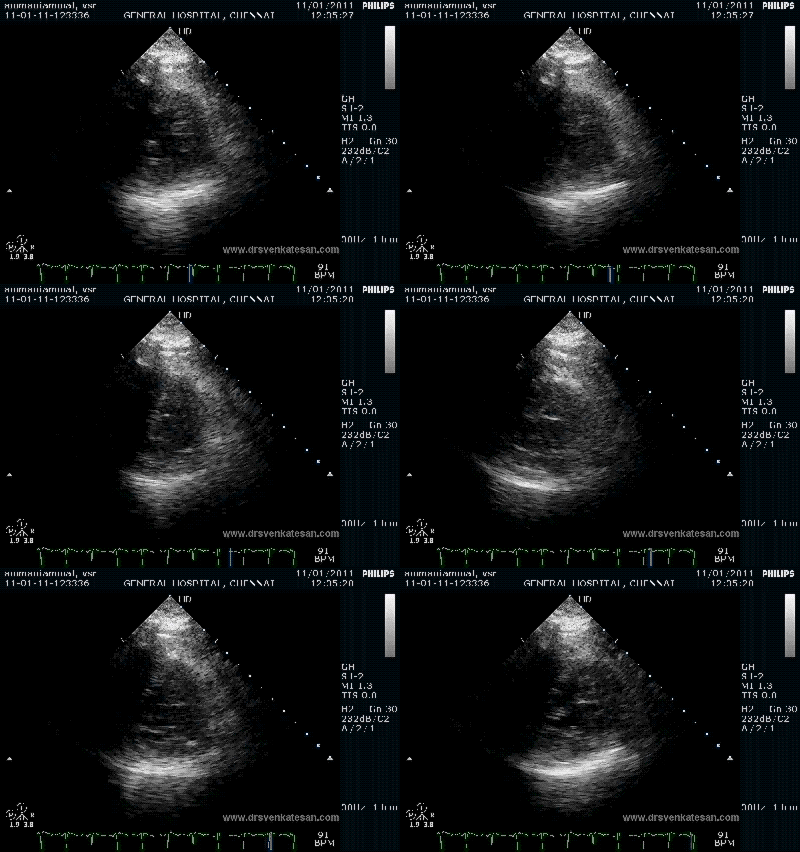
Note the septal rupture is visible even in 2D Echo


Color flow showing significant shunting from LV to RV.This shunt depends upon the LV contractile function, LVEDP and ofcourse the RV pressure


If there is severe RV dysfunction or bi ventricular dysfunction flow across the defect is inconspicuous.Brisk left to right shunting may be an indirect marker for good LV systolic function and absence of significant pulmonary hypertension.Both imply a better outcome.

The main determinant  of survival is the  underlying LV dysfunction and associated co morbidity(Renal function ) and complications .

Infero -posterior ruptures tend to be complex and  may have multiple irregular tracks  that makes it difficult to repair.

Investigations

Echo cardiogram is the mainstay .Serial echos should be done to assess the mechanical function and the progress of VSR.Hemodynamic monitoring may be done without injuring the patient .

Medical management

  • Often supportive , but  effective . Dobutamine infusion can maintain a life for few days.
  • Paradoxically , LV dysfunction and elevated LVEDP restricts volume overloading of VSD.
  • Associated MR, Arrhythmias  need to be taken care of .

Surgeons role

  • Very Vital.
  • Experience counts.(Individual as well as  Institutional )

Timing of surgery

Continues to be a controversy . Surgeons love to operate in a stable patient. But they need to realise , surgery is often needed to stabilise  many  patients. . The issue of tissue friability  is blown out of proportion in the literature .When a  life is  is at danger we can not worry about  friable tissues !

The rule of thumb could be

  • Operate as early as possible in unstable patient.
  • Post pone surgery in stable patient as late as possible ( Late here means . . .elective non emergent surgery )

Surgical options

  • Simple VSR closure without  knowing coronary anatomy
  • Simple VSR closure after knowing coronary anatomy
  • VSR closure with CABG ( total revascularization)
  • VSR closure with partial revascularization

In our experience  each of the above , has a role in a given patient depending upon the logistic , financial , social and even  the available expertise. (A good surgeon in bad Institution !)

Is coronary angiogram mandatory  before attempting to close VSR ?

Logically yes. If it is not available  just do not bother .  But, many times , when issue is saving lives , we can not afford to be too scientific , many lives have been saved by not following  such strict  protocols .A simple emergency  thoracotomy and closure of rupture site (Without even touching the LAD ) can be a distinct  and viable option in  a selected few .

Role of cardiologists

Contrary to the popular belief the role of cardiologists is minimal , except  to prepare  the patient and hand over to the surgeon.

Interventional approach to close  a VSR  is currently  be termed as an  adventurous option ! The VSRs  can assume unpredictable shapes  and the  tears can be multiple  in  different planes. The devices , catheters and  other hard ware are not specifically made to tackle these  issues  .An acquired VSR  should never be compared with congenital VSD.

Read Full Post »

LIMA-Left internal mamary  artery is the most common arterial  graft used in CABG.It is anastomosed with LAD /and or diagonal artery. Routine visualisation of LIMA is advocated by many , but it is required only  in patients with critical CAD.

LIMA angiogram is done

  1. To confirm the presence of LIMA .
  2. To exclude subclavian  stenosis.(If present hand can steal blood from heart !)
  3. To rule out disease of LIMA (Which is unlikely )
  4. Diameter of LIMA should be matched with LAD .LIMA with large lumens can accelerate restenosis in LAD due excess flow induced endothelial reaction
  5. To identify  any early branching of LIMA .This can divert the  blood flow and underperfuse LAD.
  6. Terminal bifurcation  of LIMA can some times be used as a sequential graft to LAD/LCX/OM
  7. Tortuosity and looping of  LIMA is common but generally has no hemodynamic significance.
  8. LIMA may  provide vital  nutritional support to sternum through direct or   intercostal branches .If  LIMA dependent sternal  blood supply is found to be significant ,   sufficient precautions to be taken and anticipate sternal ischemia related complications.This is especially important in diabetic subjects.

Read Full Post »

Internet has revolutionsed the way we learn . Now,  you can watch experts  perfoming  complex cardiac surgries sitting at any where in the globe !

The credit not only goes to the broad-band internet , but also the greatness of   European association of cardiothoracic  surgery  which has made it available free of cost .

A must visit website for all those  physicians and surgeons ,  concerned with  cardiac care of our population .

Read Full Post »

Mitral valve can be termed as  the most important valve of heart . The reason  for this  : It is the only valve that is dependent on the  Left ventricular function (The  parameter  which   determines the  ultimate outcome in any form CAD ! )

So , indirectly mitral valve function will invariably be affected by some degree  at least in  most  patients with LV dysfunction. (After all LV free wall , is a component of mitral valve apparatus.)

While , we have numerous modalities to assess mitral valve function  ,  the one that has fascinated the surgeons during  mitral  valve surgery is the intra operative TEE.

Many believe TEE provides live  images  of mitral valve   which are not possible  even under  direct vision ! The eye of the  TEE sees the mitral valve  from a  posterior location , (of -course It can see at any angle !)   while surgeon can see in one angle . The  types of repair , the adequacy  of repair, the annulus status,  even a trial mitral run ,  can be done with the help of TEE.

The TEE probe silently does  this job sitting inside the esophagus   , without  obstructing the surgeon’s operative field .

The success of TEE as an investigative tool did not come easy.Decades of  observation , innovation and learning( Especially from  department of cardiac science  Mayo clinic USA , where they standardized the views. )  are involved .

Now we have omni plane, real time 3D TEE probes .

The books  which are  considered the best for  TEE aspects of mitral valve  and it’s  repair are

Read Full Post »

AV nodal reentrant tachycadia(AVNRT) is the commonest mechanism of SVT. It is divided into slow-fast, fast-slow, slow-slow , representing the two limbs of he circuit.

Slow -Slow circuit is  the rarest  type of AVNRT.  It should be appreciated  ,  the scientific validity of  slow-slow circuit is  applicable  only in relative terms . A virtually  similar antegrade and retrograde limbs with identical conduction velocity and refractory  properties  , can neither  initiate  nor  sustain an AVNRT.

Caveat in the definition of slow -slow AVNRT.

Even though ,  we call it   a  slow-slow  tachycardia , one of the limbs need to be faster than the other.  So , every slow -Slow AVNRT in reality will have  two types

  • Slow- Slow ( Still , faster than antegrade slow) mimic a slow-fast physiology
  • Slow( Faster than retograde slow )  -Slow closely mimic typical  fast slow .

Implication for electrophysiologists  and   points of contention for the ablationist !

  • In Slow -Slow AVNRT ablation we do not know exactly ,  which of the slow pathway is being ablated , unless we specifically  analyse  the post ablative  data.
  • Very often it is not done.Every one in the lab is happy , for breaking the tachycardia circuit. Only after the procedure is over , we may realise the tachycardia is not really killed as it finds an alternate highway to complete  the short circuiting of heart.
  • We need to  suspect this type of AVNRT   prior to the  procedure .Electrophysiologist  shall  spend little   more time and a wide area ablation done , in the vicinity  of coronary sinus ostium can be attempted. .

It is not a smart practice to advocate  wide area ablation as a routine protocol in all AVNRT

as it directly  increase the rate of complication >

Final message

A   hurriedly  done slow pathway ablation  which  may  temporarily terminate the AVNRT ,only to recur later as  the retrograde  slow pathway may again form  a substrate  .The area of slow conduction  acts as a turnaround gateway and capture  the  retrograde fast  pathway which  could be  available in plenty in the anterior aspects of AV node  .   (Note : The unablated  slow pathway  now  form the antegrade  circuit )

Read Full Post »

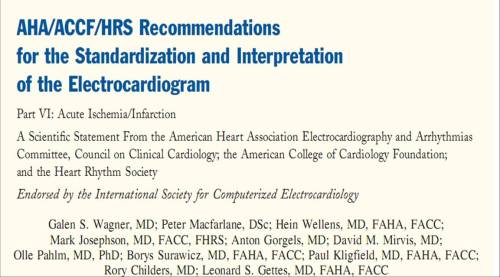
Once in a while the ACC/AHA comes with knock out articles. Here is a  must read  topic for every cardiologist.

How to diagnose MI in ECG ? Sounds , insulting ?

After reading this you should change the way 12 lead  ECG is looked at . . .

Experts from the article

  • How to make the best of lead AVR  ?  Just invert it and you get a + 30 degree lead which  was hither  to unavailable .A new window of opportunity to diagnose   antero lateral MI .
  • Shuffling  the 12 leads to a have an anatomically contiguous  ECG
  • Know , how to label STEMI  with a  .5mm ST elevation  (Minimal STEMI ?)

And lot more exciting  tips  !

If you  think ,  all these are new stuff in cardiology you are grossly mistaken .These concepts are more than 10 years old (In Sweden it is 25 years old ! )

When  European heart journal published  the article   “Myocardial Infarction redefined ”  in year 2000 many missed out the importance . For those who missed it (just  10 short  years have gone by )    ,  Let us update ourself  at least  in 2010 !

Thanks to ACC and JACC.

Click on the link

For PDF article click on the Image

Read Full Post »

« Newer Posts - Older Posts »