Feeds:
Posts
Comments

Archive for the ‘Clinical cardiology’ Category

I don’t know, any one has tried to differentiate the mechansims of dyspnea with reference to systolic and diastolic dysfunction .We have made some  observations  in certain group  of patients  during EST . I do not know how far one would agree  with this .

For  the same amount of  stress or work load persons with  systolic dysfunction  behave differently . However ,both will complete the activity but the onset and perception of dyspnea is slightly different in patients with predominant diastolic dysfunction.

Diastolic dyspnea (Dyspnea due to predominant diastolic dysfunction / HFPEF)

  • Delayed dyspnea .  It manifest  well after the exertion is completed.
  • It is more off a struggle to handle the venous return .The forward flow (Arterial circuit )  is relatively well toned and  tuned  and hence fatigue is rare .
  • Typically it has a prolonged recovery time .(? > 1-2 minutes )
  • Is it  less harmful  in terms of longevity ?  May be . . . since it is more related to physical  de-conditioning. Most of the physiological  episodes of dyspnea are probably  diastolic dysfunction  mediated .
  • Dyspnea that is triggered  in diastole is also dependent very much  on the  heart rate .If the heart rate fail to reach the baseline the recovery of dyspnea is also delayed
  • Some believe , physiological dyspnea should disappear within 30-60 seconds after termination of activity  .(Highly  arbitrary!)

The pressure volume loop in various forms of heart disease will determine the degree of myocardial stretch and the resultant dyspnea .Image source : http://www.1cro.com/medicalphysiology/chapter10/chap_10.htm

Systolic dyspnea (Dyspnea due to predominant systolic dysfunction )

  • Patients with primary systolic pump failure experience dyspnea very early into exercise  .
  • Much of dyspnea  occur during activity itself .
  • Exercising muscles show hypoxia  and hence  fatigue is conspicuous .
  • Recovery  of dyspnea is relatively immediate as the activity is stopped .Demand from exercising  muscle is  significantly dropped.
  • If the venous return is well handled by the ventricles the  recovery phase is more comfortable .

Summary

In primary diastolic dysfunction  ,the maximum stress  to ventricle occurs  when  the venous return peaks that usually happen in the exercising muscles , as they shed  vaso-dilatory  property  in post exertion phase .

Management Implication

 Fluid overload ,  Tachycardia   are more  related to diastolic dysfunction .(Beta blockers by prolonging  the diastole can , provide important relief of dyspnea in diastolic dysfunction (In HOCM patients   this action could be  more important that  the much hyped negative inotropism !)

Final message

Dyspnea is  a complex cortical  perception , influenced by filling pressure of heart, stretch receptor in lungs , respiratory and   exercise muscle . It is further impacted by number of biochemical parameters (Lactate/ O2 etc )

Of-course  , it could be a  far fetched  imagination to split dyspnea  mechanism with reference to cardiac cycle. Combinations  of both  systolic and diastolic dysfunction is the norm in many  cardiac conditions . However  , I believe  we need  more insight in the  pathogenesis of  this ,  “most important  symptom”   that emanate  from the heart .

Read Full Post »

Acute coronary syndrome is the number one cardiac emergency .In any coronary care unit there are vital differences  between men and women in terms of ACS presentation and outcome . Though there can be variation in ethnic , geographical   factors .The following is   an observation  from one of the Asia’s oldest  and  largest coronary care unit over a period of 40 years . (Madras medical college Chenna ,India )

There is  very significant gender advantage in the incidence of ACS. The male female ratio is consistently around  4: 1 .This Indicates for every day , men suffer from ACS  by four  fold more .This is a very hard data can not be ignored . Women present to the hospital much later than men .This may be due to increased tolerance of pain, social issues  waiting for their spouse to arrive etc

  • There is a  significant  difference in the pattern of ACS in men and women . Men present with STEMI  and women present with more of NSTEMI . In  NSTEMI  the gender ratio is dramatically equal 1 :1 .
  • Explosive chest pains are less common in women .
  • For some unknown reason  diabetes  afflicts  women with a  greater ferocity  !
  • Similarly  it appears  obesity and dyslipidemia has more significance in women
  • Sudden cardiac death and primary VF is many fold less common in women.
  • Mechanical complications like mitral regurgitation and ventricular septal rupture are several fold higher in women (Weak muscle low muscle mass ?)
  • Thrombolytic success is slightly lower in women than men .
  • The overall outcome in ACS is same as men .Some say women fare  worse  .This is important because while they are protected heavily against development of CAD once they develop it  the outcome seems  exempted  from the gender advantage .The reason for this is not clear

Final message

Women show their  unique way   in ACS  too ! Some   of them are  true  advantages  while  few are disadvantages .The mechanism for these differences  can not be entirely attributable to presence or absence of  estrogen . The hard fact is ,  women always score over men in the tolerance levels and  deal effectively stress situations .  It would appear Women’s body   easily nullify adrenergic triggers .

Reference

Reference less cardiology .

Read Full Post »

Failed thrombolysis is a well debated concept, while failed primary PCI is a conveniently neglected phenomenon .

How to assess successful reperfusion following PCI or thrombolysis?

I do not know how many  of us know this vital fact !

Coronary angiogram is squarely beaten by the humble  ECG in assessing the effectiveness of myocardial  reperfusion . This is not hard to understand as  coronary angiogram *  can  tell us only  about epicardial  patency ,  while ECG  sends vital perfusion  data from within the  myocytes ! Which do you  think is superior ?

And now  interventional cardiologist have realised this fact . they  measure the ST segment  regression instantly once the primary  PCI is  completed . How ?  An ECG is recorded from  right inside the infarct  related artery .

*Of course myocardial blush score , TIMI frame count are poor alternatives !

This paper just published in CCI is  a fascinating revelation .

http://onlinelibrary.wiley.com/doi/10.1002/ccd.23455/abstract

Read Full Post »

Under physiological condition ,  pre-load , after load , and cardiac  contractility should be a sequentially matching parameters . After load mismatch is an important concept , where myocardial contractility is temporarily  depressed due to  lack of adequate pre-load for a given level of after load .

This is also  referred to as descending limb LV function paradox .

The three  common clinical situation  AL mismatch  occurs

  1. Critical Aortic stenosis              (High aortic after load )
  2. Acute Hypertension                   (High after Load -Normal and  low pre-load)
  3. Severe diastolic dysfunction  (Pre-load is high -After load is normal )

If it happens acutely the myocardium becomes dyfunctional  due to  mechanical non ischemic stunning .Once the after load comes down the contractility improves .

What  is the chronic adoptive response to after load mismatch ?

LVH is the major  chronic adoptive response to AL mismatch.

LVH reduces the wall stress which will reduce the after load  indirectly .

So LVH neutralises the   high  after load .Laplace law at work . (Wall stress is equal to  2 times the radius divided by thickness of the wall )

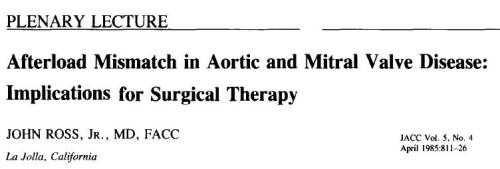
Here  is the Link to the great lecture by John Ross Jr  in LA Jolla , California in one of the annual scientific session of AHA   more than 25 years ago . http://www.ncbi.nlm.nih.gov/pubmed/966366 .The concept is alive and kicking even today .I am sorry to  note   this  important physiological concept   never received the attention it deserves .  I would vouch , it  can be as   important as Frank starling  principle .

Reference :

https://content.onlinejacc.org/data/Journals/JAC/22702/04186.pdf

//

Read Full Post »

That’s how  one of   the patient  presented  to our hospital .  An echo documented  severe aortic stenosis with a  peak aortic gradient of 80mmhg  and  a  bounding  systolic blood pressure of  180 mmhg . Is that an exception ?

I recall the early days of medical school when  we are fervently   taught  that  systolic  blood pressure is primarily determined by stroke volume and LV contractility .

The above example clearly proves this  is  explicitly wrong  .

Now , we understand  systolic blood pressure have many determinants   . Stroke volume is  just one of them .

The tone  , distensibility  of major blood vessels arising from aorta determine how a pressure wave is going to get amplified .

If you  say stroke volume is not  major determinate of systolic blood pressure   . . . .  does it  imply ,   the antique  bed side cardiac sign  Pulsus parvus  et- tardus  a myth ?

No ,  it still holds good . But it is not a hard sign .  We realise now , a patient with a well felt carotid can have a severe Aortic stenosis .

  • Pre- existing systemic hypertension is a  valid explanation.
  • The other popular explanation for  loss of systolic decapitation due to associated  aortic  regurgitation   may be  acceptable . (Not really proven though ! )

What will be the central aortic  pressure  in critical Aortic stenosis ?

It is definitely lower than brachial cuff pressure .This will explain the systolic blood pressure is actually an amplified signal .

Read Full Post »

There are many wonderful books for learning clinical cardiology.J.K.Perlof’s clinical cardiology,  Jonathan Abrams , are popular ones. Clinical chapters in  Noble O  Fowler is a  wonderful reference .

My choice for the top slot is  by Signs and symptoms in cardiology”   by Horwitz and Groves .They wrote this master piece

from a relatively  unassuming  US city, University of  Colorado.  Denver .Published by J.B.Lippincott company in 1985.

I am  not sure , any further edition of this book  has come .

Young cardiology residents  must first  identify  good  books    . . . reading comes next !

What to buy this book ? .Try  at Amazon .

http://www.amazon.com/Signs-Symptoms-Cardiology-Lawrence-Horwitz/dp/0397505124

Read Full Post »

A pulse wave is generated  with each heart beat  when  the potential energy is converted into kinetic energy.

  • For the pulse wave  to travel from the heart to periphery  Aortic integrity is vital.
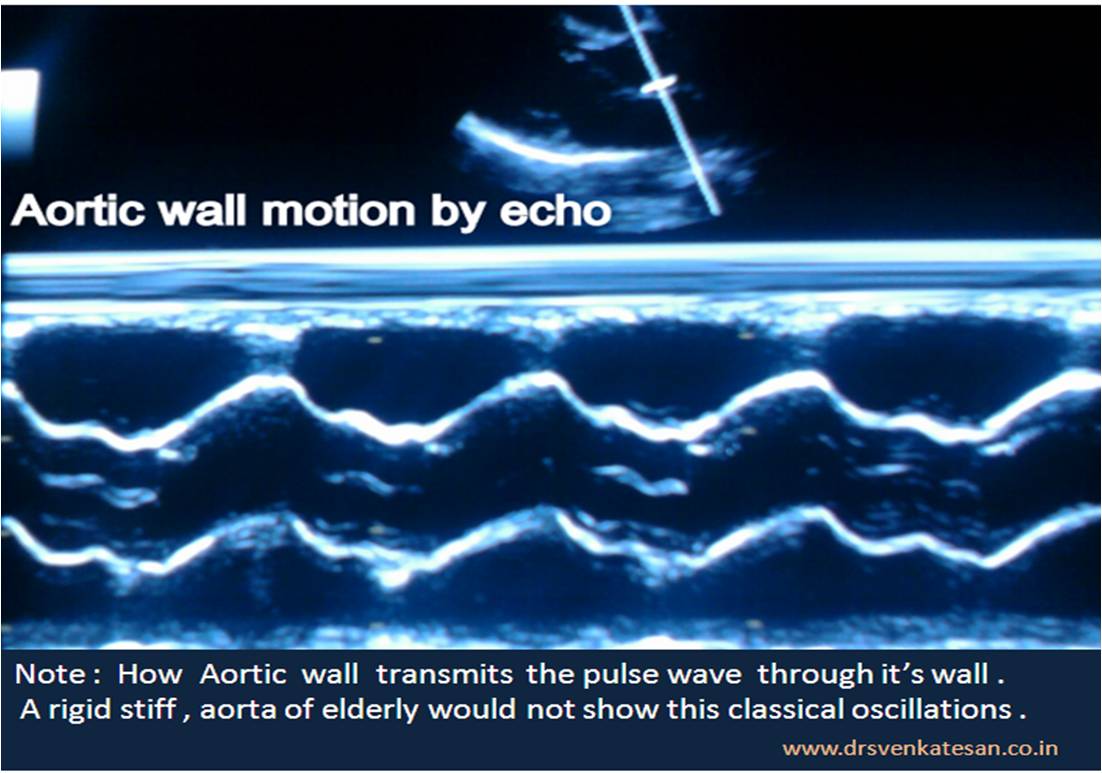
  • The pulse wave travels through the walls of arterial tree  , in the process the wall itself is set into oscillations .
  • Whether the  moving blood imparts the  pulse  on the walls or the walls itself  vibrate  independently is not clear .

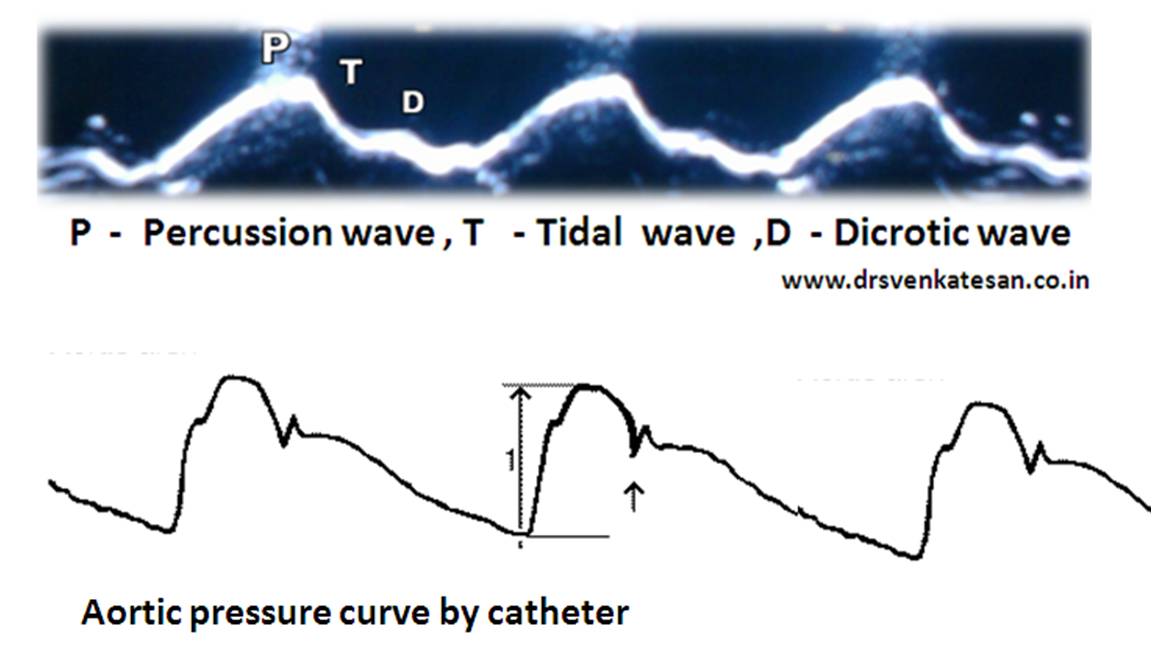
The following   M -Mode  echocardiogram  of  aorta from young man   stunningly  documents  the  morphology  of  central aortic  pulse  wave . Note how closely it resembles the  Intra- aortic  pressure curve recorded with a catheter.

The anterior aortic wall motion was sliced from the above motion image  to create a non invasive recording of aortic   pulse wave

This simple observation was made in  a crowded  echo lab our hospital. Cardiology fellows can explore  further  ,  the link between aortic pulse transduction (From mechano -hemodynamics)

Further studies are warranted regarding the  rate of raise (Slope)  of aortic  wall motion  , and the quantum of motion ,its correlation with central aortic pressure etc. This would unravel the the mechanisms  of Isolated systolic  hypertension  , where a stiff aorta amplifies  the systolic pressure due to loss of elasticity .

Read also

Rail roading of  Aorta in Severe  LV dysfunction

Wind Kessel effect

Read Full Post »

Stress related wall motion defect  is a well-known entity . It is referred to as Takotsubo cardiomyopathy .

These stress are often

  • Emotional
  • Neurological
  • General systemic stress

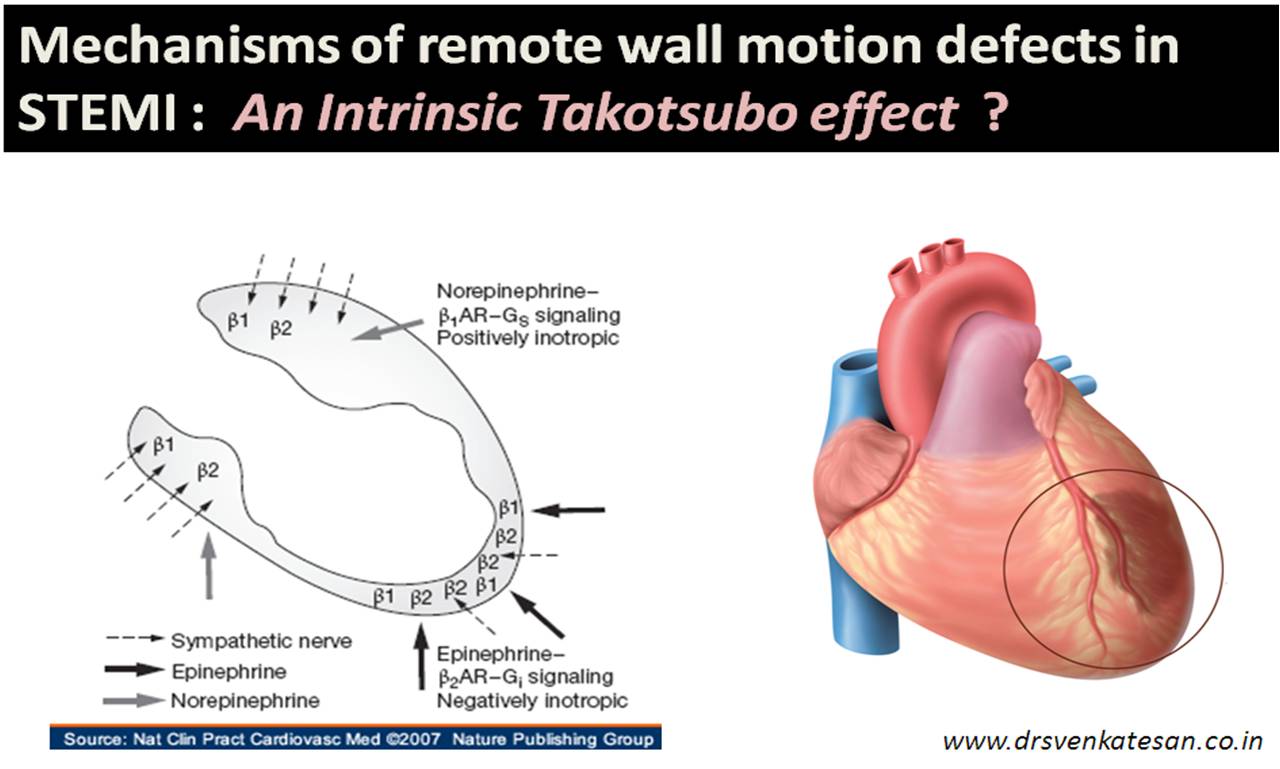
The culprit seems to be pooling of adrenaline and nor adrenaline in myocardium .These remote  neurogenic stress can cause significant wall motion defect due to adrenergic  downpour

The image depicts the wide variation in the density of beta receptors in heart.The stress of MI can result in varying degrees of wall motion defect .It is important to realise the wall motion defect in STEMI has two components .One is related to ischemia and other is due to excess catecholamines. This explains many of the unexplained remote wall motion defects during STEMI .This  may be referred to as Intrinsic Takosubo effect !

Then   . . . the following    questions arise

When systemic stress can have a profound  effect on myocardium , what   about local stress ?

Acute STEMI  is  a huge stress for the heart   . . .   isn’t  . If  so , can it   alter  the wall motion defect in adjacent  or remote myocardial segments  independent of ischemia ?

With the distribution  of adrenergic receptors  showing  huge variation ,  we do not know how an acutely ischemic heart  spills the adrenaline all over .  Is there a pattern to it  ?  or it happens at random ?  Further , the  response to  accumulated  catecholamines  is  not  going to be  uniform. This will explain why certain patients  go into ischemic  LVF  , very early in the course of STEMI  even before the myocardium is necrosed. It will  also explain  the  benefits that accrue in selected patients  who receive early IV beta  blockade  ( Which is  of course currently not popular after COMET study ! )

Final message

We  have seen at least  two patients  with severe  transient ballooning  wall  motion defect in LAD region  (LV apex)  with isolated RCA lesion and inferior Infarct .

The question raised is this 

Can  the  stress of  Inferior  STEMI   . . . result in  apical Takatsubo  like  effect ?

Reference

http://www.medscape.org/viewarticle/567069_4

http://www.takotsubo.com/

Read Full Post »

We owe a lot to our past genius minds for our current understanding of  cardiology.Youngsters   should  know how the filed of cardiology  evolved .Few  great  brains  taught us how to think   hemodynamically  in the setting of  STEMI.

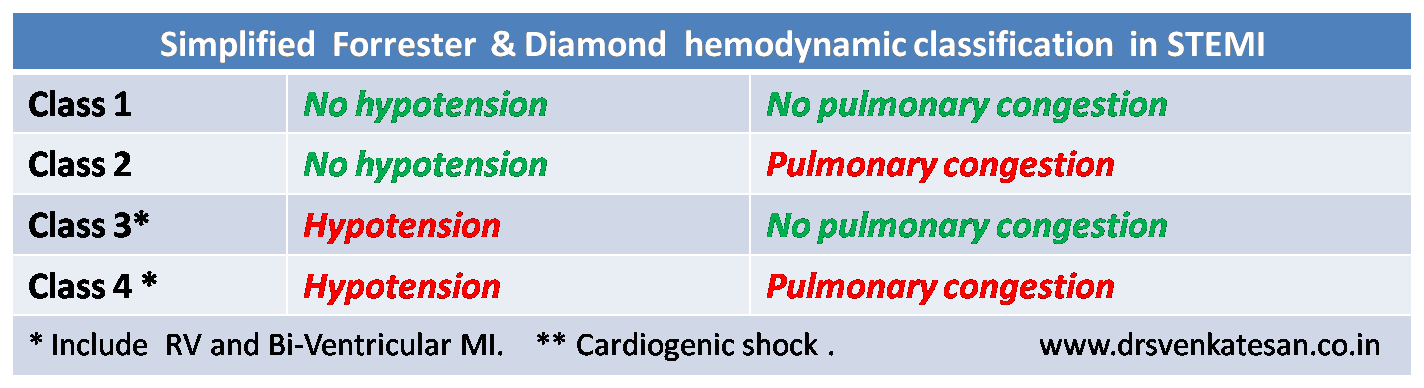
The Diamond and Forrester classification is  an  undisputed achievement of  modern cardiac  hemodynamics.They gently converted the  clinical classification of  Killip into more scientific  hemodynamic  one .Both these classification continue to fascinate  us even in the era of instant PCI for STEMI .

And youngsters  should read this again and again and critically evaluate their patients  within this system.The two key parameters he used was PCWP of  18mmhg /And cardiac Index 2.2liters . He also suggested a simplified version where  intra- arterial monitoring is not feasible.  The   cardiac Index could be replaced by systemic blood pressure  lung congestion   represents PCWP >18mmhg .

The DF classification would become

An important inference from DF classification !

The class 3  of   DF   grading  has no pulmonary congestion  but persistent hypotension . What does it mean ?

It is a stunning proof of a great concept.  As the patient moves (Worsens)  from  DF  two  to   DF three  , the lung congestion tends  to regress . This sub-set  actually  means   development of  bi-ventricular failure or isolated RV failure  . This is an ominous sign and indicate a bad prognosis . ( One may call it a paradox  , according to conventional thinking   “The more the lung crackles  , dismal  is the outcome”   DF  grading clearly proves this is  not  always true ,  as long as  the systemic pressure is maintained  crackles can be managed effectively  . In  DF 3  the right ventricle  as a pump is  becoming so weak it is not able to congest the lungs  at the same  process leads to  systemic hypotension.

James Forrester

http://www.cedars-sinai.edu/Bios—Physician/A-G/James-Forrester-MD.aspx

Forrester is also a pioneer in how we evaluate chest pain in the emergency rooms and cardiology OPDs .  His thoughts on utilization of Besean theorem revolutionized   the interpretation of exercise stress testing.

* Killip is a genius of different caliber would be discussed later .

Reference

Forrester, J, Diamond, G, Chatterjie, K, et al Medical therapy of acute myocardial infarction by application of hemodynamic subsets (first of two parts). N Engl J Med 1976;295,1356-1362


Read Full Post »

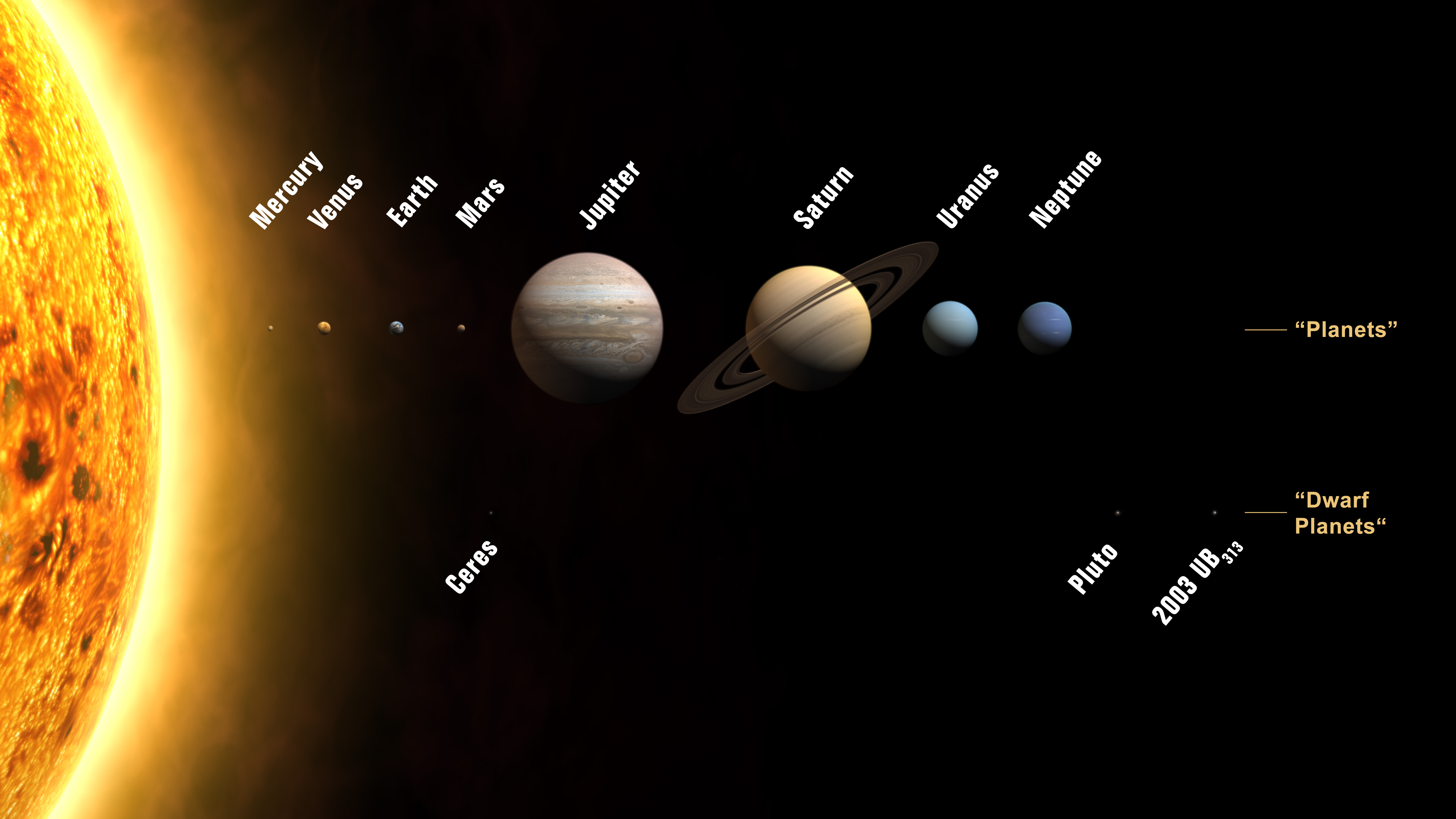
International Astronomical Union  in the year 2006  removed Pluto from the solar system for a simple reason ,  the so-called Pluto never revolved around  Sun , hence it ceased to be a planet of the solar system , it was more of an asteroid !

So, an astronomical fact engraved in our brains for so long  became a fairy tale. It is very hard  to erase  a  myth however solid the new evidence are against it.

The concept of HDL as good cholesterol has been etched deep in physician as well as our  patients.

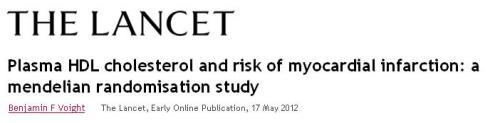
Now comes the shocker from Lancet

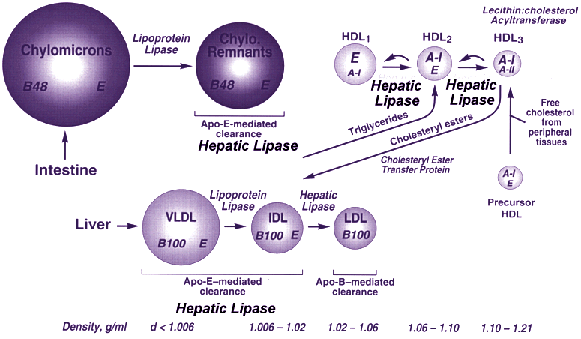
How are we so sure ,  about these  Invisible spheres of  lipids that  move  around  our “Bio-system” in a presumed fashion .  .  .  even huge visible planets  fool us easily !

The Link to lancet study

It is  a wonderfully done study where  thousands of patients  who exhibited  genetically high HDL levels , never showed any advantage in terms of CAD prevention.  A stunning blow to a belief.

Incidentally ,  few years back  the failure of  drug Torcetrapib proved the same point  .  (The drug which elevates  HDL  proved useless in preventing CAD  ) but the  medical world failed to interpret it properly.

I am sure, still sections of physician  community would continue to believe HDL is great molecule for CAD protection !

Science is  often what we presume . . . but the fact usually turns out to be some thing  else !  but the journey towards truth  must continue !

                      When  a  million tonne  Pluto  suddenly disappear from Solar system . . . it is not a  big deal for  a  “miniscule medical myth”   to get shattered !

Read Full Post »

« Newer Posts - Older Posts »