Feeds:
Posts
Comments

Archive for the ‘Cardiology – Clinical’ Category

Modern  day cardiology can do wonders. It can revive a sinking  patient in cardiogenic shock with IABP , LV  assist ,   multivessel angioplasty and bring back  life . On  the other  hand  , a young man with an infected mitral valve who is put on  intensive  antibiotic  regimen   , progressively deteriorates  throws an emboli into brain ,  raise his urea  creatinine  , cardiac   failure worsens and finally succumbs .

This is a clear case of failure  of medical therapy in infective endocarditis .  It is almost certain  surgery would have saved him .

Why  the delay ?

So the question that is been debated for so long is   “When to intervene with surgery in IE”  ?

While we show extreme  urgency for ACS , the same is not shown  with IE.This is going to change in the future .Thanks to the  EASE trial (Early surgery  in  endocarditis )  This land mark study from Korea  is likely to revolutionise  the way we will look into the  problem  of infective endocarditis. It was presented in the just concluded AHA annual scientific sessions  in Orlando

This was  our  observation  too . The issue was discussed in  the year 2008 .It reminds me ,  every  learned  thought or opinion is in fact a paper  but unfortunately modern science does not accept a  fact without evidence of a  study . Until then  it remains  as a crap !

I am glad  to note   genuine concepts will some day  get ratified . Kudos to the Korean team.It is a great study to do with  many ethical issues.

Click below to read the related article

Link to EASE Trial  http://www.theheart.org/article/1313215.do

Next question  on the cards

Should there be  a time window above which medical therapy should be   deemed (Doomed !) to have  failed  , so that the patient becomes a default candidate for surgery.

Read Full Post »

  • Acute myocardial  infarction is the number one cardiac emergency .
  • About a million papers and articles are available in  medical literature about STEMI.
  • Management of STEMI when they present early is addressed by every text book.
  • It is  really surprising to note there is no  simple and  specific guidelines  to manage STEMI when they present late to the ER .
  • Such a scheme is vital for physicians,  as experience suggest almost 40 % of all STEMI arrive late and are ineligible for specific reperfusion strategies.

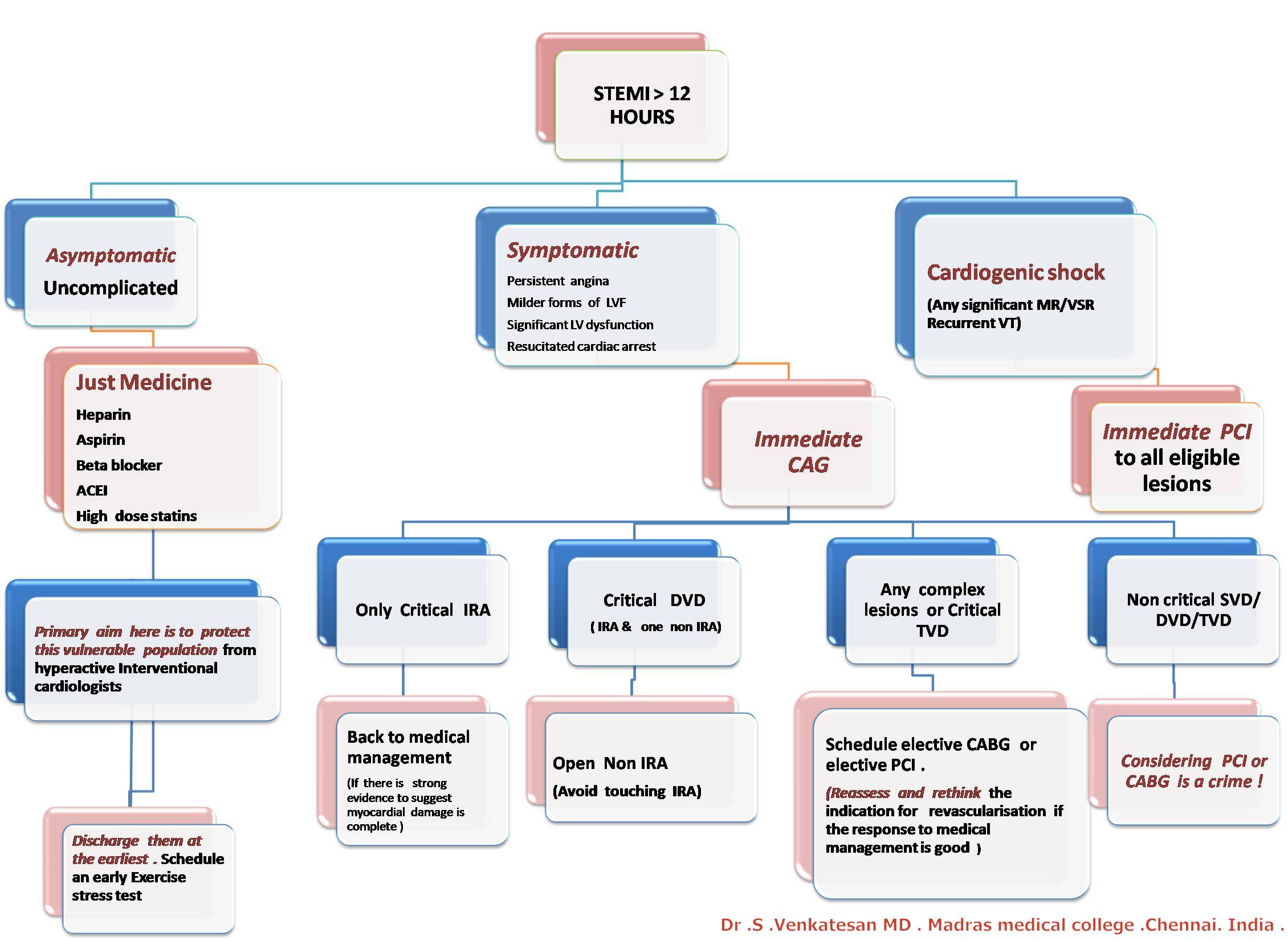
The following  flow  chart is  exclusively meant for usage in STEMI when they  arrive late >12 hours .

This is a personalised version based on working in one of the oldest CCU in  Asia which handles  about  2000 acute coronary syndromes every year with a mortality rate of 6-7 %  Hope one can bear with it !

Please click on the chart for a high resolution Image

Comments are welcome

Read Full Post »

Read Full Post »

Third heart sound is a unique heart sound  because its   perfect physiology  to hear it  in the young  ,  while the same may denote  serious LV dysfunction in patients with myocardial disease.

It is a low pitched  early diastolic sound usually correspond to  the end of rapid filling phase.The mechanism of genesis of this sound has been debated for many years .(Still I think it is unsettled !)

We know genesis of intracardiac sound is contributed  by three factors

  • The blood flow
  • The valve motion
  • The myocardial contractile and  relaxyl  property

The above  three is collectively  called cardio-hemic system . When this system vibrates heart sounds are generated .In  the genesis of S3 all the three may be important . The only difference is ,  in physiological S3 the valvular and hemic component play a major role . In pathological S3 the  myocardial component has a pivotal  role .The distended LV facilitates chest wall impact during the rapid filling phase . It is now  accepted  LV S3 is  generated outside the LV  . It  was proved elegantly by Shaver et all with sound recording on either side of  LV /Chest wall.

It is to be emphasized  the mechanism of genesis of S3 is diagonally opposite in  physiology vs  pathological  S3 in some conditions . Rapid AV filling  can  rarely be  responsible for pathological  S3  associated with severe LV dysfunction , while chest wall  impact can contribute in both physiological as well as pathological S 3 .

 One can understand the complexity of genesis of  S 3  , as  there are  too many  determinants  that contribute in  varying degree of acoustics.

Factors determining the intensity of S3 is complex 

  1. Age,
  2. Atrial pressure,
  3. Rapidity of  flow across the atrio-ventricular valve,
  4.  Rate of early  diastolic relaxation 
  5.  Distensibility of the ventricle,
  6.  Blood  volume,
  7. Ventricular cavity size,
  8.  Diastolic momentum of the  heart,
  9. Degree of contact (coupling) with the chest wall, thickness
  10. Character of the chest wall
  11.  The position of the  patient.


It is ironical, pathological   S3 which is a  diastolic  sound  though ,  still  its genesis  is largely  determined by the systolic function of the heart .This mystery is partially solved as we recognise  now ,  LV S3 is equally common in  severe degrees of diastolic dysfunction. In fact ,  while we were studying the relationship  of LVS3 in DCM  , it  has strongly predicted the  presence of   severe restrictive pattern in them .


 Reference

1.Multimedia of S3

http://www.inovise.com/learn/s3causes.html

2.Importance of  S3 in cardiology NEJM 2001 article

http://www.nejm.org/doi/pdf/10.1056/NEJMoa010641

3.Chest wall impact theory of S3  by Shaver

Shaver JA, Salerni R. Auscultation of the heart. In: Hurst, ed. Heart. 8th ed. New York, NY: McGraw-Hill, Inc; 1994:291.

Read Full Post »

Mitral regurgitation is  one of  the most common lesion of rheumatic heart disease .Mechanism of MR in acute rheumatic fever is different from chronic rheumatic heart disease.

Acute Rheumatic fever

The following mechanisms contribute to MR of acute rheumatic fever

  1. Edema of leaflets (Carey Coombs murmur )
  2. Valvulitis
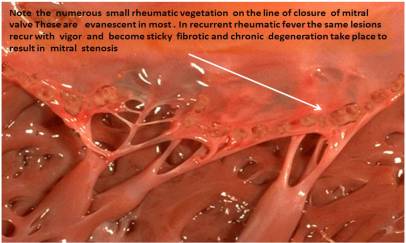
  3. Small verrucous  vegetations (See Image )
  4. Acute LV dilatation in fulminant cardiac failure.

* Note  : Acute rheumatic fever in its first episode can never  cause stenosis  however fulminant the fever may be  .There is no acute mitral stenosis .But ,  during recurrence and reactivation some amount of stenotic process may occur.  Still ,  recurrence and reactivation are more often related to significant MR rather than MS. ( Isolated mitral stenotic lesions  rarely  give h/o recurrent rheumatic fever )
Chronic rheumatic  heart disease

As the mitral valve gets progressively damaged  any combination of MS or MR occur .The following mechanism are involved in  the genesis of MR. (Pathology of Mitral stenosis is not discussed here)

  1. Chordal shortening, tethering , pulling , prevent proper co-optation
  2. Chordal lengthening
  3. Chordal disruption (Minor > Major )
  4. Prolapse of either AML or PML (Not both ,unlike myxamatous MVPS)
  5. Infective endocardits  of  leaflet
  6. Perforations of  leaflet
  7. Annular  dilatation
  8. Fibrosis of posteromedial/Antero-lateral   pap muscle(Rare )
  9. Left atrial pathology

* The direction and the  width of MR jet is  related to the mechanism of MR.

If there is chordal shortening due to fibrosis  of mitral valve  co -optation plane is altered . The degree of chordal shortening , pap muscle fibrosis (rare)  symmetry of chordal involvement determine the MR.

Rheumatic mitral valve prolapse

  • This could be  more common than we realise.
  • It can be true or pseudo.
  • True prolapse occur due to chordal weakening or lengthening .
  • In chordal disruption the leaflet tips usually become flail

Since rheumatic process fixes the PML first , the AML   appear to overshoot the plane of PML and   appear as prolapse.(Pseudo )

The sail like AML commonly  directs the jet posteriorly and laterally .(Murmur conducted to axilla and back )

It is rare for PML to prolapse in RHD , if  it does occur ,  it directs the jet anteriorly (murmur conducted to aortic area mimic AS !)

It is rare to see a  perfect  central jet in RHD  . presence of  Central jet is a good sign to consider mitral valve repair.

Myocardial involvement in RHD.

Even though rheumatic fever is a classical  example for  pan-carditis , it is surprising   to note (Of course fortunately !)   how  myocardium escapes in the  chronic process of RHD.

Is it really true  ,  myocardium do not get involved in chronic RHD ?

Clinical cardiologists rarely discuss this issue. Pathogists indeed have documented significant lesions within myocardium  . Involvement of left atrial myocardium and  rarely  ventricular myocardium in the sub mitral  zone  can influence the  degree of  MR

* Even in acute rheumatic fever with fulminant carditis , myocardial involvement is  disputed by many  ! . My belief is ,  there will   definitely a subset  in   both acute and  chronic  forms of   RHD   , in which myocardium  gets  involved . In our institute LV dysfunction associated with RHD occur in  up to  5 % of  RHD population .

Importance of knowing the mechanism of MR

Two aspects  appear important

1. Is there a potentially  reversible component in pathology so that we can  wait  before intervention  ?

I have seen children referred for mitral valve replacement due to severe MR  . In due course   MR regress by the time they reach the tertiary center (waiting period included ) At least one child i remember,  the MV surgery was canceled  due to spontaneous regression MR.

It was later found the MR was  more of valve inflammation than degeneration .

* Always think about the possibility of reversible rheumatic MR  in every severe isolated  MR in children (Do not apply this rule in adults or in combined MS or MR  )  Do a ESR, ASO and start an  intensive anti inflammatory therapy  , aspirin with strict penicillin prophylaxis .With this  one can definitely postpone the surgery  in few cases  and  may avoid it altogether !

2. Surgical implication

If we could delineate  the  exact pathology of MR   it will facilitate  the   repair . Annular  reduction and  neo  chordae  etc . Of course ,the surgery could be  very  difficult in scarred mitral valves ,  Dr Sampath kumar *of AIIMS  New delhi , India  would  feel other wise !

*A pioneer in mitral valve repair in chronic  RHD (See reference 2 )

Questions  that need  answers

How is balloon/Surgery  related injury different from rheumatic process ?

Why is  rheumatic  mitral vale  prone for bacterial infection ?

What is the relationship  between  extent of  aortic valve involvement and  degree of mitral valve involvement in RHD ?

Reference

1.http://circ.ahajournals.org/content/94/1/73.full?sid=10599470-3563-4c38-b688-c5fc8c032f96
2. http://icvts.ctsnetjournals.org/cgi/reprint/5/4/356
Books

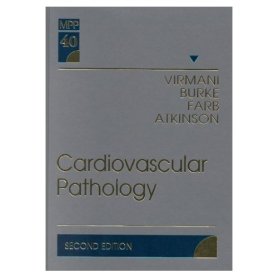
There two popular books exclusively  for cardiac pathology

1.Silver

2. Renu Virmani

Read Full Post »

Sustaining a STEMI  may be a  pathological  end  point  for  coronary  artery disease. But ,  from the  management point of view it is  actually  a starting point for CAD evaluation  .Strategies to prevent further   cardiac  events   must be formulated .

How do you manage a asymptomatic  un-complicated  post  STEMI   patient*  at discharge ?

  1. Do a sub- maximal symptom limited EST and then discharge.
  2. Advised  to come back after 2 months for a  stress test or Perfusion imaging
  3. Continue  with intensive  medical management without EST or  CAG and monitor only the symptoms
  4. Advice coronary angiogram   in all and decide depending upon the lesions (Pre -discharge CAG )
  5. I am a modern day cardiologist  . This question does not arise . . .  as I do only primary angioplasty for all my cases !

( *Please note ,  this forms the bulk of  STEMI population (up to 60 %  )

Answer : Your guess is the correct answer!

Why we need to risk stratify STEMI at discharge ?

The  morality and outcome in STEMI  though appears  to be a   continuously falling  curve ,  the slope is not linear.

The classical   mortality till discharge is about 6-8  %. Between discharge and 3oth day there is 1-2 % additional mortality

At end of first year there is  further   2 % mortality. From  second year onwards there is an annual attrition rate up to 3 %.

The aim of doing  a pre-discharge  EST is to do identify  ” patient  subset ” who are destined to die  within 30 days of STEMI.  If you schedule the   EST  after 6-8  weeks  one can not prevent these two deaths out of 100 !

( Of course ,  we assume   a prompt revascularisation in those vulnerable would prevent this !).  By doing so , we can avoid the bulk of unnecessary PCIs  that  happen  with  routine CAG following STEMI.

Pre discharge EST can be done safely  within 5-7 days  with  a symptom  limited test (70 % of  THR or up to HR of  120 /mt ) This  simple test if it is negative can virtually R/O  a  critical proximal  lesion with near 100% sensitivity.

Should we  risk stratify patients  who have undergone pPCI as well ?

Most of us  would love to believe ,   once  pPCI is  done to the  patient , he  reaches  a therapeutic end  point. But  it is not the truth . It is  the degree of  LV dysfunction ,  extent of contrary coronary lesion  ,   co existing risk   factors  and  the  intensity of medical treatment  only  would  determine the long term outcome.

It is very important to  realise  the pPCI is aimed at opening the IRA  and other lesions are  often left alone. So never  believe  pPCI   per se  would confer total risk reduction following a STEMI  .  There is considerable evidence to suggest  the opposite may be true at least in high high risk pPCI  ,where  metals are   placed  in  complex ,   vulnerable thrombotic milieu.  Hence it  seems logical  to risk  stratify  all patients   after primary PCI   (In fact, this population require  more vigilance )  .

When will you advice an  EST following  pPCI ?

It is usually not needed in the immediate discharge phase in single vessel disease which  would have been  tackled during pPCI.In multi-vessel CAD , where  only the IRA was tackled during pPCI  ,the same guidelines that of  thromolysed  STEMI shall apply  .Since we know the coronary anatomy already ,  EST helps us to evaluate the hemodynamic status of non IRA lesions if  there are any  . While ,  this is a  logical debate , logics has a rare place in medicine . It is ironical ,  stress test   is rarely  done  even after 6months following pPCI  in most centers.

Final message

It is  a  pity  ,  anatomical risk stratification  has squarely beaten  the scheme of   physiological risk stratification in most cardiology centers . A pre -discharge EST* was a  good concept that gave us an idea about the coronary reserve  after the ACS.  It was a collective wisdom of cardiologists  that has hanged this useful concept.  It is still more shocking ,  to note even the  scheduled  6 week   EST is  dropped from the  post MI work up in some  institutions.

* Many would consider  ordering an early EST in STEMI is an act of bravery ! The fear seems to be genuine   and most will agree with that.  But , please remember a physiological test  (Cheapest and simple is EST or a  Nuclear perfusion )  should precede  CAG  in all  asymptomatic  post STEMI  population  whenever possible . If  EST could not be done  prior to CAG for some reason   , at least do it following the CAG . It  will have  an  important impact  on the downstream decision making  which is often an  inappropriate  PCI  !

Read Full Post »

Atrial fibrillation is one of  the common tachycardias encountered in cardiology practice.In this condition even though atria fibrillates  up to 600 times a  minute, only a fraction of that reach the ventricles. Thanks to the AV node.It acts like an electrical sink . Hence in  most  episodes of AF ,  the ventricular rate will  be   manageable and hovers   between 150-220 .We  also know ,  in the presence of  accessory AV nodal pathway there is a risk of 1:1  conduction and  result in  ventricular fibrillation and risk of sudden death. (Sudden death in WPW syndrome)

A case scenerio

The other  day  my resident called  me  to inform about a  patient with   atrial fibrillation and  hypotension    .

I told him  , to  control  the heart  rate with Amiodarone  and  I  shall come in shortly ,

He replied ,  the rhythm looked  to him  like a bradycardia  !   I  asked him to wait  , when  I went there  , it  turned out to be  an  interesting  ECG . 

This was  a  73 year old man  in our  ER with  a  syncope  .

  1. Atrial fibrillation with ventricular bardycardia

Magnified view of lead V 1 and V 2. Note the ventricular rate of 40 /mt even a the coarse f wave are recorded > 300 mt .He had a structurally normal heart .This patient has been adviced a VVI pacemaker .


While atrial  fibrillation is primarily a tachycardia , occasionally  like the  above patient  it   may present as bradycardia ! 

 How this happens ?

As mentioned before  AV node  acts like  an electrical sink .

How AV node is able to  filter out much of the  incoming impulses is not clear. This property of AV node is actually the major physiological property of AV node .This is  refered to as decremental conduction (The  faster it is bombarded with electical stmuli the longer it will take rest !)  When this filtering function  of  AV nodal tissue  is too much   we call it  pathological  AV nodal response.Some believe  ,  it is an expression of  associated   pathological  high-grade AV nodal  block .  Others belive it is simple vagotonia.

Another possibility  is  it is a sequale to  complete  AV block and what you witness is nothing but  a  junctional escape rhythm ( But here RR interval  would be fairly regular )

Excessive AV nodal blockers (Digoxin/Verapamil )  can mimic the same picture .

What is  the  relationship between sinus  node dysfunction(SND) and atrial fibrillation  ?

AF with slow ventricular response is common in elderly population with sinus node dysfunction.

AF can be associated with SND in two ways

  1. Atrial disease  and sinus node dysfunction is known  to occur  together   .  This is not surprising,  considering the close proximity they live. SA node is surrounded by  atrial tissue in its entire length and  breadth .When degenerative and infiltrative  disease of atria occur it  may trigger a simultaneous SND  ,  as well as  atrial fibrillation .
  2. While another possibility is that   AF is a default electrical response to SND . There is  some evidence  to suggest  the atria may  release a   ectopic escape rhythm  which  may  either degenerate into AF  or  mainfest a  primary  AF .

What is controlled ventricular rate and what is slow ventricular rate in AF ?

  • This aspect is not well-defined  in literature.
  • Controlled response generally  means  HR  70- 90/mt
  • Slow  ventricular response would be <60 /mt
  • Pathological bradycardia is diagnosed with  HR < 50  or at  any  symptomatic slow rhythm .
  • Holter or event monitors would help in these situations.

What is the incidence of AV nodal disease in SND ?

AV nodal disease is seen in significant population of SND.(Some series show up to 30 %) .Further ,  the incidence of  new  onset  AV block  increase   with every year of follow up ) Reversible forms are commnly due to drugs and electrolyte disorders. The AV nodal disease has another importance as they determine the selction of pacemaker  mode .SND with intact AV node function can be  managed with atrial based pacemaker ,while  ventricle must be  paced in patients with AV block or in whom the risk of AV block is high.

  Is there a clinical advantage of   having  some AV nodal disease in AF ?

It may seem so , as long as the AV nodal disease  do not lead to severe  symptomatic  CHB.A slow ventricular rate is a desirable response in patients with  angina and cardiomyopathy (especially tachycardic ). While we continue to  debate for years  about the superiority of   rhythm  control  over rate   control  ,  if the AV node  chooses to slow down by natural means  , ventricles would   welcome it with pleasure !  

Final message

Atrial fibrillation is  primarily a  tachyarrhytmia ,  occasionally it may present as  bradyarrhytmia .In this scenario one has to suspect  hidden AV nodal as well as sinus nodal dysfunction. ( This entity was also refered to as Tachy brady syndrome )   It is important to recognise this entity  because many times  dangerous bradycardias   have occurred with a single dose of  Amiodarone  bolus or  DC shock . These episodes  represent   “unmasking  effect”   of   occult AV nodal  disease.

Read Full Post »

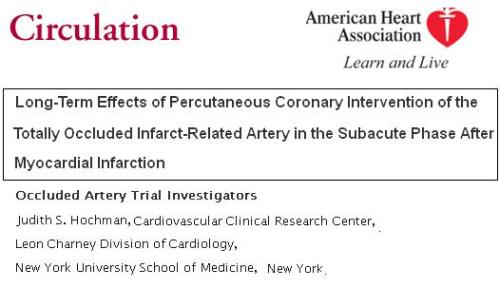
The  OAT   extension study  ,   a  6 year follow-up study on total occlusion following STEMI has just out in circulation 2011  October , online first . http://circ.ahajournals.org

There were two  important conclusions  from this study

  1. Long term follow-up  to  6 years  confirmed  the  lack of benefit of routine PCI  in  post MI total occlusions.
  2. Inappropriately   done  PCIs convert   stable coronary occlusive  disease into potentially dangerous subsets  with  risk of re-occlusion (Which  could  very well be an acute coronary syndrome )

The second one is  of critical  important than the first  .In a nut shell ,  it  suggests  routine PCI in  CTOs  could  increase the   risk of ACS many fold in other wise stable patients.

Final message

This OAT extension study  should  not experience the same fate  of  COURAGE and OAT -1  which  were  successful bitten and buried  by most  interventional cardiologists.

This time they   have to  swallow  the  unpalatable truth ! If they don’t ,  our  patients  would be the ultimate  losers and

will pay the  price dearly !

Personal foot note :

One of my colleague asked me  . . . Why am I  always  after the Interventional   cardiology  community !

I said ,  it is not my job to pull down any one group.  I am just exposing   the  irony of  “selective usage” or “selective  neglect”   of scientific  data by many of us !

Read Full Post »

The other day when  I was  observing  my colleague   puncturing  the inter atrial septum  with heavy bore needle  during a PTMC  procedure  the patient   was  comfortably watching and   enjoying   the procedure .

Even as  multiple wires  criss-crossed  the left atrium  and  the  balloon  hitting  the mitral valve repeatedly   there was  absolutely no pain.

Next day ,   in an another  patient  when IAS was punctured  it got stained  along with pericardium  ,  the patient had   severe  back pain and procedure was  to be  stalled temporarily  .

What  is the lesson learnt  ?

The pericardium and the epicardium (same as visceral pericardium )  has rich  pain  fibers. The above  patient  who had  stain  of epicardium had severe pain .

The former patient who had a perfect IAS puncture did not develop pain while the  later  who  had an  epicardial track   experienced pain.

The same analogy can be seen in patients  with myocardial rupture .While  sever chest pain is a rule  with a free wall tear , it is very rare for  patients with ventricular septal  rupture  to complain  sever pain as  IVS   rupture do not cleave the epicardial layers  .It is also uncommon for papillary muscle or chodal rupture to generate  significant pain .

What is the difference between  epicardium and endocardium in terms of pain fiber  innervation ?

Sub- endocardium has less  dense nerve supply than sub-epicardium. This is one more reason why isolated sub-endocardial  stress  less commonly result   angina ( Eg Hypertension and sub endocardial strain  often silent  ) while  even minimal irritation or insult of sub-epicardium induce severe  pain.

Further , cardiac  pain receptors   respond differently to type of stimuli  .The density of these receptors also  vary depending on planes of myocardial  tissue  .

What are  triggers for cardiac pain ?

Any of the following can trigger cardiac pain.The pain receptors in heart are not well developed as that of somatic system.

It is not clear whether the layers of heart has specialized receptors for various sensations.

  • Stretch*
  • Prick
  • Guide wire poke ,
  • Needle prick
  • Temperature .
  • Infection ,
  • Inflammation of  myocardium , pericardium*
  • Pressure injections
  • Cardiac ischemia*

These  three factors   are responsible for bulk of the cardiac pain . Please note needle prick on the heart is least painful !

How does ischemia   generate pain ?

The ischemia of myocytes secrete

Bio chemical

Substance P ,  prostaglandins, serotonin, adenosine, bradykinin,   and other mediators are involved

Neural

Carried by  myelinated A-d and unmyelinated C fibers run in the cardiac sympathetic nerves . It is understood ,both the fibers  respond to mechanical stretch while Type C fibers also carry chemo signals from bio chemical mediators as well .

Vagus  nerve has a major role in carrying  afferent signals of pain . It is  well known ,   if pain stimuli  is substantial the vaso vagal reflex is activated and bradycardia  and hypotension  occurs.

How is infarct pain different from Ischemic pain ?

Necrosis of nerve terminal will result in more intense pain and lasts longer .

Clinical examples for stretch induced cardiac pain

  • Acute RV/LV dilatation of any cause
  • Pulmonary artery/Aortic dilatation
  • Pericardial stretch could contribute more in generating this   pain
  • Mitral valve prolapse (Stretches  LV free wall )

Interventional  cardiologist should thank god for not innervating  the heart extensively . This  only allows  us to  spend  hours  together  inside the patients heart , other wise one would require a general anesthesia for doing a PCI

Does pericardium  suffer from  ischemia or necrosis ?

Pericardium is not an  avascular  structure . Pericardium gets its blood supply from twigs  of LIMA and phrenic arteries.So there  must be some impact of ischemia on pericardium . Since pericardium has  rich nerve supply there  is every reason to suspect existence of ischemic  pericardial  pain as well .

But  pericardial pain induced by   mechanical stretch  and inflammation is much more common  .While acute pericardial stretch is painful chronic stretch as in slowly accumulating    pericardial effusion is  a painless event !

Pain relief  after CABG

One of the reasons for angina relief  post CABG is attributed to the interruption to  pericardial nerve supply.

Reference

This 1957 article from circulation still  rules cardiac pain literature . http://circ.ahajournals.org/content/16/4/644.full.pdf+html

http://www.annualreviews.org/doi/full/10.1146/annurev.physiol.61.1.143

Read Full Post »

V wave  is one of two positive  upstrokes   seen  in JVP.  Physiological  “v” wave is due to  atrial filling  and reaches the peak at late  systole , while pathological ” v” waves  are often  due to tricuspid regurgitation  . It is  a mid systolic wave .It is a fusion of  “c”and “v” waves .

Here is a patient  with dilated cardiomyopathy with severe tricuspid regurgitation  who presented with prominent neck veins.

there is no difficulty in identifying the  v wave . Careful acuity will reveal  a  sharp  “a”  wave as well !

JVP pressure wave form of tricuspid regurgitation showing classical systolic cv waves

How to measure the amplitude of  v waves ?

In JVP,  there is a baseline oscillating column . Individual wave  spikes  occur over and above this baseline . Hence  technically there  should be two measurements  , but we take only the  top most part of the oscillating  column.

What is the indirect evidence for tall  v waves ?

Physiologically “y” descend is  integral part of v wave (In fact ,  “y” descend  can be referred to as down stroke of  “v” wave )  .For every  tall “v” wave  there  must be  a prominent  “y”descent . (Probably  constrictive pericarditis is an important exception ! )

If  “y” descend is not rapid but shallow one can suspect two conditions

  • Tricuspid stenosis
  • Significant RV dysfunction

How to differentiate v waves from a waves ?

“V” wave  is a passive filling wave hence it raises  slowly , has  relatively   shallow summit and  occurs in   mid or late-systole  . “A”waves are  due to active contraction of atria . It is a  sharp pre-systolic wave . One practical way to recognise   “a” wave is ,  it  never stays in the eye , it just flickers.  If your eye sees a sustained wave for more than  a fraction of  moment it can not be  “a”  wave ! Another point that may be useful is  “a” is taller than “v” in  right atrium .

Reference

Click below to hear the murmur of TR (Courtesy of Texas heart institute )

http://www.texasheart.org/Education/CME/explore/events/upload/HSPS13_TricuspidInsuff.mp3

Read Full Post »

« Newer Posts - Older Posts »