Feeds:
Posts
Comments

Archive for the ‘Cardiology – Clinical’ Category

LV dysfunction , perhaps  is  the most common  medical term used by  physicians  world over.But surprisingly , It is not easy to infer what they mean by it ! The term literally means left ventricle is not functioning all right .

LV dysfunction can be classified by many  ways.

  • Symptomatic vs Asymptomatic
  • Global vs  Regional
  • Reversible vs Permanent
  • Systolic vs  Diastolic
  • Ischemic vs Nonischemic
  • Primary vs  Secondary ( Muscle vs valve  etc)

If you analyse the above classification LV dysfunction can mean different things to different people , at different times.Though systolic dysfunction ,  as reflected by low EF % ( Less than 50% ) is the major cause of LV dysfunction  the issue is not simple.

Is coronary artery disease ( CAD  ) a must for LV to  become dysfunctional ?

No , not at all .CAD  is the leading cause of LV dysfunction .Primary muscle disorders -cardiomyopathy is an equally common entity. Valve disorders especially  aortic valve stenosis is   another common cause for LV dysfunction. Further ,  systemic hypertension, diabetes mellites, renal failure, can result in serious impairment of LV function .Some drugs ( Adriamycin ) can either precipitate or aggravate LV dysfunction.

If  physicians themselves are confronted with such complexity , how are ,  our other medical  colleagues  (Forget about the patients !   ) will understand  the concept of LV dysfunction.

But , the  crux of the matter is every doctor believes  LV dysfunction is synonymous with low ejection fraction. A surgeon or an anesthetist is quiet happy to operate  if the ejection fraction is above 60% .

Can a patient  have significant LV dysfunction with normal Ejection fraction ? (EF )

Yes , this can occur in advanced degrees of diastolic dysfunction, where cardiac contractility is normal but

fails to relax adequately .

Is diastolic dysfunction less dangerous than systolic dysfunction?

May be , that is the dominant opinion   , but  there are sufficient evidence  emerging  that opinion is wrong.The main reason for diastolic dysfunction  to send a ” not so sinister signal ” is over diagnosis of  grade 1 diastolic dysfunction in the general population  . The echocardiologists considered it fashionable for a quiet a longtime (Many have changed since then !)  to report all patients  with reversed E :A ratio in the mitral inflow doppler profile as diastolic dysfunction. This has resulted in  thousands  of  asymptomatic , healthy people getting  labelled  as grade 1 diastolic dysfunction  undermining the importance of this entity.

The fact of the matter is true diastolic dysfunction is indeed dangerous , if not more dangerous than systolic dysfunction  for the simple reason ,  there is  no specific treatment for this condition

To improve the specificity to diagnose genuine LV diastolic dysfunction it is suggested to remove grade 1 diastolic dysfunction from the literature .

Other causes of LV dysfunction with normal EF

  • Some times , there can be wall motion defects  and   mitral regurgitation but still the EF can be normal .
  • Mitral valve dysfunction can be a part of LV dysfunction .The EF is either  not affected as ischemic damage  might be confined to papillary muscle.
  • Vigorous compensation from non ischemic areas  can normalise an EF

What is the difference between LV dysfunction and  LV failure ?

Many times  both these terms are perceived  to convey the same meaning .But it  can  never be used synonymously .Cardiac failure is a clinical entity while LV dysfunction  is  a  derived  technical parameter  by and large an echocardiographic enity. Cardiac failure   is defined classically as a clinical syndrome .(elevated jvp, edema * S 3 rales etc)  Neuroueohormonal activation  can occur with both.

A patient with   LV dysfunction    when destabilsed  develops   LV  failure and after stabilisation of   LV failure he is brought  back to  the baseline  LV dysfunction

*What is the link between LV dysfunction and RV dysfunction ?

RV can not be silent companion when the LV fails  . There always have been link between the two.

LV dysfucntion begets RV dysfunction   and LV failure can trigger a total heart failure

Apart from the classical concept of ventricular interdependence  ,  where  inter ventricular  septum plays a pivotal role , now there is strong evidence  to  prove  both LV and RV myocardial muscle  bundles are interwoven . In fact failing LV drags the muscle bundles over RV also (Friendly pull , let us die together !)  and this is classically seen in idiopathic dilated cardiomyopathy where all four chambers of the heart dilate. There is also biochemical  evidence the RV myocytes deplete thier norepinephrine stores  in LV failure.

Is there an entity called transient  or temporary LV dysfunction ?

The classical chronic reversible LV dysfunction also called hibernating myocardium is a different topic shall be discussed later.

Can acute ischemia cause LV dysfunction  ?

Yes .This can occur during ischemic stunning of myocardium during NSTEMI .This can result in acute pulmonary edema* at times.This can be termed as ischemic LV dysfunction  as there is no myocardial necrosis .

* The pulmoanry edema mentioned here is the  flash pulmonary edema carries very dis prognosis.

What is the cause of LV dysfunction in critical aortic stenosis ?

Is it fibrotic ?

Is it necrotic ?

Is it ischemic ? (Associated CAD )

Or is  it simply  a mechanical inability* to contract  as the outflow is closed ?

There is no specific answer . All the above factors may contribute .*But the fact that  most patients recover full normal LV function  following aortic valve replacement would make the last explanation more likely.

What does the term LV  dysfunction mean to a  cardiac surgeon when he plans  for  a CABG ?

LV dysfunction becomes an important determinant of overall  outcome   in  patients who  are  going  to receive a CABG .The surgeon will have contingent strategies  during peroperative and post operative phase while operating  in hearts with severe LV dysfunction.

How much  of LV function  is going to recover after CABG  ?

This  can not be predicted accurately but CABG  may not  resucitate all dying myocytes and bring life in them .The buttressing effect of blood within the dysfunctional segement can improve contractility and  reduce the wall motion defect(This is an indirect mechanism of improving EF )
Read Full Post »

The answer to this question  is not  easy  , as   one  would tend to believe . In fact this question , takes it for granted     revascularisation  will  improve the LV dysfunction in patients  with severe LV dysfunction.

The truth is , we  are not sure   about the mechanisms . How   revasculariastion  will have an effect  on  chronically dying or dead myocardium  ? (Acutely dying myocardium is a different story, where revascualrisation has a profound effect , that is called salvaging the myocardium )

This  issue is  of great clinical significance  in end stage ischemic heart disease  .A typical  myocardial segment in ischemic cardiomyopathy  has millions of  the dead cells  interwoven with dying cells  with  occasional  clusters if live cells scattered all over .Once the process of myocardial apotosis sets in ,  myocardial cell death does not result  in segmental destruction  instead  an universal cell death.(Paracrine signals of  cell death that spills over to adjacent segments  )  The current standards of revascualrisation (PCI and CABG) aims to provide blood flow  in a segmental fashion. Even if the blood flow is restored in an obstructive vessel it is not clear , how it is going to enter the chronically atrophied myocytes.

Meanwhile , many studies are available   suggesting  coronary revascularisation does indeed improve LV dysfunction. These  evidence has never been  conclusive .Real world experience would also  confirm this  simple fact , that   angina relief is definite following revascularisation but not dyspnea  relief  in patients  with LV dysfunction .

So ,  when seeking the  guidelines  for revascularisation  ( PCI or CABG )  in patients  with CAD one need to ask  this  specific  question

Does the patient has

A.Angina alone

B.Angina and dyspnea

C.Only  dyspnea

If the answer is C ,  assess the patient again , rule out systemic causes of dyspnea (Anemia, renal function etc)  rethink  or postpone  revascularisation.If primary  or secondary LV muscle dysfunction has set in revascularisation has little value.

Also read

Viable myocardium

Read Full Post »

Coronary collateral circulation is the God’s gift to mankind.It has potential  benefits  ( and  of course real benefit !)  both during acute and chronic coronary syndrome.

Collaterals in CCS

The classical role of coronary collateral is in patients with chronic stable angina.It is quiet common to see patients with totally occluded  LAD or RCA with normal  LV function maintained  by extensive collaterals .

Collaterals during ACS.

An intact and functional  collateral circulation can prevent an NSTEMI  from converting into STEMI.In fact many of the patients with unstable angina patients carry on with viable myocardium just because thaey have good collaterals.It gives us a time window to intervene .Some times the col laterals are good enough and help us avoid a revascularisation in toto.

Collateral’s in  STEMI.

This is not well understood. Some  researchers  reported opening up of collateral channels very early after a STEMI. Logic would suggest , anatomically patent functionally closed collateral channels are  always available at time of crisis. But not every one is blessed with such rescue mechanism.

What determines  the native collateral channel development in human cor0nary circulation ?

When  the answer is unknown , it moves to  the  genetic domain also called  – God’s domain .

Our ignorance in decoding coronary collaterals is vast.

The chief cause of this ignorance is we always  tend , not believe things which we don’t see.

Coronary collaterals channels need to atleast 1mm  to be visualised by CAG.There could be a vast network of micro collaterals out there within the myocardium invisible to current imaging methods. (In fact , this has a link with outcome  of the COURAGE study )

Is coronary collaterals have all the three layers of an artery ?

Yes .But the media lacks muscle.

Is coronary collateral less prone for spasm ?

May be.

The drugs we give , Calcium blockers , betablockers, and nitrates have same  hemodyanmic effects  as in native coronary circulation ?

We don,t know as yet. Nitrates are supposed to improve collateralisation

How common is atherosclerosis to involve the coronary collaterals ?

How often is an ACS precipitated by an collateral occlusion ?

May be more common than we think.

Can we stent a  2mm wide  collateral to maintain  the patency in case of a CTO  ?

A question need to be answered by current generation interventional cardiologists.

Is coronary collateral gives protection against primary VF ?

In one sense ,  the number one killer of mankind is  in fact not STEMI but the VF that follows it .

Why only a few develop a VF following an MI ? What determines the arrhythmic response to ischemia ?

Some anecdotal observation  of     suggest a role for early coronary collateral  opening in the prevention of VF .

Read Full Post »

Diagnostic issues in cardiac failure : A  febrile pleural effusion in a patient with LV dysfunction .

Is it a transudate or exudate ?  How to confirm the pleural effusion is primarily cardiac failure related ?

When the classical protein criteria is inadequate or prone for errors

Try this more specific marker  within the pleural fluid

N-Terminal Brain naruretic peptide

Pleural fluid NT-proBNP is very useful in establishing the diagnosis of HF-associated effusions, and it confirms this diagnosis . The measurement of NT-proBNP rather than serum to pleural protein gradient is recommended for identifying mislabeled cardiac transudates.

Reff :Biomarkers of Heart Failure in Pleural Fluid. Chest. 2009 Apr 10.

Read Full Post »

Ectopic beats or premature depolarisations are the commonest  cardiac arrhythmia encountered . Human heart , is a  non stop  electro mechanical organ ,  and it is not surprising   ectopic beats are so common  and can literally originate  from every cell of heart. But , generally it   emanates  primarily from  the special conducting cells . At times  ,  even  other cells (Myocytes, interstitial cells )  can generate abnormal electrical potential.These ectopic electrical potentials  can be compared  to  electrical load shedding when there is excess electrical strain .

Vast  majority of ectopic are benign  in human population. When this occurs ,  in the milieu of underlying heart disease or during ischemic  episodes they become clinically important and initiate a sustained arrhythmia.

Classically and traditionally ectopic beats are described in the

A.Ventricle :      Ventricular premature beats, (VPD)

B.Atrium:             Atrial premature beats(APD)

C.AV junction : Junctional premature beats.(JPD)

If you note , one important structure is missing from the list.

Yes , it is  SA node.  Can it result in premature depolarisation ?

When do you suspect a SPD(Sinus premature depolarisation)

  • It manifests a  an sudden unexpected , sinus beat exactly as the previous sinus beat. Followed by a pause.
  • The P wave morphology exactly is similar to prior p wave.
  • Many times we miss this entity as we tend to over  diagnose APD than SPD.
  • SPDs tend to occur in bigeminy rhythm.

Differential diagnosis

  • Sinus arrhythmia and pause
  • APD
  • SA node echo beats (Part of SA node reentry)
  • SA blocks

How do differentiate  a sinus arrhythmia from sinus premature depolarisation (SPD ) ?

Sinus arrhythmia occurs in a baseline bradycardia environment.

It does not not come as   “on -off ” pattern . It has a gradual onset offset dynamics.

Clinical significance

This is a clinically unimportant arrhythmia* .This  is probably the reason , it is not a popular concept .

*But it can confound in the diagnosis of  , other important rhythm  disorders.it could be a expression of  sinus node dysfunction and a precursor of  inappropriate  sinus tachycardia The significance could be substantial in atrial triggered  based  pace maker rhythm

Final message

When you confront an unexpected , early , sinus beat not accountable to sinus  arrhythmia  or APD

suspect SPD.It is  not rare , it is a  grossly under diagnosed entity.

Reference

Sinus premature systole  http://www.chestjournal.org/content/64/1/111.full.pdf?ck=nck

Read Full Post »

Yes , we can .         Abstract : Link to Indian heart journal

b1

Vegetation Negative Infective-Endocarditis

S Venkatesan, G Gnanavelu, G Karthikeyan, V Jaganathan,  R Alagesan,
M Annamalai, S Shanmugasundaram, S Geetha, A Balaguru, G Anuradha

Madras Medical College, Chennai


The definitive diagnosis of infective endocartitis (IE) remains a contentious clinical issue. Many diagnostic criteria have been advanced. However, none has withstood the test of time. Currently Duke’s criteria is considered as de facto standard. Documentation of vegetation within the cardiac chambers and positivity of blood culture is the sine qua non of IE and evidently they constitute the major criteria. Ironically, according to Duke’s criteria, IE could still be diagnosed in the absence of vegetation, provided it fulfils other major criteria of culture positivity. In this context, we report our analysis of patients with IE without vegetation. Out of 24 patients admitted between 2004-2005 in our hospital with the diagnosis of IE, 4 patients failed to show vegetations. All had rheumatic heart disease (RHD) and presented with prolonged fever. All had severe eccentric mitral regurigitation (MR). One had severe aortic regurgitation (AR) also. One had flail posterior mitral leaflet (PML). All had blood culture positive – 3 for staphylococcus auerus 1 for pseudomonas. None had vegetations on the first echocardiographic examination. Transesophageal echcardiography (TEE) also failed to detect a vegetation or abscess. The diagnosis of IE was made on the basis of Duke’s criteria (1 major and 3 minor features). Treatment was started based on culture positivity and sensitivity. All patients underwent serial echocardiography every week for 6 weeks. New mobile vegetation was detected in 1 patient in anterior mitral leaflet (AML) measuring 12 mm after 2 weeks. Three patients never showed any evidence of vegetation. One patient developed cerebral vasculitis and another renal insufficiency during the course of treatment. Two patients stabilized with medical management. One expired and other had refractory cardiac failure and was referred for emergency surgery. The mechanism of absence of vegetation in IE could be varied. Simple temporal dissociation between appearance of vegetation and the clinical syndrome should be the first possibility. Further, vigorous antimicrobial treatment might have prevented the formation of vegetation. But, as we have seen in few patients, it never appeared. This was possibly due to layered vegetation like that of a thrombus on the surface of the valve or adjacent myocardium. The process of vegetation formation need not be endoluminal, it can burrough into the tissue plane intramurally without projecting into the cavity. Spontaneous rupture of chordae secondary to inflammation without any vegetation is another possibility.

We conclude , even though vegetations are considered sine quo non of IE in many clinical situations, IE occurs without vegetation. The mechanisms could be varied.

Download full  PPT presentation

infective-endocarditis-csi-2005

infective-endocarditis-csi-2005

infective-endocarditis-vegetation-csi-2005

Read Full Post »

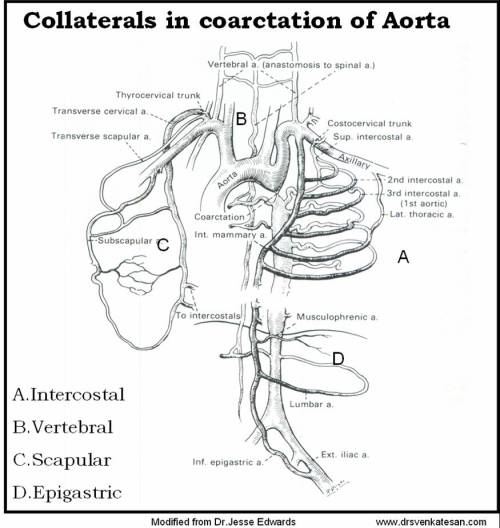
A perfect illustration  to understand

What will happen if the aorta is obstructed at the level of isthumus ?

One of the great illustrations I have come across

co-arctation-collaterals

collaterals-in-coarctation-21

Courtesy

Dr.Jesse Edwards (Fowler’s Text book of cardiology )

To  Download a PDF version and Zoom into the Aorta  as deep as you would like !

collaterals in coarctation of aorta

Also watch

Collateral in co arctation   : A video

Read Full Post »

CABG is the most common cardiovascular surgery  done world wide .

When the ventricle is dilated it is a common practice to do a ventricular  reduction surgery.

It was a logical to expect benefit when we correct the adverse remodelling of heart  that aoccur following an MI.

The STICH trial compared  plain CABG with ventricular  reconstruction and reduction .

Unfortunately , in medicine , the logics often fail  as this study  found no  mortality advantage .

Click here to read the land mark article from NEJM

Read Full Post »

  • CAD is the major cardiovascular disease of our population.
  • CABG is the most common cardiac surgery done world over.
  • LIMA to LAD graft is the most common by pass done.

The purpose is to short circuit some of the blood meant for the hand to the heart.

But ,  is it always a helping hand ?

May not be . . . at times  of crises  the  hand  sucks  blood  from the heart .This is called coronary-subclavia steal phenomenon

Is it not dangerous ?

How to anticipate or prevent this complication in patients who are posted for CABG-LIMA graft ?

Click on the link for the reveiw article from Annlas of  thoracic   surgery

lima

Read Full Post »

Dopamine and dobutamine are  the most commonly used inotropic agents in clinical cardiology.

The following table represents a simple comparison of the two drugs.

dopamine-dobutamine

Read Full Post »

« Newer Posts - Older Posts »