Feeds:
Posts
Comments

Archive for the ‘Cardiology – Clinical’ Category

Anginal equivalents are distinct  (often vague  ) symptoms that occur in response to myocardial Ischemia , instead of angina. Dyspnea or shortness of breath  is the commonest anginal equivalent . The incidence and exact mechanism  is not clear. Both angina and dyspnea are sensory  events . Both are  perceived  at the level of cortex. Angina occurs when ischemic  muscle  triggers pain signals from the   nerve  twigs engulfing the myocytes membranes  and the vasavasorum.

Dyspnea during myocardial  ischemia  is multi-factorial

  1. Signalling error .( Mismatch between respiratory /Cardiac  receptors  neural traffic)
  2. Cortical perception disorder.
  3. Autonomic neuropathy (Blocks pain signals  but still may carry  myocardial stretch response)
  4. Coronary sinus lactate –  Biochemical /Chemo receptor stimulation
  5. Isolated  Ischemic LV relaxation defects  , and resultant elevation of LVEDP
  6. Ischemic systolic stunning  and secondary  diastolic dysfunction  (elevated PCWP  pulmonary stretch receptors stimulation )
  7. Ischemic MR . Eccentric MR jets and regional and segmental elevation of pulmonary venous pressure has been reported. (Unilateral and segmental pulmonary edema)
  8. It is possible  ,  Ischemic wall motion defect per-se  can induce myocardial stretch and create a feeling of dyspnea.

Out of the above eight factors  which is  most important  ?

The most popular and easy to comprehend   mechanism   is number 5 : Ischemic diastolic dysfunction .

(Fellows will be appreciated if they  know this !   )
Read Full Post »

This is a true story  . . . happened  many years  ago under my direct  vision.

A  48 year old women came with significant breathlessness and catchy  sub -sternal chest pain .

“I  was exerting too much in recent days  doctor” , she said .

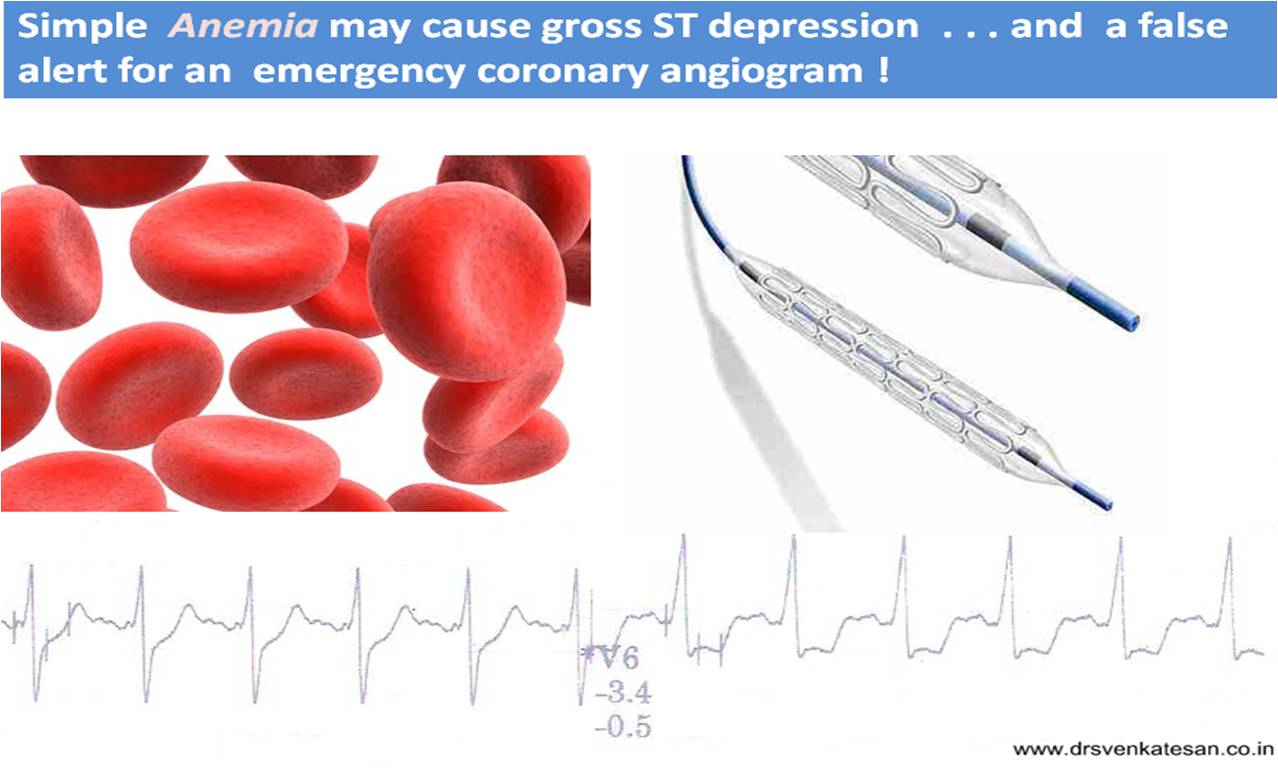
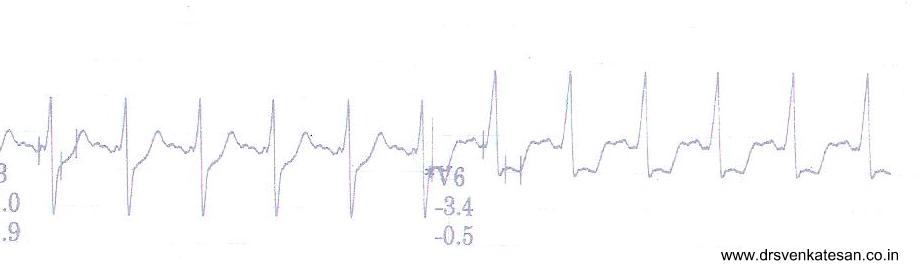
Her ECG  showed  a tachycardia and dramatic ST depression in most leads .

The ER in charge promptly texted the cardiologist .

The moment he saw the ECG ,he  had no hesitation , to order for an emergency angioplasty  (  How can he plan a angioplasty  , without even  knowing the coroanry anatomy . some one murmured  . May be   . . what he probably  meant was emergency angiogram   the other explained )    Further , he was telling his    fellows  . . . that  this is going top be  tough case and a possible  left main PCI .

An emergency  angiogram was done .  On table  it was a huge  surprise for every one ,  it was a  a classical  text book   look alike normal coronary arteries !

The moment normal CAG was  visualized  the consultant  concealed his momentary  surprise    and went on to say  it is classical case of syndrome  X   with severe micro- vascular disease causing ECG changes !

As  the patient did not give any opportunity to poke her coronaries   she was wheeled out of  wheeled out of cath lab.

Meanwhile ,  first year  fellow came rushing with the blood reports and biochemistry .

Is everything  alright ?   Yeh sir ,  except her Hb %  . . .  it is  5.6  Grams !

The bewildered  consultant *  realized   the  high  coronary drama , that is  been enacted  over the  past 2 hours !  and  learnt  (and taught) a most important  lesson to their fellows !

Hi guys , this is neither  a NSTEMI nor  a microvascular syndrome X  . . . this is simply anemia related  extreme  ECG changes !  We have erred in our reasoning and  our pre cath clinical scrutiny has  gone awry ! 

He went on to say  ,  don’t worry  many times medicine is learnt in  hard ways  . After all nothing adverse has  happened here .

The women was subsequently investigated and handed over to  gynecologist for a probable hysterectomy .

Final message

Please be reminded  , anemia  can produce  variety  of  ECG changes.  In extreme anemia  global ST depression is  common especially if  tachycardia is associated .

The lesson here  is ,  whenever  gross  ST depression is witnessed  with vague chest pain  check the hemoglobin first . This is an unusual story of a women  ,  with simple  anemia  (due to   chronic mennorhagia )   landed in cath table in an acute fashion .  Luckily  she  did not have any  incidental coronary  lesions  that prevented her becoming a  greater cath lab  victim !

* The bewildered consultant is none other than the author  of this blog.

Read Full Post »

Under physiological condition ,  pre-load , after load , and cardiac  contractility should be a sequentially matching parameters . After load mismatch is an important concept , where myocardial contractility is temporarily  depressed due to  lack of adequate pre-load for a given level of after load .

This is also  referred to as descending limb LV function paradox .

The three  common clinical situation  AL mismatch  occurs

  1. Critical Aortic stenosis              (High aortic after load )
  2. Acute Hypertension                   (High after Load -Normal and  low pre-load)
  3. Severe diastolic dysfunction  (Pre-load is high -After load is normal )

If it happens acutely the myocardium becomes dyfunctional  due to  mechanical non ischemic stunning .Once the after load comes down the contractility improves .

What  is the chronic adoptive response to after load mismatch ?

LVH is the major  chronic adoptive response to AL mismatch.

LVH reduces the wall stress which will reduce the after load  indirectly .

So LVH neutralises the   high  after load .Laplace law at work . (Wall stress is equal to  2 times the radius divided by thickness of the wall )

Here  is the Link to the great lecture by John Ross Jr  in LA Jolla , California in one of the annual scientific session of AHA   more than 25 years ago . http://www.ncbi.nlm.nih.gov/pubmed/966366 .The concept is alive and kicking even today .I am sorry to  note   this  important physiological concept   never received the attention it deserves .  I would vouch , it  can be as   important as Frank starling  principle .

Reference :

https://content.onlinejacc.org/data/Journals/JAC/22702/04186.pdf

//

Read Full Post »

Hypothyroidism is  a classical example of  generalised edema formation .  The mechanism of which is extensively studied  .Still we are  not clear  about  it .

Content of edema fluid

  • Mucopolysacharides -Hyalinorunic acid
  • Albumin

Mechanism

  • Albumin leak into interstitial and extra cellular space  due to capillary dysfunction.
  • Reduced lymph clearance – probably due to poor lymphatic tone  .

Why hypothyroid  edema  does not pit on pressure ?

For pitting to occur tissue should be compressed and retain the elasticity .This means  the fluid can escape into the cell when mechanically compressed and comes back when the  elasticity of skin  brings  it back to its original status. For this to occur the skin and subcutaneous matrix should be normal in texture.

In cardiac failure and renal  failure   edema is   primarily due to  altered hydrostatic forces and skin  is intrinsically normal .So  some amount of pitting  is retained . In hypothyroidsim and lymphedema  where there is  an intrinsic  pathology  of the  skin   pitting  is rare.

Why constriction and  cardiac tamponade are rare with hypothyroid pericardial effusion ?

Like the generalised slow response of hypothyroid individuals  the effusion is  also very slow forming and is rarely large so tamponade is rare .

The hypothyroid infiltrates which  collects within  the pericardial space it rarely infilitrates  the fibrinous pericardium (The thick outer shell ) .Unless fibrinous pericardium is inflamed or infiltrated constriction is exceedingly rare .Simple epicardial infiltration may cause some restrictive  physiology but not constriction .

Reference

Lancet. 1975 Mar 8;1(7906):564-6.Effusions into body cavities in hypothyroidism.  http://www.ncbi.nlm.nih.gov/pubmed/47029

Read Full Post »

The primary determinant of pulmonary artery systolic pressure is . . . ?

  1. Pulmonary arterial tone
  2. Pulmonary venous pressure
  3. RV contractility
  4. Pulmonary blood flow

Answer : All of the above

But what is the relative contribution of each ?

I am  100 %  sure  ,  no  one can answer this question  correctly !

It is  true  , in some  pathological situations  one can  be  fairly certain about  cause of   elevated pulmonary arterial pressure .

When we confront a patient  with left heart disease  it is the transmission of  mean venous pressure .

Whatever be  our understanding ( Pre/Post capillary pulmonary hyper tension and the related stuff !  ), the one parameter that makes mystery contribution  to PA pressure is RV contractility !

In physiology  RV   generates  about 30mmhg systolic pressure that becomes the  pulmonary systolic  pressure .The  diastolic pressure  will be around 15 and mean around 20 . During exercise  contractility of both RV and LV increase .There has been documented PASP up to 50 mmhg in normal healthy adults during   exertion .

Here one can assume RV contractility is causing  a entity called transient Isolated  systolic  pulmonary arterial  hypertension.(ISPAH)

Consider a entirely different situation

A patient with COPD  with raised  PASP .  The right ventricle pressure has to equilibrate with PASP  during systole .For this to happen   it has to generate the 60mmhg .  If the RV fails  to augment it’s contractility for some reason ,  will the  ineffective RV contraction will  lower the  PASP  ? This is the perplexing question !

While the popular understanding is ,  RV dysfunction will under- estimate the severity of   pulmonary hypertension   . . . still  . . .  we are not sure whether RV dysfunction will  reduce the PASP   per-se  ( and  subsequently PA  diastolic pressure as well )

We often see a  good example  . A patient who develops tricuspid valve disease and RV  dysfunction get symptomatic relief  from  lung congestion .

Final message

The relationship between RV function and pulmonary artery pressure is a real enigma. Though hyper functioning  RV is expected to elevate PASP  and hypo functioning  RV would pull  it down  , the relationship  is not that simple. If only we decode this  mysteries   we can try  specific  RV negative inotropic  agents  as a  modality to treat pulmonary hypertension .

After thought

Total artificial hearts  are going to come in a big way in the coming decades .It  will specifically address this issue  ,  as RV and LV contractility  need to  be individually tuned to avoid pulmonary congestion.

Coming soon

While  RV function is critical for human survival  ,  Fontan  principle  simply says entire RV is dispensable . How ?

Read Full Post »

What   are the factors other than EF %  that determine  functional capacity in cardiac failure ?

In our experience we have found the following factors  contribute immensely to the functional capacity of cardiac failure patients

  1. LV  filling  defects  (30 % of DCM have significant LV relaxation defects )*
  2. Integrity of  RV  function
  3. Mitral valve  competence(Even a mild MR can be important .It lowers the threshold for pulmonary congestion  )
  4. Severity of Pulmonary hypertension
  5. Lung Function *(Restrictive PFT common , gross cardiomegaly can reduce lung space )
  6. Basal exercise capacity .
  7. Skeletal muscle  function (Mitochondrial training )*
  8. High body weight
  9. Will power and self esteem *
  10. Spouse support and motivation

* May  have  major Impact on functional capacity

Final message

Physicians and even cardiologists are   obsessed  with EF %  to a large extent . My guess is , it   is not likely to end in the near future . The irony is ,  we have passed it  to our  colleagues  (Like anesthetists !)  and patients as well .(  for various reasons )

                        Please remember  , there are at-least 10 factors  that are  important  in the genesis of  symptoms of heart failure  . The list can extend  further  if we include  like associated renal  dysfunction , hemoglobin concentration  , etc .

Even though LV pump primarily determines  the ultimate outcome in cardiac failure ,  it is unwise  to  blame the EF %  for all the suffering  . If only  we realise this fact , one  can take  appropriate  measures .

**   Paradoxically modalities aimed to improve LVEF by positive inotropics has never been shown to improve the outcome .In-fact , there is more evidence for the contrary !

Read Full Post »

That’s how  one of   the patient  presented  to our hospital .  An echo documented  severe aortic stenosis with a  peak aortic gradient of 80mmhg  and  a  bounding  systolic blood pressure of  180 mmhg . Is that an exception ?

I recall the early days of medical school when  we are fervently   taught  that  systolic  blood pressure is primarily determined by stroke volume and LV contractility .

The above example clearly proves this  is  explicitly wrong  .

Now , we understand  systolic blood pressure have many determinants   . Stroke volume is  just one of them .

The tone  , distensibility  of major blood vessels arising from aorta determine how a pressure wave is going to get amplified .

If you  say stroke volume is not  major determinate of systolic blood pressure   . . . .  does it  imply ,   the antique  bed side cardiac sign  Pulsus parvus  et- tardus  a myth ?

No ,  it still holds good . But it is not a hard sign .  We realise now , a patient with a well felt carotid can have a severe Aortic stenosis .

  • Pre- existing systemic hypertension is a  valid explanation.
  • The other popular explanation for  loss of systolic decapitation due to associated  aortic  regurgitation   may be  acceptable . (Not really proven though ! )

What will be the central aortic  pressure  in critical Aortic stenosis ?

It is definitely lower than brachial cuff pressure .This will explain the systolic blood pressure is actually an amplified signal .

Read Full Post »

Which is  the most important factor that determines thrombolysis failure in STEMI  ?

  1. Thrombus load .
  2. Drug efficiency
  3. Time delay
  4. Presence of a mechanical lesion
  5. Hemodynamic instability

Answer : 3 .(Though all 5 factors operate )

Failed thrmbolysis occur in about 40-50% after streptokinase and slightly less with TPA   and TNK-TPA . Delayed arrival and late thrombolysis are  most common cause of failed thrombolysis. As the time flies , the  myocardium gets damaged and the intra coronary  thrombus gets organised .Both these processes make delayed thrombolysis a futile exercise.

               Not all STEMI patients have large thrombus burden. There need to be a critical load of thrombus for thrombolytic to be effective

Some may have a major mechanical lesion in the form of plaque fissure, prolapse and it simply blocks the coronary artery mechanically like a boulder on the road  . The poor  streptokinse  or the rich Tenekteplace !  nothing can move this boulder .The only option here is emergency PCI .

How will you know when the patient  arrives in ER with STEMI whether his/ her coronary artery is blocked with soft thrombus or hard mechanical boulder ?

It is impossible to know.That’s why primary PCI has a huge advantage.  But still thrombolysis is useful as some amount of thrombus will be there in all patients with STEMI.Lysing this will provide at least a  trickle of  blood flow that will jeep the myocardium viable and enable us to take for early PCI.

Final message

The commonest cause for thrombolytic failure is the time of administration and the degree of underlying mechanical lesion  . So  it does not make sense  to blame  streptokinase always !

Read Full Post »

There are many wonderful books for learning clinical cardiology.J.K.Perlof’s clinical cardiology,  Jonathan Abrams , are popular ones. Clinical chapters in  Noble O  Fowler is a  wonderful reference .

My choice for the top slot is  by Signs and symptoms in cardiology”   by Horwitz and Groves .They wrote this master piece

from a relatively  unassuming  US city, University of  Colorado.  Denver .Published by J.B.Lippincott company in 1985.

I am  not sure , any further edition of this book  has come .

Young cardiology residents  must first  identify  good  books    . . . reading comes next !

What to buy this book ? .Try  at Amazon .

http://www.amazon.com/Signs-Symptoms-Cardiology-Lawrence-Horwitz/dp/0397505124

Read Full Post »

When do you call a infected heart as healed ?

Should the vegetation disappear to call it a cure ?

Vegetation’s rarely disappear following treatment . Very small vegetation may dissolve – 20% . Many times it regress in size .

Often  our aim should be  restricted  to sterilise the vegetation. This invariably happens in most of the patients who receive complete course of antibiotic. But healing and sterilizing is not enough in many vulnerable patients.If the vegetation is large the embolic risk is still there even with a healed vegetation.

So if there is a relatively large  (>1.5cm) vegetation it is always better to remove by surgery.

Interventional  techniques may   soon  allow  capturing these vegetation by basket catheters .When technology is there to retrieve small bits of a thrombus inside a coronary artery it should be possible to remove a large vegetation with temporary aortic filters in place.

Also read

https://drsvenkatesan.wordpress.com/2011/01/12/what-is-the-natural-history-of-infective-endocarditis-vegetation/

Read Full Post »

« Newer Posts - Older Posts »