Feeds:
Posts
Comments

Archive for the ‘Cardiology-Coronary artery disese’ Category

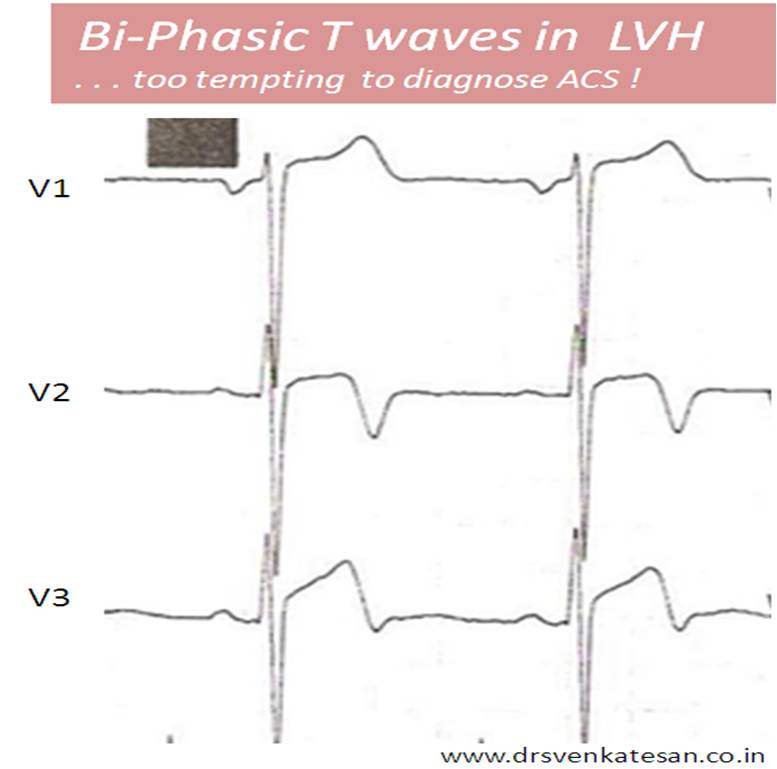
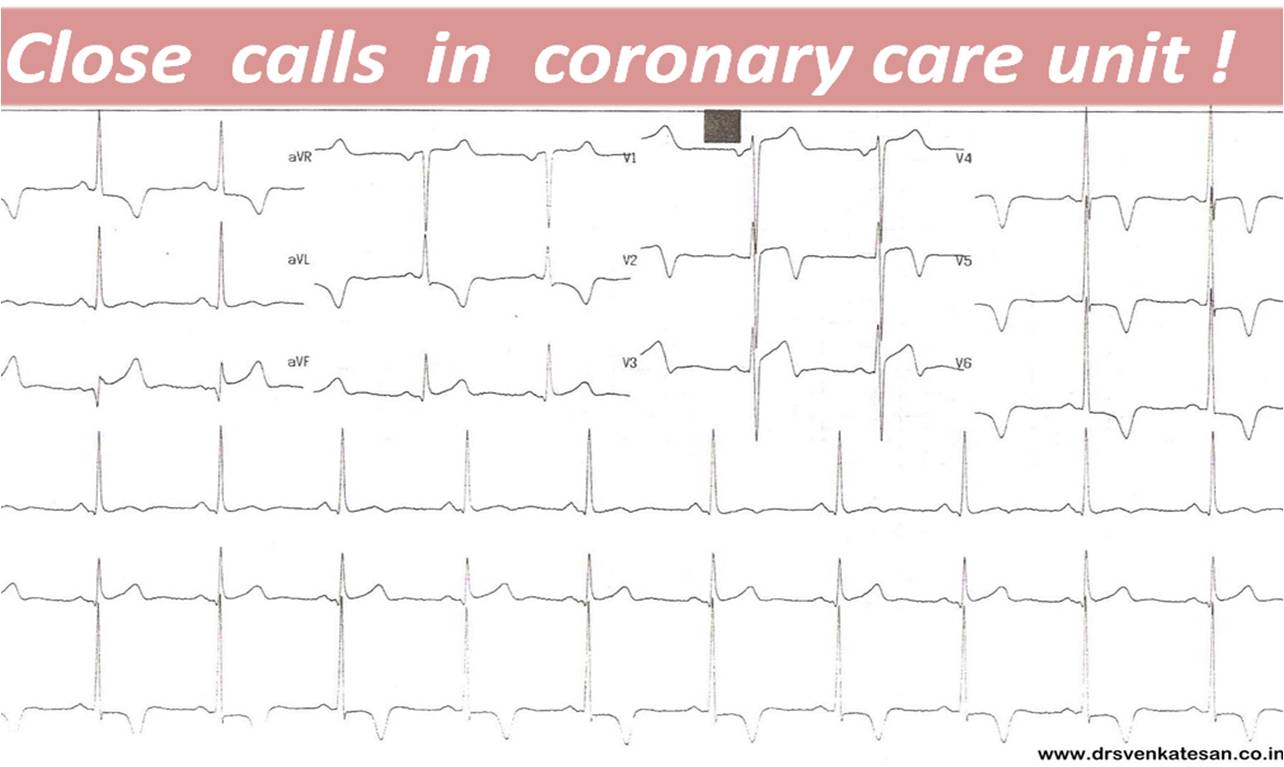
This  is the ECG  of  a  45 year old man with  H/O hypertension  and  chest pain .The general practitioner who first saw him alerted this  patient about a possible  heart  attack  asked to meet a cardiologist immediately. The cardiologist who  saw  this ECG   tended to confirm  the diagnosis  and advised admission in  a coronary  care unit .

The patient   defied  both  and  somehow landed in my echo lab  .  Looking at the ECG   I also  expected  it to be a  STEMI  evolving into a  Non Q  MI .

I was surprised  to find  only LVH with absolutely no wall motion defect  . There was no evidence of ASH,  HOCM or apical cardiomyoapthy as one of my fellows initially  suspected . His  EF was 70 %.   Cardiac enzymes were sent by then. When  I spent few minutes  with him ,  listening the history , it was very clear  what  he had was  non cardiac pain . In the anxiety ,  no one  got it right  about the character of pain ,which  was localised , lasted  for few seconds and  least suggesed angina.

The moral of the story is   listen to the patient  however dramatic the ECG may look !

What is special in this ECG ?

It is common for LVH with ST depression to be  mistaken for  ACS/NSTEMI

Here , there were  other  observations that  added  more  complexity .

  • Presence  of  ST/T changes in inferior leads(ST elevation in lead 3)
  • Bi-phasic  T wave in v1 to v3
  • ST elevation  in precardial leads

In LVH  it is usual  to note  ST depresion , how do you explain ST elevation in LVH ?

ST elevation in LVH   may occur in  leads  v1 to v3   . It is very rare  for LVH to inscribe  ST  elevation in   v4 v5 v6  .   Why certain  leads elevate the ST segment while others depress  in LVH  is not clear. It may represent  incomplete LBBB pattern where the ST segment deviates opposite to the  dominant QRS  complex. Septal  hypertrophy often elevate  while free  wall  hypertrophy depress the ST segment . Since V5,V6 leads are free wall oriented , these leads  record  classical  ST depression .

Importance of Bi-Phasic T waves

Please remember  Bi phasic T waves are notorious for it’s  unpredictability. An  innocuous looking bi-phasic T waves  (especially  with dynamic behavior )   is a  harbinger of proximal  LAD or even left main disease.

Finally , what will be ECG  changes if a patient with classical  LVH  who  develops a  real  STEMI ?

  • LV strain  pattern normalises ?
  • Further ST depression  occurs ?
  • No great changes . ECG  Looks near normal ?

Answer : ?

What is the significance  of   Bi-phasic T  waves : A  link to  a related post

Read Full Post »

Mark E Jospehson  is the man who single-handedly carried  the burden of teaching  generations  of electro-physiologists  from  Harvard  Thorndike electro physiology services , Boston USA. Today , whatever  we know  about the mechanisms of VT , it is because of such great men who  spent thousands of hours  in the  first generation EP labs in early 1970s and 80s  , meticulously analysing   the data emanating  from  over  600   scar mediated VT with complex circuitry .

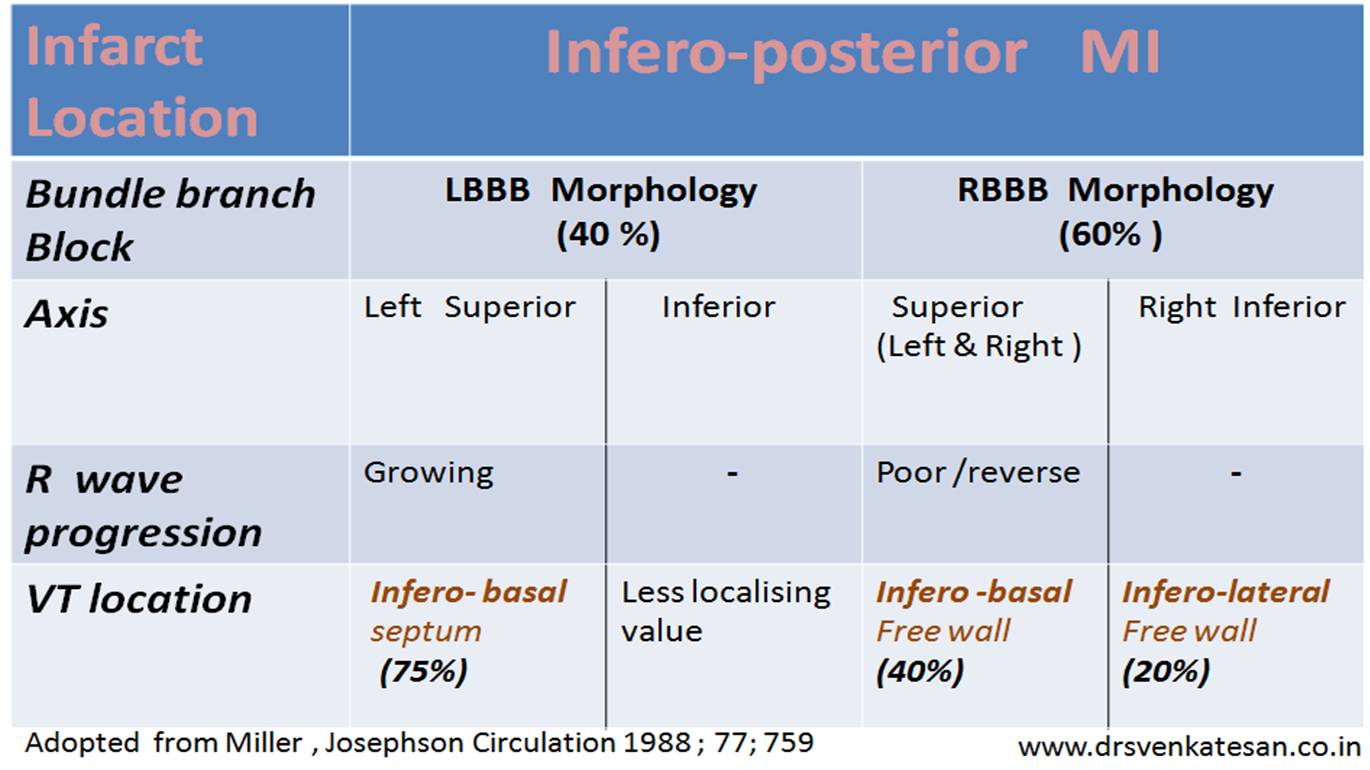
He along with  Miller published this seminal paper  in circulation 1988 , which gave us  the  algorithm  that localises  Post MI VTs.

Following table summarises their finding.

VT localisation in Infero-posterior MI

The general principles  of localisation of VT  

  • Localising VT following myocardial infarction  is difficult but distinctly  possible with  about 60 % accuracy.
  • Whenever we locate a focus we generally refer to epicardial site of exit not the focus of  origin.
  • Ischemic VTs with complex scars are difficult to locate .
  • The rule  that RBBB VT arise from  LV and LBBB VT from RV is too simplistic  in scar mediated VT.
  • The fact  that IVS is common to both RV and LV confounds the issue .Further, in a given  clinical VT  the origin  , course   and exit points of VT can considerably vary .For example  septal VT can exit  on  either side and  result in  either RBBB or LBBB morphology (Epicardial break thorough )
  • Multiple exit points are also possible.
  • VT induced in EP lab may not be reproducing the same clinical VT. So we have to be careful in what  we ablate and claim success !
  • VT with  structurally normal heart  has   more predictable behavior  , for  example RVOT VT  almost always have LBBB morphology.

Other important rules of thumb are

  • LBBB VT has more localising value .
  • Superior  axis is the most common  axis.
  • Bulk of the ischemic VT are located within the septum either in the apical or basal region .(75%)
  • Infero posterior MI has more complex scars , hence VT morphology is heterogeneous.

The purpose of localising VT is important  only with reference to  ablation.(Of course for academic reasons  as well )   With advent of electro anatomic imaging (Carto ) it is becoming   easier  to locate and track them . Still only a minority of VTs are amenable for RF ablation .

Please note ,  the most common modalities we use  in the management of VT  ,   Amiodarone  and ICDs   simply do not   bother  about   focus of origin  for it’s action !  That makes our job easy !

Reference

http://circ.ahajournals.org/content/77/4/759.full.pdf

Read Full Post »

How early one can shift a patient for rescue PCI after failed thrombolysis ?

  1.  Wait for at-least 24  hours.
  2. A minimum  cool off period of 2 hours is required.
  3. It is never an issue . Rush the patient  immediately to cath lab
  4. The question does not arise  . Often times ,  rescue PCI is a dead concept  as  sufficient damage has happened !

Answer

The irony of  medical science  lies in our belief that every medical query  has a specific answer ! In reality it is rarely true.   In this instance , any of  the above can be a correct response.

A patient with  failed thrombolysis can belong to any of the  64 possible combinations*  based on  time of  thrombolysis , extent of  MI,  associated complications, co- morbid conditions , presence of symptoms . (For example there is  a sub groups of patient with  failed thrombolysis still  asymptomatic  and comfortable )

The issues for rescue PCI  do not  arise  in a   sinking STEMI (Cardiogenic shock ) , or  STEMI with persistent angina. There  is  no  management issues in  these patients  .They need to be rushed to cath lab. Unfortunately  in  impending  LVF or manifest LVF (But not in shock )  decision making is tough , as doing a PCI in patients  with basal crackles  and hypoxia is a real challenge .These are the patients who are likely  to hit hard  from the hazards of the procedure .Extreme caution is required.

I have seen  significant cohort  of  asymptomatic hypotensive patients getting converted into   drug resistant, IABP dependent refractory shock after PCI  ,  making every one look  pathetic  !  The  only solace for the interventionist  is  the gratification  of  stenting the  IRA !

This  happens  , in spite  of having  multi national trained  in house critical care anesthetics and  dual core processing IABP  . Realise  what we need is delicate decision making ,  So use extreme diligence in selecting patients with impeding shock .

Your medical management can  provide  more teeth to stabilise your patient than a PCI .If you are doubt discuss with your learned colleagues .  ( If you  do not  ask for evidence for  this statement , probably  it would confirm  you  as  an  experienced   cardiologist  !)

Real issues pushed to the sidelines ?

While the real issue  in the timing of rescue PCI  may be  different , the discussion traditionally  revolves around   hemo-rheological aspects . We know  the lytics and PCI do not combine well for two reasons.

  • Pro-coagulant nature of lytic state .
  • Excess bleeding risk at puncture site.

Now ,  we have evidence to say fibrin specific lytics  TPA, TNKTPA has less of this issue . ( NORDISTEMI)

Patients who receive  fibrin specific lytics  can  safely  be  taken for rescue PCI  in case it is needed without any increased risk .

Bleeding complication  has dramatically reduced as radial procedures are done often even in emergency setting.

Vascular occlusive devices  have added to our comfort.

* The definition of failed  thrombolysis by  itself is not standardized . Is it symptom guided ?  or ECG / enzyme / echo guided  ? A patient with  infarct  related chest pain (dull aching )  after thromolysis can be labeled as post infarct refractory angina and rushed for emergency angiogram .(This is due to our ignorance  about  the  residual pain signals  through  type c pain fibres  for up to 24 hours )

Final message

The indication and  timing of rescue PCI is  primarily  related   to the  overall   patient profile  rather than the bleeding or pro-coagulant issues .

Although   pro-coagulant  lytic state is based on weak scientific  foundation , it  is a blessing in disguise  as it  can  act  as a deterrent  in restricting  inappropriate rescue PCI !

Read Full Post »

What is a coronary risk factor ?

Right from the days of  Framingham study we have conferred a privileged   place   to  few  cardiac  risk factors.

they are

  • Diabetes mellites
  • Hypertension
  • Hyperlipidemia
  • Smoking
  • Obesity

They are referred to as conventional risk factors .  What is the convention ?  Do they deserve  the  cult  status they enjoy ?

Today we also have a  cluster  of non conventional risk factors like , Lip (a) , low HDL, Homocystenemia , CRP , Apo B etc . Currently ,  in any large cohort of CAD  up to 30 %  do not exhibit even a single conventional risk factor  . This is a huge number .Hence   we tend to give more importance to genetic make up and mental stress etc  .The search is still  on for newer risk factors .

Why some research  findings are difficult to comprehend ?

It is because we are yet to  decode the  intricacies  of  human biology  fully . Our knowledge is so superficial  , as we chase  a pseudo scientific  proofs   for  a  presumed  hypothesis.  The classical example is the concept called good cholesterol (HDL) and reverse cholesterol transport which  is never based on solid scientific foundations.

Take the sorry story of  Torcetrapib

Many consider  low HDL  as an independent CAD risk factor to be a  myth  or else why should we miserably fail  to have any positive effect of  increasing the HDL  levels by pharmacological means . (One argument is physiological  and natural elevation of  HDL  would still be beneficial  . But the issue is still wrapped in a statistical mystery

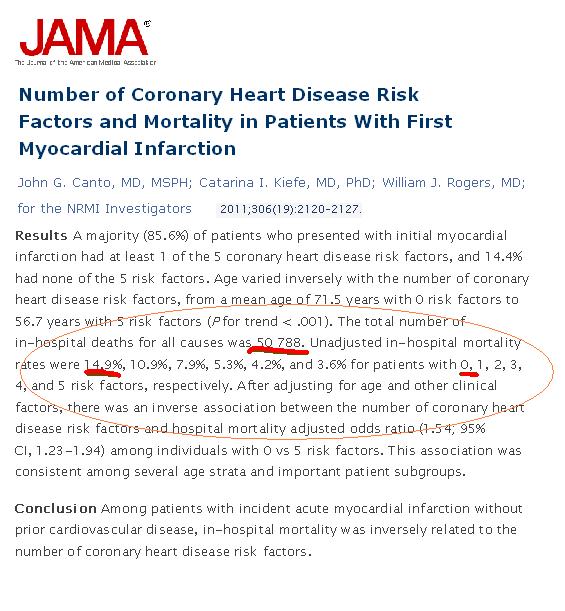
This  paper from  JAMA   adds further insight into our ignorance about  the  genesis of CAD .

The data is from  NRMI registry.

The statistics  reveal  a stunning fact .In  the overall CAD cohort ,  patients  with no major risk factors  experience  highest mortality and the ones with maximum   risk factors have least mortality ! What a shocker of a study ?

http://jama.ama-assn.org/content/306/19/2120

This  paper  would bring  jitters to the population ,  but in the real sense it sends an important message .

A significant population develop CAD without any  known risk factors.(14.5% in NRMI registry )

If a person develops  a CAD without any major risk factor  ,  it seems  . . . it is not at all a  good news   !  rather we need to introspect , why  without any risk factor he or she has suffered CAD ,

One inference is  their vascular system is more vulnerable ! Some hidden factors are operating . How to manage such  patients  without any target to intervene ?   A diabetic dyslipidemic smoker has a   definite  therapeutic target  .

What about these   lesser  humans  who   develop   CAD without any known risk factors  ? They  tend to suffer more !

Is  CAD  due to DM/SHT  is better than  others  ? This study seems to say so ” Known devils are better than unknown ones ”

Final message

Unlearning is an   “essential and fundamental”  component of   scientific learning .  In this progressive scientific world , this applies  most to   medical profession  than any other field !

Read Full Post »

Exertion and  acute coronary syndrome (ACS) has a tricky relationship. On the one  hand, it  would  appear they are not related at all  as only a miniscule of patients   give history of recent severe exertion prior to ACS   , while  few others  tell us  a clear- tale of   unaccustomed  exertion ,  just prior to the onset of chest pain.

Here is case history  of a  man  who was rushed to our  ER from  Madras central station ( Our hospital is located just opposite to it !  )

A  48 year bank officer  was  about to board  a train to Patna   . It was a rainy  November  evening ,  his car got struck in traffic .He along with  his family members were rushing to catch the rain  .He had  to run fast with his heavy luggage  .Even as they boarded  the train successfully and occupied their  seats  ,   within minutes  he  developed intense chest pain and sweating . The distressed family de-boarded the train and was rushed to our hospital  . Yes  you guessed it right   . . . he  was showing an extensive ST elevation  in anterior leads on arrival.

So what  has  happened ?  What is the coronary hemo-dynamics during heavy unusual physical exertion ?

The above patient did  not have any obvious risk factor . He vaguely recalled ,   one if his family doctors telling him ,  he had borderline high BP and was never prescribed a  drug . His wife told us  he has been a emotionally  liable individual .

It is well  known  , sudden exertion in an  emotional  milieu   would  result  in  intense  adrenergic drive  . (Here the emotion was anxiety/ fear of missing the train )  Adrenergic drive was  amplified with the  isometric exercise (heavy suitcases ) ,   shoots the intra  coronary blood pressure (normal 45-60mmhg)  into  dangerous spikes . (By the way , what happened to  coronary auto regulation  ?) . We also  realise simple raise  of  intra coronary pressure alone is not sufficient  .These patient  will  harbor at least some degree of  atherosclerosis  which face a  shearing stress and give way /tear  or fissure resulting in  a sudden substrate for intra coronary  thrombosis.  Some of them may manifest  only  as coronary vasospasm  .When sustained  it can also result in a full-blown acute coronary syndrome.

The concept of trigger vs risk factor

One should remember  both physical and mental exertion   act  mainly as a  trigger (They are not  major risk factors  like DM/HT/Smoking /Dyslipedemia) . All that is required ,  for  this   vulnerable population  to fire  is a trigger.  Physical exertion ( especially  isometric)  when  associated with  emotionally charged  brain  sends a  perfect  invitation  for an impending  ACS !

Another example  for untoward  effects of  exertion

A middle aged man who had  impaired glucose intolerance and dyslipdemia  was referred for an  EST.He did complete  12 minutes of  Bruce  protocol  comfortably . But  on the same day evening  ,  he felt  uneasy  and came to our ER ,   only to record a full blown STEMI .

These events may be rare but if properly understood   these  patients can teach  us  few   lessons in the genesis of ACS and coronary hemodynamics .

Special  issues  about   exertion in post PCI patients

One of the purpose of doing  PCI  for CAD  is to improve the  functional  capacity  (and possibly to prevent future ACS) . Paradoxically ,  we  continue  to have  some apprehension about subjecting post PCI  patients  into early stress testing . (I remember reading some guidelines that advice us to  avoid stress testing strictly for 6 months post PCI  ! Is it true ?)

If a  cardioloigst  is  not too comfortable  putting their  patients  into a  treadmill  post PCI ,  it only implies they doubt their efficacy ! It   would  also imply  these  patients   should  not be allowed to exert to their full capacity in day to day  life events as well .(Attention  cardiologists   . . . Yeh  . . . we have a  fundematal problem on our hand !)

Read Full Post »

  • Acute myocardial  infarction is the number one cardiac emergency .
  • About a million papers and articles are available in  medical literature about STEMI.
  • Management of STEMI when they present early is addressed by every text book.
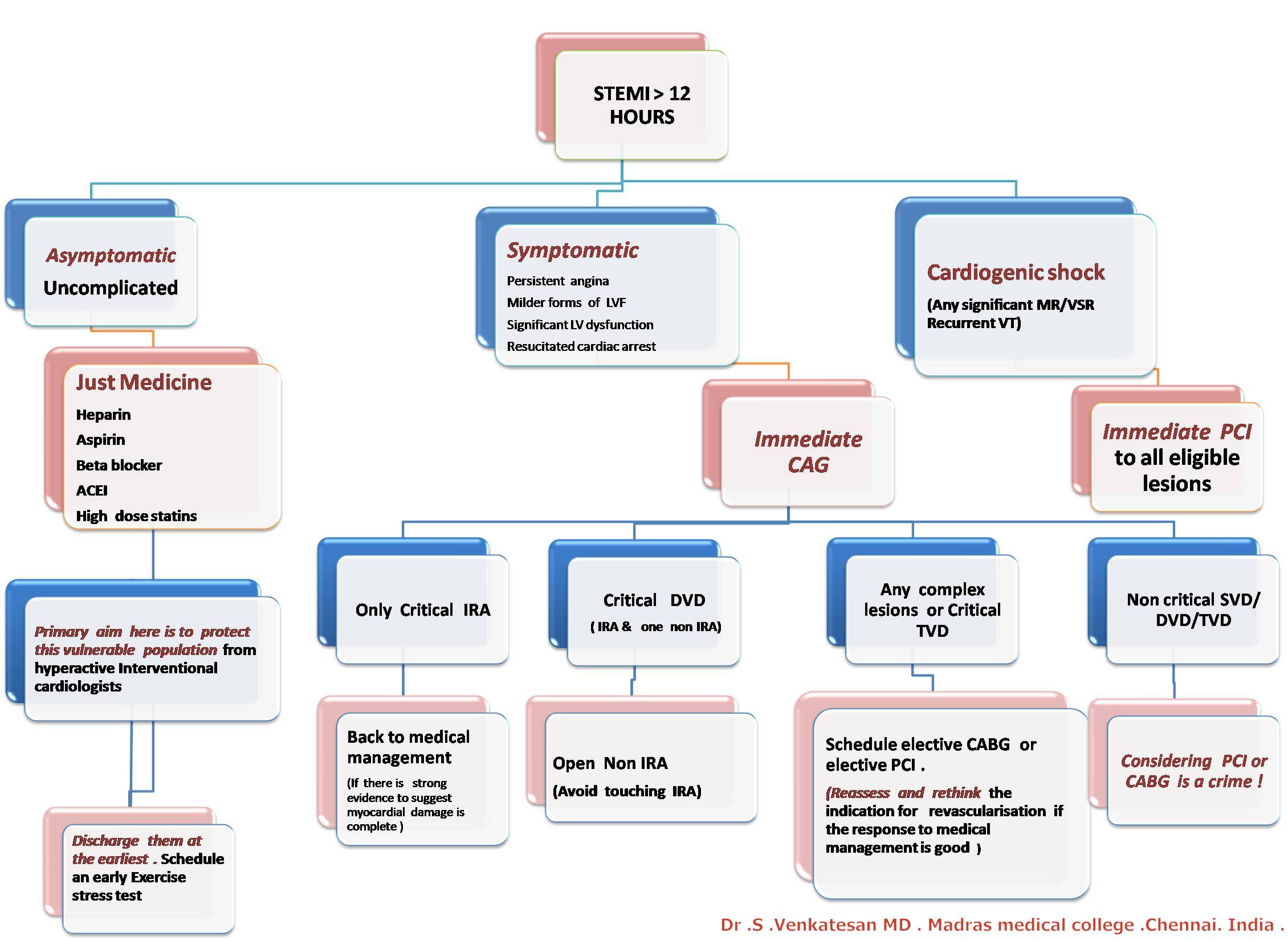
  • It is  really surprising to note there is no  simple and  specific guidelines  to manage STEMI when they present late to the ER .
  • Such a scheme is vital for physicians,  as experience suggest almost 40 % of all STEMI arrive late and are ineligible for specific reperfusion strategies.

The following  flow  chart is  exclusively meant for usage in STEMI when they  arrive late >12 hours .

This is a personalised version based on working in one of the oldest CCU in  Asia which handles  about  2000 acute coronary syndromes every year with a mortality rate of 6-7 %  Hope one can bear with it !

Please click on the chart for a high resolution Image

Comments are welcome

Read Full Post »

Sustaining a STEMI  may be a  pathological  end  point  for  coronary  artery disease. But ,  from the  management point of view it is  actually  a starting point for CAD evaluation  .Strategies to prevent further   cardiac  events   must be formulated .

How do you manage a asymptomatic  un-complicated  post  STEMI   patient*  at discharge ?

  1. Do a sub- maximal symptom limited EST and then discharge.
  2. Advised  to come back after 2 months for a  stress test or Perfusion imaging
  3. Continue  with intensive  medical management without EST or  CAG and monitor only the symptoms
  4. Advice coronary angiogram   in all and decide depending upon the lesions (Pre -discharge CAG )
  5. I am a modern day cardiologist  . This question does not arise . . .  as I do only primary angioplasty for all my cases !

( *Please note ,  this forms the bulk of  STEMI population (up to 60 %  )

Answer : Your guess is the correct answer!

Why we need to risk stratify STEMI at discharge ?

The  morality and outcome in STEMI  though appears  to be a   continuously falling  curve ,  the slope is not linear.

The classical   mortality till discharge is about 6-8  %. Between discharge and 3oth day there is 1-2 % additional mortality

At end of first year there is  further   2 % mortality. From  second year onwards there is an annual attrition rate up to 3 %.

The aim of doing  a pre-discharge  EST is to do identify  ” patient  subset ” who are destined to die  within 30 days of STEMI.  If you schedule the   EST  after 6-8  weeks  one can not prevent these two deaths out of 100 !

( Of course ,  we assume   a prompt revascularisation in those vulnerable would prevent this !).  By doing so , we can avoid the bulk of unnecessary PCIs  that  happen  with  routine CAG following STEMI.

Pre discharge EST can be done safely  within 5-7 days  with  a symptom  limited test (70 % of  THR or up to HR of  120 /mt ) This  simple test if it is negative can virtually R/O  a  critical proximal  lesion with near 100% sensitivity.

Should we  risk stratify patients  who have undergone pPCI as well ?

Most of us  would love to believe ,   once  pPCI is  done to the  patient , he  reaches  a therapeutic end  point. But  it is not the truth . It is  the degree of  LV dysfunction ,  extent of contrary coronary lesion  ,   co existing risk   factors  and  the  intensity of medical treatment  only  would  determine the long term outcome.

It is very important to  realise  the pPCI is aimed at opening the IRA  and other lesions are  often left alone. So never  believe  pPCI   per se  would confer total risk reduction following a STEMI  .  There is considerable evidence to suggest  the opposite may be true at least in high high risk pPCI  ,where  metals are   placed  in  complex ,   vulnerable thrombotic milieu.  Hence it  seems logical  to risk  stratify  all patients   after primary PCI   (In fact, this population require  more vigilance )  .

When will you advice an  EST following  pPCI ?

It is usually not needed in the immediate discharge phase in single vessel disease which  would have been  tackled during pPCI.In multi-vessel CAD , where  only the IRA was tackled during pPCI  ,the same guidelines that of  thromolysed  STEMI shall apply  .Since we know the coronary anatomy already ,  EST helps us to evaluate the hemodynamic status of non IRA lesions if  there are any  . While ,  this is a  logical debate , logics has a rare place in medicine . It is ironical ,  stress test   is rarely  done  even after 6months following pPCI  in most centers.

Final message

It is  a  pity  ,  anatomical risk stratification  has squarely beaten  the scheme of   physiological risk stratification in most cardiology centers . A pre -discharge EST* was a  good concept that gave us an idea about the coronary reserve  after the ACS.  It was a collective wisdom of cardiologists  that has hanged this useful concept.  It is still more shocking ,  to note even the  scheduled  6 week   EST is  dropped from the  post MI work up in some  institutions.

* Many would consider  ordering an early EST in STEMI is an act of bravery ! The fear seems to be genuine   and most will agree with that.  But , please remember a physiological test  (Cheapest and simple is EST or a  Nuclear perfusion )  should precede  CAG  in all  asymptomatic  post STEMI  population  whenever possible . If  EST could not be done  prior to CAG for some reason   , at least do it following the CAG . It  will have  an  important impact  on the downstream decision making  which is often an  inappropriate  PCI  !

Read Full Post »

What is  the most important factor that  will decide  the revascularsation following a  STEMI  ?

  1. Patient’s  symptoms
  2. Residual Ischemia documented by stress  test /Perfusion scan
  3. Presence of  significant  LV dysfunction
  4. Coronary anatomy and lesion profile
  5. Wealth  of the  patient (Insurance  limit  and  other  financial  resources )

Response  2  is   academically correct ,   but    practically  and politically   response 5  would be   the right one  for most cardiologists . At  any given day  ,  affordability and availability  of PCI  will prevail over all other factors  .

Affluence based cardiology

Image courtesey : Jupeter images

What is the  height of  inappropriateness in modern cardiac care ?

This world will never forgive the medical profession , if they do not fight  against  grossly inappropriate medical  care system especially in the life saving situations  .While one  cardiologist    just watches   a  left main disease patient  with unstable angina die peacefully in a Govt institution ,  while  another  patient with asymptomatic  distal PDA lesion gets a 3rd generation drug eluting stent in a  nearby corporate hospital !

Please note : Harm is the ultimate outcome in both rich and poor.One suffers with non availability while the other is the victim  of   affordability .

Read Full Post »

The  OAT   extension study  ,   a  6 year follow-up study on total occlusion following STEMI has just out in circulation 2011  October , online first . http://circ.ahajournals.org

There were two  important conclusions  from this study

  1. Long term follow-up  to  6 years  confirmed  the  lack of benefit of routine PCI  in  post MI total occlusions.
  2. Inappropriately   done  PCIs convert   stable coronary occlusive  disease into potentially dangerous subsets  with  risk of re-occlusion (Which  could  very well be an acute coronary syndrome )

The second one is  of critical  important than the first  .In a nut shell ,  it  suggests  routine PCI in  CTOs  could  increase the   risk of ACS many fold in other wise stable patients.

Final message

This OAT extension study  should  not experience the same fate  of  COURAGE and OAT -1  which  were  successful bitten and buried  by most  interventional cardiologists.

This time they   have to  swallow  the  unpalatable truth ! If they don’t ,  our  patients  would be the ultimate  losers and

will pay the  price dearly !

Personal foot note :

One of my colleague asked me  . . . Why am I  always  after the Interventional   cardiology  community !

I said ,  it is not my job to pull down any one group.  I am just exposing   the  irony of  “selective usage” or “selective  neglect”   of scientific  data by many of us !

Read Full Post »

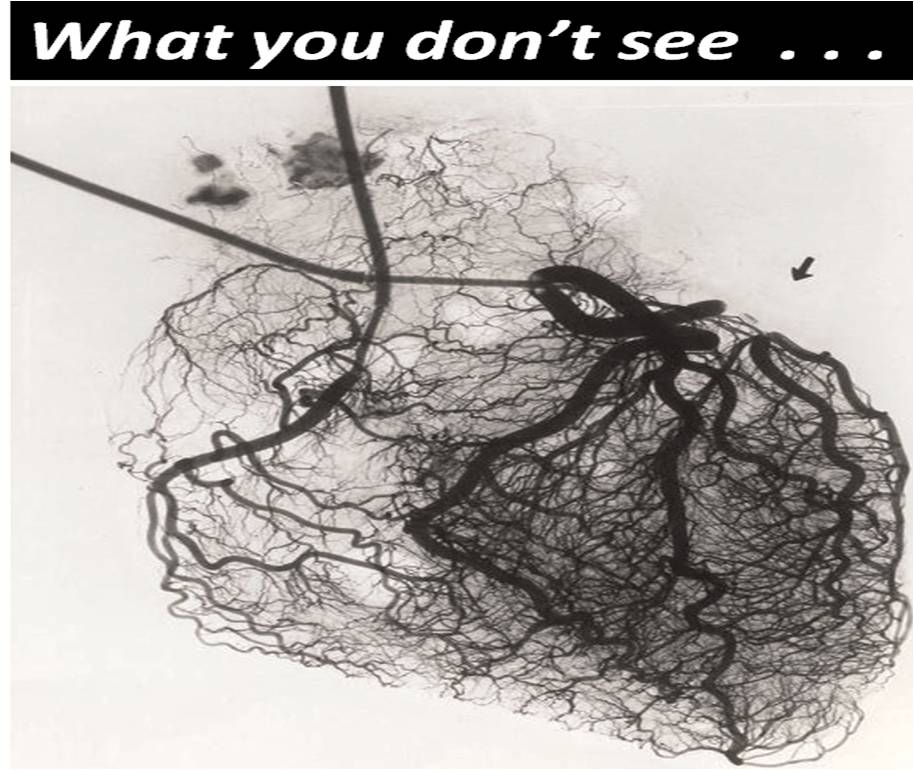
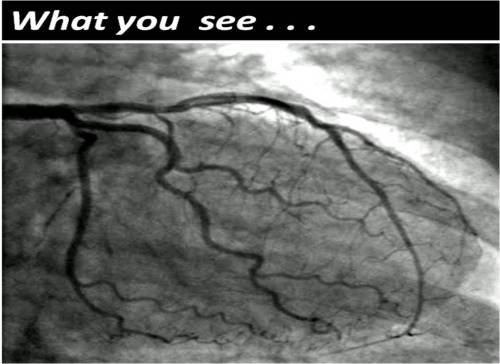
Human coronary circulation stands  unique among  others as it is a   life-sustaining circulation.It is  considered   a great  medical achievement   to visualise   the right and left coronary artery  system by coronary angiogram.  Actually  what we see is   only  a  fraction   of  the surface area  of  coronary circulation . The surface area of  epicardial coronary arteries   constitutes  less than 5 % of entire coronary vascular tree .

This  is the reason  normal coronary angiogram can never mean normal  coronary circulation !

This huge gap in our perception is the single important factor  that  explains the vagaries  of modern coronary care .

This also  make any coronary  scenario  a  reality .

“A patient with normal coronary angiogram getting a myocardial infarction the next day and a severe triple vessel disease living comfortably with medical management”

So ,  it is essentially a   false  sense of  scientific accomplishment   by the  cardiac scientists  at  least in the  of coronary circulatory physiology.

There are innumerable channels of micro vessels traversing across the heart, sharing , bridging , branching, penetrating  and  perfusing the muscle mass.They can be anatomicaly patent , physiologically non patent .They can be recruited by hemodynamic stress . It is also influenzed by  favirable growth milleu and hormonal and neural stimuli.

What determines the extent of these invisible circulation ?
and

An in vitro heart with special catheters showing the true extent of coronary circulation: Courtesy http://eurheartj.oxfordjournals.org/content/28/3/278.full.pdf+html

Why many cardiologists   do not give due credit  the   coronary collateral  circulation  ?

Right from the days  of  Levine in 1970s( Who made a seminal contribution  about coronary collateral)  the  utility value of  coronary  collateral  circulation   was  never able to convince the cardiology professionals .

It has been our traditional  teaching ( without much evidence of course  !) coronary collateral circulation  is not effective to support blood flow during exercise . This fact has been  disproved  many times . Coronary collateral circulation was indeed useful in limiting damage in ACS and  relieve symptoms in stable angina.It helps  in reverse remodeling and provided electrical stabilty as well in post MI population.

Still  the concept  was  alienated  and   made   totally irrelevant  in the interventional  era  . Many   cardiologists  found well-developed collateral’s as an interference to their expertise and ego since it has a potential to alter the indication of PCI.They  continue to have  strong  scientific conviction (Pseudo ?)   that man made collaterals must always been superior to God made collaterals !

Whenever  some credible  reports emerge about  collateral circulation   being   equivalent to  revascularisation procedure , these concepts were  prematurely buried for some reason.

In the last decade there was a concern  about  performing  PCI in patients with well-developed collaterals  .The argument was , they tend to develop early stent occlusion and restenosis . It  was a genuine  query  raised by few thought leaders in the field as  collateralised vessels  suffer from  low flow states  after PCI ,   if the pre -existing collateral continue to function.

But then , few  studies countered this  , and   said PCI  is safe and  in fact may  fares well   in  patients  with  extensive collaterals .

In these  studies  interventionist’s  argument looked  amusing !  as they  seem to  define a  successful  PCI  as  not only to open the occluded vessel  but also  make sure to close  all functioning  collaterals  .(What a  a pity for our natural biological  angiogenic forces which had  worked  and  grown meticulously for months!)

Cardiac science in the current format,  makes   the future look  bleak for coronary a collateral circulation .With  early PCI  becoming a norm we will never ever allow the natural collaterals to  grow  ,  and even the  established collaterals  will have to face a stiff   fight  for survival  with  sophisticated coronary interventions .

Competing interest in the filed of  coronary collateral   research

While the basic scientists want  to  grow collaterals with angiogenesis ,  stem cells etc  interventionists   continue to  indulge in rampant angioplasties which  will suppress  collateral growth.

This implies we will struggle to  establish  the true  importance of  coronary collateral circulation .

Final message

Can it be an  effective form of revascularisation  ? 

My personal  inference  is   coronary collateral  circulation  “would and should”  have  a definite role  in at- least  some of the subsets  with chronic coronary  syndromes. If we think otherwise . . .    it’s against the principle of  natural biological science .

A good  collateral   system with optimal medical management  can save not only our  patient’s  lives but also  their hard earned currencies !

Reference

Here is a rare article in European heart   journal that discuses coronary collateral circulation  . Let us welcome such wonderful  reviews which keep the interest alive on the filed.

http://eurheartj.oxfordjournals.org/content/28/3/278.full.pdf+html
Read Full Post »
« Newer Posts - Older Posts »