Feeds:
Posts
Comments

Archive for the ‘cardiology- coronary care’ Category

Success of primary PCI is defined by  different yardsticks  by  different  cardiologists  , in different  institutions !  But , for the patient and his family,  getting  discharged   alive with out symptoms is a huge  success !

They  do not bother  even if they are charged  Rs 3-4 lakh for their stay ,  as they  believe  surviving  a heart attack  is a God’s grace   rendered thorough the hands of  the doctor.

But we know  the real success lies elsewhere. Cardiologist’s   perception of   success of  pPCI   should be based on scientific concepts. Unfortunately many  physicians  continue to  think like  their patients  . This  tendency to get self gratification  with a patient’s  frame of  mind is  common  and  needs  introspection .

This is esepcailly  true for primary PCI . It came with big fanfare  a decade ago . Soon ,many cardiologists developed  a habit  of criticizing   the  practice thrombolysis for STEMI .If primary PCI is such a superior modality  every patient   should be prevented from significant  myocardial damage following  STEMI .

Primary PCI  may be the the most logical method  still , for reverting the STEMI process  . But “A properly performed  primary PCI  as a  concept ” lies  mainly  on paper ,  not  been  replicated in real world for various reasons.

Please remember , a successful primary PCI

  • Is  not restoring TIMI 3 flow  in IRA
  • Is not relieving  the  angina
  • Is not discharging a  patient in stable condition

Even if  . . .  we accomplish each one of the above  . . .   if   the patient  carries  home  anything  equal  to ,  or more than moderate LV dysfunction ,  primary PCI  has  deemed to have failed.

Final message

What is the reality  check ?  In one  of  the  preliminary analysis   out of 20 randomly selected  patients  who have undergone STEMI*   within 12 hours  , significant LV dysfunction  was present in  12  patients making it pPCI only 40 % successful   in real world  .( Which  would struggle to beat the outcome of  promptly administered fibrinolysis )

* Primary PCI done in state of the art institutes .

Read Full Post »

During   primary PCI , the weakest link  for a  cardiologist  is  , he is never sure whether  the  metal jacket  has covered the entire  disease segment with optimal apposition .  (Geographical miss is another issue !)

This is because  , even though the inflation pressure is  uniform  within the balloon ,  the required  apposition pressure is not the same .This is obvious as the lesion surface has a varying consistency and uneven surfaces . It is a  huge guess to quantitate the relative  contribution of thrombus and plaque  within  the 100 % occlusion  that has resulted in the STEMI. Hence  some areas may get over apposed and others lesser apposed. Further , the stent -vessel wall interface  in all likely hood enclose a   layer  of clot .This is almost certain  during complex primary PCI. One can imagine the sequel if this thrombus layer dissolves later ! (Edentulous stent )

It is surprising , why cardiologists has  so far not  thought  of a  self expanding stent  which  can snugly appose the vessel wall in this setting  . The   radial strength   from the  stored potential energy can be used up future use. This is most important  in first few days following STEMI  , when the coronary arterial lumen can vary depending  upon the

  • Vasomotor  tone .
  • presence of thrombus
  • Plaque   ploughing /milking  effect
  • Vascular remodeling

Cardiologists  deploy a stent  based on the morphology  on day zero of STEMI  .This may be  totally irrelevant  , since after a  few days    the lesion may change its morphology ,  thrombus may migrate , vascular  dimension may change. In such a  situation*  , a self expanding stent can tackle these issues very effectively by constantly adjusting  and fine tuning the luminal  diameter and  the apposition pressure . It  does not give any chance  for  thrombus to form  between the vessel wall and stent .

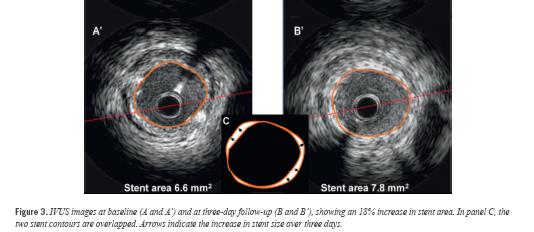
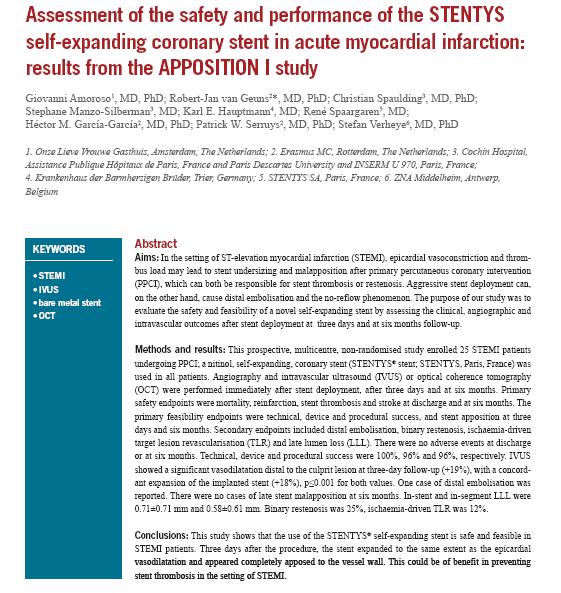
Here is a study that gives fresh insights regarding the role of self expanding stents during STEMI .

Note the “Auto adjusting”  of stent diameter  in the first few days after  the stent deployment, depending upon the luminal needs !

Animation

http://www.stentys.com/file_bdd/annexes/1284135580_video_stentys_en.swf

* Logically  during  primary PCI for  STEMI  ,  POBA and thrombus suction  may be the best option in many as all stent related complication is instantly eliminated .But it is a battered concept ,  most of the current day cardiologists would feel guilty to come out of  the cath lab  without a stent  in  primary PCI scenario  !

Final message

Self  expanding stents during primary PCI :  Is it a  perfect solution  for optimal stent apposition  ?

It seems so  . . . but  the track record of current cardiology devices never fulfilled the initial promises !

Read Full Post »

STEMIis numero uno of any medical emergency . The risk of death is maximum in the first  hour.

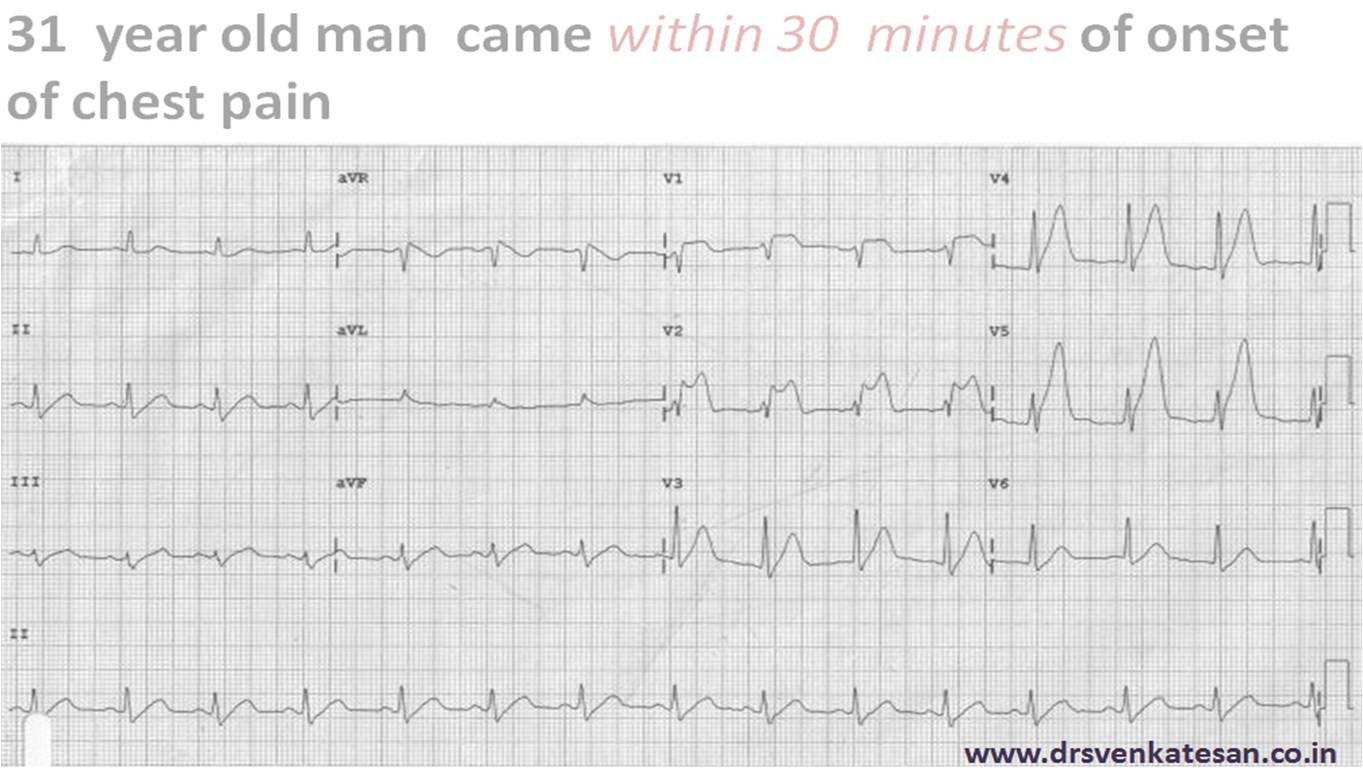
Here is a patient who presented within 30 minutes  of  chest pain.Enzyme sample was  just sent and a bed side echo  revealed a severe wall motion defect in LAD region.

What would have been  the response from a  current generation cardiologist ?

  • Alert the cath lab . Send the patient direct to cath lab .
  • This did n’t happen as we are in a underdeveloped country and the patient  is poor .
  • Should we worry about that  l ?  Not at all  . . .  He received a shot of   much ridiculed streptokinase injection which  costs 2000 Rs ( 50 dollars) in India  .

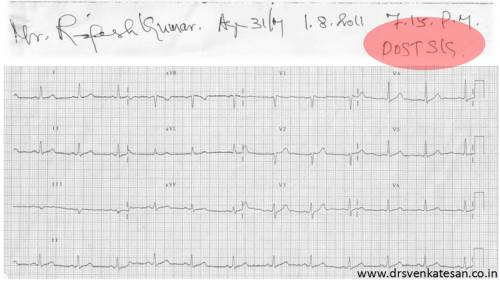
And see the result yourself !

Can you imagine this man had a major STEMI just an hour back ?

 Any intervention that is done immediately has a major impact on outcome. When the patient comes to you  early within 3o minutes and  STEMI,  or  actually a TEMI  , T wave elevation MI or Hyper acute MI .

When the patient comes to you early cardiologist should raise  to the occasion and set a new  challenge  .

What is that  challenge ?

The aim should  not to be in  salvaging  the myocardium  , rather   prevent  the  event of   ACS   and   abort the MI process itself !

How is this possible ?  Can you abort a STEMI or TEMI by primary PCI ?

Since one has  to act fast , primary PCI is a likely  loser  9/10 times in aborting a STEMI  .

The best option  is  to do an intervention which can have almost zero door to needle time* .  The good old thrombolysis  administered  at the door itself pips the pPCI  convincingly with a huge cost saving as well .

This is what  this patient received. and  see the result . His angiogram  later  showed a fully recannalised LAD .No stent  was advised .He was put on high dose  statins ,beta blocker  and antiplatelet agents.

*You  can not balloon the patient on the arrival in  door steps  !  .

Final message

Do not ridicule any modality of  therapy for being simple and cheap .  They may be most effective as well .


Read Full Post »

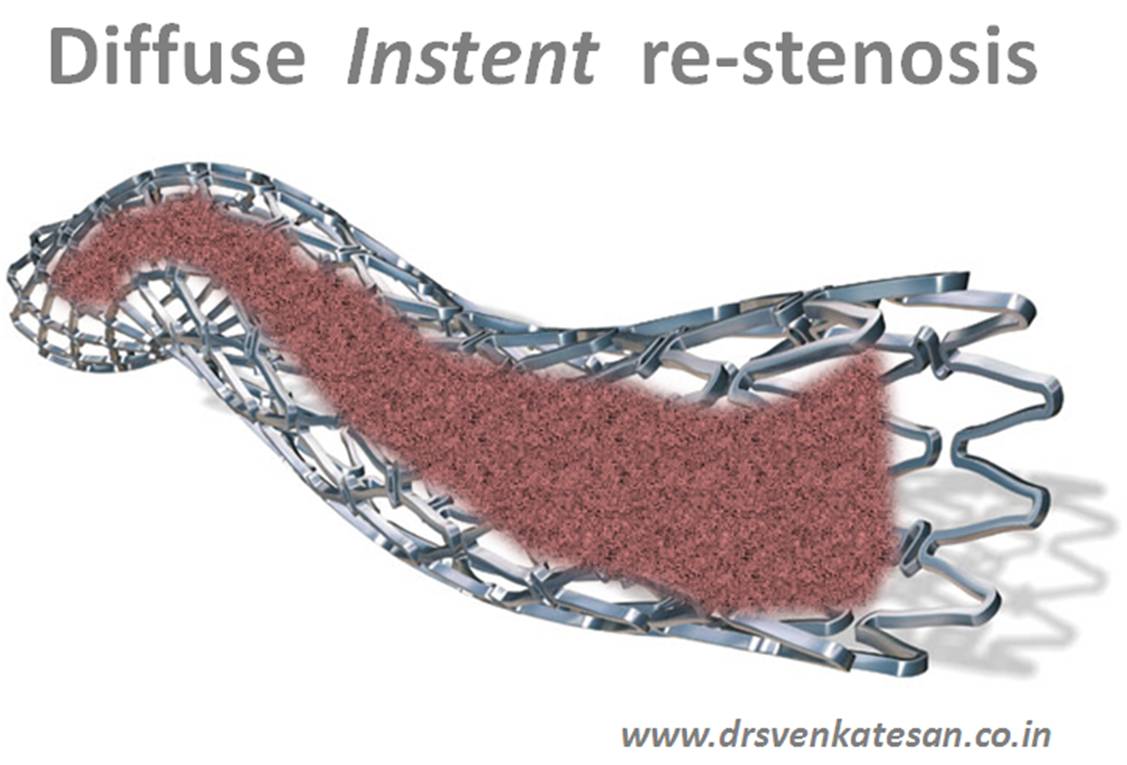
How do you tackle  In-stent restenosis  (ISR) ?

  1. Deploy another BMS
  2. Use a third generation  DES
  3. No . . . first  generation DES(Paclitaxel )
  4. Consider Plain balloon angioplasty.(POBA)
  5. Refer for CABG.
  6. Fall back on medical management.(Ingloriously  referred to  as  “No option” patient !)

Answer:  Please  note , there is no single response answer for this question .

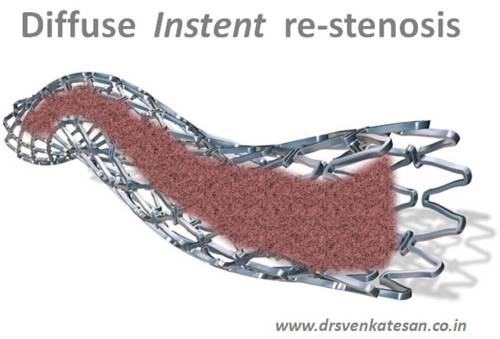
Instent restenosis (ISR) is   commonly seen with BMS .This is primarily because  we are busy blaming DES  for stent thrombosis  and we do not want to give a double blow to DES .There is a  significant population  roaming with ISR  involving  DES .  BMS is in vogue for nearly 2 decades, hence it is natural to see more of it.  In due course ,  DES  is expected to catch up with BMS  and would lead in ISR as well .

The issues in PCI for ISR

Though any of the above 6 strategies may be appropriate ,the urge to put another stent within the IRS ,  prevails over all other options in most centers. This is more off an Interventionist talent  show off  !

Please remember , the common  principles  must apply in all patients before an PCI  . Simply stated , this  principle involves  assessing  symptoms, residual  resting  ischemia, myocardium at risk  during stress, viable muscle mass etc .Lesion characteristics  should come last in the work up. ( A cardiologist  should not  report  a coronary angiogram  , if   does not  not know  basic clinical parameters.)

It is  good  to have a  rule  that  “reserves  intervention”  for ISR  only if the  patient  has refractory angina. 

Can you promise  relief from dyspnea

Contemplating  PCI for  patients with dyspnea as the main symptom is really tricky one.Unlike angina ,  dyspnoea  can be attributed to so many factors other than coronary blood flow.(Apart from LV EF , Iscehmic MR,  A transient diastolic dysfunction , lung function , volume status, renal function , physical conditioning etc)

Opening  ISR in the belief it would improve LV function is highly questionable even if viability is documented.

What is the most important step in the decision making prior to PCI for ISR ?

* Most important step  in ISR management is  probably  spending  sufficient time ,  involving  experts ,  ” democratically  debating”  the indication and techniques  in your institutional cath conference.

Once you document the necessity of intervention* The following things  are possible .

  1. If  the patient has diffuse in-stent stenosis , especially  the  proximal ones or that  involves  branch points,  it is wiser to refer  them for CABG.
  2. Discreet and focal ISRs can safely be attempted for repeat PCI.
  3. BMS or DES  ?  This  is  debated. Current preference is to use  a DES. (Many feel ,first generation DES -(Paclitaxel)  scores over Everolimus in this situation )
  4. Is POBA  possible for IRS ? Can a balloon do a job where a stent has failed ? . No  body is trying it .Many Feel guilty to  do it .  POBA for IRS is a failed concept without even trying it !  One  way of reasoning  is IRS occurred  only  because stent was  never indicated in the first place  in that  location  and a POBA would have been the choice in the initial attempt itself .So let us not make the second error !  ( May be , if  Gruientzig is alive today ,  might have  used  POBA  for ISR very effectively ! )

Issues for which  we will never ever know the answer !

In future any of the following combination of  stents  will occur in tackling ISR.

  • DES covered  BMS
  • BMS covered DES
  • Two BMSs
  • Two DESs
  • Paclitaxel covered Everolimus
  • Everolimus covered Cypher.
  • Overlapped DES and BMS
  • DES covered beta irradiated IRS
  • Rotablated BMS (Yeh metal crushing !)  followed with  DES jacket !

How does the two metals ,  two drugs in various combinations interact with  the tender coronary  endothelium ?

Endothelium is an endocrine organ. It has  to secrete as  many pro and anti homeostatic molecules (Nitric oxide, endothelin etc).This has to be  kept in mind when we develop newer and exotic devices. Of course ,  we claim our  aim is primarily  to provide  relief  to  our ailing patients , but, as things stand today  , there is a distinct risk of  converting human coronary arteries into corporate playgrounds !

Reference :
http://circ.ahajournals.org/content/100/18/1872.full.pdf+html

Read Full Post »
Surprisingly it is common !

A .Abandon the procedure call the surgeon for an emergency CABG

B. Open the most critical lesion.*

C.Attempt to open and stent all possible lesions.

D.Send the patient back to CCU for a conventional  thrombolysis or attempt a intracoronary thrombolysis.

Answer : All  can be a right response depending upon the available expertise ,  time window, associated complication and hemodynamic stability etc .

* Please note ,the most tight lesion may not be the culprit artery. Though there is high chance for that  being the culprit , it  can be very deceiving   especially when  there is multi-vessel  CAD with  chaotic collaterals.

The site of lesion and site of infarct can unimaginably remote.  (A traffic snarl at remote flyover  can have its impact  right on the busy commercial street due to diversions ! ).

What will happen if you open  a non culprit artery first mistaking it for a culprit ?

This could lead to  dangerous turn of events as whatever little perfusion the patient was getting through the ill-fated  IRA will be challenged by the fresh diversion  facilitated by non IRA angioplasty. Extreme caution is required.

Emergency CABG  within 3 hours  of MI even though advocated  by few ,  is still considered a risky  way to reperfuse  the heart.(In India  there  is  nothing called primary CABG!)

An energetic interventional  cardiologist would vouch for opening all lesions . Only thing  , he has  to  make sure is  , the patient also has enough energy to withstand  his  onslaught. Never   non culprit lesion if a patient is stable . 0ur aim is not that.If the patient  is in shock or impending LVF one can justify opening  few more lesions  that improve total muscle function which can be vital.

What about fall back on thrombolysis?

This may be seen a defeatist attitudebut  when the aim is  in the  well being of patient ,  there is no defeat or success. If severe  CAD is encountered and both  CABG / PCI  or not an option,  the cardiologist need not feel guilty or  humiliated to refer him back for thrombolysis. (Of course , Intracoronary thrombolysis  is  an option !)

Final message

Primary  PCI  is often made  to  appear ” As  a  kids play”  by many modern  day cardiologists . It is not so.  It requires a team effort. It is  race against time.   Feasibility depends largely on the coronary anatomy. The failure rate of  primary  PCI is often camouflaged .(Currently Success of pPCI is boasted at 95%)   Logically it should include pPCI ineligible anatomy as well . Many still do not understand the real purpose of pPCI.   The aim is to salvage the myocardium  at risk , sure and fast. Never attempt for total revascularisation in an emergency situation however tempting it is !

In young persons with discrete single vessel disease  the procedure is simple and outcome is straight forward. In elderly , diabetic , STEMI on  preexisting CAD,  diffuse  multivessel disease  ,   complex main left,  bifurcation lesions , one requires  lot of brain sense  to provide optimal outcome . Many times that sense includes abandoning the procedure !

Please read a related article in this site  Primary CABG

Read Full Post »

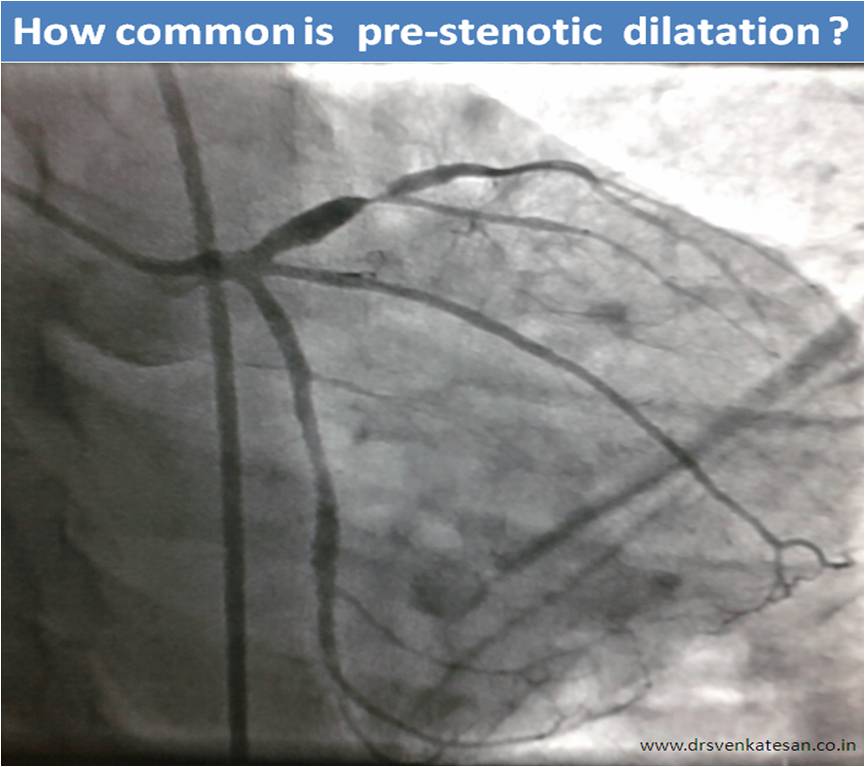
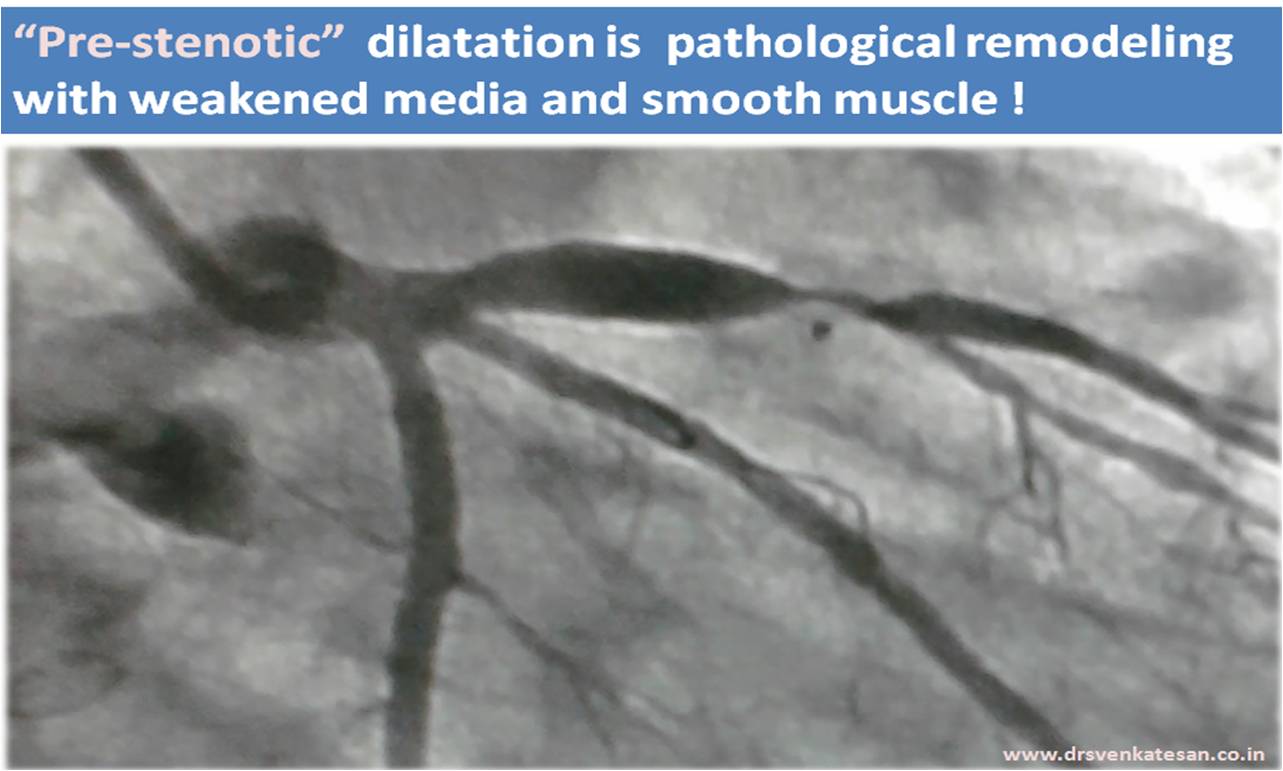
Laws of fluid dynamics dictate there is a pressure drop across   a point of narrowing  and recovery  thereafter  . At  recovery point if the vessel wall is weak it tends to balloon out .This is called post- stenotic dilatation .This is  the anatomical equivalent of Bernoulli or venturi  effect. This theoretically  occur only distal to obstruction .

How do you explain the common observation of pre- stenotic dilatation?

  • Intimal weakening due to disease process is the prime  suspect.
  • Pre stenotic  increment in mean pressure  also play a role .
  • Mechanical distention due to stagnated blood  proximal to  critical obstruction  is  a  logical explanation.
  • Finally and most importantly ,contagious , sub – angiographic  atherosclerosis.

How is  dilatation  different from ectasia ?

May be they are all related phenomenon. The definitions  of ectasia ,  dilatation, aneurysm are  more to do  with semantics than with academics.

Clinical and hemodynamic implication in cath lab

  • Sluggish  flow prone for thrombus
  • Stent selection errors likely
  • Stent dislodgment  and migration

Long term effects

  • In stent re-stenosis is more common if adjacent segment show dilatation.

Finale

Enlargement of vessel wall in both pre and post stenotic segments are possible . In small vessels pre- stenotic dilatation is  more common , while in large vessels post stenotic dilatation is  more prevalent .(Aorta, Pulmonary artery)  The mechanisms are slightly different. Apart from the lesion tightness ,  hemodynamic  and genetic factors are also responsible These dilatations are  often labeled as ectasia in coronary artery  and  most cardiologists  tend to   ignore this finding especially if  the margins are smooth.

But , newer imaging modalities like IVUS, OCT have given   better  insight about these dilatations.These   are  actually an  expression  of the  contagious  atherosclerosis .  Pre-  stenotic segments are prone for extensive disease  than even the diseased segment due to  more hemodynamic turbulence. There is some evidence atherosclerosis progresses  proximally more than distally.Smooth margins within the  pre -stenotic dilatation  does  not guarantee  disease free status.

During PCI  there could be  an  argument for covering the dilated  pre- and post stenotic segments  as well* . (We vouch for endovascular stenting when aorta is dilated why  do we hesitate  in coronary  ?)  .Careful selection of  coronary stent size  is  recommended  and  allowance should be given  for these two (Pre and post coronary dilatation ) patho -anatomic phenomenon.

* Stent missing a lesion is stylishly called geographical  miss ! This should logically include dilated segments also.

Read Full Post »

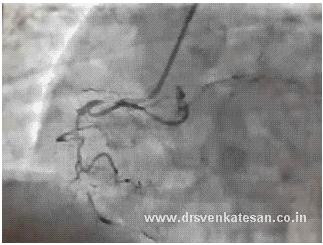
Thousands of  coronary angiograms are done every day. Cardiologist no longer get excited to see exotic coronary lesions .Still , some images can be striking and dramatic. Here is an angiogram from a middle aged man  with stable angina  , who was  one among the routine early morning diagnostic studies  in our cath lab.

Who chopped the neck of this LAD ?

How this man was able to fill up the distal LAD almost completely? (With a complete cut off  right in the neck of LAD )

Are you sure there is antegrade flow ?

Do you get any clue ?

  • Can a trickle of  ante grade flow  sustain  a  TIMI 3 FLOW  ?
  • Or is it a  very efficient  instant collaterals  from LCX ?

Yes . The first one is right . An almost invisible antegrade channel  doing a exemplary job !

How is it possible ?

Realize an important fact . The distal flow beyond an obstruction  is not primarily dependent on degree of obstruction but the status of the distal vascular  bed .  If it is normal  even a hair-line patency  can  profusely perfuse the distal myocardial segment. This is what is happening to this man with a stable angina and perfectly normal micro vascular bed.

Lessens  from this Image.

Do not get fooled by the lay man’s logic. Realise there is  no simple relation  between  the degree of obstruction and degree of  blood flow impediment.It can be linear , curvilinear , or even inverse depending upon   the evolution and timing of obstruction  ,  number of lesions , presence or absence of collateral support , finally and  most importantly  the integrity of microvascular bed .

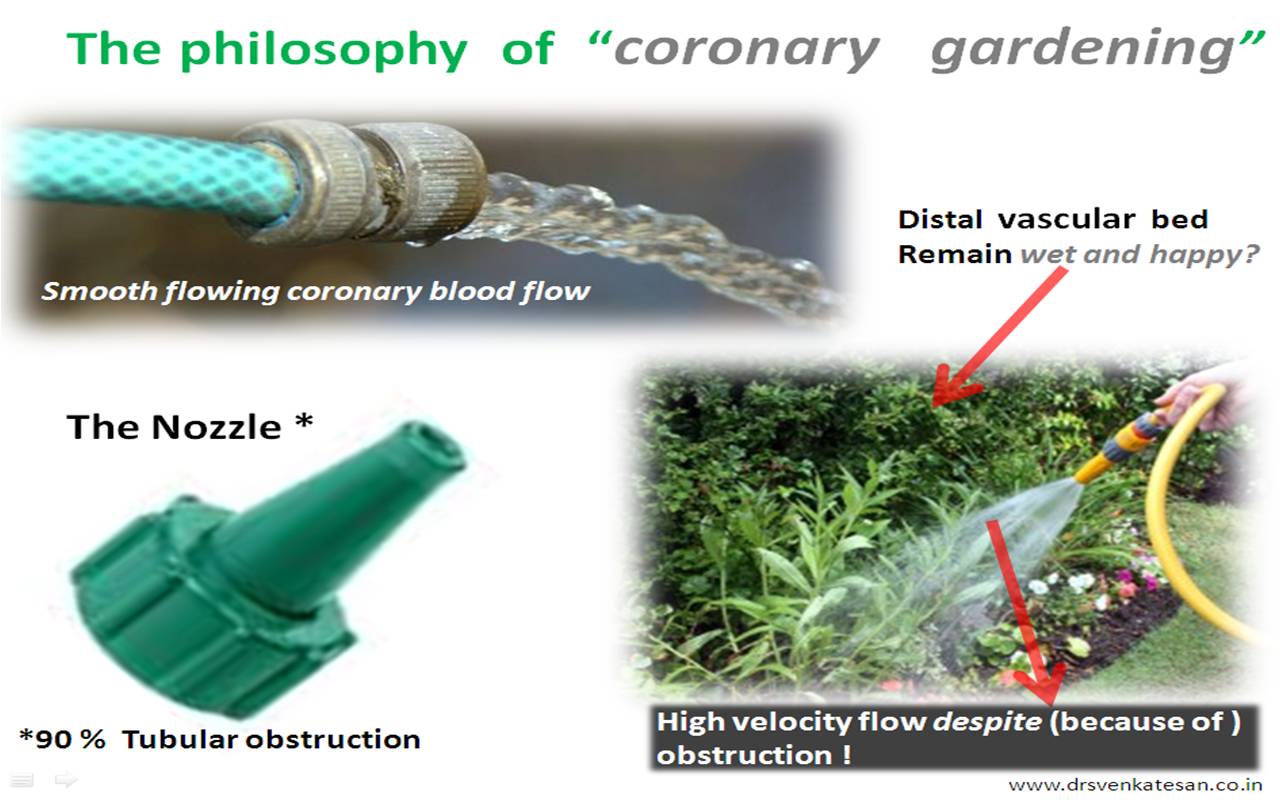
The  distal vascular bed drops its resistance drastically  once it senses  the problem in  proximal segment . This is based on Bernoulli principle and  is akin to how a  garden hose pipe  can simply increase  the velocity  by tightening the nozzle.*


* The garden hose analogy is a gross simplification of   complex factors that determine coronary blood flow.But it effectively clarifies a point ie  coronary blood flow is least dependent on coronary  stenosis (until  very late stages)

**Note further : This  hemodynamic  principle may not apply in acute occlusion as in STEMI  , where   acute  obstruction  often has a linear relationship with the quantum of blood flow.

By the way what happened to the above patient ?

Since he had significant angina there were no debates regarding management.  He  is posted for elective PCI this week-end .(We  can’t  get a stent just like that unless it is a real emergency  .Ours is a  Govt hospital !)

What is your take . Is it a going to be tough cross ?

I feel so , but my colleague Dr Gnanavelu   strongly  differs !

Let me post  our experience during PCI shortly.

Read Full Post »

Coronary atherosclerosis  can  strike  an artery  with  variety  of   lesions.It can be  any of the following.

  • Focal
  • Ostial
  • Eccentric
  • Discrete
  • Diffuse
  • Tandem
  • Ectatic
  • Multiple

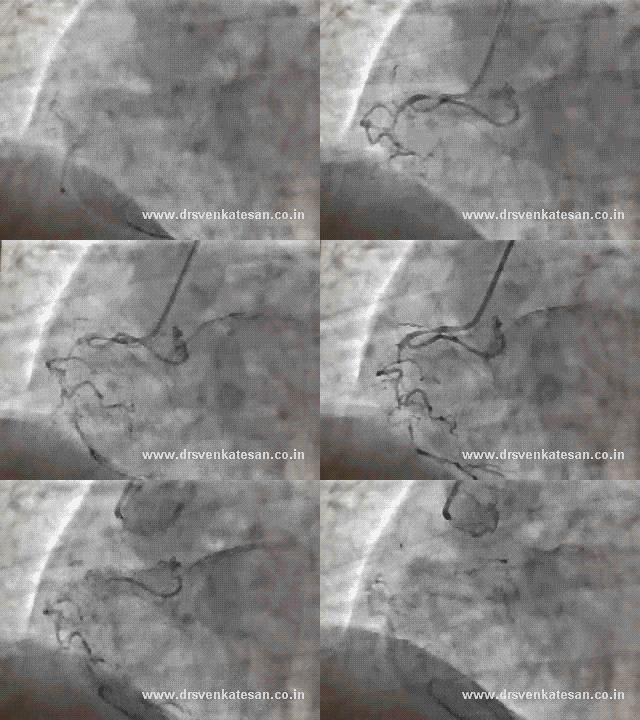
  Rarely  a coronary artery  is  blessed with  all  of the  above  characters ,     added  with homo and hetero  collaterals   . . .     resulting  in  Atherosclerotic    chaos  !


What is  chaos ?


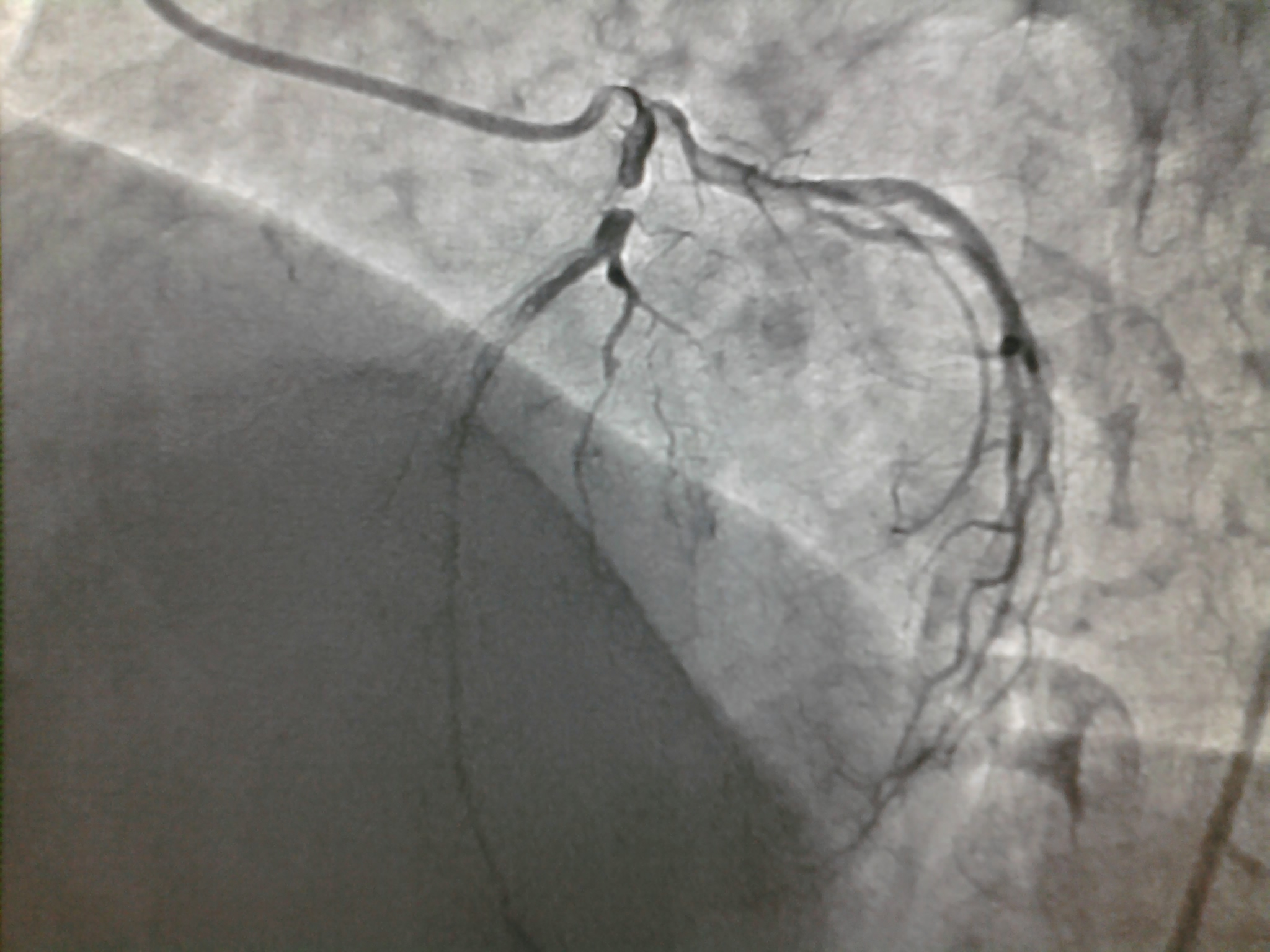
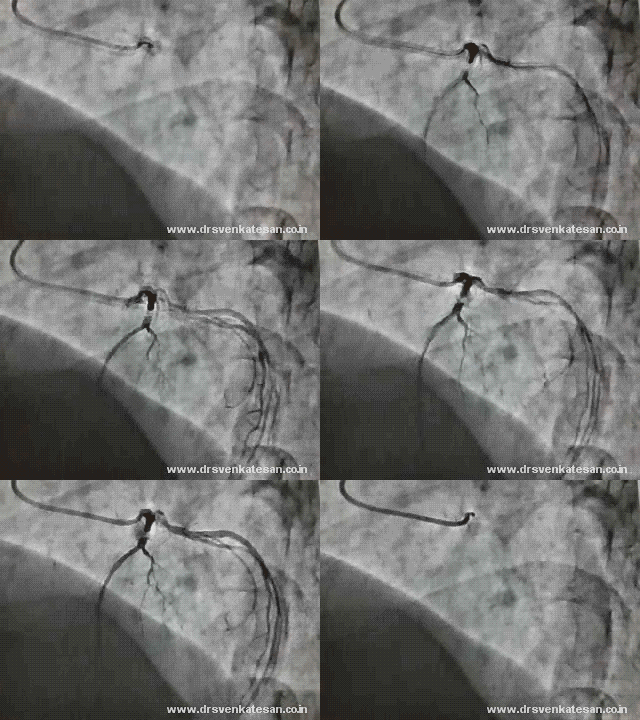
Note one such vessel inflicted with chaos lesions

How to you report the above angiogram  ? What can be done ?

We  do not treat an angiogram. We need to know the clinical background. (This  is a  50 year old man with chronic stable angina )  He also had a  lesion  in LAD and   was advised CABG with grafts to LAD  and PDA.

Is PCI possible in such a vessel ?

Most would agree , it is a crime to think about  PCI in the above vessel. Still , few hard-core  interventional  cardiologists may vouch   for success  in this vessel !

Is there any alternative management other than CABG in this vessel ?

Leaving it alone can be an intelligent strategy . (If  LAD is normal  it  may be the  best possible management)  . But , CABG will remain a default choice. But , when a person is having such a rampant atherosclerosis  he is at high  risk  for pre- mature  graft disease as well. Hence  , intensive medical management will be the key  in  such patients irrespective  of  any revascularization procedure.

Read Full Post »

Left bundle branch block (LBBB)   has a curious but important relationship with  STEMI . LBBB inflicts a dramatic change in qrs morphology   with  a diagonally  opposite   polarity of ventricular activation . This masks    the initial qrs vector  and  makes it a difficult task  to diagnose acute MI in this setting. The ST segment which is of primary importance  in STEMI is   lifted  up due to altered repolarization .

LBBB can be associated  with  STEMI in the following ways

  • Acute necrotic LBBB  with massive myocardial damage – Impending shock
  • Chronic LBBB with acute STEMI
  • Transient ischemic LBBB during STEMI
  • Rate dependent  LBBB (Usually tachycardic  ,  rarely bradycardic  )
  • STEMI in pacemaker rhythms

While every one of the above can be experienced ,  the most common diagnostic conundrum  occurs ,  when a patient   comes with acute  chest pain and LBBB . There has been many criterias  suggested to diagnose STEMI in the presence  of LBBB.

The criteria  proposed  by Sgarbosa  (A  GUSTO   off shoot )  in 1996  caught our imagination .One prime reason for this is ,  it came from the prestigious NEJM and Duke university combine. Suddenly this became the de- facto standard to diagnose  STEMI 

In the  past 15  years  ,  our experience in one of largest coronary  care units in India , we have   found this criteria   to have  little utility value  in STEMI and LBBB  . Most of the time  a correct diagnosis was made  by   simple clinical guessing .

Next to  clinical assessment, we found cardiac enzymes (Troponin and CPK ) were reliable in diagnosing  STEMI with LBBB.

Surprisingly ,echocardiography  was as unreliable as ECG .( The paradoxical  septal motion invariably confuses the already  confused  cardiology fellow who usually does the emergency echo  !) 

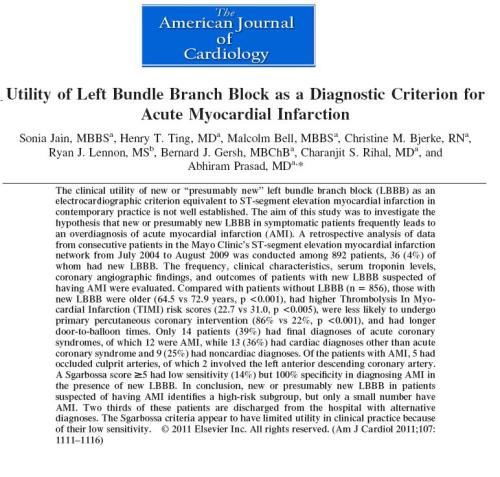
Even as our  CCU documentation was  far from satisfactory  , now this article from Mayo exactly reflect  our observation.

Sorry   Sgarbosa . . . the criteria was  based  on  sound observation and a  good  electrical principle  . . . still LBBB is able to beat   it convincingly ! ( Very low sensitivity !)

Read Full Post »

We know  acute coronary syndrome  presents* with  either  STEMI or NSTEMI. (*It actually doesn’t present , it is our understanding and interpretation ).  Bifurcating  ACS into two is more by convention and convenience .Does  the intra-coronary  plaque  dynamics  really  permit us to divide ACS in to two distinct ECG  entities ?

Are we oversimplifying it ?  Probably yes.

The following paper was presented in the cardiological society annual scientific session in New Delhi few years ago (2006)

It generated an intense debate  , finally the chair person  reluctantly concluded such events are  possible. . .

but need more proof   . What is your take on this issue ?

DUAL   ACUTE   CORONARY SYNDROME

S.Venkatesan ,G.Gnanavelu,V.Jaganathan,

Department of cardiology . Madras Medical College. Chennai

Acute coronary syndrome (ACS)  is  classified into  STEMI  and NSTEMI and has gained universal acceptance. The classification was done by   clinical & electro physiological   findings    with   some   pathological basis. The   classification   came into vogue primarily to simplify the decision making process of thrombolysis. ( STEMI –Thrombolysis eligible .NSTEMI  Thrombolysis ineligible.) The limitation of this classification is well   exposed   as   we   now know,    STEMI can evolve into NSTEMI and NSTEMI can evolve into STEMI .   Identifying the culprit artery in ACS is   not straight forward especially in NSTEMI. Adding further complexity   is   the newer   observations that diffuse vessel inflammation,  and  multiple active plaques(MAP) are responsible for many of the episodes of  ACS.

In this scenario   there   could be two are more pathological processes   one   resulting   in  a total occlusion   and other sub total occlusion resulting in both patterns of ACS simultaneously .(STEMI & NSTEMI  Dual ACS)

We   describe two  patients  who had   presented to our CCU  . Both had STEMI one in  lateral  other in anterior wall . They   were thrombolysed   as per  criteria. Both patients had gross ST depression (>4mm)  elsewhere. In one patient it  corresponded  to the reciprocal  leads .The outcome of  thrombolysis  was turbulent .Both patients worsened and one developed  recurrent VT . Paradoxically the ST elevation   regressed   indicating a successful   thrombolysis  in the STEMI  territory  even as the ST depression  was worsening in the other leads. Angiogram   revealed   multivessel CAD with   recannalised  LAD  lesion with eccentric , thrombus containing  lesion in RCA/LCX. One patient expired and other was referred for revascularisation.

We   believe   both of our   patients  experienced  Dual ACS.

When to suspect dual ACS ?

Dual ACS is likely , when  STEMI is associated with ST depression  in at least 5mm in any two leads  or   when there is disproportionate  reciprocal ST depression ( > 2mm of primary). The reason for the poor outcome could be due to a therapeutic conflict between   STEMI & NSTEMI as the former  is  thrombolysis friendly while the later is not . Role of   thrombolysis in  such situations were ACS wanders between STEMI & NSTEMI is not defined. Another possibility is the concept of reciprocal ST elevation,   where in the index event  could be NSTEMI and STEMI is a secondary response  and  thrombolysis is apparently  contraindicated.

We conclude that in patients with ACS,   two or more   plaques can simultaneously get  activated  and  present  as a combination  of STEMI / NSTEMI   in the same  patient  in two different coronary arteries.(Dual ACS) .We suggest   that in every  patient who present with  STEMI  a possibility of   dual ACS  is to specifically considered,  as  thrombolysis could be disastrous  and  instead  they  should  reach   the  cath  lab directly.  .

Read Full Post »

« Newer Posts - Older Posts »