Feeds:
Posts
Comments

Archive for the ‘cardiology -ECG’ Category

Ventricular tachycardia is a common cardiac arrhythmia. The significance of which can be very dangerous to relatively benign  depending upon the etiology and underlying heart disease . The ECG during VT is rarely useful to identify the etiology .Often times  ECG after reversal will  throw more light .

What are the ECG clues one should look for once VT is  reverted ?

  • Any evidence for old MI
  • Low voltage QRS/ LBBB/RBBB may indicate DCM
  • LVH -HOCM features
  • VPDs – Multiple , LBBB morphology / suggest  RVOT  VT
  • QRS slur or notching  indicating scars
  • Epsilon waves indicate  ARVD
  • RBBB pattern would  suggest  Brugada
  • Prolonged QT interval
  • Tall  T waves/ U waves /  Inverted  T -and other electrolytic abnormality.
  • Delta waves would indicate anti-dromic tachycardia.

Read Full Post »

We are taught in  medical schools  early in our career ,   ventricular premature  depolarization (VPD ) takes  LBBB morphology if it arise from right ventricle , and  RBBB morphology if it arise from left ventricle .This is a rough rule of thumb.

Why this rule is  unreliable ?

VPDs have a focus of origin—–a short circuit——and an epicardial  breakthrough . All these together influence the morphology. Within  the left ventricle , a deep endocardial focus  can  behave  vastly different  from superficial epicardial focus  . The  course of VPD is influenced by the myocardial status ( scars etc ) . Further,  the electrical  properties of  interventricular septum is shared  by both ventricles .

  • Generally – LBBB morphology  has  more localizing value .
  • Most RV focus have LBBB morphology (but not vice versa!)
  • LV focus can either have LBBB or RBBB

What happens to  a VPD  arising from  interventricular septum ?

IVS is  not only shared by both ventricles , it does  not have  true  epicardial  surface  (Both side  bordered by endocardium ) In most septal VPDs , breakthrough occur on either side of the ventricle  . However , It  keeps trying  to break through  epicardial surface  !  .  Hence , septal VPD  is like cat on wall situation .So the morphology varies quiet frequently.Further , the VPD can capture  the specialised conduction tissue occurs  more commonly with septal VPDs. This can alter both the width and morphology of QRS.

Read Full Post »

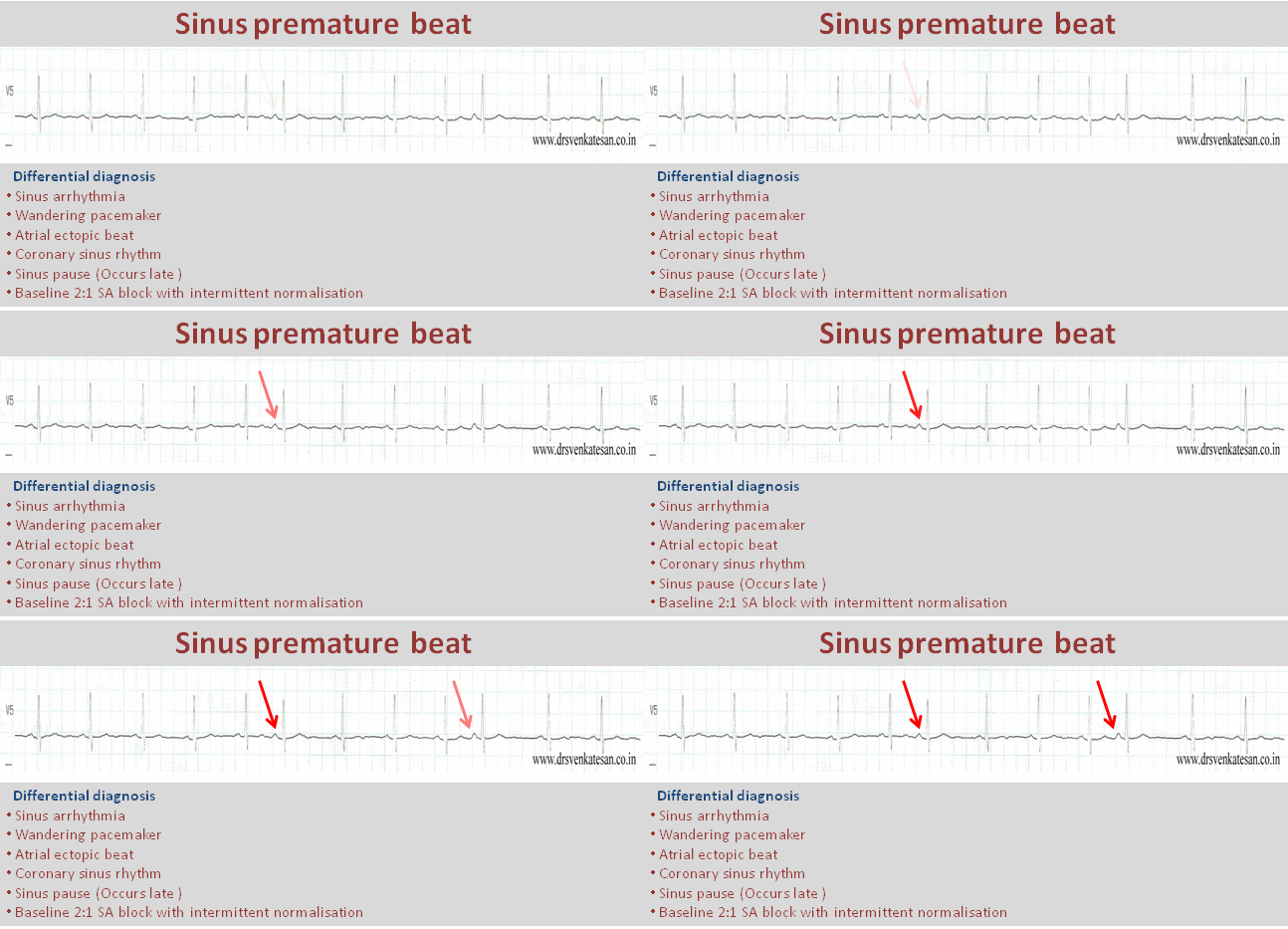
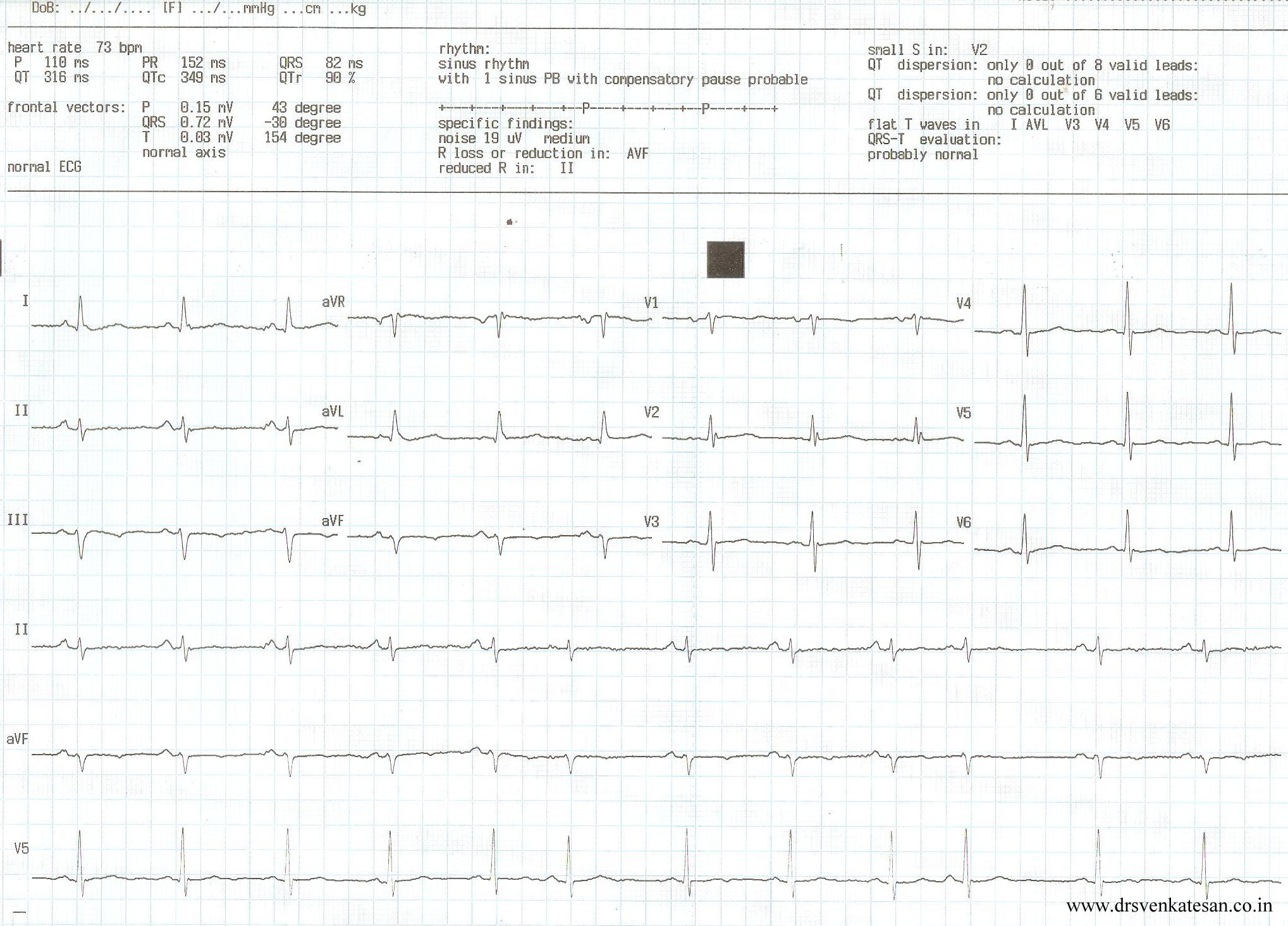
This is an  ECG which  I reported  yesterday in my clinic . I thought it was a  near perfect example for sinus node premature beat .

sinus premature beat spb 2

(Of course I need to explain  why the  P morphology  slightly  differs )

A  sudden unexpected  QRS  complex is often called as  ectopic beat . If it occurs prematurely (ie earlier than anticipated )  it is called as premature beat. If it occurs late it is refereed  to as escape beat .Please note the difference is not absolute .

Sinus node is a dramatic bundle of energy with divine powers that  drives rhythm of life !

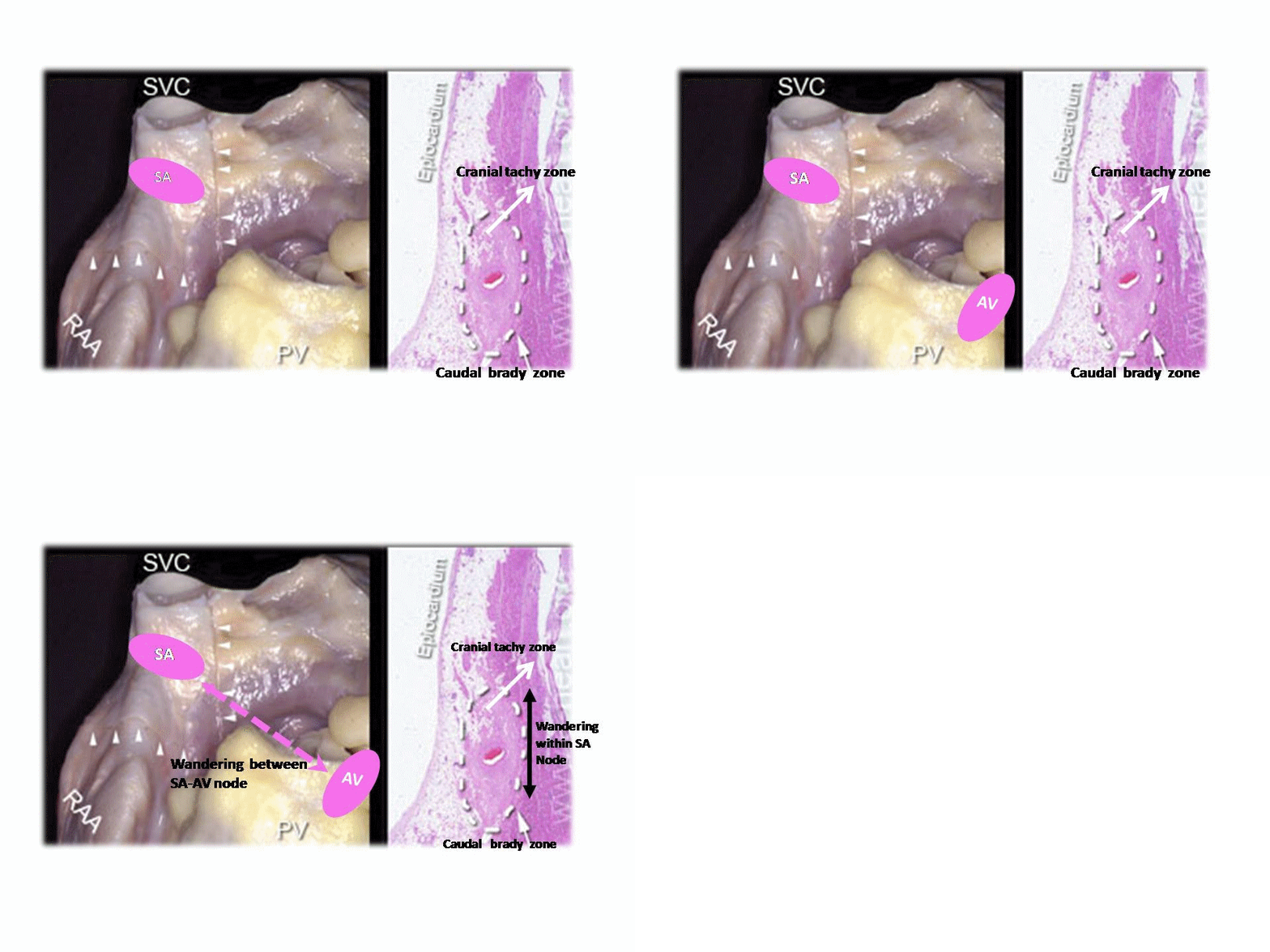
The pacemaker cells are arranged in a compact fashion with  differential properties from cranial cells firing fast and caudal cells little slower. The neural control is under constant Neuro/electro/humoral  servo control mechanism.It is well known the pacemaker shifts it’s firing location within the SA node in fairly regular fashion .The entire SA node has rich adrenergic and  cholinergic  innervation , with  a dominant control by the later . (This is  why the intrinsic heart rate is  in the tachycardia  range (around 116 )  when SA node is denerved  pharmacologically )

wandering-pacemaker

sinus premature systole spd sinus node ectopics002

SA node ,  being  a complex structure ,  it is not surprising to note  few beats to fire  slightly late  or  prematurely.If it occurs late it is called sinus pause ,  if it occurs early it is sinus premature beat , if  both occurs  interchangeably  we refer it as  sinus arhhytmia. (Read  about sinus pause here)

What is the clinical significance  of   SPD ? (Sinus premature depolarisation )

It is a  very benign entity that it is  merely an  academic fascination . By  stretching my  imagination  I  can  correlate  it  with few possible  clinical issues.

  • May be it has potenital to trigger a  SA nodal reentry tachycardia  or In appropriate sinus tachycardia/bradycardia.
  • It may be imporatnt in sinus node modification process.
  • However ,the main issue is  thee  cardiac physicians  in their enthusiasm should not mistake it for some serious  cardiac arrhythmia !

Related article

https://drsvenkatesan.wordpress.com/2009/04/14/can-premature-ectopic-beats-occur-in-sa-node/

Read Full Post »

Q waves are  neither  sacred  nor sinister waves . It represents   either of the  following .

  1. Electrical activity that goes away from the recording electrode.
  2. Or whenever there is a  electrical insulation or hurdle that interrupts the flow  of current  towards the electrode ( and if it is sustained )  it  can result in q waves (Minor interruption produces  a notch or  slurs . Please note a major slur becomes a q wave equivalent  )

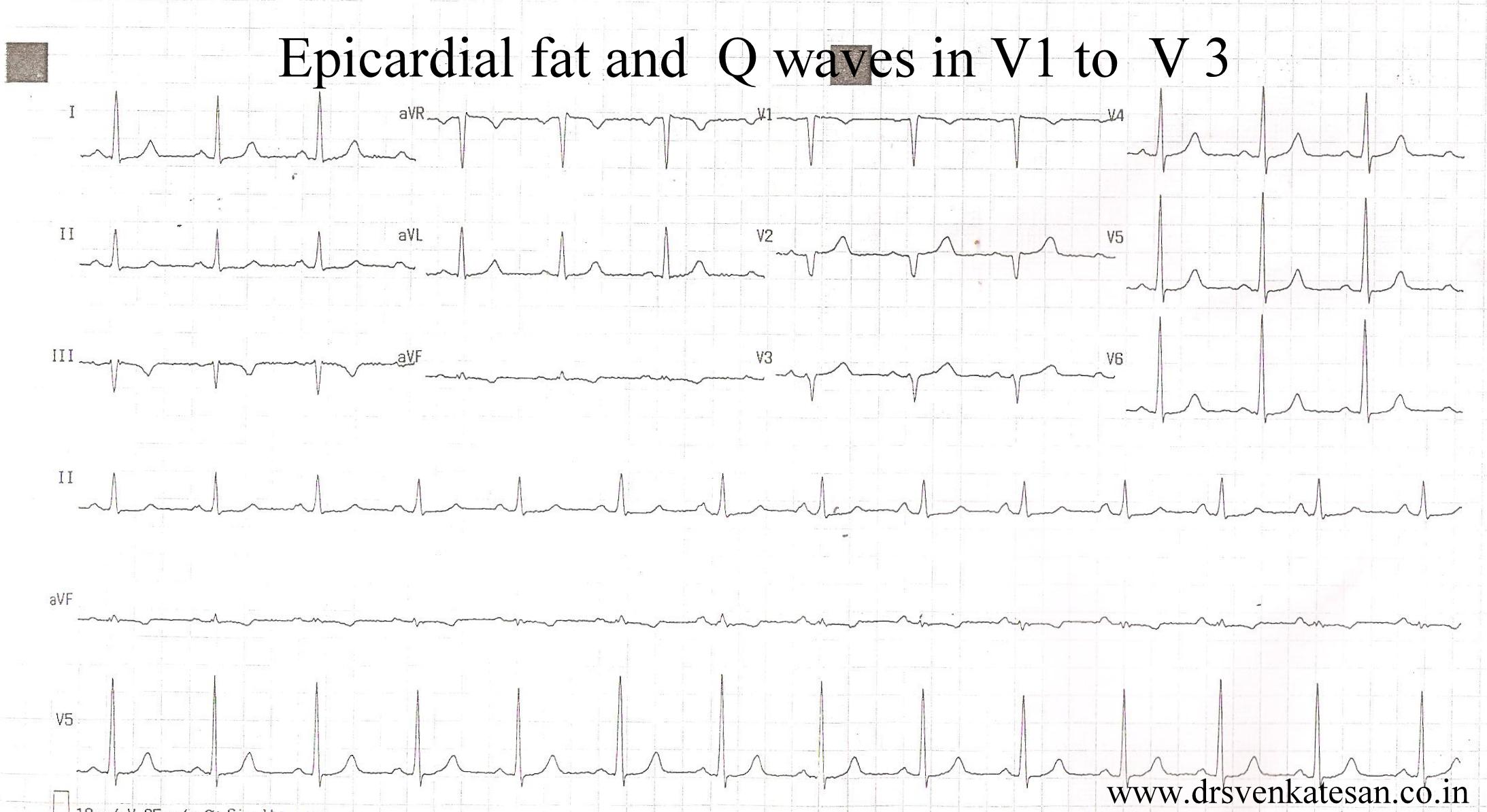
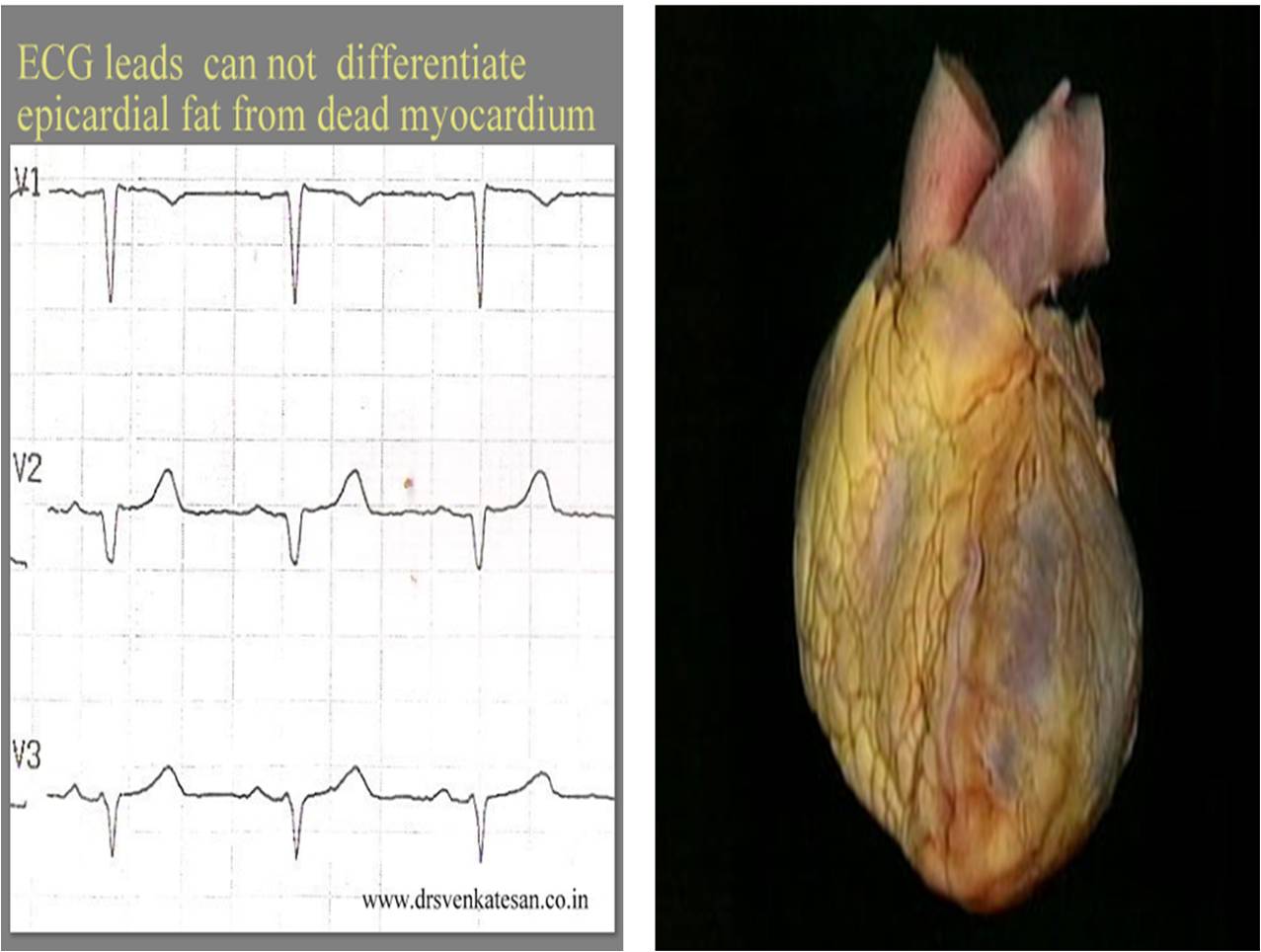
Here is young women of 42 years with  a diagnosis of  old  anterior MI for   over 5 years ( Getting a dedicated care from a cardiologist!  The prescription included Imdur/Betaloc/ Statin/Clopidogrel and Aspirin )

This was the ECG . It was very convincing for  old ASMI.
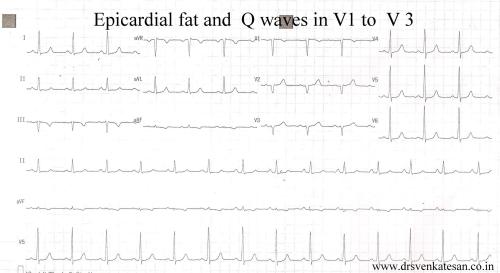
epicardial fat and poor r wave in v 1 v 2 v3 q  waves

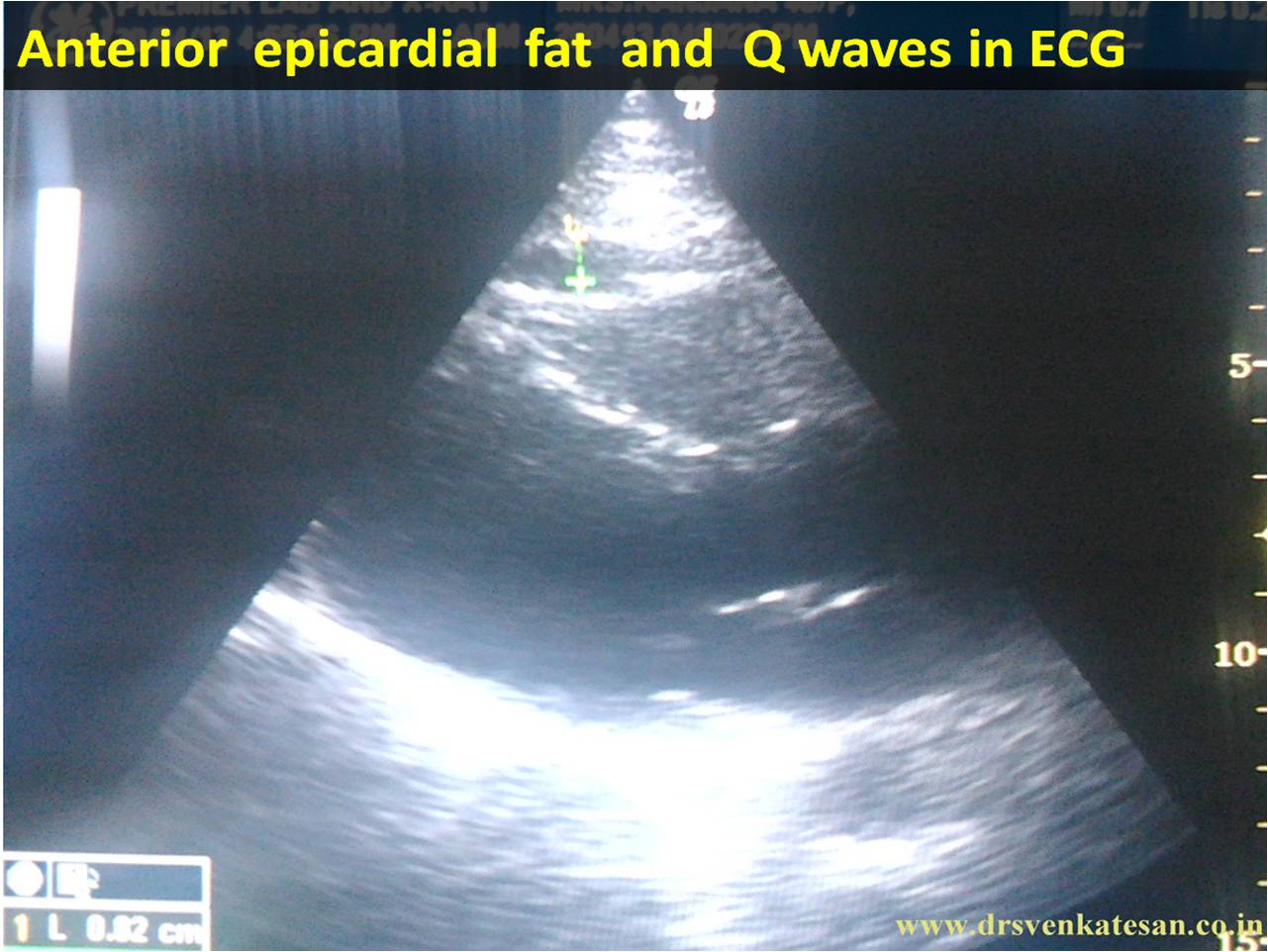
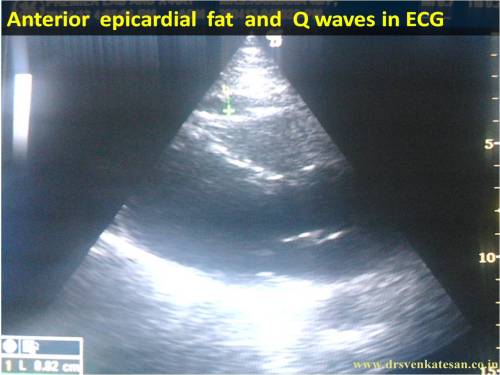
It  happened ,  I did an echo for her .
epicardial fat and q waves in ecg pesudo infarct non infarct 2  q

She lacked wall motion defects even after a meticulous search .  Instead   she had a   good layer of epicardial fat measuring 9 mm .That was more localised in  anterior wall extending little to LV apex.Her EF 65 % .

*She was a  fairly obese (not gross )  individual with a BMI of 34 .The fat pad thickness was not that huge  , I thought , still it was producing the q waves . I  have seen much thicker fat pads with good R waves in ECG . I  wonder ,  is it the type of fat that adds up to electrical insulation ?

This patient was sent back to me  again  for ruling out ASMI .  Echo was  done  two weeks  later . No evidence for  ASMI  could be detected.
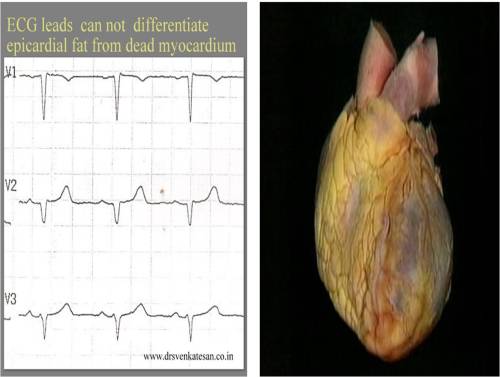
epicardial fat and q waves in ecg pesudo infarct non infarct fat 2  q

What is the normal thickness of epicardial fat pad ?

It is less than few mm . Exact normality is not known .(Empirically < 5mm ) it is very rare for fat deposition  in infero posterior aspect , except in morbid obesity.

What is the function of epicardial fat ?

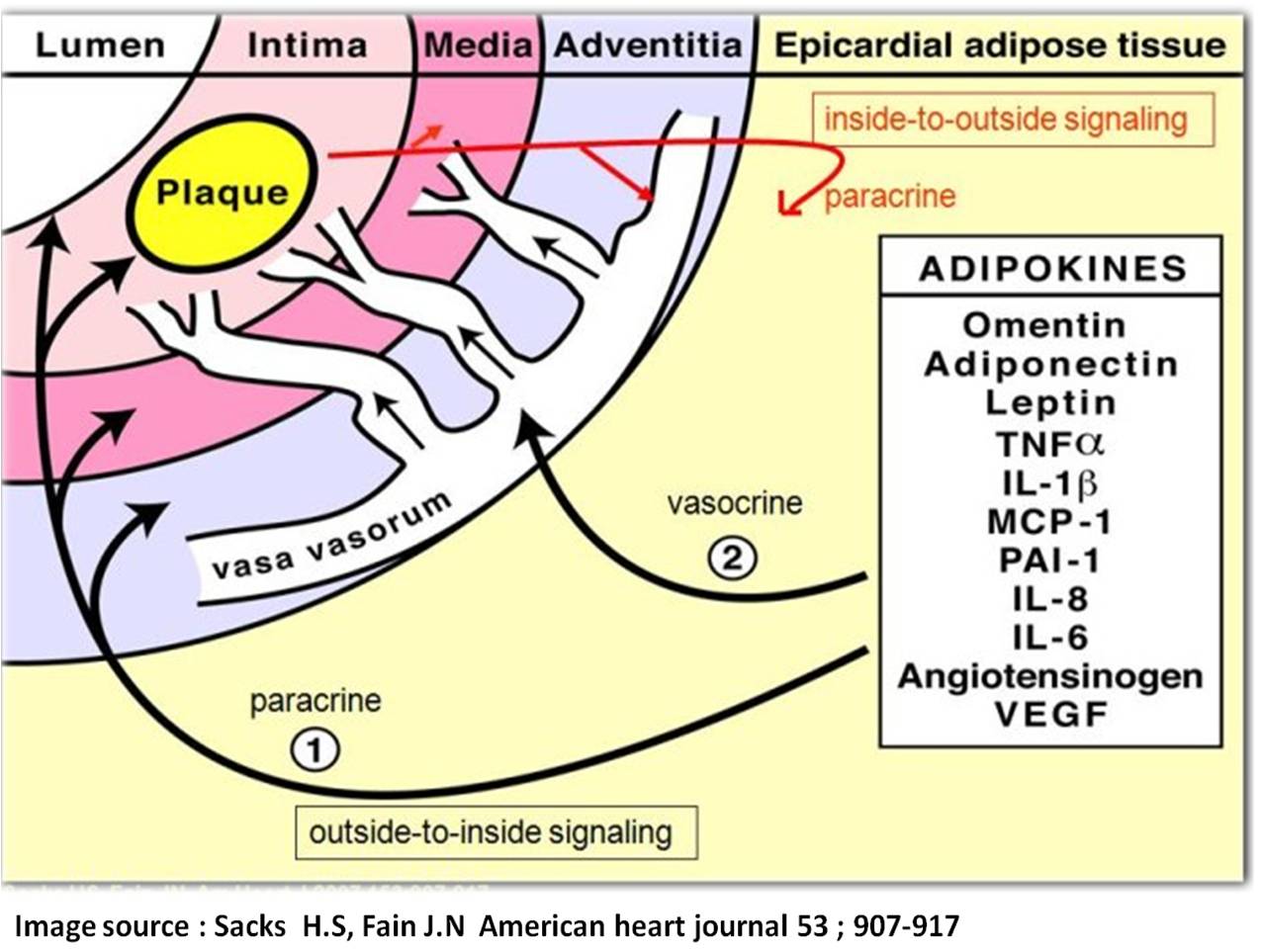
  • Long considered inert . Now , found to be a metabolically  active lipid pool.
  • We also know  heart  consumes more fatty acid than an other organs for moment to moment energy consumption .
  • Inflammatory mediator in atherosclerosis ?
  • It may also act as a mechanical cushion effect along with pericardium
  • Rarely fat infiltration can compress the heart and may result in restrictive  AV filling defects in doppler  .(May explain the unexpanded dyspnea  in many obese patients )
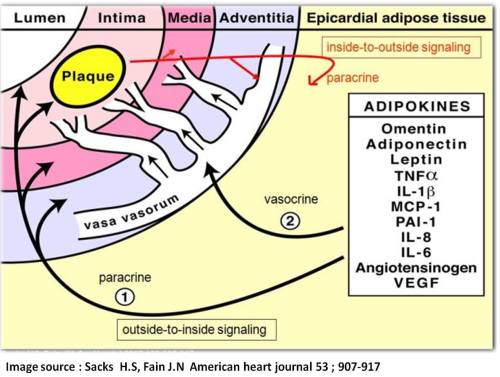
epicardial fat a dynamic depot athreosclerosis

Role of epicardial fat depot in the genesis of atherosclerosis

Subcutaneous vs  Epicardial fat.

We know thick chest wall can also interfere with ECG. Epicardial fat is more likely to record  q waves than  sub cutaneous fat ,  as the insulation is more closer to heart in epicardial fat . In thick chest wall current leaks from heart and  well scattered  hence  poor R wave is more common in such situations rather than q waves !

Following things can generate  q waves (Other than Infarct  )

  1. Fibrosis-Myocardial /Interstitial
  2. LVH
  3. Thickened pericardium
  4. Thick chest wall/ Epicardial fat
  5. Air/Fluid in pericardial space

Final message

In obese men and women  anterior Q wave can be  misleading .Such  medical errors can be so convincing .

After thought

If epicardial fat can  extinguish   R waves  and  replace it with  q waves  , these  innocuous  looking fat pads has every reason to  influence the ST segment shifts during  an episode  of ACS  as well !  .  Isn’t ?  . If so  . . . how reliable is  our ECG criterias  to diagnose  acute coronary syndromes  in grossly obese men and women ?

Read Full Post »

Those who answered  “Yes” ,  can leave this article . Those who answered  “No” read further .

* Logic would tell us myocardial revascularisation should correct  stress induced ischemia and it  should disappear promptly  . This does not happen in all cases  real world  ! That is  why medicine is  different  from mathematical science .

Some of the  reasons for  persistence of stress positivity even after an apparently successful PCI are  . . .

  1. Incomplete  correction of ischemia. (Ideally  to be referred as failed PCI )
  2. Error in Identifying culprit 9Angina related artery ) .Common feature of poorly worked up  multivessel CAD.
  3. Re-stenosis /Re-occlusion
  4. Doing very early stress test without giving time for revascularisation to work *
  5. Rapid progression of non culprit lesions .(Sub -optimal medical management )
  6. Chronic N0-Reflow phenomenon  surrounding  area of infarct .(Especially in  PCI of CTOs)
  7. Dyskinetic  or grossly remodeled ventricular segments  can result in non ischemic positive EST response (ST drag **)
  8. Associated systemic conditions especially  Anemia/ SHT & LVH -(False positive )
  9. Many diabetic patients may  continue to show stress ischemia due to  small vessel disease.
  10. A  patient with  syndrome X  characters  can have incidental  epicardial lesion as well . In such a patient EST will always be positive .

* Optimal time to do  EST  for assessing the  efficacy of  PCI/CABG is not established .Six months may be the reasonable point .If done within 2- 3 months it may  end  up  in embarrassment for the Interventionist . (So only it is kept at 6 months , this also help us  greatly  as  we can always blame it on poor life style control and progression of  the disease !)

** No reference  for this  , a  personal observation .We know  Q leads following MI ,  will show ST elevation during stress test especially if the segments are dyskinetic  . In leads diagonally opposite to q leads ,  ST depression is observed . This may not be  a evidence for true  ischemia . It probably represents   ST drag due to mechanical stretch .

Read Full Post »

In the early  20th century , Waller invented the ECG machine. Wilson  created  leads and  methods to record it. Eienthoven  formulated the concepts the electrical theory behind ECG.

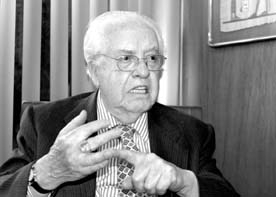
Between 1940-197os one man ruled supreme in the world of electro cardiography .   He is Dr Sodi pallares from Mexico. His deep insights revolutionised  and helped  us  understand how the cardiac electricity is generated  and propagated  in various pathological states that is the beginning new age electrocardiography! It adds much to his  credit , as in those days scientists  from non American and European countries   were hard to come  in the  global limelight.

Some of his thought processes and Inventions

  • He laid the foundation  for deductive electrocardiography.
  • Applied  vectorocardiographic  principles to scalar  ECG and helped  understand mechanism of ventricular chamber enlargements
  • He was instrumental  to analyse  the genesis of current from the myocardium . He tried to reason out  the contribution  of  cell metabolism, hypoxia, electrolytes to the current genesis.
  • Polarising myocardium with GIK infusion STEMI was proposed by him
  • Finally he tried to incorporate the laws of thermodynamics into electrocardiography .

Please remember , Sodi pallare’s  conscience  is still largely unexplored .There are lots of hidden truths .We now know fever can influence qrs voltage and febrile illness can trigger  ventricular tachycardia as in  of Brugada syndromes.

Today’s youngsters can take a  few cues from this great man and enlighten the field of electro-cardiology

DOCTOR DEMETRIO SODI PALLARES

Demetrio Sodi Pallares (1913-2003 )

If  modern-day cardiologist is able to  interpret the  ECG by a cursory 3 second scan of  strip of waves  , we are greatly  indebted to the knowledge imbibed by this great man from Mexico !

Sodi pallares

Reference

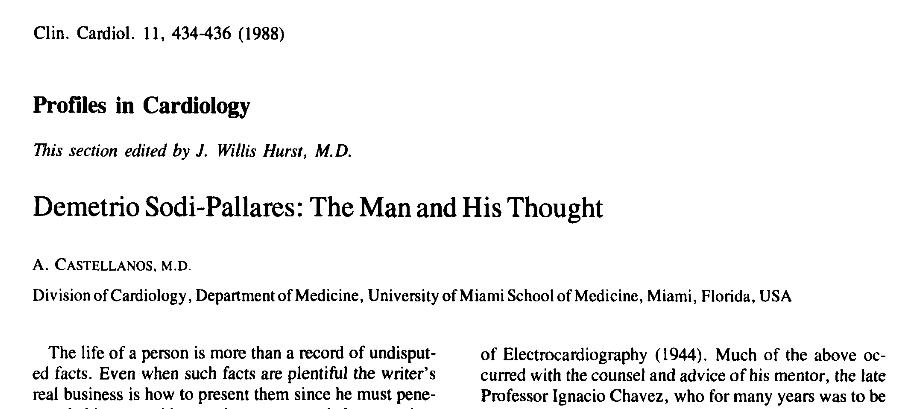
http://onlinelibrary.wiley.com/doi/10.1002/clc.4960110616/pdf

Sodi-Pallares D,Medrano GA, Bisteni A, Ponce de Leon J:
Deductive and Poly-paramerric Elecrocardiography.Instituton acionalde
Cardiologia de Mexico, Mexico,DF1970,VII,VIII
Sodi-Pallares D, Testelli MR, Fishleder BL, Bisteni A, Medrano GA, Friendland C, De Micheli A. Effects of an intravenous infusion of a potassium-glucose-insulin solution on the electrocardiographic signs of myocardial infarction: a preliminary clinical report. Am J Cardiol. 1962;9:166–181

Read Full Post »

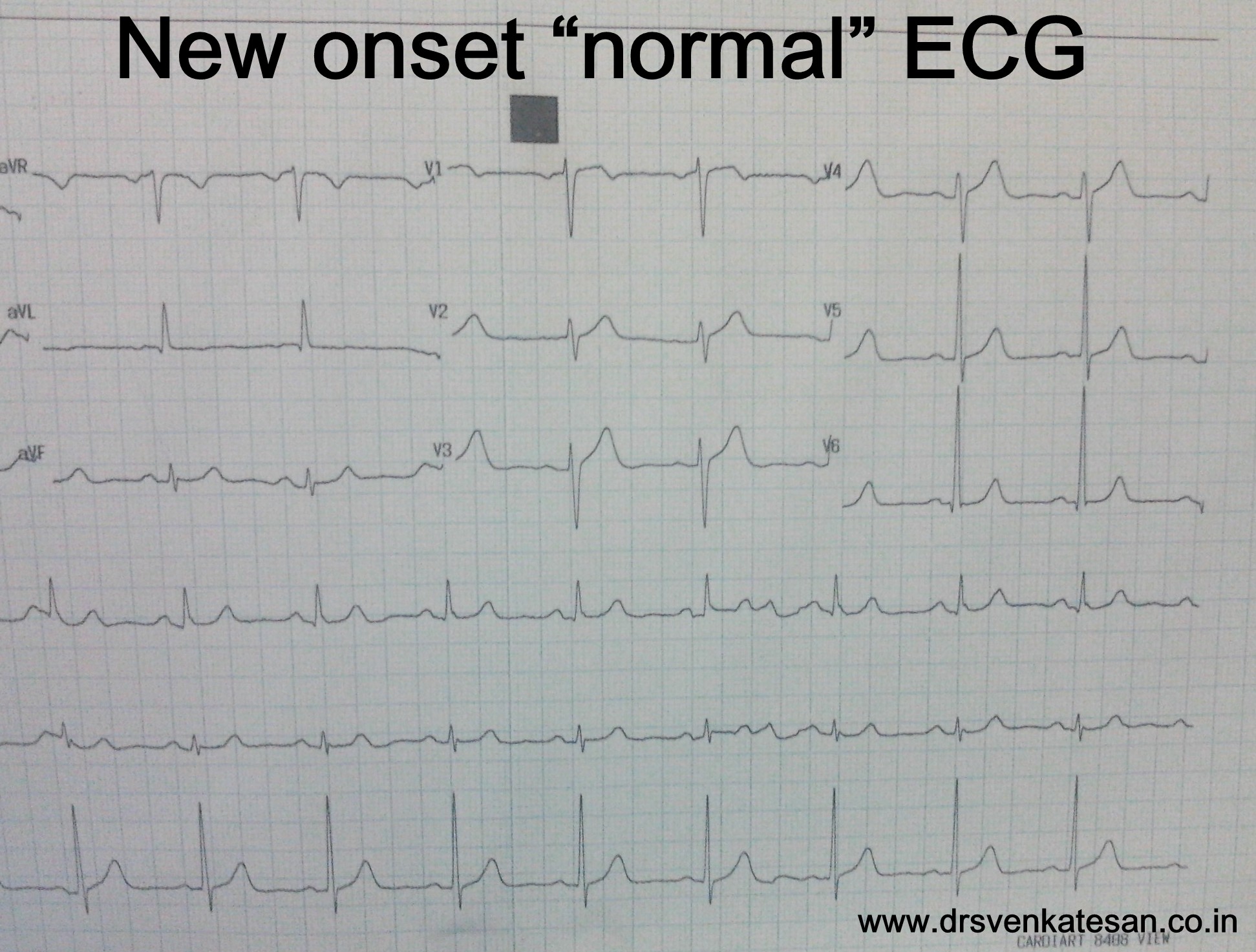
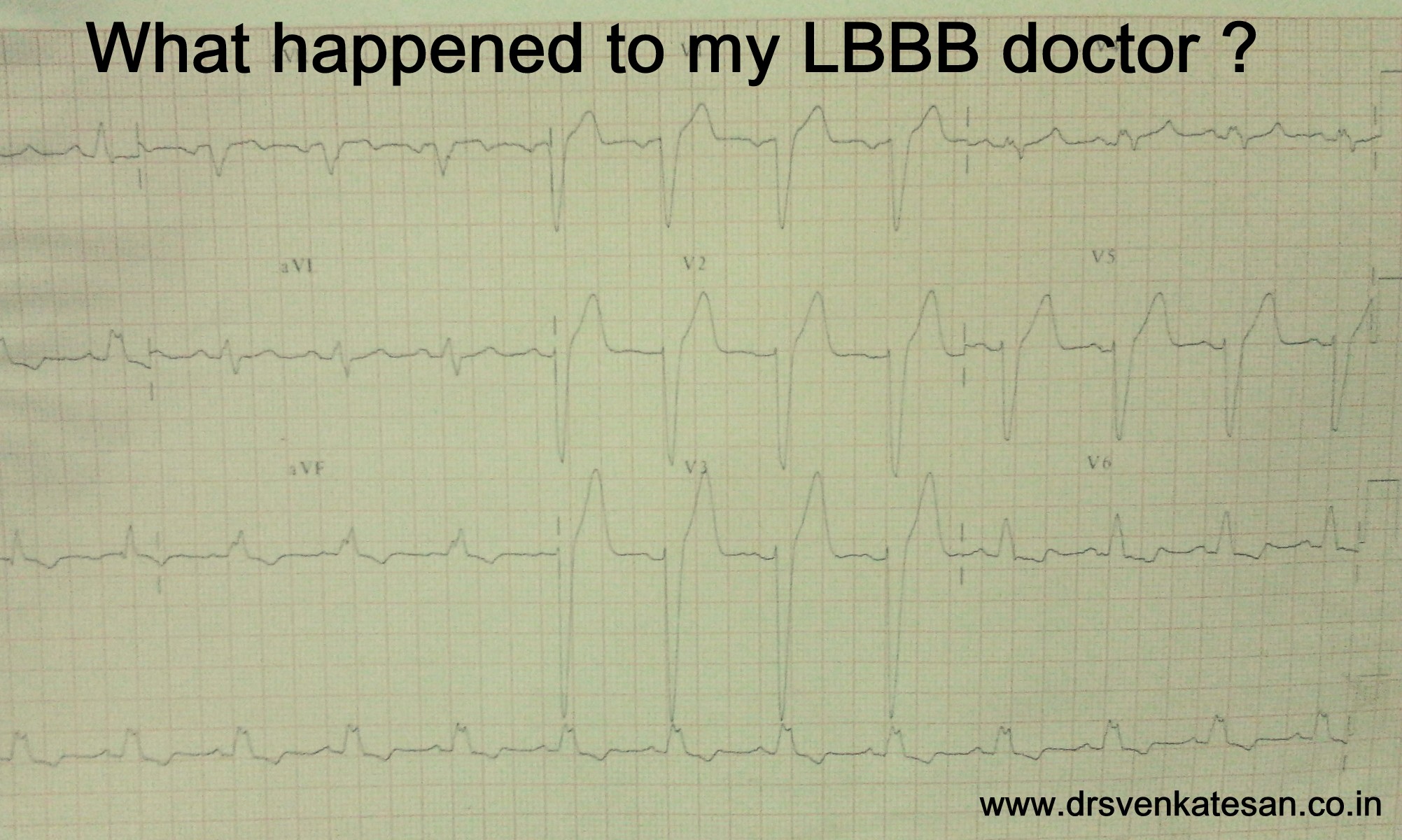
We know  new onset LBBB  creates considerable anxiety . We  experienced a  reverse situation recently . A 72 year old  man who is known to have chronic LBBB  for over  5 years came  to CCU with vague  chest  discomfort .

His   ECG  was  perfectly normal . . . every one  was  curious !

My ECG always looked like this doctor  !  Now you say it has normalised and you say it concerns you  ! I am really worried  doctor  !

What does it mean doctor ?

Cardiologist : I do not know . Any sudden change in rhythm even if it is from abnormal to normal is to be given importance .

Patient : Is  the  going bad ?

Cardiologist :  I do not know

Patient : Should I  get admitted ?

Cardiologist : I think so  but you need to undergo few blood tests and repeat an ECG .

Patient : Oh  what ?  you  are not sure either !  Are you not an expert in heart  disease doctor ?

Cardiologist : I think I am . I wish I have an answer to  your question .

Follow up

This patient was admitted in intermediate care ward and observed for 12 hours .

His enzymes and Troponin were negative . Echo showed normal LV function .

He was discharged later and adviced  a stress test .

What is the the mechanism of normal ECG  here ?

Intermittent LBBB due to rate dependency is common .But this  man  had persistent chronic LBBB for > 5 years which got normalized .That mystified us !

Can transient ischemia of left bundle  accelerate  the conduction ?

Read Full Post »

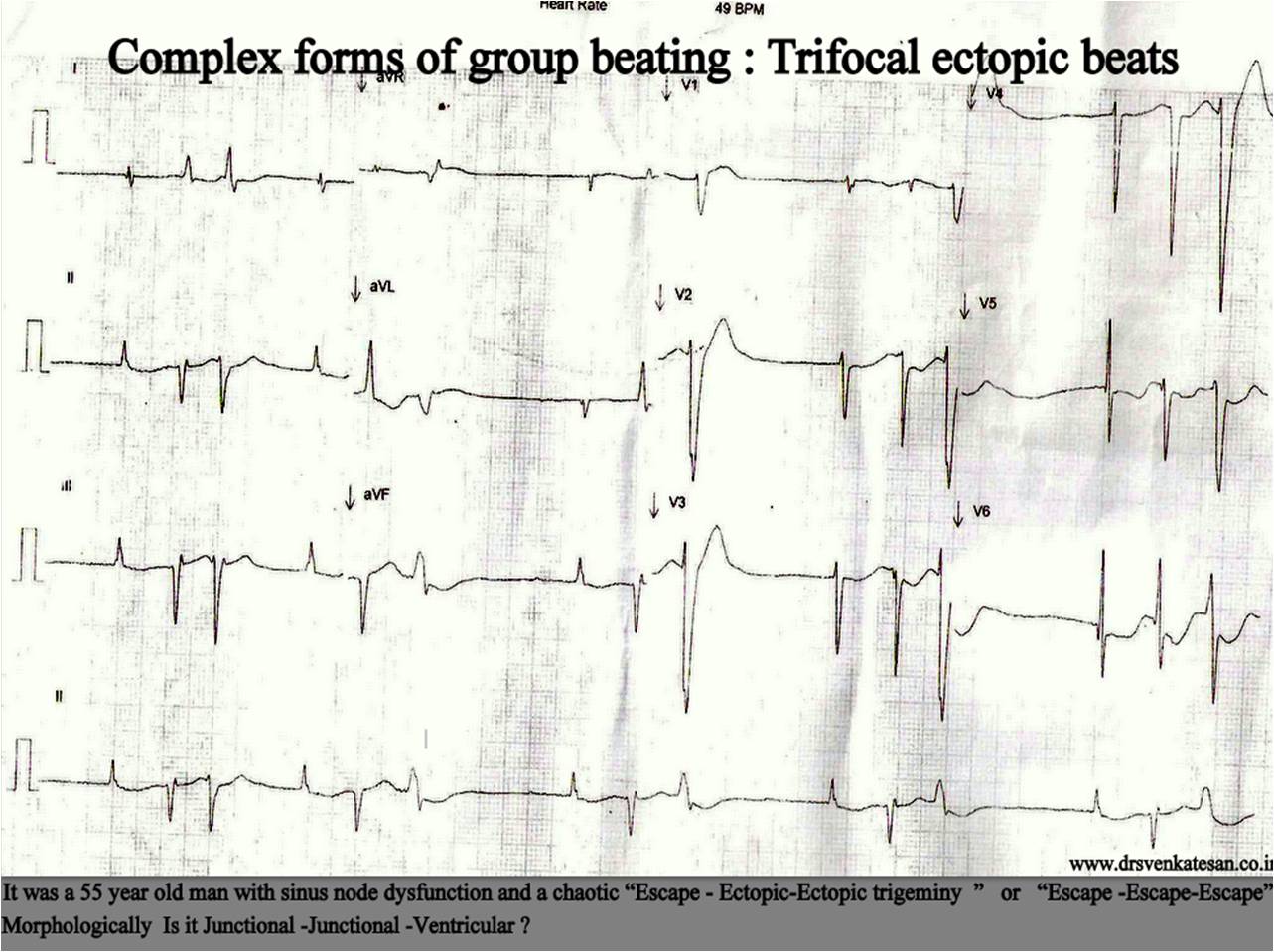
Sinus node is the electrical high command of our heart .When it gets injured  seriously (or shot down   as in sinus arrest ) there is utter chaos in the lower ranks !

This is what happened  in this patient .

trigeminy group beating vpds sinus node dysfunction escape capture

The lower pacemkers can either passively release  themselves as escape rhythm or actively fire with a  ectopic focus  . Any combination of escape / ectopic  beats can  occur .If occasional sinus beats capture the ventricles things  can become further complicated .

It is obvious , this  random intra-cardiac  shooting  makes the life of the  myocardium miserable . It is a perfect setting for syncope, tachcyardic cardio myopathy , extreme brady induced VT , VF  even SCD.

*Meanwhile , It is  heartening to note  SND   rarely lead to  sudden death in spite of all the chaos .However  extreme  bradycardias  that occur in  complete heart block  does  not enjoy this immunity as fatal complications are common if not intervened .

Read Full Post »

Can there be a small r wave in V1 and V2 in LBBB ?

Yes .

Though we expect the  reversal of septal depolarization that will   extinguish  the initial r in v1 to v3 . It is  preserved in  many. Hence the  presence of small r in v1 to   v3 does not rule out LBBB.

  1. The commonest explanation given is un-masking of RV free wall forces which is   normally  masked by early LV forces .
  2. Another possibility is the   orientation of septum  in pathological states.
  3. Third possibility is  “r” may  actually represent  the  septal q waves as in LVH or old AWMI  .(Counterpart of small  q in lateral leads )

Read Full Post »

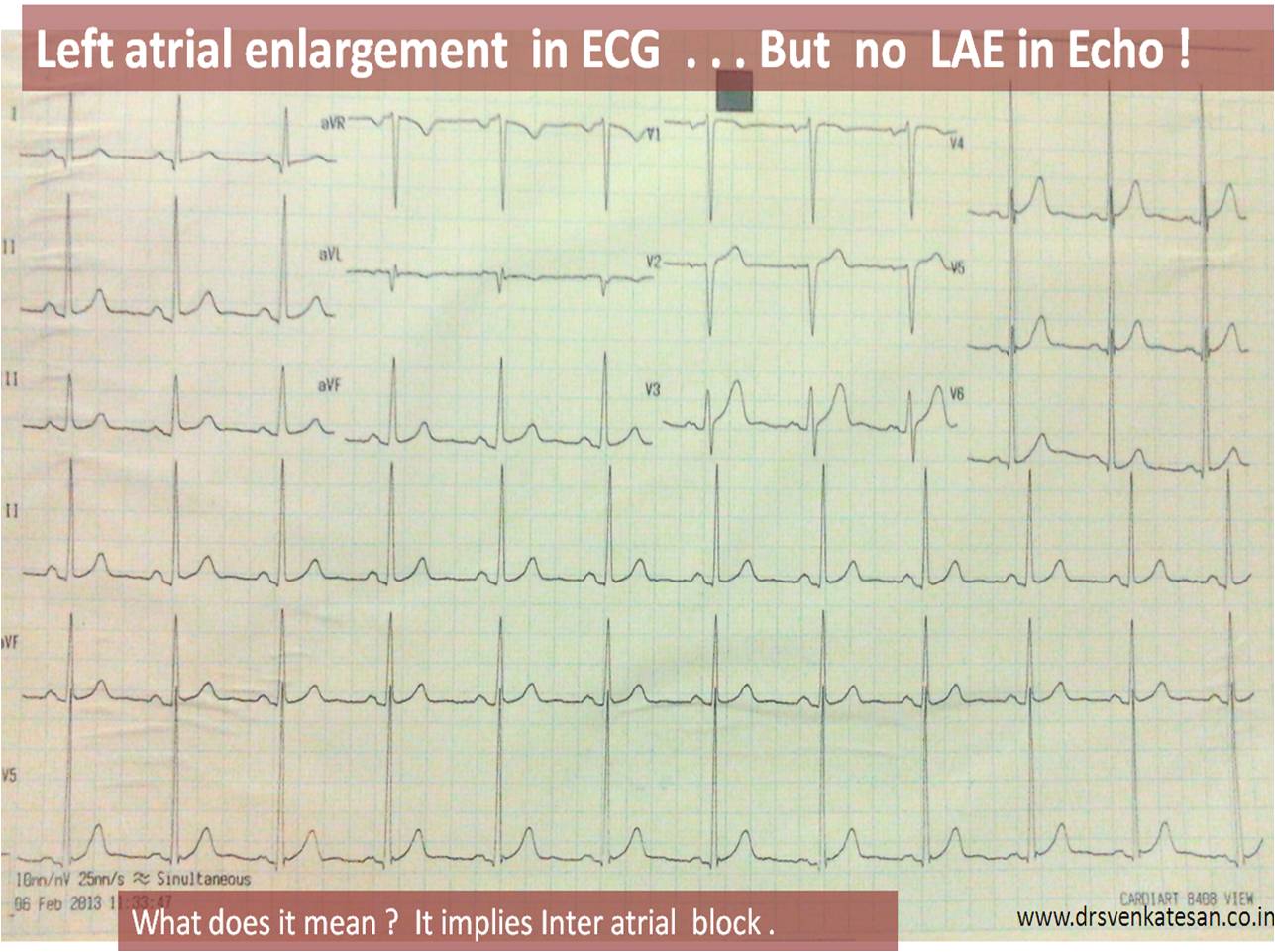
This is an ECG of a 42 year old man .He was reported as  Left atrial  enlargement (LAE) and was referred for  echocardiography . His echo was normal . LA measured 2.5 X 3.1 cm .The consultant  called back the echo lab ,  to verify   the left atrial dimension .He thought he was very sure of LAE .It took  considerable time to convince him about the credibility  of the echocardiographer . He was  right after all  . . . still . . .  ECG was  also looked  convincing  for LAE !

left atrial  enlargement by ecg limitations sensitivity

left atrial  enlargement by ecg limitations sensitivity  echo la dimension

                         Is this phenomenon  of wide P wave with normal atrial dimension  common ?

Yes it is . It  underscores  poor sensitivity of ECG in the  diagnosis  of LAE .The P wave abnormality in the above patient is due to Inter atrial block (IAB ) . This widens the p wave .

What  are the types of Inter atrial block ?

inter atrial block europace 1999 de luna


P wave widening is not synonymous with LAE .(Here P waves  widened   due to sluggish inter nodal pathway and inter atrial pathway .It is something like QRS widening in  bundle branch blocks  )

Final message

IAB is an important differential diagnosis for LAE . The significance of which is not entirely clear . It  is possible  IAB   precede LA enlargement  .It can even trigger AF due to  inhomogeneity.

Even though IAB was reported in 1950s  (Puech P* ) ,  it was  rarely  considered important With  increasing incidence of atrial arrhythmia in aging population , IAB is expected to  come into the lime- light again . The sophisticated electro anatomical mapping  can unravel the mysteries surrounding this entity .

Reference

INTER ATRIAL BLOCK

*Puech P. L’activite´ electrique auriculaire normale et pathologuique. Paris: Masson, 1956; 206.

http://www.jecgonline.com/article/S0022-0736%2812%2900227-0/abstract

http://europace.oxfordjournals.org/content/1/1/43.full.pdf

Bachman bundle branch block

Read Full Post »

« Newer Posts - Older Posts »