Feeds:
Posts
Comments

Archive for the ‘cardiology -ECG’ Category

Clinical cardiac  problems can be very demanding at  times. Here  is a  situation even the toughest will struggle.

A 52 year old man comes with a wide qrs tachycardia  with a blood pressure of 90 /70 with class 4 dyspnea .He was restless , trying to sit up because of  orthopnea. The ECG showed  a definitive ventricular tachycardia  with LBBB morphology.The patient was   connected  the   oxygen line ,  cardiac monitor, oximetery, etc

The consultant  on call instructed   immediate DC shock   and  he  warned  about  impending ventricular fibrillation .He  casually told the fellow to  do a echocardiogram also and rule out any structural heart disease. Even as  the staff was  arranging the defibrillator , the fellow did   a  rapid bed side echocardiogram . He was  shocked to find a  large mobile LV clot   with a  dilated ,  severely dysfunctional left ventricle  having an  EF  of  25 % .

Now comes  the critical time . Should we shock this man with VT and LV clot?

What will be your option now ?

  1. I will not mind the LV clot  ,  will go ahead with DC  Shock . Let him dislodge his LV clot . If It is his fate  let it be !
  2. Defer the   DC shock . Fall back on medical cardioversion like  Bretyllium, Amiodarone or magnesium  . After all . . .  it is not a pulse less VT. He is not in cardiac arrest . He can afford to wait .We can’t risk a stroke .
  3. Give a low energy  shock  25 joules  with paddles  avoiding the LV apex.  .It may not dislodge the apical clot , still  VT may be terminated.
  4. Try overdrive  pacing instead of DC shock
  5. Refer the patient for emergency surgical removal of LV clot
  6.  Suck out the LV clot with a   LV suction catheter and plan elective DC version*
  7. Insert a temporary Aortic filter and shock the patient **

*  Such catheters are in preliminary stage of development . Is  that true ?  ( If  no I  should get the royalty for the idea  ! )

(Read the related article in my blog )

** A loud imagination . Such filters do not exist.( If  IVC  can be filtered   why not  Aorta ? )

What was finally done ?

After analysing each  of the above  , we decided   option one “Prey the  God  and shock the heart” ) After all if it is  a VF ,  this  issue becomes null and void !  . Luckily God was with us.  The  patient  was  reverted to sinus  rhythm with 50joules   and  had  no  untoward events . He was subsequently anti-coagulated .  He is being planned for CRT/ICD therapy

Final message

Critical care  medicine is all about risk taking .Many times , therapeutic maneuvers  confer a  significant   risk  to life  comparable  to the   index problem.  But that  should not be a deterrent .  A careful learned decision  is warranted.

Read Full Post »

Localising  WPW syndrome is a favorite  time pass  for cardiologists in spite of  serious  limitations of surface ECG .Still , it is vital to generate a rough idea about the location of  these pathways ,  so that we can focus  our efforts  on  some sort of ablation procedure .

Arruda algorithm is probably a simple and fairly useful technique to remember. It asks us to climb 4 steps   and pause at each  step and look sideways   for the accessory  pathways !

Step 1 (Left free wall step )

Initially one need to look only two leads .

Look at lead 1  and  V1 for   delta wave and R/S ratio .After Identifying delta wave look for the polarity of delta wave (This can sometimes be really difficult ) .If there is iso-electric or negative delta it immediately  fixes the pathway  in left free wall . Similarly if V1 R >  S it also fixes in left free wall. To locate more precisely in left free wall  look  for  delta  wave polarity in  AVF  and proceed down*

If none of these finding are present then  Go to step 2 .

Step 2 (Coronary sinus step )

It is the most simple step . If negative delta  located in lead 2 (often mimic inferior MI)

Here the pathway is often located in coronary sinus /middle cardiac vein often as diverticulum.

After excluding left free wall and coronary sinus origin one has to look at possible septal  pathway  .

For this  go to step 3

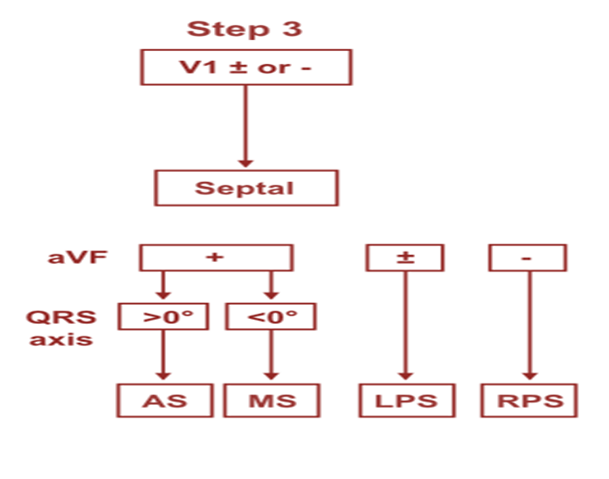
Step 3  (Septal step ) And  again v1 lead  becomes important if v1 shows negative or iso-electric  go down  to septal  pathway decoding

After ruling out septal origin the scheme takes us to right free wall by default.

Step 4  (Right free wall step)  If the delta wave does not fit in  any   of the above three steps (Including  positive  delta in V 1 )  it  fixes  the right free wall  pathway

Arruda scheme summary

Arruda scheme  guides  us  to scan  systematically  for pathway from left free wall  to  septum and lastly  the right free  wall  (The key  to  locate  the APs is  to look at  delta waves in lead  1, 2  AVF and R/S ratio In V1 )

Here is a  simplified version for basic localization

Reference

  1. Arruda MS, McClelland JH and Wang X , et al. Development and validation of an ECG algorithm for identifying accessory pathway ablation site in Wolff-Parkinson-White syndrome. J Cardiovasc Electrophysiol 1998;9:2–12.

Read Full Post »

Human life is a bundle of energy orchestrated by ions coming  in and  going out  of  every cell . Potassium is the life sustaining ion which  determines the  resting membrane potential  of our cells.

When the  heart  suffers a massive necrotic attack  what  would  happen to the potassium dynamics  inside the  myocytes ?

K  + is the dominant  intracellular cation  ,  when  about  100 million myocytes   die  suddenly ,  a chaos in the  potassium  metabolism  is expected  is it not ? .

When skeletal  muscles dies  it  releases  potassium  . We  know   this  from typical crush injuries and rabdomyolyis.

It is  more of a  common sense  to expect this   . . . from myocardium as well .


Which ion is responsible for the current of injury ?

We know a  strong and continuous  negative current that  emanates from the necrotic zone after STEMI  .  (It is so powerful it  shifts the baseline  itself  !), We do not know yet what exactly  is causing this current of injury .  It goes without saying sodium should sustain the depolarisation wave but  potassium will  also have a major role in the  propagation  of this injury current.

Do dying myocytes   excrete the potassium into the circulation   ?

Is    k+  a marker of extent of MI  ?

What is the mechanism of hyper acute tall T waves in  MI ?

Questions  galore  . . . Answers struggle !

When a  large  area of  cardiac muscle goes for necrosis  it  leads to  leaking   of   K +    . If it is true  , it  is expected to be a marker for extent of  infarct. In reality it is not . Why ?  This is because cardiac  potassium pool is much  small . A  leak from  an organ which weighs   400 grams   do not elevate the ECF  potassium .  Still , there is ample evidence  for   K + to accumulate  in the local  intracellular milieu. (Myocardial hyper-kalemia ) In fact ,  one of  the mechanisms  suggested  for tall T waves in  hyper-acute MI phase   potassium excess .

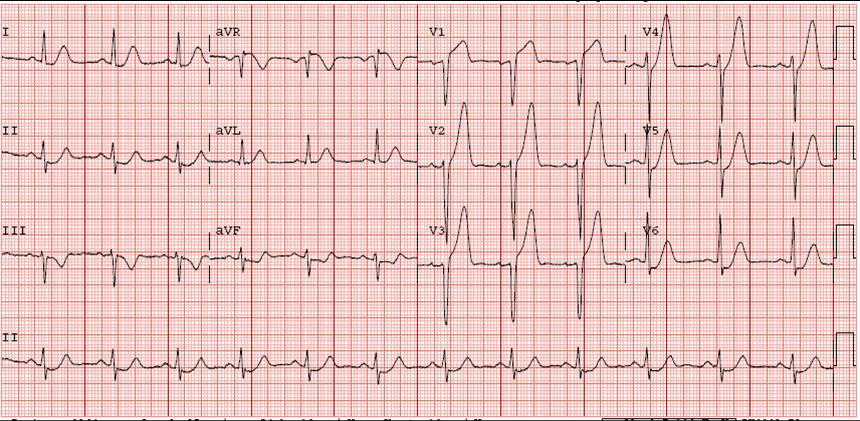
Image courtesey hqmeded-ecg.blogspot.in/2009/02/hyperacute-t-waves.html

http://hqmeded-ecg.blogspot.in/2009/02/hyperacute-t-waves.html

Potassium levels and incidence of  ventricular tachycardia.

Many of the primary ventricular arrhythmias  are  due to acute ischemia .  We  have conflicting evidence  for  the effect of ischemia on QT interval. How does ischemia trigger VT  ?
The answer to this question  remain as a missing link !  . Grossly simplifying ,  one could suggest it is  due to   ischemic cell membrane damage that alters the ion channel function  , resulting  in intracellular accumulation of calcium and triggered  activity  .

What is the effect of potassium  on cardiac contractility  ?

Myocardial paralysis.  (Please note  it is the  hypokalemia  that primarily  causes paralysis in skeletal muscles !)

It causes  myocardial  stunning  a manifestation of local potassium  leak ! A temporary myocardial paralysis.

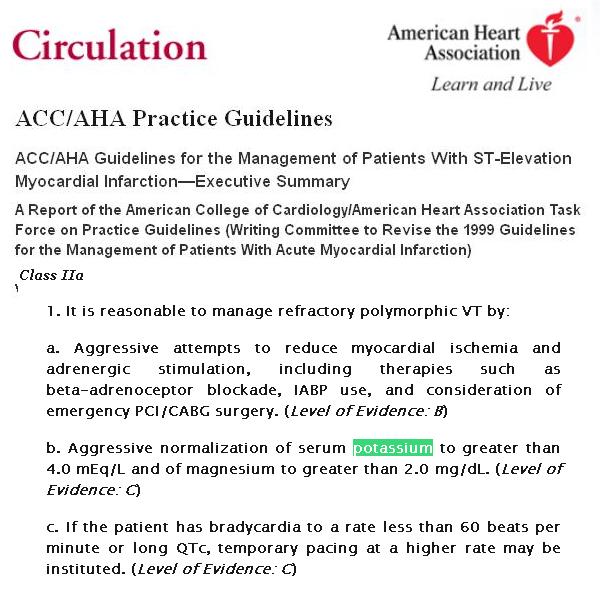
What does the current guidelines of ACC/AHA state about potassium hemostasis  in STEMI ?

It suggests   a fairly aggressive  maintenance of potassium levels  to  upper normal levels. Traditionally we are worried more about hypokalemia than the hyper. It is  surprising   we had the facts wrong . . .  for so long !

What is new in the regulation of potassium level during STEMI ?

This landmark paper from JAMA seeks  to set right the misconceptions about potassium during STEMI. It suggests  K + levels  has a U shaped  morbidity curve in STEMI . One need to be cautious in  correcting borderline hypokalemia .  Serum   K +   is   absolutely useless  surrogate marker for myocardial K +   . We do not know how  K  +  behaves in the vicinity of MI  zone . So  extreme caution is required  when giving IV  K +  supplements in coronary care units .

Watch out :  Beta blockers /ACEI   may worsen  hyperkalemia

Early introduction of ACEI and ARBs   is a strong risk factor for systemic as well as myocardial  hyperkalemia . This  is  especially true  in diabetic individuals  who have  low rennin  levels due to diabetic micro circulation defect in kidneys .(Hypo-reninic  hypo-aldosternosim )

Beta blockers are also known to raise potassium by two mechanism

1.Blocking rennin

2.Reduced uptake of K + in to  the cells.

http://medicineforresidents.blogspot.in/2010/09/hyperkalemia-with-beta-blockers.html

Final message

In the management of STEMI  ,   revascularization  of  the myocardium    is  considered as  the only  therapeutic aim . We  need to realise it   is  much more than that .  There are some subtle but important ways of resuscitating and  protecting  myocardium .  Over  indulgence in electrolytic management  in coronary care  is to be avoided.

Reference

Importance of sympathetic drive and  potassium levels

http://www.nejm.org/doi/full/10.1056/NEJM198002213020803

http://ccn.aacnjournals.org/content/23/6/14.full.pdf+html

Read Full Post »

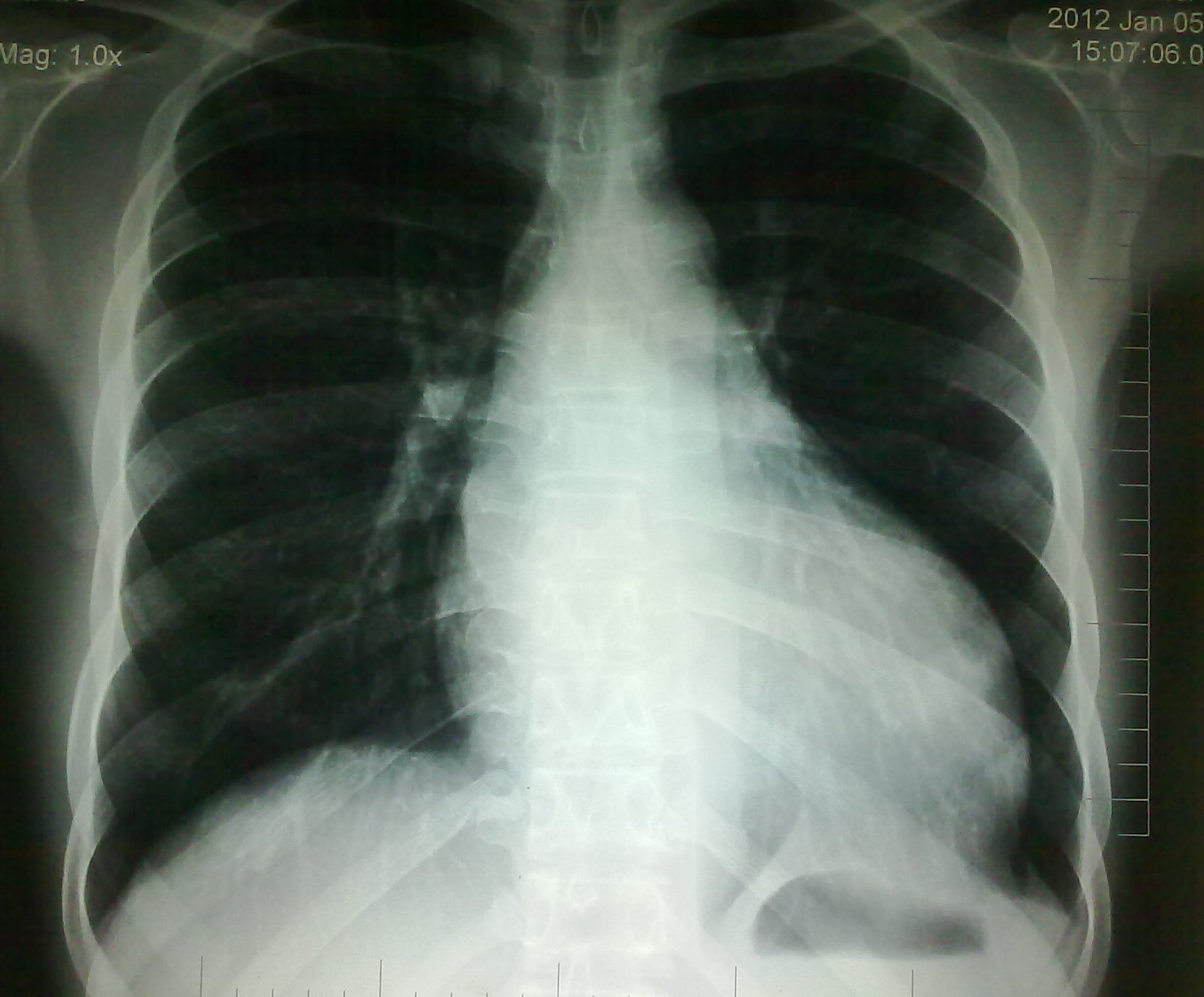
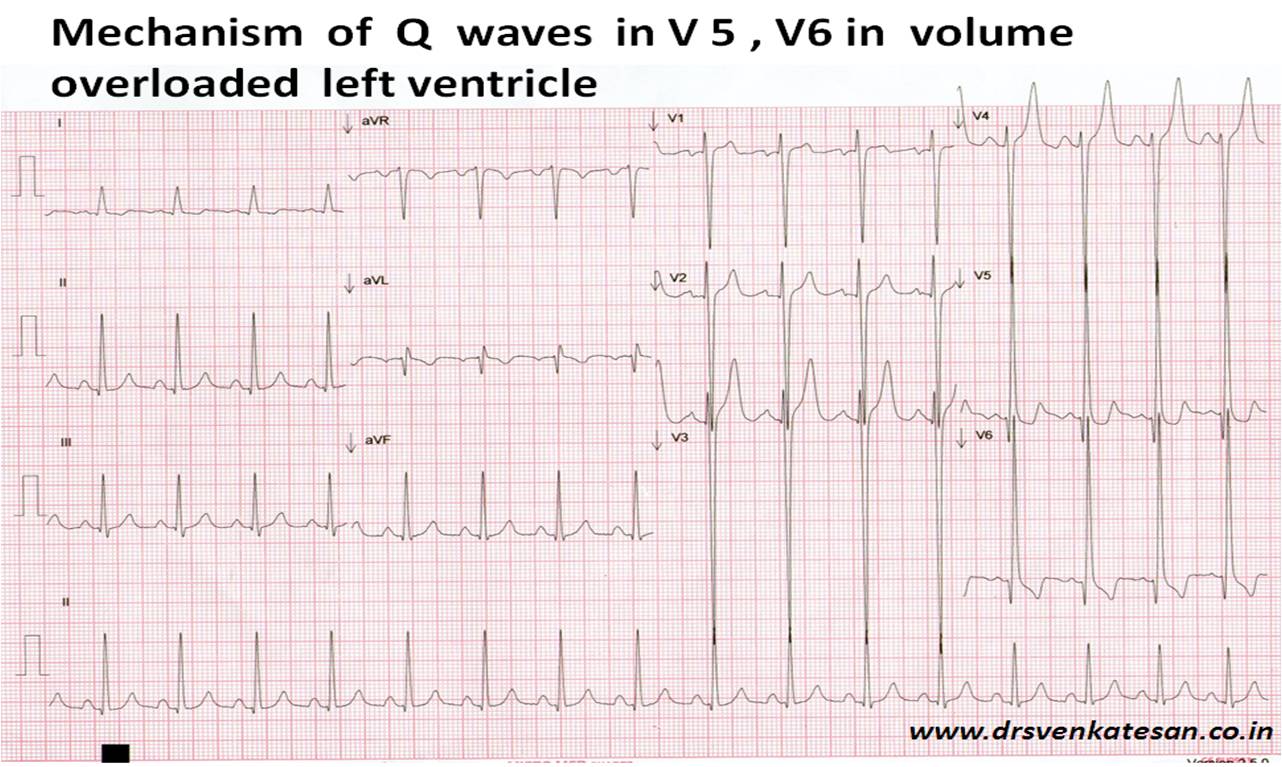
Here is an X -Ray and ECG  of a patient who came with  palpitation ,  which he  said  descriptively

“I  could feel  it   with  my hands over chest “

He also had class 3 dyspnea  and nocturnal chest pain . (Read here :  What is the mechanism of nocturnal angina in AR ? )

Clinically  it was classical  severe aortic regurgitation .

His x – ray and ECG showed

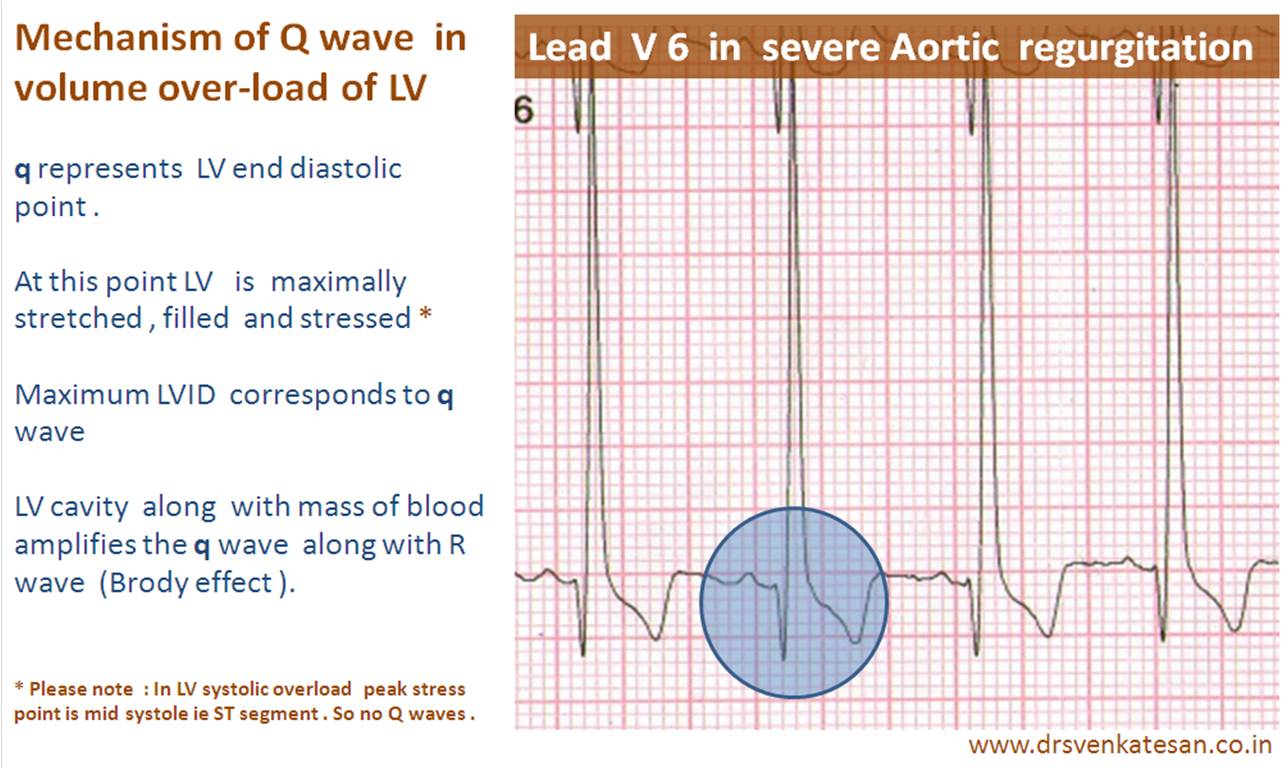
  1. q  represents  LV end diastole  . The  maximum diastolic  stress  point.
  2. q  indicate septal forces . When  LV is dilated  q  also  reflect cavity potential . Both gets  summed up inscribing  a classical deep q
  3. In severe volume overload   LV  is not only  dilated , it’s  mass increases  and is brought near  the chest wall . Since the leas V 5 and V6 are the most proximal to LV  both  R and q  increase correspondingly (Shall we call as  reversed Brody effect ?  )

Other findings of volume overload of LV are

While deep q  is  very valuable in LV diastolic volume over load there are other useful ECG signs.

  • Increased  qrs  amplitude (May be equally important like deep q . Both always go together )
  • Absence of  typical ST/T changes (Systole is stress free !in pure AR/MR) . Still ,  ST/T changes  can occur if   there is associated  LV dysfunction.
  • Left axis deviation.
  • Left atrial enlargement (In case of MR/ Large L-R shunts / or late stages of AR )
  • Rarely  U waves are reported in LV volume overload*

Can we  dignose volume overload without q waves in V 5 , V 6 ?

Most times no, but if there is associated incomplete LBBB q wave disappears.

Which  is rare in pure volume over-load. In fact absence of q in isolated systolic overload of LV is attributed to the presence of incomplete  LBBB by the ECG legend  Shamroth !

Reference

* http://www.ccjm.org/content/78/8/505.full

Read Full Post »

There are many  organic causes of mitral regurgitation. ( Ischemic , degenerative , valvular , cardiomyopathy etc.) It is not  rare for  pure  electrical events to result in valvular regurgitation.   A 70year old  man  with SHT   presented  with palpitation  and exertional dyspnea  .He was  later referred  for  Echocardiography.  Echo revealed LVH with intermittent MR and moderate LV dysfunction.

His ECG looked like

Ventricular ectopic recorded in bi-geminal rhythm

His  echocardiogram showed


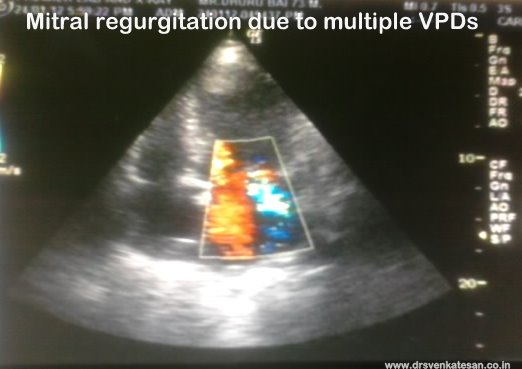
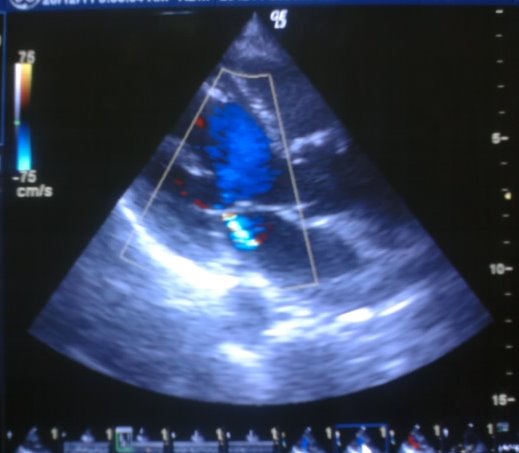
His echo showed randomly timed mitral regurgitation was detected .See the Doppler MR jets below.

We know ventricles are integral  part of mitral valve apparatus  .Hence  it  wouldn’t  be a surprise to note  abnormally timed ventricular contraction  can  have a major impact  on mitral valve function.

When ventricles  prematurely begin  to contract  ( As  during  VPDs) it  interferes with  opening of mitral valve. In other words every VPD  technically imparts a  sort of  diastolic dysfunction !

VPDs occur in which part of cardiac cycle ?

VPDs  occur  either in early   or mid  diastole . Thank fully VPDs can not occur in systole . (Refractory period )

What would be the status of mitral valve at times of  VPDs?

Though it depends upon the timing of VPD ,  generally it interrupts the rapid inflow period of diastole .

In fact ,  it converts the cardiac  cycle from diastole to a partial systole or  a combination( fusion ) of diastole   and systole ! *

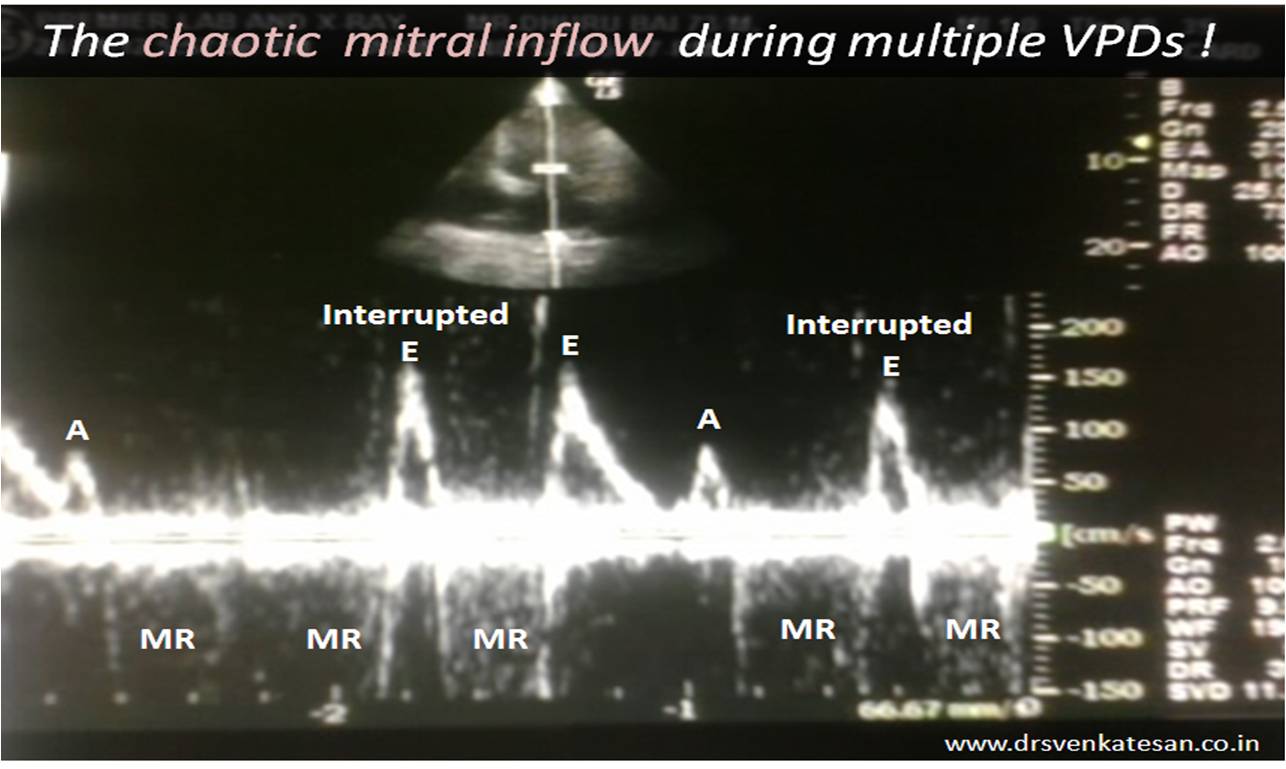
More MR jets are visualised than LV filling waves . Note the some of the E waves are sandwiched between two MR jets. ECG gating should have made this image more interesting .Any way , we have good MR jets to time systole nicely

* Is that a funny  imagination  ?

During   diastole ,  if  LV suddenly  begins  to contract   instead of  receiving the blood  ,  what will happen ?

VPDs are such a common arrhythmia , we  rarely  wondered  ,  it can have a dramatic  consequence  in a any  given cardiac cycle .While   the cardiologists think too  technically  their  patients observe with  shrewd  sense and tell us clearly  what  they feel  is  actually a   missed beat !

(Yeh  . . .  how simple  they describe the complex  hemo-dynamics  of  missing  diastole !)  .They also tell  us ,  next systole is felt as big thump as palpitation . (Post VPD potentiation )

Just imagine ,  if a patient  has  multiple VPDs  with  different  coupling intervals   that fall in different location of diastole  also  interspersed with sinus beats ,   how chaotic  would be the  the  mitral   filling .

This is what  is recorded in the above patient with multiple random MR jets .

Why all VPDs do  not cause MR ?

The timing is critical .We know all VPDs do  not generate a powerful contraction to cause MR. Atrial fibrillation, Prolonged PR intervals , heart blocks , critically raised LVEDP all can influence the trans mitral gradient . In fact these situation can result in  an  entity called diastolic MR that would be discussed later.

Can  VPD induced MR be  referred to  as diastolic MR ?

When VPDs  occur  in  diastole  , it  interrupts the diastole  and a new systole begins. In any  particular point of time there will be  leak into the LA  if the mitral valve is open .This is technically a new systole but in true sense it is the diastole of  the  previous beat . I wonder , whether   VPD induced MR  may be referred  to as one  form of  diastolic MR.  Of course ,  this MR can spill over to true  systole as well .

This also  makes  sense (Non !) as many of the VPDs do not open the  aortic valve ,   hence technically we can’t call the phase reset  by  all  VPDS   as a true systole !

What is the effect of VPDs  on pulmonary venous flow ?

Left atrial  cannon waves can occur that can elevate PCWP .This is the prime reason for resting or  exertional  dyspnea in these patients. Some may get a paradoxical relief  during exertion   as  exercise  suppress VPDs which are frequent at rest.

If VPDs can seriously interfere with mitral valve function , why  they are  often  considered benign  ?

VPDs are well tolerated* as long as  the  LV function is intact.  If VPDs are associated with  LV dysfunction  it  can initiate a vicious cycle of   hemodynamic deterioration .  Multiple VPDs  if left untreated can lead to progressive LV dilatation  in a  significant population .  Hence patients with  recurrent VPDS need some sort of  follow up. It  makes good medical sense to suppress VPDs in the long run. (Of course the  available anti VPD  drugs  are not very safe  !  The search for non toxic ,  ideal drug should go on !)

*”Well tolerated VPDs”   in no way  means  normal physiology.  Read a related article in my site.  “3 minutes crash course on VPDs”

Final message

VPDs  though considered  largely benign , can lead to dramatic  alterations in the  functions  of mitral valve , especially in diseased hearts.

We  must  realise  when ventricular  ectopic beats occur frequently  , it  interfere with the  both opening and closing of mitral valve.

It is really surprising  ,  the literature is  devoid of  major studies  about the  impact of  VPDs on  mitral valve  physiology . . . rather pathology !

Read Full Post »

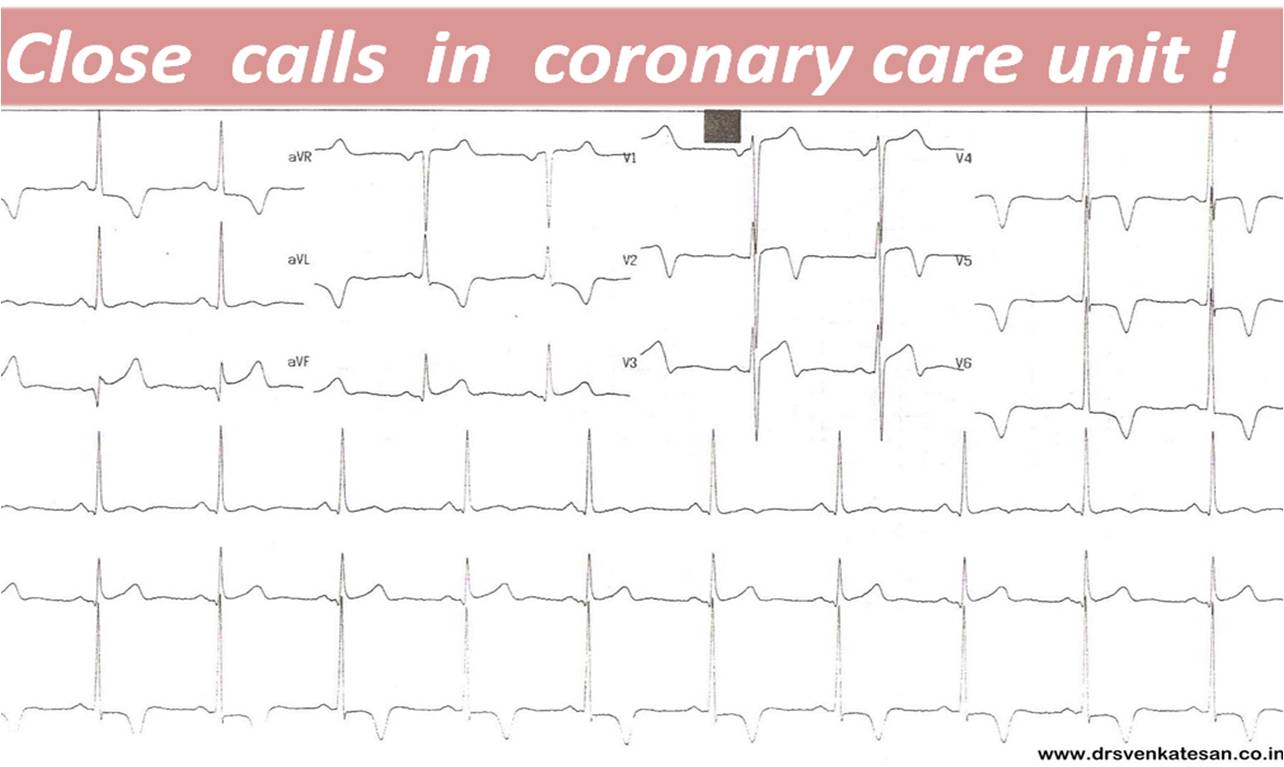
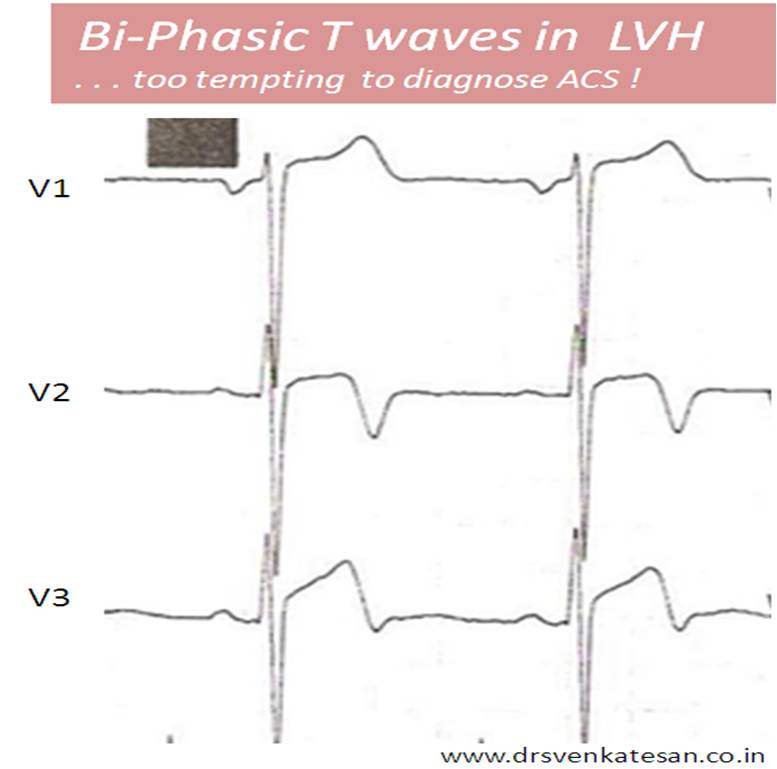
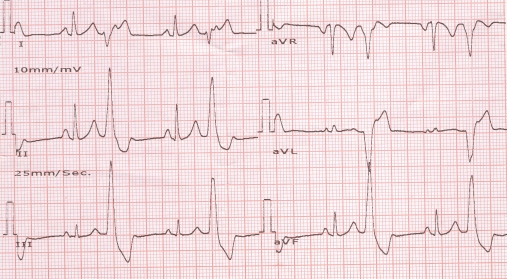
This  is the ECG  of  a  45 year old man with  H/O hypertension  and  chest pain .The general practitioner who first saw him alerted this  patient about a possible  heart  attack  asked to meet a cardiologist immediately. The cardiologist who  saw  this ECG   tended to confirm  the diagnosis  and advised admission in  a coronary  care unit .

The patient   defied  both  and  somehow landed in my echo lab  .  Looking at the ECG   I also  expected  it to be a  STEMI  evolving into a  Non Q  MI .

I was surprised  to find  only LVH with absolutely no wall motion defect  . There was no evidence of ASH,  HOCM or apical cardiomyoapthy as one of my fellows initially  suspected . His  EF was 70 %.   Cardiac enzymes were sent by then. When  I spent few minutes  with him ,  listening the history , it was very clear  what  he had was  non cardiac pain . In the anxiety ,  no one  got it right  about the character of pain ,which  was localised , lasted  for few seconds and  least suggesed angina.

The moral of the story is   listen to the patient  however dramatic the ECG may look !

What is special in this ECG ?

It is common for LVH with ST depression to be  mistaken for  ACS/NSTEMI

Here , there were  other  observations that  added  more  complexity .

  • Presence  of  ST/T changes in inferior leads(ST elevation in lead 3)
  • Bi-phasic  T wave in v1 to v3
  • ST elevation  in precardial leads

In LVH  it is usual  to note  ST depresion , how do you explain ST elevation in LVH ?

ST elevation in LVH   may occur in  leads  v1 to v3   . It is very rare  for LVH to inscribe  ST  elevation in   v4 v5 v6  .   Why certain  leads elevate the ST segment while others depress  in LVH  is not clear. It may represent  incomplete LBBB pattern where the ST segment deviates opposite to the  dominant QRS  complex. Septal  hypertrophy often elevate  while free  wall  hypertrophy depress the ST segment . Since V5,V6 leads are free wall oriented , these leads  record  classical  ST depression .

Importance of Bi-Phasic T waves

Please remember  Bi phasic T waves are notorious for it’s  unpredictability. An  innocuous looking bi-phasic T waves  (especially  with dynamic behavior )   is a  harbinger of proximal  LAD or even left main disease.

Finally , what will be ECG  changes if a patient with classical  LVH  who  develops a  real  STEMI ?

  • LV strain  pattern normalises ?
  • Further ST depression  occurs ?
  • No great changes . ECG  Looks near normal ?

Answer : ?

What is the significance  of   Bi-phasic T  waves : A  link to  a related post

Read Full Post »

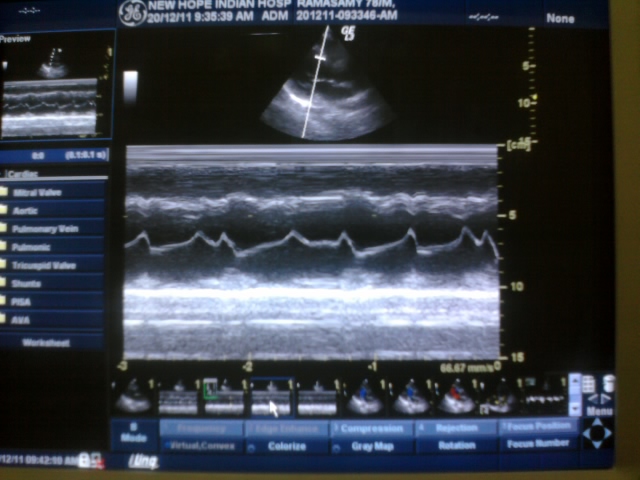
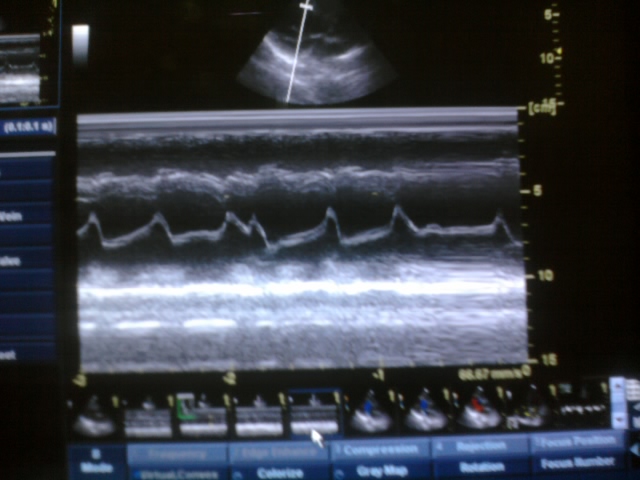
VPDs are the most common arrhythmia  that  confront  us  in  cardiology clinics .While  it can be a totally  benign   manifestation in some  ,  it may signify a sinister condition in others. ECG  is the easiest  and surest way to identify VPD.However  a shrewd echocardiographer can detect the VPDs while imaging the heart.It is often missed if one do not concentrate on the mitral valve motion.

Note :The VPD convert the typical M pattern into a inverted U pattern in mitral valve.

One of the important hemodynamic side-effect of VPD is intermittent mitral regurgitation.

Effect of VPD on mitral valve opening .

By  conventional thinking   VPDs  are expected   to impact  more on the  mitral  valve closure than it’s  opening .In reality it has indirect influence on mitral valve  opening as well. The retrograde  conduction(VA conduction) of the VPD determine the timing of atrial contraction and hence the   mitral valve opening. If the VPD gets blocked retrogradely  within AV node , the normal sinus impulse will activate the atria in an antegrade fashion .Note ,  he atrial activity  occur randomly when multiple VPDs occur.This makes the cardiac cycle too complex to assess especially the diastole. (In fact true  physiological diastole  may  not occur here !)

If  the mitral valve opening  is interfered by a   VPD  (Early diastole is  the  favorite time  for VPDs to  appear  !  )   .When it occurs the AML is    suddenly pushed  upon superiorly  by the premature ventricular activity and hence resets the  mechanical diastole. Please note electrical resetting of atrium is different from mechanical resetting.

It is also possible atria and ventricle contract simultaneously .This is the time , a cannon wave  may occur inside LA .VPDs can result in pulmonary venous canons and may even elevate pulmonary venous pressure   if  this  occurs repetitively .

Another possibility  is ,  VPDs  may not initiate a ventricular  contraction at all .It may be  simply  be an electrical event. That’s why  we changed the name of extra systole  and premature contraction into just   premature depolarisations.

Why is it important to know about M Mode motion of VPDs

Cardiologists  continue to  engage wide qrs  tachycardias   in the  wrong side  of their   brain for many  decades .The ECG debate about wide qrs tachycardia  is expected to  continue  for generations . !  Few smart cardiologists would  rapidly put  the echo probe  over the mitral valve and able to  differentiate  instantly a VT form SVT   with fair  degree of accuracy.

Detection  of regular M shaped mitral AML  will exclude a VT with a high degree of precision .(AV dissociation by echo )*

Even  presence of trivial  MR*  (More often diastolic )   which occur  irregularly  will  definitely indicate it is VT . SVT  hemodynamically   can not result in this  MR is gives us evidence for AV dissociation

* No reference for these observed indices in our lab. (Class 1 Level C expert opinion(  No one calls me as expert though ! )

What is the mechanism  of VPD induced  mitral regurgitation ?

It is well-known VPDs can cause   mitral regurgitation .Not every VPD cause MR.

  • The timing is important .
  • It can be  either systolic or diastolic MR .
  • If VPD occur in early diastole (After the T wave , the MR jet  will collide with  diastolic mitral flow. )
  • Paradoxical septal motion induced by VPDs can alter the pap muscle alignment transiently and result in MR
  • We dot not know how a LV apical VPD  differ from RVOT  VPD in the genesis of MR.
  • Logic would suggest RVOT  VPDs are unlikely to result in MR as there is  a time lag for the impulse to reach the LV base

What is  the effect of  VPD and Aortic valve opening ?

While  every VPD promptly  hits the mitral valve ,  aortic valve may or may not open with VPDs .Again timing and focus of VPD could be  important.This is the reason during  multiple  VPDs  only few open the aortic valve , that  explains  pulse deficit. (The so called missed beat )

Final message

Anterior mitral leaflet (AML) is the most mobile structure  of  the heart . Hence ,  it is not surprising to note  sudden unexpected ventricular contraction will  have maximum impact on this valve .

When VPDs occur in clusters or at random it has a complex effect on the mitral valve motion. This is responsible for  palpitation , minimal mitral regurgitation and rarely trouble some pulmonary venous cannons and raise in pulmonary venous pressure .

Careful analysis of  AML motion can give us useful clues to differentiate VT from SVT during wide  qrs tachycardia

Read Full Post »

Mark E Jospehson  is the man who single-handedly carried  the burden of teaching  generations  of electro-physiologists  from  Harvard  Thorndike electro physiology services , Boston USA. Today , whatever  we know  about the mechanisms of VT , it is because of such great men who  spent thousands of hours  in the  first generation EP labs in early 1970s and 80s  , meticulously analysing   the data emanating  from  over  600   scar mediated VT with complex circuitry .

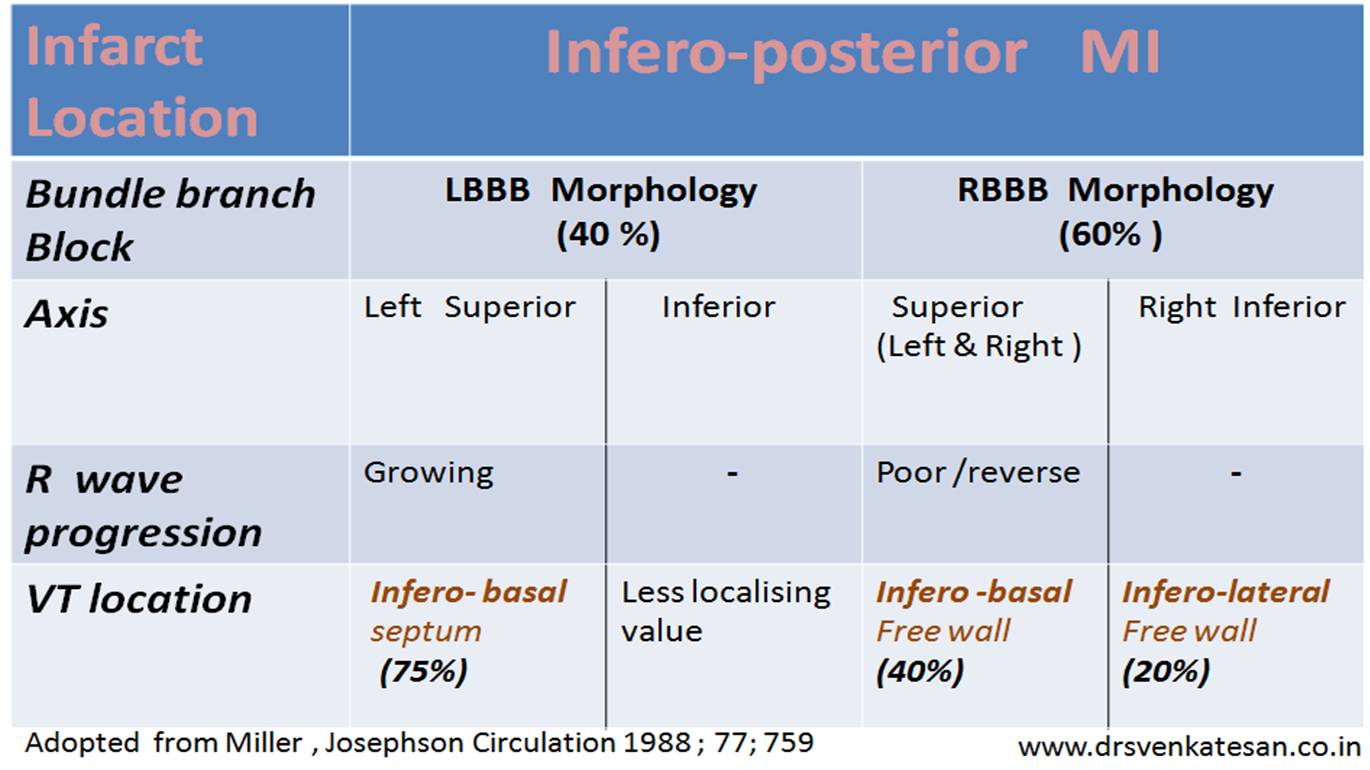
He along with  Miller published this seminal paper  in circulation 1988 , which gave us  the  algorithm  that localises  Post MI VTs.

Following table summarises their finding.

VT localisation in Infero-posterior MI

The general principles  of localisation of VT  

  • Localising VT following myocardial infarction  is difficult but distinctly  possible with  about 60 % accuracy.
  • Whenever we locate a focus we generally refer to epicardial site of exit not the focus of  origin.
  • Ischemic VTs with complex scars are difficult to locate .
  • The rule  that RBBB VT arise from  LV and LBBB VT from RV is too simplistic  in scar mediated VT.
  • The fact  that IVS is common to both RV and LV confounds the issue .Further, in a given  clinical VT  the origin  , course   and exit points of VT can considerably vary .For example  septal VT can exit  on  either side and  result in  either RBBB or LBBB morphology (Epicardial break thorough )
  • Multiple exit points are also possible.
  • VT induced in EP lab may not be reproducing the same clinical VT. So we have to be careful in what  we ablate and claim success !
  • VT with  structurally normal heart  has   more predictable behavior  , for  example RVOT VT  almost always have LBBB morphology.

Other important rules of thumb are

  • LBBB VT has more localising value .
  • Superior  axis is the most common  axis.
  • Bulk of the ischemic VT are located within the septum either in the apical or basal region .(75%)
  • Infero posterior MI has more complex scars , hence VT morphology is heterogeneous.

The purpose of localising VT is important  only with reference to  ablation.(Of course for academic reasons  as well )   With advent of electro anatomic imaging (Carto ) it is becoming   easier  to locate and track them . Still only a minority of VTs are amenable for RF ablation .

Please note ,  the most common modalities we use  in the management of VT  ,   Amiodarone  and ICDs   simply do not   bother  about   focus of origin  for it’s action !  That makes our job easy !

Reference

http://circ.ahajournals.org/content/77/4/759.full.pdf

Read Full Post »

WPW syndrome is the prototype of cardiac pre- excitation . The accessory  AV pathway short circuits the ventricle .Since  there are two options  available   for the  incoming  atrial  impulse  to reach ventricle ,  often  times  the qrs is contributed by both .Hence a  fusion  occurs  within qrs complex and stretches it wide   ,  it also  generates a delta wave and short PR interval .

The complexities of  conduction   properties and refractionaries of AV node and  accessory  pathways determine the degree of pre- excitation. When an optimally timed  APD  gate crashes  into the  accessary pathway it gets blocked ,  only to recover little late ,  unfortunately  invites AV nodal impulse  from below  . This facilitates a  re- entry circuit from ventricle to atria and result in classical AV reciprocating tachycardia .

Antegrade conduction through AV node is  physiological and  benign as it inherently checks the heart  rate . Antegrade conduction  occurring through the  accessory pathway  (which  constitutes the pathological  component  ), is   potentially  dangerous  as it lacks the  electrical breaks (Technically called decremental conduction )

What  is the  specific  ECG evidence for  antegrade conduction thorough accessory pathway  in ECG ?

Delta  waves

So,  what does it mean if there is absent delta waves  in WPW syndrome ?

It can mean three things

  1. Concealed pathway
  2. Manifest pathway , but intermittently  blocked pathway.
  3. It is not WPW syndrome at all .

We know concealed  pathways are  safe* as it allows only retrograde conduction. ( Safe  regarding   risk  of  sudden cardiac death ,  still unsafe for AVRT !)

Intermittent WPW

Intermittent pathways are equally  safe  as intermittent absence of  pre-excitation   indicate  the  presence   of naturally occurring     breaking system within accessory pathway . Are these  accessory pathways blessed with some AV nodal cells ?  May be !  . Histological studies do suggest that .This explains   intermittent missing of delta waves  which is  electro-physiologically a good sign

(We also know   there are exclusive slowly conducting accessory pathways like  Mahim and variants  )

If  one is lucky to observe this phenomenon in ECG  it can be termed as  a poor man’s  EP study  . ( Which requires specialized methods to document the refractory period of accessory pathway  to be   < 250 msec)

Techniques to  screen for or / unmask this concept.

Whenever  we  diagnose  WPW one has to look   ,  whether the patient  harbors  this phenomenon .

  • Holter monitoring has a useful role in this regard .
  • If there is nocturnal   disappearance of pre- excitation it would  suggest a safe  accessory pathway.
  • Similarly , if pre- excitation disappear during exercise  stress  testing it  would indicate a  type of intermittent WPW syndrome.

Final message

An astute cardiologist shall  look for this intermittent nature of delta waves  and  help avoid a costly and  potentially harmful EP study !

Read Full Post »

How early one can shift a patient for rescue PCI after failed thrombolysis ?

  1.  Wait for at-least 24  hours.
  2. A minimum  cool off period of 2 hours is required.
  3. It is never an issue . Rush the patient  immediately to cath lab
  4. The question does not arise  . Often times ,  rescue PCI is a dead concept  as  sufficient damage has happened !

Answer

The irony of  medical science  lies in our belief that every medical query  has a specific answer ! In reality it is rarely true.   In this instance , any of  the above can be a correct response.

A patient with  failed thrombolysis can belong to any of the  64 possible combinations*  based on  time of  thrombolysis , extent of  MI,  associated complications, co- morbid conditions , presence of symptoms . (For example there is  a sub groups of patient with  failed thrombolysis still  asymptomatic  and comfortable )

The issues for rescue PCI  do not  arise  in a   sinking STEMI (Cardiogenic shock ) , or  STEMI with persistent angina. There  is  no  management issues in  these patients  .They need to be rushed to cath lab. Unfortunately  in  impending  LVF or manifest LVF (But not in shock )  decision making is tough , as doing a PCI in patients  with basal crackles  and hypoxia is a real challenge .These are the patients who are likely  to hit hard  from the hazards of the procedure .Extreme caution is required.

I have seen  significant cohort  of  asymptomatic hypotensive patients getting converted into   drug resistant, IABP dependent refractory shock after PCI  ,  making every one look  pathetic  !  The  only solace for the interventionist  is  the gratification  of  stenting the  IRA !

This  happens  , in spite  of having  multi national trained  in house critical care anesthetics and  dual core processing IABP  . Realise  what we need is delicate decision making ,  So use extreme diligence in selecting patients with impeding shock .

Your medical management can  provide  more teeth to stabilise your patient than a PCI .If you are doubt discuss with your learned colleagues .  ( If you  do not  ask for evidence for  this statement , probably  it would confirm  you  as  an  experienced   cardiologist  !)

Real issues pushed to the sidelines ?

While the real issue  in the timing of rescue PCI  may be  different , the discussion traditionally  revolves around   hemo-rheological aspects . We know  the lytics and PCI do not combine well for two reasons.

  • Pro-coagulant nature of lytic state .
  • Excess bleeding risk at puncture site.

Now ,  we have evidence to say fibrin specific lytics  TPA, TNKTPA has less of this issue . ( NORDISTEMI)

Patients who receive  fibrin specific lytics  can  safely  be  taken for rescue PCI  in case it is needed without any increased risk .

Bleeding complication  has dramatically reduced as radial procedures are done often even in emergency setting.

Vascular occlusive devices  have added to our comfort.

* The definition of failed  thrombolysis by  itself is not standardized . Is it symptom guided ?  or ECG / enzyme / echo guided  ? A patient with  infarct  related chest pain (dull aching )  after thromolysis can be labeled as post infarct refractory angina and rushed for emergency angiogram .(This is due to our ignorance  about  the  residual pain signals  through  type c pain fibres  for up to 24 hours )

Final message

The indication and  timing of rescue PCI is  primarily  related   to the  overall   patient profile  rather than the bleeding or pro-coagulant issues .

Although   pro-coagulant  lytic state is based on weak scientific  foundation , it  is a blessing in disguise  as it  can  act  as a deterrent  in restricting  inappropriate rescue PCI !

Read Full Post »

« Newer Posts - Older Posts »