Feeds:
Posts
Comments

Archive for the ‘Cardiology -Interventional -PCI’ Category

Failed thrombolysis is an important clinical  issue  in STEMI   as  successful thrombolysis  occurs  only in  about 50-60%  of pateints . The typical criteria to define failed thrombolysis is  the  regression  of less than 50% of sum total( or maximum)  ST elevation in infarct leads.

So what do you do for these patients with failed thrombolysis ?

It depends upon the patient’s symptom, hemodynamic stability, LV dysfunction .

They  should  get one of the following .

  1. Conservative medical management  with /without CAG
  2. Repeat thrombolysis
  3. Rescue PCI
  4. CABG

Medical management is  thought to be  too inferior a  management,  many of the interventional cardiologists  do  not want to talk about . But  , there is  an important  group of patients (Not often addressed in cardiology literature)  who  technically fulfill the criteria  of failed thrombolysis  , but   still  very  comfortable , asymtomatic  and in  class 1. These patients ,  have  a strong option for continuing the conservative management .

Repeat thrombolysis does not have a consistent effect but can  be  tried in some  stable patients. CABG  can be a genuine option in few

Rescue PCI

This terminology  has become  the  glamorous one since the  catchy word  rescue is tagged in the title  itself. For most of the cardiac physicians ,  this has become the default treatment modality.This is an unfortunate perception . What  one should realise   here is  , we are  tying to rescue  the myocardium and  the patient ,   not the patient’s coronary artery !

Opening up a coronary obstruction is not synonymous with rescue .

For rescue PCI ,  to be effective it should be done within the same time window as that for thrombolysis (ie within 6 or at the most  12 hours) .This timing  is  of vital importance  for the simple reason , there will be nothing to rescue after 12 hours as most of the muscle  would be  dead. Reperfusing a dead myocardium has been shown to be hazardous in some ,  as it converts a simple  infarct into a hemorrhagic  infarct.This softens the core of the infarct and  carry a risk of rupture. Further,   doing a complex emergency  PCI  ,  in  a thrombotic milieu with   presumed  long term  benefit ,  is  a  perfect recipe for a potential  disaster.

While the above statement may be seen as pessimistic view , the optimistic cardiologist would vouch for the“Curious  open artery hypothesis” .This theory simply states , whatever be the status  of the distal myocardium ( dead or alive !)   opening an obstruction in the concerened coronary artery  will benefit the patient !

It is  huge surprise , this concept   continues to  be alive even after  repeatedly shot dead by number of very good clinical trials (TOAT, CTO limb of COURAGE etc ).

The REACT study (2004) concluded undisputed benefit of rescue PCI for failed thrombolysis  , only if the rescue was done  within  5-10 hours after the onset of symptoms.The mean time for  pain-to-rescue PCI was 414 minutes (6.5hours)

Final  message

It is fashionable to talk about time window for thrombolyis but not for PCI  .The time window for rescue PCI is an redundant issue  for many  cardiologists ! . But ,  the fact of the matter is ,  it is not . . .

The concept of time window in rescue PCI  , is as important as ,   that of  thrombolysis. Please , think twice or thrice !  if some body suggest you to do a rescue PCI in a stable patient  ,  12hours after the index event .

Important note : This rule   does not (  or need  not  ) apply for patients in cardiogenic shock  or patient ‘s with ongoing iscemia and angina.
Read Full Post »

NSTEMI constitutes a very heterogeneous population .The cardiac risk can vary between very low to very high . In contrast , STEMI patients carry a high risk for electro mechanical complication including sudden death .They all need immediate treatment either with thrombolysis or PCI to open up the blood vessel and salvage the myocardium.

The above concept , may be true in many situations , but what we fail to recognize is that , STEMI also is a heterogeneous clinico pathological with varying risks and outcome !
Let us see briefly , why this is very important in the management of STEMI

Management of STEMI has undergone great change over the past 50 years and it is the standing example of evidence based coronary care in the modern era ! The mortality , in the early era was around 30-40% . The advent of coronary care units, defibrillators, reduced the mortality to around 10-15% in 1960 /70s . Early use of heparin , aspirin further improved the outcome .The inhospital mortality was greatly reduced to a level of 7-8% in the thrombolytic era. And , then came the interventional approach, namely primary PCI , which is now considered the best form of reperfusion when done early by an experienced team.

Inspite of this wealth of evidence for the superiority of PCI , it is only a fraction of STEMI patients get primary PCI even in some of the well equipped centers ( Could be as low as 15 %)

Why ? this paradox

Primary PCI has struggled to establish itself as a global therapeutic concept for STEMI , even after 20 years of it’s introduction (PAMI trial) . If we attribute , lack of infrastructure , expertise are responsible for this low utility of primary PCI , we are mistaken ! There are so many institutions , at least in developing world , reluctant to do primary PCI for varied reasons.( Affordability , support system , odd hours ,and finally perceived fear of untoward complication !)

Primary PCI may be a great treatment modality , but it comes with a inherent risk related to the procedure.

In fact the early hazard could exceed the potential benefit in many of the low risk STEMI patients !

All STEMI’s are not same , so all does not require same treatment !

Common sense and logic would tell us any medical condition should be risk stratified before applying the management protocol. This will enable us to avoid applying “high risk – high benefit” treatments in low risk patients . It is a great surprise, the cardiology community has extensively researched to risk stratify NSTEMI/UA , it has rarely considered risk stratification of STEMI before starting the treatment.

In this context , it should be emphasized most of the clinical trails on primary PCI do not address the clinical relevance and the differential outcomes in various subsets of STEMI .

Consider the following two cases.

Two young men with STEMI , both present within 3 hours after onset of symptoms

  1. ST elevation in V1 -V6 , 1 , AVL , Low blood pressure , with severe chest pain.
  2. ST elevation in 2 ,3, AVF , hemodynamically stable , with minimal or no discomfort .

In the above example, a small inferior MI by a distal RCA occlusion , and a proximal LAD lesion jeopardising entire anterior wall , both are categorized as STEMI !
Do you want to advocate same treatment for both ? or Will you risk stratify the STEMI and treat individually ? (As we do in NSTEMI !)

Current guidelines , would suggest PCI for both situations. But , logistic , and real world experience would clearly favor thrombolysis for the second patient .
Does that mean, the second patient is getting an inferior modality of treatment ?

Not at all . In fact there is a strong case for PCI being inferior in these patients as the risk of the procedure may far outweigh the benefit especially if it is done on a random basis by not so well experienced cath lab team.
(Note : Streptokinase or TPA does not vary it’s action , whether given by an ambulance drive or a staff nurse or even a cardiologist ! .In contrast , the infrastructure and expertise have the greatest impact on the success and failure of PCI )
Final message

So , it is argued the world cardiology societies(ACC/ESC etc) need to risk stratify STEMI (Like we do in NSTEMI ) into low risk, intermediate risk and high risk categories and advice primary PCI only for high risk patients.

Reference

https://jamanetwork.com/journals/jamainternalmedicine/fullarticle/226907

Read Full Post »

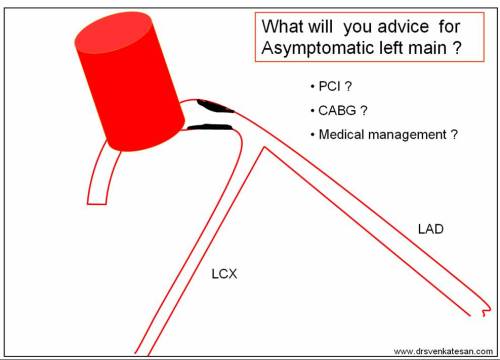
Left main disease is the  most dangerous subset of CAD population .The danger is attributable more on the perceived fear  of  sudden occlusion .How often this occurs in stable , left main plaques is not known.

There is a significant group of patients with isolated ,  asymptomatic ,  non flow limiting , leftmain  disease with stable , smooth plaques. The ideal management for this group of CAD is not clear.

left-main-d

Advising a  CABG /PCI  is  an easy and very practical  decision ! That’s what the current guideline also suggest

But is there scientific evidence  to do that ? Many times practical approach  could be    synonymous with  an  unscientific approach.

  • PCI has a potential to  convert  a stable plaque into  a vulnerable one (Metalled plaque is not inert )
  • CABG will reduce the flow across , the  already narrowed left main and  there is  a likely hood of rapid  progression of native left main disease

So what is left  ?

If it is a stable plaque ,  and does not limit the flow both at rest on exercise * medical management will be optimal.

* Excercise stress test must be done

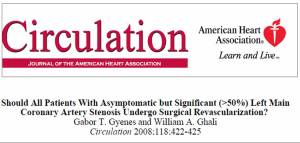
Read this article from the circulation ,  that suggests  a role for medical management for left main disease

http://circ.ahajournals.org/cgi/content/full/118/4/422

left-main-circualtion1

Read Full Post »

Coronary collateral circulation is the God’s gift to mankind.It has potential  benefits  ( and  of course real benefit !)  both during acute and chronic coronary syndrome.

Collaterals in CCS

The classical role of coronary collateral is in patients with chronic stable angina.It is quiet common to see patients with totally occluded  LAD or RCA with normal  LV function maintained  by extensive collaterals .

Collaterals during ACS.

An intact and functional  collateral circulation can prevent an NSTEMI  from converting into STEMI.In fact many of the patients with unstable angina patients carry on with viable myocardium just because thaey have good collaterals.It gives us a time window to intervene .Some times the col laterals are good enough and help us avoid a revascularisation in toto.

Collateral’s in  STEMI.

This is not well understood. Some  researchers  reported opening up of collateral channels very early after a STEMI. Logic would suggest , anatomically patent functionally closed collateral channels are  always available at time of crisis. But not every one is blessed with such rescue mechanism.

What determines  the native collateral channel development in human cor0nary circulation ?

When  the answer is unknown , it moves to  the  genetic domain also called  – God’s domain .

Our ignorance in decoding coronary collaterals is vast.

The chief cause of this ignorance is we always  tend , not believe things which we don’t see.

Coronary collaterals channels need to atleast 1mm  to be visualised by CAG.There could be a vast network of micro collaterals out there within the myocardium invisible to current imaging methods. (In fact , this has a link with outcome  of the COURAGE study )

Is coronary collaterals have all the three layers of an artery ?

Yes .But the media lacks muscle.

Is coronary collateral less prone for spasm ?

May be.

The drugs we give , Calcium blockers , betablockers, and nitrates have same  hemodyanmic effects  as in native coronary circulation ?

We don,t know as yet. Nitrates are supposed to improve collateralisation

How common is atherosclerosis to involve the coronary collaterals ?

How often is an ACS precipitated by an collateral occlusion ?

May be more common than we think.

Can we stent a  2mm wide  collateral to maintain  the patency in case of a CTO  ?

A question need to be answered by current generation interventional cardiologists.

Is coronary collateral gives protection against primary VF ?

In one sense ,  the number one killer of mankind is  in fact not STEMI but the VF that follows it .

Why only a few develop a VF following an MI ? What determines the arrhythmic response to ischemia ?

Some anecdotal observation  of     suggest a role for early coronary collateral  opening in the prevention of VF .

Read Full Post »

Radial access  for both diagnostic  coronary angiogram  and  PCI has been increasing steadily.Many centres have adopted an  exclusive radial approach. Newer ,  radial specific  hard ware  is  being produced.(Link) .It is surprising , radial approach has  gained momentum  primarily outside  USA (Europe , Japan, India ).The advantages of radial access is primarily , patient comfort, less local site complication.

Prerequisite for radial approach.

The importance of  pre procedural Allen test to document dual blood supply is  well established but the less  appreciated  concept is  preprocedure  radial artery size  assessment . It  could be as important as Allen test .

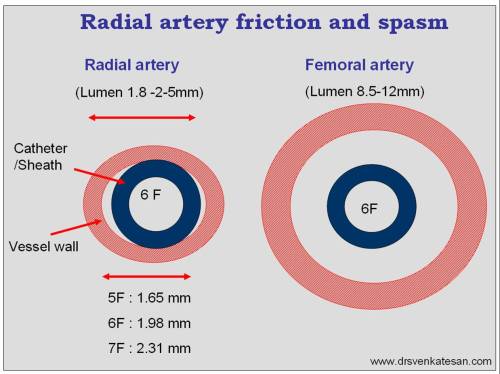
The normal diameter of radial artery lumen is 2.4mm (Range 1.8-3.0) .Some population have still smaller radial lumen(India KA.Sambasivam et all mean 1.8mm). Compare femoral artery (8.5mm diameter, 4 times bigger )

Imagine this  situation ,  a 1.65 mm (5 F) diameter catheter trying to enter a 1.7mm radial artery !

Is it not a futile excercise ?   Many of the failed radial access is due to  radial artery /catheter mismatch .

radial-artery-spasm

There has been occasions , when the radial sheath is larger than radial artery itself !

So the size of the radial artery becomes vital in planning radial CAG.

What are ways one can estimate the size  of the radial artery ?

  • Volume of pulse (Still Useful , but can fool us some times!)
  • Thick radial walls (Monckeberg,s sclerosis)
  • Ultrasound imaging

Radial artery spasm

Radial artery has more medial  smooth muscle and further the fibres  criss cross the artery. Further , the radial artery is richly innervated by sympathetic  nerve terminals.

The major factor that determines likely hood of spasm is

  • Pain  intensity.
  • Amount of free space between sheath and vessel wall
  • The frictional force between sheath and artery wall is the powerful trigger for spasm and pain.

What is the biochemical mediators of radial artery spasm ?

It is logical to believe all  vascular  spasm are due to calcium .But it is not. Calcium blockers have  no definite relief for  spasm.Nor adrenaline mediated alpha receptor stimulation  has a major contribution for RAS. Phentolamine is useful

Is there a objective and quantitative method to assess radial artery spasm ?

Removal of the radial  requires some force.  Kiemeneij ( Measurement of radial artery spasm using an automatic pullback device. Catheter Cardiovasc Interv 2001;54:437–441.) demonstrated if one require > 1kg force to remove a sheath it correlates with clinically significant spasm.

What are the serious sequel of radial artery spasm ?

Radial artery rupture and radial artery avulsion has been reported when attempting to remove the sheath from spastic arteries

Management of radial spasm

There are two aspects to this problem

  • Prevention of  spasm
  • Treatment of established spasm

How to prevent or reduce  radial artery spasm ?

Radial artery is a very sensitive artery .The incidence of spasm can be up to 20%  The spasm can be due to

Hardware, technical ,anatomical factors.

Apart from  above  three factors,  the most important is anxiety related .The key principle is ,   sedating the  radial artery is as important as sedating the patient .

Sedating the patient

Explaining to the patient about the procedure can allay the anxiety. It is a fact , the tactile perception of catheter movement  in radial route is more than the femoral .In very anxious patients (Some centres use it routinely )  IV sedation (Midazolam)

Sedating  the radial artery.

Local anesthesia : Subcutaneous lignociane , though widely used has a drawback.It can aggravate pain, induce spasm , accidental entry into lumen may cause a hematoma  .All can potentially make the pulse feeble. So care should be taken in giving minimal lignocaine ( At a specific  point needle entry) with a short needle . One should watch , the grace with which experienced radial interventionist give the local anesthetics !

Arterial cocktail

The arterial cocktail consists of combination of Nitroglyceine (200 mcg) , Xylocaine (50 mg) Verapamil (5 mg) an. Heparin(5000 IU). Sodium bicarbonate (4%) is optional to neutralise the acidity of the solution

How to administer ?

Ideally spasmolytic cocktail should be given before the sheath is introduced immediately after puncture . As the drugs has to get in contact with the arterial wall .if cocktail is given after introduction of sheath one of the following may be done.

  • Give the drug as it enters the artery.
  • Pull back the sheath when injecting the drug.
  • Use a side holed sheath.

Technical issues to prevent radial artery spasm

Try to puncture in single prick . If the first puncture is not successful , don’t attempt to cross a spastic radial artery Remember (Unlike femoral ) successful puncturing of a spastic radial artery may be the beginning of a vexing and tiring procedure.So if we have lot of difficulty in getting in ,  please avoid the procedure and switch to femoral . (Spastic signals may spill over to left hand also !)

Remember unlike femoral cathetrisation , in radial access,  getting out the catheter could  be more tricky   than getting in !

Avoid procedures that would  require  multiple catheter , guide wire exchange .Complex lesions and in emergencies.( Some experts do Primary PCI through radial !) .Now  dedicated radial hardware are available.

Sheath selection (Visit :  Arrow International )

Long sheaths have been used in the past. It makes the spastic segment lengthier.Now short sheaths are increasingly used. Long sheaths (20-25cm ) give better suppport during catheter manipulation. Side holed sheaths  is a newer innovation. This maintains the  blood flow on the sides of sheath and reduces friction with vessel wall .Further, it can deliver the arterial cocktail to vessel wall and effectively prevent or reduce spasm.

Catheters : Use 5 F/6F. Rarely 7f are used.

Guide wires :Hydrophilic guidewire are radial friendly.

How to manage established severe spasm ?

For severe  spasm with sticky sheath / catheter

  • Increase the analgesia with morphine
  • Repeat NTG and Verapamil
  • Warm compresses over the forearm
  • Never pull with force
  • Wait for an hour and try pulling again (Often successful )

Last resorts

An axillary block

Vascular surgery

Reference and further reading

For excellent collection of radial access resources  please visit  www.radialforce.org

(Much of this blog’s content is based on this article )

http://www.invasivecardiology.com/article/5446

http://meeting.chestjournal.org/cgi/content/abstract/130/4/201S-a

Read Full Post »

British Bifurcation Coronary Study: Old, New, and Evolving Strategies (BBC ONE)  concludes complex crush ,   culotte technique are to be  avoided  . Single  stent  is better than two stents  in bifurcation lesions .

Unanswered question

If  single stent is better than two , is  it not logical ,  ” No stent” would be better than single  stent ?

This question may sound a straw man like ! But the truth is  the success of  medical management  in COURAGE and OAT study  may  be  due this concept !

BBC ONE: Fewer MACE with provisional T-stenting for bifurcations

Read Full Post »

CABG is the most common cardiovascular surgery  done world wide .

When the ventricle is dilated it is a common practice to do a ventricular  reduction surgery.

It was a logical to expect benefit when we correct the adverse remodelling of heart  that aoccur following an MI.

The STICH trial compared  plain CABG with ventricular  reconstruction and reduction .

Unfortunately , in medicine , the logics often fail  as this study  found no  mortality advantage .

Click here to read the land mark article from NEJM

Read Full Post »

Coronary artery  perforation is a dreaded complication of PCI. Perforations are the Interventional cardiologists ultimate worry   as they need to  manipulate their  hardware for  long periods in many complex lesions.  Especially  it is a  real threat in chronic total occlusions.

Still , an important fact is ,  many of the coronary perforations are not life threatening ?

How is this possible ?  (Type 1 Ellis has zero mortality Read below)

As the guide wire injures and perforates the cor0nary vessel,  it results in  small puffs of dye extravasating  into peri coronary space .

The coronary artery , which is located   within the  atrioventricular groove  (LAD), or AV groove (LCX, RCA) have  two distinct anatomical relationship with reference to epicardium and pericardial space.

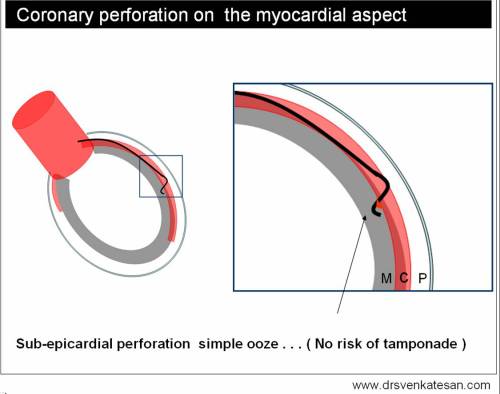
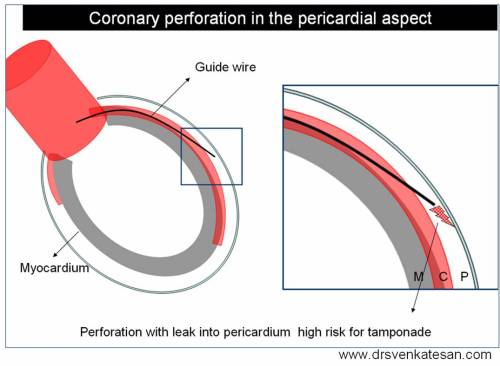
50 % 0f circumference of the coronary artery is  hugged  by the myocardium  another 50% or so is related directly to the pericardial aspect.

Guide wires hitting on the myocardial aspects face a stiff resistance than the pericardial aspect. So , generally the risk of perforating pericardial aspect is more than myocardial aspect

Even if , the coronary artery is punctured on myocardial aspect , no great danger occur as there is no potential space for the blood to drain and further,  the  elastic nature of myocardial muscle plane effectively seals the leak. At the most , mild myocardial staining is noted .

coronary-perforation-2

While ,  perforations  into  the pericardial space  , often threaten with a tamponade. The fact that pericardial space has negative pressure and  the mean  coronary arterial pressure around 40mmhg ,  it is  , all the more likely blood is sucked into the pericardial  space. Of course , very minute  perforations  even into the pericardial space ,  could  be self limited and  benign.

coronary-perforation

What is unrecognised coronary perforation?

Many times , the guidewire goes in a false track in the tissue plane.This is  nothing,  but perforation without hemodynamic implication. Most often , these are the instances of guide wire entering the epicardium.They mimic , false lumen entry , dissections, etc. There are occasion , where false lumen of the  coronary artery were  stented.

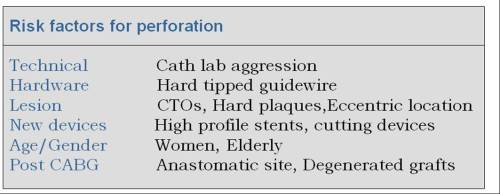
What are the  factors which increase risk of perforation ?

perforation-6

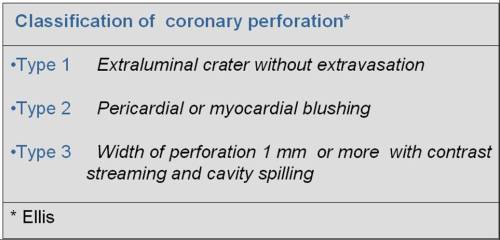
 How do you classify coronary perforations ?

perforation-3

*Ellis SG, Ajluni S, Arnold AZ,  Increased coronary perforation in the new device era. Incidence, classification, management, and outcomeCirculation. 1994;90:2725–2730


How do you manage coronary perforation?

Simple guide wire induced perforations are less trouble some unless we have crossed it with balloon without realising the fact the wire has entered the pericardial space. So, caution is required and always watch for guide wire tip movement which is often funny looking wihtin false lumens or very freely moving within pericardial space. Anticipate the complication especially so when you do CTOs and venous graft PCI.  Keep one cath lab  tamponade crash  bin  in ready mode before embarking upon a complex PCI

  • Neutralise the heparin action with protamine is the first step
  • Most are self limited, no intervention is required  but requires close observation for next 24 hours.
  • Temporary balloon occlusion may be suffice in many cases
  • Tamponade requires immediate tapping. Small collection without fall in BP can be observed.
  • keep doing the echocardiogram liberally to assess the leak and watch for any new collection.
  • PTFE covered stents if prolonged leak.
  • Emergency surgery may required in few.

2018 update 

This is  nearly 10 years old article. Now, we have gained much experience and hardware utilisation have rapidly expanded. While expertise has minimised this complication , more PCIs in complex lesion subset tend to keep the incidence static , if not higher.(Its around .5% )

Tips to use balloon occlusion during perforation

Perforations which are active and flowing should be immediately occluded with a balloon either at the site of leak or just proximal to it. Doing a proximal occlusion is easier in emergency , as often times its technically difficult to reach the site of leak especially in CTOs where the leaky site is not defined clearly or forward looking (Local balloon inflation across the leaky site is not feasible )


How long to occlude , Intermittent /complete, proximal ? or at the site of perforation ? These queries are answered in Ref 4

Reference

1.Largest report (1762 cases) of perforation from British Cardiovascular Intervention  Society Database Circ Cardiovasc Interv. 2016;9:e003449.

2.Al-Lamee R, Ielasi A, Latib A,. Incidence, predictors, management, immediate and long-term outcomes following grade III coronary perforation. JACC Cardiovasc Interv. 2011;4:87–95.

3Xiangfei Wang and Junbo Ge Balloon Occlusion Types in the Treatment of Coronary Perforation during Percutaneous Coronary Intervention   Cardiology Research and Practice Volume 2014, Article ID 784018,

4.A very good review comes from Royal Hospital, Muscat, Sultanate of Oman


iFAQs in coronary perforations

1.Does the plane of the coronary artery (Sub epicardial within the fat layers)  determine the likely hood of tamponade ?

While myocardial tissue can resist flow we are not sure about sub-epicardial fat on the pericardial aspect.

2.How common is Intra-cavitory perforation ?

Perforations into chamber is invariably associated with septal branches (PCI to septal branch itself is less common )

Read Full Post »

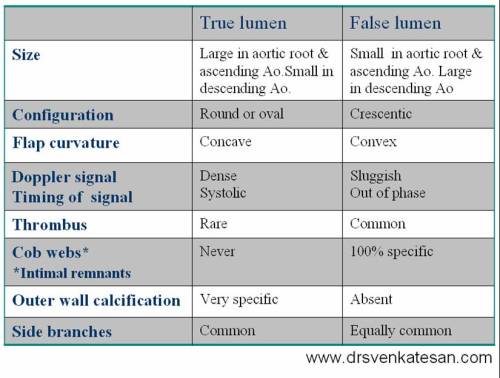
Why is identifying false and true lumen important ?

This helps the interventional cardiologist to plan the specific therapeutic procedure .

aortic-dissection-table

Is it really difficult to differentiate the two ?

One may wonder , why is that  difficult  to identify  the true aortic lumen by echo, after  all  , the LV empties the blood into true aortic lumen ! Yes  , in aortic root dissections  identifying the true from false lumen is rarely an issue.

aortic-dissection-4

The issue becomes  important and complicated as the propagation of dissection goes in a random and erratic way into the ascending aorta and arch and downwards.The situation could further get  complicated  by the fact there could  be multiple communication between the two lumens .Some of these communication are  hemodyanically patent others form  a simple anatomical continuity.The size and the configuration of true and false lumen are not uniform it is highly  variable.In the aortic root the size of the true lumen is usually  large and when it reach the descending aorta  as in type3 the whole thing could be reversed.

The enigma  of  these lumonomics , is that some of the native branches of aorta , would  either be, subtended by false or true lumen. This is a real tricky issue for the surgeons . If a aortic vessel branch (Say bronchial artery . . .) is perfused successfully by the  hemodynamically active false lumen should we meddle  that  at all ?


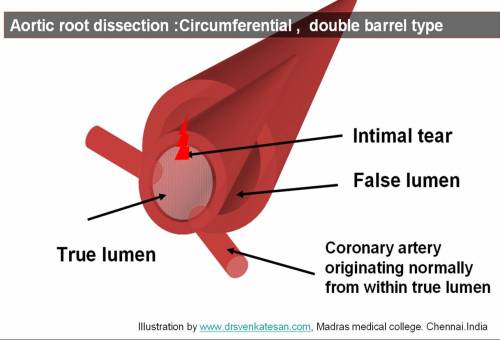
circumferential-dissection1 What are the types of false lumen ?

Usually single septae divide the aorta into two , one false lumen and true lumen.There can  be other types.

Triple lumen aorta :This is usually seen in the aortic root following dissection .Usually there is two false lumen and and one true lumen in the centre

Double barreled aorta: A circumferential   aortic dissection with a central true lumen surrounded by a  circumferential false lumen  mimicking a double barrel on within the other.

aortic-dissection

What determines blood flow within false lumen ?

  • Site of  intimal tear
  • Length of tear
  • Plane of cleavage  . Superficial  subinitmal tear with minimal  medial thickness is likey to give in easily  as the blood  dissects the plane  so it more often manifest as a flap  rather than sustained  dissection
  • Number  of exit points (It is often assumed  aortic dissection  there is typically one entrance and one exit point .

but  more  often  multiple exit points can occur. Some points can have both two and fro flow as it may act as both as entry or exit points

What  is the importance of identifying  point, exit point , true  lumen false lumen etc ?

  • This is vital for planning   repair  of  the segment
  • optimising side branch blood flow
  • some time one may require to create an exit point  for providing useful thermodynamics   of false lumen that could give branch to a vital area.

Why false lumen is  prone for thrombosis ?

  • Sluggish flow within false lumen
  • Plane of cleavage of intima  and media  create an  irregular surface that  trigger  tissue factor mediated thrombus.
  • Free floating cob webs   intimal  remnants may accelerate thrombus formation

What is the clinical significance of  finding  a thrombosed false lumen ?

Large thrombus can occur within false lumen.The presence of which , sometimes an advantage as

it limits further progression of false lumen (An organised thrombus is sort  of  natural  stent graft !)

many of these patients do well with medical management.

C J Sanderso Thorax 1981;36:194-199;

Can thrombus occur in true lumen also ? How common it is ? If so what is the mechanism ?

Yes , but it is rare  as the velocity  is  more .But it can occur in following situations.

  1. Preexisting atherosclerosis can be  a milieu for  insitu thrombus
  2. Thrombus in true lumen  can occur at the entry point where there is intimal tear ,  which  projects  into true lumen. that can  deccelerate the  flow(Rare)
  3. Thrombus in the false lumen may project into true  lumen  through another tear.
  4. Migration of false lumen thrombus may occur distally and reenter the  true lumen.

What is a cobweb ?

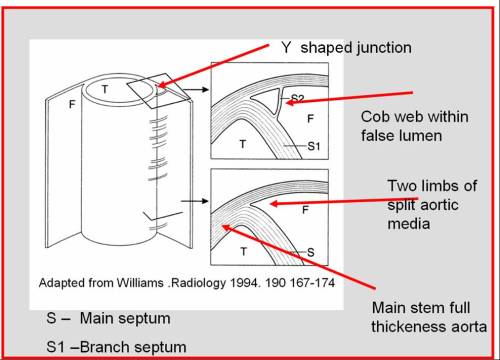
Cob web are the residual ribbons of dissected internal elastic lamina of aorta .
They are variably called as aortic bands, strands ,  septae, flaps etc.

What is the significance of the junction between false and rue lumen ?

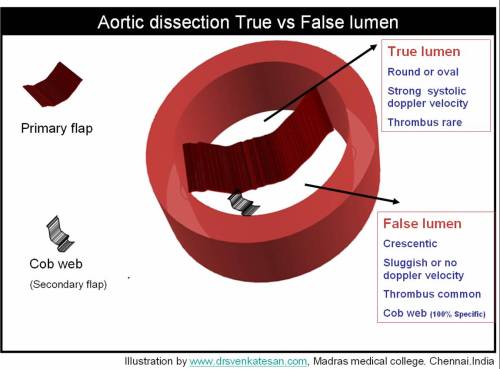
The classic false lumen is crescent shaped. True lumen is either round or oval(Gibbous moon)
Tunction between false and true lumen has some characteristic feature.It mimics  the letter Y. The mainstem of Y correspond to main(  Normal full thickness)aortic  wall of the true lumen.The  oblique lines represent the outer wall of the false lumen and the septae dividing true (Fig 3)

dissection-41

What is the natural history of false lumen after surgical correction ?

Surgeons often leave the false lumen insitu , especially beyond the arch in type A dissection.

If false lumen is large  >70% of aorta , secondary dissections may occur in the long term.

Which is the best imaging modality  for  assessing dissection of aorta  ?

Even though MR angiogram and CT scans are shown to be good imaging tools in the evaluation of  dissection of aortamany practical issues creep in doing MR or CT angiogram.Many of these patients are too ill and will be on multiple arterial and venous lines Doing an MRI is  too dificult a task .Further these imaging modalities require a another arterial access .Requires contrast injection and  CT has in addition , radiation hazard.

TEE is a simple investigation can be done even in unstable patients in the bedside .Further also help us  us evaluate the aortic valve function and associated complications of dissection. TEE will be very useful peroperative also in assessing the repair.

*But MRI  and CT can give a long axis , saggital cuts of aortic dissection depicting the entry and exit points in a single image

Read Full Post »

First and foremost is

Avoid the procedure if  not really indicated.A lesion which  has more thrombus load  than a plaque and it is ,  subcritical and not limiting the flow  , PCI may be inappropriate  especially if the ACS is stabilised.

  • Adequate anticoagulation  along with  2b 3a blockers should be used
  • Predilatation should be minimally used or to avoided.Direct stenting preferred.
  • In primary PCI suction devices (Export etc may be useful)
  • Distal protective devices  are  “hyped up devices” rarely useful in an occasional patient with good distal vessel diameter.
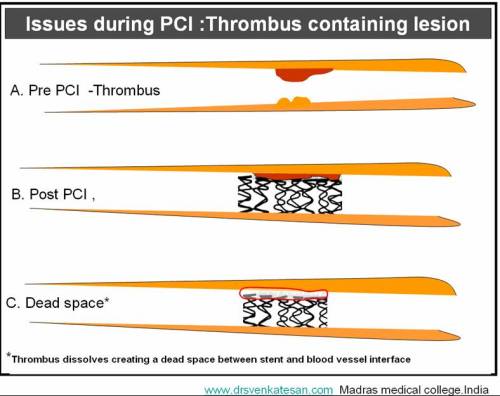
  • Pseudo stent approximati(fig 1) may occur. A Layer of thrombus may get plastered between stent and the vessel wall.In the post PCI  phase , with intense anticoagulation and antiplatelet regimen this layer may get dissolved and stent  may lose it’s grip and may dislodge or migrate.Another possibility is the dead space  beneath the stent  becomes a potential site for future  thrombus and ACS.

thrombus-and-pci

Fig 1

  • To prevent this complication , high pressure inflations and Post procedure IVUS (Intra vascualr ultraound may be done to ascertain lack of thromus between stent/vessel wal  interface)
  • Drug eluting stent evoked a special concern , when used in thrombotic milleu.This , has now been  proven to be  safe

Read Full Post »

« Newer Posts - Older Posts »