Feeds:
Posts
Comments

Archive for the ‘cardiology -Therapeutics’ Category

Statins have revolutionised the treatment of coronary artery disease .Intensive lipid lowering is the fundamental prerequisite in the management of both acute and chronic coronary syndromes. One question  is  always difficult to answer , ( rather reluctant to find the answer )  “The effect of statins on the HDL cholesterol”. Logic and the mechanisms of action would suggest HDL is not much affected , but in reality  I believe , in a given patient statins  do  reduce the HDL by at-least 10-20 % .This might have some significance. However ,  the marked  reduction in LDL  may nullify the adverse effects of lowering HDL.   Does this happen in all

What does the scientific evidence say ?
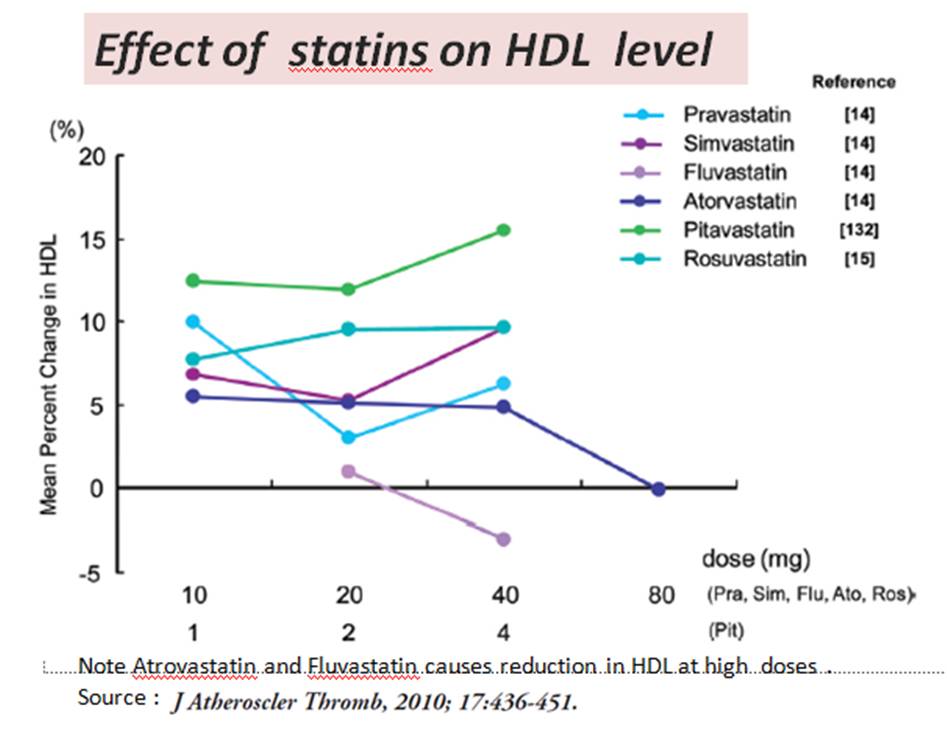
It says the opposite .  It seems  HDL is raised by statins that too significantly . The following paper also  suggests mechanism of  HDL  elevation by statins .It is Independent  to that of LDL reduction , I believe .

This JAMA article  adds more evidence
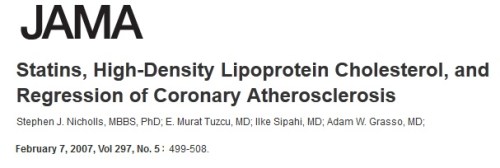
http://jama.jamanetwork.com/data/Journals/JAMA/5100/jpc70001_499_508.pdf

This paper  from  the  premier  Journal  of   Lipid research  agrees  to the   mechanism of  HDL reduction by statin  is a complex process  but still  it vouches for it .

http://www.ncbi.nlm.nih.gov/pmc/articles/PMC3035518/?report=printable

In spite of  all these  evidence . . .   it  remains a  huge suspect . . . from my personal point of  view ( My patients are  my evidence !  )

Coming soon

The above articles also raise an important  concept of dysfunctional HDL.  Simple raise  in HDL is not suffice . . .it should be functional as well !
Read Full Post »

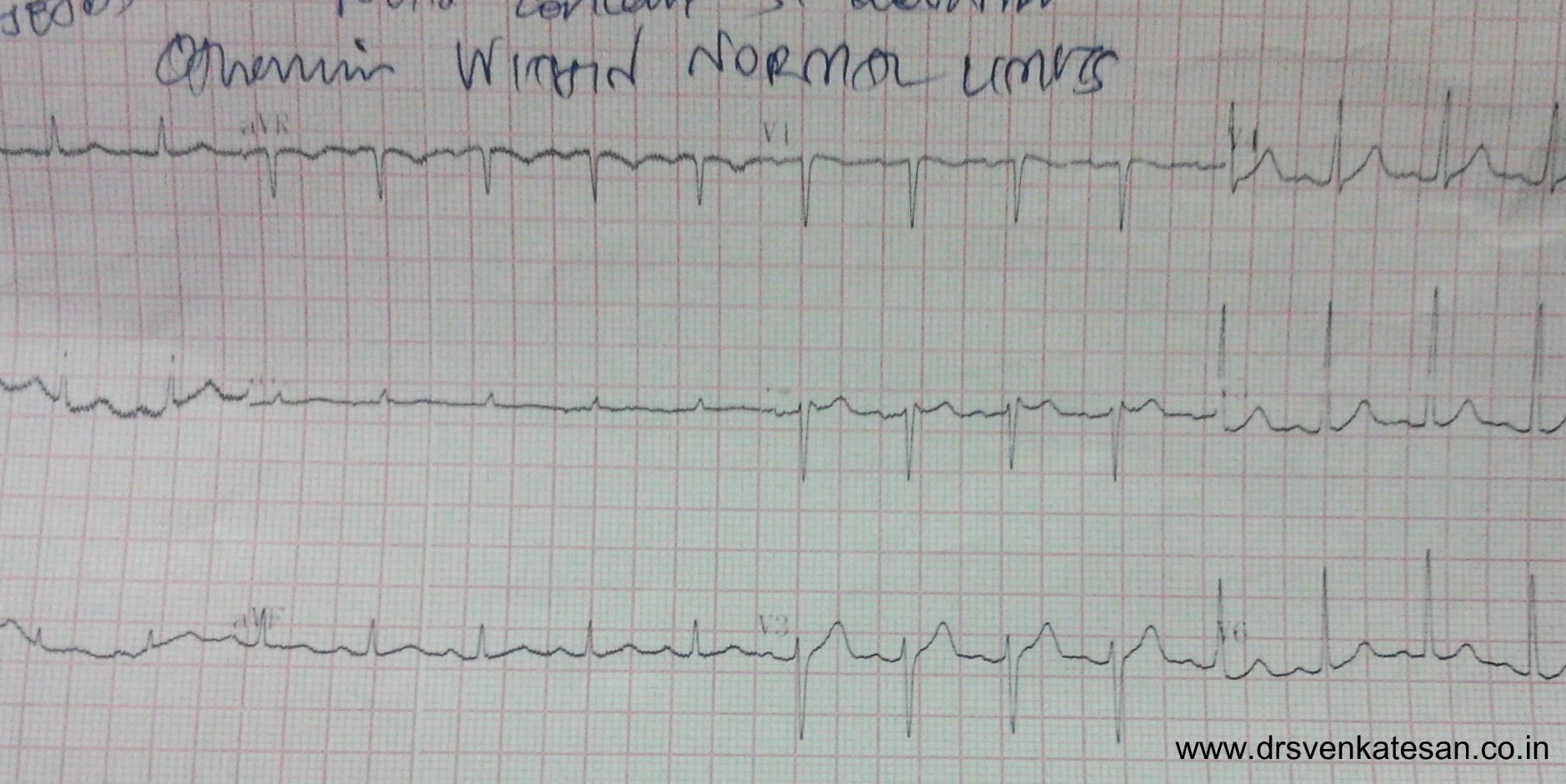
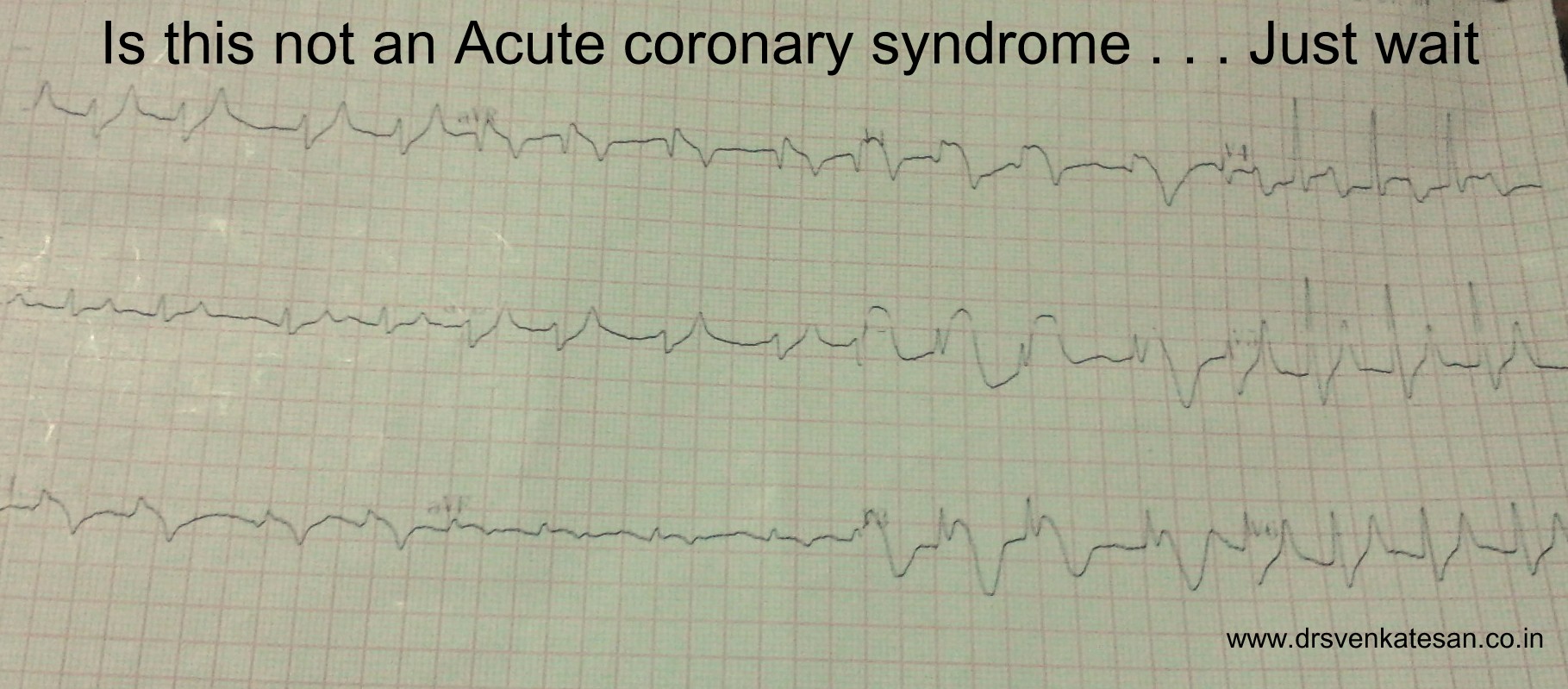
A 38 year old man presented with  acute breathlessness  and chest pain .His ECG is  posted  below . The ER in charge   medical officer promptly handed over the patient to   STEMI  alert    group (This is how  cardiologists are   referred to !   in one of the leading corporate hospital in India )

Note Atrial fibrillation , ST segment elevation, in pre-cardial leads

A team of  white coated  humans  in  various  gender and ages  swarmed the patient . ECGs and text where shared  among  the  STEMI alert group  through  I pad 3 which transmitted  HD  quality ST elevation with a  retinal  precision . A senior consultant   insisted   to shift the patient to cath lab direct  . Since he had  signs of cardiac failure , one of  the wise Junior fellow wanted  to correct the failure with Nitroglycerine  and  Dobutamine before rushing him to cath lab . Hence he was put on hold in the side room of ICU .

Echo examination showed LVH and wall motion defect could not  either confirmed or ruled out .  Initial  Troponin was negative . In the mean time the bio chemistry results came. He had a creatinine of  5.2 and Potassium of 6 meq . Hence the patient was diverted to Nephrology unit  and  dialysis was done. The next day morning  his ECG   looked like this .

It  may  sound a  pessimistic , but  still I would consider   the above  episode  is  a rare  example of appropriate care happening  ! This patient was diverted in a timely fashion from cardiology  care  to the  Nephrology . Please note , it is not the  the  clinical acumen that   helped  here.  If  he had  not presented with  LVF   he would have been a victim of inappropriate care  and landed on the cath-lab table directly  !

Final message

Every moment in clinical medicine is important , especially during the genesis of  diagnosis.  Where the patient lands  . . . in a frighteningly  large  hospital is as important  as the disease process itself. In this scientifically arrogant medial atmosphere  most of us, are  tuned  to view every problem as their own  ! This is  the default mode of modern medical  thinking process . How faulty  we are ?

The future is worrisome  as the field of  Internal medicine is  at risk of dying a premature death (or is it dead already !)

By the  way  what is the mechanism of ST elevation and Tall T waves in hyper-kalemia ?

Many factors contribute .

  1. Is it a true ST elevation  ? There is reason to believe   the tall T waves drag the fag end of ST segment along with it .
  2. Next is  related to QT interval . Hypo-kalemia widens while hypo-kalemia does  the opposite .(  though not classically) .
  3. When QT is shortened the segment gets squeezed in within a limited space ,  in order to accommodate the  ST segment it   gets rolled up and elevated . (Like an up sloping ST segment  in extreme tachycardia during stress  testing)
  4. Whatever  be the mechanism it is something to do with potassium ion flux .Transient intra-cellualr hyper-kalemia.
  5. Another possibility is diffuse uremic peri-carditis , which is a common accompaniment  of renal failure.In fact this patient did have a peri-cardial rub

Read Full Post »

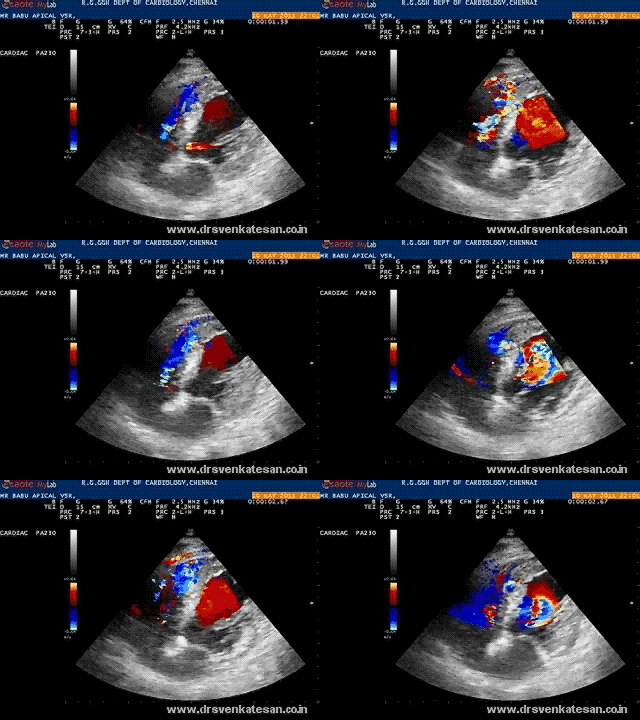
Ventricular septal rupture is a major mechanical complication of STEMI . Excruciating  chest pain ,  is the sine qua non of  any myocardial tear , dissection and rupture . It is surprising ,   VSR  following STEMI  is rarely a painful event . I can recall number of  such events  , when a  stable   patient with persistent ST elevation  in the  coronary care unit ,   wakes up next morning  with a systolic murmur.And echo reveals a septal defect promptly.

Three  reasons  can be  proposed  for relatively  pain free rupture of IVS in STEMI.

  1. Typically  VSR  occurs in 3rd or 4 th day of infarct . By this time myocardium  can be as  soft as an ice cream ! . There is not much stress and strain at the site. The necrotic  debri just gives way to spikes of   LV systolic pressure .
  2. For rupture to occur there   must be  transmural infarct  .The pain nerve terminals also die in the process .
  3. Further , it is a cavity to cavity rupture  (LV to RV ) . Direct pericardial  stretch  does not occur .

* Ventricular free wall tear   is a near fatal event is extremely painful .This  often occurs  in the first 24 hours when  the nerve terminals are  alive . The free wall rupture is more of  a  tear in the plane of  myocardium . The  pericardial  (epicardium)  layer has  rich   somatic  nerve supply .

In summary

Early  myocardial  tear   involving the epicardial  surface can be severely  painful  .  Late giving way  of softened  , necrotic  often  hemorrhagic muscle ( especially in the IVS ) is less painful or totally painless.

Coming soon   . . .

By the    . . .  what happens  to  pieces of  septal myocardium as it  gives way  and enter the right ventricle   ?

Read Full Post »

What are  the blind spots of aorta in Tans thoracic  Echo ?

What are pseudo  dissection flops in aortic arch ?

How to differentiate true from false lumen ?

Can  TEE  also  miss any  segments  of  Aorta ?

How is  Aortic Intra mural hematoma differentiated form true dissection?

Spend a minimum of 30 minutes in this 14 page  article.  You will  be able to answer all these and much more The knowledge gained ,   would easily beat  a  day  long   crash course on   Echocardiogram   !

Please thank  the European society of cardiology for providing this article free of cost !

Reference

http://ehjcimaging.oxfordjournals.org/content/11/8/645.full.pdf+html

Read Full Post »

Tachycardia – Bradycardia syndrome is the hall mark of sinus node dysfunction.

  • The commonest tachycardia in sinus node dysfunction is Atrial fibrillation . Followed very closely by sinus tachycardia . In fact alteration between sinus tachycardia and sinus bradycardia without other pathological arrhythmia is rare . (Of course , we have a name for such an entity as inappropriate sinus tachycardia / bradycardia )
  • Atrial tachycardia occurs a distant 3rd
  • Ventricular tachycardia may be an exception (Please note , extreme bradycardias which lead to pause dependent VT is not directly related to sinus node disease )

The commonest bradycardia in SND is

  • Sinus bradycardia (This fact is undisputed unlike the tachycardia component of SND !)
  • Followed be sinus pause , SA blocks and sinus arrest .
  • AF with slow ventricular response ( Bradycardic AF) We are not sure about the rhythm here (Is it truly junctional /or conducted atrial ? )
  • Associated AV block can occur up to 20 % of patients .If AV block is present the true nature of SA node disease is masked and it’s function becomes almost irrelevant .

Read Full Post »

Stress related wall motion defect  is a well-known entity . It is referred to as Takotsubo cardiomyopathy .

These stress are often

  • Emotional
  • Neurological
  • General systemic stress

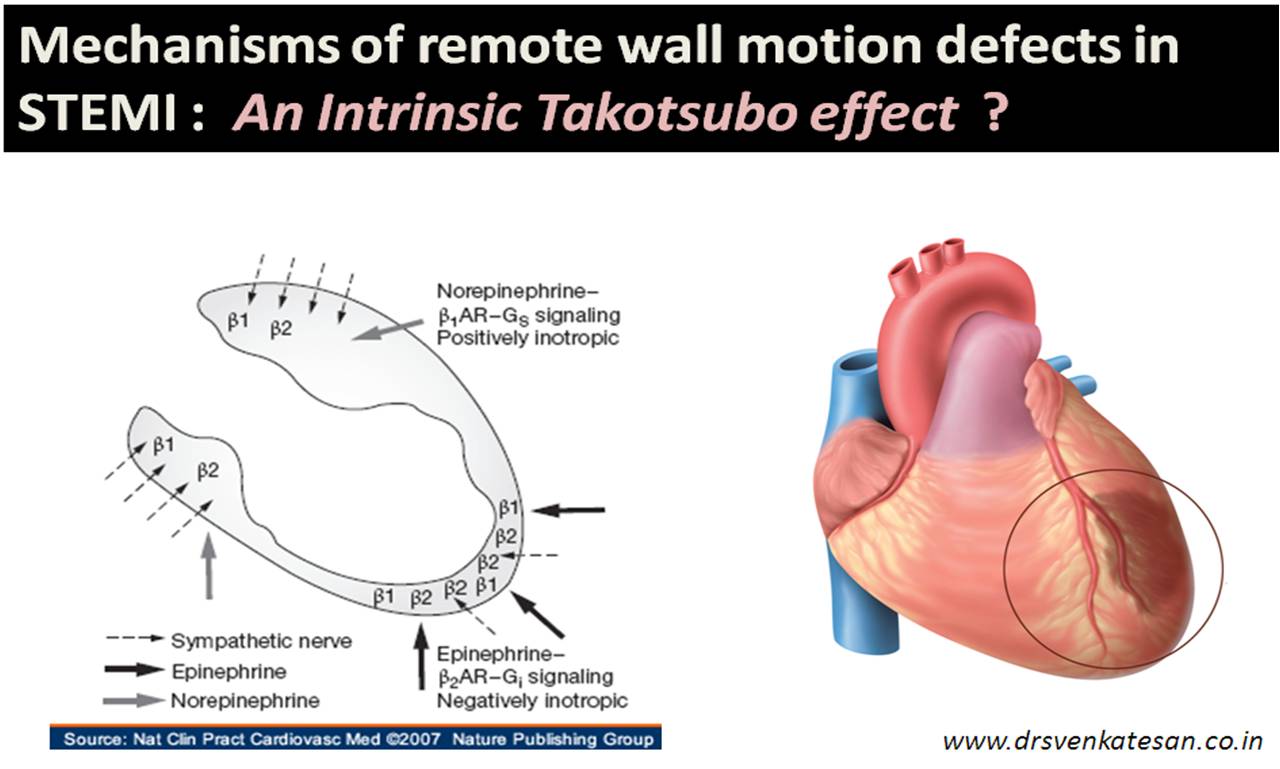
The culprit seems to be pooling of adrenaline and nor adrenaline in myocardium .These remote  neurogenic stress can cause significant wall motion defect due to adrenergic  downpour

The image depicts the wide variation in the density of beta receptors in heart.The stress of MI can result in varying degrees of wall motion defect .It is important to realise the wall motion defect in STEMI has two components .One is related to ischemia and other is due to excess catecholamines. This explains many of the unexplained remote wall motion defects during STEMI .This  may be referred to as Intrinsic Takosubo effect !

Then   . . . the following    questions arise

When systemic stress can have a profound  effect on myocardium , what   about local stress ?

Acute STEMI  is  a huge stress for the heart   . . .   isn’t  . If  so , can it   alter  the wall motion defect in adjacent  or remote myocardial segments  independent of ischemia ?

With the distribution  of adrenergic receptors  showing  huge variation ,  we do not know how an acutely ischemic heart  spills the adrenaline all over .  Is there a pattern to it  ?  or it happens at random ?  Further , the  response to  accumulated  catecholamines  is  not  going to be  uniform. This will explain why certain patients  go into ischemic  LVF  , very early in the course of STEMI  even before the myocardium is necrosed. It will  also explain  the  benefits that accrue in selected patients  who receive early IV beta  blockade  ( Which is  of course currently not popular after COMET study ! )

Final message

We  have seen at least  two patients  with severe  transient ballooning  wall  motion defect in LAD region  (LV apex)  with isolated RCA lesion and inferior Infarct .

The question raised is this 

Can  the  stress of  Inferior  STEMI   . . . result in  apical Takatsubo  like  effect ?

Reference

http://www.medscape.org/viewarticle/567069_4

http://www.takotsubo.com/

Read Full Post »

IRA localization for both LAD and RCA , LCX  is a fascinating  exercise for cardiologists.I suspect  our understanding  about this crucial issue is  far from complete .While  localizing  level of lesion within LCA  or RCA requires more precise data and erring is acceptable  , it is not uncommon to  call  even the  IRA wrong  especially in multi -vessel disease.

Why current   criteria of IRA localisation goes awry many times  ?

The  factors  that operate are not few   . . .  it  runs into a dozen  at least  !

  1. Dominance  is never considered during IRA localization  (A right dominate system can vastly influence the LAD localization  algorithm PLV branches  can protect LV postero- lateral segments in spite of proximal LAD lesions )
  2. The length of  mid LAD   IS  controversial entity ( Traditionally  it refers  to  the  segment  between first major diagonal to second  major diagonal or septal  leads to faulty   coronary mensuration .It is not uncommon to have a  mid LAD measuring few  mm  when  full the full  length of  LAD  is about 15-19cm
  3. Diagonal vs OM  trade off occurs  in every alternate patient which is ignored  !
  4. Ramus  is never considered worthy enough  to be included in the IRA  localization scheme (In spite its presence  in 20 % )
  5. Type of LAD is not given allowance.
  6. Finally &  most importantly these rules of IRA localization will not apply in  the setting of  multivessel  CAD
  7. In the presence of Pre existing CTO
  8. STEMI following chronic stable angina
  9. Extensive collaterals
  10. Re Infarctions
  11. Post CABG etc

Final message

Decide for yourself  . . .  how good is the value of IRA localization  after  considering all the above variable. . It is not a great thing to predict  correctly RCA from LCX in an  inferoposterior MI  with a  70 % accuracy  . (It actually means  20 % accuracy  )    statistically when there are only two options  . . .  we are blindly  right 50% of times   !

Read Full Post »

A  patient who presents with predominantly right  heart failure  is  an interesting clinical challenge . Constrictive pericarditis (CP)  remains  a popular diagnosis in this setting. However  in the bed side clinical  examination (and in cardiology Board exams )  the following  differential diagnoses are  to be  considered .( And ruled out one by one)

  1. Restrictive cardiomyopathy* especially Right  sided .In India endo myocardial fibrosis tops the list
  2. Primary Tricuspid valve disease( Tricuspid stenosis / Carcinoid etc)
  3. Chronic cor-pulmonale in terminal RV failure
  4. Silent Mitral stenosis with right heart failure
  5. Ebstein anomaly
  6. Severe forms of valvular pulmonary stenosis with RV dysfunction
  7. SVC obstruction
  8. Cirrhosis of liver
  9. Porto pulmonary hypertension

( The list is not complete , readers may contribute )

Bed side clues

  • Remember  a deep “y” descent  is  the bed side counter part of   Square root sign  recorded by  invasive RV pressure study
  • Similarly , pericardial knock is the auditory   equivalent (You hear the square root !  . . .yes  )as the ventricle thuds the rigid thickened pericardial shell in very early diastole !)
  • Pulsus paradoxus and kussmal sign can occur in both CP and RCM.
  • If a good LV apex , is  palpated it  goes against CP .
  • Please be reminded , even restrictive cardiomyopathy  will ultimately dilate their chamber pre-terminal and clinical features may be confounded with that of DCM.
  • Silent heart would suggest CP.
  • AV valve regurgitation would favor RCM
  • Features of  Pulmonary hypertension will help confirm Mitral valve disease , Cor pulmonale,
  • Deep  “y”descents  are against  any form of  Tricuspid stenosis.
  • Opening snap of mitral valve is to be distinguished from pericardial knock.( Opening snap high pitched  and occur later than   pericardial knock in diastole   , best heard in expiration )
  • Cirrhosis liver with hypo- proteinimic   fluid retention is  a traditionally close mimicker  .It  may be ruled out by the careful history taking as exertional dyspnea is an exception , if  at all , it is a very late event  in cirrhosis.
  • The issue gets further weird   as chronic constriction can lead on to chronic congestive liver and cardiac cirrhosis .
  • Severe  forms of constriction can invade the myocardium and result in features of myocardial dysfunction .It is more common than we recognise.

How to confirm ?

Following should be performed in that order

  • ECG
  • X -Ray
  • Echocardiogram
  • CT scan
  • MRI

*Cath study is no longer done (Only for academic purpose )

Final message

Even in this era of sophisticated  medical  imaging  , clinical examination  remains the key . One should  realise the importance  of  meticulous  clinical history  ,  sequential examination and interpretation .It  will   “rule out  or rule in”  majority of  cardiac disorders .

The hi tech imaging  modalities should be used only to confirm , risk stratify and  plan management . If you skip the clinical  part , one  may still arrive at a correct  diagnosis  but there is  high chances of erring in  management.

(Cardiac pearls lie in the bed side not in cath labs !   Here is  one such pearl  . Not every constriction  require surgery !

Please note about 20 % of constrictive pericarditis are  transient !)

Read Full Post »

Brugada syndrome continues to fascinate  us for two reasons.

One , it deals with mysterious sudden  deaths of young  men and women

Two , it is one of the  fine  examples  of how  advances in molecular biology , links  physical defects in ionic channels to  sudden electrical  death (Most of them  are due to inherited defects  sodium channels  of myocyte cell membrane )

While high risk subsets of Brugada are easily managed , it is  the asymptomatic  ones  that bother us.

The following are some of the  difficult  questions ,   a  cardiologist faces when dealing with   patients , who exhibit  only Brugada pattern in ECG .

  1. Should I go for an EP study Doctor  ?
  2. Will  I  require an ICD  Doc ?
  3. Do I carry a significant risk of  dying  suddenly  ?
  4. Do  I need a genetic test for sodium channel mutation ?

Fortunately,  we can answer  all these questions with much  courage than before.

(Thanks  to the European Finger registry published in 2010  !)

“No” is the  clear  answer for all of them !

Summary from the FINGER registry. 

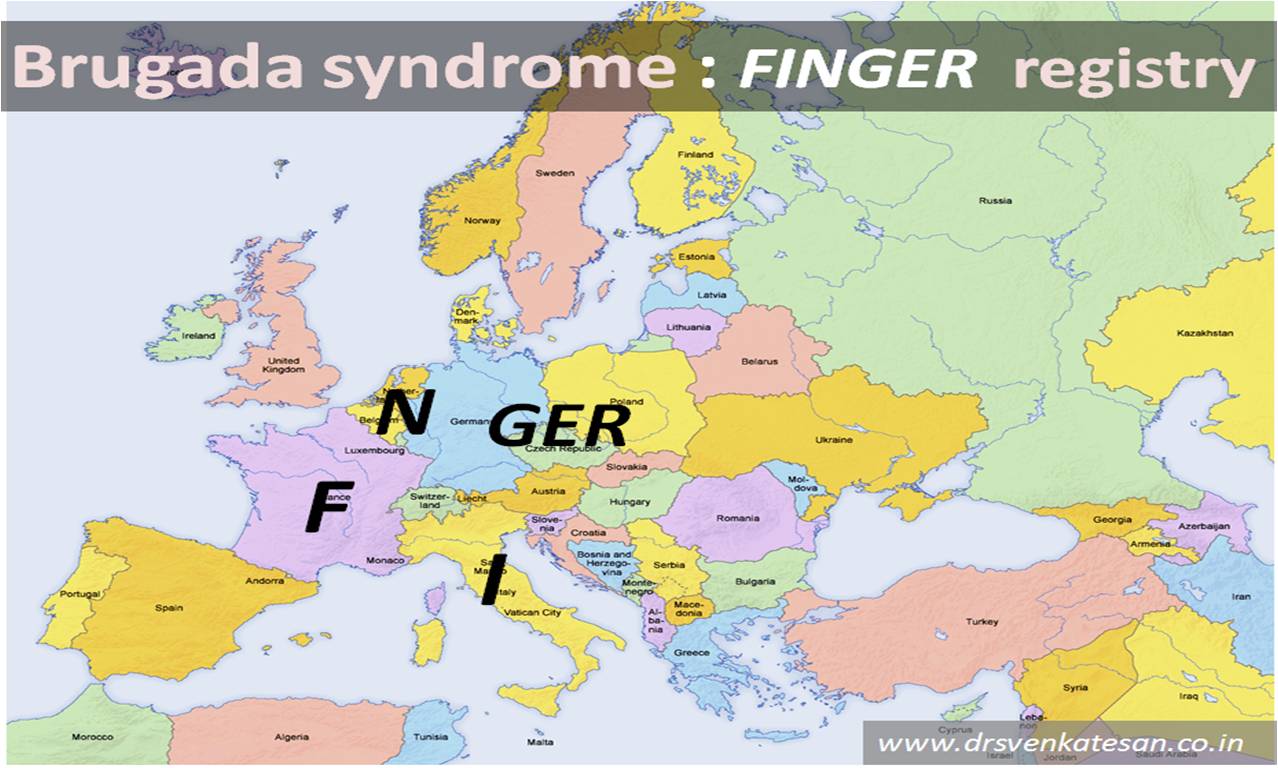
(France  , Italy, Netherlands, GERmany)

The registry included 1029 consecutive individuals

(1) Aborted SCD (6%);

(2) Syncope otherwise unexplained (30%);

(3) Asymptomatic patients (64%).

In the  follow-up of 31.9 (14 to 54.4) months . A total of  7 death occurred .

The cardiac event rates per  year was 

  • 7.7% in patients with Aborted SCD,

  • 1.9% in patients with syncope

  • 0.5% in Asymptomatic patients.

Predictors of cardiac  event

  1. Previous syncope
  2. Spontaneous type 1 ECG

Non predictors ( Surprisingly there were more non predictors ! )

  1. Gender has no predictive role
  2. Familial history of SCD,
  3. Inducibility of ventricular  tachy-arrhythmias during  EP study,
  4. Presence of an SCN5A mutation


Follow up

PRELUDE study  almost reaffirms  Finger data

(PRogrammed ELectrical stimUlation preDictive valuE)

Just publicized in JACC 2012 from the pioneer of   Brugada Silvia  Priori of   university of Pavia  Italy

Reference

http://circ.ahajournals.org/content/121/5/635.full.pdf+html

http://content.onlinejacc.org/cgi/content/abstract/59/1/37

Read Full Post »

Time and again cardiologists are called to opine  in critically ill ICU patients with  hypotension.  The circulatory shock of septic shock  is often refractory  . Many  times it  degenerates  into multi -organ failure . The mortality remains high in- spite modern treatment .Even in those patients who recover , they require prolonged  inotropic support  (for days or even weeks)

Here is a  recent call I attended to .

A 44 year old   febrile   , ventilated patient  (With a pneumonitic patch , PEEP of  6 , near ARDS )  ,  precarious renal function and altered sensorium , maintaining a blood pressure of 100/70mmhg with high dose dopamine and nor- adrenaline  , monitor showing a heart rate of 125 /mt sinus  .This status -quo  has continued for more than 72 hours. To my surprise,  the ICU physician told  me there is  in-fact a  minor improvement in general condition than before  . After blinking  at the patient’s  file for few  minutes  , I did a customary bed side echocardiogram .The only positive finding  I  found was  his  heart was  structurally normal  and EF was  64 %  , still the right heart chambers were struggling  to do it’s job   fighting with the PEEP.

The physician had  a very  specific query  from the cardiologist . How to wean the inotropic support and shift him off  ICU ?

(The poor patient  has no  insurance  , and has to shell  Rs 10000 everyday  which is equal to his monthly income ! )

A very  valid question indeed   !   After all  , cardiologists  claim to  have special  knowledge  and wisdom about disorders of  vascular system .

Heart being normal , the crux of the problem is loss of vascular tone. (Autonomic dysfunction ) .How to improve it ? I  discussed the following suggestions.

  • Early passive muscle exercise (Augmenting  muscle tone and transforming it to  into arteriolar and venous tone )
  • Venous support ,stockings etc.
  • Ensure adequate intra-vascular  fluids
  • Sodium supplements
  • Corticosteroids.
  • Fludro-cortisone , the mineralo-corticoid may have a specific advantage as it could retain sodium in vessel wall that can be exchanged with smooth muscle calcium and improve vascular tone .
  • ECMO is  often a pre terminal intervention .
  • Will power . We know vascular  tone is in fact neurogenic in origin .The tone flows from brain stem .Administering  will power could be a useful intervention . (parental infusion of fighting spirit !)It can be done through pep talks from  close family  members   in   conscious patients .(One controversial advice is to allow  near and dear  into bedside , ICU phobia may delay recovery of vascular tone !)
  • Finally  I suggested , a  vascular consult from the GOD  . Organised prayer .  There is some evidence ,  even  proxy prayers do exert benefits in unconscious patients .

After a 15 minutes stay in the ICU , for doing nothing  I  received a significant consultation fee  , and I left the  place  sheepishly  with a  definite dose of guilt !

Reference for role of Hydrocortisone in septic shock

The CORTICUS study

It has no overall impact but hastens recovery from septic shock . Even though the study appears to denote a negative connotation

it has the role in selected individuals .http://www.nejm.org/doi/full/10.1056/NEJMoa071366

Read Full Post »

« Newer Posts - Older Posts »