Feeds:
Posts
Comments

Archive for the ‘Cardiology -unresolved questions’ Category

This paper is to  be presented in the the Forth coming   Annual CSI meet New Delhi  December 2012

Beware of Primary PCI : Is there a Low risk STEMI where  pPCI is potentially contraindicated ?

Venkatesan Sangareddi  . Department of cardiology  . Madras Medical college

Primary PCI has proven to be the best  option for management of STEMI . But it need to be done early,  by an experienced team , in a good facility . It is not the individual expertise that matters !  Any treatment , which has great therapeutic potential  also  carries a hazard . So , these treatments  must be used with caution.  Not every STEMI patient , carry a high risk for death.  In fact , the mortality  in some of the subsets of STEMI  can be as low as 1%. If , a  STEMI patient , with a likely 1% mortality is going to get a procedure with  3 – 4 % ,risk it should (And Must !) raise a validity question  But,this issue is rarely addressed in the interventional summits.

In a case pool of 56  randomly collected primary PCIs from various institutes , the outcome  of pPCI  was analysed .It is a retrospective , observational study .STEMI was graded as high risk when one of the following features  were present and it was “low risk” when none of the feature  was  present ( Second STEMI , Extensive  anterior MI , Class 3 /4 killip, An episode of VT/VF, Complete heart block, Diabetic individuals )  High risk STEMI  constituted 22 patients .The overall in hospital  mortality  was (5/56) 9 % In high risk STEMI it was (2/22 )9.5 % in low risk  STEMI it was 3/34 6.4 % .In the corresponding period 40 patients with STEMI who were treated by only thrombolysis or heparin (If beyond time window ) was used a control . 15 patients  were in high risk In the this group the  mortality in high  risk STEMI  was (3/15 )19% and low risk STEMI  there was nil mortality (0/25) 0% .

There was an unacceptable moratlity  with  pPCI  in the low risk STEMI which fared worse than even simple administration of heparin.These data reveal a dangerous fact , that is , primary PCI does not differentiate in the procedural  risk with reference to the patient profile it deals with .While , it dramatically reduce the risk in high risk STEMI It confers a astonishing risk to low risk STEMI .The exact cause for this risk is not known . Common sense would tell , pPCI is  expertise driven driven while thrombolysis is not .Our analysis also suggest bulk of early hazard of pPCI is also logistics related.

Primary PCI could be  cautiously and consciously avoided  in  patients with  low risk STEMI even if it is technically and academically indicated. This can have a great impact in the overall outcome of STEMI management.It is suggested every STEMI patient need to be risk stratified on arrival.(It is still a mystery , why we do this for NSTEMI and not in STEMI ) . A change in the current PCI guidelines to this effect is to be considered.
Read Full Post »

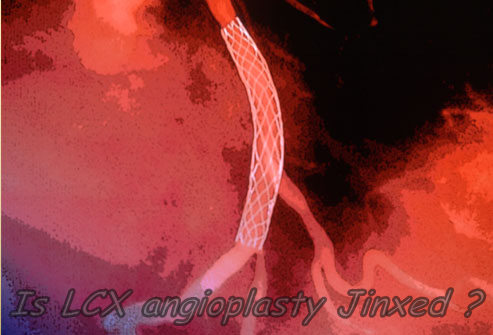
We frequently  hear  a comment  about  LCX angioplasty   being a  tricky intervention   . Even  many experienced cardiologists   do agree with this .

What could be the  apparent explanation for this seemingly important observation in cath lab ?

  1. The first and foremost is the anatomical  uniqueness of  origin and course of LCX. LAD is direct continuation of  left-main  , while LCX always  originate  with a  considerable angle at  it’s origin   . Further downstream  it flexes circum-ferentially over the lateral free wall of left ventricle .This  ensures  the  catheters and stents  we   maneuver often  traverse a hair pin bend  .
  2. The  endurance of  coronary stents are  put into biggest test during LCX angioplasty . While any mediocre metal stent can sit comfortably in LAD , LCX is different story altogether.(A flexible multi link  model  like that of Abbot Vision platform seems ideal . )
  3. The LCX wire crossing and exchange  is vested  with  potential  threat  to  the much important LAD circulation . Time and again , we have observed  ,  prolonged procedures  inside    LCX  some how compromise    the LAD  flow.
  4. Once the LCX is opened ( especially in  a CTO , ) there is a sort of   stealing  of LAD blood flow. We have witnessed this in  at least 2 patients , who developed  anterior  MI after opening up of LCX CTO. (Who  had a insignificant  LAD lesion )
  5. LAD may be widow maker artery ,  but it remains a fact  LCX   has much  more important role in regulating  mitral valve  papillary  muscle  . Even transient  ischemia  in  LCX territory can result in  lung congestion or even  flash pulmonary edema .This  is  fairly frequent during complex LCX angioplasty .
  6. The antero-lateral pap muscle is located in a critical location especially so in post infarct remodeled left ventricle  even minor degrees of ischemia can  create  a havoc .This is what   occurs during  flash  pulmonary edemas in LCX angioplasties.
  7. Spillover of thrombus from LCX to  LAD  can occur  during  aspiration  of   LCX  primary PCI
  8. Finally,   ECG  changes   are often blind in LCX territory . It remains an  Irony ,  we  do not monitor  the heart  with 12 leads during   sensitive procedure like a PCI.(The monitor leads easily miss LCX ischemia .This is hardly surprising,   as we know   LCX territory  has blind spots even with 12 lead ECG !)


Final message

It is  true LCX angioplasties can not be taken casually . One can not afford to have a prolonged procedure  within LCX.Whether dominant or not   LCX  delivers  blood supply  to more vital areas  of myocardium  that typically  includes lateral free wall and  mitral valve function .It is possible septal ischemia is  relatively well tolerated while free wall ischemia triggers an early mechanical deterioration .

Read Full Post »

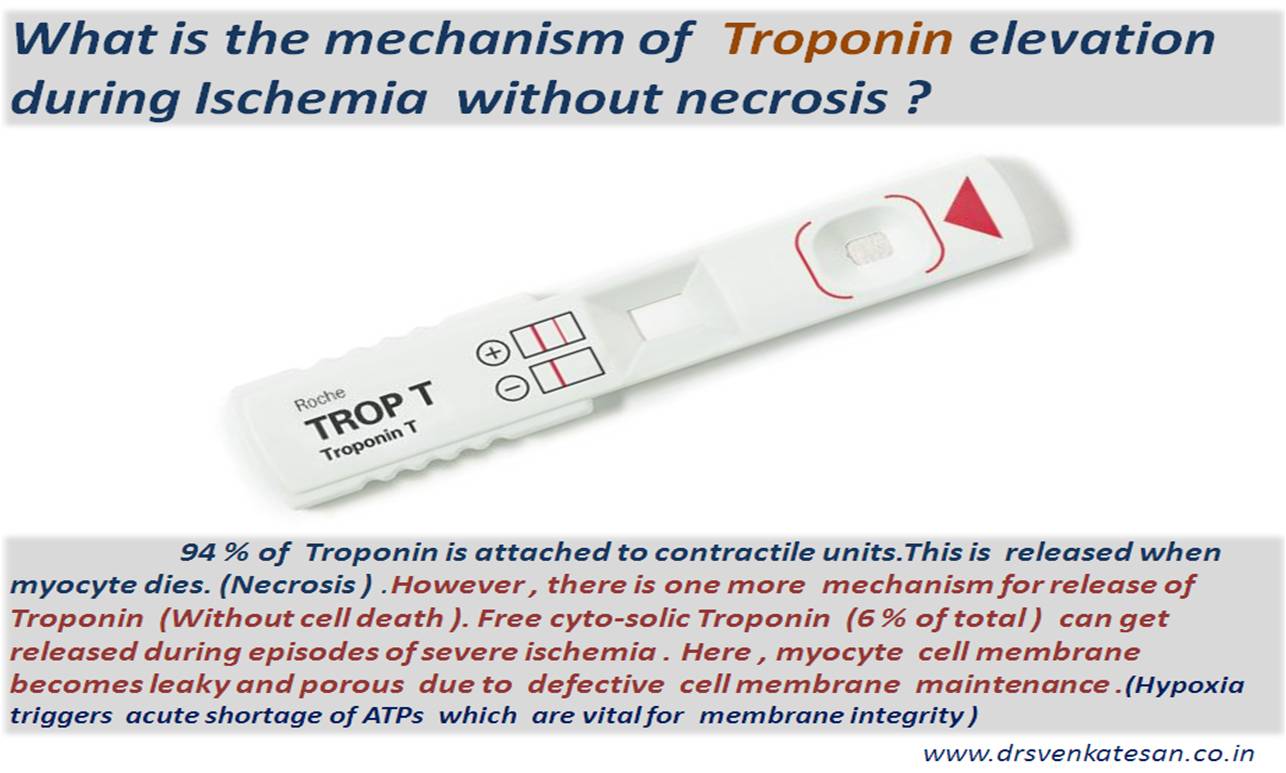
Does Troponin release during  Ischemia  ? (Without myocyte necrosis )

How often this happens ?   . Some believe , it is rare . Here is a possible explanation for it .I feel the mechanism is still not clear . It all depends upon the degree of ischemia.


Read Full Post »

I don’t know, any one has tried to differentiate the mechansims of dyspnea with reference to systolic and diastolic dysfunction .We have made some  observations  in certain group  of patients  during EST . I do not know how far one would agree  with this .

For  the same amount of  stress or work load persons with  systolic dysfunction  behave differently . However ,both will complete the activity but the onset and perception of dyspnea is slightly different in patients with predominant diastolic dysfunction.

Diastolic dyspnea (Dyspnea due to predominant diastolic dysfunction / HFPEF)

  • Delayed dyspnea .  It manifest  well after the exertion is completed.
  • It is more off a struggle to handle the venous return .The forward flow (Arterial circuit )  is relatively well toned and  tuned  and hence fatigue is rare .
  • Typically it has a prolonged recovery time .(? > 1-2 minutes )
  • Is it  less harmful  in terms of longevity ?  May be . . . since it is more related to physical  de-conditioning. Most of the physiological  episodes of dyspnea are probably  diastolic dysfunction  mediated .
  • Dyspnea that is triggered  in diastole is also dependent very much  on the  heart rate .If the heart rate fail to reach the baseline the recovery of dyspnea is also delayed
  • Some believe , physiological dyspnea should disappear within 30-60 seconds after termination of activity  .(Highly  arbitrary!)

The pressure volume loop in various forms of heart disease will determine the degree of myocardial stretch and the resultant dyspnea .Image source : http://www.1cro.com/medicalphysiology/chapter10/chap_10.htm

Systolic dyspnea (Dyspnea due to predominant systolic dysfunction )

  • Patients with primary systolic pump failure experience dyspnea very early into exercise  .
  • Much of dyspnea  occur during activity itself .
  • Exercising muscles show hypoxia  and hence  fatigue is conspicuous .
  • Recovery  of dyspnea is relatively immediate as the activity is stopped .Demand from exercising  muscle is  significantly dropped.
  • If the venous return is well handled by the ventricles the  recovery phase is more comfortable .

Summary

In primary diastolic dysfunction  ,the maximum stress  to ventricle occurs  when  the venous return peaks that usually happen in the exercising muscles , as they shed  vaso-dilatory  property  in post exertion phase .

Management Implication

 Fluid overload ,  Tachycardia   are more  related to diastolic dysfunction .(Beta blockers by prolonging  the diastole can , provide important relief of dyspnea in diastolic dysfunction (In HOCM patients   this action could be  more important that  the much hyped negative inotropism !)

Final message

Dyspnea is  a complex cortical  perception , influenced by filling pressure of heart, stretch receptor in lungs , respiratory and   exercise muscle . It is further impacted by number of biochemical parameters (Lactate/ O2 etc )

Of-course  , it could be a  far fetched  imagination to split dyspnea  mechanism with reference to cardiac cycle. Combinations  of both  systolic and diastolic dysfunction is the norm in many  cardiac conditions . However  , I believe  we need  more insight in the  pathogenesis of  this ,  “most important  symptom”   that emanate  from the heart .

Read Full Post »

A young man with   VT  (LBBB morphology ) and  apparently normal heart by   echocardiogram  is  a  real  diagnostic challenge .
Here is a comparison  of  the two  closely mimicking  entities. RVOT VT and ARVD .
Please note -Micro reentry and triggered activity  are very closely related cellular evens. For all clinical reasons there is generally no purpose in differentiating the two.

*Please note -Micro reentry and triggered activity  mimic each other at the cellular level . For all clinical reasons there is generally no purpose in differentiating the two.

*RVOT- Right ventricular outflow tract. ARVD/ARVC -Arrhythmogenic  right ventricular dysplasia /cardiomyopathy

(Caution : RVOT vs ARVD  -In  the traditional medical teaching system , we are often taught to differentiate  two closely related  entities.Our brain also loves to look things in either black or white . Realise , medical science always brings  surprises . There can be significant overlaps between the very entities we want to differentiate.Bear that in mind)

Reference

1. Hoffmayer KS, Machado ON, Marcus GM, Electrocardiographic comparison of ventricular arrhythmias in patients with arrhythmogenic right ventricular cardiomyopathy and right ventricular outflow tract tachycardia. J Am Coll Cardiol. 2011 Aug 16;58(8):831-8.

2 .Ainsworth CD, Skanes AC, Klein GJ Differentiating arrhythmogenic right ventricular cardiomyopathy from right ventricular outflow tract ventricular tachycardia using multilead QRS duration and axis. Heart Rhythm. 2006 Apr;3(4):416-23.

T wave inversion in V1 TO V3 for diagnosing  RVOT VT .

3.Daniel P. Morin,  Andreas C. Mauer, Kathleen Gear, Usefulness of Precordial T-Wave Inversion to Distinguish Arrhythmogenic Right Ventricular Cardiomyopathy from Idiopathic Ventricular Tachycardia Arising from the Right Ventricular Outflow Tract .Am J Cardiol. 2010 June 15; 105(12): 1821–1824

Read Full Post »

The  commonest  cause for death in massive pulmonary embolism is 

  1.  RV shock
  2.  Massive Hemoptysis
  3. Primary VF   originating  right ventricle
  4. Refractory Type 1 Respiratory failure

Answer : 1  .(RV shock , RV standstill and RV , RV stunning  is the unequivocal  cause for sudden death in pulmonary embolism . This RV shock occur very early .Once the patient survives the initial  RV scare (say 24-48 hours) usually do well if prompt thrombolysis and anti-coagulation is administered  )

Read Full Post »

Mitral valve prolapse  probably is the most common cause for  abnormal added  sounds in cardiac auscultation . MVPS occurs  when  mitral valve tissue  and its accessories  overgrow disproportionately    with reference to  the mitral valve orifice (Also referred to elongated or redundant leaflet) .The net mass  of mitral valve apparatus has an inverse relationship with  LV  cavity volume . Because of  excess motion  ,  leaflet may bulge into left atrium to different degrees and different angulations. This entity  as rule is  benign  in most people . Still ,  rampant diagnosis in the community  (With the  pathological proliferation of   scan centers  )  has raised considerable anxiety .

watch?v=esDNcqop_Ew&feature=relmfu

Hence , the criteria  to  diagnose MVPS are made stricter .Unless the leaflets are thickened and some degree of MR  occurs the  usage of the term MVPS  is  not justified .

watch?v=h6aJSuUTVb0

Unusual  sounds in MVPS

In many patients ,  AML become so nimble ,  it flexes, bends and   stretches  in both systole and diastole. These leaflets   can generate clicks  not only during  prolapse . Simple folding and unfolding of  long redundant  is known  to produce clicks.

generally folding occurs in diastole and unfolding in systole ( of course in extreme redundancy  both can occur in both phases )

This diastolic  clicks in MVPS has been reported rarely  in literature . It is   more common than we realise .The timing  of these clicks  are  not constant .Audibility is low .It can easily  be confused with opening snap of mitral stenosis .

The spatial  relationship between the sound generation and the anatomical prolapse  does not match . It is always  possible  when  PML prolapses  AML may generate a click and vise versa . Diastolic clicks or opening snaps  are known to occur in some of the severe forms of MVPS.  The first heart sound is not only loud  , the  differential  motion AML and PML  may distort  two componets of  M1  .It needs to be emphasized the loudness  of  S1  can be  preserved even in the presence of significant MR .(Even as the PML prolapses  causing MR ,  an  elongated  AML continues to generate a booming S 1)

Final message

Can MVPS produce diastolic added sounds ?   Yes . . . it can .

Mid systolic click  , and  late systolic murmur  is the classical  manifestation of MVPS . In reality , one can get a variety of noises from prolapsing mitral valve apparatus in both phases of cardiac cycle.

Reference 

These are all inferred from bed side observation . Luckily  I have found a  reference from a New york state journal of medicine .Other wise my observations would have been ridiculed .  Gone are the days   when we spend  hours together  in  clinical auscultation  of mitral valve motion  .

Today we are  in the era  , working in hi- tech cath labs ,  aiming  to  capture those same  redundant  mitral leaflets  with catheters  and clip its wings to reduce the mitral regurgitation  .

Asking for a phon0-cardiographic  documentation of diastolic mitral click in MVPS    would be a laughing stock among current generation cardiologists  !  Still I would argue for such a study !

Read Full Post »

Anginal equivalents are distinct  (often vague  ) symptoms that occur in response to myocardial Ischemia , instead of angina. Dyspnea or shortness of breath  is the commonest anginal equivalent . The incidence and exact mechanism  is not clear. Both angina and dyspnea are sensory  events . Both are  perceived  at the level of cortex. Angina occurs when ischemic  muscle  triggers pain signals from the   nerve  twigs engulfing the myocytes membranes  and the vasavasorum.

Dyspnea during myocardial  ischemia  is multi-factorial

  1. Signalling error .( Mismatch between respiratory /Cardiac  receptors  neural traffic)
  2. Cortical perception disorder.
  3. Autonomic neuropathy (Blocks pain signals  but still may carry  myocardial stretch response)
  4. Coronary sinus lactate –  Biochemical /Chemo receptor stimulation
  5. Isolated  Ischemic LV relaxation defects  , and resultant elevation of LVEDP
  6. Ischemic systolic stunning  and secondary  diastolic dysfunction  (elevated PCWP  pulmonary stretch receptors stimulation )
  7. Ischemic MR . Eccentric MR jets and regional and segmental elevation of pulmonary venous pressure has been reported. (Unilateral and segmental pulmonary edema)
  8. It is possible  ,  Ischemic wall motion defect per-se  can induce myocardial stretch and create a feeling of dyspnea.

Out of the above eight factors  which is  most important  ?

The most popular and easy to comprehend   mechanism   is number 5 : Ischemic diastolic dysfunction .

(Fellows will be appreciated if they  know this !   )

Read Full Post »

How to manage an  asymptomatic 45 year old man with  90 %  mid  LAD lesion  , with  FFR  .9   who is  stress test  positive at 9 Mets  ?

Six  cardiologists and six responses   . . .  and the elusive seventh sense

  1. FFR is most scientific test to assess  physiology of coronary stenosis  . I will  go with that  and put this patient under  medical management.
  2. I agree with FFR, still the  patient has no symptoms  , but why the hell is EST  + ve ?  I am confused  .
  3. I would definitely stent the lesion irrespective of the symptoms .
  4. I would order a stress thallium . I do not believe in FFR
  5. The data provided  is insufficient. I would like to this patient in my clinic , and if necessary  may  order a fresh CAG.
  6. For a 90 % LAD  lesion FFR should not have been done in the first place .That is the root of the confusion. He should have received a stent long back .

Final message

FFR is  a terrible concept   for two reasons . One ,  it never bothers about flow across  a lesion. It simply  relies upon  pressure drop. we all know  there  is an intricate relationship   between pressure and flow . Simple pressure drop can never be  expected to translate into incremental flow in biological systems .The  second major limitation is  it  ignores the  morphology of the lesion . We know an eccentric soft  lesion with a  good distal   FFR  is  live  coronary explosive .

Read Full Post »

This is a true story  . . . happened  many years  ago under my direct  vision.

A  48 year old women came with significant breathlessness and catchy  sub -sternal chest pain .

“I  was exerting too much in recent days  doctor” , she said .

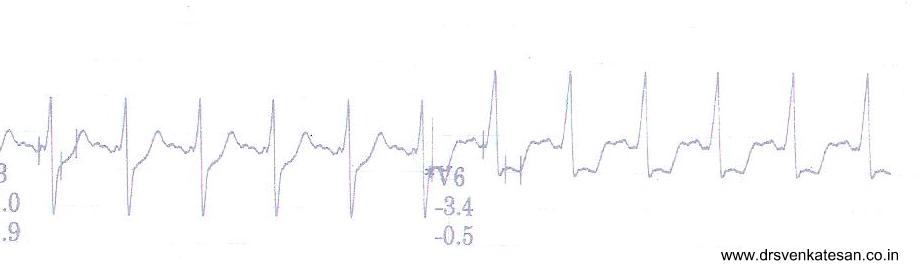
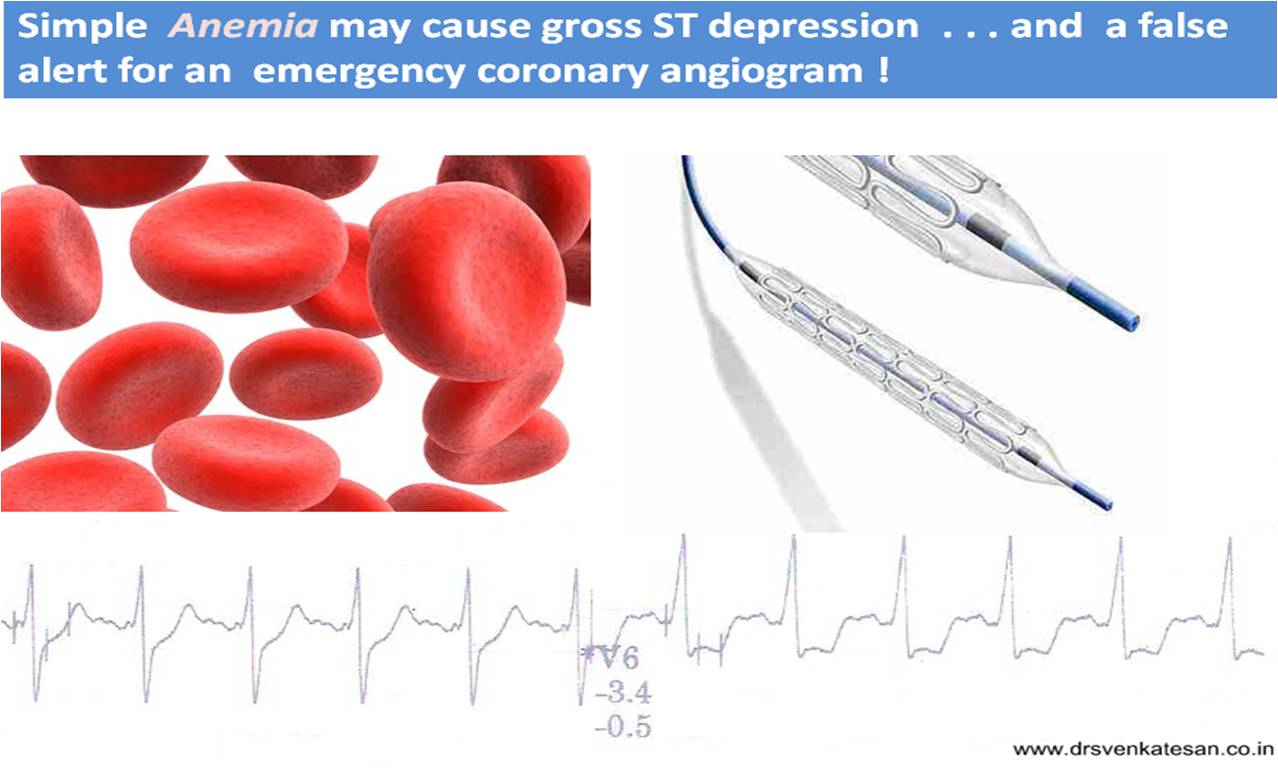
Her ECG  showed  a tachycardia and dramatic ST depression in most leads .

The ER in charge promptly texted the cardiologist .

The moment he saw the ECG ,he  had no hesitation , to order for an emergency angioplasty  (  How can he plan a angioplasty  , without even  knowing the coroanry anatomy . some one murmured  . May be   . . what he probably  meant was emergency angiogram   the other explained )    Further , he was telling his    fellows  . . . that  this is going top be  tough case and a possible  left main PCI .

An emergency  angiogram was done .  On table  it was a huge  surprise for every one ,  it was a  a classical  text book   look alike normal coronary arteries !

The moment normal CAG was  visualized  the consultant  concealed his momentary  surprise    and went on to say  it is classical case of syndrome  X   with severe micro- vascular disease causing ECG changes !

As  the patient did not give any opportunity to poke her coronaries   she was wheeled out of  wheeled out of cath lab.

Meanwhile ,  first year  fellow came rushing with the blood reports and biochemistry .

Is everything  alright ?   Yeh sir ,  except her Hb %  . . .  it is  5.6  Grams !

The bewildered  consultant *  realized   the  high  coronary drama , that is  been enacted  over the  past 2 hours !  and  learnt  (and taught) a most important  lesson to their fellows !

Hi guys , this is neither  a NSTEMI nor  a microvascular syndrome X  . . . this is simply anemia related  extreme  ECG changes !  We have erred in our reasoning and  our pre cath clinical scrutiny has  gone awry ! 

He went on to say  ,  don’t worry  many times medicine is learnt in  hard ways  . After all nothing adverse has  happened here .

The women was subsequently investigated and handed over to  gynecologist for a probable hysterectomy .

Final message

Please be reminded  , anemia  can produce  variety  of  ECG changes.  In extreme anemia  global ST depression is  common especially if  tachycardia is associated .

The lesson here  is ,  whenever  gross  ST depression is witnessed  with vague chest pain  check the hemoglobin first . This is an unusual story of a women  ,  with simple  anemia  (due to   chronic mennorhagia )   landed in cath table in an acute fashion .  Luckily  she  did not have any  incidental coronary  lesions  that prevented her becoming a  greater cath lab  victim !

* The bewildered consultant is none other than the author  of this blog.

Read Full Post »

« Newer Posts - Older Posts »