Feeds:
Posts
Comments

Archive for the ‘Infrequently asked questions in cardiology (iFAQs)’ Category

Management of  atrial fibrillation has been a  big puzzle for cardiologists  for many  decades  till  it became a corporate game , and  now in the era of recession it has become  medicare’s  night mare !

So , we  were  made to dance to the tunes of the so called evidence based cardiology . . .

  • From only rhythm control to . . . in 1990s
  • Either rhythm or rate control  . . .       in early  late 1990s
  • Then cost control  was found  more important than rate control  . . .
  • . . . So rate control became superior to rhythm control in early 2000s

In 2010 , even the  rate control  became  a luxury ,  here comes the  real ace !   ” Casual rate control may be  suffice in most cases of AF “

Read this article  from  NEJM , which tries to  make  sense out of nonsense  and judge for yourself

Probably the most influential  article  in electrophysiology over  the  next decade

Click  below to reach Nejm article

http://content.nejm.org/cgi/content/full/NEJMoa1001337?query=TOC

http://content.nejm.org/cgi/content/full/NEJMe1002301?query=TOC

Gist of the trial

Technically and literally it  means a  “Take it easy attitude” as long as patient is comfortable , even a rate  of  more than 100 is allowed . Few years back the above concept could be termed a “non sense”

Final message

In this  perennial  management issue  of AF  ,  Whether ,   we were successful in  restoring   sinus rhythm or not , we have restored  the common sense*  Thanks to RACE 2 investigators.

* Do not unnecessarily trouble a  asymptomatic  patient with those powerful  and costly  antiarrhythmic drugs .

Read Full Post »

Human body is a collection of trillions of cells.  Life  is nothing but , a bundle of energy flowing across each of these cells  .Every  organ  has a  specailised mode of communication among themselves and others. When a cell is in an excited state , there is a  likelihood of spontaneous electrical activity.This can happen in nerve cells, cardiac cells , GI tract,  or virtually in  any cell  which has a porous cell membrane and ionic fluxes across it .

  • Each cell membrane has a resting membrane potential . It  varies between -60 to – 90mv in most cells. When this potential increases there a propensity for  arrhythmias in heart  and convulsions in the brain , peristalsis in intestines and so on .
  • Drugs  like local anesthetic lignociane acts by blocking the  Na+ channels and there by neural activation .Similarly magesium  acts on these channels to reduce the excitability of these cells.
  • We know,  the sharp ascending stroke of cellular  action potential is mediated by Na + .Blockage of this channel blunts the action potential voltage and thus  the  early and late after depolarisation is prevented
  • Magnesium sulphate’s anticonvulsant action is directly  attributable  to this membrane stabilising action

Thus , membrane stabilising action  can be termed as “membrane sedating”  action

Read Full Post »

Cannon Sound

A loud first heart sound (S 1)   which is  heard intermittently in patients with complete heart block (CHB)  is  often referred to as  cannon sound .

What is the mechanism of loud S1 in CHB ?

We know , the intensity of S 1 is  mainly determined by the  relative position of mitral leaflet (To be precise, the  anterior mitral leaflet(AML) )   at the onset of systole.  We also know the  PR interval  has an intricate relationship to  mitral leaflet  position .

The shorter it is ,  wider the leaflet separation  and a longer PR interval makes a mitral leaflet assume a almost closed position   by the time the ventricle contracts.this happens because  a long drawn PR interval fills the ventricle more completely and LVEDV  reaches the maximal levels and LV blood column lifts up the mitral leaflets , and hence the LV  contraction  which follows does not close it with a  bang. In a short PR interval the opposite happens and hence a loud S1 .

In CHB we have variety of PR intervals ranging between  very short to long   ( falling just before the qrs complex) It is not difficult to understand this , as P waves are totally dissociated with the QRS complex  in CHB.In fact p waves have a liberty to fall any where in the ECG tracing , some call this as marching through the qrs complex !.

Hence typically the S1 is variable in intensity , varying between loud to soft.  When  P wave falls just behind a QRS complex , it generates a very  loud S 1  that is called cannon sound .This happens intermittently.

Cannon wave

This is entirely different phenomenon except that it shares the word cannon . Cannon a wave is  a visual finding on the jugular venous pulse.(JVP) .It is a systolic event . It is also seen in CHB as like a cannon sound

This is a giant a wave  in  JVP  when the right atrium contracts against a closed tricuspid valve. In physiological situations atrium contracts with an open AV valves , so that ventricle gets  filled . So atrial contraction  does not does not cause any reflux of blood back into vena cava.

But, when the atrium  contracts and  finds , the AV valve closed  there is no other option   for the incoming blood  to reflux  back into  the neck veins. This is seen as giant a waves called as cannon ” a “waves

With reference to ECG  location ,  this cannon”  a” wave occurs   whenever p wave falls within the ventricular systole ie  the QT interval .The cannon waves also occur intermittently like the  cannon sounds.

What is the  peculiar relationship between cannon a wave and   sound ?

In fact , it is  a non- relationship.  Though  , both the sound and wave   can occur in a given  patient with CHB ,   they can not occur simultaneously .This is because ,  for cannon sounds   to occur  the  P  wave has to fall before  QRS  and for cannon waves to occur the  p   waves must fall after QRS  ie with QT interval .

Clinical significance  of  cannon wave

Complete heart block is the most common situation for cannon waves to occur.

Ironically ,the VVI pacemaker which is used  to treat CHB does not prevent the cannon waves , and atrial contractions continue to occur at random , causing various degrees of intermittent venous reflux into the veins .This may produce, worrisome venous palpitation in some (Usually settles down after few weeks !)

Some attribute , the so called pacemaker syndrome ie giddiness, dizziness to this abnormal venous waves triggering the carotid baroreceptors (Venous -artery spillover )

Will DDD pacemakers  eliminate venous cannon waves ?

We hoped so , it does in fact . But,  it really happens only if the A sense V pace mode . A pace V pace mode with programmed PR interval is not a realiable way to produce AV synchrony. It is  common ,  many of the DDD pacemakers fall back to VVI mode either intentionally or by mode switching  for various reasons.

//

Read Full Post »

STEMI is the commonest cardiac emergency . Many believe , we  are close to  conquering  it .  It is hardly the truth .

  • The  mortality is  up to  30 % out of hospital and another 6-8  % within CCU  and another 2 %   at  30 days due to recurrent ACS   .This  is followed by an   annual attrition rate OF 25  due to progressive LV failure  .
  • The commonest mode of death is electrical,  ie primary VF.
  • Mechanical deaths are also equally important. Free wall rupture carries 100% mortality . Ischemic MR, Ventricular  septal rupture (VSR ) may also result in deaths.

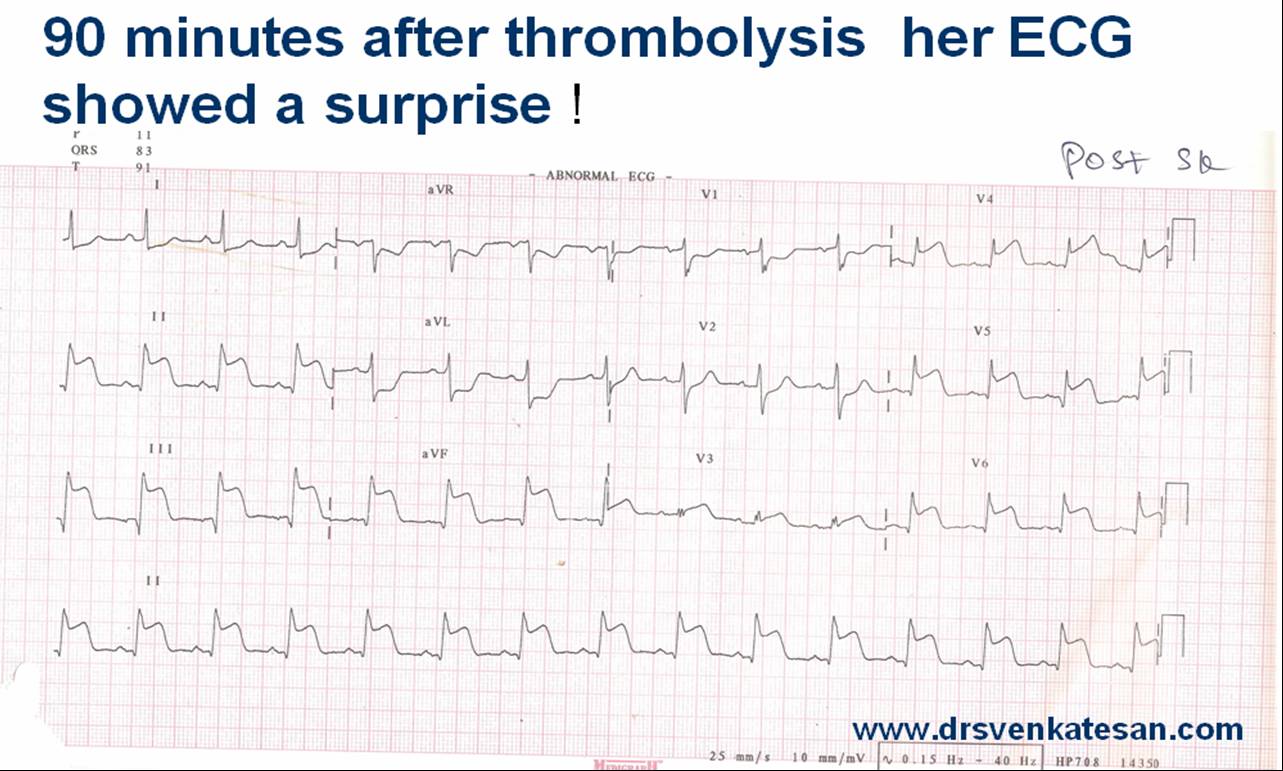
Here is a case history and ECG of a  patient with STEMI .

After thrombolysis , the paradox happened . ST elevation  increased by 4mm and soon the patient became restless with worsening pain and became silent instantaneously ,  with monitor showing EMD and asystole .A diagnosis of free wall rupture was made.

What we used refer  in our CCU (Madras medical college Chennai .One of the oldest CCU in  South Asia )

as   “Action pontentialisation”  of surface ECG . This ECG finding has  great  clinical significance .

Here is a zoomed up view of a qrs complex of  the patient , which is very

closely resembles an action potential

Picture courtesey  http://ocw.tufts.edu/Content/50/lecturenotes/634488/634591

Pathological basis of  “Action potenial”  Like ECG

  • When the ST elevation is huge and wide it mimics  an action potential .
  • Myocyte action potentials are normally recorded epicardially in physiology lab where a  micro electrode with glass pipettes directly enter the myocyte.
  • A giant ST elevation and a sustained dome indicate , the quantum of  electrical injury is  very large and the  ECG electrodes is picking up the myocyte electrical events like that of a intra cellular electrode.
  • It is to be recognised  ,  ST elevation in chest leads is substantially taller than limb leads   because the exploring electrode  is located just above the myocardium . But,    when a  huge  ST elevation  is recorded  over a limb lead (as in this patient )  one can imagine ,   how intense the electrical  charge  of  the myocardium  should  have been  !

This heavy downpour of electrical energy that  emanate from the myocardium   means two things

  • The area of infarct is very substantial
  • The tissue in question is  very unstable .

Clinical correlates of  action potential ECG

  1. Damage is transmural , the   infarcted area is soft, friable and often hemorrhagic .
  2. The pericardium is also  likely to get involved in the injury process .
  3. The myocardium is  rupture prone or already torn .
  4. Even minor hemodynamic stress can be fatal in these patients
  5. An episode of vomiting, a fall in blood pressure,   an episode of  LVF or a short run of VT is suffice  to result in a fatality.

The death happens by a sudden rupture ,  EMD and asystole .

Can a life be saved  by the much fancied Emergency PCI  ?

Not really. The PCI  can not reverse the myocardial damage ,  so it’s role is little . But , any way it should be done and  .  .  . it  will  be done  in most institutions to give the benefit of doubt (Of course , with  a definite the risk of doubting  !)

What is the risk  of  PCI in these situation ?

The infarct related artery * if opened up can convert a bland infarct into a  “angry red”  hemorrhagic  infarct .This   is as good as  giving  the patient ,  a  farewell  party for his journey to heaven !

Note : Primary PCI  definitely  saves life in STMI . The  * is applicable only in persistent ST elevation , late after an acute MI.

How could  have the above death prevented ?

As one of the comments to this article  suggested, we need to have methods to identify impending rupture early and accurately .This should  followed by a prophylactic  surgical intervention (Reinforcing the friable myocardium – with a patch or mesh  )  .This is again not  a easy decision to make .

Final message

When the ECG  assumes  a shape of an  action potential ,  it is often a sign of  imminent  death  . Even though it may sound a pessimistic  view  it is often the truth  . Of course , an  emrgency PCI or  CABG  are  the only options available , we have  to be remember the above truth  ,   as we   play  those sophisticated  games  within their coronary arteries.

Read Full Post »

As the name suggests   dilated cardiomyopathy  would imply  cardiac chambers will dilate , at least some time in the course of the disease .It can be minimal, mild or massive. A new entity called  non dilated cardiomyopathy is also gaining wider acceptance . (That will be dealt seperately )

Logic would suggest , the first chamber to dilate in DCM  should be the left ventricle because it is  facing the direct load of systemic blood. But we also know , whenever  LV is stressed , left atrium comes to it’s assistance .

Left atrium does this    by total self sacrifice ( by all  means!)  increases  it’s  force of contraction, elevating it’s  mean pressure or even increasing it’s rate (AF) .

Like most  other critical questions in cardiology  ,  the factors that determine LV dilatation in DCM ,  is  also poorly understood !

  1. Is it the after load ?
  2. Is it the  muscle mass ? or it’s turgid  or flabbiness ?
  3. Is it the interstitial integrity?
  4. Is it the blood volume ?(LVEDV ,  LV residual volume )

When the issue is complex , it is  usual  to  make the   the unknown  genetic defects  ,  the scapegoat !

As of now the most important determinant of LV dilatation  could be  the behavior of the desmins, the gap junctions and myosins the titins etc

If  the LV of a DCM patient  refuses  or  resists  dilatation what  might happen ? Is it good or bad for the patient ?

Here is a catch .  A  LV  that does not dilate  obviously should be  be good for the patient  is in’t ? Medicine is not that simple.

When   LV  fails to  dilate  it means it has become  too  stiff and rigid    and pass on the  burden to  to LA which  faces the music. And in the process it dilates.This is the reason , we  observe  diastolic dysfunction in vast number of DCM patients.( Currently it is estimated > 75% DCM will have significant diastolic dysfunction )

So , now we can imagine how complex the sequence of hemodynamic stress in DCM that determine the chamber enlargement.( RA, RV  dimension in DCM is a separate issue !)

So now answer this question :  Which chamber dilates first in DCM ?

  1. Left ventricle
  2. Left Atrium
  3. Any of the above
  4. Both of the above dilate simultaneously

The answer must be 3 .

Why  recognising this sequence of  chamber enlargement  in DCM   is important ?

  • It gives us an opportunity to assess the dominant mechanism of LV dysfunction.There are reports , where some  DCMs  have more diastolic dysfunction than systolic dysfunction  .This will have important therapeutic implication.Further , many of the infiltrative   disorders of LV can have features of both DCM & RCM .
  • When a RCM begins to dilate it is usually  a harbinger of terminal heart failure. But,  it need not be always true .  A small restrictive LV  , when  dilates ,   may acquire a  slightly improved diastolic properties , as the  LV becomes more placid . And ,  if it happens the LA size may regress.
  • The role of LV restriction devices like, Acron mesh, Dor procedure, plication  in refractory  DCM is not well defined. All these   modalities actually  adds  a small dose of diastolic dysfunction in these patients who have grossly dilated ventricles. This fact is  very important  , as presence of any preexisting  significant diastolic dysfunction in DCM makes  the role of LV restrictive devices and surgery a big question mark !

Read Full Post »

Magnesium is a powerful cell membrane stabilizing agent. It is well recognized to act on the cerebral motor cortical cells and  suppress seizure , especially in eclampsia of pregnancy .

Mg SO4 is still the drug of choice for seizures of pregnancy. It  was soon realised  ,  the  molecular basis of  cellular excitability    is    similar  for  every cell  . And  thus , we got this  great antiarrhythmic drug !

  • Magnesium is a  cofactor in the enzyme Na /K ATPase in the myocyte cell membrane
  • Integrity of this enzyme is essential for proper maintenance of the intracellular potassium levels.
  • Many times hypokalemia can not be  fully corrected by administration of K + alone .
  • Co- administration of magnesium  increase the intracellular K +    and hyperpolarize the cells and make  it less excitable.
  • Further , magnesium competes with ca++  ions  to enter the cells and thus   it is a natural calcium blocker. This property also helps in controlling refractory calcium dependent  cardiac arrhythmia.

Indications for magnesium

  • Torsades de pointes . Note:  Magnesium does not shorten the QT interval significantly but still effective in torsades.
  • Any refractory VT especially , post MI.
  • Digoxin induced , hypokalemia dependent atrial tachycardias, MAT

It is administered 1-2mg boluses of 2-3 boluses.

Where we should not use magnesium ?

Routine Use of magnesium in recurrent non sustained VT following MI is not recommended .(Courtesy ISIS -4 trial )

Reference

http://www.ncbi.nlm.nih.gov/pmc/articles/PMC1368485/

Magnesium : Nature’s own calcium blocker

http://www.ncbi.nlm.nih.gov/pmc/articles/PMC1368485/

ISIS 4

Some think ISIS 4 was a delibrate attempt to defame magnesium !

Read Full Post »

Persistent ST elevation is the  general technical term for  failed thrombolysis.Regression of 50%  of admission ST elevation is the required criteria for susccesful thrombolysis .

Thrmobolysis fails in about 40-50% .

Main determinant is the timing of thrombolysis – not the thrombolytic agent ! do not get carried away with all those curent hoopla  about Tenecteplase stuff

If we take 100 patients with persistent ST elavation 90-95 will be in anterior LAD territory .

This is a stunning a cardiology secret no book of cardiology address . . . Implication of which could be very significant . Primary PCI  will always struggle to  prove it’s superiority over thrombolysis  in the right coronary artery .(Note LCX STEMI is different , infact it is more tricky than even even LAD .This issue will be addressed seperately in my blog.)

Read the following link  for  answer to the title question .

How common is persistent ST elevation in inferior leads following STEMI ? https://drsvenkatesan.wordpress.com/2008/09/22/why-thrombolysis-rarely-fails-in-right-coronary-artery/

Read Full Post »

It is a well known fact  ,   CABG and PCI  provides immediate relief  for patients with angina ,  which is refractory to medical therapy. Of course , this happens only if a critical occlusion of  at least one epicardial coronary artery is  opened . It need to be realised ,  angina  due to  microvascular  disease can not be cured by maintaining  epicardial  patency .

While angina  relief is prompt ,  dyspnea is not ! . If we  believe,  opening  up a  coronary artery  in a patient with LV dysfunction will  restore the LV function  ,  it  is grossly mistaken !

Why is it so ?

Angina  relief requires  simple  restoration  of  oxygen supply and correction of local ischemia .  This happens without any issue as the blood  seeps in to the ischemic cells and soothes the ischemic nerve fibres that trigger the pain signals   . While  ,  for LV function to improve , the blood flow has to be converted to mechanical activity in the form of myocyte actin/myosin interaction. For this,   there need to be an intact  cellular contractile mechanism . The myocyte architecture should be appropriate .In post MI ventricles we know there is  zig zag  orientation of myofibrils due to myocyte slippage that interfere with mechanical recruitment . Further , integrity of  extracellular matrix  namely the collagen frame work is also vital . Note ,  angina relief  is not concerned with any of the above .

And now ,  we also realise  dyspnea  in failing ventricles  is vitally  dependent on diastolic function ,  which is also very much  impaired in ischemic DCM .There is little proof for  PCI/CABG  to correct the  molecular   mysteries in  diastolic dysfunction !

Dysfunctional LV means what ? (read the link )

It is a collection of  variety of myocardial tissues . Viz : Fully  necrosed , partially necrosed ,  ischemic viable, non ischemic viable, ischemic non viable, non ischemic non viable , Apart from this patchy necrosis, patchy ischemic, areas are common. Finally , necrosed segments   may  also be perfused normally by  spontaneous reopening of an IRA.

One can imagine the complexity  of events in these segments  once we do the  PCI /CABG . The response  is highly variable and unpredictable. The major concept we  , the physicians  believe or ( to be precise made to believe !) is  the  sanctity  devoted to  the viable myocardium .For  many us ,  it is considered a  holy  exercise  to identify viable myocardium in patients following MI and then revascularise them if  found to have significant viable myocardium (Atleast 20% of infarcted area )

A full 2 decades were lost or (shall  we   say wasted on this futile exercise !) as   we have since  realised most of the cardiologists do not follow this rule .

Now , even a scarred myocardium is revascularised in the hope of recovery .As such , we have reached a stage where  there is no contradiction for not doing a PCI /CABG   with reference to LV dysfunction.

Now every  patient  with post MI  LV dysfunction  is considered to  have  some amount of viable myocardium that is  fit   enough  for revascularization

Are we justified in doing  this ?

Many clinical  trials  have revealed  , the  recovery of LV function  in these segments  has not been consistent at all .

The most surprising discovery is  a viable myocardium need not  be ischemic   .It might get adequate blood supply either  from invisible collaterals or trickle of antegrade flow .  Hence an adequately  perfused myocardial segment can  still be   non contractile . This shatters the myth  that  revascularisation must have a dramatic effect on the recovery of contractility in all viable segments.

The other major finding is  ,  even ischemic   viable   myocardium ( documented by metabolic activities PET etc)  need not regain it’s original contractility  after the ischemia is fully corrected .

*reference for  both the above statements are available from variety of sources including real life experiences .(Type C evidence )

Final message

  • Do a PCI/CABG promptly for patients with refractory angina.
  • Never  advocate PCI/CABG  for  a primary relief of dyspnea .  (Never is a harsh word,  let it be  “use it  with caution ” ! and  the  patient  should be  revealed  the whole facts  about  what we know and what we do not know regarding the complex  hemodyanmic events  in  revascularisation   )

Counter point

If  the above statements are really true ,   How does PCI/CABG   help  relieving  dyspnea  and functional class  what is your answer for thousands of patients  with CAD and ischemic DCM who have greatly benefited from CABG ?

The answer could  be  simple , The revascularization  piggybacks  over the   medical management (which , these patients pursue vigorously)     like  ACEI,  statins, salt restriction, betablockers  , optimal diuretics and tend to hijack the credits from the poor  drugs !

Read a related blog

Revascularisation for ischemic DCM

Read Full Post »
Acute MI is a major medical emergency encountered in ER . Prompt adminstration of thrombolytic agents or rapid   triaging for a  primary PCI   may be required . The whole concept of management of STEMI  revolves around time as a therapeutic   target .Every minute counts . The beneficial effects of  reperfusion   and the resultant  myocardial salvage  rapidly declines over time . Hence ,  the symptom to door time  remains the ultimate determinant of  outcome in most situations.

So , estimating the  time window of  “Symptom to door time ” becomes an all important parameter. This is often done by paramedics .

The apparently  simple  job  measurement of time window  can be  misleading at times especially in elderly, diabetic and alcohol abusers .

When  a patient  says he has chest pain since yesterday straightaway he is excluded from reperfusion strategies as 12 hours  would have elapsed

When a patient  describes  chest  pain since two days , but  more intense  only since today morning what does it imply ?

  • The first episode of pain could  either  preinfarction angina or infarct
  • The second episode of pain could again be the continuation of same  angina or conversion of that angina into infarct

So ,  calculating the time window  when a  patient has recurrent episodes of angina prior to an MI is a real difficult issue.For the benefit of doubt, we have to take the last episode of chest pain  which was continuous and more severe as the infarct pain.

How does ECG help to time STEMI ?

When it is difficult  , to differentiate pre infarction angina from infarct pain, the ECG may give  useful clues to time the STEMI.

  • Degree  ST elevation
  • T wave inversion
  • Q waves

Among the  above three ,T wave inversion is most useful to time an infarct. If T wave begins to invert, it can generally assumed the acute  infarct process is  almost complete . Q waves are less reliable  to time a acute MI as ischemic stunning can in the  very early phase of STEMI   inscribe a q wave over the infarct territory.

How will you time a STEMI in silent MI ?

There is no symptom to door time in patients with silent MI . Many do not even reach the door , for the simple reason there is no symptom that drives them to hospital. Those who are refered  have vague non cardiac symptoms and incidental ECG  which shows STEMI like changes. Here , the decision to thrombolyse is taken entirely on the basis of ECG *finding .

Note : Cardiac enzymes are can also be  used  to  diagnose  to estimate the time window .

Read Full Post »

Ectopic beats , other wise called premature depolarisaton are one of the common ECG abnormalities  diagnosed by physicians.

  • Atrial premature beats (APDs)
  • Ventricular premature beats(VPDs) 

APDs and VPDs  form  the bulk of all clinically important ectopic beats.

Heart has a specialised electrical conducting system , every cell in this system is capable of firing on it’s own. But why then only the atrium and ventricle produce ectopic beats .Other structures like AV node, His bundle , purkinje are relatively rare to produce ectopic beats .

Is the AV junction relatively immune to develop JPDs?

The answer to this question would be  “May be yes” . Yet, we need to recognise they may not be as rare as we think , many times we fail to  diagnose  it or rather recognise it !

Certain observation about Junctional premature depolarisation are made .AV junction has unique properties than any other parts of the heart.The basic purpose of AV junction ( AV node is not a preferred word as it has no anatomically distinct demarcation)  is to apply a electrical break on the incoming electrical signal .Nature does this with a purpose .   It is essential for the ventricles to fill adequately . We call it as PR interval.

So, when the basic purpose of AV junction is slow down the conduction it is logical to expect it won’t get irritated that  easily  and  result in ectopic beats. So JPDs are less common than other forms of ectopic beats.

What is invisible JPD and HIS ectopics ?

We should realise many of the JPDs  & his bundle ectopics are not conducted ,  the impulses simply dissipate down hill .  Unlike the atrium and ventricle the junctional and his tissue has no associated chambers to depolarise , hence they are not  often visible in the surface ECG.The only evidence in the surface ECG may be an unexpected pause which represents concealed conduction. A EP  study  of the bundle  ECG often unmask these silent JPDs and His VPDs.

 JPDs are  less common  , while  junctional escape beats are the  hall mark of any  severe supraventrcualr bradycardia . How  does  that occur ?

AV junctional cells have  an unique behavior in that , it comes to the rescue of the heart whenever the native SA node becomes too slow  . This happens as a passive response .We call this as junctional escape beat.The major difference between a JPD and Junctional escape beat (JEP or JED )  is in the initial timing of the beat . Escape beat comes late .The coupling interval of escape beat (We generally use coupling interval for ectopic beats only , but  it helps to understand )  will be longer than the previous sinus cycle. So escape beat is never premature (Rather a  post mature beat !) .Ectopic beats are always premature ,( except Interpolated ) and occurs earlier than the next anticipated beat.

The other difference is escape beats are tolerated well as the primary purpose is to rescue back up.Their rate is generally equal to the  intrinsic rate  of AV junction ie around 40-50.

General characters  of  Junctional  premature beats and tachycardia

  • Fortunately rare,  fires at a  higher rate.(Unlike junctional escape beats )
  • Enhanced automaticity is a common mechanism
  • Reentrant JPD is rare , unless the patient has AVNRT or it’s variant  physiology.
  • Manifest as narrow qrs complex . JPD with aberrancy is distinctly possible .In that case differentiation from VPD may be difficult.Retograde  P wave morphology may help.But it is non specific as VPDs also have varied atrial capture depending upon the VA conduction .
  • Causes include Hypoxia,  (Rarely ischemic junctional tachycardia. ) common causes include  digoxin induced , post operative states, incessant JT
  • JTs are Difficult to control.Overdrive pacing may be needed. May lead onto tachycardic cardiomyopathy.
  • A benign form of junctional ectopic tachycardia is also reported .

Importance of Junctional escape rhythm

The role of AV junctional escape is vital in extreme bradycardia , as if the junction fails to escape the dangerous ventricular cells take  over  electrical control  and that’s  bad news for the heart  with  sinister consequence.The situation can rapidly degenerate to VT  , what we call  as phase  dependent or brady dependent VT. The treatment for which is increasing the proximal heart rate. By isoprenaline or pacing. So the AV junction does  a delicate balancing act .At times of tachycardia it blocks unnecessary impulses.At times of extreme  bradycardia it assists the heart as escape rhythm . The problem here is many of the disorders that affect SA node , affect the AV node as well .So ,  AV node may not be able to help the SA node always.That is the reason many extreme myocardial end up with VT straightaway.

Final message

JPDs are not very uncommon as one would believe.It has some unique properties. There are vital difference between JPDs and junctional escape beats.JPDs can trnasform into JTs in local pathological milleu and as a rule they are difficult to control.

AVNRT is also a type of  junctional  tachycardia  but,  it  is delinked from  the ( unofficial  ! ) classification of JT  , not  with  any  academic purpose  but by tradition.

Read Full Post »

« Newer Posts - Older Posts »