Feeds:
Posts
Comments

Archive for the ‘Uncategorized’ Category

Mystery  surrounding  the Inherited cardiomyopathies are  getting  unraveled . Now ,we have  a unique entity of cardiac muscle disease due to  Desmoplakin mutations which affects the  cardiac intercalated disks.  They are Naxos disease and Carvajal syndrome.

Source : Wikipedia

Heart has a skeleton too

We know skeletal muscles   need  a bone for its attachment   . If  we  think cardiac  muscle can work independently . . . we are mistaken !

Heart is not a simple mass of muscle.It has a fibrous skeleton around which the muscle is spun around. Myocytes  not only  need to stick with one another,  it has to  be packed over the cardiac fibrous skeleton systematically.

The cardiac  gums that do this job need to  be under strict quality control . After all ,  these muscle sticking proteins  need to be serviced constantly  throughout life span of heart. It is  simple to understand ,when there is  breakdown of this process  , protein  to protein disconnection  takes place  . It results in  cardiomyopathy.

Thus many of the  cardiomyopathies are  not  primary  disorder of cardiac  myocytes as such . They can be termed as disorder  of myocyte adhesion to cytoskelton.

These  present as cardio cutaneous syndromes .(Skin share similar adhesion molecules)

Carvajal syndrome

This is due to mutations of plakoglobin  family of protein . Involves desmoplakin ,  a defective desmosomes and disruption in myocyte adhesion  which  promote  abnormal myocardial stretch ,  dilatation  later fibrosis  and progressive cardiac failure. Non compacted LV can be a feature in carvajal syndrome. Recurrent VT/VF demands an early ICD therapy.

Natural history

  • Woolly hair at birth
  • Cutaneous changes at appear at  the age  of one year.
  • Cardiac involvement  occur in adolescence
  • Can overlap with ARVD

How  is Carvajal syndrome   different from Naxos disease.

It has

  • Predominant LV involvement.
  • Fatty infiltration uncommon

Reference

http://www.ncbi.nlm.nih.gov/pubmed/14761782

http://circ.ahajournals.org/cgi/reprint/116/20/e524.pdf

From cell biology to Inter cellular biology

For over a century biologists were concentrating  research inside the  human cells .Now we are more interested in the inter cellular planes. It  remains an ultimate mystery how the zillions of  cells are sticked together in an orderly fashion  without fighting each other with a  perfect anatomical and physiological harmony.

Understanding the molecular  basis of cell adhesion will  help us decode the pathological states   in which  inter cellular  disintegration  is the hall mark !

A review article on the topic.


Read Full Post »

Coronary artery stenting  , many consider  as the 2nd revolution in cardiology after   the invention of  cardiac catheterisation .  Millions of angioplasties  take  place  world wide every year .  Suddenly it would appear that medical therapy  was forcibly  thrown  out into the  bin .This in spite of  the fact there is no  major difference in ultimate CAD outcome in the long term between PCI and medical  therapy in chronic CAD.

The COURAGE trial which gave a renewed lease of life to medical therapy , was  severely criticized by the interventionists. 5 years after the COURAGE  the inappropriate stent usage continues unabated.

The term inappropriate usage ,  some how undermines the seriousness of the issue.  Few realise  the fact , inappropriate usage  actually amounts to  mal-practice or  an act of  medical  negligence (Guideline  violation)   which deserve  a strong  condemnation .

The general media is just been exposed to the tip of the Iceberg  (Not even the tip !) At least in USA and other developed countries  they  have systematic data  about  the usage of stents. In a country like India  . . .less said is better. There are many  like  Dr Mark  Midei  camouflaged  in every country.

More pro active Media is required like the ones below.

Read Full Post »

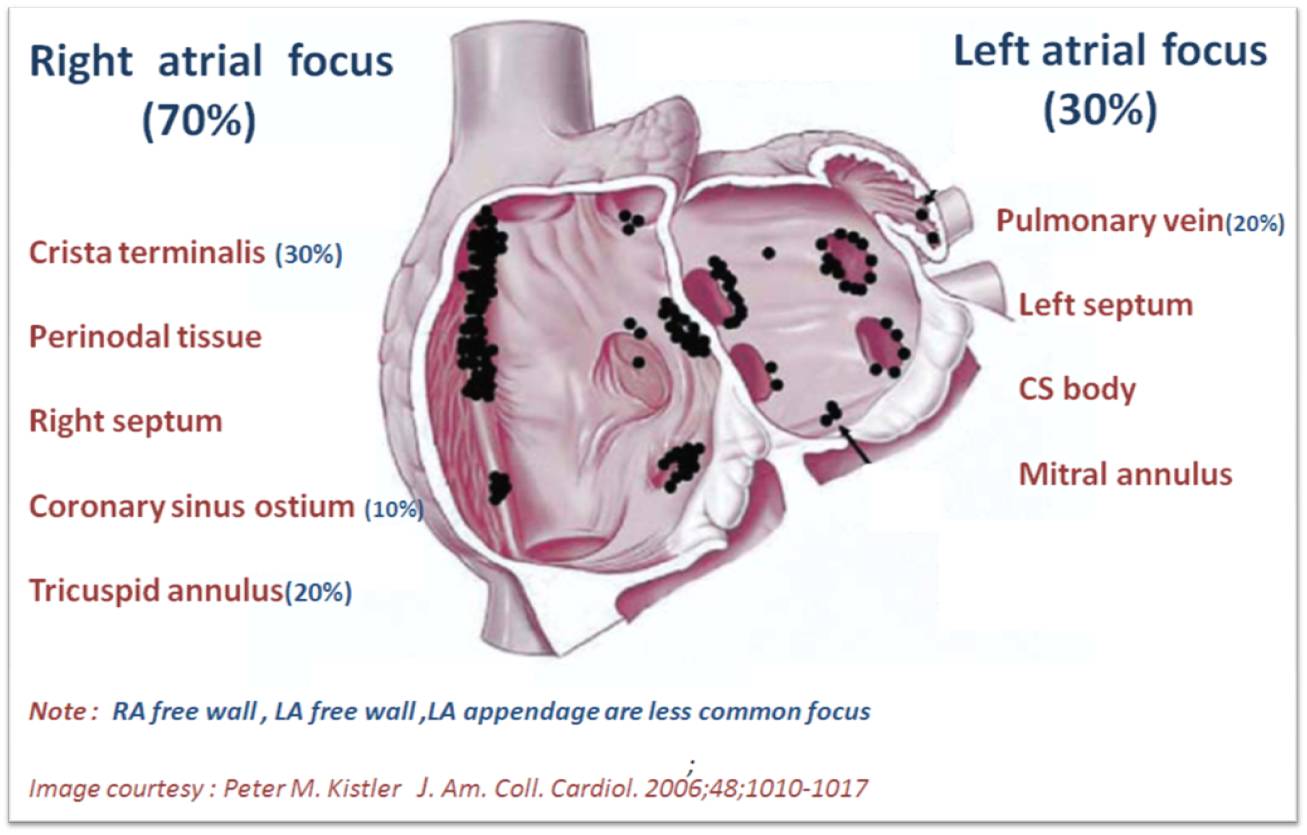
Human atria is a rough terrain infested with peaks and  troughs like the  Himalayan range . The two atria together has a minimum of ten entry or exit points . Cardiac arrhythmias are   something similar to the  uneven  earth plates  triggering an  earth quake.  Like the earth surface there are  areas in the atria  with high seismic activity !

It is now discovered there are nine vulnerable points in human atria that can initiate focal electrical activity at times of hemodynamic/ischemic/metabolic stress .

The common causes for Focal /Ectopic atrial tachycardia are

  • Hypoxic AT -COPD ( Probably the most common cause .If persistent it will degenerate to MAT- AF )
  • Structural atrial disease
  • Hypertensive heart
  • CAD
  • Valvular heart disease
  • Drug induced

Note ,  all these  vulnerable points are located either in the  junction of  an anastomosis  with a venous structure or valve or septum.

Further, these sites are often the  embryological fusion points making it still more vulnerable due to tissue defects.

Why free wall of atrium  is  a less common  focus ?

They are relatively smooth, lack ridges and joints. Unless the walls of atria are diseased  focal tachycardias are less common from these sites .

Other forms of Focal atrial tachycardias

Indian perspective  and Rheumatic atrial tachycardia.

In developing  countries  focal atrial tachycardia in rheumatic heart  differ very much from the tachycardia described above. In fact many of the rheumatic atria present straight away  to atrial flutter or fibrillation.

Pulmonary vein focus should rarely be considered in atrial tachycardia that occur in RHD.

Post operative tachycardias

Surgical scars can result in what  is called  Incisional tachycardia.(Especially after complex atrial  surgeries like Sennings, Glean/TCPC  etc )

Multi focal atrial tachycardia .

This is nothing but a focal tachycardia which tend to fire from different angles towards different targets  often lead to a chaotic atrial rhythm .  Digoxin and DC shock paradoxically aggravate this arrhytmia.

Atrial epicardium/pericardium interface as a focus

When pericarditis is the predisposing  event  then it can emanate from anywhere from  epicardial surface .

Since left atrium is only  partially covered by pericardium it is not logical to assume pericarditis related AT arise from RA epicardium.

Atrial tachycardias in congenital heart disease.

Complex atrial anomalies, SVC type ASDs, PAPVCs can  give raise to abnormal  electrical focus

Reference

An excellent original work from  Royal Melbourne Hospital, Melbourne  Australia.

A must read  . . . http://content.onlinejacc.org/cgi/reprint/48/5/1010.pdf

//

Read Full Post »

Is there a ECG marker for recent syncope ?

Yes . This was classically described many  decades ago. Following a Stokes -Adam attack  when the patient recovers from the loss of consciousness a peculiar ECG pattern was observed.

A typical ECG from our CCU

The mechanism is not clear.It can be due to

1. Repolarisation abnormalities due to ischemia.

2.Acute adenergic surge triggered  due to  transient   cessation of circulation* .

3.CNS  injury  and extreme  vagal with drawl

4.Hypokalemia

* Thought to be the major mechanism

Out come

The ECG is more dramatic .The physician is usually more tense than the patient !

It  is often  benign .Prompt pace maker implantation is required.

Reference

Read Full Post »

Reporting a coronary  angiogram  may look like child’s play  for most cardiologists. Many do it in less than a minute. (It goes something like this  90 % LAD , 30 % ostial OM1, 50 % mid RCA etc etc ) The famous and meticulous  classification of Ellis and Ambrose proposed  two  decades ago appear largely redundant.

In this review we shall  briefly  debate an eccentric plaque or lesion .

Pathological definition

Pathologically  an eccentric lesion  will have a disease free arc  within an  atherosclerotic lesion.If we apply this criteria most of the plaques appear to be eccentric.

Angiographic definition

In simple terms  eccentricity is  said to be present when the plaque  volume is three times more on one side when compared  to opposite side .

The incidence of eccentric lesion is largely under estimated.  It can be up to 40 % of all lesions.

It has histological  as well as  hemodynamic  significance.

How to measure eccentricity index ?

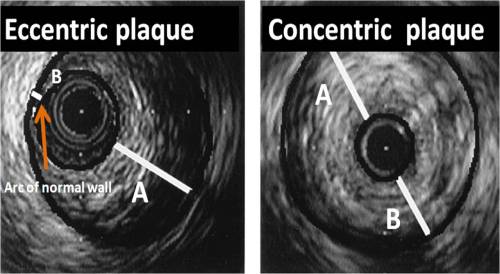
Ratio between maximum plaque thickness and minimum plaque thickness (Including the media )

Image courtesy modified from Circulation. 1996;93:924-931

In the above figure : The eccentricity index is measured  as the ratio of the maximum  to minimum plaque plus media thicknesses. In the eccentric lesion  the maximum wall thickness measures 2.6 mm, minimum wall thickness measures 0.2 mm, and eccentricity index is calculated to be 5.2.  In the  concentric lesion  the maximum wall thickness measures 2.2 mm, minimum wall thickness measures 1.6 mm, and eccentricity index is calculated to be 1.4.

What are the associations of eccentric plaque ?

Calcification and hard plaques are more common in eccentrically placed plaques.The  most vulnerable point for plaque  rupture or disruption is  the shoulder region between normal and plaque segment.

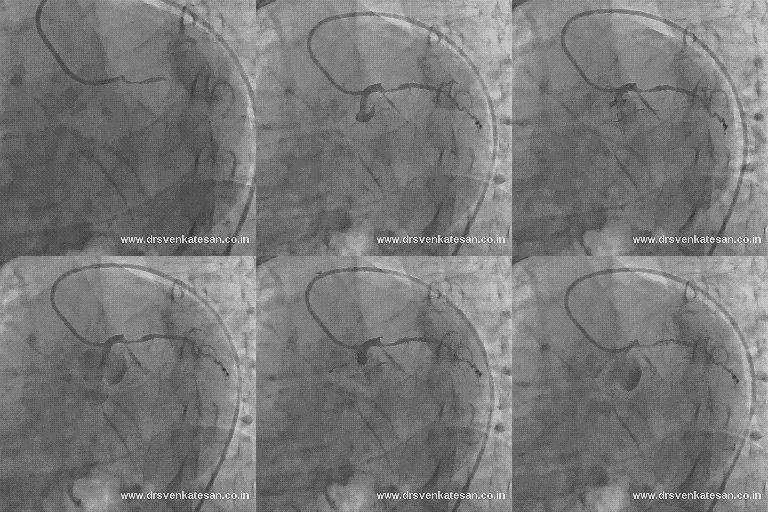
A long eccentric lesion with over hanging plaque


Clinical implications

  • Acute recoil
  • Coronary spasm
  • Mechanical effects : Asymmetric expansion of stent
  • Drug eluting stents

An arc of normal plaque circumference predispose to acute recoil and spasm.this is logical as the normal  arc will have a fully functional  medial smooth muscle  which are prone for spasm.

Does stenting reverse  the eccentricity of plaque ?

It may not .  The drag effect of major plaque mass may either result in plaque prolapse or  asymmetric stent approximation  or even stent crushing effect.

How does the  the stents  elute in an eccentric lesion ?

Stents are not intelligent enough to  differentiate  the plaque surface and normal surface. We  also know these drugs are  toxic to  normal endothelium  and hence  are not welcome in the normal arcs of an eccentric lesion.

Since the drug secretion   is uniform throughout the circumference   it makes the   DES a perfect misfit in eccentric lesions  As  we  realise most of the lesions are pathologically eccentric one can guess the long term  consequences .

Final message

The more we think we know . . . the less  is understood .

The images we see daily in cath labs are too simplistic to make vital decisions .There are  constant innovations coming up but none seems succeed in  imparting  common sense to  majority  us.(Namely  direct plaque intervention can never succeed over a diffuse medical  disease called atherosclerosis  )

A good reference article

http://circ.ahajournals.org/cgi/content/full/93/5/924

Read Full Post »

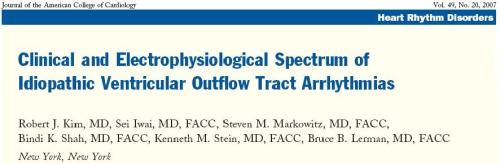
A well researched article on a difficult topic. By Kim et all from Cornell university , New york.

A must read by all cardiologists . The link is placed with the courtesy of Jacconline

http://content.onlinejacc.org/cgi/reprint/49/20/2035.pdf

After reading this article   one  should be able to answer the following questions.

  1. What is Gallavardin VT ?
  2. Classification of RVOT VT
  3. How a non sustained VT becomes a sustained one ?
  4. Why some VTs cause syncope ?
  5. What is the association  between idiopathic VT and Idiopathic VF ?
  6. How does exercise  trigger a  VT ?
  7. What do we mean by structurally normal heart ?

Readers are encouraged to post link to good articles on this topic.

Read Full Post »

How to name  a ventricular tachycardia ?

This  continues to be a  favorite past & present  time of  modern-day cardiologists. Especially ,  VTs associated with structurally normal heart  suffers with this  protracted problem .Widespread use of  EP study has not solved the issue as yet.

The   VTs that arise from the left ventricle in an apparently normal heart   has been referred  by  various terms.

  • VT with structurally  normal heart
  • Idiopathic left ventricular tachycardia
  • Verapamil sensitive  VT
  • Septal VT (It can be either myocardial /non myocardial origin)
  • Narrow qrs VT
  • Fasicular VT
  • LVOT tachycardia
  • Hemodynamically stable VT
  • Belhassen VT

Now we have still more exotic VTs like Cuspal , mitral annular , etc . All of the above can mean anything , or same thing   in different centers  ,  different cardiologists in different times .

* RVOT tachycardias also have  many synonyms.( Adenosine sensitive, Adrenergic,  Gallavardin, Parkinson Pop, etc )

VTs associated with CAD , valvular , myocardial diseases generally devoid of  nomenclature problems. Ischemic VT  is yet to be classified in a proper fashion.

The confusion in classifying VT is  not due to the complexity of heart disease. It is due to  the general  comprehension failure as  every VT can be described with reference to clinical , ECG morphology, hemodynamics and presence or absence of underlying heart disease. A simplified and clinically useful VT classification is being prepared in this forum .Will be published shortly .

Read Full Post »

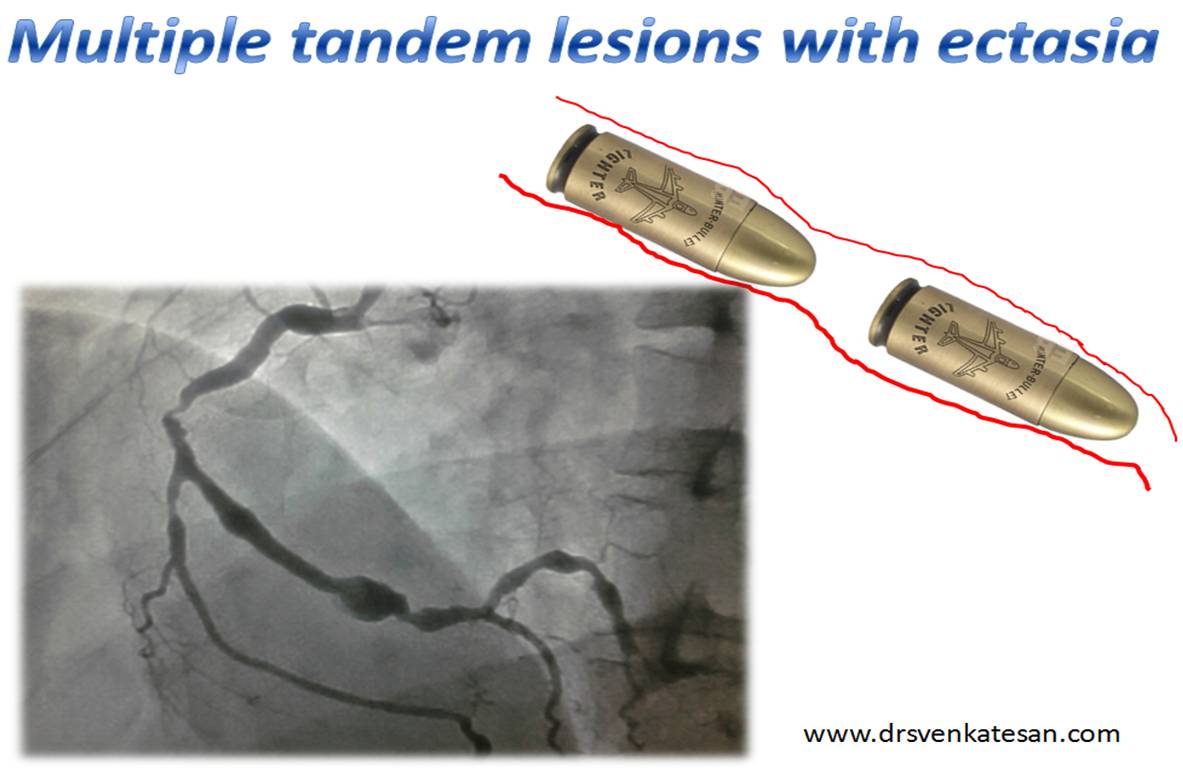
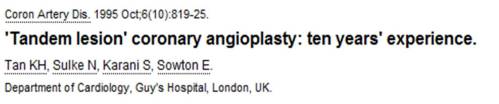
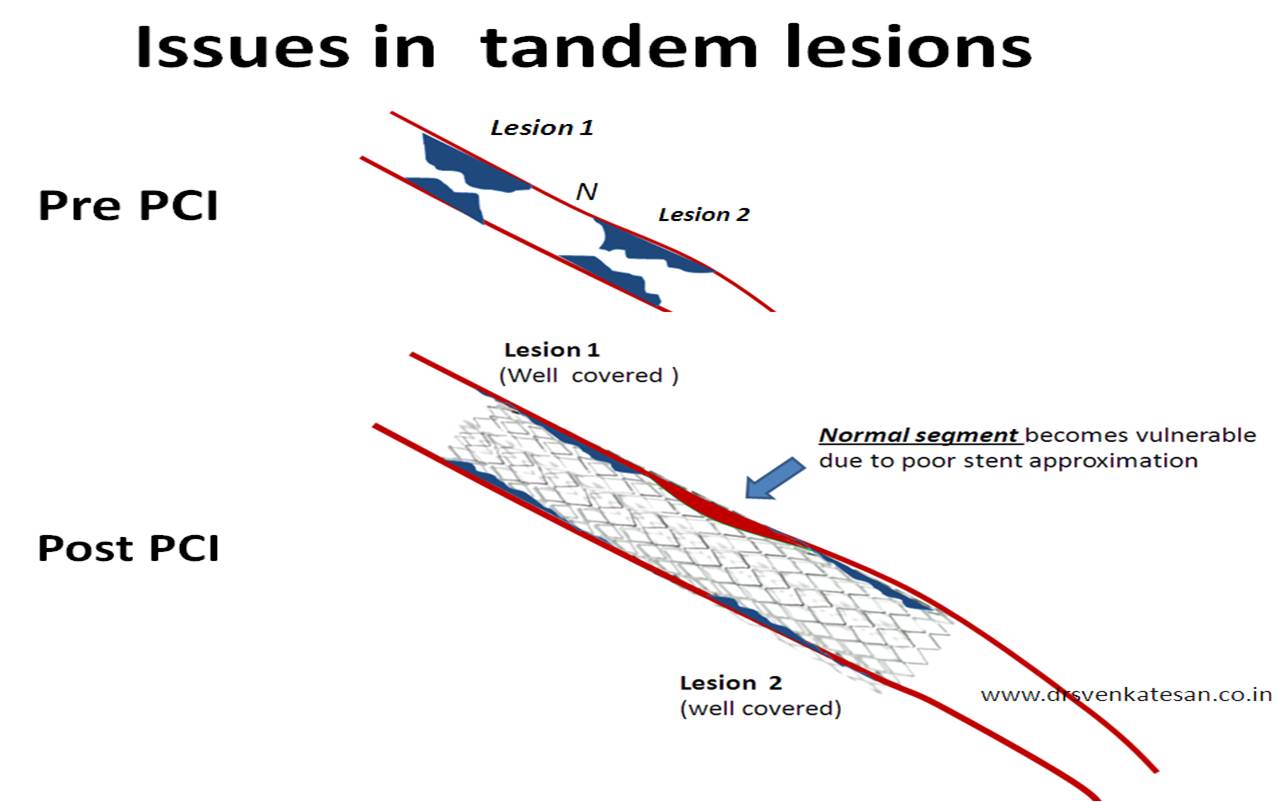
Coronary artery lesions can be classified by many types . The popular ones are by Ambrose and Ellis  .They are adopted by ACC and SCAI  .While various  terms  are  used to   describe a lesion. (diffuse, discreet , eccentric , long , tubular  etc) A tandem lesion is the one which has special significance , but is not well discussed in the literature .

A tandem lesion is  diagnosed when  two lesions  closely abut  each other one behind the other  with an  intervening normal segment. (Like the bullets loaded in a  tandem fashion  in a  gun )

Generally there will be at least  few millimeters of normal intervening  coronary segment.This is  referred to  as  connecting segment.

Clinical importance of tandem lesion

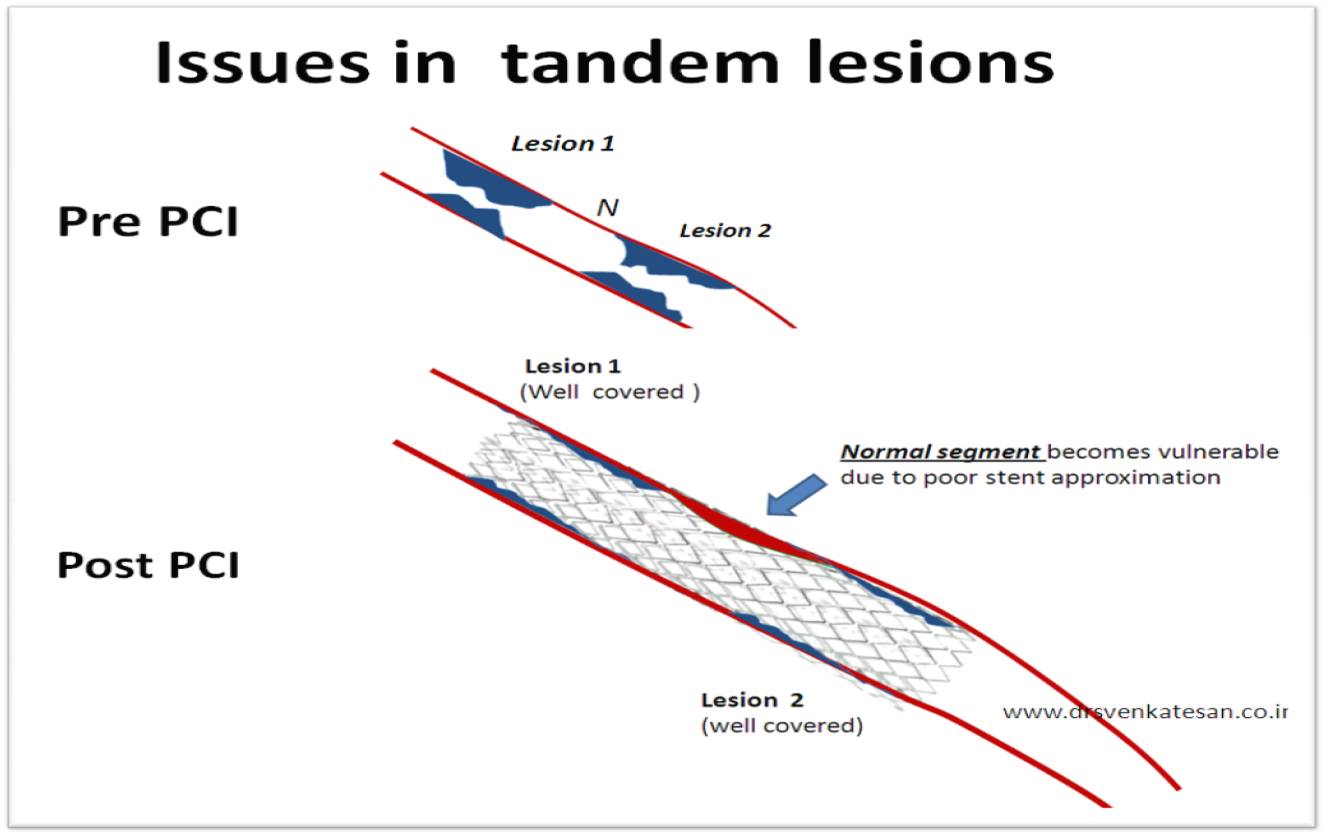
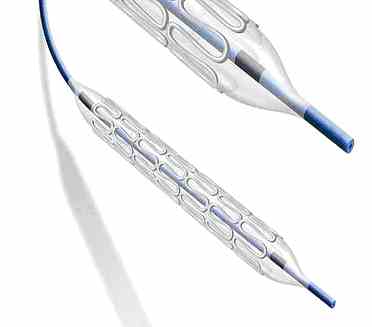
Tandem lesions  carry  the  same significance  like  any other lesion. But ,the primary aim is to tackle the two lesions with a single stent. We know stent edges are rheological culprits.  Two stents  have   4 edges. It is better to cover  the tandem lesions with one long stent* even if we have a sufficient  connecting segment.Geographical miss is less likely with a long stent.  In the strict sense one wold require an IVUS (Intra vascular  ultra sound ) to confirm the normality of the connecting segment. Tandem lesion is  a  marker  of diffuse atherosclerosis  and  the connecting segments often   show ectatic changes.

* This is a ironical as  the conventional wisdom would  tell us , lesser the  metal load it is better for our coronary arteries.But once we embark on a complex  intervention we just can’t restrict the use of stents. The more you put the more it will demand.There are some interventional cardiologists who convert the entire coronary artery in to a metal tube (With or without realising the consequences !)

Illusions of  tandem lesion.

Many  times ,  spiral folds  from a single  atherosclerotic   lesion mimics  a double lesion .This need to be differentiated from true tandem lesion.

What is the hemodynamic significance of  tandem lesions ?

Rules of hemodynamics  would  dictate ,  in a linear and laminar flow  model across a tube ,   immediately after an obstruction there will be a significant  drop in resistance.

This  forms the fundamental   phenomenon  within the coronary artery  . This explains the biggest mystery in cardiology . . .  How  the  TIMI flow is  maintained till 90 % of the  lumen is narrowed. This  also  explains the concept of flow limiting lesion .(Why  a coronary lesion do not obstruct the flow  till late stages  ?)

Does this rule on  hemodynamics  apply in tandem lesions ?

When a lesion is followed  by a lesion with little normal segment in between what happens ?

The blood gets a double jolt every time it traverses a tandem lesion. There  may not be sufficient time and anatomy for the mandatory pressure drop to occur. So for a  given degree of obstruction ,  tandem lesions  is likely to be   more thermodynamically significant than a single lesion.

Pressure recovery after  an obstruction is also incomplete , as the forward head of blood column encounters another hurdle even before it recovers from the initial turbulence.

Which lesion is more important   in tandem proximal  or  distal  ?

The distal lesion determines the thermodynamics of proximal lesion while the distal lesion as  such is  less influenced by proximal.

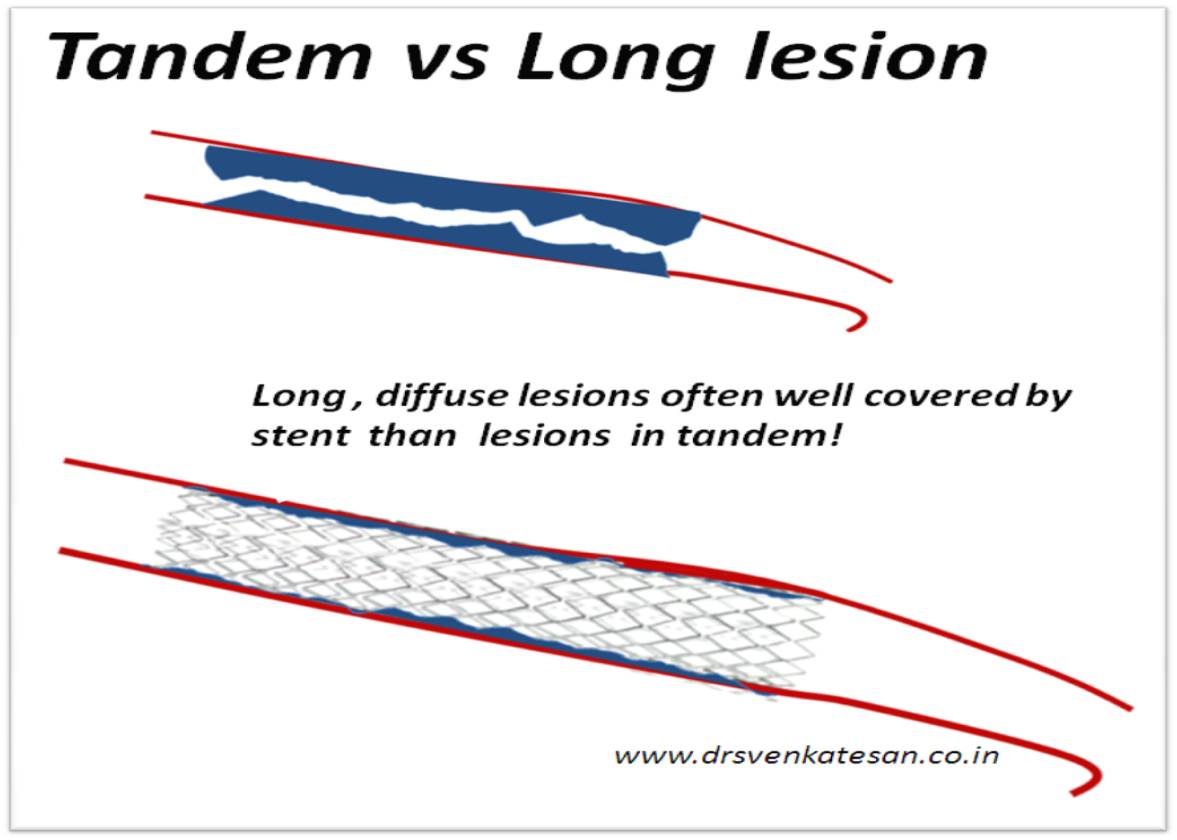
Long lesion vs tandem lesions


Some times it may appear ,  it is better to have a long lesion than  a two lesion  in tandem. This is because the stent will approximate more evenly .Further there is less likely hood of in -stent restenosis in long lesions as the   edge effect can occur  right in the middle of  the stent in tandem lesions .

Now it is increasingly realised, many of the sub acute thrombosis  are due to po0r stent approximation in tandem lesions or long lesion.


http://www.springerlink.com/content/g063752436617n51/

http://www.ncbi.nlm.nih.gov/pubmed/8789675

Read Full Post »

Time is muscle .This  may sound as  an old fashioned statement now ,  for many of us. But the fact remains. Every minute following  STEMI ,  myocytes  keep  losing it’s life one by one unless , the  intervened.

The prevention of myocyte death can be accomplished by three ways

  1. By early thrombolysis
  2. By Primary angioplasty
  3. The  one  that happens naturally by a process called spontaneous thrombolysis *

* Most have a  strong belief  that the  natural forces are incompetent to lyse a  small thrombus within our coronary  arteries  ( While  , we  fully  realise   natural  forces  like  the Tsunami can wash out  the entire ocean floors  ) . Never under- estimate the force of  nature !

Balloons are not privileged !


It is widely accepted , a time window of up to 12 hours is optimal for reperfusion. Beyond that time , there is no point in reperfusing  the muscle  as   it  might have died. While ,  the majority of cardiologists agree  to this and they  promptly  refuse  to thrombolyse ,   if the patient comes  12 hours after an onset of STEMI  .They are labeled  ” late on  arrival”  and  coded  as ineligible for thrombolysis.

The moment they are labeled as ineligible for lysis , a dangerous thought process runs across  the minds of  many cardiologists. It is  possibly  the most important paradox (Shall  we call it as sense failure ? )

Such lysis ineligible  patients    become  automatically eligible for primary PCI . . . It is curious  to note , the  time window for primary PCI is also less than 12 hours is strangely forgotten.

It has become a prevalent  practice  by all unscientific means  , most  cardiologists extend  the time window for primary PCI well beyond 12 hours  , some even up to 36-48 hours.  No wonder . . . then why open artery trial (OAT) miserably failed . Even a  novice  can predict the out come when  one tries  to resuscitate the  dead muscle .

Final message

Myocardium  does not behave in a privileged  manner  during a STEMI.  It  simply does  not bother  about the way  by which  it is going to be rescued and reperfused  .All it needs   is a timely help. It can not extend its   life just because it is being rescued by a  sophisticated modalities like pPCI.

If the patient is late for thrombolysis ,  he is late for  primary PCI as well .

Please do not change the time window in STEMI  according to  our  whims and fancies . It is  an  unscientific and unprofessional  way to practice cardiology .

Read Full Post »

Medical imaging technology is the fastest growing  sub specialty in medicine .Now,  we can image almost every organ in detail in our biological system.With capsule  endoscopy one can visualise deep interiors of intestines,  we can get into the coronary artery  by angioscopy.We can even image the molecular metabolism within the cells.

While  , we   feel elated about all these technologies , every emergency  physician  will awkwardly recall how difficult  it is  to  visualise a structure  , located  just few centi- meters  beneath our throat called vocal cords  .

I am sure more  lives are lost in this world by delayed and difficult  intubation than any thing else  in medical emergencies. Cardiac arrest can be tackled lot easier as the defibrillator is largely independent of  rescuer expertise .Intubation of airway is vitally  dependent on expertise.

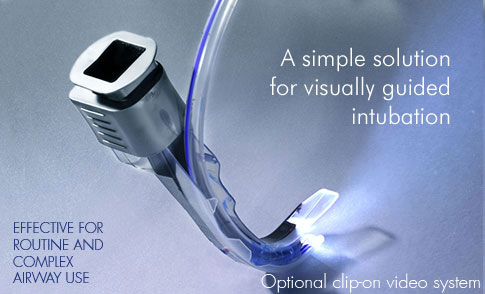
Click on the Image to reach Airtraq web site


When we are able to visualise the  deep segments of bronchus  with  fibro-optic scopy ,  why there has not been a  simple , practical ,cheap optical solution to the   superficial structure namely the larynx ? Human mind is too  funny ,  if  only larynx was deeper  our scientists  would have discovered such a  device very early .  Since it is just below the oral  cavity  no body  thought it is  worth to  discover a  scopy for that !

Now  the long wait is  over ,  we have a tool called Airtraq .There needs to be further refining of this device .

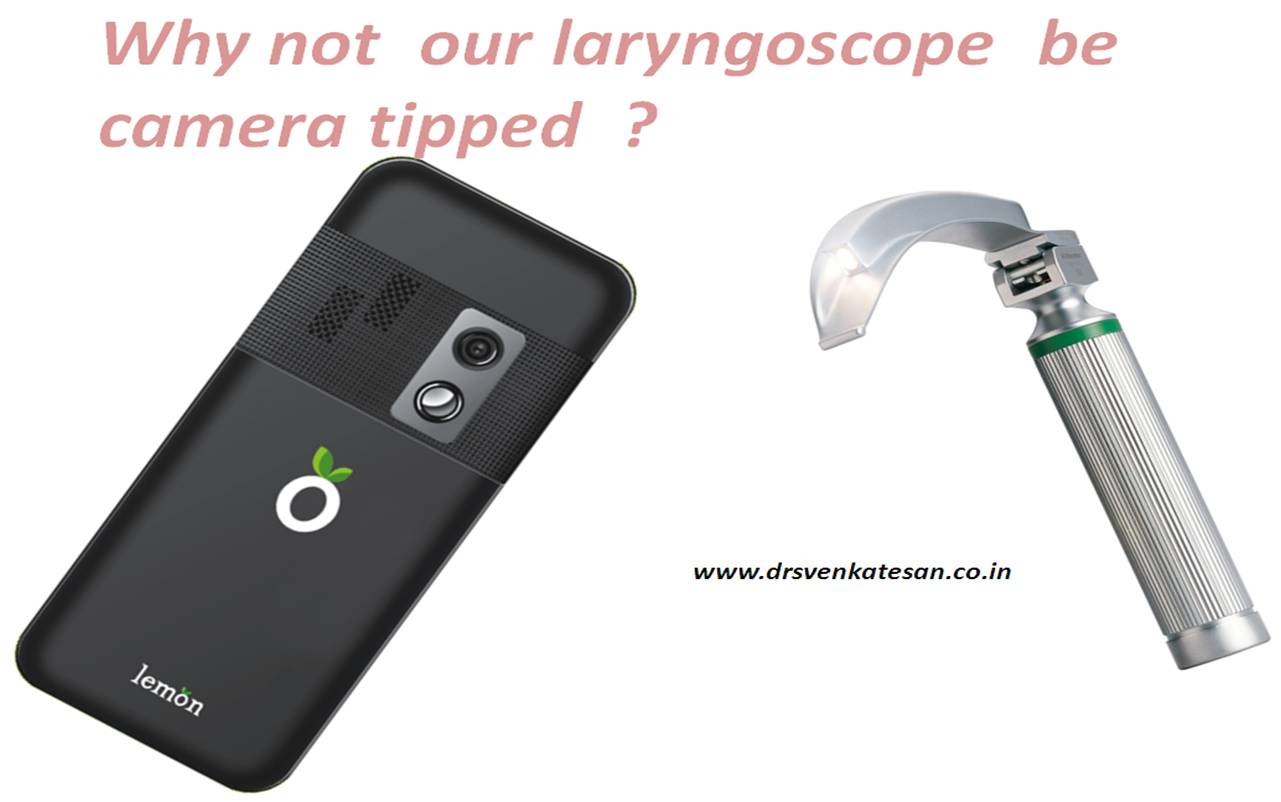
Is it possible for the tips of endotracheal tubes to  have  cameras  that  transmit  live images wireless ?  , which  can guide the tube   straight to the trachea .

We have twin cameras for our fancy cell phones while the life saving tracheal tubes are as blind as ever !

It is argued more such devices should flood the market . Every doctor and paramedical  worker should acquire one  ( Preferably  integrated to their phones ) Imagine if they  can beam the live pictures of the vocal card into their trendy  3 inch  screens of  i Phones . This could be the greatest revolution to occur in cardiopulmonary resuscitation .

(Airtraq please note this . . .I do not need a  royalty for  the  Idea !)

Final message

It  is vital for the   emerging technologies  , to be intelligently used  for the   betterment of our patients. When video  phones  calls transmit  live action  to  our mobiles  across the continents  ,   Is it not  funny we struggling    hard to get a good image of human vocal cords   that are  sitting  just few cm below the throat !

Let us think simple for complex problems .  Many breakthroughs  will automatically  happen.

Three cheers to the developer of this Airtraq device !

Read Full Post »

« Newer Posts - Older Posts »