Feeds:
Posts
Comments

Archive for the ‘Uncategorized’ Category

VSD is  the leading  cause  of   congential heart disease .

  • The natural history is hugely variable spectrum , from totally asymptomatic  , incidentally detected in   childhood to a fulminant cardiac failure  and death in early  infancy .
  • Many small VSDs get closed by year 10. None of the large VSDs close spontaneously.Few of the moderate sized VSD may get closed.
  • The site of the VSD is a major determinant of spontaneous closure. Muscular  VSDs are more likely to get closed .Of course many of the membranous VSD have  at least a rim formed by a adjoining muscular septum
  • Associated defects, RVOT obstruction and late onset AR also has a  influence  on the natural history.
  • Progressive PHT  leading onto   Eisenmenger  syndrome  occurs  has become a diagnostic curiosity in many countries .

It  is natural to expect  the VSDs   to share a  close relationship with  the conduction system which   fights for  “equal rights”  to occupy the inter ventricular  septum  , (In spite of   a defective septum ! )

How often we see conduction defect in VSDs ?

It is  rather surprising  to note   conduction  defects are not  common in VSDs .In fact it can be termed  rare . How  this is  posssible ?   VSDs , however large it maybe   ,  usually spares the conduction system . This is simply due to the fact , developmentally the two systems  , ventricular septum and the electrical  system  of the heart comes from different embryological focus and and are simply anchored together.

If the IVS is not formed properly ,the bundle  of His and it ‘ s major right and left branches  are  simply displaced  and not are  destroyed  ,  they  tend to occupy  one of the rims of VSD

*Further, a VSD located peripherally and distally towards the apex has little impact on the conduction tissue as it has already fanned out and small little twigs are affected ,while central , proximal,  and basal VSDs  can have more significance .

Classically ,  it has  major  significance   for the  surgeons than cardiologists  , as post operative blocks are more common than the preoperative blocks !

What are the  changes to the conduction system in various VSDs ?

Membranous VSD

  • Migration  of  A-V node   posteriorly toward crux of heart *
  • His bundle  courses  along  the  posteroinferior rim of defect

* This makes sure the compact AV node never comes into picture of VSD . It  also it explains the  rairty of   complete heart block  due to mechanical damage  to the  AV node  by the  VSD jet

How to avoid  injury during surgery ?

Sutures  are  made a few millimeters from postero-inferior rim,  Do not penetrate  the septum.  Suture along  RV side  of the  septum  as the  His bundle  is  often located on the  LV side of muscular septum.

RV approach to close VSDs,  make  postoperative RBBB a common issue but generally it has no great clinical significance

Location of conduction defect in various  VSDs

  • Membranous VSD  –  Conduction tissue runs along posteroinferior border of defect
    Muscular VSD
  • (Especailly with Inlet extension)  – conduction tissue is anterosuperior to defect
  • AV canal defects . This is the only type of VSD where serious defects of conduction occur  .Interruptions can also occur in the AV node.

Coming  soon . . .

Where  will the conduction system run in single ventricle where there is no IVS ?
Read Full Post »

Many believe  modern science is pure and uncontaminated.

I wish it to be true ,  But reality mirror tells a different story !

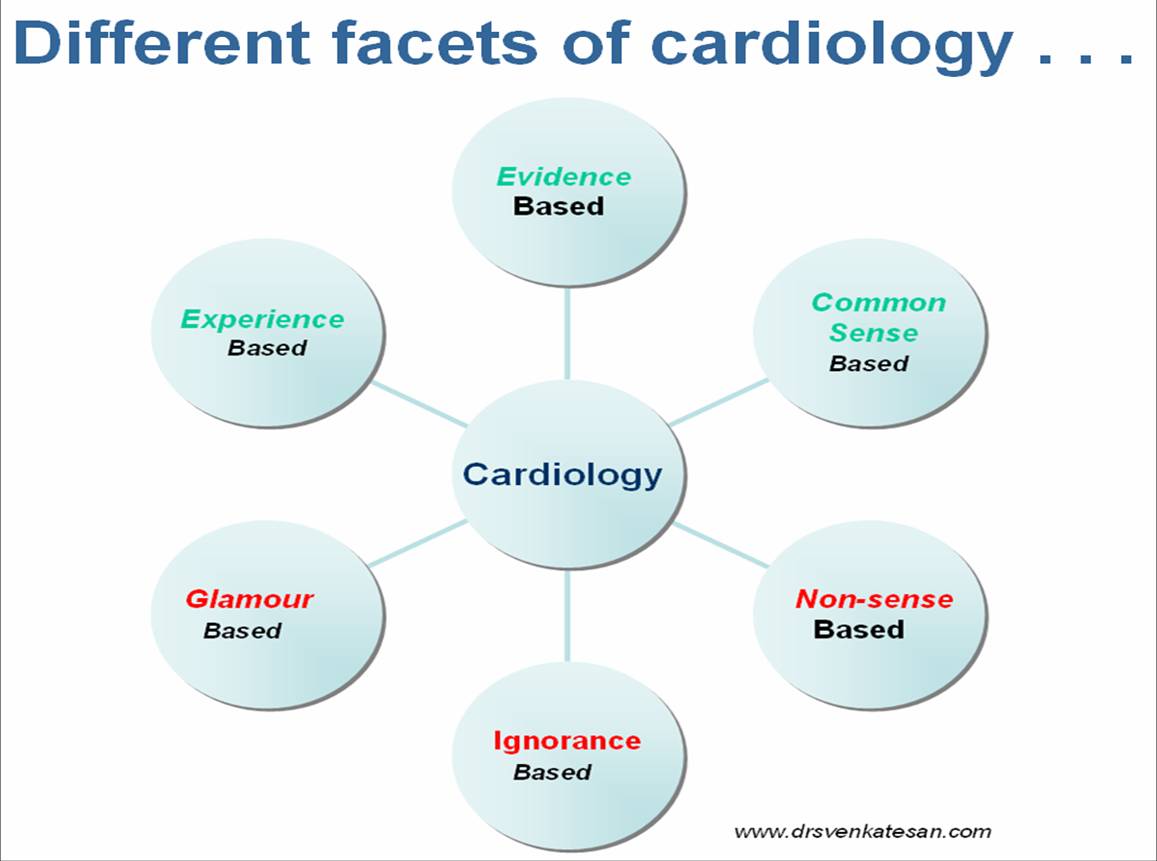
The following  “spheres of knowledge”  collectively  form the  cardiology literature .

How much ?  each sphere , contribute is any body’s guess !

The same  rule might  apply  in all  medical  specialties.

Readers are argued to add more spheres of  knowledge.

The seventh sphere may be Eg :  “Commerce based cardiology “

Read Full Post »

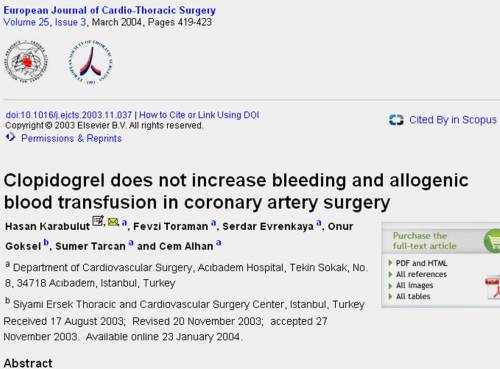
The funny thing in medicine is  ,   simpler the  question ,   greater the  difficulty to answer ! f  Clopidogrel  is   an  irreversible blocker of platelet aggregation . It  probably ,  is one  of the top  cardiovascular  drugs  used currently .It came into human domain as an aspirin killer and failed miserably , and currently piggy packing on the ageless aspirin for it ‘s action. The concept of dual antiplatelet agent is a classical example . The fact  that , Clopidogrel can rarely be used as a successful  mono anti platelet agent while aspirin can do this job with flying colors will unmask the secrets of  antiplatelet drug industry .

Do you know ,  this drug which  is considered  as a   great  antiplatelet drug , does  not even, pass the  basic test of   prolonging  the bleeding time  in a consistent fashion  ?

Still , we are not clear why it  does  or does not increase the bleeding time in vitro or vivo in linear  fashion.We have  confirmed this  in simple bedside experiments. (More dogmatic conclusions   can be drawn  in bed side , than those  double-blind studies) . In many patients 300 mg of clopidogrel failed to prolong the bleeding time even by  few seconds ! Surgeons who operate on clopdogelised patients differ  widely in their  experience  when they do emergency surgeries on them .

The issue is very vital  ,  Questions raised  are  critical  !

  • If clopidgorel  has a  notoriously unpredictable impact on prolonging  bleeding  time , Then ,  is it not  dangerous ? ,  for those millions of patients with DES(Drug eluting stents )  who live at at the  mercy of clopidogrel’s   erratic behavior.
  • Cardiology community  never got shocked  ,  even as  in this era of evidence based cardiology , a drug  which is being used for over 10 years without even a basic monitoring strategy for it’s efficacy.
  • Such is the scenario ,  it is not at all a surprise ,   to find a huge population  of DES patients   who  dial 911 or 108  with   sub-acute sent thrombosis  due to  clopidogrel failure and resistance.

Read this article published in one of the prestigious cardio thoracic  journal and comprehend  yourself   about clopidogrel’s controversy .

Final message

End of life , is  looming large on Clopidogrel , but it has done it’ s intended mission : Increasing the basic cost of cardiovascular   care in general population  .

A costly and a   dubious equivalent to  Aspirin   wrote a  phenomenal    success story in the narrow lanes of  medical wall street !

No doubt , it   will face the same fate as Ticlopidine ,   Prasugrel has just landed to repeat the same old story !

The easiest   job  to do  in   this wold is to fooling around   the public

and  it is an  irony medical professionals  and their patients  are  often

the   victims

Read also the herd mentality in  medical science

Read Full Post »

There are about 5000 medical journals ,  churning out tens of thousands of articles every month .Most of these  papers  come from developed world where publication is made mandatory to get a medical  degree . So it is not surprising  to find   proliferation of medical journals .

Publishing a paper is strictly monitored by a peer reviewing system in most journals . But , it is also a fact an article rejected  out right  by a journal , invariably appear in some other journal.

There is a joke going around among medical researchers,  if it is difficult to get your article published in a  journal , you start your own journal . . .It is much easier !

Where is the problem ?

Further  , bulk of current day research work is sponsored by drug and device companies .It is possible these papers may have 100% acceptance rate.

Brighter side

Even in this scenario , it is heartening to find  occasional  excellent  academic  treasures  and landmark research articles .

How common is irrelevant , pseudo , futile  , clinical research  articles  published  in medical journals  today ?

I agree , I  have prejudiced  view  on this issue . I  would like to know am I  really wrong ? What is your take on this issue ?

Read Full Post »

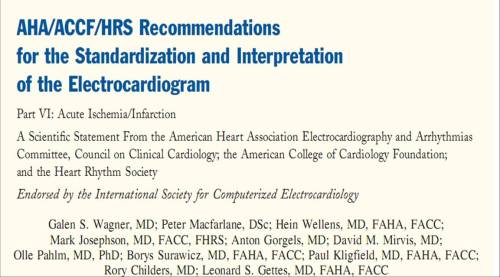
Once in a while the ACC/AHA comes with knock out articles. Here is a  must read  topic for every cardiologist.

How to diagnose MI in ECG ? Sounds , insulting ?

After reading this you should change the way 12 lead  ECG is looked at . . .

Experts from the article

  • How to make the best of lead AVR  ?  Just invert it and you get a + 30 degree lead which  was hither  to unavailable .A new window of opportunity to diagnose   antero lateral MI .
  • Shuffling  the 12 leads to a have an anatomically contiguous  ECG
  • Know , how to label STEMI  with a  .5mm ST elevation  (Minimal STEMI ?)

And lot more exciting  tips  !

If you  think ,  all these are new stuff in cardiology you are grossly mistaken .These concepts are more than 10 years old (In Sweden it is 25 years old ! )

When  European heart journal published  the article   “Myocardial Infarction redefined ”  in year 2000 many missed out the importance . For those who missed it (just  10 short  years have gone by )    ,  Let us update ourself  at least  in 2010 !

Thanks to ACC and JACC.

Click on the link

For PDF article click on the Image

Read Full Post »

A combination of  low voltage  qrs  and high voltage  qrs is a well known marker of dilated cardiomyopathy . classically patients with  severe forms  of  dilated cardiomyopathy show high voltage qrs complex in V1 to V6 and significantly low voltage in limb leads.

Why this happens ?

This happens due to two reasons.

1 .We know , chest leads are unipolar and picks up the electrical activity directly beneath the lead. In dilated  cardiomyopathy the enlarged heart (Usually more than 6 cm in diastole , may reach 9cm ) brings the myocardium closer to chest .This increases the electromotive forces reaching the lead.

2. The enlarged LV increases the  residual  end systolic and  end diastolic  volume , this increase in blood volume independently increases the electrical  conductivity and inscribes a high voltage complex.

This is some  times called as Brody effect .The same phenomenon occurs  in physiological conditions  as in stress testing  where excercise increases the qrs voltage due to increased

Why  limb leads do not show this high voltage ?

The limb leads are bi polar leads  hence as a rule , they record a smaller voltage than chest leads.In many patients with cardiomyopathy , the muscle mass  is  replaced by fibrotic tissue (Interstitial fibrosis ) and this brings down the net electrical energy draining from the heart.

Note : In spite of this, a dilated LV  records high voltage in precardial leads as explained above

When can limb leads  record high voltage in cardiomyopathy ?

It should be realised conduction defects can cause an increase in qrs voltage irrespective of the status of the muscle .This happens due to LAFB,LBBB, non specific IVCD. Because  , these conduction defects are very common in cardiomyopathy ,  there is very poor correlation of LV mass verses  high  voltage  qrs .

What is the correlation of low voltage to LV muscle mass ?

This has better correlation a very poor voltage < 5 mm( the largest qrs ) in the limb leads  predicts a very badly scarred LV .

Read Full Post »

“Time is muscle” is  the often quoted “sermon”  in emergency cardiology , implying ,  every patient with STEMI should be taken up for   thrombolysis or primary PCI at the earliest  after the onset of symptoms.

While thrombolysis is the proven method of reperfusion for over 25 years , Primary PCI , a costly , risky but better  alternative is struggling to prove it’s impact in the world of acute coronary syndrome ! (Some may  see non- sense in this statement !  But it still can make sense  !)  In India hardly 3 -5 % of STEMI is taken for primary PCI .This includes the much hyped corporate cardiology centres.

If primary PCI is a revolutionary reperfusion strategy  , why it has not invaded the cardiology field  by strom  ?(A pathetic 5% growth over 15 years will tell the true story !).

We know 6 hours is the acceptable time window before which some form of repefusion must be attempted. A time limit of 90minutes   for the   “door to  balloon”   is  fixed  as optimal for primary PCI .

In other words ,  if primary PCI can be arranged within 60-90 minutes   one  can afford to lose the golden hour !  How does this logic works ?

In fact it does not work ! in many .

The 90 minute criteria is not strictly followed . Common  sense would have it ,  this 90 minute time frame for primary PCI  would  logically be the   “symptom to  balloon time”,

But in reality  the time window of STEMI   is a collection of  following

  1. Symptom recognition  and 911/108 alert
  2. Ambulance arrival time
  3. Ambulance  to ER time (Traffic delays)
  4. ER to Fellow
  5. Fellow to consultant
  6. Consultant decision-making time
  7. Insurance clearance time
  8. ER to Cath lab door time
  9. Cath lab to needle time(Femoral /Radial )
  10. Needle to Balloon time

Where does the   90 minute  rule  for performing primary PCI stand ? It  can  mean many things

After all those hectic  activity  any one of the following is achieved !

Coronary flow – TIMI  3 ?  TIMI  2 ? TIMI 1 ,  Slow flow, Low flow ? No flow , No re-flow ?

* Prehospital thrombolysis avoids atleast   8  (No 3-10)  components  of time delay in our goal to salvage myocardium.

This is the simple reason, why primary PCI is not reaching it”s logical conclusion all over the world.

Summary

In simple terms ,  one  do not require a double blinded multicentred trial  to  show  primary PCI  performed at 2 hour time ( 2 hour  + 90 minute door to balloon time )  window   would be  far inferior to   pharmacological thrombolysis done at   15 -30  minute time window  (An ambulance driver can do it !).

Finally the most important fact , the often ridiculed thromolytic agent does not show  discrimination in it’s  effetiveness whoever  administers  it ! A  lay person or an ambulance driver with 10th grade education can open up the coronary artery 70% times  while  a cardiologist with a 20 year training  does the  slightly  improved version of the same job  costing   nearly 100   times( Rs  25oo for streptokinase vs  2 lakh for a PCI )  more  . In  the process  often  the   golden hour is lost ! Apart from this,  primary PCI is fraught with a risk of  procedure related  hazard  and  it is a hugely expertise driven procedure .

One more message  is ,  poor countries need not  feel dejected for not having those sophisticated country-wide cathlabs  and emergency air dropping of patients.What we  need is good transport systems and quick access to a near by   coronary care units with support staff.

Always remember  at any given time frame  , a well equipped  CCU can save  thousand lives more than a cath lab

Note of caution :

This article is written in the  overall interest of cardiac patient in the developing and non developing and Primary PCI can make merry in all those rich countries for the simple reason they can afford to  do that (Not necessarily  cost-effective !) . Still , primary PCI/surgery  is the only option for patients coming with a electrical or mechanical complication.

Reference

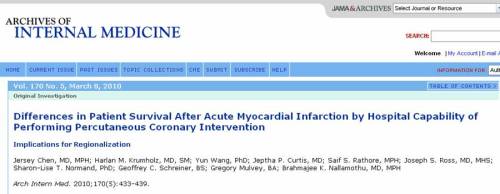
All that glitters is not Gold !

Know , how even high volume centers  struggle to prove he worthiness of primary PCI !

This is not a small study ,  it  is a huge study involving 5 lakh patients with STEMI spread all over the United states.

The conclusion from  his article indirectly supports the view , an early non PCI approach in STEMI can be superior  even if  infra structure and technical expertise are available  for PCI.

Read Full Post »

Human heart is a vital bundle of muscle  weighing  about 300-400 grams. The blood  supply of this muscle  mass  is highly variable . Some areas are abundantly  vascularised ( eg -IVS.) Some areas have a balanced blood supply  or   twin blood supply (Often the  LCX and RCA in the  crux of the heart ). Certain areas have a precarious blood supply . They are  some times called as water shed areas or  the vulnerable  (The Bermuda triangle of the heart ) overlapping zones of   of  LV apex,  LV free wall and  the anterior surface. This  is  often a  no man’s  land .Every major arterial branch  ignores  this area  and shrug of their responsibility .

This  is the reason ventricular free wall and IVS rupture is more common in this area  making the  mechanical complication  a leading cause of mortality in STEMI.

Similarly , even among the survivors , this area is more prone for aneurysmal  dilatation and adverse remodelling .Though . this  is related more to the LV stress distribution (Laplace law)  , early softening  due to watershed infarct of LV apical zone , also play  a major role .

Read Full Post »

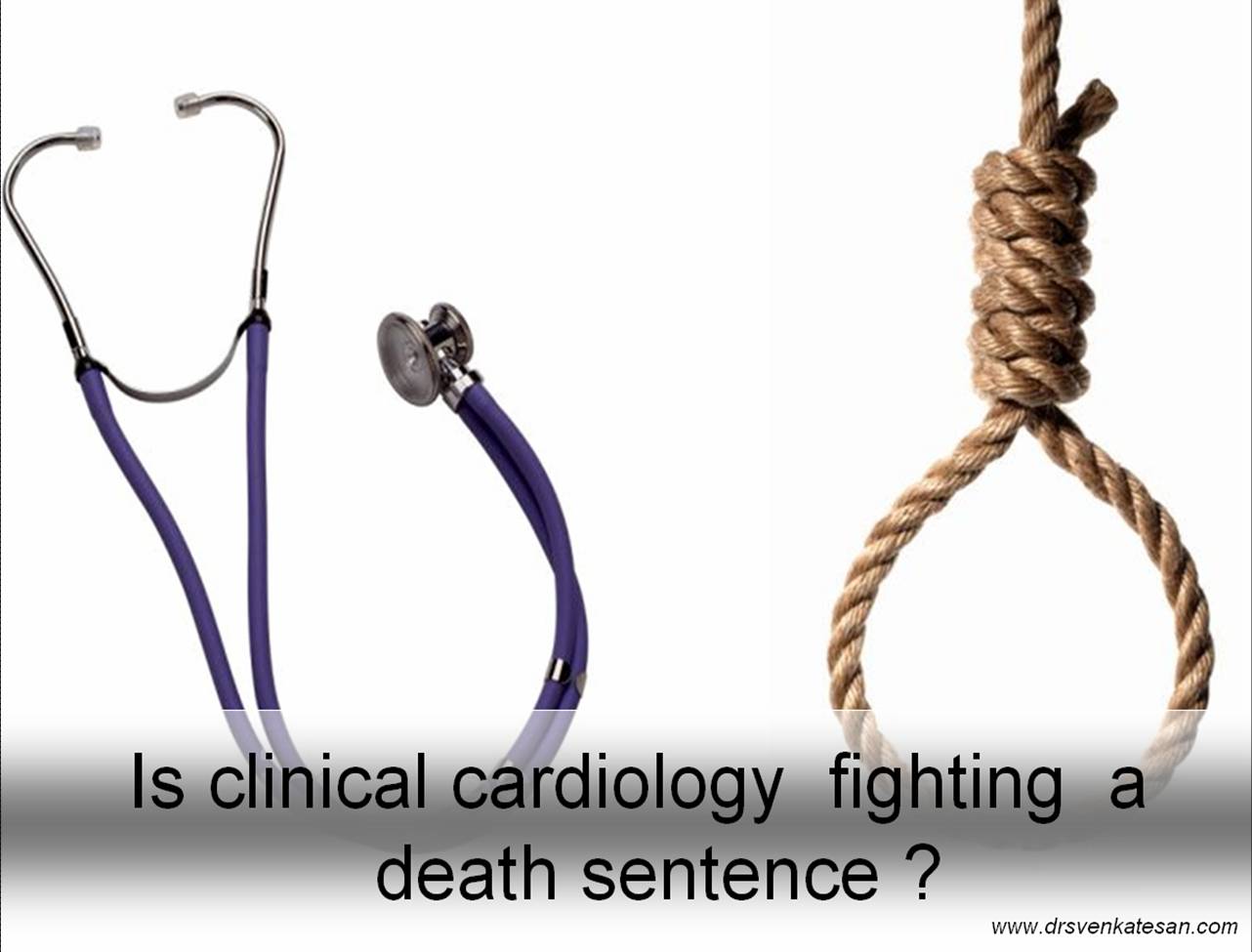
Probably , this is  most important question  for a  modern-day cardiologist.

Q : Clinical cardiology as a speciality is  . . .

A.Hale and healthy

B.Dying slowly  and steadily

C.Terminally ill

D.Dead long ago

If your answer is A , it would be a  blatant lie ! If the answer is D , you are a pessimist .

The  real answer could be  somewhere between C and D , more towards  D “

 Why  clinical cardiology has  plunged  in  to  such a sorry state of  affairs  ?

 Why it has become an objectionable sub -speciality among current generation cardiologists ?

You blame it on anything, but the real culprits are pseudomodernity , commercial onslaught and the glamourous mindset of  many cardiologists. In every walk of life  tradition, culture and heritage of the past is preserved except in medicine .There  is rarely a backward journey in medicine  . This ,  in spite  of the fact there are lots of hidden treasures  left by our elders.

Image courtesey : Jupeter Images

Now , cardiology  as a specialty is  in a miserable  state .It has almost become synonymous with putting stents across the obstructive coronary arteries. There is a perception among  juniors (  seniors too ! )  Choosing  clinical cardiology is an inferior  pursuit of cardiology .

Many belive clinical cardiology  means ,  measuring blood pressure , looking at JVP , apical impulse, S1 S2 etc  .Clinical approach  does not end with  Inspection , palpation and auscultation of the  heart .

Then , what could be the defintion for clinical  cardiology in the current era ?

It is the process of application of our mind in toto on the patients symptom and it’s  impact on the overall health  with specific reference to cardiovascular system  .It also refers to  the thought process that will decide the optimal  managemnt strategies .( That puts the patient’s interest first )

In simple terms being clinical , is being sensible  and ethical

For example, a comfortable post MI patient with near normal LV function should be sent home for a later evaluation (If , and only if  he develops significant symptom ) This  is clinical cardiology working at it’s best .

If such a patient is sent to cath lab directly  , clinical cardiology is deemed to have doomed !

Similarly , a patient with Atrial fibrillation with the rapid ventricular rate should receive  digoxin or a beta  or calcium  blocker for rate control as a first measure . If a physician refers such a patient to an  university EP  lab ,  clinical cardiology is deemed to have doomed !

If a patient with ASD with less than 2:1 shunt is adviced device  closure clinical cardiology is considered  failed.

If a patient with renal artery stenosis is blindly stented ,  clinical cardiology is in the highway to death .

If you prescribe a latest generation sartan for your hypertensive patient instead of advising physical activity, diet and lifestyle modification , it implies  clinical cardiology is  given a death sentence and being publically hanged.

 Finally ,   it is the ultimate  mockery of clinical cardiology ,  when a physician diagnoses  cardiac failure  by pro BNP and CVP  , even as the  patient’s lungs are sounding with crackles and the neck veins are violently pounding .

Worse still ,  the same patient miay be  ruled out of cardiac failure  , if  the BNP level  is within normal levels  !

As you  come across   any of  the above situations ,  too often , one  can predict the future of clinical cardiology.

My impression is ,  the mortality  of  clinical cardiology at this point  of time  is ,  it may not survive too long and the  5 year survival  rate appear dismal. Of course ,  in many institutions    especially  the corporate ones ,   it is  already  been packed and sent to the  mortuary !

Read Full Post »

Some journals do a great work silently .Impact factors are a non issue for them

It is the content that matters . Pediatric cardiology is one such journal !

Of course , they don’t publish papers  that have  greatest  significance to mankind !

like Telmisartan is not inferior to Ramipril in the mangement of hypertension

and Fondapaurinox  is as effective as regular Heparin   . . . etc  . ..etc

They dedicate themself in the decoding the mysteries of congenital and acquired heart disease of children .

Read Full Post »

« Newer Posts - Older Posts »