Feeds:
Posts
Comments

Archive for the ‘Uncategorized’ Category

Ectopic beats or premature depolarisations are the commonest  cardiac arrhythmia encountered . Human heart , is a  non stop  electro mechanical organ ,  and it is not surprising   ectopic beats are so common  and can literally originate  from every cell of heart. But , generally it   emanates  primarily from  the special conducting cells . At times  ,  even  other cells (Myocytes, interstitial cells )  can generate abnormal electrical potential.These ectopic electrical potentials  can be compared  to  electrical load shedding when there is excess electrical strain .

Vast  majority of ectopic are benign  in human population. When this occurs ,  in the milieu of underlying heart disease or during ischemic  episodes they become clinically important and initiate a sustained arrhythmia.

Classically and traditionally ectopic beats are described in the

A.Ventricle :      Ventricular premature beats, (VPD)

B.Atrium:             Atrial premature beats(APD)

C.AV junction : Junctional premature beats.(JPD)

If you note , one important structure is missing from the list.

Yes , it is  SA node.  Can it result in premature depolarisation ?

When do you suspect a SPD(Sinus premature depolarisation)

  • It manifests a  an sudden unexpected , sinus beat exactly as the previous sinus beat. Followed by a pause.
  • The P wave morphology exactly is similar to prior p wave.
  • Many times we miss this entity as we tend to over  diagnose APD than SPD.
  • SPDs tend to occur in bigeminy rhythm.

Differential diagnosis

  • Sinus arrhythmia and pause
  • APD
  • SA node echo beats (Part of SA node reentry)
  • SA blocks

How do differentiate  a sinus arrhythmia from sinus premature depolarisation (SPD ) ?

Sinus arrhythmia occurs in a baseline bradycardia environment.

It does not not come as   “on -off ” pattern . It has a gradual onset offset dynamics.

Clinical significance

This is a clinically unimportant arrhythmia* .This  is probably the reason , it is not a popular concept .

*But it can confound in the diagnosis of  , other important rhythm  disorders.it could be a expression of  sinus node dysfunction and a precursor of  inappropriate  sinus tachycardia The significance could be substantial in atrial triggered  based  pace maker rhythm

Final message

When you confront an unexpected , early , sinus beat not accountable to sinus  arrhythmia  or APD

suspect SPD.It is  not rare , it is a  grossly under diagnosed entity.

Reference

Sinus premature systole  http://www.chestjournal.org/content/64/1/111.full.pdf?ck=nck

Read Full Post »

Pacemaker rhythms  result in classical ECG with  LBBB morphology.It is a universally understood  fact that  RV pacing would  produce LBBB and LV pacing a  RBBB pattern in surface ECG.As with any other rules in medicine , it is not 100%  perfect .(May be 70%)

In the process of oversimplification of rules  we have forgotten a simple fact , that is, interventricular  septum is  shared by both the ventricles . ( functionally and electrically )

In due course , cardiologists and electrophysiologists  have  recognised this fact. A pacemaker lead hitching on the IVS  can behave independently and disobey this  golden rule of pacing.(RV-LBBB,LV-RBBB). Depending upon the orientation of the lead and the pressure it exerts  on the tissue  and degree of penetration of the screwing lead into the septum, the resultant   ECG can  either have a complete RBBB pattern ,  partial RBBB or partial LBBBB or combination of both.

Can RBBB pacing be stable ?

Yes.,  provided the the fixity of the lead and other parameters like impedance and pacing threshold are good.

Before labelling RBBB pacing as safe one should rule out pathological RBBB pacing like septal perforation and

accidental entry into LV through foremen ovale.

Is coronary sinus pacing an acceptable alternative  for  long term permanent pacing ?

The answer is generally ” No ” ,  but it needs rethinking.

A coronary sinus pacing may happen accidentally.The leads get located  either in the main stem coronary sinus or it”s tributaries.the morphology of ECG depends upon the branch it enters.Leads when they reach LV aspect result in RBBB morphology.

Can  we do intentional coronary sinus  pacing for complete heart block ?

There are many accepted  references in literature  that terms   RV pacing as unphysiological and has high risk of precipitating or aggravating cardiac failure. So currently , alternate sites of pacing are explored.( Septum, his bundle , biventricualr etc)

It is an irony , in this era of cardiac resynchronisation therapy where we do coronary  vein pacing  , the same concept is not being tried for regular  permanent pacing in special and difficult situations.( Severe TR, Left sided SVC, AC canal defects etc)

Final message

  1. RBBB morphology following  permanent pacing  need not elicit a panic reaction provided all parameters are stable.
  2. In patients  with difficult RV anatomy* ,  who need permanent pacemaker implantation a modified  coronary sinus pacing can be a solution .But as of now no such speciifc leads are available.EP Industry should take a note on this .

*Epicardial pacing is an option in such situations .But it requires surgery.

Ref:

Safe right bundle branch block pattern during permanent right ventricular pacing Journal of ElectrocardiologyJanuary 1, 2003   Yang, Yung-Nien ; Yin, Wei-Hsian ; Young, Mason Shing

Read Full Post »

PDA is a common congenital heart disease.It results in progressive left to right shunting.

Development of pulmonary hypertension is the major complication.PDA need to be closed once the diagnosis is made.Until recently surgery was the only option.Now we have device, coil closure   available. Not all ducts are amenable to device closure.

For a duct to be closed by device we have to know the exact anatomy of the ductus.echocardiography has  limitation to  accurately image the ductus. Angiogram is the specific method.

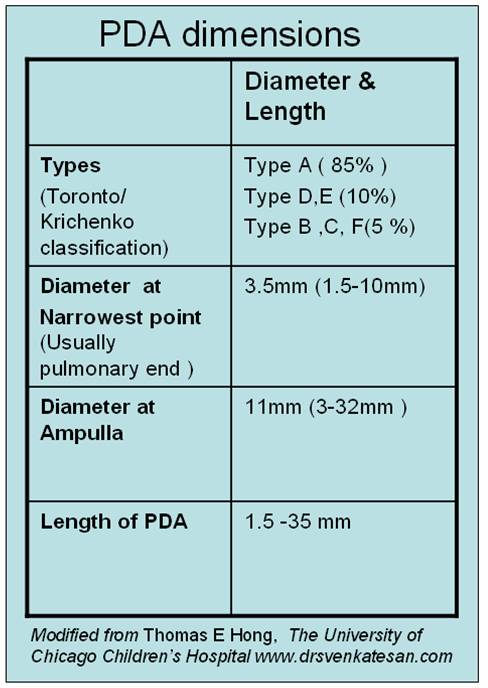
What is  the normal length of patent ductus  arteriosus ?

The length of duct is very variable it can vary between 1 mm to 35  mm.

A 2 mm PDA is nothing but direct adherence of aorta and pulmonary artery (Ultra short form , similar to AP window )

pda-size-ductus

What is the branching angle of ductus from aorta and the entry angle at the pulmonary artery ?

This is an important determinant of technical success of device closure .Very abtuse or acute angled ductus can

face difficulty in deploying devices. The normal angle in lateral view is between 30-60 d

How do you classify PDA ? .

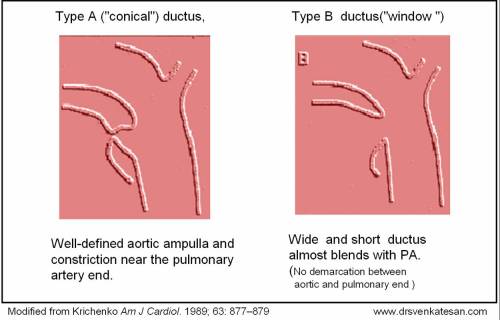
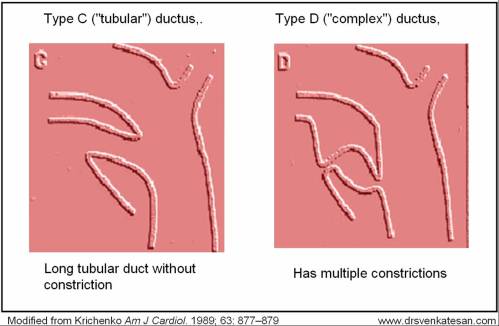
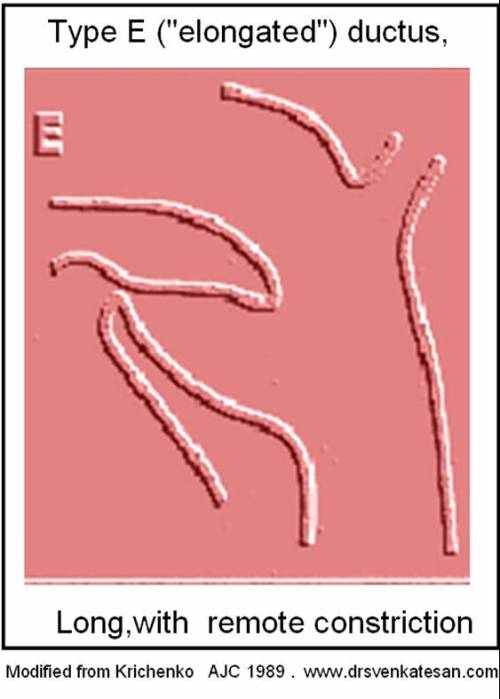
There is only one classification of PDA available  based on angiogram .Krichenko*

pda-4

pda-2

pda-31

Taken from  *Krichenko A,. Angiographic classification of the isolated, persistently patent ductus arteriosus and implications for percutaneous catheter occlusion. Am J Cardiol. 1989; 63: 877–879

Review article on PDA

http://www.circ.ahajournals.org/cgi/content/full/114/17/1873

Read Full Post »

Coronary collateral circulation is the most poorly understood, and often neglected concept among the cardiology community.There is a general perception , in obstructive CAD ,  coronary collaterals are an inferior modality of  back up blood supply than artificial collateral (Also called CABG ) ! One of the reasons,  it is   been ridiculed by many  mainstream cardiologists is   because  , it comes by nature , and also free of cost !

The often quoted statement* ,collateral blood flow can not sustain blood flow during exercise ,  is not based on solid scientific data. In the real world , there are thousands of patients actively pursuing life with chronic total occlusion and good collaterals.

It is surprising , there is no  physiologically valid ,  controlled study available to compare CABG with natural collaterals

*When repeatedly told , a  statement becomes a fact !

It can be assumed (Unscientifically ofcourse ! )   the  remarkable  success  of medical therapy  in COURAGE  and the OAT * study  can be attributable to the naturally occurring coronary collateral circulation.

* Summary of COURAGE & OAT : A   block  in the coronary artery  need not be opened  to prolong human survival !

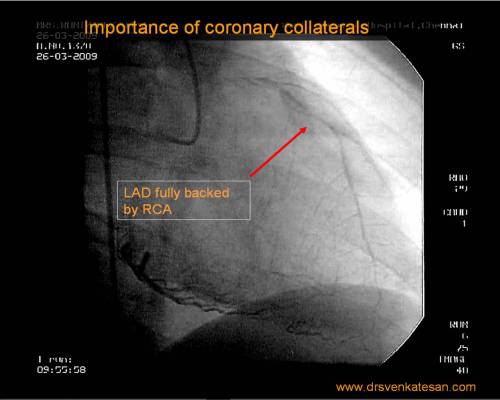
You draw your own conclusions from the  following case study

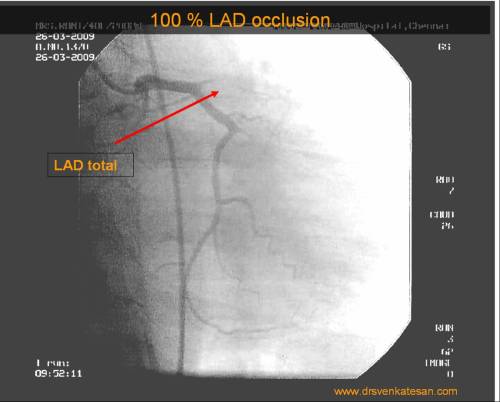
A 40 year old women , with stable angina and good physical activity

Her angiogram shows.

coronary-collateral-2

RCA injection

coronary-collateral

Read Full Post »

Coronary artery  perforation is a dreaded complication of PCI. Perforations are the Interventional cardiologists ultimate worry   as they need to  manipulate their  hardware for  long periods in many complex lesions.  Especially  it is a  real threat in chronic total occlusions.

Still , an important fact is ,  many of the coronary perforations are not life threatening ?

How is this possible ?  (Type 1 Ellis has zero mortality Read below)

As the guide wire injures and perforates the cor0nary vessel,  it results in  small puffs of dye extravasating  into peri coronary space .

The coronary artery , which is located   within the  atrioventricular groove  (LAD), or AV groove (LCX, RCA) have  two distinct anatomical relationship with reference to epicardium and pericardial space.

50 % 0f circumference of the coronary artery is  hugged  by the myocardium  another 50% or so is related directly to the pericardial aspect.

Guide wires hitting on the myocardial aspects face a stiff resistance than the pericardial aspect. So , generally the risk of perforating pericardial aspect is more than myocardial aspect

Even if , the coronary artery is punctured on myocardial aspect , no great danger occur as there is no potential space for the blood to drain and further,  the  elastic nature of myocardial muscle plane effectively seals the leak. At the most , mild myocardial staining is noted .
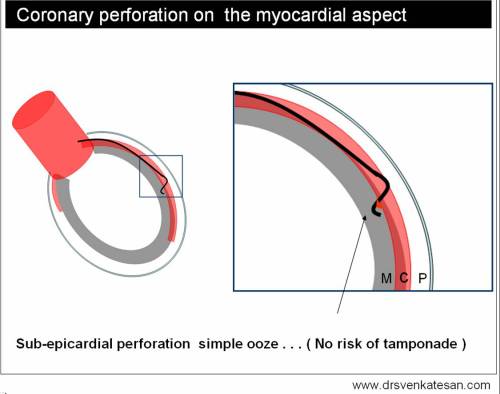
coronary-perforation-2

While ,  perforations  into  the pericardial space  , often threaten with a tamponade. The fact that pericardial space has negative pressure and  the mean  coronary arterial pressure around 40mmhg ,  it is  , all the more likely blood is sucked into the pericardial  space. Of course , very minute  perforations  even into the pericardial space ,  could  be self limited and  benign.
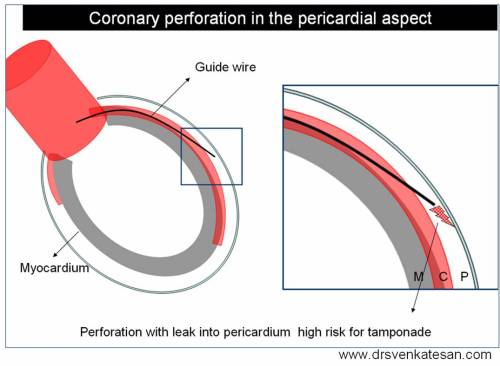
coronary-perforation

What is unrecognised coronary perforation?

Many times , the guidewire goes in a false track in the tissue plane.This is  nothing,  but perforation without hemodynamic implication. Most often , these are the instances of guide wire entering the epicardium.They mimic , false lumen entry , dissections, etc. There are occasion , where false lumen of the  coronary artery were  stented.

What are the  factors which increase risk of perforation ?
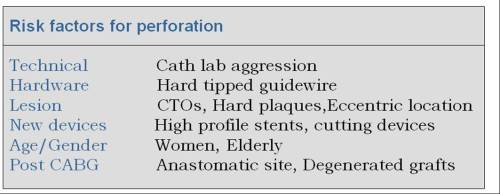
perforation-6

 How do you classify coronary perforations ?
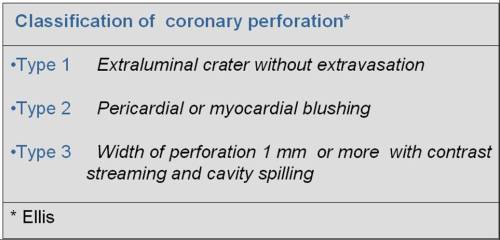
perforation-3

*Ellis SG, Ajluni S, Arnold AZ,  Increased coronary perforation in the new device era. Incidence, classification, management, and outcomeCirculation. 1994;90:2725–2730


How do you manage coronary perforation?

Simple guide wire induced perforations are less trouble some unless we have crossed it with balloon without realising the fact the wire has entered the pericardial space. So, caution is required and always watch for guide wire tip movement which is often funny looking wihtin false lumens or very freely moving within pericardial space. Anticipate the complication especially so when you do CTOs and venous graft PCI.  Keep one cath lab  tamponade crash  bin  in ready mode before embarking upon a complex PCI

  • Neutralise the heparin action with protamine is the first step
  • Most are self limited, no intervention is required  but requires close observation for next 24 hours.
  • Temporary balloon occlusion may be suffice in many cases
  • Tamponade requires immediate tapping. Small collection without fall in BP can be observed.
  • keep doing the echocardiogram liberally to assess the leak and watch for any new collection.
  • PTFE covered stents if prolonged leak.
  • Emergency surgery may required in few.

2018 update 

This is  nearly 10 years old article. Now, we have gained much experience and hardware utilisation have rapidly expanded. While expertise has minimised this complication , more PCIs in complex lesion subset tend to keep the incidence static , if not higher.(Its around .5% )

Tips to use balloon occlusion during perforation

Perforations which are active and flowing should be immediately occluded with a balloon either at the site of leak or just proximal to it. Doing a proximal occlusion is easier in emergency , as often times its technically difficult to reach the site of leak especially in CTOs where the leaky site is not defined clearly or forward looking (Local balloon inflation across the leaky site is not feasible )


How long to occlude , Intermittent /complete, proximal ? or at the site of perforation ? These queries are answered in Ref 4

Reference

1.Largest report (1762 cases) of perforation from British Cardiovascular Intervention  Society Database Circ Cardiovasc Interv. 2016;9:e003449.

2.Al-Lamee R, Ielasi A, Latib A,. Incidence, predictors, management, immediate and long-term outcomes following grade III coronary perforation. JACC Cardiovasc Interv. 2011;4:87–95.

3Xiangfei Wang and Junbo Ge Balloon Occlusion Types in the Treatment of Coronary Perforation during Percutaneous Coronary Intervention   Cardiology Research and Practice Volume 2014, Article ID 784018,

4.A very good review comes from Royal Hospital, Muscat, Sultanate of Oman

 

iFAQs in coronary perforations

1.Does the plane of the coronary artery (Sub epicardial within the fat layers)  determine the likely hood of tamponade ?

While myocardial tissue can resist flow we are not sure about sub-epicardial fat on the pericardial aspect.

2.How common is Intra-cavitory perforation ?

Perforations into chamber is invariably associated with septal branches (PCI to septal branch itself is less common )

Read Full Post »
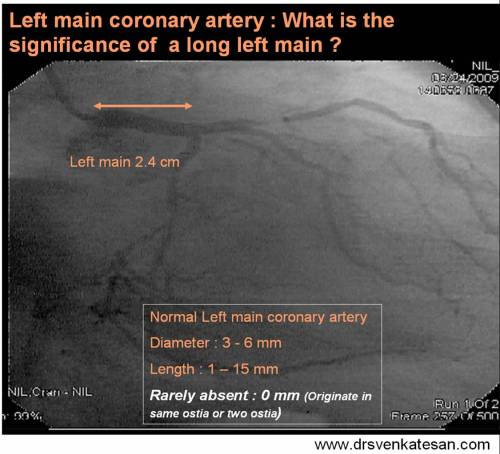
Left main coronary artery disease is  a  major form of CAD .

left-main-41A long left main by virtue of  it’s surface area   statistically ,  are  more prone for atherosclerosis as it preferentially affect the proximal vessel.A long and tubular leftmain generally give  the LCX branch at right angles(In the above pateint it is 90*).This makes  interventions in Lcx difficult.

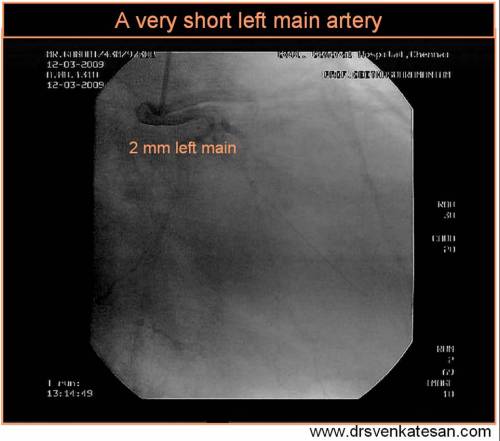
A short leftmain or absent leftmain could be a blessing for the simple reason these people have the unique freedom from developing left main disese the dreaded form of  CAD !

Have a look at this angiogram

left-main-31

Read Full Post »

Beta blocker use in cardiac failure has come a full circle from a “contraindication to indication”

You don’t need gimmicks of statistics for science to progress. What you require is meticulous observation.

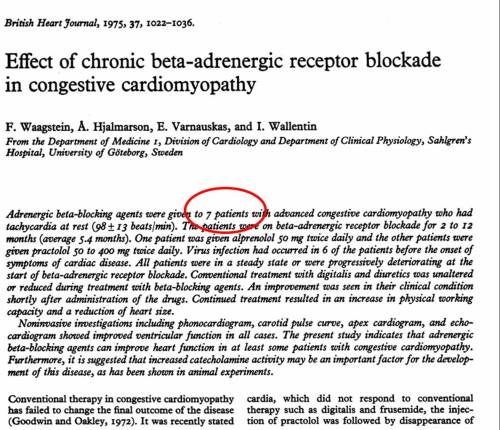
F .Waagstein of    Sweden just did this  with a  study population of seven  patients .

This land mark study , was least significant statistically , but most significant clinically

Today , as on 2009 , if any one submits a manuscript of a study  to a journal  ,  done with seven patients   he or she   will be called as a  fool  !  BMJ  , in 1975 had a courage in not  doing  so  and thus a break through concept was born.

So young scientists , should not  get bothered about sophisticated statistical method.

Science is not about number gimmicks it is about truth and nothing but truth  ! Truths  may  come out from  single digit study or even a single patient study

beta-blocker

To read & download  this land mark article click here

Read Full Post »

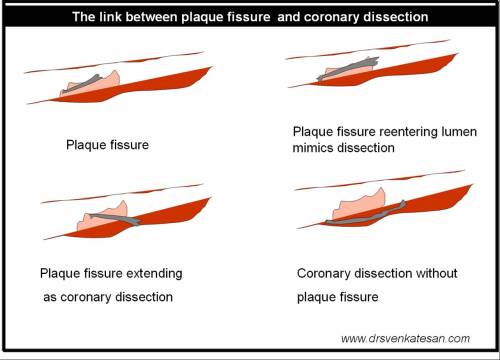
plaque-fissure-and-coronary-dissection

  • Plaque fissure is  the most common intra-plaque event that   precipitates  an acute coronary syndrome.
  • It is the  site of   attachment  for coronary thrombus
  • It can  either be spontaneous or PCI induced.
  • Plaque fissure can  either be  partial or complete and  may  reenter the lumen.
  • Eccentric plaques are likely  to fissure often  , as the  wall stress on the plaque shoulder region is  high  (Laplace law)
  • Angiographically  it is often difficult to differentiate  fissure from true coronary dissection.Both manifest as intraluminal filling defect.Coronary dissection  often extend beyond the length of plaque.
  • Many of the reported cases of spontaneous coronary dissection are thought to be  nothing  , but plaque fissures and their extensions.

Is plaque fissure a painful event ?

Plaques do not have neural innervation.So the plaque fissure is generally not painful.But when it extends into the media of vessel wall it can be severely painful.

Read Full Post »

To further understand women's heart click on the title

SCD  continues to be  the major mode of  death of  our  population . Millions of men die every year instantly .The commonest mechanism is due to primary ventricular fibrillation following an abrupt closure of coronary artery due to a thrombus.Most die , within few minutes of the event, some  before reaching the hospital , few within the ambulance  and an  unlucky few die on the CCU bed  or cath lab table even after getting the best treatment.

If we analyse the data, there is a  surprising fact !  Men form the bulk of these SCD victims.In our experience , out of 100 cases of consecutive  in hospital primary VF only  6 were females , indicating  an important  biological phenomenon to be studied.The data for out of hospital primary VF is more difficult to get , but the  log records of EMRI and emergency rescue team consistently confirm the male preponderance of primary VF .

How  does the female heart enjoys this relative immunity from primary VF even as the blood supply is acutely compromised ?

The answer  is  not known . If we are able to  decode this , one can replicate the same  model in male .

The QT paradox and incidence of primary VF

QT interval represents a combination of  electrical depolarisation and repolarisation .It is a well established   scientific  fact  that  women have   relatively  prolonged QT interval .This  is determined by evolutionary biology and  inherited characteristics of  potassium channels  during myocardial repolarisation

In simple terms, the female heart  knows how to relax slowly and prolong the electrical relaxation time.(Not mechanical)

It is also a well known  fact ischemia mediated a prolonged  QT interval is a trigger for dangerous ventricular arrhythmia.This ischemia induced QT prolongation is less pronounced in females than males as the baseline QT itself is slightly longer in women.The percentage increment of QT interval during acute ischemia is significantly higher in male .This could be one reason for the preponderance of VF in men

The billion dolor question and a real challenge for the cardiologists is

How to make a heart electrically inert during ongoing ischemia ?

  • Pain is also trigger for primary VF due to high adrenergic tone.Prompt control of chest pain make VF less likely.
  • Lignoacaine a myocardial anesthetic if administered quickly can prevent many of the primary VF.

And now , shall we  think little wildly !

What if , if  we administer lignocaine spray straight over the (or sublingually ) in every patient with  chest pain

as like a sport injury and try calm down the heart electrically !

Also read

1.Lignocaine  the forgotten hero .

2.View this video -Ignorance based cardiology !

Reference

Arrhythmias and sex hormones


Read Full Post »

CABG is the most common cardiac surgery done world wide. Traditionally saphenous vein graft and LIMA are used .Now radial artery is being used often. The life of venous grafts is short, so total arterial graft is preferred.The issue here is lack of good arteries for grafting especially when a second CABG is required  .

So what  are the options ?

  • Cardiac surgeons often use synthetic conduits for many of the congenital heart diseses.
  • But some how this has never been thought as an option for CABG.
  • This may be due to small nature of the vessels, but now there has been some developments on this .
  • In future sunthetic grafts might replace the conventional grafts.


Chronoflex, is one such graft under trial  and is engineered to be pulsatile, biostable, torque-resistant and suturable. Once implanted, the graft is able to incorporate the patient’s own cells and tissue, so that the inner surface mimics the normal environment for blood contact. The material is also flexible, so that the graft can pulsatile like a  vein as it carries blood to the heart.

www.cardiotech-inc.com

Read Full Post »

« Newer Posts - Older Posts »