Feeds:
Posts
Comments

Cardiac arrhythmias by nature connote a serious implication ,especially  so  with ventricular ones. Here is an  arrhythmia which arise from the ventricle by excessive automaticity  ,   fires independently  ,   still  very   benign compared  to others ventricular arrhythmias.

Why AIVR is a stable arrhytmia ?

Primarily due to its low rate.

Since  it is a  reperfusion arrhythmia the outcome is good.

Mechanism

It is not due to reentry , it is thought to be due to enhanced  automaticity  without pathological  intra-myocytic  calcium spikes  (Like true VT )

Absence in surface  ECG does not mean it is not existent.  In-fact there  is some  evidence to call this arrhythmia as a form of ventricular parasystole.

Focus of arrhythmia

Since it is a reperfusion arrhythmia it has to arise somewhere from  re-perfused myocardium.

The fact that  it  can occur in both RCA and LCA reperfusion  indicate the focus can be  in any of the ventricle .

Usually it follows the reciprocal rule of bundle branch block  pattern  (RBBB in LV focus LBBB in RV focus.)

Septal AIVR  can have either RBBB or LBB morphology.   Usually  left axis is noted .

How to differentiate it from  non sustained VT ?

  • Ventricular rate in AIVR should be between 60 -110 .(Note -The inherent ventricular rate is 35/mt .There is three fold acceleration )
  • Basic idoventricular rhythm is about 35.  Three times accelerated
  • Characteristically   AIVR  starts with an escape beat rather than an  ectopic beat .

AIVR  is common  in  RCA or   LCA reperfusion ?

It is supposed to be more common in infero-posterior MI  as sinus slowing is an important predisposing factor  for releasing   the idio ventricular rhythm.

AIVR after primary PCI

Is not reported much as  current interventional  cardiologists  do not bother much to watch about this arrhytmias

Other causes for AIVR

  • Myocarditis.
  • Digoxin toxicity

Management

(The commonest issue with AIVR  could be    . . . Nurses  /Fresh interns may mistake it as VT and  pressing the false alarm ! )

  • Rarely  requires treatment .
  • Atropine ,Isoprenaline to increase sinus rate.

What will be the  pulmonary capillary wedge pressure ( PCWP ) in grade 1 LV diastolic dysfunction ?

  1. Significantly elevated
  2. Marginally elevated
  3. Usually Normal
  4. It depends upon  age, LA size and LV  function.

Answer is 3 . (Of course  it depends on  4 )  Normal PCWP  is  4-12mmhg

Are these patients with grade  1 LV diastolic dysfunction  are at  risk for  acute pulmonary congestion at times of stress ?

Probably not ( in  most )*

                                             The grade 1  LV diastolic dysfunction or defect is the most used (abused ! )  echo terminology .The diagnostic simplicity of this condition namely  a simple documentation of “a”velocity more than “e” , has made it  as an epidemic in echo labs  world wide. After all  , it reflects a simple  fact that  left ventricle  has  summoned   the atria  for assistance   (Which is  all the more  physiological   at times  of stress   !)

When does this physiology becomes pathology ?

As long as  the atria is  doing its job of assisting the LV without any fuss  ,  the mean pressure of LA(PCWP) is maintained  within  normal level . Only if the atrial function is stretched  beyond the limits ,  PCWP begins to raise.  It can happen  in a variety of  ways . Most commonly it happens   elderly hypertensive /Diabetics  especially with LVH .

It can also occur in healthy individuals when they become physically deconditioned. (Left ventricle   goes  for  disuse and find it difficult to relax)

Final  message

Isolated  grade 1 LV diastolic dysfunction in people  > 40 years   generally do  not indicate a serious  abnormality.

Only if they have DM/HT and myocardial  disease they need to be evaluated further.

One practical clue is ,  if LA size is normal one can rule out  significant  diastolic dysfunction.

Caution

* In elderly population ,   when they undergo any major  surgery ,  presence of even grade 1 LV diastolic dysfunction can be a marker for peri -operative LVF and  lung congestion .

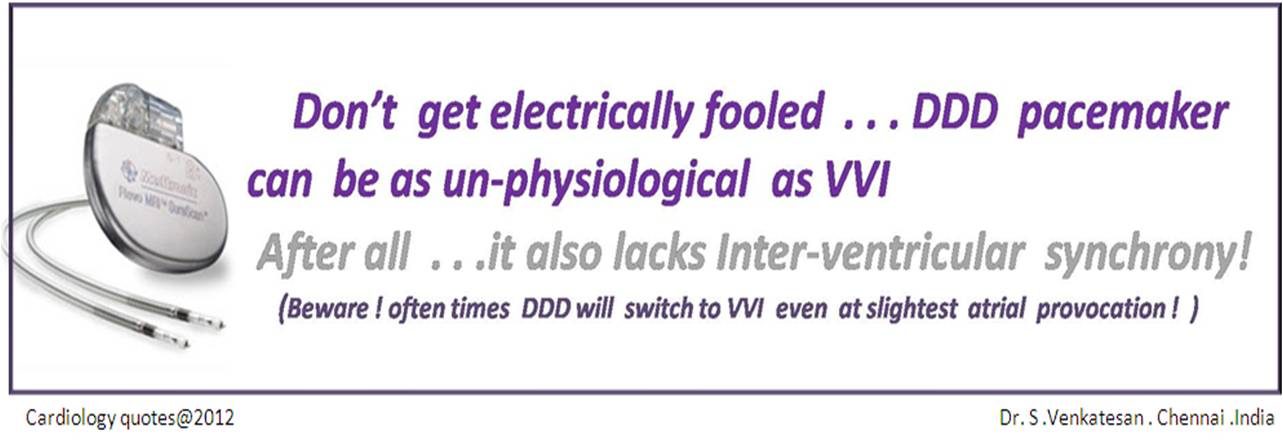
Choosing a pacemaker  is not a child’s play . It is a  complex game played by cardiologists , electro-physiologists and their  ill-informed

patients. The  superiority of dual chamber pacing over single chamber pacing  was never convincingly proven.

Still . . . usage of  dual chamber pacing is steadily increasing over the years  for various reasons.

“Every thing hangs around a key word called quality of life . DDD pacemaker is supposed to enrich life due to their AV synchrony “

World  health organization  says  quality of life  of homo-sapiens are  determined by at least few dozen factors .They are  mostly non medical.

How an extra lead at a cost of  2000 dollars more , is  going to  provide that  elusive “quality of life”  to all those poor patients with bradycardia  in  this world  ,   which     . . . they  any-way lacked even  in their best of times  !

Scientifically also there is  a major  flaw in calling DDDR as physiological pacemaker

Clinical sense

  • First and fore most  dictum  is  not  every  prosthetic valve obstruction  is  thrombotic (Most cardiologists are tuned to think that way )
  • Pannus, Mechanical failure  and  vegetations can increase the gradient across prosthetic valve.
  • If the clinical presentation is acute (< 48 hours ) it is  more likely to be a thrombotic event .
  • History of  recent discontinuation of oral anticoagulants /sub optimal INR will favor thrombosis.

A meticulous Echocardiography is vital (TEE though gives more information in an emergency TEE is suffice )

  • Thrombolysis is to be considered in all .
  • For right sided prosthetic obstruction thrombolysis is the  initial modality of choice.
  • For left sided valve thrombosis   surgery is the preferred option .However a trial of  thrombolysis for 24 hours may be tried .
  • For a high risk mobile thrombus , thromolysis is contrandicated.

The success rate is less with Mitral than Aortic valve  . Success depend upon more on the  location / Freshness of thrombus than the type of the lytic agent used.

Is there a time window for prosthetic valve thrombolysis ?

Thrombus organisation takes 2 weeks at- least.Hence , it better not to attempt thrombolysis in documented late prosthetic valve thrombosis.

Thrombolysis of left-sided valves has inherent risk of  stroke .

Heparin controversy

Simultaneous usage of heparin along with streptokinase or TPA is  perceived as risky (No good evidence for this perception )It is logical to expect even as the thrombus  lyses the clot lots of pro-coagulant debri  are released . Concomitant usage of heparin  will definitely help accelerate thrombus dissolution. (I am glad  Joseph S   Alpert also feels the same ! )

Assessing successful  thrombolysis

  • Can be a tough task .
  • Relying purely on gradient is vested with risk of huge error.
  • In a patient with shock or LV dysfunction gradients are not reliable as low flow status masks the gradient.
  • A accelerated thrombolytic  protocol 15lakhs streptokinsae in 60 minute may be tries in unstable patient .
  • It is wiser to rapidly asses for clinical improvement in high risk subsets  and refer the  patient for early surgery .

Surgery

Prohibitive mortality reported in many centres.

It need to be remembered no surgeon will operate on a  sick patient in  shock  exposed to  cocktail of heparin and streptokinase.

Valve replacement is required in most case. Simple valve debridement  (servicing the  valve ) and releasing  discs  from the  sticky thrombus is  also possible in an occasional patient.( Do not ask reference for this !)

Reference (Surprisingly most of the good papers in the topic appeared  in JACC)

http://content.onlinejacc.org/cgi/reprint/41/4/653.pdf

http://content.onlinejacc.org/cgi/reprint/41/4/659.pdf

http://content.onlinejacc.org/cgi/reprint/35/7/1881.pdf

http://content.onlinejacc.org/cgi/reprint/35/7/1874.pdf

After thought

I have not seen a single case of acute prothetic valve thrombosis involving Starr Edwards valve  in the  last  20 years of  of clinical cardiology practice.

Is it true   . . . the new age valves  with more mechanical stress points  are proving more injurious to our patients. Our  pursuit  towards a  perfect artificial  valve need some introspection .

Read a related article in my site :  Who killed Starr Edwards valve ?

If only we realise . . . even a healthy  human life   . . . has a mortality of 100 % at some point of  life  , the mentally immortal  modern human species won’t demand for  a  2 % chance of living   “30 more  miserable days”   with terminal cancer !

Venkatesan  Sangareddi (2012)


Up to 24 hours

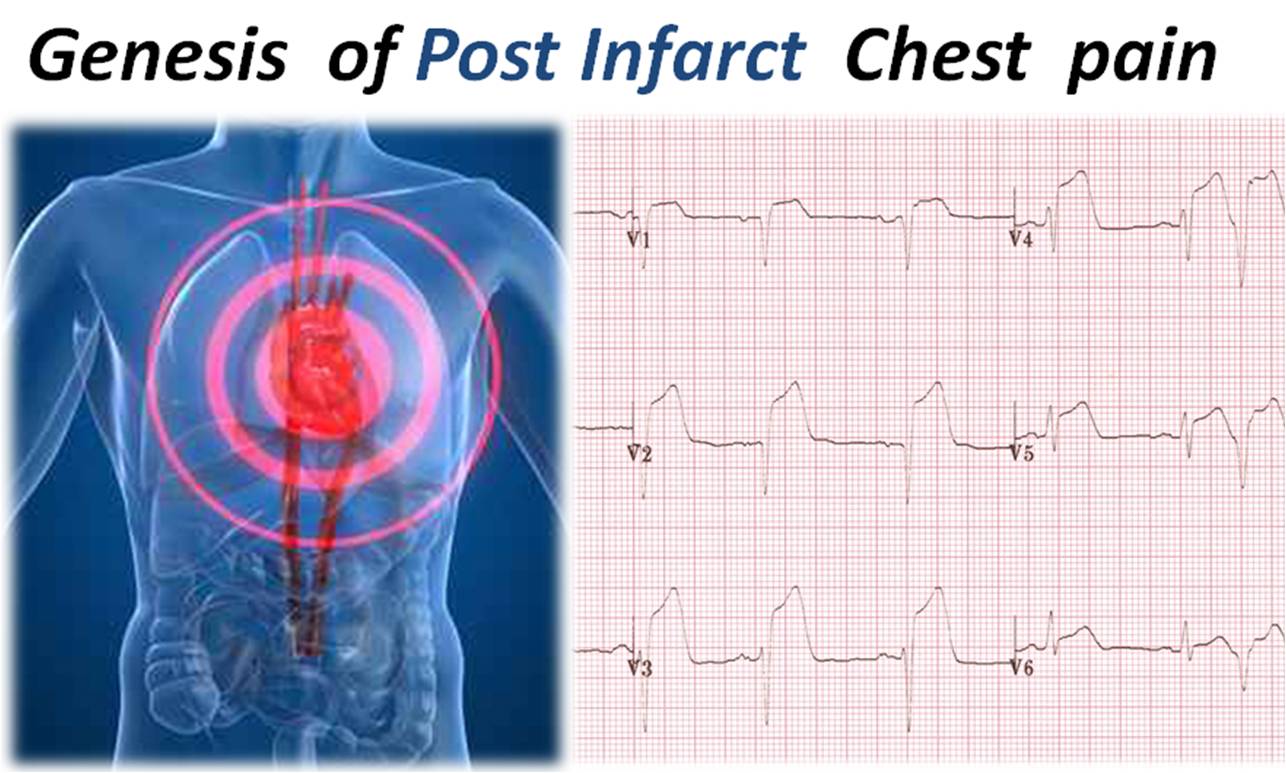
  • Failed thrombolysis and persistent infarct related chest pain
  • Prolonged  Infarct pain  in spite of successful thrombolysis (Rare)
  • Dual STEMI and Dual ACS ( Combination of STEMI/NSTEMI)  *

* Generally  until   after  24 hours one should not make a second coronary syndrome  though  logically  it is possible ( Dual acute coronary syndrome)

After 24 hours -up to 2 weeks

  • Post MI angina  – IRA related (Re-occlusion, Threatened reocclusion)
  • Post MI angina -Non IRA related ( Critical  non -IRA lesion)
  • Thrombus migration /Side branch occlusion
  • Re infarction -Same territory
  • Re-infarction-Remote territory
  • Infarct extension, Infarct expansion , Dyskinetic segments  ( Acute ventricular  remodeling  has a potential to generate pain )
  • Combinations of the above

Caution

24 hour is  arbitrary cut off .There can be spill overs and over laps

*Refractory non ischemic  chest pain often atypical not relieved by anti anginal  medication   – Pericardits, Coronary dissections , myocardial /Pap muscle  tears .

After thought

Do we need to break our brain  to  find  the source of angina  following STEMI ?

Principles of scientific medicine  would demand it  . However   in this era of  hyper active interventional  cardiologists  there is little purpose  as they  tend to  open up all occluded arteries   guided by the  their  ignorance about the source of chest pain.

Reference

Video on Dual  coronary syndrome

Click  to down  load a PDF  version

This was presented in the cardiology fellow training course in Chennai – March 2012

(Acknowledgement : Paul wood collection , J.K Perloff , Credit to Images from open source )

Improving upon  (or help  improve )  others idea is still  a great  research contribution.

No need to feel inferior about it !

Steve Jobs exactly did this  . . . and  he was a great visionary !

Unfortunately ,  it is looked upon as partial  plagiarism in some quarters  . It need not be !


Left main coronary artery is  considered as the sanctum sanatorium  for  the cardiologists .

One would wish  to rule out  disease of left main  in any given  patient with CAD.

Though there are strong clinical predictors of  LMD, this  segment of the coronary artery  tends to  throw   surprises.

A  strongly positive stress test,  ST elevation in AVR  , fall in blood pressure with exertion  are good markers of left main disease.

Still,  in the era of  optical coherence tomography (OCT )  and IVUS  , we do  have a simple tool that can image the left main coronary artery fairly accurately .

We know the  resolution power of  routine trans thoracic echo  is 3mm and above  . (It can detect vegetation of that size easily !)

So , it can easily accomplish  the task of  imaging the  left main ostium .(which is a minimum of  4-5mm diameter )

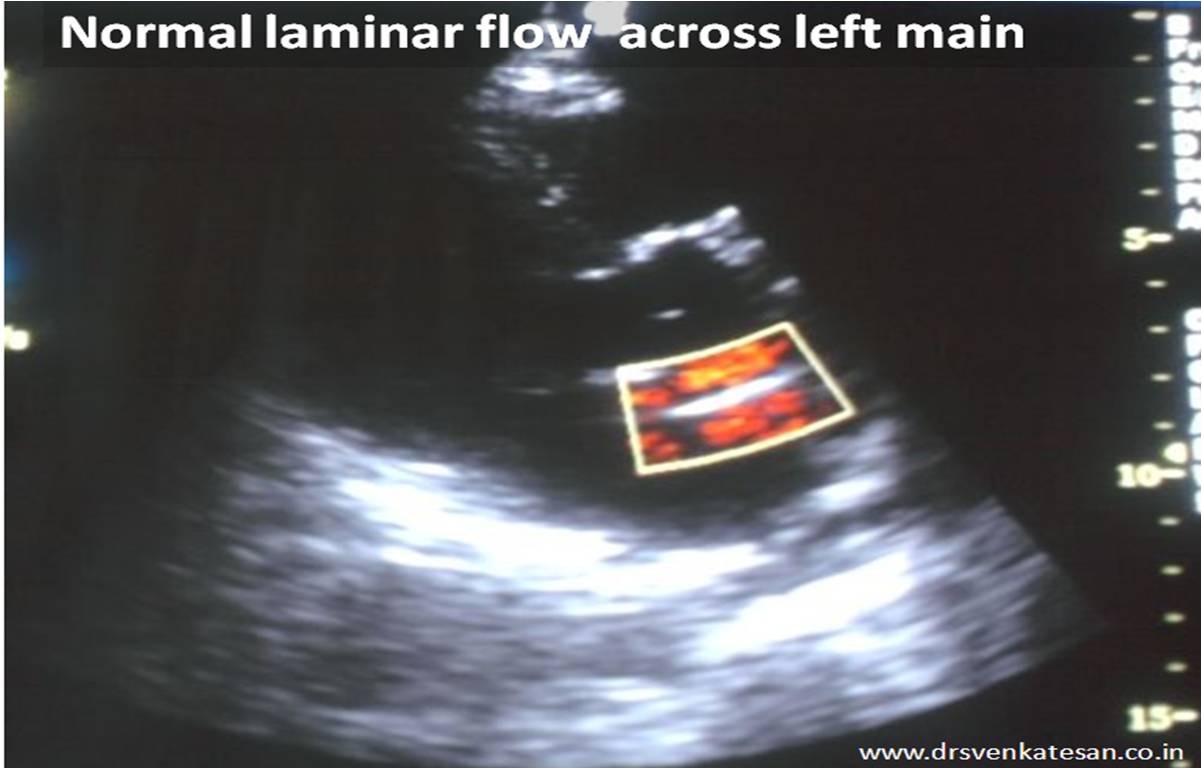
How to image left main by echo ?

  • Parasteranal long axis  or short axis  the ideal view. Short axis would also  help.
  • Normal left main is easily diagnosed  by two parallel  lines . ( See above picture )
  • Plaques are  diagnosed when this line is  distorted  and filled by haziness.
  • Significant ostio proximal  lesion must never be missed by TTE .However distal left main can not be assessed in most .
  • Doppler assessment may not be possible in all as pulse doppler sample volume can not be placed in left main.
  • Trans esophageal echo would increase the yield.

Final message

Processing power of echo machines  and  their image quality has improved  vastly over the years. The existing literature about left main imaging  by echo are based on old generation machines. The data are as obsolete as those  machines . This has to be kept in mind.

I wonder why most cardiologist are averse ( rather feel guilty ) to report  the  status of  left  main  artery  by  echo cardiography .

Every patient with  a  positive TMT must undergo a  focused echocardiogram  of  left main . You will be rewarded with a  good glimpse of the sacred segment  of coronary artery 9 out of 10 times  !

So , can we shoot the Left main  at the bed side  ?

Yes definitely  . . . if only we wish to !

* A correction

The left coronary visualised in this parasternal Long axis view is in fact exceptional. The ostium and shaft often better seen in short axis in around 3-4 O clock position.