Feeds:
Posts
Comments

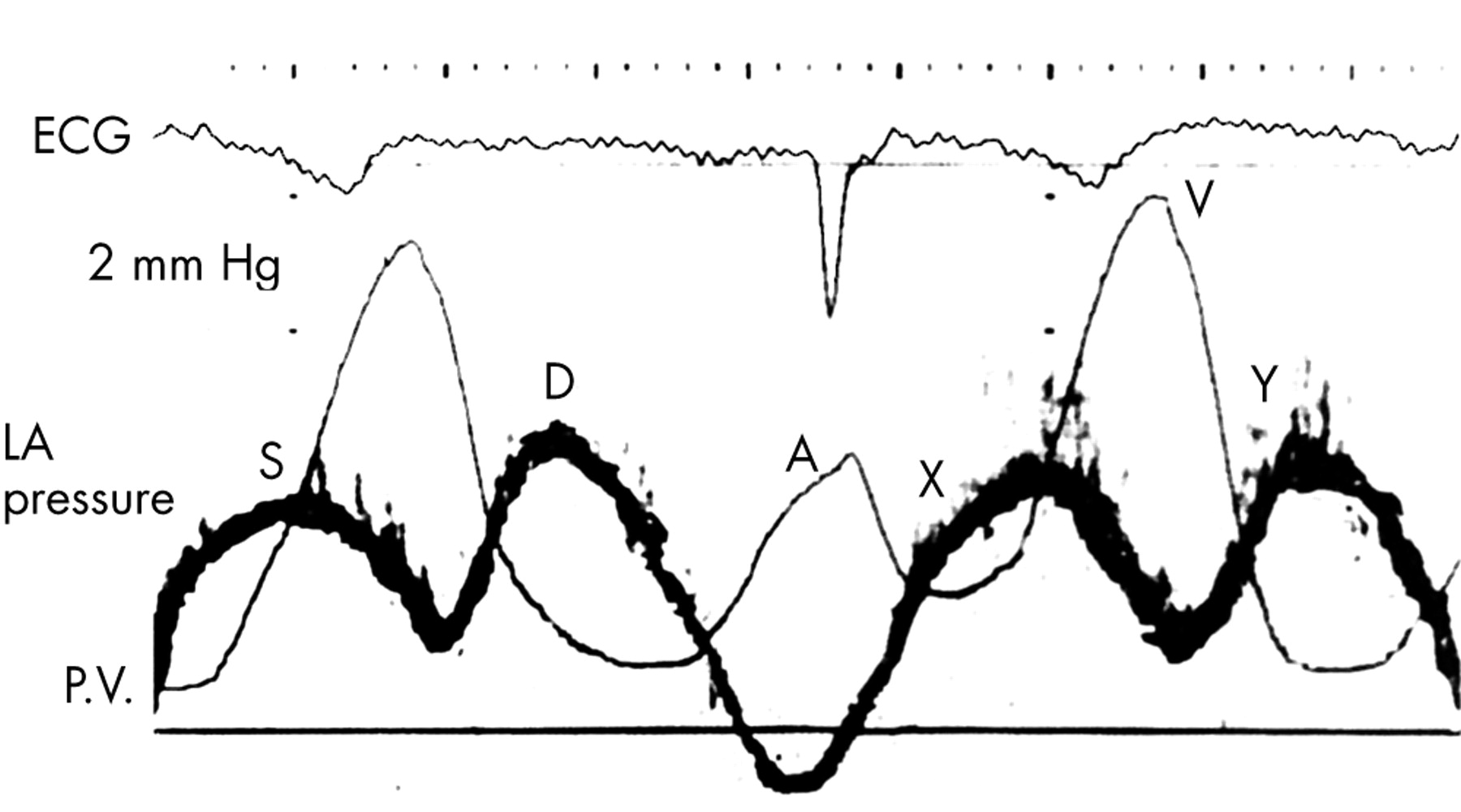
We know the atrial pressure  wave forms vary between right and left  atrium .In the right atrium “a” waves are  prominent and taller than “v” waves, while the reverse is true in left atrium .

Typical filling pattern of Right side chambers .Note The tall A waves . Source : http://www.ncbi.nlm.nih.gov/books/NBK2213/

Note the left atrial a waves are diminutive and v waves are tall .The dark black  wave is pulmonary venous waves. Source :http://heart.bmj.com/content/89/2/231.full

The  reasons for  tall  left atrial v waves are

  1. V waves are passive atrial  filling waves and  are timed  during ventricular systole .Left atrium is relatively  thick *,stiff , less compliant chamber .( Compliance : Rate of raise of pressure per unit change in volume .)
  2. Apart from relative thinness,* right atrial volume is more , hence  it can  accommodate more volume without raising its pressure .
  3. The left atrium is decompressed by  relatively stiff  pulmonary veins  with a mean pressure of 8 mmhg ,  can not adequately  dampen the   refluxing tides of  v waves , while the low pressure vena cava  of RA  dampen the right atrial v waves with ease  .
  4. Further ,the adjoining  systemic  left ventricle  ,  adds up to the stiffness of  left atrial   filling .

(*Thickness of RA -2mm,  LA -3mm )

Related article .

What is left atrial pressure volume Loop ?

http://www.wellsphere.com/heart-health-article/left-atrial-pressure-volume-loop/1208152

Ventricular tachycardia can be classified in a variety of ways. Monomorphic VT  and polymorphic VT  is one such classification based on VT morphology.Polymorphic VT  generally conveys a meaning of origin from multiple focus .But in reality  bulk of the polymorphic VT originate from a single focus .

How does a single focus have a multiple QRS  morphologies ?

This is possible because ,  even though VT arises from a single focus , the route it takes to exit  from the myocardium is different and hence they inscribe different QRS morphology for each  beat. It is also possible ,  as the conduction time varies with each  exit route  the VT  becomes  irregular. This  phenomenon   is called  polymorphic VT.

It is assumed the VT focus  is often located in the sub endocardium and breakthrough occur in the epicardial side as  we record  the activity  in the surface ECG. Electrophysiology of VT is not that simple ,  focus  of VT can be anywhere ,  the focus can be single or multiple and exit pathways  can also be multiple it and  it may even exit into endocardial cavity . Please note , even  a single  electrically abnormal cell  shall  act as a  focus . To confuse us further ,  some of  VTs  may not exit at all , extinguishes before reaching the surface.

It is  a  difficult  job to fix  a given  polymorphic VT  to arise   from a single focus or from multiple focus  .  Multifocal VT  can be  diagnosed  with  confidence only  after a through electro physiological  study.Clinically few clues are there. Electrolytic disorders and ischemia  are usually  multifocal,  while scars VT gives single focus .Other famous  example  of polymorphic VT are Torsedes de pointes .

Polymorphic VTs are  usually hemodynamically unstable but it is not a rule. Surprisingly ,some of the polymorphic  VTs are well tolerated . This is especially common in  multi focal polymorphic  VTs  which are hemodynamically and electrically  better off  . Ironically ,   presence of  multiple focus may be  a blessing  as they    compete with each other ,  in the process  pulling  down the other focus from triggering a VF . It  is possible  one focus acts like a natural anti tachycardia pacing for a  VT from another focus.

Ventricular fibrillation can be termed as an extreme form of irregular polymorphic VT as the wavefront breaks into innumerable fragments  each exiting the myocardium at will in a random fashion bringing ventricles to a standstill.

Final message

The term multifocal polymorphic  VT  is generally been abandoned at the bedside  as distinguishing  it from single focal  polymorphic VT  is a difficult task*.Still  the concept of  multifocal VT  is alive and  kicking in the EP labs ,  giving sleepless nights to  our Electro-cardiologists!

*Please note , multi focal VPDs can be recognised  with ease by different coupling intervals, but  it is difficult to identify during a  run of VT .

It is a combination of biochemical and  pulmonary receptor mediated dyspnea.

1. Hypoxia gets accentuated on exertion and it stimulates  chemoreceptors  located  in brainstem  as well as  aortic arch and its branches.

2. Equally important is the ventilation /perfusion mismatch that occur during exertion as the pulmonary blood flow significantly drops while the lung will continue with normal ventilation .This  increases the  Vp/Vq   (> 1) and  worsen the hypoxia  and   can independently trigger the sensation of dyspnea due to stretching of airway mechanoreceptors..

(It is  prudent to recall ,the later mechanism (Vp/Vq mismatch ) is  explicitly involved in  isolated  valvular pulmonary stenosis .Here , there is no admixture  mediated hypoxia , still the patient experience significant dyspnea  due  to meager  reduction  in pulmonary blood flow.)

3. Further ,  there are some morphological changes that occur in pulmonary vasculature in patients with TOF.This is due to chronic hypoxia as well as  “chronic low flow” mediated vascular reactivity. Micro vascular dysfunction in the alveolar capillary bed  is  possible in TOF. There  is  some evidence to suggest pulmonary gaseous exchange is impaired when compared to normal lungs.This can also contribute to the dyspnea in TOF.

Reference

The following article excellently describes the pulmonary dysfunction  that occurs in patients with TOF .It is prudent to note  ,the abnormal  lung function fails to get corrected even after total surgical correction in many.

http://onlinelibrary.wiley.com/doi/10.1002/ppul.1950160106/abstract

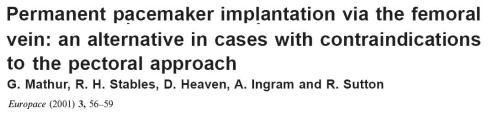
Venous access for permanent pacing can be troublesome . Especially with anomalous subclavian ,  second implantation  ,obese patients with upper limb DVT . Temporary pacing through femoral vein is a well known concept.

Here is a concept of implanting the PPM  through femoral vein ,    in the upper thigh and the pacing  lead all the way reaches the right ventricle .There were few  issues which were  thought to be critical .As patients ambulate   there could be more  generator motion  than the sub pectoral location .(By the way , upper limb movement is equally common daily living is isn’t !)

Surprisingly excess  motion is  rarely an issue .  Even dual chamber  pacers were implanted  through femoral approach.Implantation  procedure  are simpler than one would have thought  and  complications are less as well .Since most of the leads are now screwing type  and  actively fixed   dis-lodgement  is never an issue.

Final message

The femoral venous access can be considered in all in whom SVC approach is difficult or not possible . 85cm lead is ideal . It is routinely available.

Always consider trans-femoral approach  whenever you encounter difficulty in subclavian .  Falling back on  epicardial  approach in such cases should be avoided at all cost. After all , epicardial approach is a major procedure.

Unfortunately,  very   few centers   practice transfemoral modality  for PPM right now . Brazil has some experience I understand.Royal Brompton  hospital ,London , Memorial  heart institute ,Long beach , California  have advocated this approach with good success.

We Indians , have a huge potential to propagate this useful concept.I wonder  why Femoral –  IVC approach  could  not be a  first choice for permanent pace maker implantation  especially in small children and adults ! The  main issue is  not technical , it is more of   perceived  fear  and reluctance to change the tradition.

Reference

The  article  by Ellsted  http://onlinelibrary.wiley.com

During   primary PCI , the weakest link  for a  cardiologist  is  , he is never sure whether  the  metal jacket  has covered the entire  disease segment with optimal apposition .  (Geographical miss is another issue !)

This is because  , even though the inflation pressure is  uniform  within the balloon ,  the required  apposition pressure is not the same .This is obvious as the lesion surface has a varying consistency and uneven surfaces . It is a  huge guess to quantitate the relative  contribution of thrombus and plaque  within  the 100 % occlusion  that has resulted in the STEMI. Hence  some areas may get over apposed and others lesser apposed. Further , the stent -vessel wall interface  in all likely hood enclose a   layer  of clot .This is almost certain  during complex primary PCI. One can imagine the sequel if this thrombus layer dissolves later ! (Edentulous stent )

It is surprising , why cardiologists has  so far not  thought  of a  self expanding stent  which  can snugly appose the vessel wall in this setting  . The   radial strength   from the  stored potential energy can be used up future use. This is most important  in first few days following STEMI  , when the coronary arterial lumen can vary depending  upon the

  • Vasomotor  tone .
  • presence of thrombus
  • Plaque   ploughing /milking  effect
  • Vascular remodeling

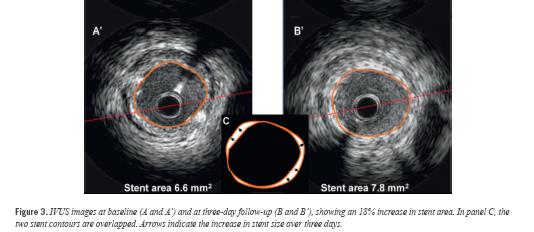
Cardiologists  deploy a stent  based on the morphology  on day zero of STEMI  .This may be  totally irrelevant  , since after a  few days    the lesion may change its morphology ,  thrombus may migrate , vascular  dimension may change. In such a  situation*  , a self expanding stent can tackle these issues very effectively by constantly adjusting  and fine tuning the luminal  diameter and  the apposition pressure . It  does not give any chance  for  thrombus to form  between the vessel wall and stent .

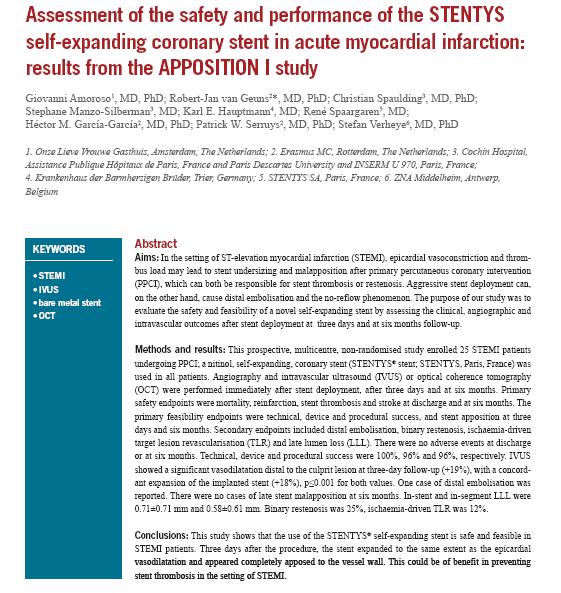
Here is a study that gives fresh insights regarding the role of self expanding stents during STEMI .

Note the “Auto adjusting”  of stent diameter  in the first few days after  the stent deployment, depending upon the luminal needs !

Animation

http://www.stentys.com/file_bdd/annexes/1284135580_video_stentys_en.swf

* Logically  during  primary PCI for  STEMI  ,  POBA and thrombus suction  may be the best option in many as all stent related complication is instantly eliminated .But it is a battered concept ,  most of the current day cardiologists would feel guilty to come out of  the cath lab  without a stent  in  primary PCI scenario  !

Final message

Self  expanding stents during primary PCI :  Is it a  perfect solution  for optimal stent apposition  ?

It seems so  . . . but  the track record of current cardiology devices never fulfilled the initial promises !

Off label prescription 

  1. Is a great scientific concept
  2. Is a deceit camouflaged  with a pseudo scientific fabric.
  3. Can be encouraged in very selective patient  population and diseases by experienced  cardiologists , as  it may be really useful when no other options are available.
  4. Is diagonally opposite  to evidence based medicine , should be banned in toto !

Answer:

4 is the correct answer .occasionally 3 can be true

Some of the examples of off label indication

  • Statins for Aortic stenosis
  • VSD device for RSOV closure
  • Ivabradine for cardiac failure

By the way how does an off label become on label?

It is not the ” God ” who  gives the label to them

There are few “Demi Gods” sitting aside  in the regulatory corridors of  New york and  Geneva who decide the fate of these drugs and devices . Ultimately the integrity of these organizations that will either protect or injure our patients !

Final message

Medical science grows my mistakes  . . . hence  we should be encouraged to do more of that  . . . so that we can grow !

ST segment depression is a fairly common observation in anterior precardial leads. It   is  due to

  1.  Pure electrical phenomenon (Referred to as reciprocal changes)*
  2.  Additional  ischemia in LAD territory
  3.  It could imply  the IRA  is  a critically occluded  LCX and STEMI is actually an   infero -posterior STEMI
  4.  Simply  indicate a  multi vessel disease.
  5. Many times  reciprocal changes may simply indicate extensive nature of the  index  inferior MI.

How to differentiate reciprocal ischemia from true  remote ischemia ?*

  • Logically true ischemia patients  should suffer from double dose of angina (Infarct pain plus ischemic). Most of these patients will present in a   scenario of  post infarct persistent  angina . Patients with   pure electrical reciprocal  changes are relatively  quiet and  severe distress is uncommon.
  • In true ischemia  , both patterns are  not temporally related  in time. If its a  pure electrical phenomenon they should be linked in time .
  • Disproportionate ST segment depression  (ST elevation  in inferior lead  is  2 mm  while ST depression in v1,v2, v3 is >  3 mm )
  • Persistence of ST depression even after thrombolysis  or PCI to IRA.
  • Worsening with thrombolysis would suggest ST depression in V1V2 and v3  is indeed an  episode of  true NSTEMI  of LAD , where thrombolysis is contraindicated. (Also  read  – A  related article  dual acute coronary syndrome in this site )
  • Echocardiogram will give us a clue .One can  detect ischemic the wall motion defect in the segment in dispute .(Reciprocals do not show WMA )
  • Coronary angiogram   would provide   definite  answer to the speculations in most  . Still , it may   require a FFR  to confirm ischemia in the contra lateral artery.

Primary PCI (pPCI) is probably*  the   best modality in the management of STEMI .

( *Probably because ,    we  know “Time” ( fate !) is  still the  most crucial determinate of ultimate outcome of STEMI )

Any experienced interventional  cardiologist will be aware of the surprises  and difficulties  they encounter during primary PCI.

The pPCI  is all about  opening up the IRA rapidly and  wheel  out  the patient  from cath lab at the earliest.

But ,  ironically , an often  under- reported   issue  is the difficulty in  identifying IRA itself  !

One may wonder  , how this can happen ?

Following difficulties  can occur  in identifying IRA during  primary PCI*

(* There are some  hyper-talented  cardiologists who would never consider IRA recognition as an issue  .This article is not meant for them.)

The problems can range anything between the following   queries

  • Where is the IRA?
  • Is that the IRA?
  • No IRA ?
  • Multiple IRAs !

Angiographic encounters during  pPCI  and  IRA  trouble shooting .

  • When there is diffuse multivessel disease.
  • Thrombus vs  eccentric plaque  both  showing  intra luminal filling defect .
  • Thrombus spill over to adjacent branch or A mid LAD lesion with  stagnating thrombus extending to LCX ostium  mimicking two IRA
  • A bifurcation lesion with both LAD and LCX  ostial occlusion.
  • Multiple active looking  plaques with thrombus
  • STEMI in patients with preexisting CAD . Is it a CTO ?  ATO ? (Acute total occlusion ) A  CTO  ,which is  fed by collaterals from contralateral artery  ,  if this feeding vessel is  occluded even  partially ,  STEMI will occur in CTO territory . Here  , for rapid salvage you need to open the vessel that feeds the CTO territory.
  • Post CABG and post PCI form a special subset . Some times it is very difficult or even impossible   to label a graft as an IRA

Finally and most importantly  , when  there is no visible lesion in any of the coronary arteries   and look  near normal  !   Is that  no IRA  ?  or Wrong diagnosis of STEMI ?  Every one blinks  in cath lab . The consultant  howls the fellow to verify the ECG . Finally it may  well turn out to be an early  repolarisation  syndrome . These are wages we  often pay for the modernity !

How to approach  the situation when one is confused with  identifying the IRA ?

The good old ECG will come to  our  rescue sometimes. Realise in a multivessel CAD  , ECG is also vested with errors.

Echocardiography  rarely  gives a convincing answer to localise IRA. (Segmental overlap , preserved sub epicardial  contraction , residual ischemia all tend to confound )

Most confusions occur between LAD and  diagonal /LCX as there can be a huge overlap in the ECG territory  anterolateral segments

In a infero posterior STEMI, if  you have both  RCA  / LCX lesion and you wonder which  is the IRA  it is easy to solve by looking for RV involvement. (LCX lesions however dominant they are  . 99/100 times can not infarct the RV significantly  !)

If the lesion  is in PDA  the  issue is made simple.

Doing a primary PCI  blindly without knowing the IRA

This is  modern-day cardiology  at its scientific  low ! . Cardiologists  indulge in such  things much more commonly than one would imagine.

Probably  they would reason ,  it is safe to stent every vessel that is potentiality  an  IRA  , rather than  missing it. Though the concept of  multivessel stenting in STEMI   may help   patients with complicated MI ,  like pump failure ,  it generally increases   risk of primary PCI outcome in otherwise stable STEMI. Primary PCI procedure must be as short as possible. The other option is to do plain balloon angioplasty in less deserving vessels.

Important considerations  in the setting of complex multivessel CAD  during pPCI .

  1. Fall back on medical therapy
  2. Staged PCI
  3. Deferred or Immediate CABG
  4. Hybrid procedures like PCI  with CABG

Final message

IRA identification can  indeed be a difficult task  during primary PCI.  Sound knowledge and experience about coronary anatomy and its draining territories especially  in  the setting  of  multivessel  CAD  is essential to avoid errors.

Do you fear to deploy DES during primary PCI ?

  1. No. Not at all !
  2. May be  “Yes”
  3. Yes, definitely
  4. It depends upon which drug it Elutes !

Answers  that might  decode  the  cardiologist  mind. ( Excuse me  if it errs !)

If the answer is 1 ,  You are the most optimistic cardiologist  and scientifically  updated ,   data driven  cardiologist , and with little concern for the patient welfare.

If the answer is 2 , Your are a cautious cardiologist may be . . . may be . . .  an   ideal one . The chances of you , using a  DES is  still low in  STEMI.

If the answer is 3 , You are a pessimist and  with   anti technology thoughts but still you  have more concern  for  your patients!

If your answer is 4 ,  You are undecided  and probably  ignorant as well . Most likely   you would not use it  for some reason  .You need to read more  on the topic .

By the way , my answer is  response three.

Read further ,  the EXAMINATION trial just released in ESC 2011 Paris .

This RIFLE  shoots without  bullets . Yes ! it  helps the cardiologist to  trouble shoot  the kidneys which often  suffer from  cath lab cross fires .

As  the cardiologists indulge in sophisticated cardiac procedures ,  in more and  more  sick and co- moribund  patients , it is becoming increasingly  important  for them ,  to   give due  respects  to  other organs as well !

Renal function is an important determinant   in the  over all outcome  in any cardiac patient.

  1. How to assess  the baseline renal function ?
  2. How to measure  the impact  of the  cardiac procedure ?
  3. How to  follow  up and monitor the  progress of  renal function   in coronary  care unit.
  4. How to  reduce the enhanced renal  risk ?
  5. When do you call for  the Nephrology consult ?

Every step becomes  vital . Do not ever think , a  cardiologist’s job is over  once few  stents are deployed . Wheeling   out a  sick  and fragile diabetic  with borderline  creatinine    out of the cath lab  may be  considered   as a procedural success  , but the real success happens only after  every organ of the  your patient  comes  out  unscathed  after the procedure .  In this  context  , we should first aim to  become a nephron  savvy and a nephron friendly cardiologist .

I have witnessed  cardiologists  spend hours  together  in cath lab with liberal injections of contrasts  even in  elderly  who have delicate kidneys .Cardiologist should realise  kidneys are soft and gentle  organs  which unlike the heart  , do not  know  how to cry  (Angina) at times of stress  as they lack  well developed pain fibers  (unmedulated  type c fibers to be precise!) .Only thing they  know  is ( like touch me not plant !)   they  strike work  the next   next morning (What we refer to  technically as Acute renal  shut down !)

Now , we see little  interaction  occurring between a  cardiologist and nephrologist  prior to PCI , even though  those two organs ( The   respective experts behold )  are  constantly in touch  with each other , every minute ,  by neural and hormonal mechanisms. The new generation organ  specialists  has to learn  a lot   from these sincere , interactive  , democratic  human   biological system.

Coronary arteries can gulp any amount of dye but  not the renal  arteries .The   future looks still more frightening ,  as we have a variety of devices lined  up  to invade human vascular tree (TAVI, Renal ablation, per cutaneous aortic pumps etc)

So what should we do ?

  • Patients  prone for  CIN should be promptly  recognized .
  • Ask repeatedly  the question .  Am  I   sure  ?  . . .does this patient  require this  procedure at all ?  If  so , have I taken all the precautions ?
  • Use the nephrologist’s services more liberally

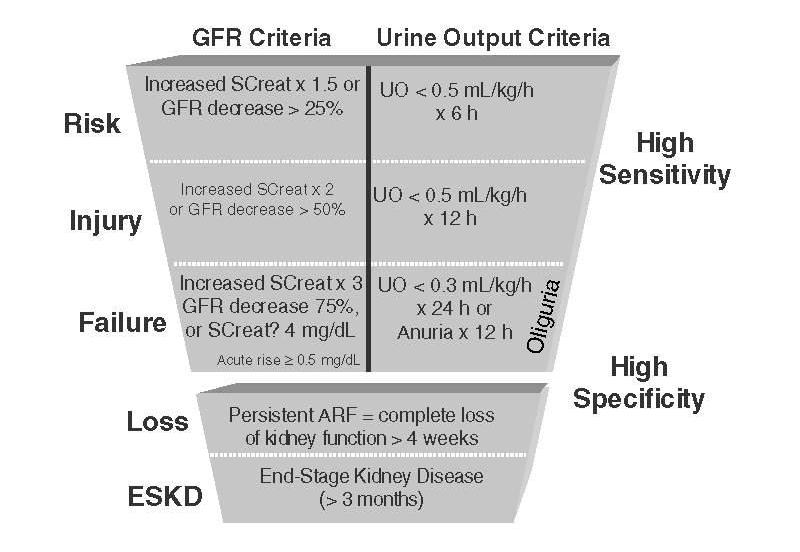
Finally ,  read the basics of  nephrology   lessons  once again .  The international consensus group has  classified   the Acute kidney  injury  (AKI)   with a  simple and lovely criteria  for  risk  triaging .     It is a  five faceted ,  inverted  (Tip less ) triangular  cartoon called  RIFLE .

The beauty of  RIFLE   lies in its  simplicity . All  it requires  is  serum  creatinine   (eGFR)  levels  and urine output.  Let  every  cardiologist  master this scheme of AKI . It will immensely  help  our  patients   and make us  a  complete  physician   instead of   being  labelled as a  “master of  an  organ”   or   ” An accessory sub physician”

The CIN prevention recipe.

Source Catheterization and Cardiovascular Interventions 69:135–140 (2007)

References

For review about Contrast nephropathy (CIN)  there are lots of excellent articles.

One company is trying to find a new  solution for  this complication . Let us welcome it ! The device is called rena  guard .

Renal Guard : A new technology to prevent CIN