Feeds:
Posts
Comments

When you  encounter  a patient  with shock and  hypotension , the first ( instinct ) response would be to  start  an  IV line and push fluids rapidly . This is more so if  the patient is a child. This is what medicine has taught us for over a century . Now this  NEJM article surprises us with  its conclusion.

The accompanying  editorial in NEJM reiterates  a  fact . . . “In medicine there is nothing called  dictum”   , what you perceive as life saving treatment  will be doing the opposite !

Such is  the fragility of  present day  medical facts.

Please  remember , in medical science  not only  the drugs  have  expiry date even  some of the  break through  concepts suffer from it . 

This study may not have  great implications for cardiologists  but the filed of cardiology is also  infested with  many such false dictum(s ) are waiting to be damned !

In this funny world . when the  scientific methods are  imperfect  ,  we have to realise  two such U turns make  the  original path right .

Similarly ,  some of  those who do  not  make the initial   path correction ultimately  travel  in  the right path !

Message to patients

Many of my patients often wonder how two diagonally opposite  views are expressed  by doctors  for a given medical  condition .  My simple answer to them is do not ever  try to understand your medical condition beyond a point , . .  .  we  our-self  have not yet  mastered it  !

LIMA (Left internal mammary or thoracic )  is an unique  artery ,   incidentally runs close to  heart ,  has  a  privilege  of supporting   of human  heart in its hour of crises ! .  CABG  surgery was started with saphenous grafts in 1967 .  We have  since moved  on ,  from venous grafts to  total arterial grafts .  LIMA as a graft for coronary artery was a  great innovation for cardiac surgery  .Now , it can be stated  ” CABG should not be done without a LIMA graft “

Advantages of LIMA

LIMA   has good anatomical  match for LAD. The 10 year  patency  rate is very favorable (60-80%) .LIMA is also a live graft enriched with nitric oxide , as it has native  communication with subclavian artery  .

Anatomy

The internal mammary artery  originates  from the under surface of the first portion of the subclavian, opposite the thyrocervical trunk. It descends behind  the  upper six ribs at a distance of about 1.25 cm. from the margin of the sternum, and at the level of the sixth intercostal space divides into the musculophrenic and superior epigastric arteries.

The branches of the internal mammary are:
Pericardiacophrenic. Intercostal.
Anterior Mediastinal. Perforating.
Pericardial. Musculophrenic.
Sternal. Superior Epigastric.

There are few Anatomical issues for LIMA

Subclavian -LIMA ostial stenosis : Rare

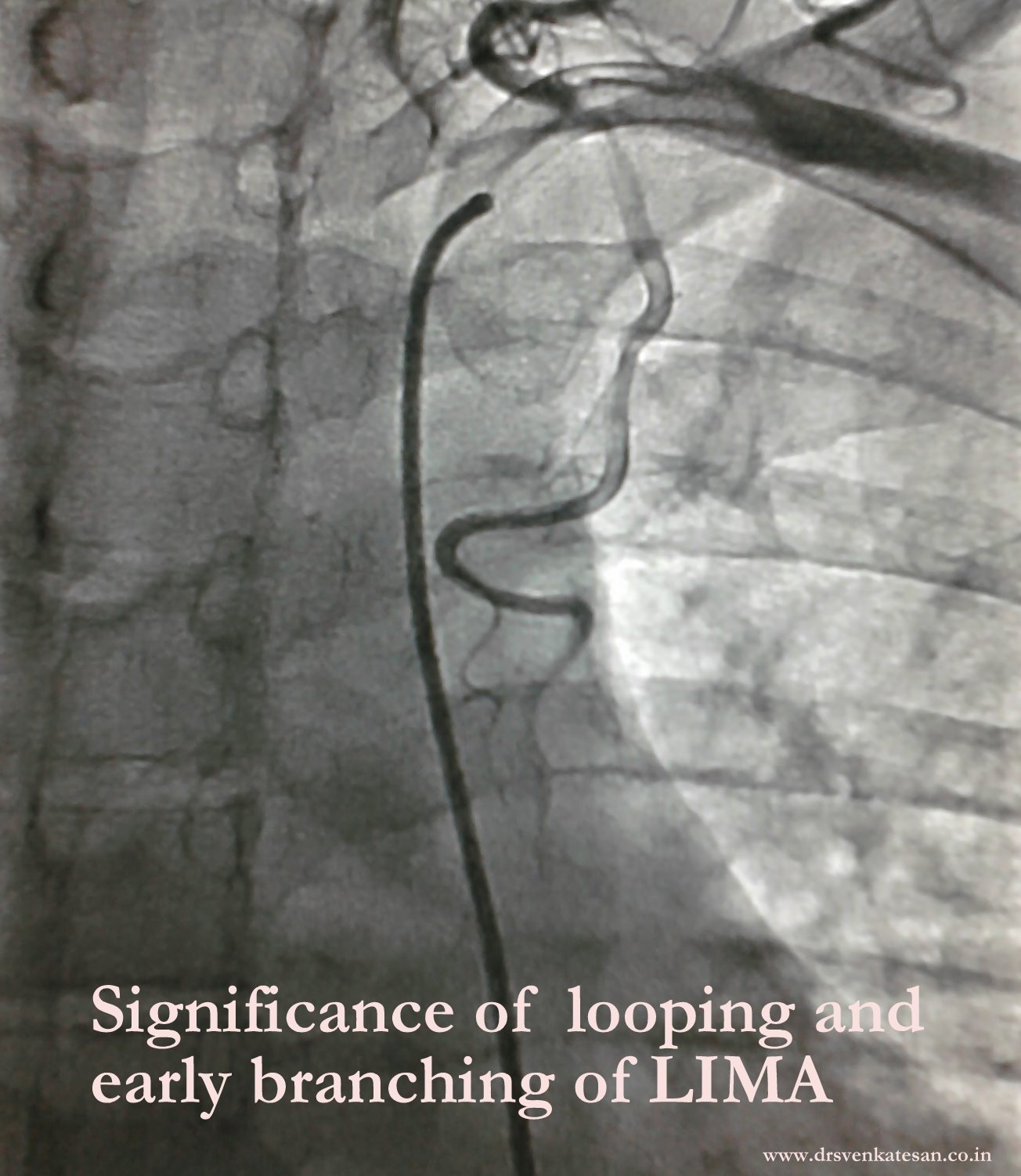
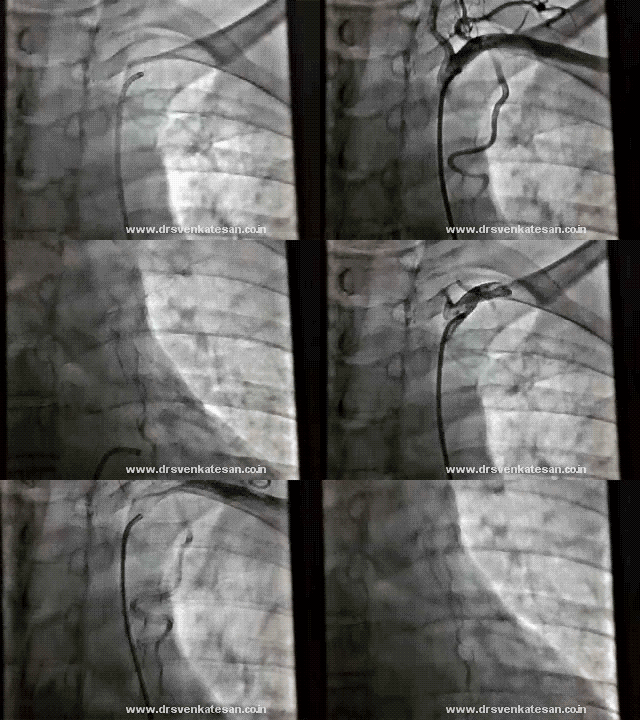
Looping of LIMA is rarely an issue in hemodynamic point of view. But some  believe  a looped up LIMA is slightly prone for graft disease.Complex looping are reported rarely.

A loop and a early branch of LIMA : What is the implication ?

Abnormal  or premature branching pattern  of LIMA  needs clipping as it may divert blood supply to LAD.Terminal branches can be used as a sequential graft to a branch of LAD  usually a diagonal. In spite of all these issues , LIMA is  rarely unsuitable either anatomically or physiologically .It is a safest vessel to graft.

Future of LIMA  graft assessment.

Currently selective LIMA angiogram is the gold standard.

MDCT (64 slice) gives stunning images of LIMA graft , but unfortunately , it has little value for functional assessment .

Functional assessment of LIMA graft By  angiographic frame count  is being attempted in our institute.Will be reported in 2012.

Is hypertension really a major risk factor for CAD ?

    1. Yes it is !
    2. No . . . it is not !
    3. May be !
    4. I don’t think so !

Ans : Any of the above can be a  right response , depending upon our basal and perceived  level of knowledge .

Answer analysis

  1. SHT  is  one of the risk factor for CAD  agreed ,  but definitely not a major one , as SHT per-se rarely precipitate a STEMI
  2. Unless SHT occurs with dyslipidemia, smoking or diabetes it is  rare to cause ACS.
  3. The only  adverse effect of SHT  is  , it has a potential  to aggravate atherosclerosis  by promoting epithelial injury and dysfunction.
  4. Hypertension is a well known  major risk factor for cerebro vascular disease while it is minor risk factor for CAD !
  5. We do not know yet why cerebral vessels are intolerant to high blood pressure while coronaries are pretty happy  with it !

Final comment

SHT is not a major risk factor  for CAD ! At worst , it can propagate chronic CAD. This sort of reasoning  may be considered a huge controversy  . . .but it is really not !

  • One evidence for the above observation is  , we  have  been struggling hard  for over a half a century  to prove a elusive  point that controlling blood pressure  to optimal levels  would  dramatically reduce  cardiac   events !
  • Further,HT’s  relationship with acute coronary syndrome especially STEMI  is vague , it is very rare for patients with accelerated hypertension or malignant hypertension to  present with STEMI *

* Caution :Young doctors should not get confused with this seemingly  controversial observation .This write-up , tries  to convey  a point  , SHT may not be that bad for coronary arteries when compared to cerebral arteries . However BP control remains  vital in  all patients who have  developed a cardiac  event or in patients with multiple risk factors .

Please note ** SHT is still  a powerful risk factor for cardiac failure.(Acute LVF to be precise ) ***SHT can aggravate unstable angina , but very  rare to precipitate unstable angina.**** SHT ./High intra-coronary  pressure can theoretically  dissect or fissure a plaque . (The fact that , HT is so prevalent in a community  but spontaneous  coronary  dissections are not !  should make us think further !)

What  is the   “secret of success”   among current generation  cardiologists ?

A . Strong foundations in cardiology with excellent clinical skills and a rational approach to the given problem.

B.  The  secret lies in the  nimble  fingers  which  acts  almost , like an extension of catheters  in cath lab !

C.  The speed with which he can mobilise a cath lab team in an ” off – office hour”  primary  PCI !

D. It is the the cunning art of  converting coronary  angiograms into angioplasties , by lucid  discussions  with patients and their   relatives  in the the silent cath lab corridors  !

Answer:

When this question was posed to a group of cardiologists ,  D  was considered  most important B,and C came close behind   and   A  was  probably least important  and few thought  “A” character  is rather an  impediment to  become a successful cardiologist !

*Unfortunately a successful cardiologist is defined in India by number of angioplasties he does per month, What  a disgrace to a great medical specialty called cardiology !

What is normal CAG to angioplasty conversion ratio ?

LVH is traditionally believed to be adverse marker for both coronary events and cardiac failure. . (Framingham ) While  this may be  true most of  time  we  also  have evidence to  suggest  patients with LVH  tolerate ischemic injury better.The area of MI is less.  In fact , the coronary drug project was not able to identify LVH as a major risk factor  for MI.  But many other studies continued to portray  LVH  dangerous parameter in ACS.

This paper from Sheba medical center Israel   tries  to answer this  question succinctly !

Summary

LVH  indeed  is an  adverse  predictor  for cardiac outcome  in the  long term.Meanwhile , since the   7 day mortality of STEMI  is well below  3% if  associated with LVH    keeps the controversy alive  ( 5-7% in non LVH group ) .This piece of statistics     gives credibility to the belief   LVH  may  really prevent  early deaths  in STEMI.

This phenomenon about LVH is  consistent with our observation  in  one of the Asia’s oldest coronary  care units (Started in 1972)   .None of the  STEMI patients with LVH  had a cardiogenic shock  in the recent past   !

* It is important to realise not all LVH are same. Inherited LVH, Diabetic LVH and  uremic(  or sub uremic ) LVH  behave differently. Since  the concept  of LVH is  carried  by physicians   in  a single basket ,  we tend to miss the  true benefits of LVH that occur purely due to good exercise training or a mild HT !

In other words , LVH that do not involve interstitial proliferation  is  probably  good for the heart !

Final message

With due regards to Framingam study  , presence of LVH in ECG in any form of acute coronary  syndrome  should  bring a sense of comfort  in the coronary care units .I agree  , it may increase risk of sudden death in some of the population but still it has some unique and definite  advantages at times of  ACS.

Reference

1 Levy D, Garrison RJ, Savage DD, Kannel WB, Castelli WP. Prognostic
implications of echocardiographically determined left ventricular mass in the
Framingham Heart Study. N Engl J Med 1990;322:1561–1566

2.The Coronary Drug Project Research Group. Left ventricular hypertrophy patterns and prognosis. Experienced post infarction in the Coronary Drug Project.Circulation 1974;49:862–869.

3.Behar S, Reicher-Reiss H, Abinadar E, Agmon J, Barzilai J, Friedman Y, Kaplinsky E, Kauli N, Kishon Y, Palant A. Long-term prognosis after acute myocardial infarction in patients with left ventricular hypertrophy on the
electrocardiogrm. Am J Cardiol 1992;69:985–990.

*Coronary drug project (A old study done in early 1970s has more credibility when LVH was not considered as pharma target !)

We presume  ECG  fails miserably against echocardiography for assessing hemodynamics , while  echocardiogram  has  little value  when it comes to studying   electrophysiology .  Ironically ,  we often  ignore  the fact  ,   ECG can  provide  important long-term   hemodynamic  data . The pattern of  chamber enlargement  give us  vital clues to the prevailing hemodynamic  stress and loading conditions. While echo  can be termed as an  anatomical and  physiologic   modality  , ECG  apart from  its unique capacity to record cardiac  electrical finger prints ,  it  provides  useful ,  anatomical ,  hemodynamic information too !

While Doppler is a  fascinating modality to measure hemodynamic data in a moment to moment fashion it can never ever tell us  , what has been going around in the preceding months or years. This  is were chamber size helps which  give us chronic physiological information (Chronic  Doppler ?)

A simple E:A reversal  in  mitral inflow doppler can be a  innocuous  finding in isolation  . If it is associated with even   minimal grades of  LAE  it gains huge importance. That is why left atrial size is  funnily referred to as HB A1C of diastolic dysfunction ( A marker of chronicity  of  diastolic dysfunction)

If LAE is so important to diagnose diastolic dysfunction , why  we are so  obsessed  with doppler filling profiles  of mitral valve ,pulmonary veins, mitral annular tissue Doppler and what not ! .Many of these sophisticated doppler methods are extremely operator dependent  and are  subjected  to technical and mathematical errors. Especially , with  tissue doppler where we  magnify the errors as we  filter  extremely  slow tissue motion .

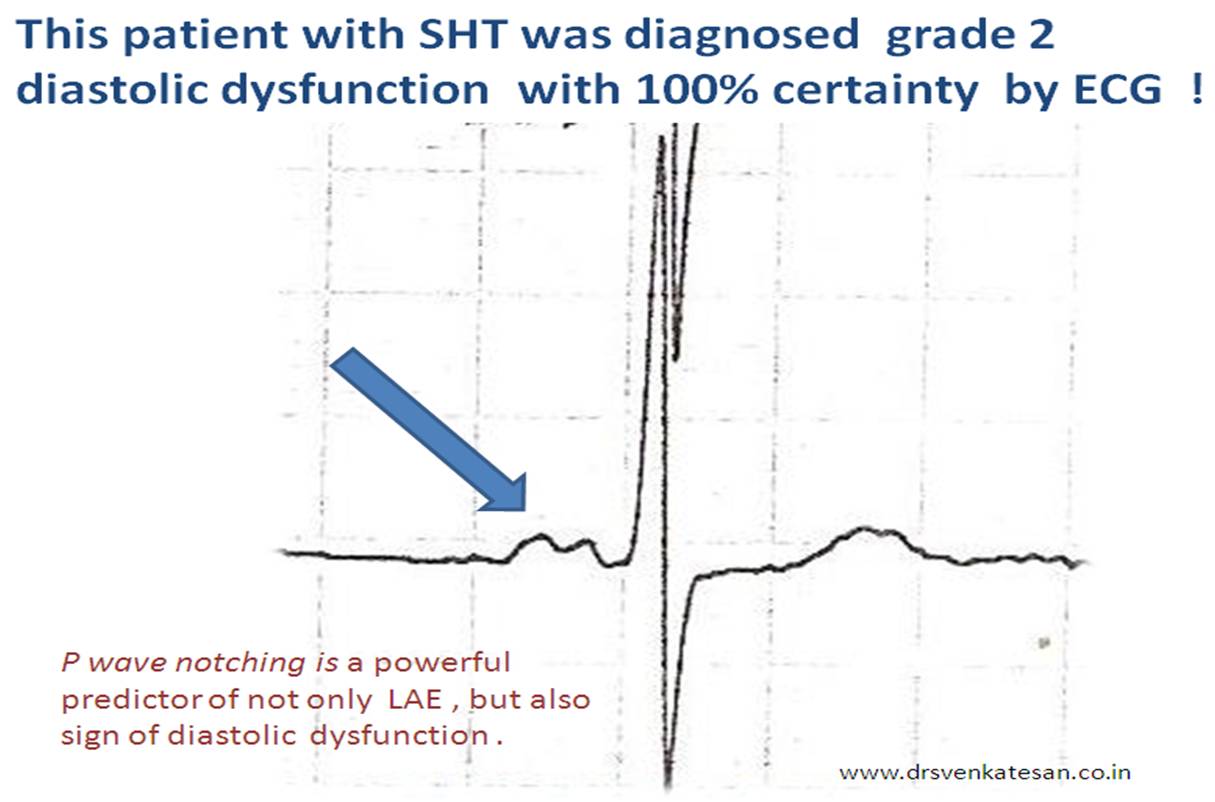
For  many  decades  we  have failed  to impress ourselves  , about the importance of subtle P wave abnormalities in the  ECGs   of  hypertensive patients.

In fact those  innocuous looking  slurs and notches   in P waves ,  suggest the left atrial  stress and a definite marker of underlying LV diastolic dysfunction .

P wave is the only electrical wave that occur in diastole .Hence there is no surprise  ,i  gives us enormous information about this phase of cardiac cycle .

If only we look  at them carefully, zoom it (Now it is made easy with so many softwares)  analyse critically we can find a wealth of information about the atrial behavior in hypertension.

Experience from our hypertension clinic  with periodic echocardiograms suggest ,  the following  ECG  findings   can be   good markers  of significant  diastolic dysfunction .

  1. Notched P wave
  2. Wide  P waves
  3. Slurred  P wave
  4. Bi-phasic P waves

* Surprisingly  , these abnormalities correlated with at least grade 1 diastolic dysfunction even in the absence of  for LAE or LVH by echocardiogram.

** In an  occasional patient  P waves  can widen due to inter atrial block or conduction delay. This a rare exception for wide P waves without LAE.

Final message

A well recorded and   analysed   ECG can  predict diastolic dysfunction  with fair  degree of accuracy .This fact need to be emphasized  by every one  .  Next to ECG ,  LA size and volume  by 2d echo are excellent parameters  to assess diastolic function in a long term fashion. Sophisticated  but  error prone ,  momentary doppler parameters are getting too much attention  at the cost of simple ,  shrewd ECG and 2D echo  !

LVH can be diagnosed with fair degree of  accuracy  by surface ECG . We have a set criteria .The Estes  scoring is  the most popular. Very rarely we have all  the classical features of LVH in a given ECG .

With the advent of echocardiography ECG diagnosis of LVH has become redundant . Still , it is essential to  build the  foundations  in cardiology  for the current generation cardiologists.

The following are the  magnified views from the above   ECG

High Voltage
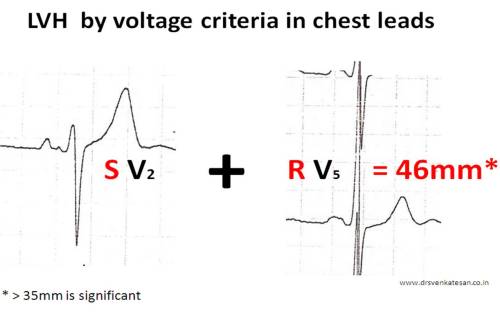
High voltage QRS is a hall mark of LVH .It increases in both chest  and  limb leads .In chest leads , both R and S wave gets amplified , while in limb leads only the R wave  is taller . We have to sum up R  from lead  V 5 and S from V2  (Practically any deep S and tall R can be added . LVH is diagnosed  if  sum qrs voltage  is  >35 mm . Voltage criterias in limb leads do not require these  addition business . An  R wave amplitude > 11mm  in limb leads by itself  would indicate an LVH (In the absence of bundle blocks )

Pit falls in voltage  criteria

It is our belief    qRS voltage  would faithfully   reflect the   quantum of cardiac muscle mass ,  but in general  to equate qRS voltage  to myocardial  mass  is   a  huge error we make ! (Of course  It  may be true in  some cases  following MI )  .

The qRS  voltage is determined by   numerous  factors (Important ones are :  chest wall thickness , age , LV cavity size ,  amount of blood inside LV cavity,  heart rate , conduction delays  etc ) This is the reason a 10-year-old boy’s   ECG will  satisfy the criteria of LVH  by 100 % .Do not ever report a ECG without knowing the age of the patient .

At high heart rates R wave amplitude increases(Broddy effect) due to high conductance of blood

Chest lead always balances RV and LV forces .One can mask the other .So be ready for surprises when you find a perfectly normal ECH in bi-ventricular  hypertrophies ) A balancing act !

Mini summary : Never diagnose LVH with high voltage alone

Left axis deviation

The axis deviation is again non specific  . The LV mass shifts the mean axis to left (Beyond -15 degrees) .The axis shift would also be contributed by mild forms of LAFB . This  fascicle  which criss crosses the LVOT  easily gets injured to hemodynamic stress ( or rather insulted ) and  lose its function . So its job is  transferred to  the posterior fascicle  which  shoots  towards  anterior and superior and left , hence the  left axis deviation) .The LAFB is generally a benign defect unless it occurs in an acute fashion as a response to ischemia.

Mini summary : Never diagnose LVH on the basis of left axis alone

Left Atrial  abnormality

This need not be present in every one with LVH . It happens only  if  LVH  is associated with relaxation defect , when   it calls for  LA’s  assistance .(In other words , presence  of LAE in hypertensive  patients is  a  sure and simple way to confirm diastolic dysfunction ) . Similarly absence of  LAE (  with a   significant LVH )  is a good sign as the LV is able to tackle the hypertensive stress in solo fashion in all likely hood free from significant diastolic dysfunction.
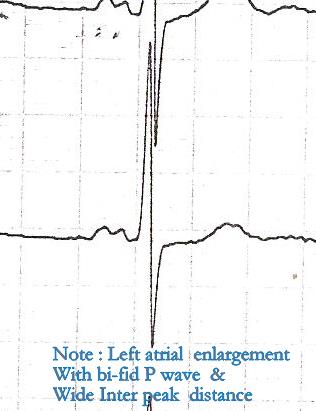
Apart from LAE , note also the p wave encroaches good part of PR interval .

Mini summary : LAE can be very useful parameter to diagnose LVH . (Is it not ironical  to note   LAE is more reliable to diagnose LVH ! . This is because qrs morphology is unreliable as it influenced by many factors  while p wave  changes are  not subjected to such influence )

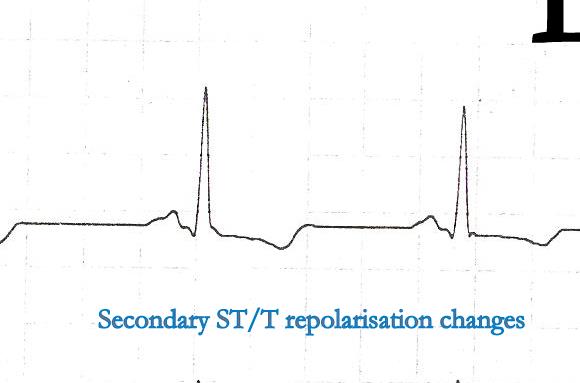
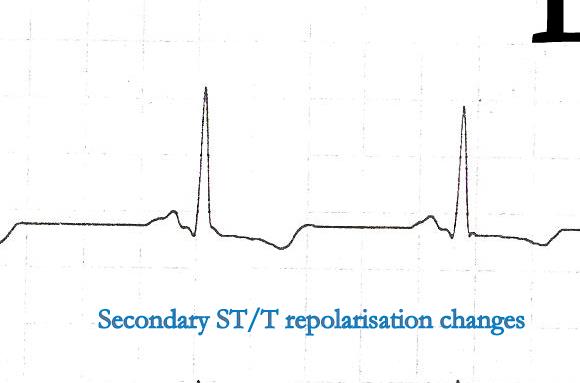
Secondary repolarization changes

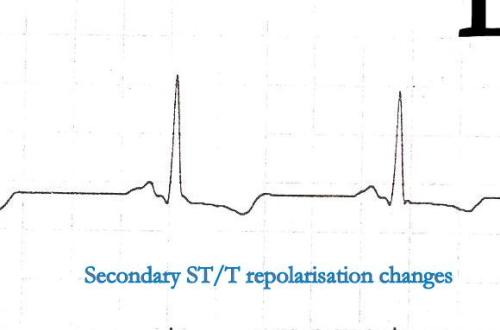
We know ventricular depolarization and repolarization are interlinked phenomenon .Both  occur in  opposite directions still  , able to  record   ECG deflection  in same direction  (positive QRS/positive T)  . This is due to the fact  the epicardium and endocardium has  action potential with different velocities . At times of   LVH this epicardial  , endocardial heterogeneity in repolarization becomes void. (Note : This is a simplified statement of a complex repolarization process)

Because of this the repolarization is recorded opposite to that of depolarization .Hence we get all sorts of secondary ST /T changes. (The  term secondary is used to denote secondary to alteration  in depolarisation ).

Many times  all of the following  could   mean the same  in the bed side clinical parlance !

  • Secondary ST/T changes
  • Non specific ST/T ,
  • LV strain
  • LV systolic over load etc .

Note : Primary ST depression occurs in true ischemia without any alteration in LV Mass or conduction defect.

*** For advanced readers  only : Some of the ST depression that occur in ischemia could again be secondary changes. This  needs further reading.
Definitions

Echo is the gold standard for diagnosing LVH .There are two definitions .

  1. Based on septal thickness
  2. Based on LV mass*

LV mass > 200mg in men and 175mg in women is considered LVH . LVH based on LV mass is  ideal . But can be misleading in a dilated heart where the mass may be increased with a  relatively   thinned  out IVS .

Final message

There are numerous  ways to miss    LVH in ECG,  But the definite way  for not missing  is by echocardiogram !


Mechanical complications are not rare  following acute MI .In fact , it closely competes with electrical deaths . Many times it is not recognised  and get wrongly labeled as  simple pump  failure .

Echocardiography has revolutionised the way , we approach these deadly complication.(Of course , many  deaths  could  not be prevented still !)

The early days of STEMI is critical . This is the time the infarcted muscle softens and invaded by blood components like  neutrophils etc. The biochemical events  in the infarct zone is a least studied aspect by  current generation  cardiologists. Some ,  especially women tend to lyse their interstitial collagen faster. This minute break ups  coalesce to form a tear , When this tear is subjected to hemodynamic stress and mechanical stretch a rupture is  all too likely.

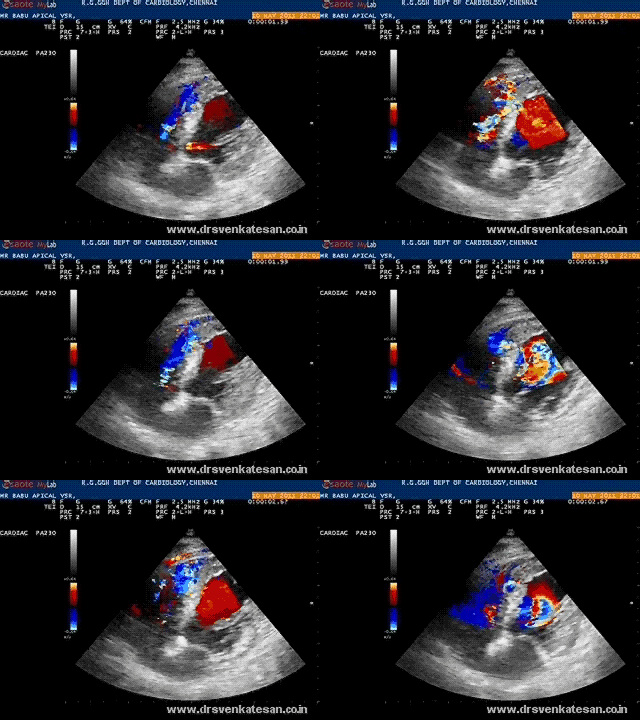
The rupture site is predetermined by the patients fate !. If the tear occur in free wall of LV  , in all likely-hood ,we are going to lose the patient. If he is blessed  , the rupture take place in the interventricular  septum .Here , the issue is less disastrous as the  blood is  simply shunted to a different chamber .In fact , some consider VSR puts an ailing ventricle at  a slight hemodynamic advantage which is referred to as decompression .   The LVEDP has  a biphasic response to VSR  .An  initial raise bfollowed by a flat response.This has a clinical correlation too  with a temporary deterioration and subsequent stabilisation.

The issue of thrombolysis and ventricular rupture  was controversial for decades  .It never got a correct answer and finally we have our own conclusions  .

Thrombolysis as such reduces  the net incidence of ventricular rupture even though  late thrombolysis do  increase the risk of rupture. What does the above statement mean to you ?  confusing is isn’t ?

For population based approach  thrombolysis  has a  no negative impact ,  but in a given individual  one has to weigh  the risk vs benefit .

An irregular tear in the mid ventricular septum

This patient did well with initial medical support and referred for surgery electively

How to manage ?

Unstable patients (Real shock or impending shock  . . .please note every one with  90mmhg  pressure   is not  unstable !)

  • Emergency coronary angiogram  , VSR closure , CABG
  • VSR closure only , without  angio /CABG  (An useful option if your surgeon )

Stable patients

Four approaches available

  • Treat as emergency as above
  • Wait still instability  begins (Yeh . . .I really mean it !)
  • Sort out a  elective  plan.
  • Send the patient home with VSR * ( we have two patients attending our OPDs for >5 years )

* Exceptional case not to be taken as a model for management.

There is rarely an  agreement between surgeon and cardiologist in timing intervention in VSR  patients. Treatment protocols vastly differ in various institutions with the common theme being early  surgery .

Cath based therapy for VSR closure is still  considered a cardiology  adventure sport .

Some  observations about VSR

  • The doppler  VSR jet if  reaches 4-5 m/sec (65-100 mmhg) the prognosis is often good , as it indirectly  reflects the native LV function .A ventricle which could generate 100mmhg pressure head,  even after a supposedly large MI  is great by any standards.These are the ventricles  that fight till the end and patients do well in the  adverse circumstances.
  • In the  other end of the spectrum we have a VSR with a faint murmur and 3m/sec jet .They will be  hypotensive and end up in shock soon.
  • Infero posterior VSRs  do badly due the complexities of tears.
  • Medical management do have an important role in stabilising  these  patients.
  • LVH if present is again a favorable sign
  • Tissue friability could be an important issue why many surgeons fear early surgery.(Some deny this and some say it is never an issue .I am yet to get clarity on this aspect .I expect an answer from cardio thoracic surgeons .)

Pulmonary circulation  is a  low pressure  , low impedance  but  a high capacitance  system  . The job  of  pulmonary circulation  is  not only  to  ferry  the  blood from  right ventricle to  left atrium  ,   it should also ensure smooth gas exchange as it traverses the circuit . (How vital  it’s job is  . . . but we tend to be  obsessed with heart !)

The paradox is ,  for  the  flow of blood to occur you need a pressure head . (Note :  the pressure head is 120mmhg in systemic circulation.) The pulmonary  pressure head  is  only about 5-10mmhg it has to push the entire blood .(Pulmonary   pressure head  = Mean pulmonary artery pressure -mean LA pressure )

In  healthy persons

  • Pulmonary artery pressure (PAP)  is not supposed to increase beyond few mmhg.
  • The diastolic pulmonary artery pressure can not  afford to increase  even  those  few mm.

If it does , it  can cause serious hemodynamic and oxygenation issues. Both these statements are  based on  strong scientific  beliefs But now we realise the margin of these elevation has been revised a little higher  in normal persons .

  • In health ,  athletes can reach a systolic PAP  up to 40mmhg .
  • Diastolic PAP still largely remain a mystery . You can’t measure it when the patient is running you know !

Here is a recent article from chest  (2011) which documents pulmonary artery systolic pressure in trained athletes .

Relationship between exertional dyspnea and PA pressure.

The mechanism of  exertional dyspnea in any  individual is largely attributable  to  exercise induced pulmonary vascular  stretch .(J receptors etc ) . Many still believe  human functional  capacity is limited primarily by  the  lung function and the cross sectional areas of  pulmonary microvascular  bed .( Is this the  reason  two  patients with 25% EF  has vastly different functional capacity ?)

* Note : Exercise induced  pulmonary artery pressure  elevation are well-recognized in pathological states.

  • Mitral valve disease
  • In established COPD
  • In patients  with LV dysfunction

.

Can the LV  ejection fraction change with every  heart beat  ?

EF % is one of  the  glamorous  cardiac functional indices that has  caught  the  imagination of both patients and physicians. How accurate it is ? How reproducible it is ? How many methods are available  to arrive at EF % ?

Picture courtesey http://rachel.worldpossible.org/ocw.tufts.edu Munther Homoud, M.D

 How many of us  realise  it can  potentially   change  with  every  heart beat ? *

Apart from the heart rate dependency ,  the echocardiographic error can be amplified  by

  • Difficulty in identifying  the  leading and trialling edges  of endocardium
  • Patient posture errors
  • Edge detection errors in 2D
  • Pap muscle shadowing .
  • Angle errors
  • Sub optimal echo windows  when EF is measured  in the  bed side  in critical care units
  • Mental status of performing sonographer/cardiologist  (One who chops  2D shells hurriedly and obliquely !  )

All these make this index a highly  variable parameter(  next only   to your  city temperature ! ) This happens whether you measure EF  with M Mode, 2D Simpson , 3D volumetric etc .

* The term  “beat to beat” changes may be  a little exaggerated  statement .It is used   to convey the point of   ” huge  variability” of this parameter.  It  means there can be variations of EF %  with varying heat rate.

The heart is not an Independent organ rather, it is a slave to preload and afterload !

How to overcome the limitation  of EF ?

To overcome this  error a new  parameter called myocardial performance index (MPI) which accounts for heart rate came into vogue . (Did it come really ? Ihaven’t seen a single cardiologist  do this in his clinic ) . 3D volumetrics,  velocity vector imaging , and many other innovations has been added.  Nothing  was  able to replace the EF % . Because of complexities in the newer  modalities  most cardiologists (including  the author  )  continue to romance  the  much flawed EF %  .

Simplicity  shall   reign supreme   .  .  . in spite of  inaccuracies ,  in any walk of life  !

 How does  EF  change  beat to beat ?

The answer is simple . The contractility of heart is dependent   upon the previous  diastole ,  during which heart fills. Heart is primarily an elastic organ. Whenever the  filling is  is more   ventricle is stretched  more ( diastolic filling is the stretch ) and the subsequent force of contraction is more . This is the basis of famous frank starling law.

LV filling is dependent on RV filling which in turn depend on venous return ..Venous return is a function of  vascular tone and the persons physical activity .

Apart from this  adrenergic drive make the heart contract vigorously . This is the reason ,  many patients  with  severely compromised  LV function  in ICU  , supported  with  inotropic agents  show vigorous contraction of heart .(Basis of doubutamine  stress test )

** Every one of us is aware about the huge influence  the preload  has ,  on LV contractility .  Surprisingly,  it   can also  swing  with changing  after load . This fact is often  under recognised .This is called Anrep effect .

So , imagine the scenerio . . .the heart is simply  a “squeezing- slave”  of   pre load and  after load  !  . . . And still we are happy with assessing the cardiac function ,  in isolation without giving any respect to the loading conditions.

Final message

EF ,  would rank  first among all  medical  investigations ,  that is  significantly  flawed , still  continue  to  enjoy huge popularity  ! It has little value as a  screening   test for assessing  LV function in  general  population . But ,  it  has an  important role to assess  the damage following   MI and in  the  follow up of patients with   significantly  compromised LV function.

Cardiologist are aware of this fact ,  but most non cardiologists , especially  Anesthetists  and Surgeons  revere  the  EF% with    sanctity  . This is definitely un-called for . It is the duty of the cardiologists to pass on  this  message to their colleagues in other fields.