Feeds:
Posts
Comments

British Bifurcation Coronary Study: Old, New, and Evolving Strategies (BBC ONE)  concludes complex crush ,   culotte technique are to be  avoided  . Single  stent  is better than two stents  in bifurcation lesions .

Unanswered question

If  single stent is better than two , is  it not logical ,  ” No stent” would be better than single  stent ?

This question may sound a straw man like ! But the truth is  the success of  medical management  in COURAGE and OAT study  may  be  due this concept !

BBC ONE: Fewer MACE with provisional T-stenting for bifurcations

CABG is the most common cardiovascular surgery  done world wide .

When the ventricle is dilated it is a common practice to do a ventricular  reduction surgery.

It was a logical to expect benefit when we correct the adverse remodelling of heart  that aoccur following an MI.

The STICH trial compared  plain CABG with ventricular  reconstruction and reduction .

Unfortunately , in medicine , the logics often fail  as this study  found no  mortality advantage .

Click here to read the land mark article from NEJM

  • CAD is the major cardiovascular disease of our population.
  • CABG is the most common cardiac surgery done world over.
  • LIMA to LAD graft is the most common by pass done.

The purpose is to short circuit some of the blood meant for the hand to the heart.

But ,  is it always a helping hand ?

May not be . . . at times  of crises  the  hand  sucks  blood  from the heart .This is called coronary-subclavia steal phenomenon

Is it not dangerous ?

How to anticipate or prevent this complication in patients who are posted for CABG-LIMA graft ?

Click on the link for the reveiw article from Annlas of  thoracic   surgery

lima

Biochemical diagnosis for PHT and Eisenmenger syndrome

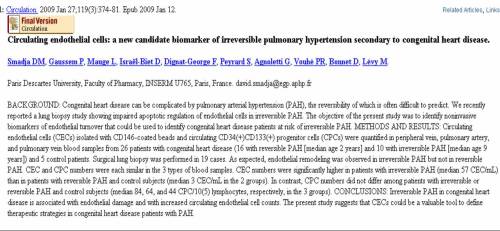
Identifying reversibility of pulmonary arterial  hypertension remains a difficult clinical problem.Heath edwards grading of pulmonary hypertension is based on lung pathology .Grade 4 and 5 constitute severe obstructive vascular pathology including pulmonary vascular necrosis.

Lung biopsy is an invasive procedure and has a  huge risk in patients with elevated pulmonary artery pressure.

Do we have an alternative ?

Does the pulmonary artery  sheds  necrosed  endothelial cells  into the circulation  ?

Yes it seems so , This month’s Nature cardiology  reveals a breakthrough concept

The CEC (Circulating endothelial cells count )  can be used as marker  and  may be considered a non invasive equivalent of lung biopsy

http://www.nature.com/nrcardio/journal/v6/n4/full/nrcardio.2009.18.html

nature1

pht

Dopamine and dobutamine are  the most commonly used inotropic agents in clinical cardiology.

The following table represents a simple comparison of the two drugs.

dopamine-dobutamine

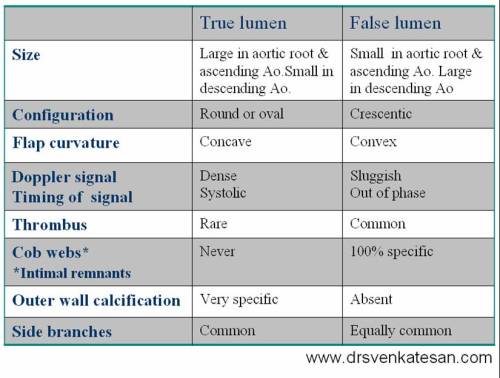
Why is identifying false and true lumen important ?

This helps the interventional cardiologist to plan the specific therapeutic procedure .
aortic-dissection-table

Is it really difficult to differentiate the two ?

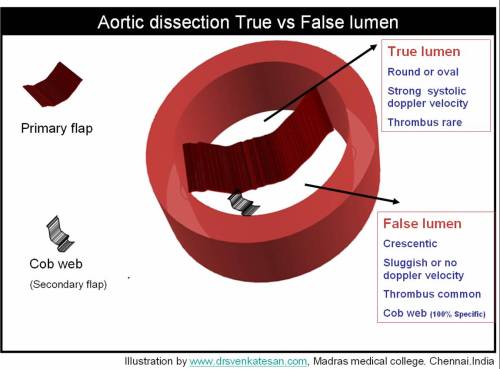
One may wonder , why is that  difficult  to identify  the true aortic lumen by echo, after  all  , the LV empties the blood into true aortic lumen ! Yes  , in aortic root dissections  identifying the true from false lumen is rarely an issue.
aortic-dissection-4

The issue becomes  important and complicated as the propagation of dissection goes in a random and erratic way into the ascending aorta and arch and downwards.The situation could further get  complicated  by the fact there could  be multiple communication between the two lumens .Some of these communication are  hemodyanically patent others form  a simple anatomical continuity.The size and the configuration of true and false lumen are not uniform it is highly  variable.In the aortic root the size of the true lumen is usually  large and when it reach the descending aorta  as in type3 the whole thing could be reversed.

The enigma  of  these lumonomics , is that some of the native branches of aorta , would  either be, subtended by false or true lumen. This is a real tricky issue for the surgeons . If a aortic vessel branch (Say bronchial artery . . .) is perfused successfully by the  hemodynamically active false lumen should we meddle  that  at all ?


circumferential-dissection1 What are the types of false lumen ?

Usually single septae divide the aorta into two , one false lumen and true lumen.There can  be other types.

Triple lumen aorta :This is usually seen in the aortic root following dissection .Usually there is two false lumen and and one true lumen in the centre

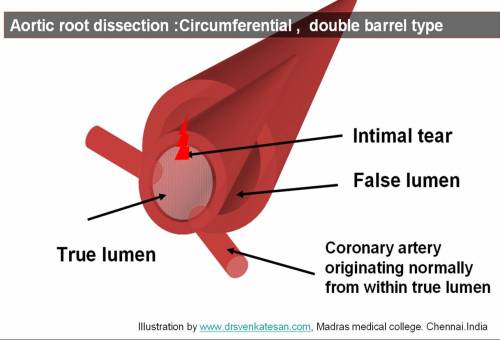
Double barreled aorta: A circumferential   aortic dissection with a central true lumen surrounded by a  circumferential false lumen  mimicking a double barrel on within the other.
aortic-dissection

What determines blood flow within false lumen ?

  • Site of  intimal tear
  • Length of tear
  • Plane of cleavage  . Superficial  subinitmal tear with minimal  medial thickness is likey to give in easily  as the blood  dissects the plane  so it more often manifest as a flap  rather than sustained  dissection
  • Number  of exit points (It is often assumed  aortic dissection  there is typically one entrance and one exit point .

but  more  often  multiple exit points can occur. Some points can have both two and fro flow as it may act as both as entry or exit points

What  is the importance of identifying  point, exit point , true  lumen false lumen etc ?

  • This is vital for planning   repair  of  the segment
  • optimising side branch blood flow
  • some time one may require to create an exit point  for providing useful thermodynamics   of false lumen that could give branch to a vital area.

Why false lumen is  prone for thrombosis ?

  • Sluggish flow within false lumen
  • Plane of cleavage of intima  and media  create an  irregular surface that  trigger  tissue factor mediated thrombus.
  • Free floating cob webs   intimal  remnants may accelerate thrombus formation

What is the clinical significance of  finding  a thrombosed false lumen ?

Large thrombus can occur within false lumen.The presence of which , sometimes an advantage as

it limits further progression of false lumen (An organised thrombus is sort  of  natural  stent graft !)

many of these patients do well with medical management.

C J Sanderso Thorax 1981;36:194-199;

Can thrombus occur in true lumen also ? How common it is ? If so what is the mechanism ?

Yes , but it is rare  as the velocity  is  more .But it can occur in following situations.

  1. Preexisting atherosclerosis can be  a milieu for  insitu thrombus
  2. Thrombus in true lumen  can occur at the entry point where there is intimal tear ,  which  projects  into true lumen. that can  deccelerate the  flow(Rare)
  3. Thrombus in the false lumen may project into true  lumen  through another tear.
  4. Migration of false lumen thrombus may occur distally and reenter the  true lumen.

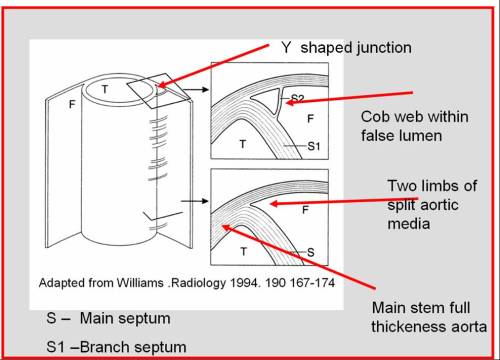
What is a cobweb ?

Cob web are the residual ribbons of dissected internal elastic lamina of aorta .
They are variably called as aortic bands, strands ,  septae, flaps etc.

What is the significance of the junction between false and rue lumen ?

The classic false lumen is crescent shaped. True lumen is either round or oval(Gibbous moon)
Tunction between false and true lumen has some characteristic feature.It mimics  the letter Y. The mainstem of Y correspond to main(  Normal full thickness)aortic  wall of the true lumen.The  oblique lines represent the outer wall of the false lumen and the septae dividing true (Fig 3)
dissection-41

What is the natural history of false lumen after surgical correction ?

Surgeons often leave the false lumen insitu , especially beyond the arch in type A dissection.

If false lumen is large  >70% of aorta , secondary dissections may occur in the long term.

Which is the best imaging modality  for  assessing dissection of aorta  ?

Even though MR angiogram and CT scans are shown to be good imaging tools in the evaluation of  dissection of aortamany practical issues creep in doing MR or CT angiogram.Many of these patients are too ill and will be on multiple arterial and venous lines Doing an MRI is  too dificult a task .Further these imaging modalities require a another arterial access .Requires contrast injection and  CT has in addition , radiation hazard.

TEE is a simple investigation can be done even in unstable patients in the bedside .Further also help us  us evaluate the aortic valve function and associated complications of dissection. TEE will be very useful peroperative also in assessing the repair.

*But MRI  and CT can give a long axis , saggital cuts of aortic dissection depicting the entry and exit points in a single image


First and foremost is

Avoid the procedure if  not really indicated.A lesion which  has more thrombus load  than a plaque and it is ,  subcritical and not limiting the flow  , PCI may be inappropriate  especially if the ACS is stabilised.

  • Adequate anticoagulation  along with  2b 3a blockers should be used
  • Predilatation should be minimally used or to avoided.Direct stenting preferred.
  • In primary PCI suction devices (Export etc may be useful)
  • Distal protective devices  are  “hyped up devices” rarely useful in an occasional patient with good distal vessel diameter.
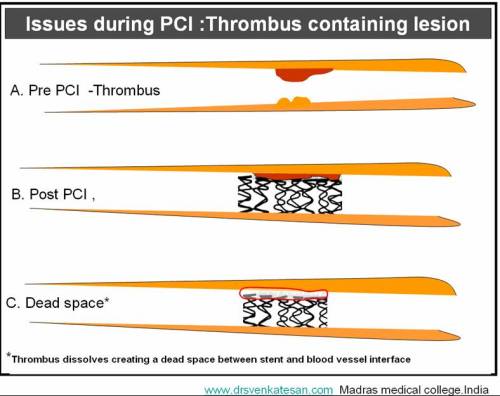
  • Pseudo stent approximati(fig 1) may occur. A Layer of thrombus may get plastered between stent and the vessel wall.In the post PCI  phase , with intense anticoagulation and antiplatelet regimen this layer may get dissolved and stent  may lose it’s grip and may dislodge or migrate.Another possibility is the dead space  beneath the stent  becomes a potential site for future  thrombus and ACS.

thrombus-and-pci

Fig 1

  • To prevent this complication , high pressure inflations and Post procedure IVUS (Intra vascualr ultraound may be done to ascertain lack of thromus between stent/vessel wal  interface)
  • Drug eluting stent evoked a special concern , when used in thrombotic milleu.This , has now been  proven to be  safe


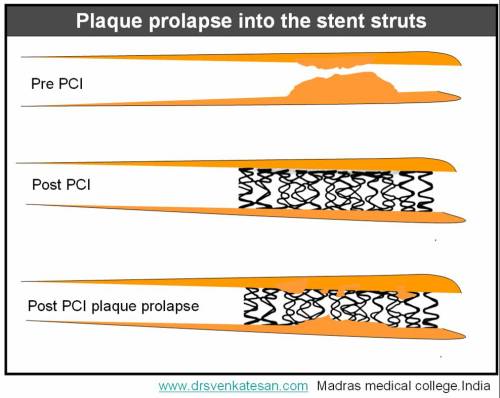
Coronary stents have revolutionised the management of CAD. Stents are metallic scaffolding devices that help keep the atherosclerotic plaque  plastered within the coronary arterial wall.Thus it gained the name angioplasty. Stents have aradial strength that  exerts a constant force on  the plaque . Since metals are unfriendly partners for coronary artery , we need to have minimum metal within the coronary artery.The stent struts weave around the lumen generally the stento/ artery area ratio should be as less as possible (15%).

But this has a trade off .The uncovered area of plaque tend to project into the lumen .This is many times not significant.But can be a problem if the plaque is very soft and bulk of the lipid core may reenter the lumen.this event is called plaque prolapse.

plaque-prolapse

What is the time taken for plaque to prolapse ?

Generally it is late event.But it can happen immediately after the procedure also.

Which type of lesions are more likely to have plaque prolapse ?

Eccentric and complex lesions especially with overhanging edges are prone for prolapse

What is the sequale ?

It can be benign.If there is a erosion due to stent struts can precipitate an ACS.It progresses into instent restnosis in many.

What is the angiographic appearnce ?

Angiographically it often appears as luminal  irregularity withi stented segment .

Many times , it may appear as a filling defect also.

Is there any specific issues in plaque prolapse in drug eluting stents ?

Coornary artery is not drugged uniformly by the drug eluting stents.In fact contact  lines of metalic struts  , through it’s micropore oozes the drug with polymer.Pathological studies have revelaed non homogenous drug penetration and resultant irregularity on the plaque surface.This could amplify the plaque penetration preferentially in few areas.

How to manage plaque prolapse ?

It should be managed as any other instent restenosis.Plaque resection with atherectomy devices has not solved the problem to the desired levels.A second stent is the most common approach advocated by the cardiologists.(Whic is not ideal though !)

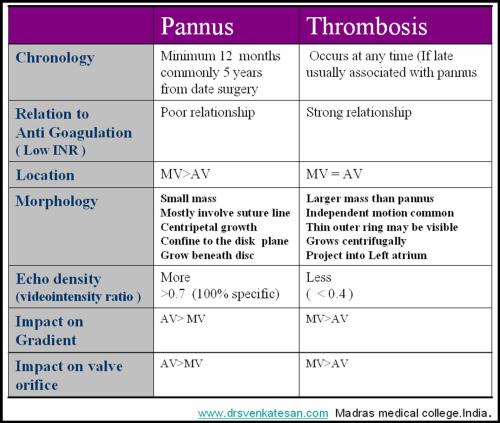
Prosthetic valve obstruction is an important complication of artificial valves.The incidence of prosthetic valve obstruction  is  estimated  to  be  4% per year.

  • Pure thrombus 75%*
  • Pure pannus 10%
  • Combination of pannus and thrombus 12%

Data from Deviri (J Am Coll Cardiol, 1998; 32:1410-1417 )

pannus-2

*Note statistically you are going to be right 3 times out of 4 if you diagnose thrombus over pannus

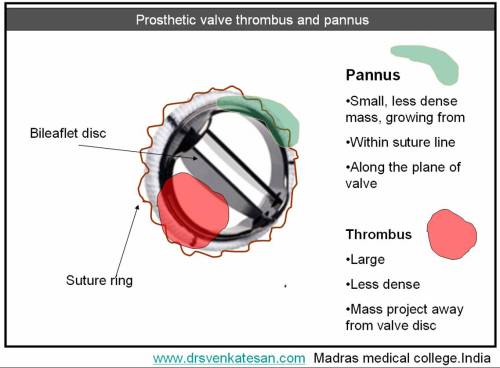
Pannus  literally means a hanging flap of tissue. It is is a membrane of granulation tissue as an response to healing.It can  occur anywhere in the body. When it occurs in the prosthetic valve tissue interface it has important consequences.It  is  same  as excessive scarring , ( something similar to keloid formation ) .

pannus

How do they clinically present ?

Prosthetic valve thrombosis is usually a acute or sub acute event as thrombus formation rapidly deteriorates the clinical situation.Pannus brings a patient with the complaints of chronic progressive dyspnea.(This rule is very subjective  but . . .)

What are the determinants of pannus growth ?

Time is the major determinant. minimum period required is 12  months. It is a avascular mass.It should be noted  a  injured pannus can predispose  a thrombotic process and a chronic thrombus  can trigger intravascular   growth factors  that promotes pannus growth.

What is the direction of growth of pannus in prosthetic valve ?

The pannus grows , usually in the tissue valve interface.It tracks and creeps along the suture lines .Generally this does not encroach the valve orifice or chamber sapce  , but occasionally the hanging edges can hit upon a leaflet.This is more common with tilting disc on the side of minor orifice. When excessive it can make a valve leaflet almost standstill.

How common is pannus formation in starr edwards valve?

Is relatively uncommon as the dynamic ball periodically interrupts the process of pannus in growth within the orifice.

Final message

Why is recognition of pannus important ?

Prosthetic valve thrombois is amenable to thrombolysis and it should be proptly differentiated for pannus.This is many times a difficult excercise, but the above observation will be helpful.

Further reading

http://content.onlinejacc.org/cgi/content/full/32/5/1410

CABG is tretment of choice for left main and  complex proximal LAD  lesions. So most patients get CABG in these situations.

The hemodynamic effects of LIMA graft on native left coronary artery can be tremendous and some times deterimental.

  • One of the consistent observation has been , the moment LIMA is bypasssed into distal LAD the antegrade flow through left main is reduced .This is still more significant if circumflex is also grafted .
  • For inital few weeks there is competition between LIMA flow and LAD flow and invariably LIMA wins  , and native leftmain or LAD  flow regresses and many times  closes totally.
  • Some studies have observed accelerated left main and LAD atherosclerosis.
  • The native LAD and leftmain could be a source for thrombi and atheromatous debri and these migrate distally and have potential to block the LIMA entry point  into LAD
  • The advantage of having a patent native left main and LAD  is that if the LIMA  graft occludes later on native circulation may assist.