Feeds:
Posts
Comments

Post myocardial infarction revascularistation either by PCI or CABG forms the bulk of the coronary interventions world wide.There has been considerable controversy in selecting the patients for the procedure.

Certain basic rules are to be applied.

  • Never do any thing on a totally asymptomatic and fully functional patient.(Functional , means good exercise capacity of atleast( 10Mets).Just medical treatment with good doses of statins, beta blockers will do.
  • If a patient has persistent angina  following MI  ,the issue is relatively simple as  they are  candidates  for CAG  and intervention .
  • The issue becomes little complex when the primary complaint is breathlessness and echo showing  LV dysfunction.

This dilemma is due to a  simple fact

coronary revascularisation has a  great impact in relieving angina but has  less impact in reversing

left ventricular  dysfunction

So,  how do you approach a patient with LV dysfunction and exertional  breathlessness and absolutely no chest pain ?

  1. Do a  CAG
  2. Assess the lesions if any (Some times,  to our surprise there may not be any critical lesions at all ! )
  3. If there is / there are critical lesions try to corroborate with infarct segments.(Use Echo for this correlation)
  4. Don’t bother much,  if a  vessel has a lesion  that is supplying a scarred myocardium.
  5. If there is gross LV dilatation, mitral regurgitation and LV clot refer these pateints  may benefit  from surgical management

One of the rules written by the cardiology community over the past few decades has been

We must document viable myocardium before doing a revascularisation procedures on them.

This rule was self imposed ,  to prevent inappropriate revascularisation in  post MI population.

So , a  gamut of investigations (Both invasive and non invasive came into vogue) to identify viable myocardium in post MI population. Stress echo, Thallium-sesta MIBI, PET  to name a few .

Even after liberal usage of these invesitgations , we realised ,  the confusion in the  optimal selection of candidates for revascularisation has not settled.

In fact,  the correlation between viabilty and subsequent interventional benefit is  inconsistent .Not withstanding this  issue  ,cardiologists inspite of the negative results of OAT and TOAT trials ,  started  opening or by passing any occluded vessel irrespective of viability status.

Unanswered  &  Unasked questions in myocardial revascularisation ?

1.Why viable myocardium is viable even in the adverse compromised vascular  environment ?

It  is viable for the simple reason it has some capacity to be alive . By it’s inherent survival capacity (Survival of the fittest ) or it somehow gets the nutrients by cell to cell perfusion.

2. It is viable allright  ,  why it is not contracting ?

Because ,  it is biochemically and metabolically alive (Can be documented by FDG PET scan mismatch ) but it can not synthesise adequate ATPs to make the muscle contractile.

3.”Viable myocardium is viable ” what more you want from it   ?

Simple viability is not suffice . How to make it mechanically active and contractile ?

4.Is viable  myocardium    synonymous with ischemic myocardium ?.

No,  it is not (Contrary to the popular perception ) .

5. Is it not  common to find dysfunctional segments with good TIMI 3 flow ?. So what is the purpose to document viability ?

It is not suffice to simply document viable myocardium but it is an absolute necessity to prove this viable segment is also  critically ischemic .

7.If angina is  a sign of viabilty why most of viable myocardium is painless ?

This again confirms the fact , much of the viable myocardium in the post MI phase is not ischemic but” still dysfunctional” waiting for healing time. This concept  was  introduced with great fanfare* as  stunned myocardium ,  20 years ago , which was subsequently rejected my mainstream cardiologists , as this concept tend to  restrict the  freedom of interventionists. * Even though ,the concept was genuine and proven scientifically !

6.Are we  certain , the  viable ,  non contractile myocardium  (Which we painstakingly document )  will get back the contractility once the  segment is    revascularised?

Absolutely not. (With lot of PET study doumentation )  This,  we can not guarantee even in ischemic, viable segments  ,  while in the  non ischemic, viable segment it is all the more unlikely.

7. What are the chances of these viable but  non contractile myocardium  regain the contractility  by natural course ?
Very significant chances .In fact every patient recover some LV  function spontaneously over time .

Final message.

  • Revascularisation is non controversial in patients with angina
  • In patients with  primary symptoms of dyspnea  ,  it is less effective and documentation of myocardial viabilty per se will not guarantee successful outcome following revascularisation.Out come depends on  multiple factors .
Intraluminal filling defect is often  observed during coronary angiogram .Thrombosis  has become the default diagnosis in most situations.This has resulted in over diagnosis of thrombosis .In fact a strategically located plaque stained by the dye is an equally common cause for intraluminal filling defect.

In fact there are many recognised caused of filling defect

  1. Thrombus
  2. Dissection
  3. An eccentric plaque
  4. Dye trapped within  plaque fissures
  5. Calcification projecting into lumen
  6. Plaque prolapse from stent struts
  7. Artifacts-End on view of  side branches
  8. Static myocardial bridges
  9. Trapped air bubble(Transient filling defect)
  10. Streaming  effect  dye may mimic a filling defect

Message

It is  not advicable  to make a  default dignosis of coronary thrombosis in all cases of intraluminal filling defects

What is the simplest and accurate way to predict  the   origin of Right atrial tachycardia(RAT)  from left atrial tachycardia(LAT) ?

Look at the P waves in V 1 ( Don’t look further ! )

  • A  negative  or  a biphasic (+/- ) P wave in V 1  is 100% specific  for a right atrial tachycardia
  • A positive P in V1 or  a biphasic ( –/+ ) P-wave in lead V1  has 100%  sensitivity  for a left atrial tachycardia

What are the incidence of left and right atrial tachycardia ?

RA- 75%

LA -25%

What are the common focus of right atrial tachycardia ?

  1. Crista terminalis (60% of all RAT)
  2. Tricuspid annulus
  3. Coronary sinus ostium
  4. Perinodal tissue
  5. Right side of IAS
  6. Right atrial appedage

What are the left atrial focus in Left atrial tachycardia ?

  1. Right & left pulmonary vein (50% of all LAT)
  2. Superior mitral annulus
  3. LAA
  4. CS body
  5. Left septum

(Please note  this rule is not applicable for re-entrant tachycardias, atrial flutter, AV nodal tachycardias)

Source :

P-Wave Morphology in Focal Atrial Tachycardia

Development of an Algorithm to Predict the Anatomic Site of Origin

peter M. Kistler  et all. 

This paper  from  Melburne, Australia is a rare gem of  an article for understanding  atrial tachycardia .This  paper won the  the Eric and Bonny Prystowsky Heart Rhythm  society Fellows Clinical Research Award, New Orleans, Louisiana, 2005.

Click on the Link  to reach the article

http://content.onlinejacc.org/cgi/content/full/48/5/1010


//

idh

  • Hypertension  is  major determinant of cardiovascular health  of our global population
  • Millions suffer,   hundreds of societies ,  and as many guidelines , and drugs are still struggling  to control the menace.
  • An important sub group of HT , (ie IDH ) population has been neglected and never received the scientific interest , which it deserves !
  • In our study it occured in 7.2% of all HT  patients.
  • JNC,  the world authority on HT never considered  IDH as a separate entity, and as of now there is no specific guidelines.
  • And the irony is complete . There is not  a  major study available to analyse the differential effects of anti hypertensive drugs on systolic and diastolic blood pressure.

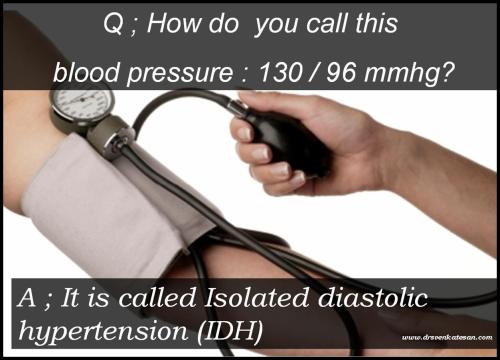
If  a patient with the BP of 120/96 asks you , “Doctor , will the drug,   you have prescribed , selectively lower my diastolic blood pressure ” what will be your answer ?

A clear ,  I don”t know !

The following paper was presented in the World congress of cardiology Sydney  2002

Isolated  Diastolic Hypertension

S.Venkatesan,S.D.Jayaraj.Gnanavelu, Madras Medical College. Madras, India.

Abstract : Systemic  hypertension  continues to  be a major determinant of cardiovascular  morbidity. While isolated systolic hypertension(ISH) has been identified as a specific clinical entity, isolated  diastolic  hypertension(IDH) has not been reported as a separate group. When we analysed our data from our hypertension   clinic  we found  a distinct subgroup of patients who had  elevated  diastolic blood pressure   with  normal systolic pressure. We report the clinical profile of these patients. 440 newly registered hypertensive  patients between the year 1998-99  formed the study population. All  patients with secondary hypertension  were excluded.. IDH  was defined as  diastolic BP more than 90mmhg and systolic BP less than 140mmhg.

IDH was present in 32(7.2%) patients.  The male female ratio was 3:1, mean age was 42(Range32-56) The mean diastolic pressure was 96 mm (Range 90-110).The mean systolic pressure was 136mm(Range 128-140). LVH was observed in 4 patients(12.5%). Diastolic dysfunction was detected by echocardiography   in 20patients.(62%)

We conclude that isolated diastolic hypertension  constitute a  significant subset among  hypertensive  patients and they need further study regarding the pathogenesis, clinical  presentation and  therapeutic implication.

Link to PPT  will be available soon .

                                         Ventricular  tachycardia is considered as a dangerous electrical rhythm abnormality .It can immediately degenrate into ventricular fibrillation and result in SCD in many.Ironically, it is also a fact , a patient with VT can  present silently  without any symptom  .Some VTs are slow and recurrent without much affecting The hemodyanmics.


In chronic recurrent, beningn VT (Some may consider it , ” height of  absurdity ” to call a VT beningn ! but it  is a reality , the term beningn denotes –  very remote chance of converting into VF) ” Is there any other therapeutic option other than convertng into sinus rhythm. “(  Read related topics)


The following paper was presented in the Annual scientific sessions of  Cardiological society of India,  Kochi , seven years ago in  2002


VENTRICULAR RATE CONTROL  IN  VENTRICULAR TACHYCARDIA 

S.Venkatesan,,. Madras Medical College. Chennai


                           Mangement of  hemodynamically  stable  recurrent   ventricular tachycardia  remains a  delicate clinical problem. Reverting to  sinus rhythm  is  considered as  the only aim  of  treating  VT.While rate control is accepted as a therapeutic  option  in atrial fibrillation,  it is not  so,  for  ventricular tachycardia.In this  context  we attempted to analyse  the effect of  Amiodarone on   ventricular  rate  in stable ventricular tachycardia  which fail to convert  to sinus rhythm.


                            The  study cohort consisted of 49 patients with stable VT  who were admitted in the coronary care unit  of  Govt. General Hospital  between 1998 to 2002.The criteria for inclusion   were systolic BP>100mmHg and absence of  hypoperfusion of vital organs  The mean age was 52 years (range 26-68)  with a male female ratio  of 4:1.   Of the study group 36 patients  were either reverted with  IV lignocaine , Amiodarone ( 150-300mg   bolus )  or  DC  cardioversion . 13  patients  who did not respond to   either of these   were  followed up  with  Amiodaroneinfusion(1000mg)  for 24 hours.  The baseline  diagnosis were old MI (6)) DCM (3)  Arrhythmogenic RV displasia(2). Idiopathic VT was diagnosed in  2 patients.All these patients had  VT  during  most part of  the   24 hour  follow up.


                         The pre Amiodarone mean  ventricular rate was  152  (124 –196).  Post amiadaorne (at 24hrs) mean ventricular rate was 128(88-142). The time taken for   50% heart  rate reduction was  6.6h (4-24h).  The average  systolic blood pressure  improved from  100   to  112mmhg . These patients were  discharged  in stable clinical status with oral Amiodarone and  were  referred for  EP study.


                          It is concluded that Amiodarone, apart from it’s cardioverting ability , has a distinct ventricular  rate controlling  effect  which  can be of therapeutic value in  at least certain subset of chronic recurrent VT.

Final message


Some of  the patients  with VT carry a very low risk of VF  and SCD .In these  patients , the only  other major  aim is to prevent tachycardiac cardiomyopathy  that can be done with drugs which  controls  the ventricular rate whenever  VT occurs !

Corrrecting the primary cause like cardiac failire , revascularisation ,detailed EP study  ,tachycardia mapping , followed by RF ablation and ICD implantation is  the state of the art approch in the management of VTs.But this small clinical observation was made to  impress rate control could also be an option  in patients  in whom these procedures are  contraindicated  or not  available . 


Lignocaine , probably has saved more lifes  world over  than any other cardiac drug .

It was the only choice for ventricular tachycardia  till 1990s, both in pre and post  thrombolytic era.Every coornary care unit has reverted tens of thousands of  unstable VTs with this simple and cheap intravenous drug.the utility value of lignocaine is not limited to ischemic VT alone it is effective in in almost all forms of VT.It was classically administered in two or more boluses followed by an infusion.

What happened to this wonder drug  with great performance record ?

The  power of   statistics , and inappropriate interpretation by the scientific community  has left a serious blow to this wonder drug .Now the drug has been made redundant, and mainstream cardiac literature has made everyone feel  guilty , if  anybody  uses this drug for VT .

Why did lignocaine lose the battle ?  The reason is three fold

  1. The advent of  much fancied Amiodarone
  2. One negative study  for antiarrhythmic drugs in post MI period (CAST) 
  3. And two so called  positive studies  for Amiodarone (ALIVE & ARREST) has sounded the death bell for this drug  which has resuscitated millions of life !

CAST study http://content.nejm.org/cgi/content/abstract/321/6/406 

All , CAST  said was routine suppression of  asymptomatic ventricular arrhythmias  in the post MI period is unwarranted. But you know , how this  world interpreted it  “Lignocaine  has no role in ventricular arrhythmias in post MI setting ”  The most funny thing  was  lignocine was never used in CAST study .

The  studies involving one to one comparison  of Lignocaine and Amiodarone (ALIVE and ARREST study) was also not interpreted  properly.These studied only shock resistant VTs. What about the role of lignocaine where defibrillator was not available ?

Link to ALIVE and ARREST  read and make your own conclusion.

http://content.nejm.org/cgi/content/abstract/346/12/884

http://content.nejm.org/cgi/content/full/341/12/871?ijkey=8fa241f3cebb86a177632ec6ccadfb5a3ded7bc2

 Final message

  • Lignocaine is not  only a topical anesthetic  , it is powerful and gentle myocardial anesthetic when administered in post MI period.
  • With this property it  successfully cardioverts and prevents dangerous ventricular arrhythmias.
  • Time tested and worthiness proven.
  • While , we are made to believe  the success rate of  Amiodarone in VT is far superior than ligncaine .It is a falsehood.
  • Any experienced cardiologists will recognise ,  many times even  Amiodarone resistant VTs often respond to Lignocaine .
  • The fact of the matter is , without a good quality  one to one study  , lignocaine was ditched. One reason for this could be  Lignocaine ,  is a generic drug and has no market value.

Let us take home , the message (scientific or unscientific ! ) Lignocaine still has a great role to play in the management of dangerous ventricular arrhythmias .The only caution is ,  it should not be used routinely and indiscriminately in all asymptomatic patients with  VPDs or nonsustained VT . (Acknowledging CAST conclusion.)

Cannon waves occur classically, during  ventricular ectopic beats .(Commonly irregular) regular cannon waves occur during Junctional tachycardias with 1:1 VA conduction

Cannon like wave may appear  in the jugular vein if the VPDs is timed in a such a fashion ,the atrial systole occurs with a closed AV ( Tricuspid and mitral valve ) so the atrial  contractile wave is reflected back into the veins.This not only happen in right atrium but also  in the left atrium , but the cannon waves are sent into the pulmonary veins , which is not visible. As by  tradition  cannon waves are  meant to be seen only in neck veins , we rarely realise   the importance of such waves in the pulmonary veins.

There must be some significance for this  abnormal pulmonary venous waves  which  travel  in a retrograde fashion.In fact , with  the advent of echocardiography, we realise  pulmonary flow reversal is an important contribution for raised PCWP.

The dyspnea during multiple  VPDs can be due to

1.Transient Mitral regurgitation and resultant elevation of PCWP.

2.Pulmonary venous cannon waves and  it’s effect on  J receptors.

3.Many of the intermittent  episodes of  dyspnea  (Especially paroxysmal nocturnal dyspnea ) , other wise unexplained could be due to this pulmonary venous cannon waves.

4.It also need to be studied how this pulmonary venous cannon waves distribute themself into the 4 pulmonary veins.

//

Angina is classified in many ways .The most useful , clinical classification is stable and unstable angina . While  ,the former generally is considered   innocuous  the  later conveys a sinister  signal to the patient as well as  the physician. 

Why stable angina is  stable ?

In stable angina

  • The patient knows how the pain is going to behave by his past experience.
  • Very predictable .The patient knows at what distance it’s going to come
  • He also knows when  it will disappear.(For some , with rest for others with nitrates)
  • He also knows where the chest pain will radiate.
  • If some thing is unusual it is unlikely to be  stable angina , also any  first episode of angina is considered unstable as one wouldn’t  know how the angina is going to behave !

How is that stable angina has such a learned behaviour ?

The main reason for  the beningn nature of  stable angina is the coronary artery has “stable plaques”

Stable plaques produce stable angina  ,Unstable plaques cause unstable angina

Stable plaque s restrict blood flow only at times of  increased demand( ie supply side ischemia.) There is no thrombus in these plaques.As soon as the exertion ends the angina is relieved.So in chronic stable angina, the patient is stable, the angina is stable , the palque is stable , the coronary blood flow is stable.

Unstable palques have erosion and thrombus , and it interferes with blood flow even at rest .So in  unstable angina, not only the angina is unstable , the plaque is unstable  ,coronary blood flow is unstable. So it is obvious unstable angina , may not be relieved by bed rest.It needs intensive treatment.

Is there a overlap between stable and unstable angina?

Yes. In fact it is more common than we realise.

Read this post https://drsvenkatesan.wordpress.com/wp-admin/post.php?action=edit&post=2177

Related topics

How is a stable palque converts into a unstable plaque ?

How do you identify these vulnerable plaques ?

————————————————————————————————————————————————


                                    Competence of mitral valve is vital  for proper hemodynamics of  heart .A trivial mitral regurgitation ,is observed in nearly 10-20% of normal population detected by doppler echocardiograpgy .This is other wise clinically insignificant. In fact , it is expected  , the sonographers do not report this,  as it might increase the patient anxiety.

Can a mildly incompetent mitral valve be a hemodynamic advantage ?

Left ventricle , physiologically can have only one exit, namely LVOT and aortic valve.If there is normal  impedance , at this level (LV after load )  it  is refered to as  physiological .In disease states , as in cardiac failure there is raised after load or LV wall stress.this makes the LV struggle to pump blood into aorta.The more the dilatation the more the wall stress (Laplace law). more the wall stress more the after load.

 The  main principle of management of cardiac failure  for decades  has been promoting  LV inotropism .Now we have realised this is fundamentally a wrong concept, (Except in acute heart failure). Hence the main option available now is to reduce the after load , ACEI do that most effectively and proven to improve survival.

What is the effect of  trivial or mild MR on LV after load  ?

It is a hemodynamic fact for MR  to increase LV contractility  and Dp/Dt  due to a relative reduction of after load.

In patients with cardiac failure , even a mild improvement in LV contractility can give a  symptomatic improvement .


09tmr1

Can mitral valve act as controlled safety valve allowing only a trivial or mild MR ?

This may be difficult . But it happens naturally in many of our patents in cardiac failure .

Probably , these are same  patients who come under the 20% incidence of physiological  doppler  MR .Other group could  form the  functional MR*

We have found, patients with  DCM  with mild mitral regurgitation tolerate excercise better than patients who have very competent and rigid mitral valve.It is presumed a mitral valve which gives in a little bit , decompresses the LV with a symptomatic benefit.But if the MR , is occurs in an eccentric path or it results in significant volume burden the potential advantage becomes a liability.

Related issues

*Functional mitral regurgitation. Functional MR is said to occur , when patients with cardiac failure, and resultant dilatation of mitral annular ring, and lack of opposition of leaflets

While milder forms of MR are well tolerarted  , when it occurs  acutely ( even if it is mild) ,  it can be dangerous and result in sudden pulmonary edema  .This usually happens in acute MI or infective endocarditis etc.

 Final message

  • Minimal or mild  mitral regurgitation without any significant volume overloding  in some of the patients with dilated cardiomyopathy  could bring  a hemodynamic advantage .
  • So one may not unduly worry about , a mild MR (central jet) in patients with DCM.It could be after all a safety exit for overstrained LV

We will report the results of the ongoing study about the impact of presence /absence    of  mild MR on the 6 minute walk test in patients with dilated cardiomyopathy.

  • Gastric pain is a great mimicker of cardiac pain.
  • It may have , almost all the typical characters of angina . . . in some cases ECG changes too.
  • The confusion is complete ,  as esophageal pain can also  be relieved by sublingual nitrates !
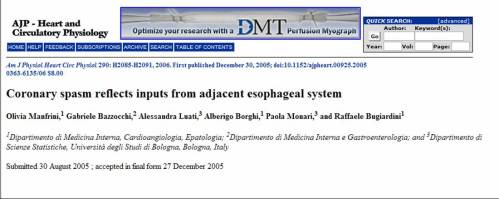
  • The issue is further complicated, when  esophagus and coronary artery share  the same neural codecs, and each may induce spasm among themselves !
  • It is thought , of course with  some  evidence !  many of the syndrome X  patients ( positive stress test with normal coronary arteries )  have esophageal motility disorders.
  • The ST segment depression during EST  in these patients  is apparently attributed to  stress induced esophageal spasm !
  • And many of the patients with variant angina  ,  have associated esophageal sapsm .

Read this land mark concept paper  documenting the neural link between esophagus and the coronary artery

Click on the article

esophagus


Final message

  1. Don’t ever forget the esophagus in your scheme of things when evaluating  CAD.
  2. Realise  that esophageal disorders  not only cause non cardiac pain but also cause    ischemic chest pain (Also called linked angina)
  3. EsophagEal  smooth muscle cell  can  exert electrical influence on the ST segment of  cardiac ECG !(After all every cell

has an action potential )