Feeds:
Posts
Comments

Soft skills in pPCI 

Experience  would tell  us only about 70-80 % of STEMI are truly eligible for a  good  quality pPCI .(Multivessel CAD, Complex bifurcation lesion, difficulty in identifying IRA, No IRA-sapsms , complete spontaneous reperfusion )  The remaining 20-30 %  should , logically  be included in the failed pPCI category .This fact is largely concealed in the literature .

Beware of huge thrombus load in every patient with STEMI .The  contribution of  mechanical occlusion  vs thrombus  (in the total occlusion )  is the single most important factor in determining the intervention strategy.

Deploying a stent in a poorly  prepared (debrided of thrombus  ) lesion confers  further continuous  risk of a STEMI .Stents smartly jail  even large thrombus against the coronary vessels and they release it into the lumen in a controlled fashion  and prolong  the  acute coronary  risk phases

If thrombus aspiration  does a neat job and establishes a good   flow , if the   lumen  appear   good , think twice or even thrice before deploying a stent .It is akin to stent a  zero % lesion and we know it is foolish to do that at any stretch of imagination .(Stenting has never been proven to convert a vulnerable ulcerated lesion into stable one )

IVUS, OCT are not the answer in the above situations  as we are dealing with  emergency coronary  fire fighting !

Of course the intensive anti-platelet   protocols , will take care of  potential after effects of the intra coronary contact sport we play  !    . But . . . there is a limit for every thing. So spend as little time as possible when attempting catheter based reperfusion during STEMI.

In the early  20th century , Waller invented the ECG machine. Wilson  created  leads and  methods to record it. Eienthoven  formulated the concepts the electrical theory behind ECG.

Between 1940-197os one man ruled supreme in the world of electro cardiography .   He is Dr Sodi pallares from Mexico. His deep insights revolutionised  and helped  us  understand how the cardiac electricity is generated  and propagated  in various pathological states that is the beginning new age electrocardiography! It adds much to his  credit , as in those days scientists  from non American and European countries   were hard to come  in the  global limelight.

Some of his thought processes and Inventions

  • He laid the foundation  for deductive electrocardiography.
  • Applied  vectorocardiographic  principles to scalar  ECG and helped  understand mechanism of ventricular chamber enlargements
  • He was instrumental  to analyse  the genesis of current from the myocardium . He tried to reason out  the contribution  of  cell metabolism, hypoxia, electrolytes to the current genesis.
  • Polarising myocardium with GIK infusion STEMI was proposed by him
  • Finally he tried to incorporate the laws of thermodynamics into electrocardiography .

Please remember , Sodi pallare’s  conscience  is still largely unexplored .There are lots of hidden truths .We now know fever can influence qrs voltage and febrile illness can trigger  ventricular tachycardia as in  of Brugada syndromes.

Today’s youngsters can take a  few cues from this great man and enlighten the field of electro-cardiology

DOCTOR DEMETRIO SODI PALLARES

Demetrio Sodi Pallares (1913-2003 )

If  modern-day cardiologist is able to  interpret the  ECG by a cursory 3 second scan of  strip of waves  , we are greatly  indebted to the knowledge imbibed by this great man from Mexico !

Sodi pallares

Reference

http://onlinelibrary.wiley.com/doi/10.1002/clc.4960110616/pdf

Sodi-Pallares D,Medrano GA, Bisteni A, Ponce de Leon J:
Deductive and Poly-paramerric Elecrocardiography.Instituton acionalde
Cardiologia de Mexico, Mexico,DF1970,VII,VIII
Sodi-Pallares D, Testelli MR, Fishleder BL, Bisteni A, Medrano GA, Friendland C, De Micheli A. Effects of an intravenous infusion of a potassium-glucose-insulin solution on the electrocardiographic signs of myocardial infarction: a preliminary clinical report. Am J Cardiol. 1962;9:166–181


mid diastolic murmur

mid diastolic murmur in  sinus rhythm

With the onset of Atrial fibrillation

  1. The  first heart sound becomes variable in Intensity (Soft to loud in pliable valve / Soft to softer in calcified valve )
  2. Opening snap continue to occur as long as the  valves are  pliable and noncalcified  .The timing may vary but Intensity remain same .
  3. A 2-OS interval is usually less influenced by AF  as it is primarily determined by mean LA pressure at the onset of diastole which has little variation beat to beat .
  4. Length of the diastolic murmur varies . In Short cycles  MDM  can be  very brief  or even in audible.
  5. In long cycles MDM will be distinct.
  6. A late diastolic murmur in long cycle indicates severe MS.
  7. Even pre-systolic accentuation may be appreciable in some of the long cycles .

Link  to  Echo Image of  Mitral stenosis .

https://www.youtube.com/watch?v=3qvOMwOshg4

How to assess the severity of  MS in the presence of AF ?

  1. Presence of AF by itself indicate presence of severe MS  in most .
  2. A2-OS interval  may be useful
  3. Concentrate on long cycle .Look for ( rather listen !)  for late diastolic component of  MDM .If  you hear it ,  MS is usually severe

Other signs  are often useful

Low volume pulse

Inconspicuous LV impulse

Presence  of  any significant Pulmonary hypertension

Squatting is a simple physical  maneuver that can  be done in bed side.

  • Squatting  increases  systemic venous return.
  • Raises aortic after load and SVR

It is  ideal to do  “Stand -Squat -Stand” sequence to appreciate the attenuation during squatting and augmentation during standing

squatting dynamic auscultation mvps mitral valve prolapse

Hemodynamics

MVPS-MR is  a pre load (LV volume )  dependent phenomenon.The degree of prolapse is inversely proportional to the LV size.

Squatting increases the venous return and after load both tend to  increase the LV volume. More blood in the LV  , means mitral leaflet floats much closer to the  mitral annulus . Hence the  force of LV contractility is not only  less on the prolapsing  leaflet , it  reaches late ,  hence the click is delayed  and murmur is short (It may be less intense as well * )

(* Squatting increases aortic after load hence the murmur of MR  may  get amplified .)

Reference

We know  new onset LBBB  creates considerable anxiety . We  experienced a  reverse situation recently . A 72 year old  man who is known to have chronic LBBB  for over  5 years came  to CCU with vague  chest  discomfort .

His   ECG  was  perfectly normal . . . every one  was  curious !

My ECG always looked like this doctor  !  Now you say it has normalised and you say it concerns you  ! I am really worried  doctor  !

What does it mean doctor ?

Cardiologist : I do not know . Any sudden change in rhythm even if it is from abnormal to normal is to be given importance .

Patient : Is  the  going bad ?

Cardiologist :  I do not know

Patient : Should I  get admitted ?

Cardiologist : I think so  but you need to undergo few blood tests and repeat an ECG .

Patient : Oh  what ?  you  are not sure either !  Are you not an expert in heart  disease doctor ?

Cardiologist : I think I am . I wish I have an answer to  your question .

Follow up

This patient was admitted in intermediate care ward and observed for 12 hours .

His enzymes and Troponin were negative . Echo showed normal LV function .

He was discharged later and adviced  a stress test .

What is the the mechanism of normal ECG  here ?

Intermittent LBBB due to rate dependency is common .But this  man  had persistent chronic LBBB for > 5 years which got normalized .That mystified us !

Can transient ischemia of left bundle  accelerate  the conduction ?

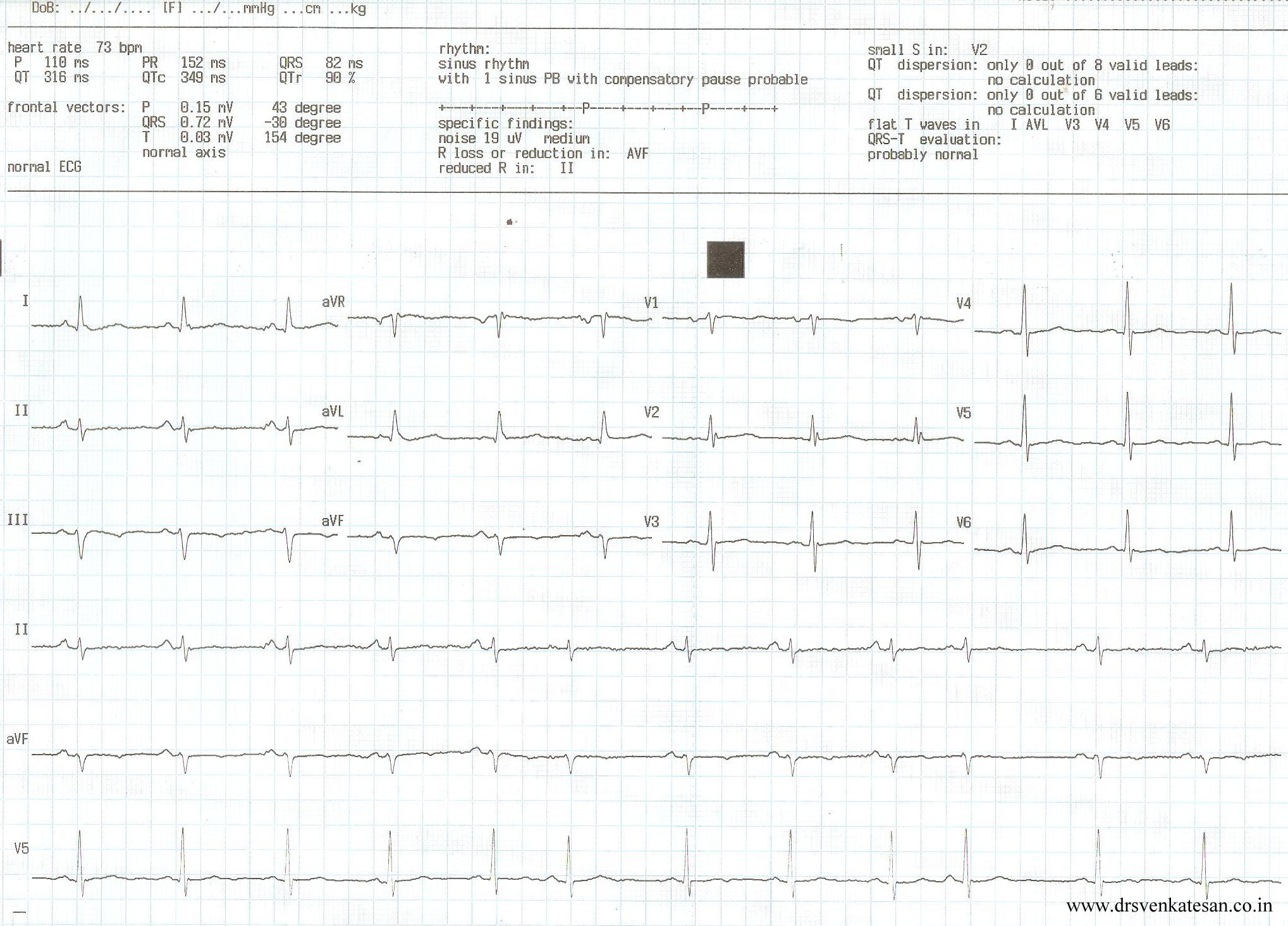
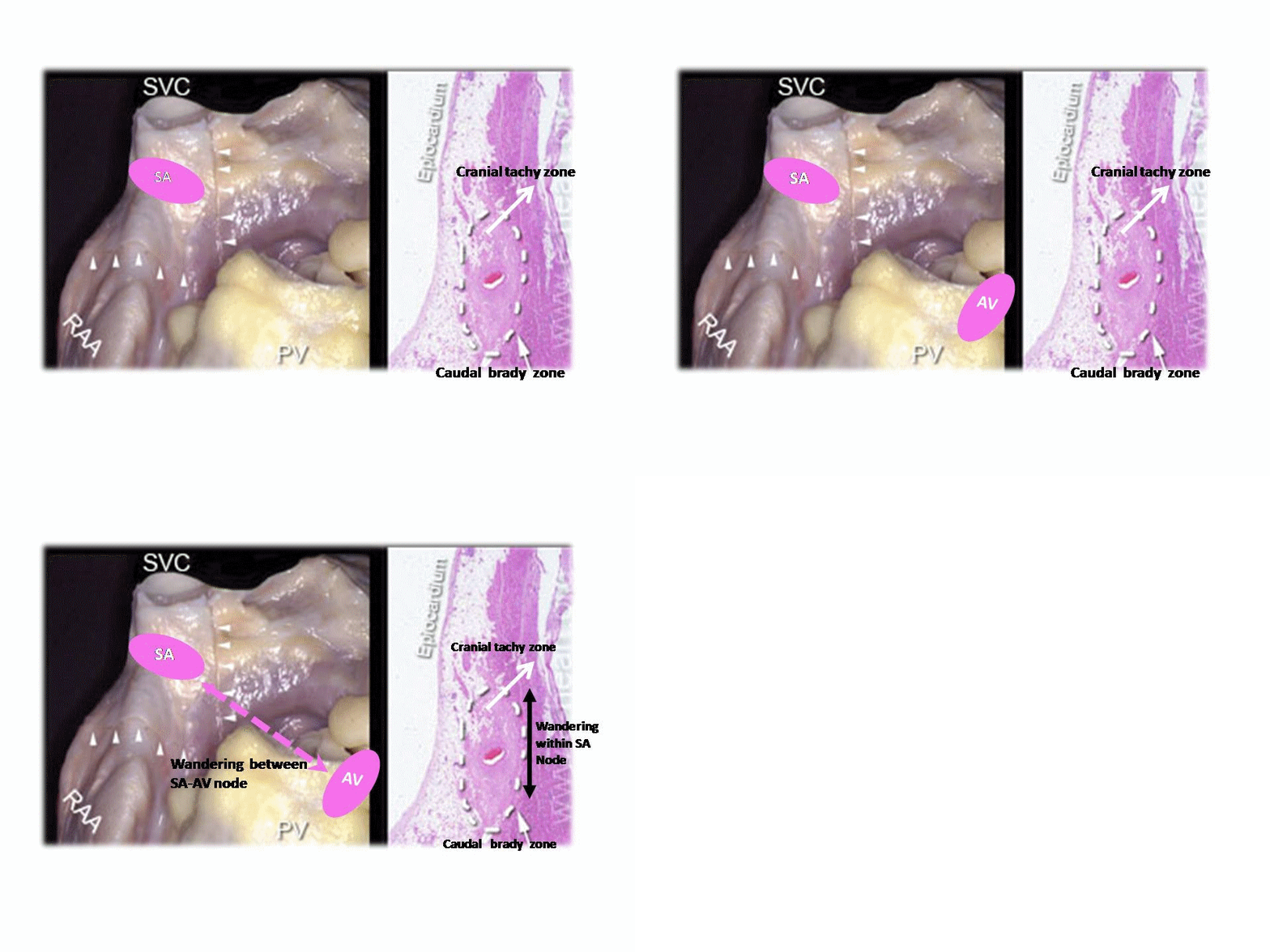
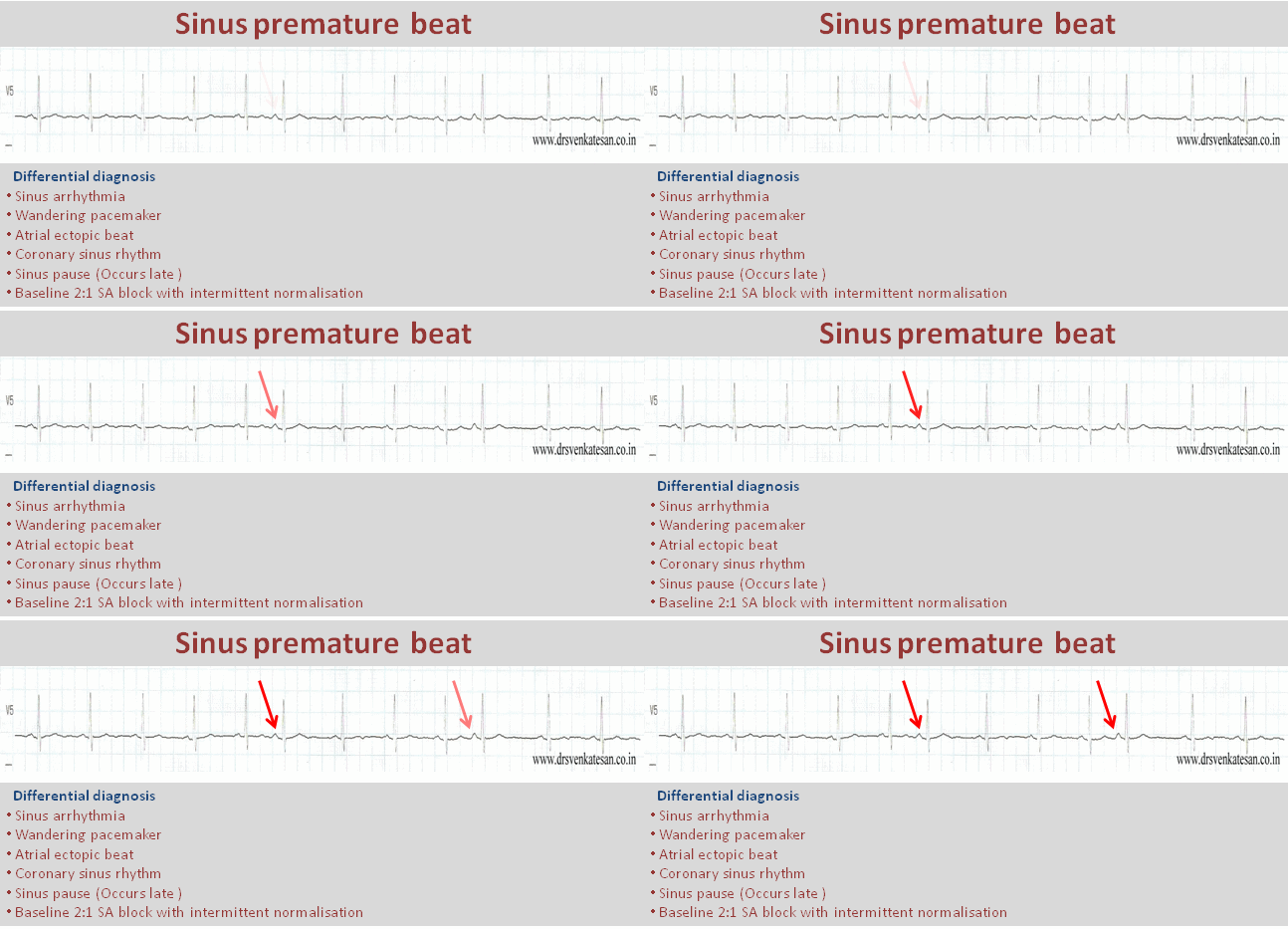
Sinus node is the electrical high command of our heart .When it gets injured  seriously (or shot down   as in sinus arrest ) there is utter chaos in the lower ranks !

This is what happened  in this patient .

trigeminy group beating vpds sinus node dysfunction escape capture

The lower pacemkers can either passively release  themselves as escape rhythm or actively fire with a  ectopic focus  . Any combination of escape / ectopic  beats can  occur .If occasional sinus beats capture the ventricles things  can become further complicated .

It is obvious , this  random intra-cardiac  shooting  makes the life of the  myocardium miserable . It is a perfect setting for syncope, tachcyardic cardio myopathy , extreme brady induced VT , VF  even SCD.

*Meanwhile , It is  heartening to note  SND   rarely lead to  sudden death in spite of all the chaos .However  extreme  bradycardias  that occur in  complete heart block  does  not enjoy this immunity as fatal complications are common if not intervened .

The irony of modern medical care is  9/10 times  medical negligence is  defined in terms of  acts of omission  in  required  level of care . In reality  most medical negligence acts are related to knowingly overdoing a futile diagnostic or therapeutic modality.

This irony was never understood by the public, the professionals or  even the judiciary .This remains  the most dangerous issue  facing modern medicine !

Finally some light is appearing in the horizon . A Missouri  Cardiologist is suspended for overdoing things he knows best  . . . namely coronary stenting ! 

This may bring chills over many cardiologist’s spine .

cardiologist stents inappropriate use interventional

http://www.stltoday.com/news/local/metro/missouri-healing-arts-board-issues-first-emergency-suspension-of-doctor/article_205eaffd-1825-5d7d-a9de-a289c010fd65.html

Can there be a small r wave in V1 and V2 in LBBB ?

Yes .

Though we expect the  reversal of septal depolarization that will   extinguish  the initial r in v1 to v3 . It is  preserved in  many. Hence the  presence of small r in v1 to   v3 does not rule out LBBB.

  1. The commonest explanation given is un-masking of RV free wall forces which is   normally  masked by early LV forces .
  2. Another possibility is the   orientation of septum  in pathological states.
  3. Third possibility is  “r” may  actually represent  the  septal q waves as in LVH or old AWMI  .(Counterpart of small  q in lateral leads )

Normal sequence of  S2 split is A2 followed by P2. This split is heard only in  inspiration . The split is due to pulmonary low vascular impedance and is represented by the hang  out interval (40-80ms) . Inspiration transmits the low intra-pleural  pressure into pulmonary vasculature  and split widens. In expiration the reverse happens and split narrows.Normal human ear does not recognize the normal expiratory split.

If the split S2  is well  heard in expiration especially in sitting posture it is abnormal .

What is paradoxical split of S 2?

If split occurs and is well heard only in expiration and  becomes single in inspiration , It is classical of paradoxical split.

What is the paradox ?

In physiological conditions  S2  splitting occur during inspiration and become  narrow or single during expiration.

In paradoxical split ,  the physiological  behavior with reference to respiratory phases is lost and it can even become single in  inspiration .(It is also reversed  because A2 follows P2 )

s2 splitting second heart sound split a2 p2 paradoxical split reversed split

Conditions causing paradoxical split of S2 .

  • LBBB
  • RV apical pacing .
  • Aortic stenosis
  • Chronic sever AR

Japanese are the pioneers in CTO reopening .(I understand they do less   CABG surgeries  for  religious reasons ) CTO is the ultimate test for cardiologist patience .  it may  take  hours to open up a CTO (or even to abandon it .)  Here is a  success prediction tool from Japan .

cto score success in chronic total occlusion

j cto score  sheet

Source courtesy  : JACC: Cardiovascular Interventions Volume 4, Issue 2, February 2011

Reference

http://www.sciencedirect.com/science/article/pii/S193687981000912X