Feeds:
Posts
Comments

Posts Tagged ‘ventricular tachycardia’

                                         Ventricular  tachycardia is considered as a dangerous electrical rhythm abnormality .It can immediately degenrate into ventricular fibrillation and result in SCD in many.Ironically, it is also a fact , a patient with VT can  present silently  without any symptom  .Some VTs are slow and recurrent without much affecting The hemodyanmics.


In chronic recurrent, beningn VT (Some may consider it , ” height of  absurdity ” to call a VT beningn ! but it  is a reality , the term beningn denotes –  very remote chance of converting into VF) ” Is there any other therapeutic option other than convertng into sinus rhythm. “(  Read related topics)


The following paper was presented in the Annual scientific sessions of  Cardiological society of India,  Kochi , seven years ago in  2002


VENTRICULAR RATE CONTROL  IN  VENTRICULAR TACHYCARDIA 

S.Venkatesan,,. Madras Medical College. Chennai


                           Mangement of  hemodynamically  stable  recurrent   ventricular tachycardia  remains a  delicate clinical problem. Reverting to  sinus rhythm  is  considered as  the only aim  of  treating  VT.While rate control is accepted as a therapeutic  option  in atrial fibrillation,  it is not  so,  for  ventricular tachycardia.In this  context  we attempted to analyse  the effect of  Amiodarone on   ventricular  rate  in stable ventricular tachycardia  which fail to convert  to sinus rhythm.


                            The  study cohort consisted of 49 patients with stable VT  who were admitted in the coronary care unit  of  Govt. General Hospital  between 1998 to 2002.The criteria for inclusion   were systolic BP>100mmHg and absence of  hypoperfusion of vital organs  The mean age was 52 years (range 26-68)  with a male female ratio  of 4:1.   Of the study group 36 patients  were either reverted with  IV lignocaine , Amiodarone ( 150-300mg   bolus )  or  DC  cardioversion . 13  patients  who did not respond to   either of these   were  followed up  with  Amiodaroneinfusion(1000mg)  for 24 hours.  The baseline  diagnosis were old MI (6)) DCM (3)  Arrhythmogenic RV displasia(2). Idiopathic VT was diagnosed in  2 patients.All these patients had  VT  during  most part of  the   24 hour  follow up.


                         The pre Amiodarone mean  ventricular rate was  152  (124 –196).  Post amiadaorne (at 24hrs) mean ventricular rate was 128(88-142). The time taken for   50% heart  rate reduction was  6.6h (4-24h).  The average  systolic blood pressure  improved from  100   to  112mmhg . These patients were  discharged  in stable clinical status with oral Amiodarone and  were  referred for  EP study.


                          It is concluded that Amiodarone, apart from it’s cardioverting ability , has a distinct ventricular  rate controlling  effect  which  can be of therapeutic value in  at least certain subset of chronic recurrent VT.

Final message


Some of  the patients  with VT carry a very low risk of VF  and SCD .In these  patients , the only  other major  aim is to prevent tachycardiac cardiomyopathy  that can be done with drugs which  controls  the ventricular rate whenever  VT occurs !

Corrrecting the primary cause like cardiac failire , revascularisation ,detailed EP study  ,tachycardia mapping , followed by RF ablation and ICD implantation is  the state of the art approch in the management of VTs.But this small clinical observation was made to  impress rate control could also be an option  in patients  in whom these procedures are  contraindicated  or not  available . 


Read Full Post »

Ventricular tachycardia is considered as one of the most  dangerous  cardiac arrhythmia .Rather , it is the label  VT  that spreads more  fear than the arrhythmia itself. It is a fact many patients with VT walk into hospital , still  VT will always be a sinister arrhythmia as long as it carries a risk of degenerating into ventricular fibrillation.

What determines hemodynamic stability in VT ?

  • Origin and location of VT
  • The ventricular rate
  • Presence or absence of AV dissociation
  • Impact on mitral inflow pattern
  • Associated left ventricular dysfunction or valvular heart disease.
  • VT in the setting of acute coronary syndrome.(Ischemic VT)
  • Inappropriate drug selection

Origin and location

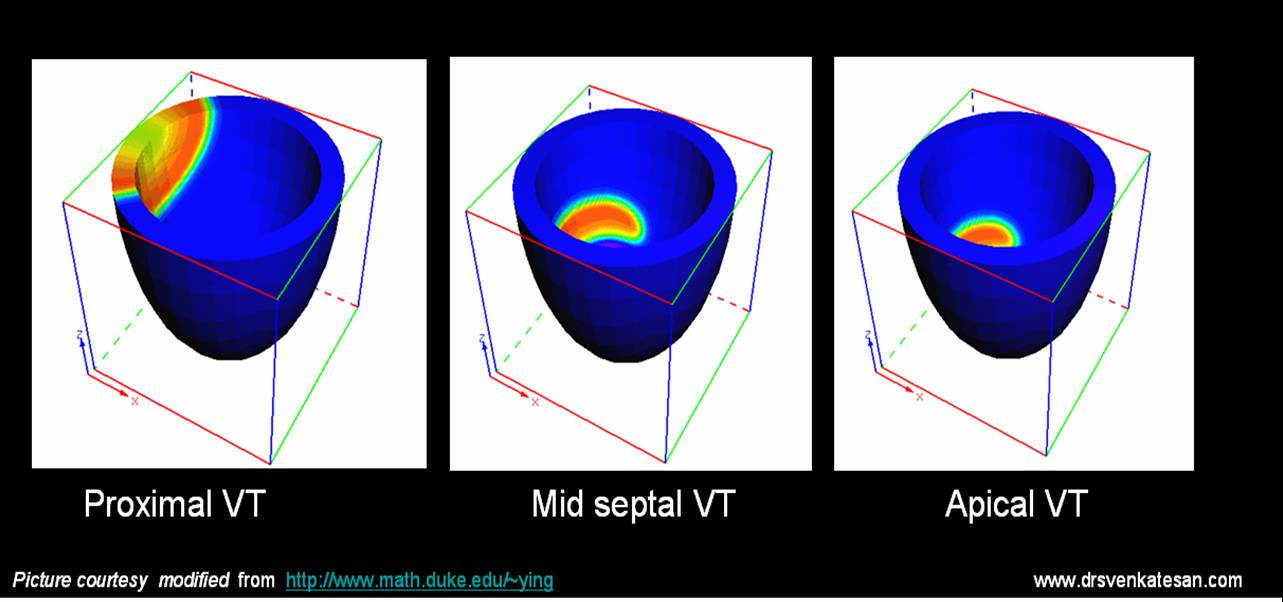
VTs originating high up in the ventricle( High septal VT,Proximal VTs) have more organised ventricular contraction  and they are more stable.Distal VT  originating  in the myocardium away from the conducting system has chaotic myocyte to myocyte conduction.These are very unstable.

The term fascicular VT is nothing but VTs originating  in the His bundle and it’s branches( Can also be termed Septal VT ).These VTs are also stable and some of them respond well to calcium blockers indicating that they are very close to the AV junction and carry the properties of junctional tachycardia. QRS width gives  a rough estimate about the location of VT. Narrower the VT higher it’s origin.( But remember even in VT ,  qrs can further widen on it’s way downhill !)

LV dysfunction.

This is probably the most important determinant of the outcome in VT. Patients with severe LV dysfunction (EF <30%) fare badly .Hence the land mark concepts from MADIT 1& 2 demanded ICDs in these patients.The most common clinical setting is  dilated cardiomyopathy.SomE of them have bundle branch re entry(BBR).This particular  VT can be stable for many  hours.

Ventricular rate.

Usually VT has a rate between 120-200.Higher the rate of VT more the chances of instability .This rule is also not always true as fascicular VT can be well tolerated at high rates.So location of VT focus  and LV dysfunction usually over rides the impact  of ventricular rate.

Mitral inflow pattern

Proper left ventricular filling is the key to hemodynamic stability in VT. In proximal, septal,fascicular, LVOT VTs doppler studies  suggest (ACC /AHA Type C evidence : Personal observations in CCU during VT) near normal preservation of  bi modal filling of mitral valve inflow.In ischemic myocardial VT  the mitral inflow profile is critically affected . There is no distinctive forward filling was observed .In fact  at rapid rates a short pulsatile MR jets are noted instead.

Associated valvular diseases

It is obvious,  aortic  and mitral valve disorders can aggravate the hemodyanmic instability.

Final message

The clinical behavior of  ventricular tachycardia is widely variable and dependent on multiple factors.

Associated LV dysfunction and  structural heart disease ultimately determine the outcome.


Read Full Post »


                                                             Syncope by definition is a transient loss of consciousness due to cerebral hypo perfusion and loss of muscular tone, and the patient falls but  recovers fully and gets up either assisted or spontaneous.The cardiac and vascular counter response to syncope is most often intact .This makes syncope characteristically transient . If a patient does not recover from syncope it could either be a prolonged loss of consciousness( Stroke etc)  or if he never gets up he will be called a victim of cardiac arrest or  a SCD ! (Sudden cardiac death ) . So technically by defintion ,  all  patients  will  have to  survive  the  syncopal episode.

But the following questions need to be answered   

  1. How prolonged  a syncope can be ?
  2. Can syncope lead onto  sudden cardiac death ?(SCD)  
  3. What are  life  threatening syncope and non life threatening syncope ?                           

What is the link between, syncope and SCD in patients with ventricular arrhythmia’s ?

Some case of long QT syndromes could be life threatening especially in children as they inherit sudden death. A patient with a non sustained VT  may develop syncope  if  the  VT  becomes sustained especially  if there is underlying heart disease and LV dysfunction . Among this  few , may degenerate into ventricular fibrillation and patient may die.  

How common is syncope in acute myocardial infarction ? 
 Syncope is a very  rare presentation of acute myocardial infarction. 
 
Can syncope precipitate  or precede a  cerebro vascular accident  ?   


Prolonged syncope , TIA,  stroke in evolution and completed stroke   can be a continuous spectrum in patients with carotid and cerebrovascular  disese . But when a syncope evolves in to a stroke the   patient is not considered to be a victim of syncope but  they enter the stroke protocol.

There is a big list for the causes of syncope

But to put it simply

A.Cardiac

  •    Purely electrical ( Arrhythmic- Brady, Tachycardia)
  •    Mechanical( Valvular obstruction, and other structural heart disease etc)

B. Non cardiac

  • Vasovagal (Commonest 90% of all syncope)

C. Metabolic*

  •  Anemia
  • Hypoglycemia
  • Hypoxia
*Metabolic causes  coupled with simple  vaso vagal(Neuro cardiogenic)  constitute the bulk of causes of syncope .Siezure disorders are very  common and a close  mimicker of syncope and need to be ruled out.

How to work up  a patient with syncope ?

                   First ,  one need to confirm  it is indeed a syncope . If the initial examination is not clearcut   one  need to  go back to the  history and ask for  circumstances under which the syncope occured  and  details of prodromal symptoms  if any . Patient’s  family members who witnessed the event can give useful information . It  is the most  cost effective ( Comes free of cost infact !)  investigative tool available .Cardiac syncopes are usually sudden, vasovagal often have environmental or emotional factor. Apart from routine investigations , ECG, Echocardiography, holter are done generally, head up tilt test, Loop, event recorders may be reuired in few.

Final message

                                          Syncope is one of the common symptoms in cardiology and  general medical practice. Many times the diagnosis is easy . Common syncope is  never fatal but , ruling out dangerous  tachy and bradyarrhythmias is a key aim.  In a significant number (20-30%) identifying the cause could be really  difficult and  may never be made in spite  of the modern diagnostic tools. These syncope of unknown origin is grouped along with the neurocardiogenic category.

The one,  positive thing about syncope is (unlike chest pain) , it is rarely fatal in it’s first episode ,  gives the physicians to  investigate and correct the underlying problem.

Read Full Post »

                              Cardioversion with DC shock  offers immediate cure in many of the dangerous ventricular and atrial tachycardias.  It is often  taught ,  any hemodynamically unstable tachycardia  refractory to  medical therapy respond to electrical cardioversion.  One should also  remember electricity is in fact be called  as a drug !  and it should be delivered in proper form and dose. Here it is the paddle size, paddle position and the axis of current flow all are important. Now we have bi phasic currents for better efficacy.

                             While it is true, most of cardiac arrhythmias respond to shock,  there are few which do not respond or respond very transiently.There are few arrhythmias  in which ,DC shock is not only ineffective but may precipitate a ventricular  fibrillation.

                            Generally arrhythmias of reentrant etiology respond well to DC shock were interuption of  electrical circuit by external current is easily possible. In arrhythmia’s of enhanced automaticity ,  and ectopic tachycardia  it is difficult  to extinguish  the tachycardia focus with DC shock .

Arrhythmias where DC shock is not going to work are

A. Mutifocal atrial tachycardia(MAT)

B. Digoxin induced arrhythmias.Patients who are on digoxin,  has  enhanced ventricular  automaticity.These patients if they  get a DC shock will unmask the  ectopic foci.

C. In elderly with atrial fibrillation and sinus node dysfunction it may be dangerous to shock them with out temporary pacing support as sinus node goes for prolonged sleep mode.

D.In electrical storm with VT ,  if more than three shocks are required within a minute,  the VT will most often going to be permanent and the  electrical therapy can be termed as a failure. These patients will require intensive pharmacological management( Including magnesium, bretyllium etc)

E. And finally , sinus tachycardia (whatever the rate)  is an absolute contraindication for DC shock.

 Verapmil is often effective in MAT  but correction of hypoxia and acidosis may be critical.For digoxin induced arrhythmias phenytoin may be tried.

What to do when the DC shock fails?

  • It will be a  tricky situation and one wonder what to do next when the so called  universal antidote for cardiac arrhythmia fails !
  • Cellular internal millieu  is altered  by hypoxia and acidosis .It may prevent the  effectiveness of cardioversion.So try to correct them .
  • Over dirve atrial  pacing  is one option for automatic tachycardia.
  • And now ablation of arrhythmic focus is possible with radio frequency waves  in some of these patients.( Diffiuclt as an emergency procedure)

Read Full Post »
« Newer Posts