Feeds:
Posts
Comments

Archive for 2011

It is often said optimism is key to success . From the patient’s and physician’s  perspective   it is the willpower that has saved many lives. Positive minded patients  do not die without fighting. We  know self belief can do wonders in medical  care  !

If  self  belief is  the ultimate healer ,   trusting the   doctor  and  the hospital  are  equally important  . Patients believe in  doctors and doctors believe in science . Science is not sacred .It is man-made   .Those men  who create  science  need not be  holy  either !

Can  we  trust modern medicine in the current form  ?

I am afraid the answer is  too tilted towards  . . . “No”   I am not a pessimist  in the strict sense  . However ,   the future   looks bleak  in most places  ! unless some strong remedial measures are under taken.

Statistics   suggest , patients  are  rapidly losing   the belief   in their physicians   ,  considering the track record of our  health care management in recent  times . Global trends in the last 5 decades indicate the health care delivery system has gradually  been  hijacked from the Govt to the private hands.

It is  quiet a shocking  revelation ,   the private  sector  health care  has done  more damage  than  the state   driven health care . How  foolish   our expectation  can  be !   For fulfilling the millennium  goal ( Health for all )  most  countries  have  handed  over the  baton  to the  greedy corporates .

How on earth , one can expect  the   private / corporate  sector  to provide  equitable health   for all  . It  would be wealth for all  those involved in  this flawed medical care  system  at the cost of  poor !

Read this book  . . .To understand the nuances of how our health care industry is bulldozing  , like an army tank into the population  and  most of us  is a victim or a partner to this .

Click here  for  the  Book review
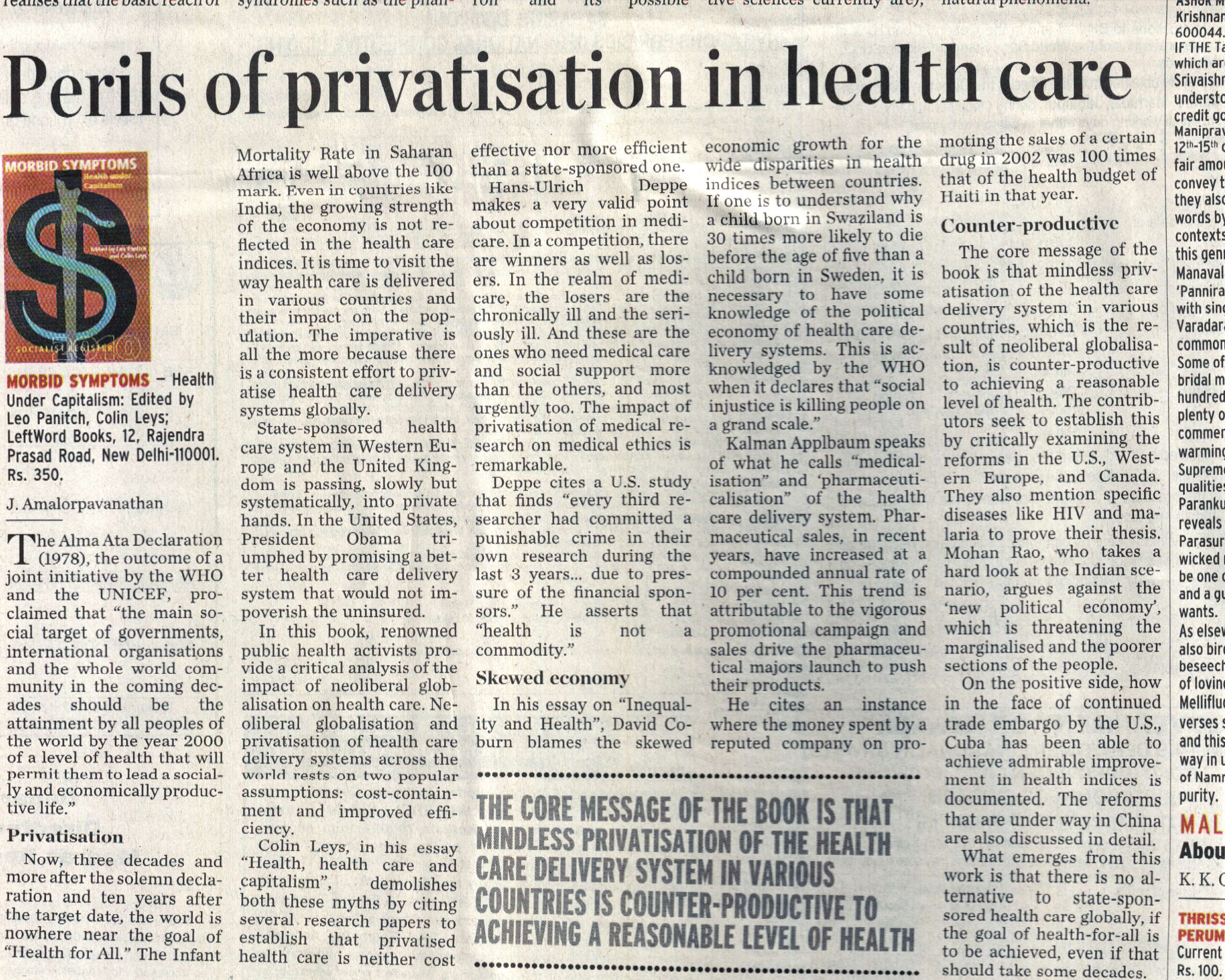
From The Hindu January 2011

Final message

Entry of capitalism into health sector is probably the worst  infliction   man kind  has suffered , than all those deadly viruses and bacteria   over a last few centuries !

Medical science is a phenomenal  gift  created , nurtured and grown by the sixth sense of our ancestors .Their only aim was to provide relief to the sufferings.  Now their dreams,  vision and goals lie  shattered .

No hospital  has a  specialty called  “humane care”  , while  many  have  a separate  department   to  do a  neuro  metabolic imaging    for a  depressed  man with Alzheimer  disease   in his nineties   and  a  Bio – Robot  driven    fuzzy logic  lab   to  predict cardiac  events  in a soon to die rich man . Absolute waste of resources !

There is  no doubt , we have become a  sort of  salves to  science  . . . (Irrational science to be precise ! ) It is a man-made monster.  Even a most conservative person  (including the author )  could    be causing  some damage as we  are forced to follow  the unruly scientific publications .  Probably  . . .yes . . . we can’t eliminate  it   but   identify  futility of modern science try to get  rid of it . !

A related article

Those were the days   . . .  When doctors practiced medicine  . . .and much more  . . .

A  wonderful  piece of writing   by Dr Susikaran  Thangasamy from the open pages of  India’s national newspaper

‘The Hindu” http://www.thehindu.com/opinion/open-page/article1137935.ece

What is the remedy ?

First of all , every one should answer this question to their conscience

What ails  our health care  system  today ?

Do not be part of it . . .  solutions  will come automatically !
Read Full Post »

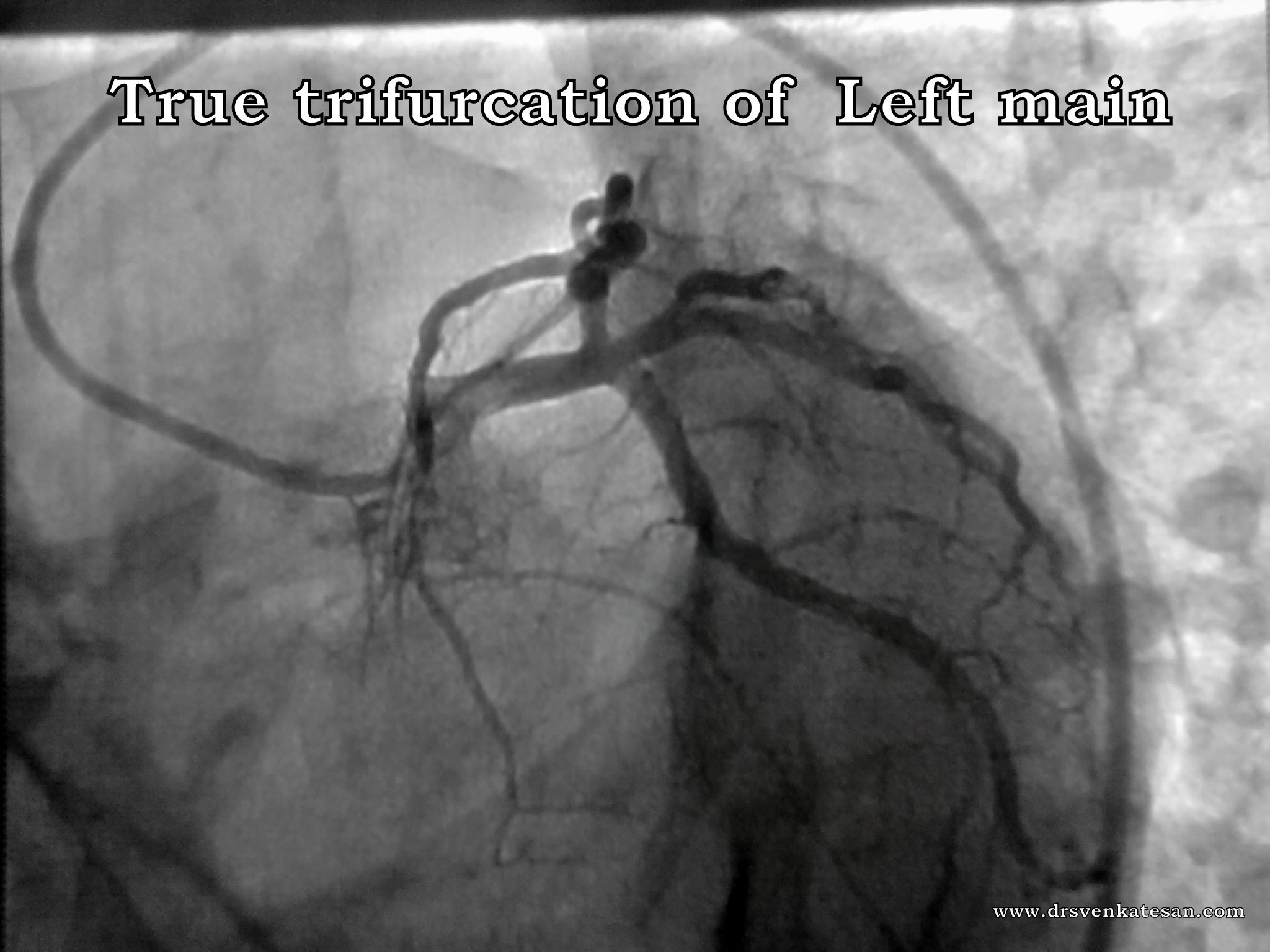
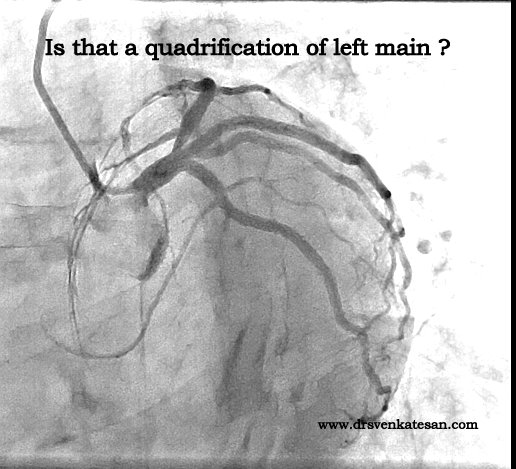
Left main divides into two. Some times into three . Very rarely into 4

Look  at this angiogram ,  This looks  like  a quadrification, if not quadrification equivalent

Clinical implication

A 4 way division invariably means the OM and diagonal or going to be diminutive.These people are expected to have favorable coronary hemodynamics during ACS , and  left main lesions are  less likely  to  occur

Reference

This article is from Singapore medical Journal

Read Full Post »

Life cycle of PTCA : Let us hope it do not become extinct !

Does PTCA  , a great Innovation for mankind,  is facing a threat of  extinction ?

It seems so . . . the stents  are losing its shine  in most situations. A simple evidence  . . . for that . . . can  be found in answering the following question

What drives the extensive research in biodegradable stents now ?

The simple answer is , we are fed up with the metals inside the coronary  artery. We want to get rid of it !

Too much of knowledge , often blunts our senses . Our track record clearly  reveals this fact. We needed a major study INTERHEART to tell the world   that  ,exercise is good and tobacco is bad for heart  !  Now ,we forgot a  simplest solution for  getting rid of  metal inside the coronary artery ,  which  is  “not to implant  the stent”  at all ! (Instead we do billion dollar research for making  bio – absorbable stents ,  which in the first place may not be required in the majority !

Read the related article . Does POBA has a role now ? in my site

The only situation  , where PCI   may  withstand the test of time could be in ACS (Both in STEMI and high risk NSTEMI !) PCI is cosmetic in most of the chronic coronary syndromes .

Final message

Our fight against human atherosclerosis will have to be , by medical means .PCI at best will  provide  a supportive role in selected patient group. It requires lots of common sense  and   scientific ignorance to achieve this.   Risk reduction ,  prevention , optimal   medical therapy  will have to play a dominant role in the next few decades .  This is something similar to the environmental issues we face in protecting our planet .No amount of green industry  will protect  the earth . It requires better social and  behavioral  ethics  from  mankind   and their  rulers !

Read Full Post »

God creates life  with  infinite variation .  The  heart gets  bulk of its blood supply from the left coronary  artery , which divides into two  after a short course.  Bifurcation is the rule . Left main becomes  left circumflex and LAD  in about in 85-90 %.

Note the left main divides into 3 equal caliber vessels.very lucky to have such a branching pattern !Distal left main is unloaded by three large ostia . This makes stasis of blood in left main very unlikely . LAO caudal view


Note : The OMs are small in these people. RAO caudal view

Few men and women are blessed with three branches from LCA . The anatomical and physiological importance of this  branching pattern  is not well analysed in the literature .There  could be  few advantages  of having a trifurcation instead of  bifurcation .

  • Left main  impedence is less in trifurcation . This is due to the fact ,  left main empties into three distinct ostia rather than two.The combined  cross sectional area of these three ostia  confers a hydrodyamic advantage.
  • The importance of  any proximal LAD lesion in these patients , is negated  by  33 % as two other vessels are there to take care the  rest of the heart.
  • A large Ramus usually  supplies a vast area in the angle between LAD and LCX.  This   has a potential  to protect against ventricular  fibrillation during acute occlusion of LAD  by providing  electrical stability .

Disadvantage of trifurcation !

  • It is also a fact , people with a large Ramus may have a trade off by having a diminutive diagonal or OM .
  • A trifurcation with a small calibered  ramus  can often  be a disadvantage , as it is prone for atherosclerosis  since it  restricts  left main flow  by  venturi effect . (The first rule of atherosclerosis states its  prone at branching points)

* A related blog  elsewhere in my site . The explanations  offered above are based on personal observation .

https://drsvenkatesan.wordpress.com/2008/12/16/what-is-clinical-significance-of-ramus-intermedius-coronary-artery/

Read Full Post »

Few web sites provide   free  cardiology  service.  This one from cardiomath beats  all  ! It makes the job easier for all those cardiologists who spend  lots of time in echo lab . It provides  simple  online tool  for all common calculations in clinical echocardiography

Here is  the link to the website of cardiomath

With  due  Courtesy   to

Author: Dr. Chi-Ming Chow  Developer: Edward Brawer  Illustrator: Ellen Ho
Sponsored by  Canadian society of echocardiography

Read Full Post »

Nothing in this world is black and white. In fact,  most events are in between . The irony is , our brain  always wants to view  things in two distinct entities !

  • Success or failure
  • Beautiful or ugly
  • Good or bad
  • Win or lose,
  • Rich and poor etc . . . etc

So it is no  surprise !  cardiologists  also travel in the same boat !

They classified  the events after thrombolysis   into two dogmatic categories . Successful  thrombolysis or failed thrombolysis   . . .  as if no other event  can occur in between .

Traditionally 50% regression of ST segment is called successful .   What  about 30%  and 40 % ST regression ?

Further , there is an important caveat  in the timing,  as we  traditionally assess ,  90 minutes of thrombolysis .

Consider the following  situation  :

  1. Thrombolysis  is failed at 90 minutes, but  succeeds  at 120/180  minutes ?
  2. Is 50 % ST regression at 180 minutes is as bad  or as good as 25 % regression at 90 minutes ?
  3. How to label a patient who  is extremely comfortable in spite of ECG criteria of failed thrombolysis ?(Surprisingly this situation is fairly common !)

So, without finding answers to some critical questions , we have defined the success  of thrombolysis with  half baked data .

This is exactly , is the reason we  are unable to do a  valid  study on failed thrombolysis, rescue PCI etc .  We know the results of rescue PCI  ,  always  been  contradictory to the general logic !

It is estimated a substantial number of  STEMI patients following   thrombolysis   fall into a category of partially successful thrombolysis implying partial restoration of blood flow and salvage. The correct definition for  successful thrombolysis and reperfusion should be at the myocardial mass level , and  not at the level of coronary artery.The ECG  is the best available indicator.

Implication for having a  poor definition  of  failed thrombolysis

It is not a rare sight to wheel  in , a patient to a cath lab  with label of failed thrombolysis dangling in his neck  who is clinically  stable  (Has a less than required 50%  ST regression , but a definite, favorable trend with a 30 % ST regression  at 90 minutes  )

How many cardiologists will be willing to abort a CAG/PCI  , as a repeat ECG just  before puncturing  in the  cath lab reveals    successful  thrombolysis ? (little  delayed though !)

If only we have better methods to risk stratify patients following thrombolysis , we can avoid

  • Huge costs incurred
  • Expected and unexpected hazards of doing an emergency  intervention in an adequately salvaged STEMI
  • Hundreds of cardiology man hours can be saved  for better purposes .

Final message

Classifying thrombolyis into  success  or  failure  is a  skewed  way of looking  at this important  issue .

It is an irony ,  cardiologists often  triage LV dysfunction , valve disease , cardiac failure  etc  into 4  grades (  minimal  , mild , moderate or severe  ) . It is  still a mystery ,  why thrombolysis  is never graded  like that ,  and it is always considered as  all or none phenomenon !

There is a substantial number of patients  with partially successful ( or shall we call partially failed !) thrombolyis  .This group must be given adequate attention or inattention  . There  is a urgent need for a through review of how we look at  the post thrombolysis status  . It is better to use the newer imaging modalities like PET/MRI more  liberally to identify  exact sub group  of failed thrombolysis who will benefit form revascularisation .

Read Full Post »

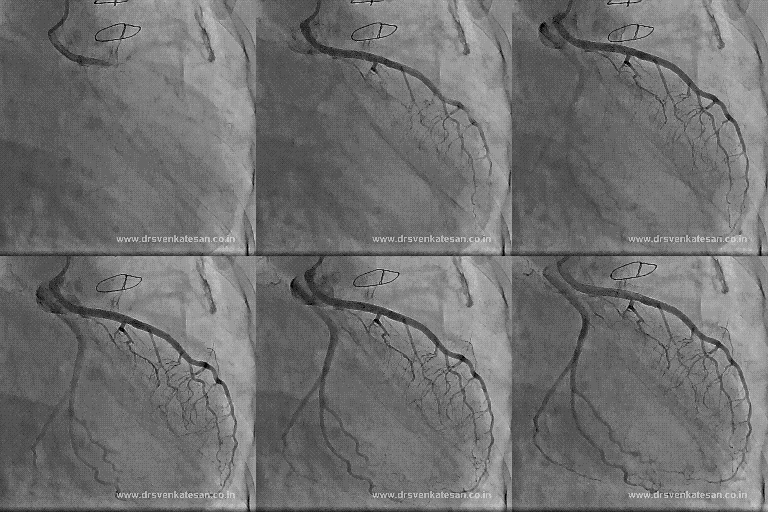
Is it not ,  boring to  see  normal coronary arteries every day  ! There need to be surprises  in cath lab to make our time lively  and keep our brain alert .  Have a look at this angiogram in  RAO caudal view.One of our junior cardiology fellows thought it was  a split left main artery .

How can an artery split . . .of course the image indeed looks like that !

It was indeed an absent left main.  Also called as separate origin of LAD and RCA.

Note : There can be three  types of absent  left main.

  • LAD and LCX from same ostia on the left coronary sinus*
  • LAD and LCX separate  ostia but both from same sinus**
  • LAD from left coronary sinus, LCX from right sided sinus (Probably the  common type )

* Some books mention about a left main of 0 -5mm .

** Very difficult to delineate and is rare

Zero  mm  left main is nothing but  single  ostial origin of both LAD and LCX. A very short left main , say 1 0r 2 mm will practically mimic an absent left main.

Here is the  the dynamic angio image. It is  surprising how a catheter in left sinus is able to visualise the LCX from right sinus so well !

Note the separate origin of LAD and LCX.The LCX was originating near the right sinus.It is intriguing to note even though they originate in different sinuses , the main stem of LAD and LCX wants to maintain a close parallel relation.


Advantages of having  absent left main .

  • It requires no great brains  ,  to predict  the above patient is  immune  to  develop  Left main  or true bifurcation disease
  • Sudden death is  presumed to be less common in this population.

Implications for interventional cardiologists

Guiding catheter selection and positioning could be difficult.

Read Full Post »

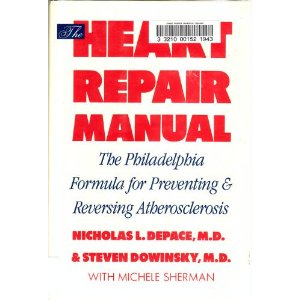
Manuals are not only for doctors . There are few heart  maintenance manuals for patients as well.

This one from Philadelphia ,  is worth reading and of-course  following  thereafter  !


Some books can be as effective as CABG or PCI .

This  one is definitely in that league  . . .

Read Full Post »

God has created  and arranged every organ in an order  with a purpose .  The unique  relationship  of the food tube and  the heart which run silently , posterior  to the heart has evoked much interest for the cardiologists.

Whenever LA is enlarged it pushes the Esophagus back .We also know  the vintage clinical entities   of cardiac  dysphagia that occurred with rheumatic mitral stenosis.

Since the  lower end of  esophagus just hugs  the left atrium , this anatomical concept was successfully exploited   for imaging heart in TEE.Now cardiac  anesthetists routinely use the esophagus as an imaging port during complex mitral valve surgeries.

How  esophagus can be utilized to resuscitate the heart at times of emergency ?

Note , the esophagus does a friendly hug as it crosses the heart posteriorly .It is a perfect anatomical sense , to Image and pace the heart from within the esophagus !


In a  cardiac  arrest  situation , when we need to   rapidly   access to heart  , we have  multiple  options  .Each has some  advantage and few draw backs.

  • Trans-venous pacing   is the standard method,   but even for experts  it needs   few minutes to reach the heart for pacing
  • Trans cutaneous pacing (Zoll)  is  a viable option , but  not widely  popular for some  unknown  reason (Patient discomfort ? High threshold ?)
  • Emergency trans-thoracic  needle pacing option is  a primitive method still can save a life or two on it’s day !

It was in 1980 ,  a dramatic  concept was conceived  . Why not    use the  esophagus as an access   for pacing  the  heart

after all ,  it  reaches as close as possible to the heart !

How to convert  a  Ryles tube into a  a  trans – esophageal  pacing lead ?

There was a certain article on this topic , which I read , when I was cardiology resident. It answers the following. Distance form mouth ,  Discomfort of  the lead ,   Pacing threshold ,  Esophageal burns .

I am unable locate that article. Will  post  it  once I get it.

Limitations of trans-esophageal pacing*

  • The most important limitation is it can pace only the atria with high degree of success.
  • Ventricular pacing is not that successful for the simple reason esophagus is anatomically insulated by the atrial chambers.
  • Tran gastric positioning  may reach  the basal aspects of Left ventricle , but the threshold needed  is too high that will invariably cause  discomfort.This can be used in a dying patient  when there is no  other option .

* Primarily  useful in acute SA nodal defects, sinus arrest or any other atrial electrical failure. Infra- nodal complete heart block trans esophageal pacing may not be effective .

Other potential uses  of trans-esophageal  leads

Over drive pacing

Overdrive entrainment of tachycardias ,  including resistant ventricular tachycardia is possible.

Trans esophageal ECG recording .

This can magnify p waves during supra ventricular tachycardias and aid in decoding narrow qrs tachycardias

Safety  Issues and Caution

Good earthing is necessary .Burns can occur.

Final message

Every cardiac physician is  expected to possess  the expertise to rapidly pace a heart  by trans jugular /subclavian access at times of  emergency .

Further , any modern CCU will have a defibrillator equipped with trans-cutaneous pacer as well. (The  disposable pads are too costly and is a deterrent in many hospitals  !).

This article  explores other possible way to pace the heart in dire emergency situations.

It has one more purpose !  It rekindles   the acumen , motivation  and hard work   of  our  cardiac  ancestors  (Which many of us are pathetically lacking !)

http://circ.ahajournals.org/cgi/reprint/65/2/336

Role of trans-esophageal lead during EP study  atrial fibrillation

http://cardiovascres.oxfordjournals.org/content/38/1/69.full

Read Full Post »

In pacemaker science ,  any pacemaker that maintains AV synchrony is often referred to as physiological pacemaker. This is  of course , a  wrong reasoning .None of the pacemakers available today can be claimed to  be completely physiological .All  pacemakers  which paces the right ventricle  induces IVS dysynchrony (Including  the modern DDD)

Single chamber physiological pacing

AAI

Paradoxically ,  the most primitive of pacemakers AAI can be the near perfect physiological  pacemaker . The simple explanation  is ,  In AAI mode , expect for the origin of pacemaker impulse the entire depolarisation and repolarisation  is through the normally existing physiological conducting system .(AV node, HIS, Purkinje etc)

(It not only has atrio ventricular synchrony but also  has ventriculo ventricular and intra ventricular synchrony )

So, technically AAIR  is most physiological pacemaker possible .But  the practical utility of such a pacemaker is limited.It can be used  only in  isolated sinus node dysfunction with intact AV conduction . (The problem is the AV nodal conduction can develop later )  To over come this DDDR pacemaker can be programmed to AAIR as a default mode.

VVIR

This rate adaptive pacemaker  ,  to a  certain extent  can be termed physiological as the heart rate can improve with exercise . (Still it is unphysiological as it  paces the RV )

VVD

This is based on the concept ,  for pacing to be physiological , it  requires  atria  to be  at least sensed not necessarily paced.This mode which has a floating sensor attached to the lead as it crosses the atria.This facilitates atrial sensed ventricular pacing .But many believe  the atrial sensing is not consistent in VDD mode.Currently this mode is not popular.There is scope for improving the atrial sensor technology .

Dual chamber physiological pacing

DDD, DDRR

Both  these are the prototype dual chamber physiological pacing modes.

Bi-Ventricular or triple chamber pacing  ( one atria two ventricle)   are our  elusive answers for attaining perfect physiological pacing . it need to be realized, we simply ,  can not mimic the natural cardiac  conduction system.It is  estimated to be more than 10 miles long specialized fibers .

Final message

In our quest for physiological pacemaker we often forget the fact  , AAI is the most physiological pacemaker mode  available .(It even has  VV synchrony !  )

We should use it liberally whenever possible .Of course ,we cannot use it in complete heart block .Still 50 % the  permanent pacemaker  we implant is for sinus node dysfunction. Many of them could be candidates for AAI mode .If current generation cardiac physicians feel out dated to insert a AAI pacemaker, at the least they should program the DDDR into AAI mode with a mode switching to ventricular pacing modes whenever required.

In spite of all  advantages ,  why atrial based pacemakers are not gaining popularity ?

  • Ignorance
  • Lack of expertise
  • Technical difficulty of fixing atrial  lead
  • Perceived fear of lead dis-lodgement.
  • The fact remains  the  ventricular based pacing  is always safe  in case of sudden AV block due to any reason .

Read Full Post »

« Newer Posts - Older Posts »