After years of of experience I realised knowledge and Ignorance share an intimate relationship !
venkat.quotes@2012
Posted in bio ethics, medical quotes, tagged dr s venkatesan, ethics and medicine, venkat quotes, venkt quotes on April 17, 2012| 3 Comments »

venkat.quotes@2012
Posted in Cardiology - Electrophysiology -Pacemaker, Cardiology quotes, medical quotes, Quotes, tagged choosing a pacemaker, dddr vs vvi paceamker, pathological pacing, physiological vs unphysiological pacing, single vs dual chamber pacing on March 29, 2012| Leave a Comment »
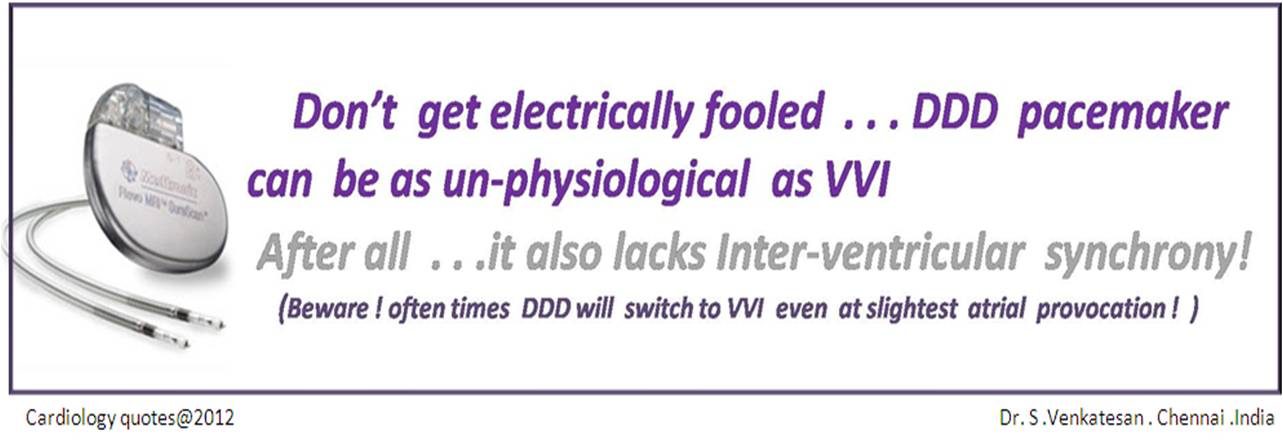
Choosing a pacemaker is not a child’s play . It is a complex game played by cardiologists , electro-physiologists and their ill-informed
patients. The superiority of dual chamber pacing over single chamber pacing was never convincingly proven.
Still . . . usage of dual chamber pacing is steadily increasing over the years for various reasons.
“Every thing hangs around a key word called quality of life . DDD pacemaker is supposed to enrich life due to their AV synchrony “
World health organization says quality of life of homo-sapiens are determined by at least few dozen factors .They are mostly non medical.
How an extra lead at a cost of 2000 dollars more , is going to provide that elusive “quality of life” to all those poor patients with bradycardia in this world , which . . . they any-way lacked even in their best of times !
Scientifically also there is a major flaw in calling DDDR as physiological pacemaker

Posted in bio ethics, medical quotes, tagged quality of life quality of death, quantity of life . quantity of death on March 23, 2012| Leave a Comment »
If only we realise . . . even a healthy human life . . . has a mortality of 100 % at some point of life , the mentally immortal modern human species won’t demand for a 2 % chance of living “30 more miserable days” with terminal cancer !
Venkatesan Sangareddi (2012)
Posted in bio ethics, cardiology-ethics, tagged hippocrates, medical errors, medical ethics on February 11, 2012| Leave a Comment »
Doctors would simply hate this book because it tries to expose them !
I would n’t agree with the tone and conclusion of this book . But one should soul search , why such books are written in the first place ?
The medical professionals definitely need to ponder over this issue .
I stumbled upon this book in Amazon book store
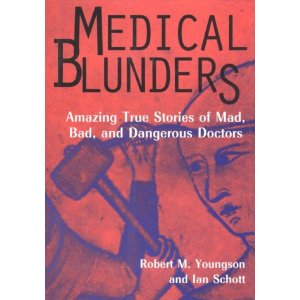
http://www.amazon.com/Medical-Blunders-Amazing-Stories-Dangerous
How frequently doctors make blunders ? What is your take ?
Would you like to vote in this poll ?
Posted in bio ethics, cardiology-ethics, tagged cardiology ethics, cost of care in medicine, crp apolipoprotien b, ethics in coronary care unit, homocysteine, homocyteine, inappropriate investigations in ccu on August 14, 2011| Leave a Comment »
In one of the corporate hospitals which I visited in my city(Chennai*) , happened to see a nurse taking blood sample from a patient who has been just admitted in a Hi-tech coronary care unit for UA-NSTEMI.
It included blood tests for CRPs,homocysteine,Apo-lioprpitein B etc . She was being supervised by a capitation fee fed , just delivered , neo- medical graduate from a country side medical college.
I asked her what for you’r doing these tests.
She said , it is to detect risk of developing CAD.
. . .I reminded her , the patient had already developed full blown CAD .
She was too innocent to say ” I do not know all those things sir , my consultant asked me to do it !
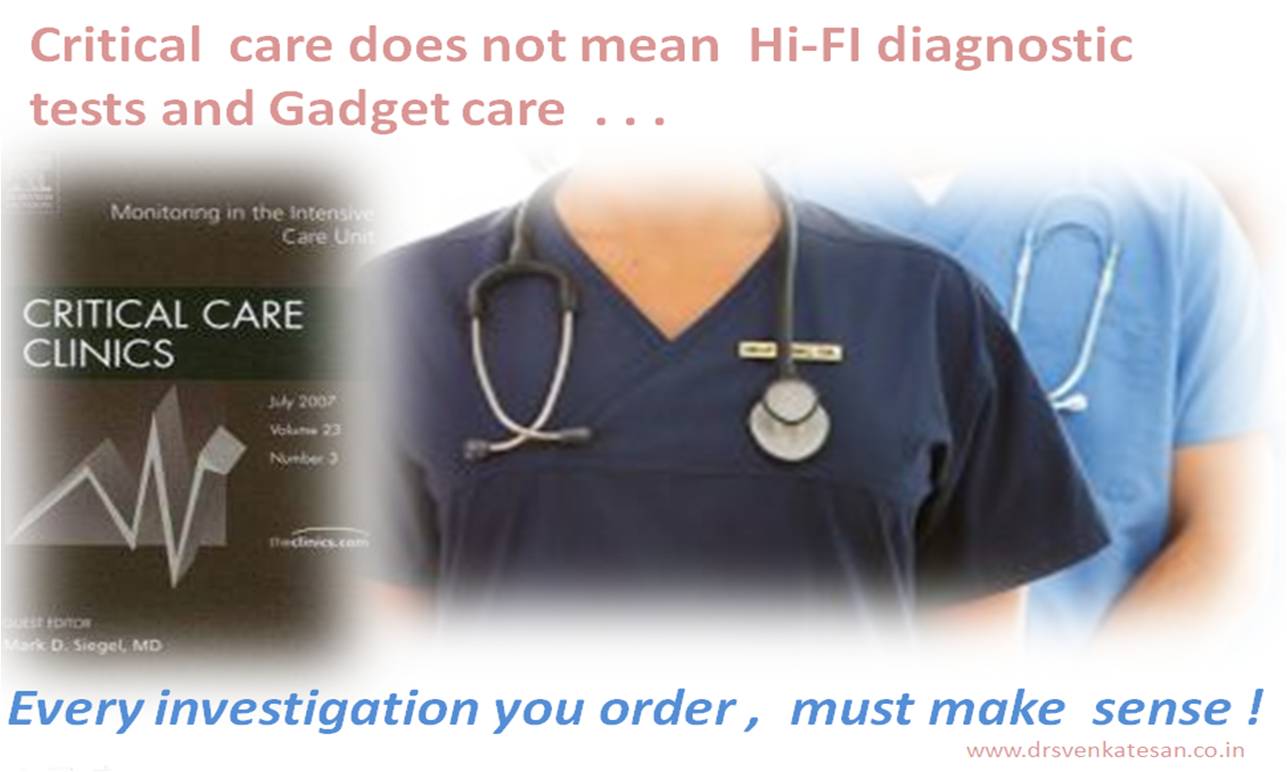
This is how some corporate coronary unit* functions and handle their prized possession . And every one enjoys it , as science prevails over common sense !
* Shall I name the hospital ? . . . No , it would invite trouble . . . oh , what a freedom of expression we enjoy !
Posted in bio ethics, Cardiology - Clinical, Cardiology -Interventional -PCI, cardiology -Therapeutics, Cardiology -unresolved questions, Cardiology-Land mark studies, tagged cardiology ethics, inagural issue of nejm 1812, medical ethics on July 14, 2011| Leave a Comment »
It was the year 1812 , exactly 100 years before the Titanic sank over the Atlantic , a small bulletin from Massachusetts General Hospital was released . It later on became the single most important journal for the medical community. The appearance of an article about angina pectoris in the inaugural issue , reiterates the importance of cardiology even in those days of primitive medical care .
The volume. 1 : No. 1 issue of NEJM egan with a classical and critical observation of angina pectoris written by Jhon Warren .
http://www.nejm.org/doi/pdf/10.1056/NEJM181201010010101
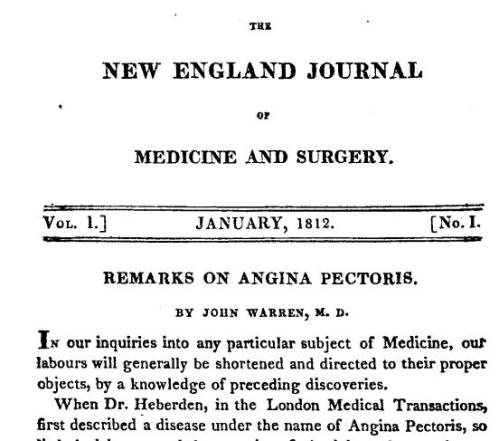
The first issue of NEJM . . . Witness to 200 years of medical excellence
Those were the days when angina was treated with tincture opium and Fowler solution (Arsenic potash ) .They can be termed as height of inappropriateness and also condemnable acts . . . is it not ?
200 years later . . . in 2012 what do you think has changed , in terms of appropriateness of management of angina pectoris ?
What a surprise , two centuries later , even as we are treating angina in hi-tech cath labs with bio-degradable stents and metabolic modulators , bulk of our population is grappling with inappropriate therapy for angina pectoris .
Today ,patients are subjected to questionable modalities in the management of CAD , which the following paper tries to expose !
Keeping the inappropriate flag high . . .200 years later in 2012
What a way to progress in Medicine ! The reason for this “200 year old ailment” is attributed to extreme scarcity of common sense !
( A study , which says regular exercise can be as good as PTCA in multivessel CAD , would sound as a “nonsense article” for most cardiologists of current generation !)
Finale
When we look at human history , where billions lived ( and continue to live ) in this age old planet , it would appear a trivial matter whether you treat angina pectoris with Tincture opium / Arsenical potash or Prasugrel / Rosuvsatin . . .
Whatever be the scientific advancement the ultimate outcome on human health will depend on how we apply it. So, all young medical fellows beware of this !
Posted in bio ethics, Cardiology -Interventional -PCI, cardiology -Therapeutics, tagged bed side clinical research, clinical and basic medical research, current medical research, double blind prospective trial, ethics in medical research, evidence based medicine, fraud in medical research, lancet, medical research, poverty a disease, war and terrorism as disease on June 5, 2011| Leave a Comment »
Medical research can be divided into few broad categories
*Logically the top 5 should constitute the bulk of research , in reality last one wins the race with considerable ease . Why ?
The important issues that confront today’s medical research starts right from the “Aim” of the research , methods , materials statistics, and goes on to ethical issues , conflicts, futility , gimmicks 0f publication , marketing and ultimately left for human assimilation .
(Read a related article in this blog can Aim of a study be wrong ?)
Data(s) won’t lie . . .humans do !
Science is nothing but collection of facts , rechecking the facts , and finally confirming , they are indeed facts. So medical data collection becomes vital . Data, if properly collected , wont lie. Bias is always an issue in prospective trials. Further , and whenever and wherever scientifically motivated human beings interact with data the later becomes a vulnerable target and get manipulated for various reasons . (Read the famous article on data torturing in NEJM : I will link it soon ) So blinding becomes mandatory and it should be total as some studies tend to gain vision half way through !

Image courtesey : Jupeter images
Simplicity of observational studies.
We give undue importance to RCTs . What we fail to understand is RCTs are required only in selected situations in medical research (New drugs and interventions ) Meanwhile , we can do wonders with retrospective observational data. These data can not be manipulated as the events have occurred already and those people who collect or record the data wouldn’t know this data is going to be utilized for a study (This , in fact is equivalent to 100 % natural blinding and constitute a real world study )
Observational study can involve patient behavior , disease behavior , community impact, drug action, investigation modality , etc . . .etc . Your mind is the limit . Cost of doing a observational study is less but the impact on the society can be great .
Observing skills are the biggest causality in modern medical times , This was only scientific weapon of our ancestors had , which they used in an exemplary fashion .( Recall how Heberden described angina and Harvey taught us about circulation without even ECG and X RAY chest )
Fraud in medical research
Wherever big money is flowing corruption and fraud is unavoidable . . .at the least . . . we should recognize it
( Many journals just point out this possibility by simply displaying message of conflicts .They do not bother more than that . . . just a warning message )
Now in the modern scientific world , even as the genuine contributions from our ancestors left to stare the back of us , we try to indulge in all sort of unpleasant things.
In an audit against fraud in medical research , it was found most of the fraudulent research happened with drug and device trials and few in basic science involving genetics and molecular medicine . It was rare to identify fraud in research involving purely clinical and epidemiological analysis .
Drug trials need to be prospective . Vested interest can play havoc in prospective data .There is a thing called steering committee in all major studies . . . we do not know what does the word steering really mean .
There has been many occasions even well conducted studies turn out be fraudulent . Now we realise many such studies are struggling to prove its worthiness .
In fact it is argued every study before getting published should undergo a global , independent trial monitoring board for genuineness of the study . (Not the customary peer review !)
Final message ( Sorry its a long one !)
We have a huge problem here . I am afraid we haven’t even understood , what we mean by medical research !
For today’s youngsters medical research means doing sophisticated tests in nano- labs , human genome mapping , space age imaging modalities or involving a multi- billion dolor drug trials . This is absolute falsehood.
What we need to do is “search” , ” search” , search again (That is why it is called re-search ) for all those elusive problems our patients face .Not only in their body , in their home , in their community, etc . Every patient teach us few points, observing and learning new things and publishing is also an important aspect of research .One can do a instant research in the crowded OPD of a hospital , in the wards , (What is the profile of fever pattern in a winter season in your hospital ? does it reveal a new viral epidemic ?)
An ideal research should identify a problem and suggest a practical solution to a given problem .There are millions of such issue waiting for our attention in the bed side. But what is happening currently ? Current medical research is largely direction less , fueled by vested interest , makes sure it avoids all genuine problem areas !
Many studies happen based on flimsy scientific basis .We are still wasting our time to increase human HDL levels. ( Not with standing the famous Torcetrapib fiasco ) .Hundreds of thousand of dollars are pumped into this research even after realising only the endogenous HDLs generated by natural methods like exercise are the really good HDL !)
While we do million dollar research with a dubious risk factor called high sensitive C reactive protein , there is no takers against number one killer disease of human kind namely “The poverty” (WHO ICD codeZ59.5 )*
Let us prey God to instill common sense to all of us . Patients suffer with disease and we suffer from irresponsibility or reduced responsibility ! It makes us happy at-least few forces like Lancet , British medical journal etc are fighting lone war against this ailment medical science is suffering .
*Please note : http://www.icd10data.com WHO labeled poverty as disease many years back without much fanfare ! It is rarely mentioned in any graduate student** medical text in whom our future lies . I do not know whether Wars and terrorist acts been included as disease or not !
**Our students rattle about about the exotic tick borne Lyme disease happening once a year in remote hills , while most will stare blank when asked how to diagnose and treat nutritional anemia with which millions suffer every day !
Posted in bio ethics, tagged bio statisitcs, critical decision in cardiology, fluid bolus in chidren with shock, fluid resucitation in shock nejm on June 3, 2011| Leave a Comment »
When you encounter a patient with shock and hypotension , the first ( instinct ) response would be to start an IV line and push fluids rapidly . This is more so if the patient is a child. This is what medicine has taught us for over a century . Now this NEJM article surprises us with its conclusion.

The accompanying editorial in NEJM reiterates a fact . . . “In medicine there is nothing called dictum” , what you perceive as life saving treatment will be doing the opposite !
Such is the fragility of present day medical facts.
Please remember , in medical science not only the drugs have expiry date even some of the break through concepts suffer from it .
This study may not have great implications for cardiologists but the filed of cardiology is also infested with many such false dictum(s ) are waiting to be damned !

In this funny world . when the scientific methods are imperfect , we have to realise two such U turns make the original path right .
Similarly , some of those who do not make the initial path correction ultimately travel in the right path !
Message to patients
Many of my patients often wonder how two diagonally opposite views are expressed by doctors for a given medical condition . My simple answer to them is do not ever try to understand your medical condition beyond a point , . . . we our-self have not yet mastered it !
Posted in bio ethics, Infrequently asked questions in cardiology (iFAQs), tagged medical statistics on May 12, 2011| Leave a Comment »
In this world of evidence based medicine the funny bedside vocabulary of medical statistics has withstood the test of time. The following words are liberally used by physicians of all walks of life.
We never bother to find what these words mean to our patients !
Here is a crude and wild numerical attempt to decode these words.
Apart from the above there two hugely popular medical words used over million times every day in all walks of medical practice.
They are ” May” and “May not”
The greatness of these words lies in the fact it can convey any of the above 10 meanings in a single phrase without any fuss !
Further , the words may and may not are numberless un-quantified statistical jargons that can convey a deep meaning or . . . no meaning depending upon the circumstances !
Doctor , is there a possibility of my stent getting occluded as i have skipped the clopidgrel ,and aspirin for the past two weeks
You may be at risk . . . but you may not develop an heart attack immediately . I would advice you start the drug immediately .



 Dr.S.Venkatesan MD