Feeds:
Posts
Comments

Archive for the ‘cardiac surgery’ Category

The one and only journal for cardiovascular surgery from the subcontinent. Great to  know   full text articles are available from year 2003  , free of cost .Every cardiologists from India must read this journal regularly to update  about what our surgical colleagues are doing  in our country.

Thanks to the  National Informatic centre  for hosting this journal in their server .

http://medind.nic.in/ibq/ibqai.shtml

Read Full Post »

PAH  is  the major determinant of surgical outcome of left to right shunts. In this  modern era of cardiac care  allowing a child  with   left to right shunt   to progress to a  stage of   Eisenmenger syndrome  is  considered  as a  huge medical failure . But  , this is still rampant in many of the developing countries .

Cardiologists are divided over the issue of  operability of Eisenmenger syndrome .The confusion is largely due to the conflicting data of outcome in these patients. While  there is strong   data  when  PVR exceeds  SVR  ,  the death is imminent in the post operative period .

What has complicated the issue is   there are  many case reports  where severe PAH patients have been successfully operated. Most would think it is a statistical exception and one can  not alter the traditional criteria based on few case reports.

But ,it remains an irony as on 2009 ,  we do not have a proper methodology to assess reversibility of PAH in Eisenmenger syndrome . Further ,  there is a  significant number of  patients with high PVR  , who continue to experience  an  unabated left to right shunting .  We do not have an answer  for either the mechanism of such shunts and  how to manage these patients.

Click over the slide  to view full  PPT  presentation in PDF format .

This short paper was presented in the Annual scientific sessions of cardiological society of India 2009 regarding the usefulness of a new parameter to assess reversibility of PAH. This may not be called as  a study rather a report of  our experience  in  five  patients  with eisenmenger syndrome

Download the full PPT presentation in PDF  format.

pulmonary artery pulse pressure

Read Full Post »

Diastolic dysfunction is a common clinical cardiac problem which has no specific therapy.It can occur either in isolation or in combination with systolic dysfunction.The later may  be more common.

Isolated diastolic dysfunction

  • Hypertensive heart disease.
  • Aortic valvular stenosis
  • Restrictive cardiomyopathy
  • Early stages of CAD
  • Pericardial disorders
  • Idiopathic stiff ventricles

In association with systolic dysfunction

  • Dilated cardiomyopathy (20%)
  • In any form of cardiac failure some degree of diastolic dysfunction is noted .

General principles of management

Even though there is no specific drugs to tackle diastolic dysfunction the following measures may have significant impact.

  1. Correct the underlying problem.(HT/CAD etc)
  2. Reduce the basal  heart rate .At lower heart rates as diastole is prolonged , the stiff muscles has  extra time to relax and stretch itself  longer.
  3. Regular isotonic exercise  preconditions the muscle  for smooth contraction  relaxation .
  4. Optimise diuretics (Excessive diuretics has an  adverse effect on the  diastolic pressure profile across the AV valves)
  5. Avoiding positive inotropic agents like digoxin .This will not be possible in combined dysfunction.
  6. ACE inhibitors, ARBs, Aldosterone have some benefits as they could prevent tissue proliferation in the cardiac interstitium
  7. Milrinone (The non digoxin positive inotrpic)show some promise

What are the  treatments in the horizon ?

Antifibrotic drugs   ,Antiproliferative drugs

Collagen breakers ,

Read Full Post »

What are the fundamental  difference between randomised  studies and observational studies ?

New discoveries come from shrewed  observations made in bedside or labside  while ,  randomised studies evaluate these discoveries for it’s effectiveness or futileness  .

Let us realise ,  RCTs   primarily  never  contribute to  generation of  original  concepts or discoveries  ! .It is a  statistical tool to assess an observation .

Click below to reach the excellent knowledge  source on above  the issue .

PLoS Medicine: Observational Research, Randomised Trials, and Two Views of Medical Science

The fact that  observational studies are done with open eyes &  mind ,  it is  obvious it  demands  intense conceptualization and thinking .
Blinded studies  are  mechanical studies . It is pure statistical research . It requires  no thinking  , medical  mind , in fact one can do it with eyes closed as it is a strict protocol driven  , even a  non medical men  can do a  medical research , while it needs a  alert mind to do a observational study .

Observational studies , especialy  when done retrospectively  has  zero bias  as the case selection and  the potential intervention are completed even before the research question  is raised. In fact many of the  greatest medical breakthrough comes from retrospective analysis. Of course this has to be proved prospectively  preferably in a randomised fashion.

So , we the medical professionals ,  shall  do great observational  research with open eyes and mind and let the  the statisiticins do the outcome analysis blind folded .

If the core medical professionals are bothered more about  randomised blinded  studies ,which is  meant only for evaluation purposes , the  future of intellectual  medical research is  going to be in jeopardy!

Read Full Post »

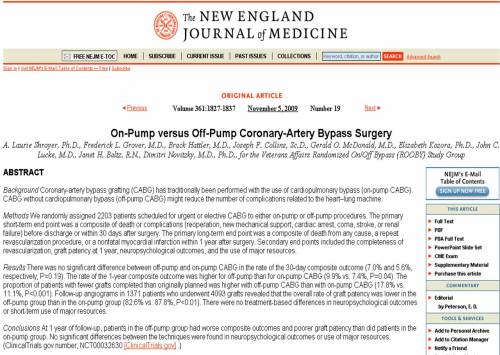
The NEJM’s breaks the  hidden truths about cardiopulmonary bypass in a beating  heart. The irony in medical science is   ,  trend setting  land mark articles usually arrive  very late . . .   to disappoint  all those  patients who  got the wrong treatment ! Off pump by pass is definitely one among them . . .

The major reason for off pump CABG’s s poor showing is

  • The surgeon’s  conflict   in defining   what is successful CABG  .The success of CABG   is   in    relief of symptoms & providing good bypass graft  with long term patency   .It is not in  less  thoracic trauma or in  a quick hospital discharge  !
  • The second major reason is denial of  the fact  that off pump CABG is indeed inferior  and hence no course correction was attempted  ! ( And  now that it   has become a hard  evidence   we expect some changes  . It  required almost 10 years for our cardiology community to  recognise this .)
  • Lesion access and  difficulty in mobilizing LIMA .Many times the the point of anastomoses is preselected by the accessibility and technical issues rather than lesion guided approach .This often happens than we imagine , and this could be a very bad advertisement for off  pump CABG

cabg on pump vs off pump beatin heart

Click on the link to NEJM abstract  ROOBY study

http://content.nejm.org/cgi/content/short/361/19/1827

Read Full Post »

Conduction disturbance is a fairly common occurrence following  MI. Inferior STEMI is especially prone for AV blocks. This is because  the  blood supply to AV nodal  tissues and the inferoposterior surface of the heart  share the same arterial territory . AV node gets it supply  90% of time by right coronary artery(RCA )  and 10% by  LCX. Very rarely from both .

The common bradyarrhytmias that we encounter in inferior MI are

Sinus bradycardia

Sinus pauses ,SA blocks

AV blocks

Functional

Vagotonic

Organic

Ischemic

Necrotic

ECG types

1  degree AV block

2 degree  AV block – Type 1 Wenke bach

Complete heart blcok

Mechanisms

The inferior aspect of the heart has rich innervation of vagal nerve terminals (While the  sympathetic adrenergic system is concentrated in the anterior surface) . The moment infero posterior MI occur it stimualtes the vagus and a prompt bradycardic response occur .Many times the classical hypotension /bradycardia reaction is simply a reflection of heightened vagal tone.

Consequence of vagal tone on SA nodal and AV nodal conduction

As expected, vagal stimulation can result in a spectrum of arrhythmias from the  simple bradycardia to complete SA block  to  AV block. Extreme bradycardia , may release the junctional pace maker and result in junctional rhythm with a rate of around 40-50. There can be a functional AV dissociation between SA node and AV node. Careful ECG analysis is required here ,  as it can mimic organic AV block.The simple way to differentiate between organic AV block from simple AV dissociation is to look at the p waves.In AV dissociation both atrial rate and ventricular rate are nearly equal or VR  is slightly more than AR .In CHB atrial rate  exceeds ventricular  rate.

SA and AV block occur due to various mechanisms in inferior  MI

  • High vagal tone
  • Ischemia of SA/AV node
  • Necrosis of AV node
  • Drug effects -Like morphine
  • Reperfusion bradycardia*

Ischemic AV nodal arrhythmias are  some times very difficult to differentiate from vagotonia especially if occur within 24h.

Irreversible AV nodal block due to necrosis is rare.But if occur , usually  associated with extensive inferior mI/RVMI/ .AV block  that  persist beyond 48-72hours should raise the suspicion of damage to AV node.( As vagal tone is very unlikely;y to last beyond 48h)

* Some time a an episode of sudden severe  bradycardia  can be manifestation of RCA reperfusion.Flushing of SA nodal or AV nodal branch of RCA might trigger this. This has a potential  to  bring the heart to asystole.The resultant extreme bradycardia often triggers VT/VF .The reported high incidence of primary VF in infero posterior MI is attributed to this sudden RCA perfusion.

Medical management for CHB

Brady arrhythmia’s due to high vagal tone are generally benign .No specific intervention is required.Atropine will be suffice in most situations.Some times isoprenaline may be required. Aminophyline , now Ivabradine may have a role. Atropine not only corrects the HR it raises the BP also as  it counters  both cardioinhibitory and  vasodepressive  limbs of vagal stimulus mediated by  acetyl choline .

Pacing for Bradycardias in inferior MI.

  • Generally not necessary for sinus bradycardia.
  • Few with CHB require it
  • Persistent hypotension and RVMI  needs it often.(Dual chamber temporary pacing preferred as AV synchrony is vital here.)

Weaning of temporary pacing in inferior MI.

This could be a tricky issue. It can be weaned off in less than a week.A practical way is to use temporary pacing  only in back up mode at a heart rate of few beats less than the patients rhythm.Pacing for long hours  at high rates may delay the resumption of patients own rhythm and may result in false diagnosis of irreversible CHB and a subsequent PPM

How many will require permanent pacing following infero posterior MI ?

Only a fraction of patients with CHB require long term pacing . There are some centres tend to overuse PPM in this situation. Wait and watch policy may be the best.A unnecessary lead  within a  infarcted ventricle  has a potential to create problems .There have been  occasions a stable RV MI has been destabilised due to RV pacing lead triggered recurrent VF.

Tachycardias in inferior MI

It is relatively uncommon.Atrial involvement is more common with infero posterior MI and hence a greater incidence of atrial fibrillation .

RV MI can induce ventricular tachycardia arising  from the RV myocardium

Read Full Post »

It is the  embryological remnant within right atrium  often observed as , mobile strands within RA extending fromIVC orifice to IAS. Some  times  it is difficult  to differentiate from eustachian valve  of IVC.The network is formed by collagenous material  and mimic valvular tissue

chiary network echo

Incidence

2% of general population . ( Means 10 crore persons  in our world ! )

What is considered  a benign echocardiographic observation for long  ,  may not be innocuous  . It  can predispose to certain clinical events , although rare.

  1. Mistaken for right atrial mass
  2. May produce  innocent murmur
  3. Catheter entrapment within RA
  4. Infective endocarditis of the network , and tricuspid valve
  5. Abnormal P waves and trigger for  atrial tachycardia
  6. Disrupted chiary network  prolapsing into RV
  7. Associated  foramen ovale  may induce  streaming  .This maintains  an embryonic right atrial flow pattern into adult life and directing the blood from the inferior vena  cava preferentially toward the interatrial septum

Reference

http://content.onlinejacc.org/cgi/content/abstract/26/1/203

http://ats.ctsnetjournals.org/cgi/content/abstract/76/4/1303

http://content.karger.com/ProdukteDB/produkte.asp?doi=10.1159/000096780

Read Full Post »

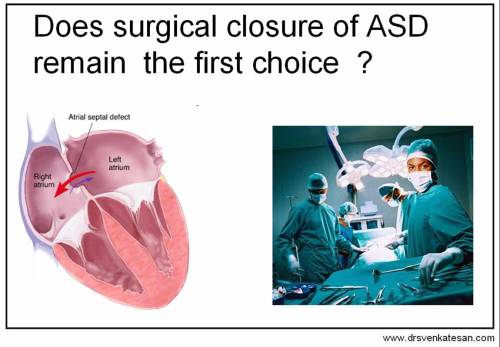
Atrial septal defect is one among the commonest congenital heart disease .After years of controversy, there is consensus  now , all significant ASDs  need to be closed ,  at whatever age it is detected.

This rule does not apply to small ASDs without chamber  right atrial and right ventricular dilatation. These defects and PFOs need not be closed .

Over the years , the  controversy  has shifted  from   Should we close ?  to  How to close ?

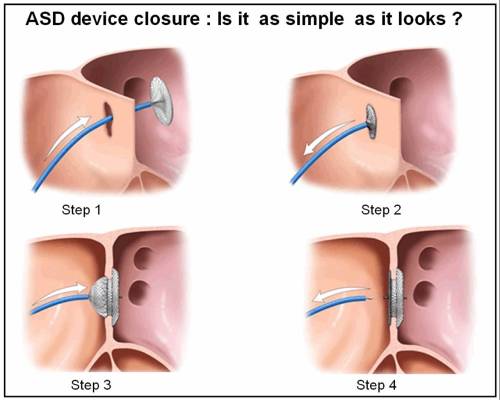
There are two options available : Device closure , Surgical closure

asd closure device www.drsvenkatesan.com

asd closure www.drsvenkatesan.com

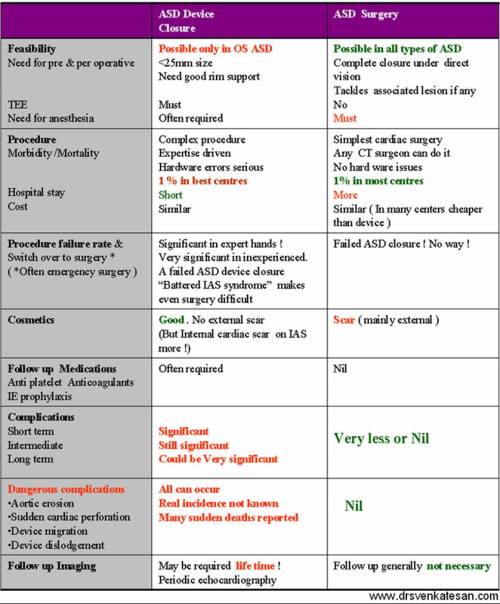
The following table compares the both treatment  modalities

( Personal perspective )

asd device closure 4

Final message

Device closure is a complex, costly, often  difficult  and  error prone   cardiac procedure .It needs long term follow up and may  carry a life long risk of major cardiac complication.It is useful only in selected subset of ASD patients. Surgical closure prevails over device closure in most situations.

Is this article  has biased view against this  emerging pediatric  interventional procedure of ASD closure ?

It may appear so . But that is the reality as on 2009 !.May we hope technology evolves further and take our surgeons head on .

2012 update on ASD device closure .

The   hard-ware  as well as the  expertise has   improved a lot and it is on right track to become a real challenge to surgery.

The only issue again is the availability of  rims to mount the device . Another  realistic and sensitive issue  which  have I come across is  , many interventionist cardiologist do feel awkward  when they experience  unexpected rim shortage on table.  They should realise it is not their  fault.

Always be ready to abandon the procedure and refer to the surgeon , according to your  true conscience 

After all , improperly delivered device is  a life long pain for the patient .He has come to you with a  great belief  isn’t !

2014 update

Device closure for most ASDs in both children and adult is  now possible with high degree of success. We have crossed about 50 patient experience. And  I am truly amazed  , how within a short period the device closure is about to conquer the crown from the surgeons ! (Exciting new data are coming from   my colleague Dr Gnanavelu from  the new Super specialty hospital of Government of Tamil Nadu Chennai. )


Reference

Aortic erosion following ASD closure

http://content.onlinejacc.org/cgi/content/full/45/8/1213

Read Full Post »

Can we advice CABG for single vessel disease  ?

Yes, CABG  may be indicated  in

  • Critical , proximal , complex  LAD disease   with or without  ostium involvement.
  • Many of the bifurcation lesions with large and significant  side branch
  • Small caliber LAD with diffuse disease .

When these occur  in diabetic  subjects , the  indication for CABG is more certain .

* Present generation cardiologists  would feel  every  lesion  is  stentable and should not be referred to the surgeon .But it should be emphasized here,   technical feasibility alone  ,  does not  imply  PCI is superior and ideal in all coronary interventions.

Can we do a CABG  in  single vessel disease  with  normal  LAD ?

CABG is  very rarely  indicated   for isolated RCA or LCX disease. It should be consciously avoided in this patient population.

This is because the at risk myocardium  supplied by these vessels are far less than that of LAD. PCI  is  preferred    in these vessels .(Ofcourse , after considering medical management  ) .

CABG is  ,  too traumatic a  surgery , to  offer  in this  low  risk  coronary  lesions.

Exceptions

CABG  can still be done in following situations  for non LAD single vessel disease.

  • Left dominant circulation  with  complex lesions in LCX /OMs.
  • It is common to see diffuse , long segment  and severe disease of RCA with normal LAD /LCX system .PCI is not feasible in this subset.
  • Failed PCI
  • Recurrent instent restenosis.
  • Bail out CABG after a acute complication during PCI

One should remember ,  inability to do a PCI  does not  mean ,  the patient  should   land in surgeon’s table .We should recall , from our memory medical management is an effective and established form of treatment in single vessel disease ( Mainly for non LAD , and some cases of LAD also !)


Read Full Post »

LV dysfunction , perhaps  is  the most common  medical term used by  physicians  world over.But surprisingly , It is not easy to infer what they mean by it ! The term literally means left ventricle is not functioning all right .

LV dysfunction can be classified by many  ways.

  • Symptomatic vs Asymptomatic
  • Global vs  Regional
  • Reversible vs Permanent
  • Systolic vs  Diastolic
  • Ischemic vs Nonischemic
  • Primary vs  Secondary ( Muscle vs valve  etc)

If you analyse the above classification LV dysfunction can mean different things to different people , at different times.Though systolic dysfunction ,  as reflected by low EF % ( Less than 50% ) is the major cause of LV dysfunction  the issue is not simple.

Is coronary artery disease ( CAD  ) a must for LV to  become dysfunctional ?

No , not at all .CAD  is the leading cause of LV dysfunction .Primary muscle disorders -cardiomyopathy is an equally common entity. Valve disorders especially  aortic valve stenosis is   another common cause for LV dysfunction. Further ,  systemic hypertension, diabetes mellites, renal failure, can result in serious impairment of LV function .Some drugs ( Adriamycin ) can either precipitate or aggravate LV dysfunction.

If  physicians themselves are confronted with such complexity , how are ,  our other medical  colleagues  (Forget about the patients !   ) will understand  the concept of LV dysfunction.

But , the  crux of the matter is every doctor believes  LV dysfunction is synonymous with low ejection fraction. A surgeon or an anesthetist is quiet happy to operate  if the ejection fraction is above 60% .

Can a patient  have significant LV dysfunction with normal Ejection fraction ? (EF )

Yes , this can occur in advanced degrees of diastolic dysfunction, where cardiac contractility is normal but

fails to relax adequately .

Is diastolic dysfunction less dangerous than systolic dysfunction?

May be , that is the dominant opinion   , but  there are sufficient evidence  emerging  that opinion is wrong.The main reason for diastolic dysfunction  to send a ” not so sinister signal ” is over diagnosis of  grade 1 diastolic dysfunction in the general population  . The echocardiologists considered it fashionable for a quiet a longtime (Many have changed since then !)  to report all patients  with reversed E :A ratio in the mitral inflow doppler profile as diastolic dysfunction. This has resulted in  thousands  of  asymptomatic , healthy people getting  labelled  as grade 1 diastolic dysfunction  undermining the importance of this entity.

The fact of the matter is true diastolic dysfunction is indeed dangerous , if not more dangerous than systolic dysfunction  for the simple reason ,  there is  no specific treatment for this condition

To improve the specificity to diagnose genuine LV diastolic dysfunction it is suggested to remove grade 1 diastolic dysfunction from the literature .

Other causes of LV dysfunction with normal EF

  • Some times , there can be wall motion defects  and   mitral regurgitation but still the EF can be normal .
  • Mitral valve dysfunction can be a part of LV dysfunction .The EF is either  not affected as ischemic damage  might be confined to papillary muscle.
  • Vigorous compensation from non ischemic areas  can normalise an EF

What is the difference between LV dysfunction and  LV failure ?

Many times  both these terms are perceived  to convey the same meaning .But it  can  never be used synonymously .Cardiac failure is a clinical entity while LV dysfunction  is  a  derived  technical parameter  by and large an echocardiographic enity. Cardiac failure   is defined classically as a clinical syndrome .(elevated jvp, edema * S 3 rales etc)  Neuroueohormonal activation  can occur with both.

A patient with   LV dysfunction    when destabilsed  develops   LV  failure and after stabilisation of   LV failure he is brought  back to  the baseline  LV dysfunction

*What is the link between LV dysfunction and RV dysfunction ?

RV can not be silent companion when the LV fails  . There always have been link between the two.

LV dysfucntion begets RV dysfunction   and LV failure can trigger a total heart failure

Apart from the classical concept of ventricular interdependence  ,  where  inter ventricular  septum plays a pivotal role , now there is strong evidence  to  prove  both LV and RV myocardial muscle  bundles are interwoven . In fact failing LV drags the muscle bundles over RV also (Friendly pull , let us die together !)  and this is classically seen in idiopathic dilated cardiomyopathy where all four chambers of the heart dilate. There is also biochemical  evidence the RV myocytes deplete thier norepinephrine stores  in LV failure.

Is there an entity called transient  or temporary LV dysfunction ?

The classical chronic reversible LV dysfunction also called hibernating myocardium is a different topic shall be discussed later.

Can acute ischemia cause LV dysfunction  ?

Yes .This can occur during ischemic stunning of myocardium during NSTEMI .This can result in acute pulmonary edema* at times.This can be termed as ischemic LV dysfunction  as there is no myocardial necrosis .

* The pulmoanry edema mentioned here is the  flash pulmonary edema carries very dis prognosis.

What is the cause of LV dysfunction in critical aortic stenosis ?

Is it fibrotic ?

Is it necrotic ?

Is it ischemic ? (Associated CAD )

Or is  it simply  a mechanical inability* to contract  as the outflow is closed ?

There is no specific answer . All the above factors may contribute .*But the fact that  most patients recover full normal LV function  following aortic valve replacement would make the last explanation more likely.

What does the term LV  dysfunction mean to a  cardiac surgeon when he plans  for  a CABG ?

LV dysfunction becomes an important determinant of overall  outcome   in  patients who  are  going  to receive a CABG .The surgeon will have contingent strategies  during peroperative and post operative phase while operating  in hearts with severe LV dysfunction.

How much  of LV function  is going to recover after CABG  ?

This  can not be predicted accurately but CABG  may not  resucitate all dying myocytes and bring life in them .The buttressing effect of blood within the dysfunctional segement can improve contractility and  reduce the wall motion defect(This is an indirect mechanism of improving EF )

Read Full Post »
« Newer Posts - Older Posts »