Feeds:
Posts
Comments

Archive for the ‘cardiology-Anatomy’ Category

LVH can be diagnosed with fair degree of  accuracy  by surface ECG . We have a set criteria .The Estes  scoring is  the most popular. Very rarely we have all  the classical features of LVH in a given ECG .

With the advent of echocardiography ECG diagnosis of LVH has become redundant . Still , it is essential to  build the  foundations  in cardiology  for the current generation cardiologists.

The following are the  magnified views from the above   ECG

High Voltage

High voltage QRS is a hall mark of LVH .It increases in both chest  and  limb leads .In chest leads , both R and S wave gets amplified , while in limb leads only the R wave  is taller . We have to sum up R  from lead  V 5 and S from V2  (Practically any deep S and tall R can be added . LVH is diagnosed  if  sum qrs voltage  is  >35 mm . Voltage criterias in limb leads do not require these  addition business . An  R wave amplitude > 11mm  in limb leads by itself  would indicate an LVH (In the absence of bundle blocks )

Pit falls in voltage  criteria

It is our belief    qRS voltage  would faithfully   reflect the   quantum of cardiac muscle mass ,  but in general  to equate qRS voltage  to myocardial  mass  is   a  huge error we make ! (Of course  It  may be true in  some cases  following MI )  .

The qRS  voltage is determined by   numerous  factors (Important ones are :  chest wall thickness , age , LV cavity size ,  amount of blood inside LV cavity,  heart rate , conduction delays  etc ) This is the reason a 10-year-old boy’s   ECG will  satisfy the criteria of LVH  by 100 % .Do not ever report a ECG without knowing the age of the patient .

At high heart rates R wave amplitude increases(Broddy effect) due to high conductance of blood

Chest lead always balances RV and LV forces .One can mask the other .So be ready for surprises when you find a perfectly normal ECH in bi-ventricular  hypertrophies ) A balancing act !

Mini summary : Never diagnose LVH with high voltage alone

Left axis deviation

The axis deviation is again non specific  . The LV mass shifts the mean axis to left (Beyond -15 degrees) .The axis shift would also be contributed by mild forms of LAFB . This  fascicle  which criss crosses the LVOT  easily gets injured to hemodynamic stress ( or rather insulted ) and  lose its function . So its job is  transferred to  the posterior fascicle  which  shoots  towards  anterior and superior and left , hence the  left axis deviation) .The LAFB is generally a benign defect unless it occurs in an acute fashion as a response to ischemia.

Mini summary : Never diagnose LVH on the basis of left axis alone

Left Atrial  abnormality

This need not be present in every one with LVH . It happens only  if  LVH  is associated with relaxation defect , when   it calls for  LA’s  assistance .(In other words , presence  of LAE in hypertensive  patients is  a  sure and simple way to confirm diastolic dysfunction ) . Similarly absence of  LAE (  with a   significant LVH )  is a good sign as the LV is able to tackle the hypertensive stress in solo fashion in all likely hood free from significant diastolic dysfunction.
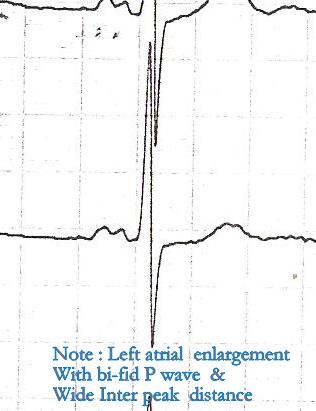
Apart from LAE , note also the p wave encroaches good part of PR interval .

Mini summary : LAE can be very useful parameter to diagnose LVH . (Is it not ironical  to note   LAE is more reliable to diagnose LVH ! . This is because qrs morphology is unreliable as it influenced by many factors  while p wave  changes are  not subjected to such influence )

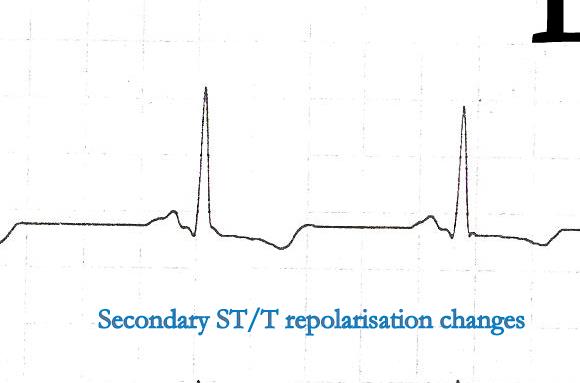
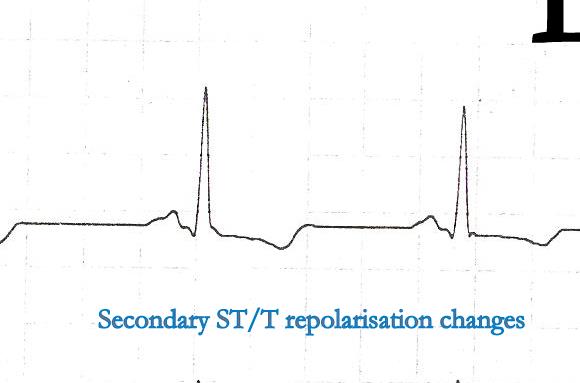
Secondary repolarization changes

We know ventricular depolarization and repolarization are interlinked phenomenon .Both  occur in  opposite directions still  , able to  record   ECG deflection  in same direction  (positive QRS/positive T)  . This is due to the fact  the epicardium and endocardium has  action potential with different velocities . At times of   LVH this epicardial  , endocardial heterogeneity in repolarization becomes void. (Note : This is a simplified statement of a complex repolarization process)

Because of this the repolarization is recorded opposite to that of depolarization .Hence we get all sorts of secondary ST /T changes. (The  term secondary is used to denote secondary to alteration  in depolarisation ).

Many times  all of the following  could   mean the same  in the bed side clinical parlance !

  • Secondary ST/T changes
  • Non specific ST/T ,
  • LV strain
  • LV systolic over load etc .

Note : Primary ST depression occurs in true ischemia without any alteration in LV Mass or conduction defect.

*** For advanced readers  only : Some of the ST depression that occur in ischemia could again be secondary changes. This  needs further reading.
Definitions

Echo is the gold standard for diagnosing LVH .There are two definitions .

  1. Based on septal thickness
  2. Based on LV mass*

LV mass > 200mg in men and 175mg in women is considered LVH . LVH based on LV mass is  ideal . But can be misleading in a dilated heart where the mass may be increased with a  relatively   thinned  out IVS .

Final message

There are numerous  ways to miss    LVH in ECG,  But the definite way  for not missing  is by echocardiogram !

Read Full Post »

Ever since Brugada found the unique pattern of ECG on right pre- cardial leads and its  association with  premature electrical death ,cardiac electro-physiology got a new impetus. Hundreds of articles(May be thousands !) on Brugada are  available . Many criterias  were proposed.  Brugada  and his colleagues should be credited for bringing  in such an interest in the  field of inherited ventricular arrhythmias.

On the down side ,  as we have a habit of  prematurely formulating criterias  ,  it brings  an artificial academic  barrier  Funnily , in medical  science  deviating   from a criteria (However hastily it  was  proposed  )   is a considered  big  offense Further . the hype surrounding  any new scientific  entity makes it difficult  for others  to overwrite  it .

Brugada recognized a ECG pattern with  a genetic predisposition for VT and VF  . Now , we know there are many etiologies  with a similar pattern  of ECG . What Brugada did was ,  he  exposed the tip of Iceberg called inherited ventricular arrhythmia . But the essential criteria –  Absence of structural heart disease ,  to diagnose Brugada   was  always questionable.

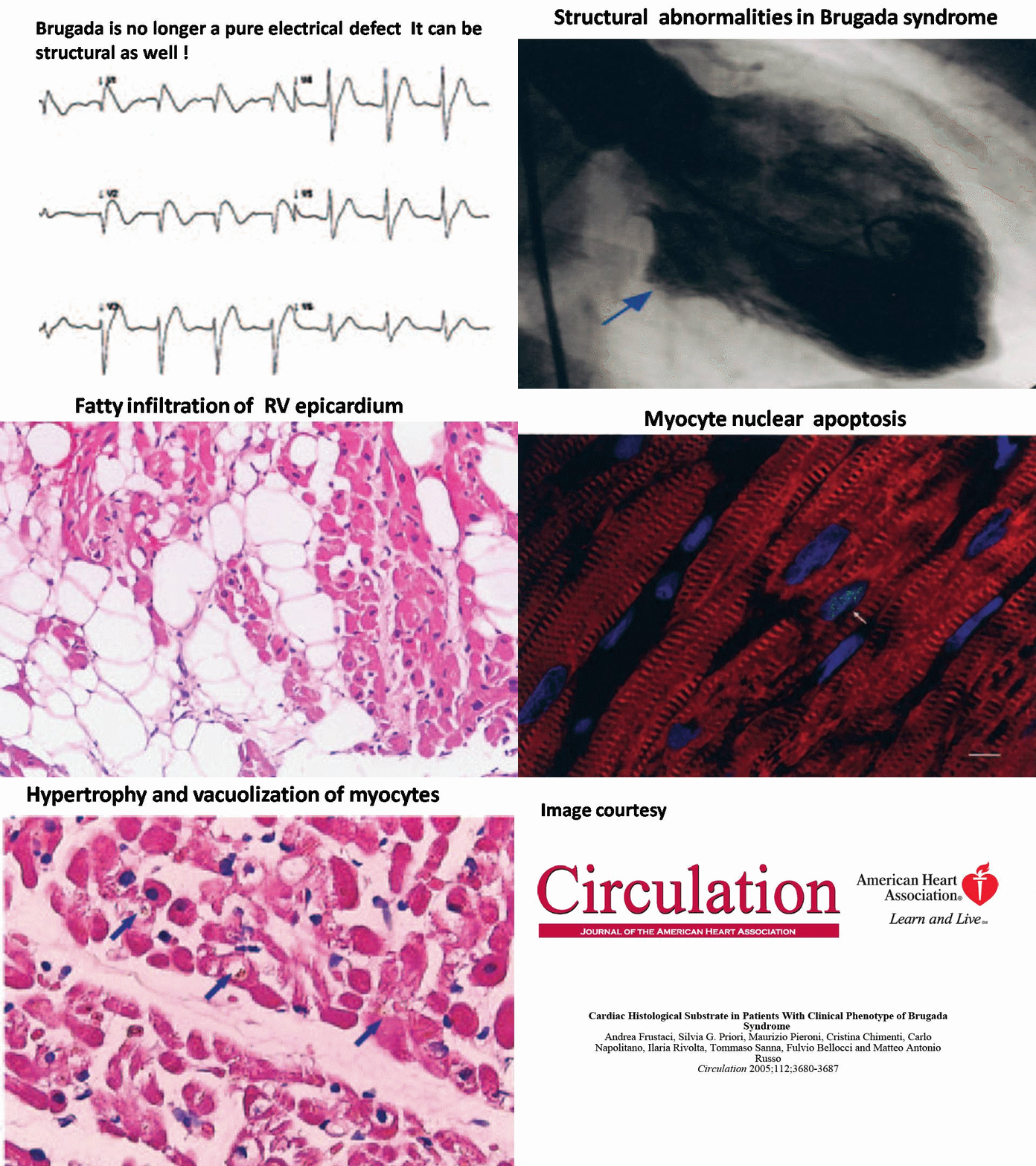
(Please realize , presence  or  absence of structural  heart disease depends , more  on  how advanced  our  imaging modalities are . If you can map a virtual histology of RV epicardium one may detect some  microscopic abnormality in every case of Brugada. In human biological system , God  usually bonds  structure and function too  closely  and hence  functional  abnormality rarely occur  in isolation )

Brugada is  not  a new disease ,   it is  a  recognition  of a  pattern of ECG  related  to sudden deaths . Subsequently , we  realized any dispersion in repolarisation in RV epicardial surface  , the   risk of sudden death  is increased. From the days of  Brugada  we  have  come  a long way.

What is new in Brugada syndrome  ?

(Not exactly new . . .  it is  known  for many years )

Brugada is no more an exclusive  functional disorder of  sodium channels of RV  epicardium .It can have structural defect (known & unknown ) .It may  have infective , degenerative etiology as well .

How does these structural changes appear ?

Chronic sodium channel malfunction  can result in cell membrane defects which can augment   Idio-osmole   inside  the cell and result in  apoptosis   etc .

Which comes first ,  electrical or structural abnormality ?

It is an  another  chicken- egg tale  waiting to be decoded   within the RV epicardial cells

Can wall motion defect occur in Brugada ?

Early observations done in out hospital (MMC Chennai ) has found anterior  RV free wall motion defects. Tissue Doppler studies are  being undertaken.

Final Message

The  following paper  wonderfully documents  the structural and histo-pathological  changes in RV epicardium .  This  implies ,  our belief   about this  unique electrical  disorder  is  bound to take a beating  and  we  expect a major perception makeover regarding Brugada  in the years to come .

Probably the most important paper on Brugada syndrome was published in circulation in 2005

*http://circ.ahajournals.org/cgi/content/full/112/24/3680

Read Full Post »

Coronary artery dilatation is a less discussed entity in clinical cardiology .It is important to realise  coronary artery has one more behavioral pattern in response to atherosclerosis .  Atherosclerosis not necessarily means obstructive disease . Dilatation is also  a common  expression of coronary atherosclerosis .

It all depends upon the medial weakness and resistance.If the medial weakness  is more plaque grows inwards ,  if the resistance  is more plaque grows out.(Read the related topic -Glagovian phenomenon )

What is the difference between aneurysm and ectasia?

The difference between ectasia, aneurysm are often subtle and  mainly  semantic. . If the length of the dilated segment is more than 50 % of diameter it is called ectasia. When  the diameter is more than 50 % of length it is termed aneurysm .( With a  minimal enlargement of 150 % of the reference segment.  To add to the  complexity both can occur in the same vessel.

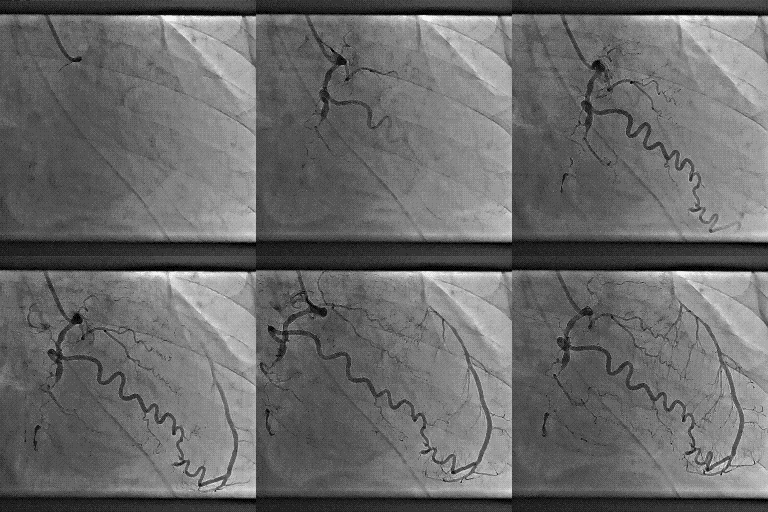
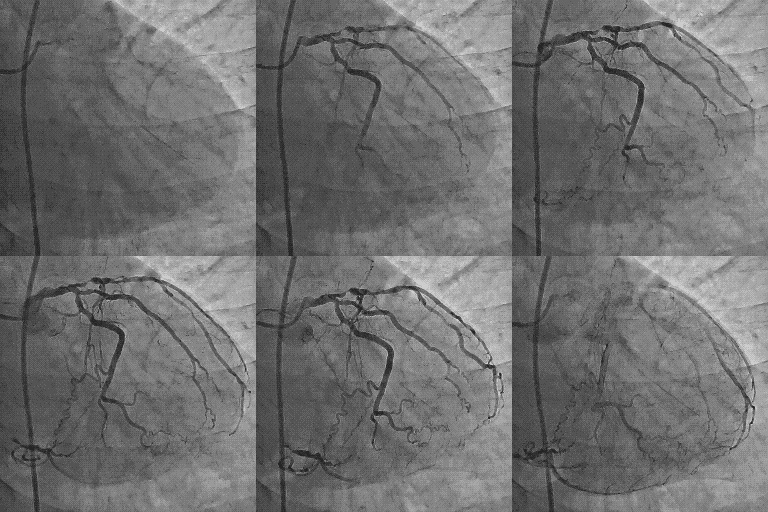
Here is the patient from our institute  who has an Aneurysm in LAD and ectasia in RCA.


Clinical Implication

  • Ectasia generally do not limit blood flow.
  • Thrombus formation in the walls can be  common.

*Obstructive Ectasia.This can happen  either when ectasia develops in  an obstructive  lesion or a ectatic lesion getting obstructed .

Stenting and ectasia .

Ectasia creates special  challenges in the Interventional era. Stenting an ectatic segment confers  a real danger ,   as  these stents are prone for  dislodgement   or  even collapse  into the lumen or  migrate downstream   triggering an  ACS. In fact , such complications of PCI are never recognised  and hence not  reported.

Final message

Coronary artery dilatation is also an  important pathological state like coronary  stenosis . Since it rarely limits the blood flow  in  isolation  , it is a less respected lesion.

But , interventional cardiologists beware :  PCI in a ectatic vessels can give you (And your patients too !)  sleepless nights .

Treatment of isolated ectatic segments is controversial .Less aggression is always better . CAD risk factor profile management  is adviced . If severe ectatic changes  are present   it is a good practice to add  oral anticoagulants like Warfarin. Surgical excision of aneurysm is rarely required.

Kawasaki disease is a distinct entity that need to be addressed separately in pediatric population.

Read Full Post »

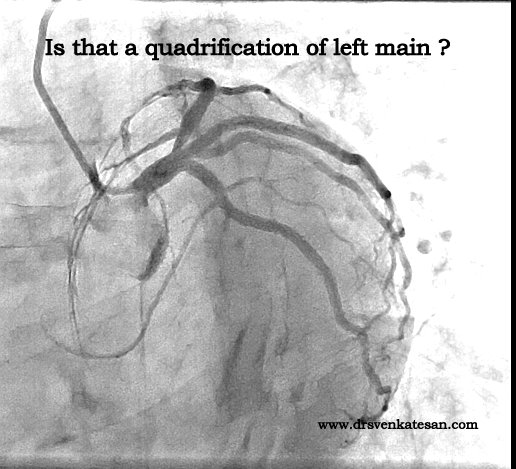
Left main divides into two. Some times into three . Very rarely into 4

Look  at this angiogram ,  This looks  like  a quadrification, if not quadrification equivalent

Clinical implication

A 4 way division invariably means the OM and diagonal or going to be diminutive.These people are expected to have favorable coronary hemodynamics during ACS , and  left main lesions are  less likely  to  occur

Reference

This article is from Singapore medical Journal

Read Full Post »

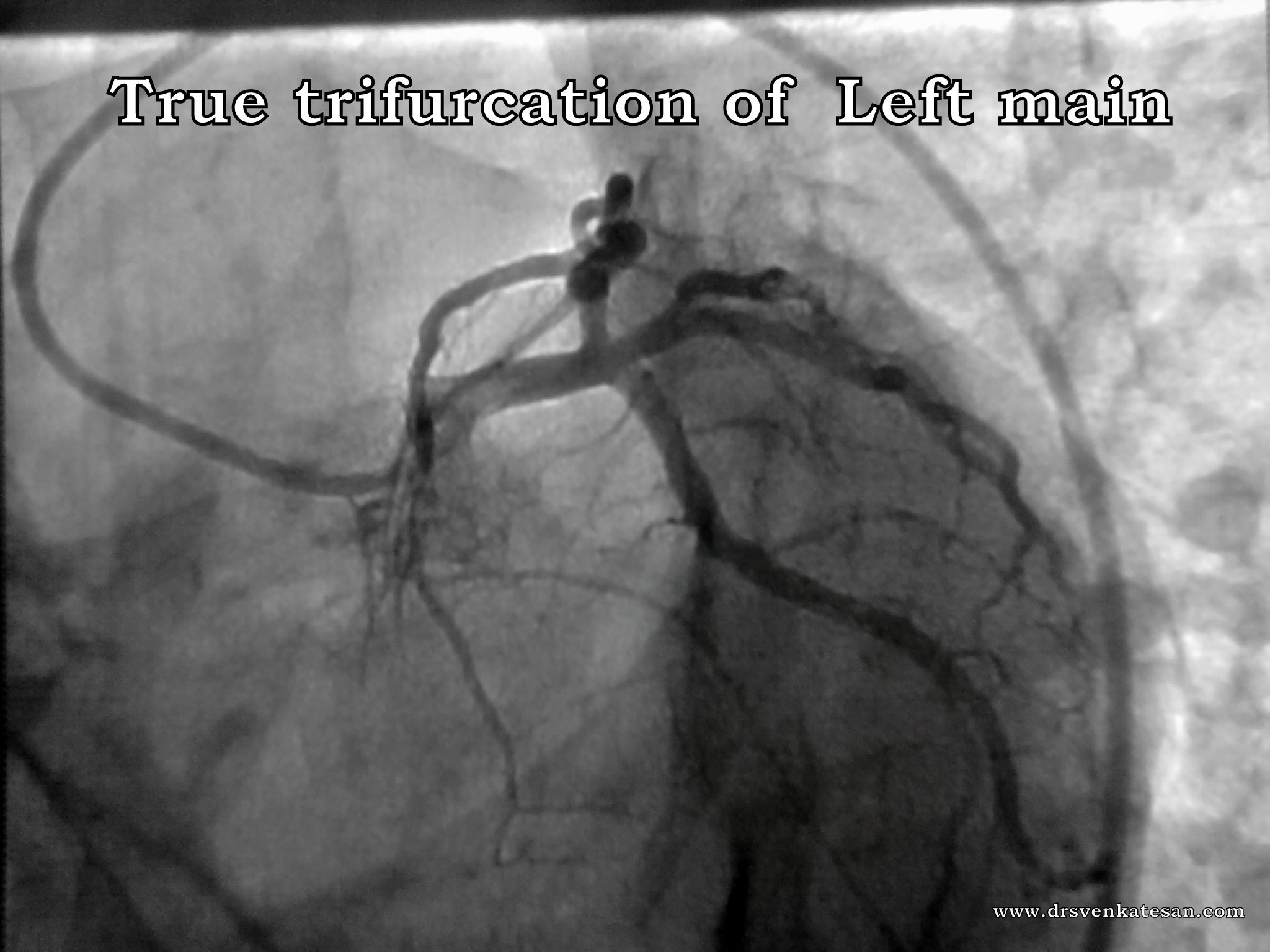
God creates life  with  infinite variation .  The  heart gets  bulk of its blood supply from the left coronary  artery , which divides into two  after a short course.  Bifurcation is the rule . Left main becomes  left circumflex and LAD  in about in 85-90 %.

Note the left main divides into 3 equal caliber vessels.very lucky to have such a branching pattern !Distal left main is unloaded by three large ostia . This makes stasis of blood in left main very unlikely . LAO caudal view


Note : The OMs are small in these people. RAO caudal view

Few men and women are blessed with three branches from LCA . The anatomical and physiological importance of this  branching pattern  is not well analysed in the literature .There  could be  few advantages  of having a trifurcation instead of  bifurcation .

  • Left main  impedence is less in trifurcation . This is due to the fact ,  left main empties into three distinct ostia rather than two.The combined  cross sectional area of these three ostia  confers a hydrodyamic advantage.
  • The importance of  any proximal LAD lesion in these patients , is negated  by  33 % as two other vessels are there to take care the  rest of the heart.
  • A large Ramus usually  supplies a vast area in the angle between LAD and LCX.  This   has a potential  to protect against ventricular  fibrillation during acute occlusion of LAD  by providing  electrical stability .

Disadvantage of trifurcation !

  • It is also a fact , people with a large Ramus may have a trade off by having a diminutive diagonal or OM .
  • A trifurcation with a small calibered  ramus  can often  be a disadvantage , as it is prone for atherosclerosis  since it  restricts  left main flow  by  venturi effect . (The first rule of atherosclerosis states its  prone at branching points)

* A related blog  elsewhere in my site . The explanations  offered above are based on personal observation .

https://drsvenkatesan.wordpress.com/2008/12/16/what-is-clinical-significance-of-ramus-intermedius-coronary-artery/

Read Full Post »

Sharing and caring for  others  is the  unique human nature . Some believe this is  now gradually   becoming  rare in human domain ,   but still  found in plenty among  animal species. While modern human  likes to live independently  wants to stand on his own legs  our  biological system still  think differently .

A 40-year-old man with diabetes and hypertension with class 3 angina had this angiogram

RCA to LAD collaterals

A different view

RCA to LAD in RAO caudal view

See , how a  pair of  human coronary arteries  mutually  help   their  colleague  at times of distress !

The astonishing observation is ,  the  RCA even as its suffering  with  a severe,   long segment disease it  helps out-of-the-way ,  with a long arm  of  support to  the entire LAD . While , the LCX reciprocates  the RCA by sending  thank you twigs to distal RCA

LCX sending reciprocating twigs to RCA

By the way , this patient was referred  for CABG after an   intense  debate in the cath meeting  .The argument ranged from medical management /PCI/CABG.

The key question were

  • How good is the collateral’s and what  are the chances of  graft flow  exceeding the collateral  blood flow ?
  • What is the effect of CABG on the existing collateral’s ?

Final message

Coronary arteries  has unique sense of sharing and friendship at times of vascular crises.

This is the fundamental basis for   coronary collateral circulation .

Read Full Post »

LIMA-Left internal mamary  artery is the most common arterial  graft used in CABG.It is anastomosed with LAD /and or diagonal artery. Routine visualisation of LIMA is advocated by many , but it is required only  in patients with critical CAD.

LIMA angiogram is done

  1. To confirm the presence of LIMA .
  2. To exclude subclavian  stenosis.(If present hand can steal blood from heart !)
  3. To rule out disease of LIMA (Which is unlikely )
  4. Diameter of LIMA should be matched with LAD .LIMA with large lumens can accelerate restenosis in LAD due excess flow induced endothelial reaction
  5. To identify  any early branching of LIMA .This can divert the  blood flow and underperfuse LAD.
  6. Terminal bifurcation  of LIMA can some times be used as a sequential graft to LAD/LCX/OM
  7. Tortuosity and looping of  LIMA is common but generally has no hemodynamic significance.
  8. LIMA may  provide vital  nutritional support to sternum through direct or   intercostal branches .If  LIMA dependent sternal  blood supply is found to be significant ,   sufficient precautions to be taken and anticipate sternal ischemia related complications.This is especially important in diabetic subjects.

Read Full Post »

Constrictive pericarditis(CP)  has been a fascinating disease   for the cardiologists  for many decades .  (Of course , not  so fascinating for  our  patients!) The reason why clinicians were thrilled to diagnose this entity is due to the unique clinical and echocardiographic and hemodynamic features. Further , it is  one of the few  curable forms of cardiac failure.
It is also about the  philosophy  , pericardium an inert  membrane  which is supposed to protect the heart , becomes a  villain  . When this innocuous layer  is insulted by  chronic   infection (Tuberculosis most common) , radiation injury or post cardiac surgery  it takes a dangerous avatar and  start invading   the organ which  it  guards .
The pericardium becomes thickened , (often > 5mm -2cm) calcified , behaves like a “shell of tortoise‘ and begin to constrict the heart . Once the process of constriction sets in it becomes relentless . It only   requires   , a 10 -15mmhg of constrictive  pressure to make  the poor heart  struggle to relax .(The maximum intracardiac  diastolic pressure ,12mmhg(LV)   .For the right side of the heart it is very low (0-5mmhg) .
So it is obvious the right side of the heart RA, RV gets compressed first .This is why the classical features of constriction with edema , ascites elevated JVP occur.The associated hepatomegaly some times mimic a chronic liver disease.  Of course  relying only  on the  classical findings to diagnose CP would be a crime now .
There are many atypical varieties of CP
  • Localised constriction
  • LV>RV constriction
  • RV>LV constriction
  • Transient constriction
  • Effusive constrictive

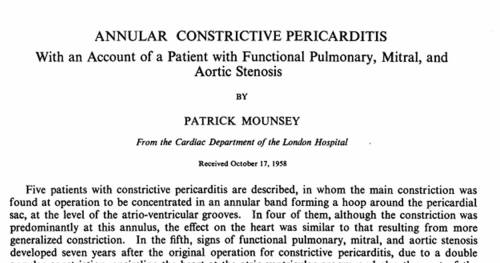
* Rarely  constriction is confined to AV groove .  This article  is about this entity.

It is difficult to imagine how a pericardium constrict a rigid fibrous skeleton of the heart namely the AV groove.
But what happens is ,  there  are some gaps in the ring  . The  posterior mitral annulus which  has a deficient  rim  and forms  the most vulnerable  zone for pericardial constriction
Further , AV groove  is located  in a relatively  gravity dependant portion  of the heart  . It facilitates  stasis of inflammatory exudate  in this groove .This may be  the reason  why the  AV groove  shows high incidence of   calcification.
Clinical features of AV groove constriction
It mimics  a presentation of valvular heart disease.
A mid diastolic murmur across mitral valve may occur mimicking valvular MS.
Synonym : Mounsey’s pericarditis
This type of pericarditis should ideally  be called as Mounsey’s constrictive pericarditis   for his
elegant description of this entity 5o yearts ago  even before    Echocardiography was invented.
(These are the days , we struggle to diagnose Mitral stenosis without echo is a different story !)

Read Full Post »

Chest pain as a symptom in  acute MI is vitally important as it only  brings the patient  to the ER. (Realise ,silent MIs  can never reach the hospital in time ! ). Heart is  located  few  centimeters beneath the chest wall and extend up to  15 cm posteriorly.The location heart within the chest wall  , make it a  three dimensional structure .Theoretically  pain can initiate in one focus and radiate to any direction. Traditionally , when we say  chest   pain , we mean the anterior chest wall on either side .Technically , chest contains a lateral  and a posterior wall .The posterior  surface of the chest is called back of chest , or some times simply the  back .

We know , chest pain can radiate to many sites , of course the  much hyped  (May not be common yet !) being  the radiation to left shoulder , and arm.

The ischemic chest pain , even though described  as classical angina over a century ago . It applies mainly to stable exertional  angina .In    STEMI  or  unstable angina  these rules are   can not be expected to be followed  strictly.

We often think the pain of MI comes only from the myocardium ,  but there are many potential sources

  • The adjacent pericardium
  • coronary artery dissection, plaque fissures
  • Neuralgic pain from the  ischemic  nerve terminals
  • Finally dermatomal  reference pain

What is the quantum of pain signals  arise from each of these  components ?   Obviously ,  myocardial pain should be the dominant one .Here again ,  there is a dichotomy .Whether   the infarct segment elicits more  pain or the surrounding  ischemic   segment is also not clear. The  is an important difference the character of pain infarct pain is a  severe continuous  dull  aching .Some believe in   a fully infarcted segment where the nerve terminals are dead can not carry  pain  signals and pain is absent, while partially dead muscle produce maximum pain.

The somatic nervous system , that mirrors the visceral pain  into the dermatomes that the patient  feels as if the pain is originating from these sites. Heart is a huge middle mediastinal structure , primarily reflects the pain to the anterior chest wall , but  no surprise if it deflects  the pain signals posteriorly  also. Of course , the spine and the thick posterior chest muscle walls tend to  block this transmission.

But , on many occasions  patient who are admitted with ACS in CCU complain pain in the   back of chest

the following things has been observed.

  • Severe back pain in  a patient with large STEMI invariably indicate a myocardial tear .
  • Mesentric and coeliac artery occlusion
  • Aortic dissection

Back pain only STEMI

Every cardiologists would have seen atleast   few cases of STEMI presenting only as back pain.The problem here is they land up in varied departments .We have on instance of  a STEMI landing to a ortho surgeon .He was good enough to suggest an ECG and that showed an extensive infero posterior MI and later shifted to coronary care unit.

Back pain as marker of impending rupture

Severe back pain in an established STEMI is a ominous  sign as it is often a  marker of impending rupture. Here the patient is in extreme distress, and may become violent and restless .(Hypoxia adds to woes!)

Does posterior  MI  more likely to produce back  pain or posterior chest pain ?

Not proven  but distinctly possible.  ( posterior MI -Posterior pericarditis- Back  pain .)We emphasize  posterior  chest leads  in  ECG V7  to V10 in inferoposterior MI .  We  expect  the injury current to  flow to  the back , is it not logical  some of the neural signals would  also  reach the back.

Final message

Never underestimate back pain. We are tuned to think chest  has only one surface that is anterior .This is a gross missense .After all , there is a huge area(> 30X 30 cm )  of chest wall located behind us .

Take an ECG in all patients with  acute  pain  in the back of the chest . Even though this may look a  funny advice   . . . it is  an  important clinical tip   for all those  budding physicians  of this world. If  one life   is  saved per 100 innocent back pain cases ,  this article  acheives it’s purpose !

Read Full Post »

Myocardial infarction (STEMI)  occurs in two distinct arterial  territories .The anterior LAD circulation and postero- inferior RCA/LCX circulation.The incidence is equally shared.

There has been some  learned and unlearned perceptions about Inferior MI.

Inferior MI is less dangerous than anterior MI.  True or false ?

Answer: Essentially true in most situations.

Reasons.

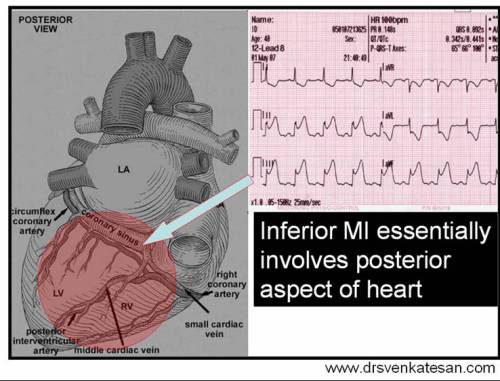
Inferior wall of the heart (strictly speaking there is no walls for heart , only surfaces , which blends with adjacent areas)  inferior wall  is formed by diaphragmatic surface and posterior surface.Inferior MI can occur by either RCA or LCX obstruction.The outcome of inferior MI is determined by mainly by  the extent  of   LV myocardial   damage it inflicts.To  quantitate this  we need to know , how much of LV is supplied by RCA , or LCX or combination of both ? This depend on the coronary dominance .It is estimated , the bulk of the LV is supplied ( up to 75%  ) by LCA. This becomes further high in left dominant circulations . In fact , it is believed LV can never get involved in non dominant RCA occlusions. This has brought in a new terminology  called “Small inferior MI”.Inferior STEMI due to PDA  occlusion or in a co -dominant circulation is not yet studied

Apart from the above  anatomical considerations the following clinical observations  have  been made regarding inferior MI.

  • When thrombolysis was introduced , many studies  suggested the the ST elevation in inferior  leads toched the isolectric levels  in most situations even without thrombolysis.Technically, this implies spontaneous , successful thrombolysis are more common in RCA. Among the thrombolysed ,persistent ST elvation is a rare phenomenon.
  • The well known difference in the conduction defect between anterior and inferior MI  is an important contibutor for better outcome in the later.(AV blocks in inferior MI , are often transient, non progressive, supra hisian location rarely require permanent pacemakers)
  • During acute phase cardiogenic shock occurs in a minority (That too , only if RV shock is included )
  • Even in the follow up the ejection fraction in inferior MI is  almost always above  40%. In many EF is not affected at all.
  • Progressive adverse remodelling of LV is rare

When can Inferior MI be dangerous ?

Anatomical factors

Inspite of the  above  factors  inferior MI can not be taken lightly . Especially when it  extend into posterior, lateral , (Rarely anterior) segments.

While  posterior extension  is often  tolerated , lateral extension is very poorly tolerated .This is probably explained as  the extension involves the vital free wall of LV and the laplace forces could precipitate LVF. Free wall rupture is also common in this situation.

Posterior extension , predominantly involves the surface of RV which is less important hemodynamically. Of course incidence of MR  due to it’s effect on posterior mitral leaflet can be trouble some.

inferior MI ECG

High risk clinical catagories.

Out of hospital STEMI  are at  equal  risk irrespective of the territories involved  .This is because,  primary VF does not differentiate , whether  ischemia comes from RCA or LAD .

  1. In elderly , dibetics and co existing medical condtions  the the established  benign   character  of  inferior MI disappear, as  any  muscle loss  in LV has equally adverse outcome.
  2. Even though  inferior MIs are immune  to cardiogenic shock  , a equally worrisome  prolonged hypotension due to high vagal tone, bradycardia, plus or minus RVMI can create trouble. Fortunately , they respond better to  treatment. Except a few with extensive transmural RVMI outcome is good.
  3. Presence of  mechanical complications of  ventricular septal rupture , ischemic MR can bring  the mortality on par with large anterior MI.

How different is the clinical outcome of infero-posterior  MI with reference  to the  site of  coronary arterial  obstruction   ?

The sequence of  outcome  From  best to worse  : Non dominant RCA* → Dominant RCA but distal to RV branch → LCX dominant with large OMs

* It is believed   an  acute proximal  obstruction of a  non dominant RCA may not be mechanically significant, but can be electrically significant as it retains the risk of primary VF and SA nodal ischemia. The ECG changes  can be very minimal or  some times simple bradycardia is the only clue. One should be able to recognise this entity (Non dominant  RCA STEMI)  as the outcome is  excellent and these patients  would never require procedure like primary  PCI

** A inferior MI due to a dominant LCX and a large OMs have comparable outcome as that of extensive anterior MI. The ECG will reveal ST elevation in both inferior and lateral leads.

***In patients with prior CAD  and collateral dependent  multivessel disease  the  inferior anterior sub classification does not make much sense as  entire coronary circulation can be mutually interdependent.

Final message

Inferior STEMI  generally lacks the vigor  to cause extensive damage to myocardium in most situations .Further they respond better to treatment. Risk stratification of STEMI based on the location of MI has not been popular among mainstream cardiologists. This issue needs some introspection as  the costly and complex treatment modalities like primary PCI  is unwarranted in most of the low risk inferior MIs.

Related posts in my blog:

1.Why thrombolysis is more effective in RCA?

Read Full Post »

« Newer Posts - Older Posts »