Feeds:
Posts
Comments

Archive for the ‘Cardiology-Coronary artery disese’ Category

Instent restenosis is a  common problem.

Diffuse long segment instent restenosis is somewhat rare.

We  encountered one such patient who had diffuse instent restenosis of RCA.

ISR is ssupposed to be rare in DES, but here ISR occured with a Cypher stent  one year following implantation

He presented with angina which  was relieved  by plain baloon angioplasty.

 link to a  related article in  this  site  regarding the mangementof ISR.

Read Full Post »

We know primary PCI is a race against time  both for the  patient  and his  physician.

What is the upper limit for this unique race where the stakes  are high   and it involves  human lives  and  big  corporate  warfares  ?

  1. 6 hours
  2. 12 hours
  3. 24 hours
  4. 36 hours
  5. 54 hours
  6. Time does not matter . You can do a PCI as late as possible as long as  patient has sufficient insurance coverage and we have the expertise

Answer :

Please note there is  only one exception  . Cardiogenic  shock has been given a extended  lease of time window (Which can be technically up to  54 hours ) . PCI can be performed   if the onset of shock  is   within 36 hours  of STEMI  and to be performed within  18 hours after the onset ! )

* Even though we  have a  well set criteria for re-perfusion which bans primary PCI to be performed after 12 hours , cardiologists have enough technicalities to overcome this hurdle and keep doing the futile pPCI well after 12hours.

How they are   able to indulge in these futilities   without  any ethical issue ?

The answer  is very simple. Instead of calling it as primary PCI they refer to it as delayed PCI or rescue PCI !  Strict time specific guidelines are only for primary PCI . By changing the terminologies they   make a mockery of the concept of time window which  is vital for any intervention for STEMI !

Read Full Post »

Success of primary PCI is defined by  different yardsticks  by  different  cardiologists  , in different  institutions !  But , for the patient and his family,  getting  discharged   alive with out symptoms is a huge  success !

They  do not bother  even if they are charged  Rs 3-4 lakh for their stay ,  as they  believe  surviving  a heart attack  is a God’s grace   rendered thorough the hands of  the doctor.

But we know  the real success lies elsewhere. Cardiologist’s   perception of   success of  pPCI   should be based on scientific concepts. Unfortunately many  physicians  continue to  think like  their patients  . This  tendency to get self gratification  with a patient’s  frame of  mind is  common  and  needs  introspection .

This is esepcailly  true for primary PCI . It came with big fanfare  a decade ago . Soon ,many cardiologists developed  a habit  of criticizing   the  practice thrombolysis for STEMI .If primary PCI is such a superior modality  every patient   should be prevented from significant  myocardial damage following  STEMI .

Primary PCI  may be the the most logical method  still , for reverting the STEMI process  . But “A properly performed  primary PCI  as a  concept ” lies  mainly  on paper ,  not  been  replicated in real world for various reasons.

Please remember , a successful primary PCI

  • Is  not restoring TIMI 3 flow  in IRA
  • Is not relieving  the  angina
  • Is not discharging a  patient in stable condition

Even if  . . .  we accomplish each one of the above  . . .   if   the patient  carries  home  anything  equal  to ,  or more than moderate LV dysfunction ,  primary PCI  has  deemed to have failed.

Final message

What is the reality  check ?  In one  of  the  preliminary analysis   out of 20 randomly selected  patients  who have undergone STEMI*   within 12 hours  , significant LV dysfunction  was present in  12  patients making it pPCI only 40 % successful   in real world  .( Which  would struggle to beat the outcome of  promptly administered fibrinolysis )

* Primary PCI done in state of the art institutes .

Read Full Post »

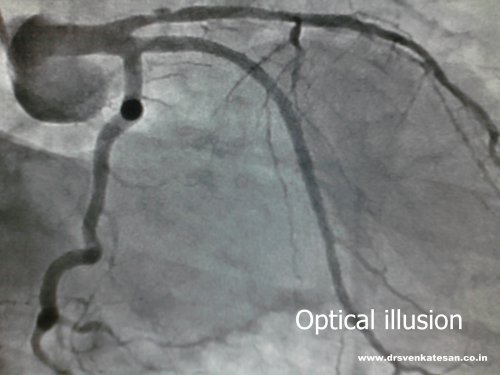
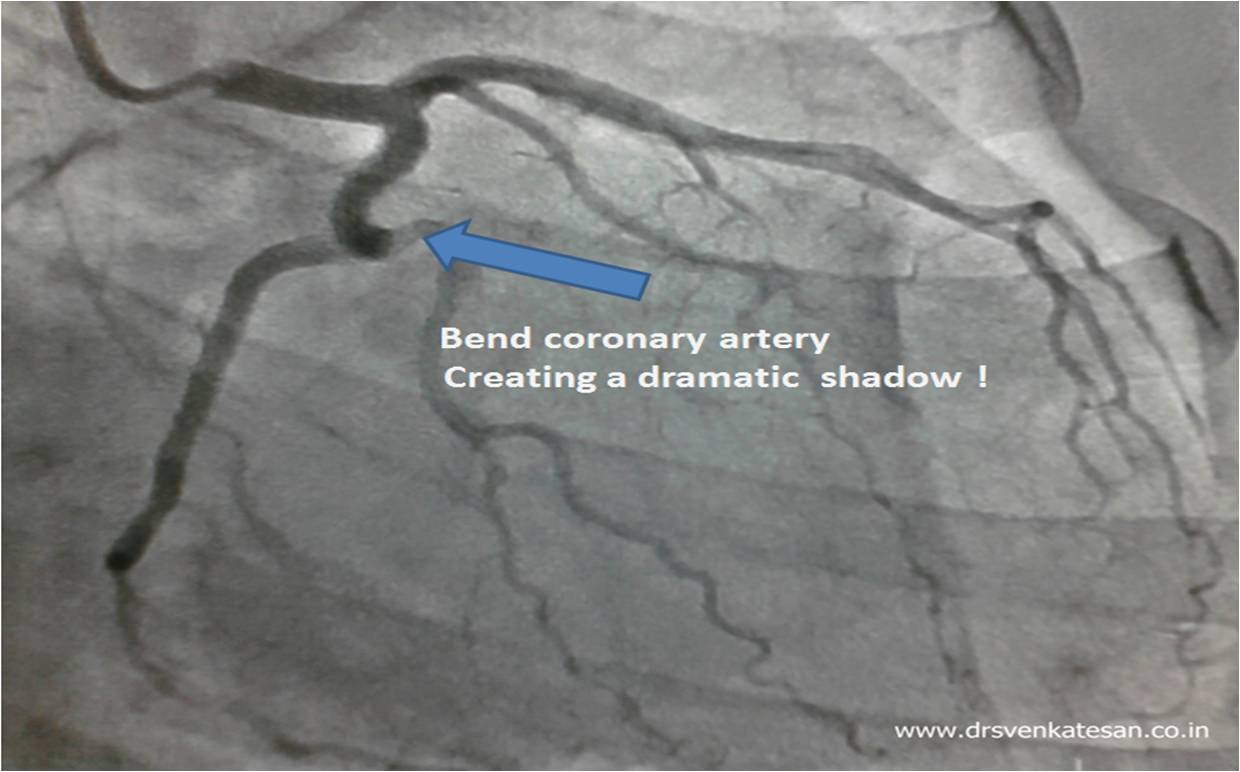
Coronary angiogram is  a videographic snap shot of  moving targets. Coronary arteries are dynamic  , tortuous  vessels of varying dimensions .Normal vessels  sometimes appear as an  illusion of lesions and tight lesions may appear innocuous at times. So the  rule is never rely on a single view before reporting.

This is an  angiogram of a patient , which  one of my fellows referred to as  “a black pearl  inside the LCX !

The same patient,s angiogram showing  origin of OM1

Final message

Beware of radiological artifacts in various angiograms. It can lead to erroneous interpretation and interventions !

Read Full Post »

During   primary PCI , the weakest link  for a  cardiologist  is  , he is never sure whether  the  metal jacket  has covered the entire  disease segment with optimal apposition .  (Geographical miss is another issue !)

This is because  , even though the inflation pressure is  uniform  within the balloon ,  the required  apposition pressure is not the same .This is obvious as the lesion surface has a varying consistency and uneven surfaces . It is a  huge guess to quantitate the relative  contribution of thrombus and plaque  within  the 100 % occlusion  that has resulted in the STEMI. Hence  some areas may get over apposed and others lesser apposed. Further , the stent -vessel wall interface  in all likely hood enclose a   layer  of clot .This is almost certain  during complex primary PCI. One can imagine the sequel if this thrombus layer dissolves later ! (Edentulous stent )

It is surprising , why cardiologists has  so far not  thought  of a  self expanding stent  which  can snugly appose the vessel wall in this setting  . The   radial strength   from the  stored potential energy can be used up future use. This is most important  in first few days following STEMI  , when the coronary arterial lumen can vary depending  upon the

  • Vasomotor  tone .
  • presence of thrombus
  • Plaque   ploughing /milking  effect
  • Vascular remodeling

Cardiologists  deploy a stent  based on the morphology  on day zero of STEMI  .This may be  totally irrelevant  , since after a  few days    the lesion may change its morphology ,  thrombus may migrate , vascular  dimension may change. In such a  situation*  , a self expanding stent can tackle these issues very effectively by constantly adjusting  and fine tuning the luminal  diameter and  the apposition pressure . It  does not give any chance  for  thrombus to form  between the vessel wall and stent .

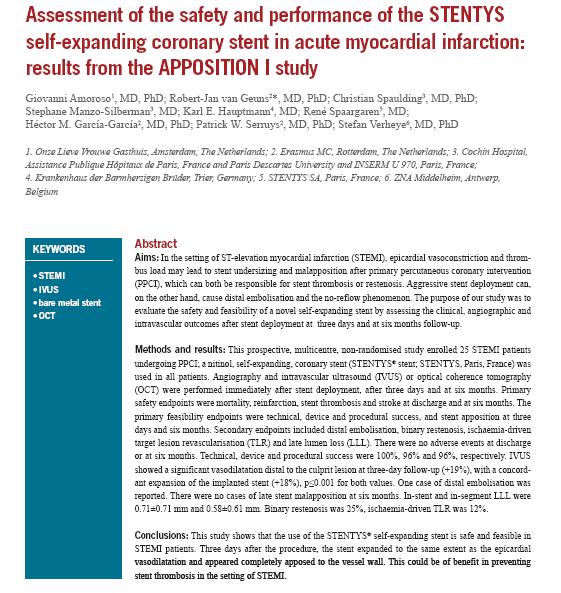
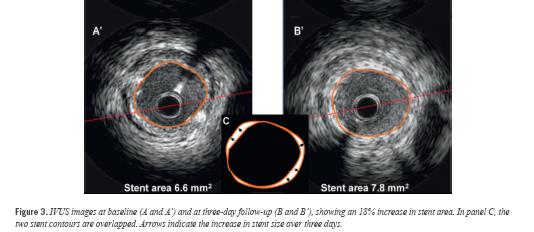
Here is a study that gives fresh insights regarding the role of self expanding stents during STEMI .

Note the “Auto adjusting”  of stent diameter  in the first few days after  the stent deployment, depending upon the luminal needs !

Animation

http://www.stentys.com/file_bdd/annexes/1284135580_video_stentys_en.swf

* Logically  during  primary PCI for  STEMI  ,  POBA and thrombus suction  may be the best option in many as all stent related complication is instantly eliminated .But it is a battered concept ,  most of the current day cardiologists would feel guilty to come out of  the cath lab  without a stent  in  primary PCI scenario  !

Final message

Self  expanding stents during primary PCI :  Is it a  perfect solution  for optimal stent apposition  ?

It seems so  . . . but  the track record of current cardiology devices never fulfilled the initial promises !

Read Full Post »

Surprisingly it is common !

A .Abandon the procedure call the surgeon for an emergency CABG

B. Open the most critical lesion.*

C.Attempt to open and stent all possible lesions.

D.Send the patient back to CCU for a conventional  thrombolysis or attempt a intracoronary thrombolysis.

Answer : All  can be a right response depending upon the available expertise ,  time window, associated complication and hemodynamic stability etc .

* Please note ,the most tight lesion may not be the culprit artery. Though there is high chance for that  being the culprit , it  can be very deceiving   especially when  there is multi-vessel  CAD with  chaotic collaterals.

The site of lesion and site of infarct can unimaginably remote.  (A traffic snarl at remote flyover  can have its impact  right on the busy commercial street due to diversions ! ).

What will happen if you open  a non culprit artery first mistaking it for a culprit ?

This could lead to  dangerous turn of events as whatever little perfusion the patient was getting through the ill-fated  IRA will be challenged by the fresh diversion  facilitated by non IRA angioplasty. Extreme caution is required.

Emergency CABG  within 3 hours  of MI even though advocated  by few ,  is still considered a risky  way to reperfuse  the heart.(In India  there  is  nothing called primary CABG!)

An energetic interventional  cardiologist would vouch for opening all lesions . Only thing  , he has  to  make sure is  , the patient also has enough energy to withstand  his  onslaught. Never   non culprit lesion if a patient is stable . 0ur aim is not that.If the patient  is in shock or impending LVF one can justify opening  few more lesions  that improve total muscle function which can be vital.

What about fall back on thrombolysis?

This may be seen a defeatist attitudebut  when the aim is  in the  well being of patient ,  there is no defeat or success. If severe  CAD is encountered and both  CABG / PCI  or not an option,  the cardiologist need not feel guilty or  humiliated to refer him back for thrombolysis. (Of course , Intracoronary thrombolysis  is  an option !)

Final message

Primary  PCI  is often made  to  appear ” As  a  kids play”  by many modern  day cardiologists . It is not so.  It requires a team effort. It is  race against time.   Feasibility depends largely on the coronary anatomy. The failure rate of  primary  PCI is often camouflaged .(Currently Success of pPCI is boasted at 95%)   Logically it should include pPCI ineligible anatomy as well . Many still do not understand the real purpose of pPCI.   The aim is to salvage the myocardium  at risk , sure and fast. Never attempt for total revascularisation in an emergency situation however tempting it is !

In young persons with discrete single vessel disease  the procedure is simple and outcome is straight forward. In elderly , diabetic , STEMI on  preexisting CAD,  diffuse  multivessel disease  ,   complex main left,  bifurcation lesions , one requires  lot of brain sense  to provide optimal outcome . Many times that sense includes abandoning the procedure !

Please read a related article in this site  Primary CABG

Read Full Post »
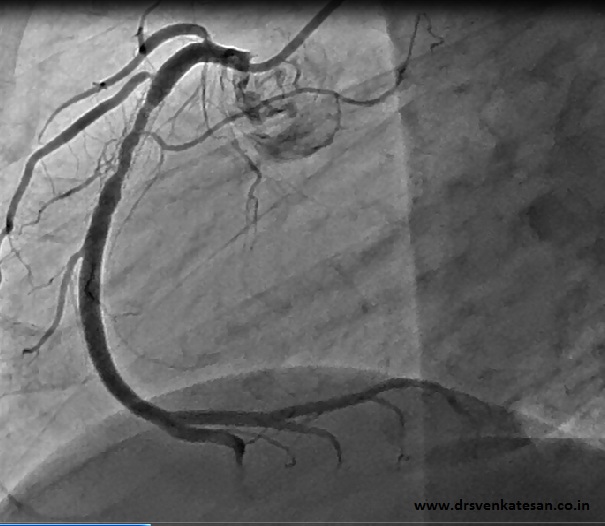
Atherosclerosis is an  inflammatory and degenerative disease of blood vessel.The common  belief is  (Of course , it is a fact ) it  mainly causes vascular obstruction and compromise vital organ function(heart, Brain, Kidney etc)

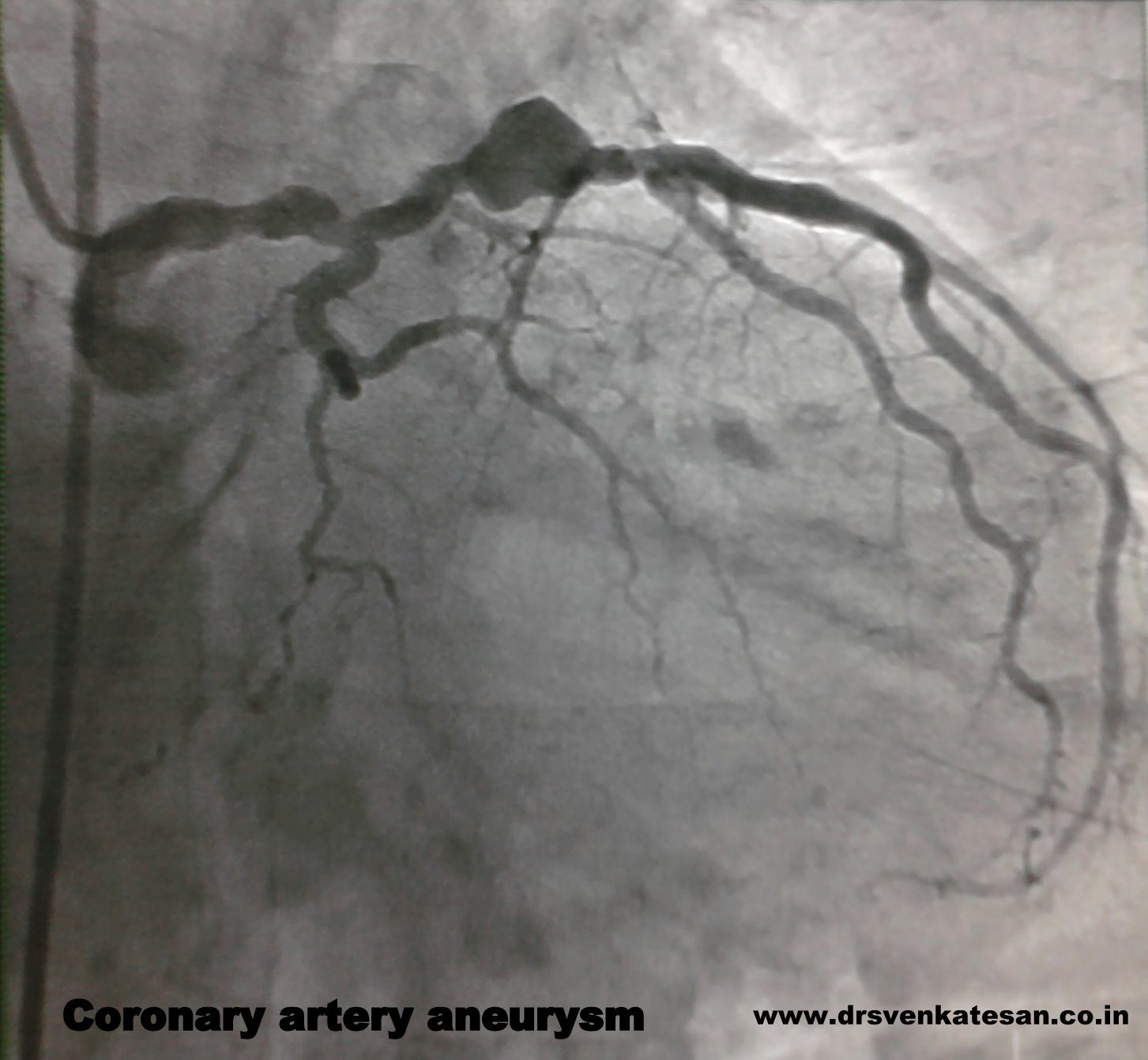
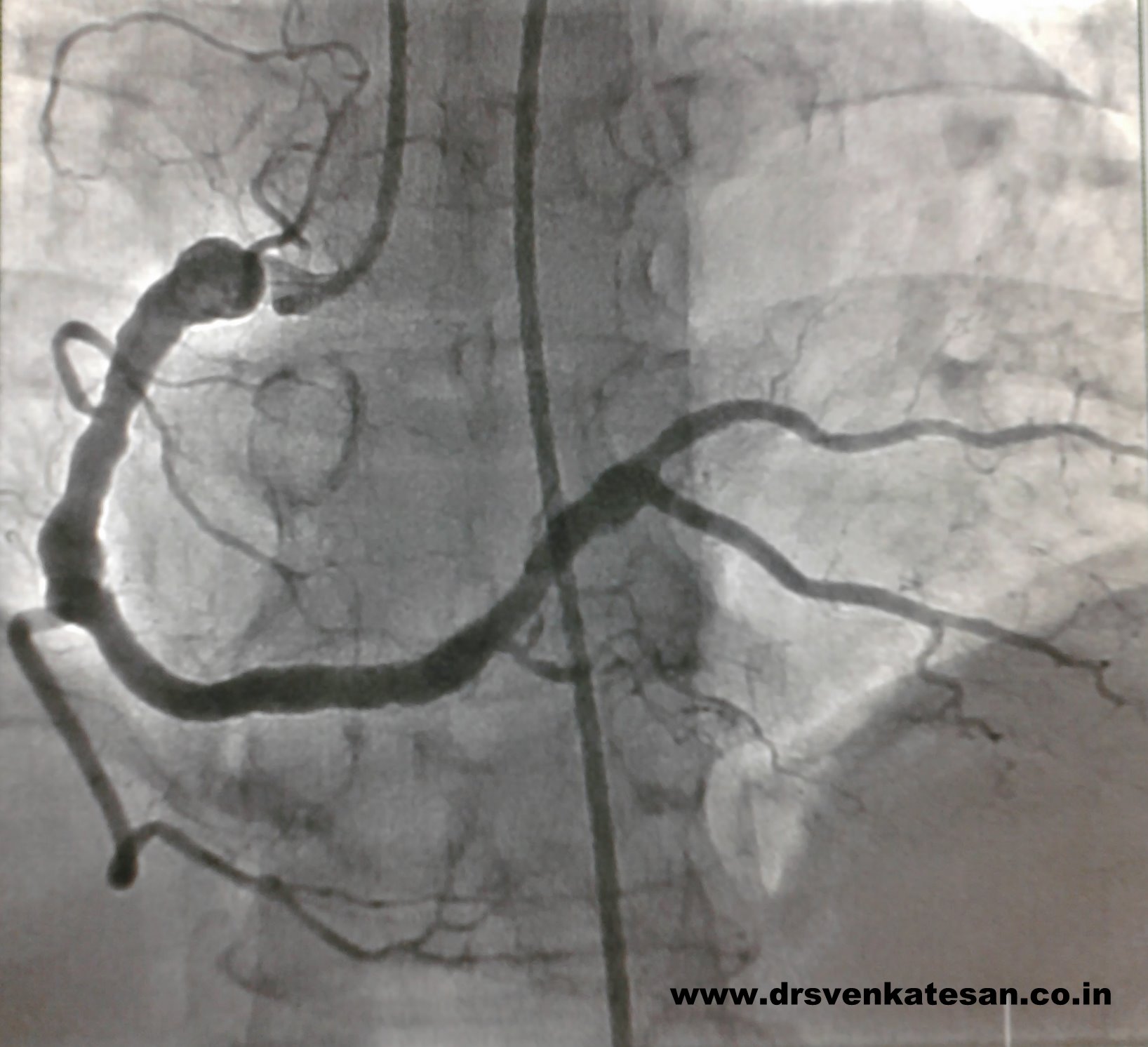
Here is a different facet of atherosclerosis , A middle aged man  surprised us with this  coronary angiogram .   Instead of obstructing the flow the  coronary vessel begins to dilate. This is due to a medial weakness .(The media for some reason begins to give way rather than proliferate to the atherogenic  stimuli.)

Same patient's RCA

One may wonder why he underwent CAG when obstruction is least expected in such a vessel   !  It was paradox of sorts , this man  in spite of his  wide bore coronary artery ,   was prone for coronary thrombus and one such episode landed him in our CCU . ( Please note both faces of atherosclerosis “obstructive and dilatory” can manifest in the same  vessel in different combination.)

This angiogram may be reported  as any one of the following

  • Diffuse atherosclerosis
  • Diffuse atherosclerosis with focal dilatation  and aneurysm formation
  • Coronary  ectasia

These patients should get life long  medium  intensity  (INR 2-2.5) oral  anti coagulants  for preventing coronary thrombosis.

Watch out for similar aneurysmal changes elsewhere (Renal, Cerebral, Aorta etc )

Counter point

How are so sure it is is due to atherosclerosis ?  Can it be a  congenital coronary medial weakness ?

Your guess is not my guess . . . My vote is for atherosclerosis .

Read Full Post »

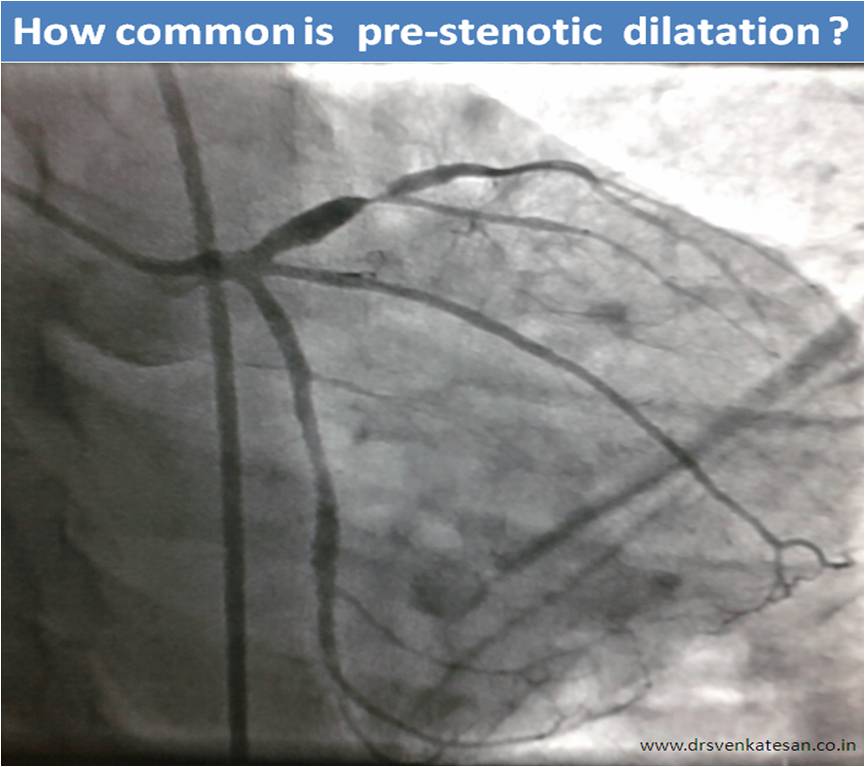
Laws of fluid dynamics dictate there is a pressure drop across   a point of narrowing  and recovery  thereafter  . At  recovery point if the vessel wall is weak it tends to balloon out .This is called post- stenotic dilatation .This is  the anatomical equivalent of Bernoulli or venturi  effect. This theoretically  occur only distal to obstruction .

How do you explain the common observation of pre- stenotic dilatation?

  • Intimal weakening due to disease process is the prime  suspect.
  • Pre stenotic  increment in mean pressure  also play a role .
  • Mechanical distention due to stagnated blood  proximal to  critical obstruction  is  a  logical explanation.
  • Finally and most importantly ,contagious , sub – angiographic  atherosclerosis.

How is  dilatation  different from ectasia ?

May be they are all related phenomenon. The definitions  of ectasia ,  dilatation, aneurysm are  more to do  with semantics than with academics.

Clinical and hemodynamic implication in cath lab

  • Sluggish  flow prone for thrombus
  • Stent selection errors likely
  • Stent dislodgment  and migration

Long term effects

  • In stent re-stenosis is more common if adjacent segment show dilatation.

Finale

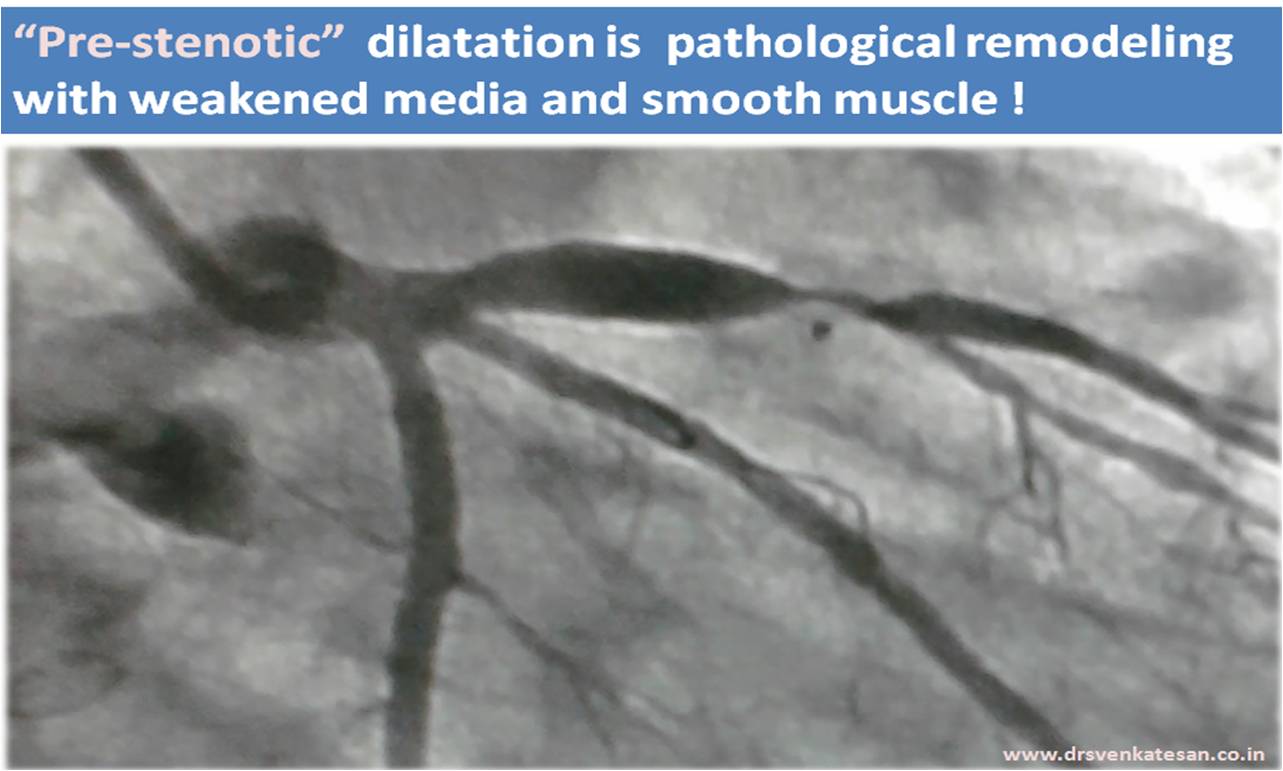
Enlargement of vessel wall in both pre and post stenotic segments are possible . In small vessels pre- stenotic dilatation is  more common , while in large vessels post stenotic dilatation is  more prevalent .(Aorta, Pulmonary artery)  The mechanisms are slightly different. Apart from the lesion tightness ,  hemodynamic  and genetic factors are also responsible These dilatations are  often labeled as ectasia in coronary artery  and  most cardiologists  tend to   ignore this finding especially if  the margins are smooth.

But , newer imaging modalities like IVUS, OCT have given   better  insight about these dilatations.These   are  actually an  expression  of the  contagious  atherosclerosis .  Pre-  stenotic segments are prone for extensive disease  than even the diseased segment due to  more hemodynamic turbulence. There is some evidence atherosclerosis progresses  proximally more than distally.Smooth margins within the  pre -stenotic dilatation  does  not guarantee  disease free status.

During PCI  there could be  an  argument for covering the dilated  pre- and post stenotic segments  as well* . (We vouch for endovascular stenting when aorta is dilated why  do we hesitate  in coronary  ?)  .Careful selection of  coronary stent size  is  recommended  and  allowance should be given  for these two (Pre and post coronary dilatation ) patho -anatomic phenomenon.

* Stent missing a lesion is stylishly called geographical  miss ! This should logically include dilated segments also.

Read Full Post »

Human body is a bundle of mystery.   In an  average  life span of human beings,   millions of   afflictions come and go . Most are benign . Our body has a  full-fledged defense ministry    armed with sufficient weaponry in the form of , immune cells, thousands of regulating enzymes, hormones ,  cell service molecules  etc  .It can tackle most of  the ailments our body encounters  with out a doctors help (Jungle animals rarely die of disease!)  .

Of course , the body  needs  external help  when it’s  intrinsic resources fail . There are few   serious disorders that has to be intervened .However ,a big  fraction of them  will   die  in spite of whatever we do .

Is it not  fascinating to know more than  100s  of chemicals  act day in, and  day out ,  to  prevent our  blood  from clotting and keep it flowing .  If only the natural lytic mechanism fails  for an hour , and  create a  vascular  chaos   we will realise  importance of it !

Even as we debate appropriateness of medical care  in this  21st century   here is startling scenario ,

When a child  presents  with physiological hypertrophy of lymphoid tissue  , as their body begin to  learn and record the micro biological mysteries  of our environment  , it is  often “cross labeled ” as  tonsillitis  or appendicitis and  end up in surgical tables.

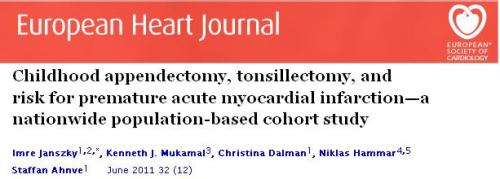
This article just released  in  European heart journal , tells us ,  how the rampant use of appendectomy and tonsillectomy in the early child hood  may make them susceptible for CAD in later age group.

The role of medical professionals is identify the trivia ! and prevent unnecessary interventions.

Unfortunately  or (Should I say dangerously)   many of  the   professionals  understood it  in a diagonally  opposite manner . Identify the trivia ,  instill fear in our patients  and intervene ,   in the process injure  our great biological system.This is also applicable to many cardiac  interventions.

Final message

Heavens sake ,  youngsters  , please  remember  , medical  profession is all about removing suffering from patients  . Do not fish out “non -existing” illness from your patients  body !   Let me remind you ,  professional approach means  , whatever you do it should be in the  interest of our patients . The moment  you deviate ,  you cease to be professional .

Also realise  ,  good   intentions can never be an excuse for  inappropriateness !

Reference

http://eurheartj.oxfordjournals.org/content/early/2011/05/27/eurheartj.ehr137.abstract

Read Full Post »

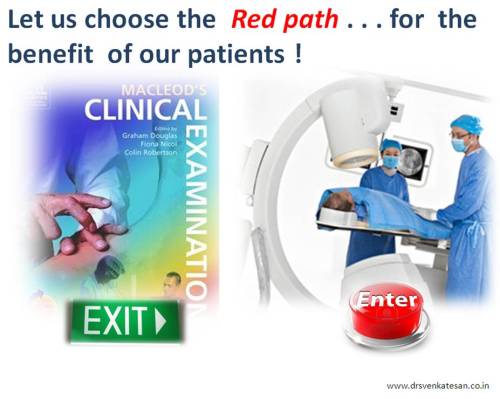
Most important MCQ in clinical cardiology

Many cardiologists  would love to do away with detailed  clinical examination because  . . .

  1. They think it is an inferior job to do  . By skipping  it , they get a false sense of superiority.
  2. It is a time killer  and eat into precious cath-lab  time
  3. They no longer believe in  these “perceived – primitive” medical methods.
  4. Fear of colleagues making  fun of hem if they  indulge  in detailed clinical examination.( At-least in India ! )
  5. To give more job opportunities  to para medics.
  6. They are no longer confident about making a good clinical examination as they  are neither  trained  adequately nor interested in it !

Answer :  All of the above can be true .  The 6th response is  likely to be  more  correct !

While cath labs can prevent few deaths occasionally . . . it is the general wards and OPDs that add life every day

Read Full Post »

« Newer Posts - Older Posts »