Feeds:
Posts
Comments

Archive for the ‘Cardiology -Interventional -PCI’ Category

Right ventricular infarction (RVMI ) is a  common  cardiac emergency in coronary care units. It can be termed as a mechanical complication of infero-posterior STEMI .However ,  around 10 % of anterior  MI do develop this complication . Onset of refractory hypo-tension in spite of correcting hypovolemia  suggests  RVMI.RVMI generally comes under class 3  (Cidar Siani /Diamond -Forester classification of STEMI )  , ie   silent lung with systemic hypotension.       (RV shock requires an unique definition , as it can not be included in traditional  definition of cardiogenic shock as the PCWP is likely to be normal.

How to manage a full blown RVMI  who is not showing  signs of improvement ?

Following is an extract  from our coronary care unit experience

(do not ask for evidence for everything !)

  • Consider immediate angiogram  to know the  anatomy of the problem .Try opening the RCA which is most  likely to be  the culprit (Any associated critical  LCX /LAD lesion  must be attended too ! )If  the duration of MI is beyond 36 hours  culprit lesion may be  left untouched or at least not our primary target !
  • Inotropic support (Doubtamine continuous infusion is preferred .Milrinone  for the rich !)
  • There is no specific RV assist devices available.(LV  assist device has no role in RV )
  • Restrict fluid (Opposite  to RVMI guidelines) There have been instances of  overzealous fluid therapy resulting intra-cardiac  hypervolemia. IVS encroaching LV worsening the cardiac index .
  • Pacing is  definitely required in severe bradycardia or CHB .  Dual chamber pacing is the  ideal  choice to maintain AV synchrony as we desperately need  the  atrial booster pumb  for a failing RV . (Please realise , VVI  pacemakers ,  can still save lives as it takes care of extreme bradycardias  effectively )
  • PCWP in the setting  of RVMI is an  unreliable parameter of true cardiac function.(In almost 90 % of RVMi some degree of LVMI is present ) . In RVMI  PCWP is determined by a  delicate balance between LVEDP and the  onward stroke volume from a failing RV .) The alter tend to bring the PCWP down former would keep it high . Which component is  operating at a given point is a  wild guess  . The situation get quiet complex in the setting of multiple vaso-active drugs , pacemaker , ventilator
  • Balloon Atrial septostomy  /dilatation might help ( Hypoxia may worsen as elevated RA mean pressure may shunt right to left  however cardiac out put might improve)
  • Pericardiotomy  or simple splitting  of pericardial  layers has been tried   (Improves RV restriction effect)
  • If the patient is on ventilator keep the PEEP well below the standard recommendations (RV will struggle more ! )
  • Pacing catheters  can irritate the RVMI in their  raw zone and trigger recurrent ventricular arrhythmia .( Often  labelled wrongly  as Ischemic electrical storm !)
  • Call  Nephrologist  consult  if  renal function  deteriorates . Peritoneal  dialysis is preferred  .  It  is worthy to know , deaths have occurred on hemo dialysis  table.

Final message

RV shock  carries a dismal  outcome , almost  reaching  as that of an LV cardiogenic shock. Ironically ,the most important prognosticator  in RVMI  is the quantum of LV involvement !

Read Full Post »

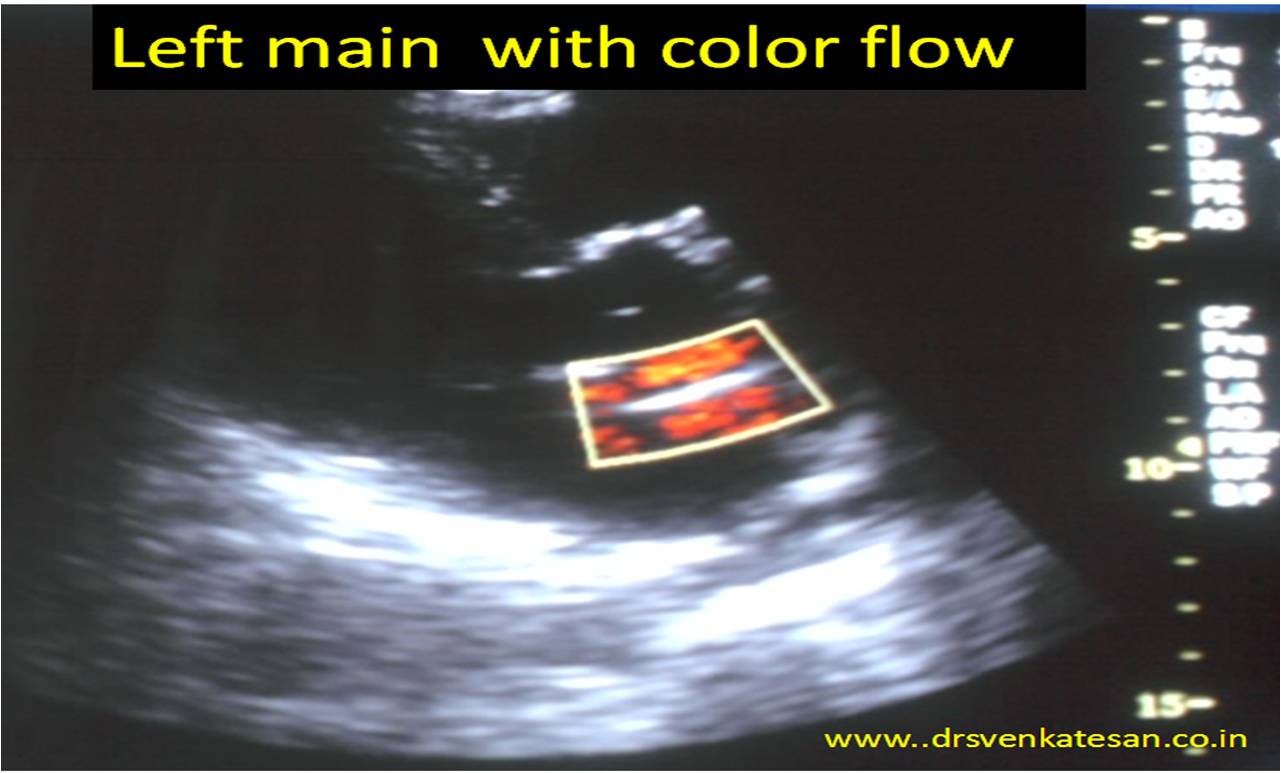
If only  . . . we get  an  image like this , echo can help rule out most  left main disease with conviction .

Have a close look  at it ! One can get a good image of  coronary ostia in short axis view . But , here it is well visualized  in long axis .

left main

I tried to put color flow within left  main .

left  main color flow

What about pulsed  Doppler across left main ?

After all it needs 2mm sample volume and this left main was near 4.5mm . So keep trying !

Read Full Post »

In this complex world , simple innovations fail  . . . just because  they are simple !

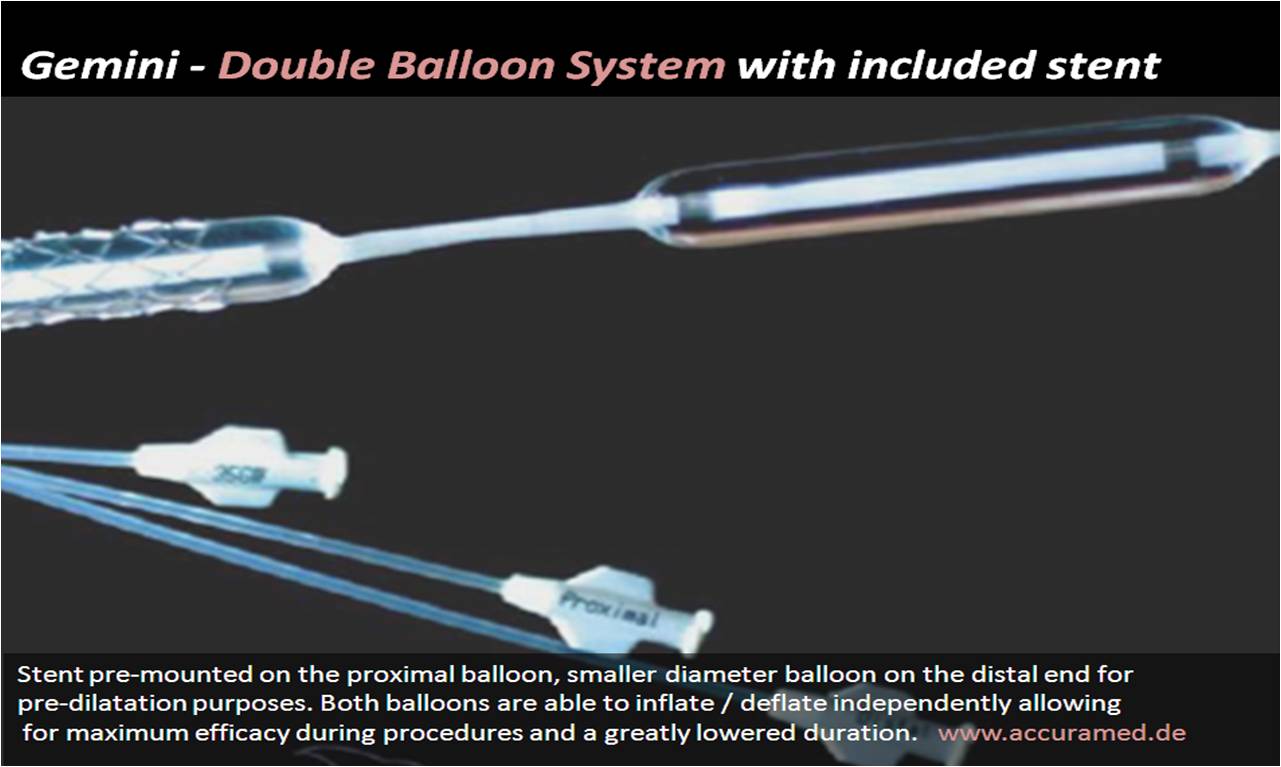
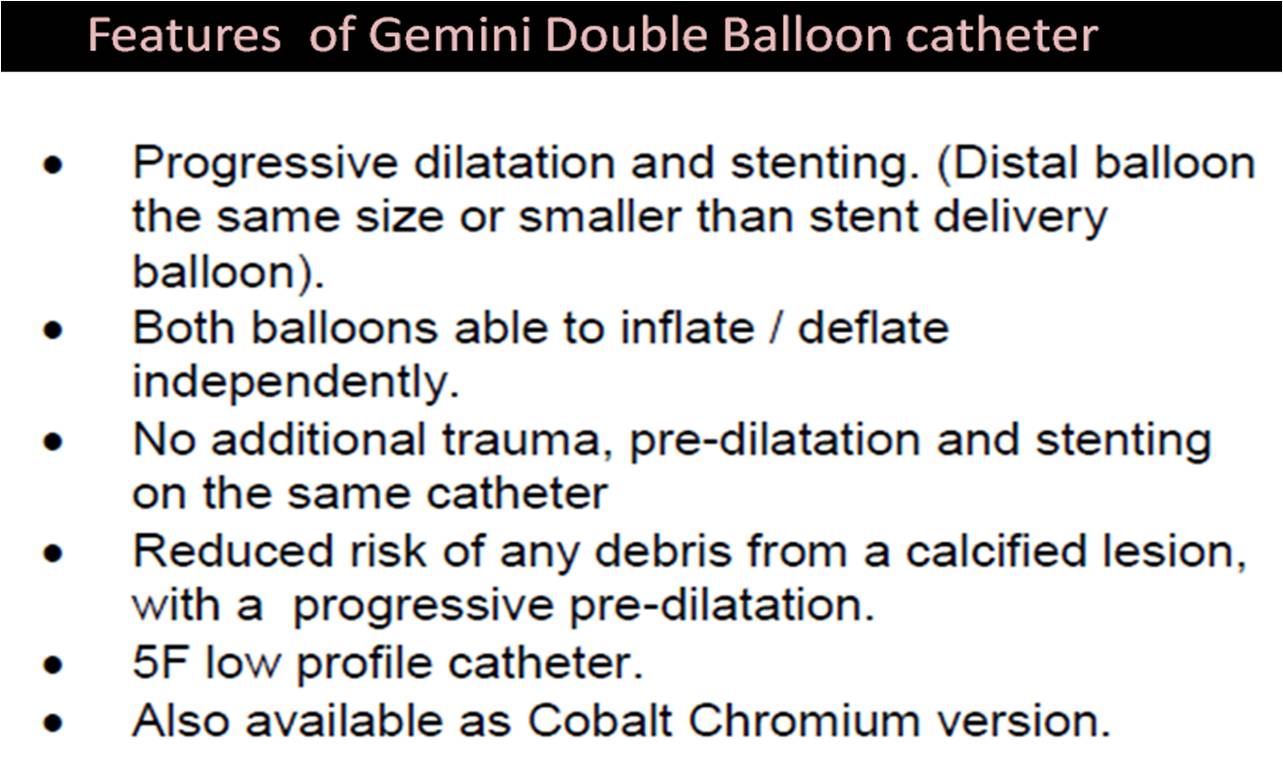
Here is a new* PTCA  catheter which has a  two balloons  ,  the distal one dilates the lesion and the proximal one has a stent over it  . The stent is just deployed after the dilatation by the proximal balloon . The proximal balloon  not only help us prepare the lesion before stenting it also helps  in crossing difficult lesions  . Further   , it can be even used to post dilate the lesion . It can be a non compliant balloon  as well . It appears a  good  concept .

*Not really  new  I  believe  ,  Accuramed  owns the patent for  this twin balloon catheter over a decade now .(First twin balloon Gemini PTCA was used in 1988 )

gemini balloon catheter twin two ptca pci

I do not know why we haven’t adopted it yet ,  while many  dubious  innovations are making merry around the world !

GEMINI DOUBLE BALLON STENT ACCURAMED 2

GEMINI DOUBLE BALLON STENT ACCURAMED  3

The only downside could be ,   combinations of stent and balloon sizes are limited . But ,  it is not a major issue .The ability to  fine tune the stent apposition  moments  after the procedure , by h a simple pull back  is just amazing !

This catheter is  made by

A C C U R A
Medizintechnik GmbH
Max-Planck-Str. 33 61184 Karben Germany
Tel +49-6039-9201-0 Fax +49-6039-9201-22
E-Mail info@accura.info
http://www.accuramed.de

Final message

Two  balloons  over a  single catheter  is a  new development  .I wonder it can be  the standard of care in all PCIs . Hope somebody takes  this concept to the next level  for the benefit of our patients.

Link to the manufacture

http://www.accuramed.de/fileadmin/daten/en/Gemini_System.pdf

Read Full Post »

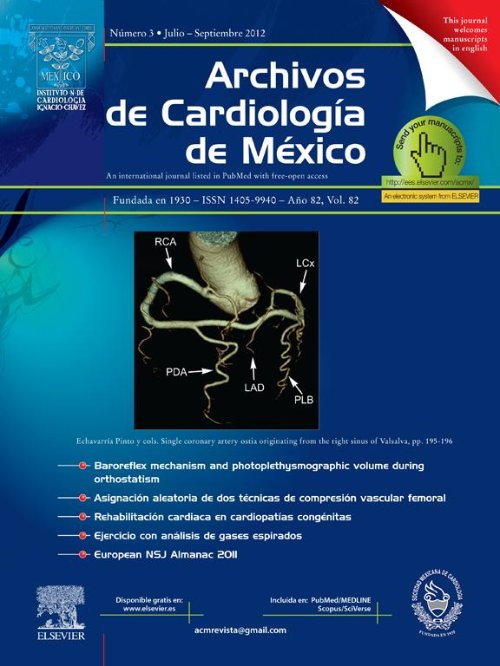
This article   provides  you every thing  you  want to learn  about ASD device clsoure .The anatomy , the art of doing TEE in cath lab etc.Do not ever shy away from lesser known journals .It is simply amazing  to find  hidden treasures .Thanks to  Mr Tim BernersLee  invenor of the Internet !


mexican cardiology journal


Sample this arricle

 http://www.elsevier.pt/en/pdf/90140903/S300/


Read Full Post »

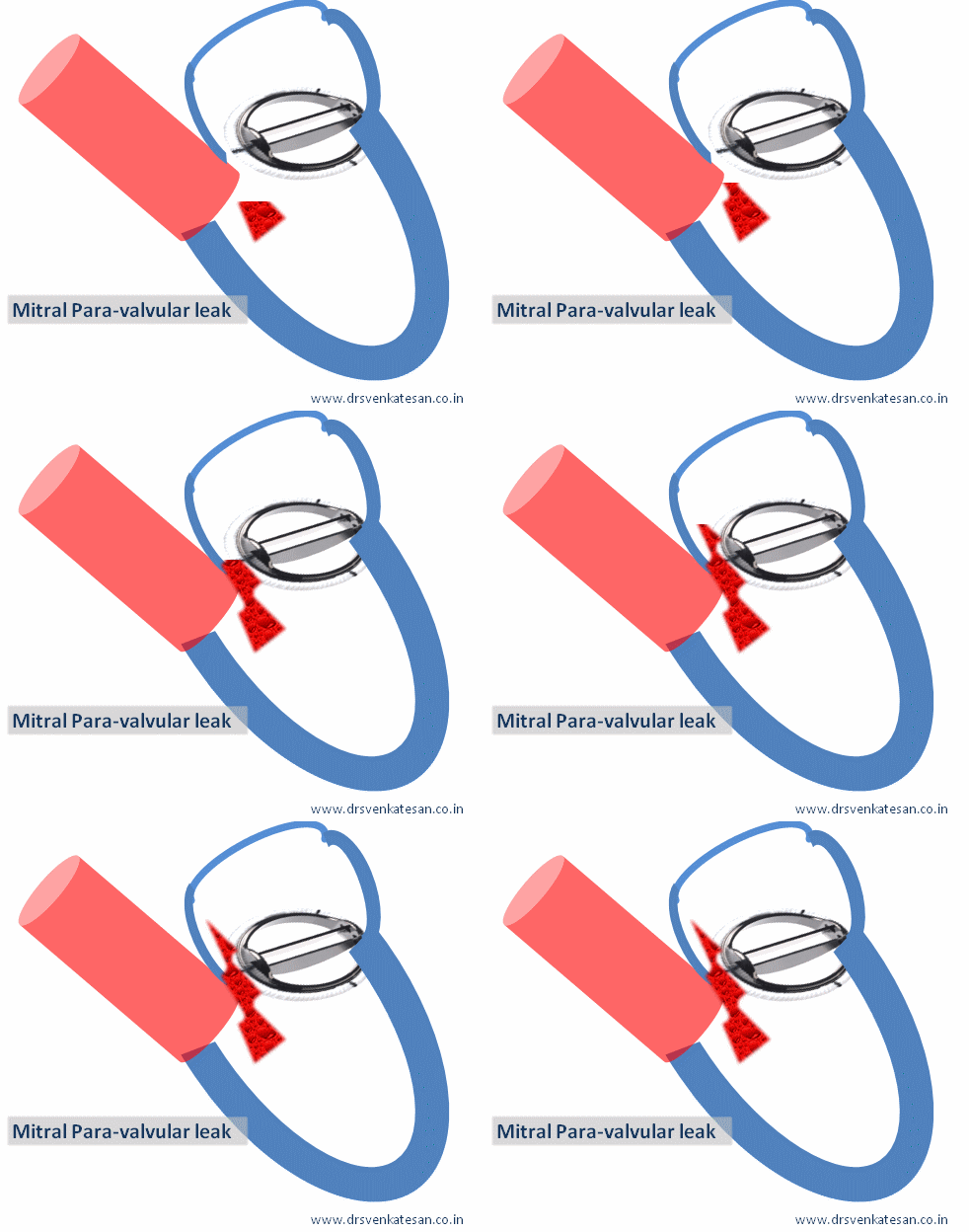
Mitral para-valvular leak

para valvular leak 002

How to manage para valvular leak ? 

Does  the terms  peri  & para valvular leak mean the same ?

Coming soon  . . .

Mean while , read this article from ESC journal  for an excellent discussion on the topic .

1. http://www.escardio.org/Para valvular leak

2. The ultimate  reference on the topic of prosthetic valve assessment by Echocardiography  http://www.asecho.org/files/public/pvtext.pdf

prosthetic valve echocardiography guidleines acc asecho esc

Read Full Post »

This paper is to  be presented in the the Forth coming   Annual CSI meet New Delhi  December 2012

Beware of Primary PCI : Is there a Low risk STEMI where  pPCI is potentially contraindicated ?

Venkatesan Sangareddi  . Department of cardiology  . Madras Medical college

Primary PCI has proven to be the best  option for management of STEMI . But it need to be done early,  by an experienced team , in a good facility . It is not the individual expertise that matters !  Any treatment , which has great therapeutic potential  also  carries a hazard . So , these treatments  must be used with caution.  Not every STEMI patient , carry a high risk for death.  In fact , the mortality  in some of the subsets of STEMI  can be as low as 1%. If , a  STEMI patient , with a likely 1% mortality is going to get a procedure with  3 – 4 % ,risk it should (And Must !) raise a validity question  But,this issue is rarely addressed in the interventional summits.

In a case pool of 56  randomly collected primary PCIs from various institutes , the outcome  of pPCI  was analysed .It is a retrospective , observational study .STEMI was graded as high risk when one of the following features  were present and it was “low risk” when none of the feature  was  present ( Second STEMI , Extensive  anterior MI , Class 3 /4 killip, An episode of VT/VF, Complete heart block, Diabetic individuals )  High risk STEMI  constituted 22 patients .The overall in hospital  mortality  was (5/56) 9 % In high risk STEMI it was (2/22 )9.5 % in low risk  STEMI it was 3/34 6.4 % .In the corresponding period 40 patients with STEMI who were treated by only thrombolysis or heparin (If beyond time window ) was used a control . 15 patients  were in high risk In the this group the  mortality in high  risk STEMI  was (3/15 )19% and low risk STEMI  there was nil mortality (0/25) 0% .

There was an unacceptable moratlity  with  pPCI  in the low risk STEMI which fared worse than even simple administration of heparin.These data reveal a dangerous fact , that is , primary PCI does not differentiate in the procedural  risk with reference to the patient profile it deals with .While , it dramatically reduce the risk in high risk STEMI It confers a astonishing risk to low risk STEMI .The exact cause for this risk is not known . Common sense would tell , pPCI is  expertise driven driven while thrombolysis is not .Our analysis also suggest bulk of early hazard of pPCI is also logistics related.

Primary PCI could be  cautiously and consciously avoided  in  patients with  low risk STEMI even if it is technically and academically indicated. This can have a great impact in the overall outcome of STEMI management.It is suggested every STEMI patient need to be risk stratified on arrival.(It is still a mystery , why we do this for NSTEMI and not in STEMI ) . A change in the current PCI guidelines to this effect is to be considered.

Read Full Post »

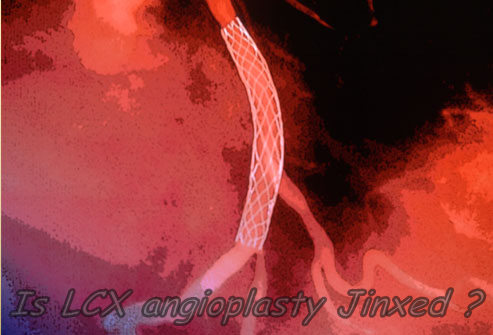
We frequently  hear  a comment  about  LCX angioplasty   being a  tricky intervention   . Even  many experienced cardiologists   do agree with this .

What could be the  apparent explanation for this seemingly important observation in cath lab ?

  1. The first and foremost is the anatomical  uniqueness of  origin and course of LCX. LAD is direct continuation of  left-main  , while LCX always  originate  with a  considerable angle at  it’s origin   . Further downstream  it flexes circum-ferentially over the lateral free wall of left ventricle .This  ensures  the  catheters and stents  we   maneuver often  traverse a hair pin bend  .
  2. The  endurance of  coronary stents are  put into biggest test during LCX angioplasty . While any mediocre metal stent can sit comfortably in LAD , LCX is different story altogether.(A flexible multi link  model  like that of Abbot Vision platform seems ideal . )
  3. The LCX wire crossing and exchange  is vested  with  potential  threat  to  the much important LAD circulation . Time and again , we have observed  ,  prolonged procedures  inside    LCX  some how compromise    the LAD  flow.
  4. Once the LCX is opened ( especially in  a CTO , ) there is a sort of   stealing  of LAD blood flow. We have witnessed this in  at least 2 patients , who developed  anterior  MI after opening up of LCX CTO. (Who  had a insignificant  LAD lesion )
  5. LAD may be widow maker artery ,  but it remains a fact  LCX   has much  more important role in regulating  mitral valve  papillary  muscle  . Even transient  ischemia  in  LCX territory can result in  lung congestion or even  flash pulmonary edema .This  is  fairly frequent during complex LCX angioplasty .
  6. The antero-lateral pap muscle is located in a critical location especially so in post infarct remodeled left ventricle  even minor degrees of ischemia can  create  a havoc .This is what   occurs during  flash  pulmonary edemas in LCX angioplasties.
  7. Spillover of thrombus from LCX to  LAD  can occur  during  aspiration  of   LCX  primary PCI
  8. Finally,   ECG  changes   are often blind in LCX territory . It remains an  Irony ,  we  do not monitor  the heart  with 12 leads during   sensitive procedure like a PCI.(The monitor leads easily miss LCX ischemia .This is hardly surprising,   as we know   LCX territory  has blind spots even with 12 lead ECG !)


Final message

It is  true LCX angioplasties can not be taken casually . One can not afford to have a prolonged procedure  within LCX.Whether dominant or not   LCX  delivers  blood supply  to more vital areas  of myocardium  that typically  includes lateral free wall and  mitral valve function .It is possible septal ischemia is  relatively well tolerated while free wall ischemia triggers an early mechanical deterioration .

Read Full Post »

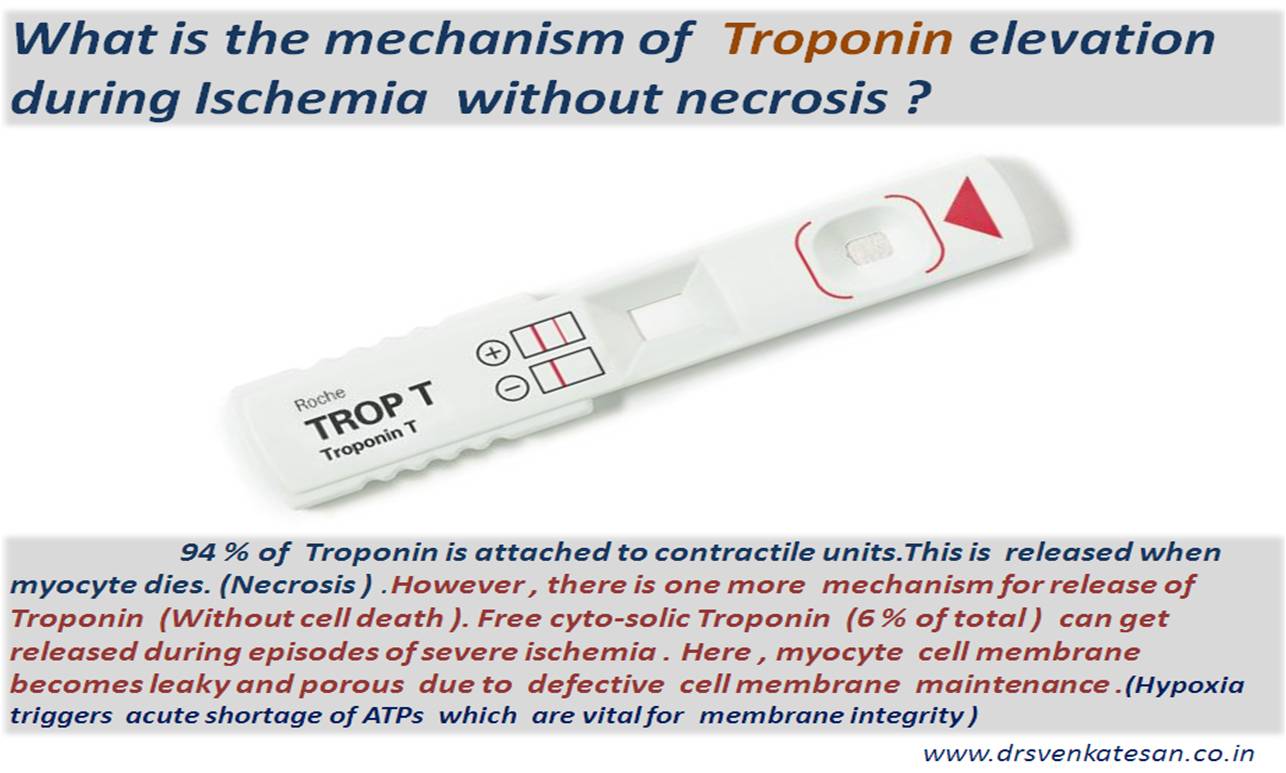
Does Troponin release during  Ischemia  ? (Without myocyte necrosis )

How often this happens ?   . Some believe , it is rare . Here is a possible explanation for it .I feel the mechanism is still not clear . It all depends upon the degree of ischemia.


Read Full Post »

Top 5 conditions that closely mimic and often mistaken for STEMI !

  1. Early repolarisation syndrome
  2. Left bundle branch block(LBBB)/ Left ventricular hypertrophy(LVH)
  3. Hyperkalemia
  4. Pericarditis
  5. Brugada syndrome

ERS

The repolarisation is due to  K + efflux . The  K channel porosity  is subjected to high degree of genetic  variations .If the repolarisation starts even by 10 milli- second earlier,  it would have early take off from descending  limb of R wave  and  the J point  ST segment appear elevated.

  • Common  in young  males . Especially in vago-tonic persons with relative baseline bradycardia
  • The ST elevation in ERS is often global .
  • Concavity is upwards .
  • ST elevation can be dynamic ( Further  confusing the picture ! )
  • On EST it  is expected to the  touch the baseline .
  • Benign entity in most . ( False alarm of STEMI is the major risk !)
  • There is some evidence ERS may confer a risk  of  primary VF ,  if they  experience a true STEMI  (Michel Haïssaguerre 2008  NEJM )

* STEMI in ERS :  The issue becomes too delicate ,  if  a  patient with ERS  develops  a true ACS .   ERS being a common ECG pattern in general population , it is not wise to label  every  chest pain in  ERS patient as benign . Suspicious  ones demand observation in step down units , at least !

LBBB

 “Any patient with  LBBB & chest pain . . . suspect  MI”  .

Unfortunately,  this rule is  too reverently followed by  physician community.  In fact ,  ACC/AHA guidelines  reinforced this behavior ,  as it  added a key word  in  their STEMI guidelines   “New onset”  or   “presumably new onset ”  LBBB is  an  indication for PCI/Thrombolysis    .( Physician presumption is a too delicate thread  to hang  our concepts !   )

               Every LBBB is new onset unless you have  a  documented proof otherwise  . . .   it seems to suggest !

Probably , this  is the reason many of the LBBBs are thrombolysed when they present to ER in an acute fashion . Of course , we can apply criteria of  Sgarbossa  to differentiate !  however flimsy it may appear . It  help us to exclude few benign LBBBs. Still ,  Sgarbossa will  struggle to  differentiate  an acute STEMI  in Chronic LBBB  from an  acute LBBB in  old AWMI .

Simply put . . . even old MIs  are at risk of  acute intervention if they have LBBB  and vague chest pain !

How to overcome this ?  Always rely on clinical  features  . If  STEMI is causing the LBBB ,  it  should be a large extensive one and you can not  expect the patient to be  comfortable .(Logic  would suggest necrosis of  large  parts of IVS is necessary to cause LBBB ) Chronic  LBBBs  are relatively comfortable  .

Of course , there  is one another  issue to comprehend  ie  transient ischemic LBBB .We do not know the true incidence  and long-term significance of this entity . Here , LBBB is  not due to necrosis of  the bundle but due to ischemia . (Almost impossible to differentiate it from  rate dependent LBBB  with  aberrancy  )

Role of enzymes and Echocardiogram in LBBB  and suspected STEMI .

You can always ask  for   Troponin  T / CPK MB .(They are helpful only  if 3 hours have elapsed , can we afford to wait ? ) . LBBB  due to STEMI  will  purge  a large quantum of cardiac enzymes from the infarcted zone . (So a marginal elevation is not going to help!)

Unfortunately,  LBBB  can induce wall motion defect in septum that may awkwardly simulate an ischemic wall motion. Even experts have erred in this . One clue  is,  the motion defects  can  not  extend   into anterior wall . It  is confined to septum ,the second clue  is a little delayed  post QRS  thickening of IVS (Septal beaking sign will vouch  for benign LBBB with fair degree of success  )

LVH

  • LVH can mimic a STEMI due to secondary ST/T changes . (Secondary to tall R wave )
  • LVH with incomplete LBBB  – A very common association that can further elevate ST segment in v1 to v3 .
  • Left ventricular hypertrophy  mimics old MI as poor R wave progression in V1 to  V3.
  • Contrary to our belief even Inferior  leads can  show q waves due to  inferior  septal hypertrophy.

Hyperkalemia.

With aging population and rampant  acute and chronic renal disorders it is becoming  a daily affair to get calls from medical units for ECG changes .We know  the rapidity of  efflux  potassium is responsible for ventricular re-polarisation .Phase 2, and 3 are K + exit zones. This is the same phase ST segment and T wave are inscribed.In hyperkalemia  K + accumulates inside the cell and keep  ST/T  segment  elevated .T wave also  becomes tall . It can mimic  both as hyper acute  STEMI .

Read a related article (Dialyisable current of Injury )

Pericarditis

  • ST elevation is not confined to an arterial territory
  • Can be global .(Regional ST elevation  does not exclude pericarditis)
  • ST elevation is concave upwards as in ERS

Link to Read regional pericarditis
Brugada syndrome

Brugada syndrome  is  an ECG -Clinical complex in which ST elevation in pre-cardial leads is associated with  ventricular arrhythmia. The defect lies in sodium channel . It reflects  a mis -match between RV and LV epicardial repolarisation forces .It keeps the RV epi-cardial current afloat and  the pre-cardial leads  facing the RV records ST elevation that  mimics  STEMI. It often  shows  a RBBB pattern and varying patterns of ST morphology  . The  ST segment is  also  subjected to dynamism  , due to change in autonomic tone and myocardial temperature  .(Febrile VTs)

After thoughts

Other close contenders for the top 5 slots

Myocarditis

Acute pulmonary embolism

Dissection of aorta

More

  • Acute stroke (Neurogenic ST elevation )
  • Stress cardiomyopathy (Takot Subo )
  • Acute abdominal conditions mimicking inferior STEMI.
  • Panic attacks /Anxiety states / chronic anti psychotic  medications which are known to elevate ST segments.
  • Contusion chest

(Cocaine hearts / Coronary arterial spasm / LV dyskinetic segments  and  LV aneurysms  were not nominees ! )

Read Full Post »

Acute coronary syndrome is the number one cardiac emergency .In any coronary care unit there are vital differences  between men and women in terms of ACS presentation and outcome . Though there can be variation in ethnic , geographical   factors .The following is   an observation  from one of the Asia’s oldest  and  largest coronary care unit over a period of 40 years . (Madras medical college Chenna ,India )

There is  very significant gender advantage in the incidence of ACS. The male female ratio is consistently around  4: 1 .This Indicates for every day , men suffer from ACS  by four  fold more .This is a very hard data can not be ignored . Women present to the hospital much later than men .This may be due to increased tolerance of pain, social issues  waiting for their spouse to arrive etc

  • There is a  significant  difference in the pattern of ACS in men and women . Men present with STEMI  and women present with more of NSTEMI . In  NSTEMI  the gender ratio is dramatically equal 1 :1 .
  • Explosive chest pains are less common in women .
  • For some unknown reason  diabetes  afflicts  women with a  greater ferocity  !
  • Similarly  it appears  obesity and dyslipidemia has more significance in women
  • Sudden cardiac death and primary VF is many fold less common in women.
  • Mechanical complications like mitral regurgitation and ventricular septal rupture are several fold higher in women (Weak muscle low muscle mass ?)
  • Thrombolytic success is slightly lower in women than men .
  • The overall outcome in ACS is same as men .Some say women fare  worse  .This is important because while they are protected heavily against development of CAD once they develop it  the outcome seems  exempted  from the gender advantage .The reason for this is not clear

Final message

Women show their  unique way   in ACS  too ! Some   of them are  true  advantages  while  few are disadvantages .The mechanism for these differences  can not be entirely attributable to presence or absence of  estrogen . The hard fact is ,  women always score over men in the tolerance levels and  deal effectively stress situations .  It would appear Women’s body   easily nullify adrenergic triggers .

Reference

Reference less cardiology .

Read Full Post »

« Newer Posts - Older Posts »