Feeds:
Posts
Comments

Archive for the ‘Cardiology-Land mark studies’ Category

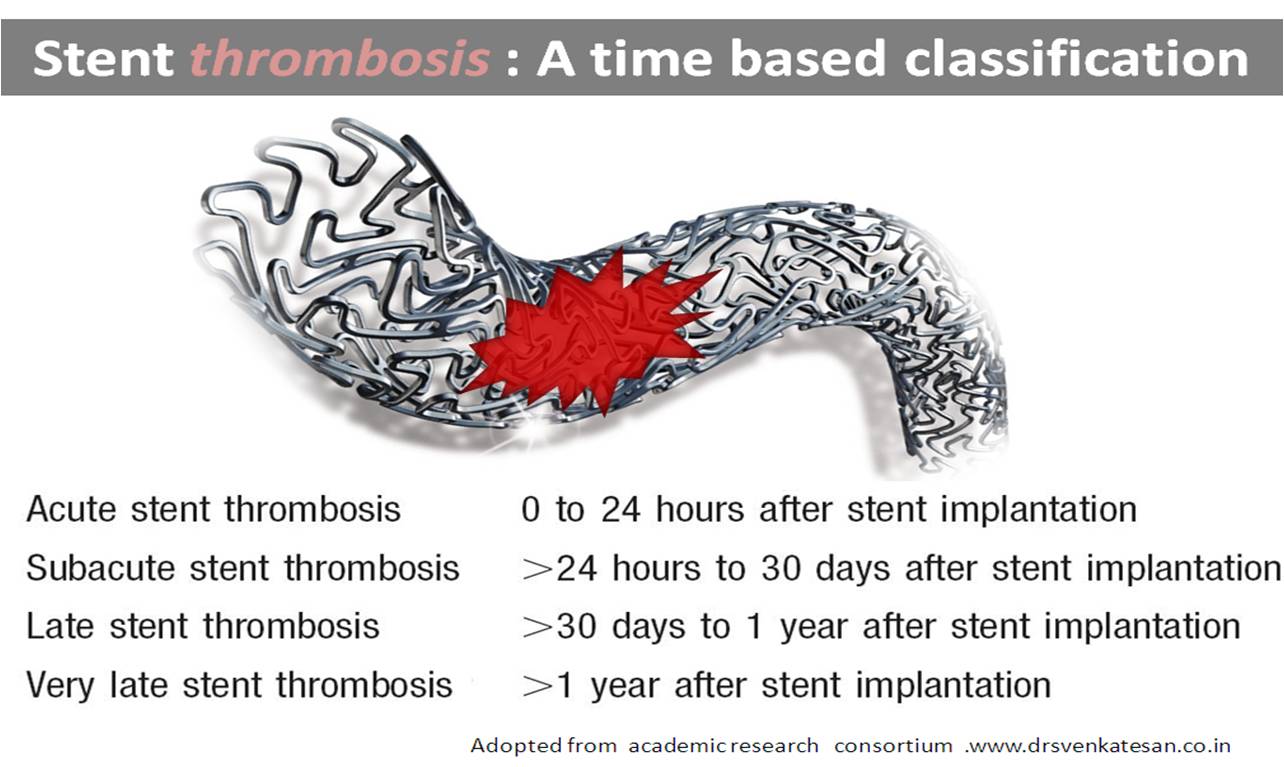
  • How do you classify  stent thrombosis ?

  • What is target vessel revascularisation ?

  • How do  you define  peri-procedural MI ?  Is  troponin elevation alone  enough ?

Want answers for all these ? Your search ends here  . . . The academic research consortium criteria committee provides everything free .

A must read for both  mature and immature  cardiologists . http://circ.ahajournals.org/content/115/17/2344.full.pdf+html

Here is a cartoon for classifying  stent thrombosis (Time based )

There is another etio-pathological /Geographical classification for  stent thrombosis  that will be discussed later.

( Entry block , exit block  , diffuse thrombosis  etc  Read -Geographical miss.)

A word about Academic research consortium

ARC is a consortium of clinical research  from the  Harvard medical school and their associates . The aim of which is  to bring clarity in the  definition of  medical  terminologies and study endpoints.A universal  criteria is being prepared  so that  the study results are comparable which currently use  different criteria  and end points.

For cardiology ARC came out with standardized definition in the year 2007.

Read Full Post »

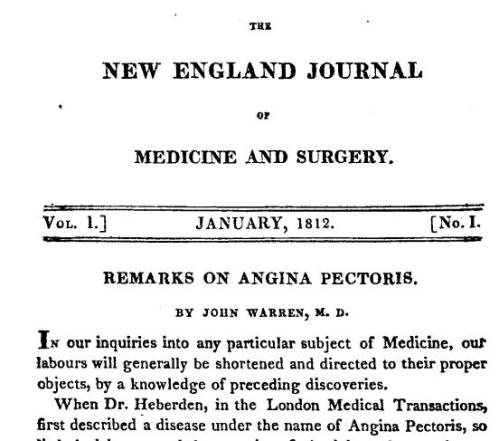
It was  the year 1812 ,  exactly 100 years before the Titanic sank  over the Atlantic  , a  small bulletin from  Massachusetts General Hospital was  released .  It  later on became  the  single most  important  journal  for the medical community.  The appearance of  an article about  angina pectoris in the inaugural issue ,   reiterates the  importance of cardiology  even in those   days of primitive  medical care .

The volume. 1  : No. 1  issue of NEJM egan with a classical and critical observation of angina pectoris written  by Jhon Warren .

http://www.nejm.org/doi/pdf/10.1056/NEJM181201010010101

The first issue of NEJM . . . Witness to 200 years of medical excellence

Those were the days  when angina  was treated with tincture  opium and Fowler solution (Arsenic  potash ) .They  can be  termed as  height  of  inappropriateness  and  also  condemnable acts  . . .  is it not  ? 

200 years  later   . . .  in 2012  what  do you think has changed ,  in terms   of  appropriateness  of management   of angina pectoris  ?

What a surprise ,  two centuries  later ,  even as we are  treating  angina  in hi-tech cath labs  with bio-degradable stents and metabolic modulators   ,   bulk of our  population is  grappling with inappropriate therapy for angina pectoris .

Today ,patients are subjected to  questionable modalities  in the management of CAD ,  which the following paper   tries to expose !

Keeping the inappropriate flag high . . .200 years later in 2012


What a way to progress in Medicine !  The reason for this  “200 year  old ailment”  is  attributed to  extreme scarcity of common sense !

( A study , which says regular exercise  can be  as good as PTCA in multivessel CAD ,  would  sound  as a  “nonsense article”  for most  cardiologists  of  current  generation  !)

Finale

When we look  at human history , where billions  lived ( and continue to live ) in this  age old planet , it  would appear  a trivial matter  whether you treat angina pectoris with Tincture opium / Arsenical potash or  Prasugrel  / Rosuvsatin . . .

Whatever be the scientific advancement  the ultimate outcome on human health will depend on how we apply it. So, all young  medical fellows beware of this   !

Read Full Post »

Management of  severe  pulmonary hypertension continues to be a difficult task .Medical therapy is not definitive, in-spite of the new prostocyclins, endothelin antagonists and  sildenafil analogues.Natural history  depends mainly on  the presence of  any treatable cause ( Especially ,connective tissue disorders)  ,  supportive management along with anticoagulation.

Ultimate  strategy  would involve a   plan  for a “Lung “or  “Heart -Lung”transplantation  , if feasible. Last decade saw an innovative modality of creating an  artificial inter atrial  shunt to decompress the right heart .This had varied response in the  real world  , still  most  showed some benefit .In fact , in 1998 the world symposium on PHT ,  formulated guidelines for BAS (Balloon atrial septostomy)

Principle of  Balloon atrial septostomy (BAS)  and mechanism of benefit

The symptomatology  of  pulmonary HT  is largely  determined by mean RA pressure .

Puncturing  the  IAS and diverting blood  flow into left atrium would decompress the RA ( or even the RV )  and reduce the Mean RAP.

The resultant  right to left to shunt  can   increase the cardiac output  only  slightly ,  still  good enough to  provide   relief from the fatigue.(Though at the cost of  desaturation.)

What is the risk involved in the BAS.

Procedural risk of  a cath study in a sick  patient with hypertensive lungs (Can be really high !)

In some patients  even a small  fall in systemic  oxygen saturation can be counter productive.

What is the balloon used ?

Mansfield or Tyshak balloons are good choices .

Balloon diameters are between 5 -14 mm

Technique

Involves standard Brockenborough needle /Mullin sheath /Guide wire in pulmonary vein.

Atrial anatomy to  be well  analysed prior to BAS  . (Please note even though it is similar to PTMC , anatomically we encounter a large right atrium rather than left atrium .)

Fluroscopy with  TEE guide optimal

Pulmonary angiogram might help.

Intra-cardiac  Echo may be  ideal.

Blade septostomy may be preferred if hardware is available

The endpoint of procedure

  • Size of ASD > 5mm
  • Fall of arterial saturation < 80 %
  • Sustained atrial fibrillation with hypotension
  • Any  disabling complication

Hemodynamic impact

  • Cardiac output increase by 750 ml to 1 liter
  • It is expected ,  RA  mean pressure  would fall at least 5mmhg from  the baseline value.
  • PA pressure , no significant impact expected.
  • Tricuspid regurgitation regresses.
  • RA,RV size marginal reduction observed.

Follow up and outcome

  1. Greatest  relief is from syncope.
  2. Functional class improvement  in >50% .
  3. One year survival benefit is substantial (75-90%)  .Beats the  natural history (40%) convincingly.
  4. Late deterioration  can occur as ASD gets closed in few.

When  BAS is contraindicated ?

  1. Critical RV failure
  2. Patient in class 4
  3. Mean RA pressure > 20mmhg
  4. Pulmonary vascular resistance index> 55 Wood units / sq.meter

* BAV should not be considered as a  live saving  procedure  in any dying patient with PAH.  It needs to be  selected early and carefully .In fact,  the very high procedural complication  rate is related to late selection of patients.

Natural foramen  PFO better than BAV ?

We do not know yet.It is highly possible  natural opening up of PFO is good thing to happen for patients with severe pulmonary hypertension.

Reference

1 . SS Kothari  et all  Indian heart journal 2002

2. http://content.onlinejacc.org/cgi/reprint/32/2/297.pdf

3. http://www.ncbi.nlm.nih.gov/pmc/articles/PMC484602/pdf/heart00028-0066.pdf

  4. http://erj.ersjournals.com/content/early/2011/02/24/09031936.00072210.abstract

Read Full Post »

Tuberculosis is rampant in our country ( of course in any developing country ). Many of the patients who are referred  for cardiac  failure has history of pulmonary  tuberculosis.

In our echo lab we handle  100s of  patients every month from the regional TB sanatorium  . While the clinical presentation  mimics  COPD ,  many of them  have be severe bi-ventricular dysfunction  in echocardiography   and  bulk  of them satisfy the criteria for dilated cardiomyopathy . So what are we missing ? or guessing ?

The following paper  which  finds a  strikingly similar observation  . . .   is important for many reasons

  • It  comes for a prestigious Institute from India (PGIMS Chandigarh)
  • It strongly  suggest the link between DCM and tuberculosis
  • It also tells us both can be completely curable.

We know cardiac failure is a relentlessly progressive disease . We also know ,  certain forms  of DCM are reversible  especially infectious and toxic ones .Whenever we ask  our residents (Bitten by the western bug !)   for causes of reversible cardiomyoapthy  they promptly rattle out exotic conditions  like selenium deficiency and cobalt cardiomyopathy etc ,

  we tend to forget  “a big possibility  of   tuberculosis”  as cause for reversible cardiomyopathy.

  Students are not be blamed ,we have never taught them to think  in Indian  perspective !

Finale

DCM is a biggest  cardiac problem in our country next only to CAD. While our country men suffer , we are perennially happy to  label  them    as  idiopathic DCM   ,  even as   we  continue to  loose our  precious time  every day ,   in  ballooning dubious lesions  in  hi -tech cath labs  and help  fill the corporates coffers !

I entirely agree with the authors ,   DCM due to Tuberculosis  is  a hugely under-recognised entity  in a country with over  12o0 million people. So , youngsters  are  argued to find  answers to this   burning  issue . (* I am afraid how many of us are aware of such  an important  article published from India. )

We propose to under take a study from from Chennai  tuberculosis research center about this. Any body wishing to fund this project ?

How does tuberculosis affect heart muscle ?

Will be posted  soon .

Read Full Post »

Constrictive pericarditis is a well known mechanical disorder  of heart that occurs due to the  compression  by thickened pericardium .Constrictive pericarditis is  the classical cause for  severe diastolic dysfunction.

We know , lungs are   prone for restrictive disorders due to chest wall , skeletal  disorders. Does the heart get mechanically restricted in extreme obesity ?

Not really , one may reason out . Chest wall fat can have little effect on cardiac function but when excess fat accumulates within the layers of heart , it is indeed possible for  the  fatty layer to impede mechanical filling of heart. This may be considered rare as of now , but many times it is not recognised ,  as most of the dyspnea in morbid obesity is attributed to some other known factors.

Dyspnea in obestity  can  due to

  • Pulmonary hypoventilation
  • Increased  MVO2 due to elevated cardiac mass
  • Diastolic dysfunction of  LV/RV
  • Increased demand  due to  excess BMI.

Image courtesey : http://www.onlinejacc.org

Now, we have evidence for  altered RV hemodynamics due to compressing effect  of epicardial fat pad. It may be due to   simple mechanical effect  of epicardial  fat over the distensiblity of RV or occasionally  LV. (The distribution of epicardial fat is mainly over the right ventricle or septal areas.)

This   paper  from Korean circulatory journal  succinctly describes this new possibility .

http://www.ncbi.nlm.nih.gov/pmc/articles/PMC2771803/pdf/kcj-39-116.pdf

Final message

Bed side cardiology  continues to  bring surprises  , it  never fails to fascinate us   !

Heart  is  a dynamic organ ,  has a potential to get restricted by  any  layer that  surrounds  it. Constriction by pericardium got huge attention so far .We need to realise , the epicardium which is  a part of pericardium has a variable fat depot  . It  can take a different avatar  in an occasional obese individual  and   exert  important hemodynamic impact.

Excess fat is excess load on heart . . .  we have  to unload it

It is possible , sucking out the  epicardial  fat in morbid obesity can bring important relief to  those patients with unexplained dyspnea . We  need to  explore this possibility.

Read Full Post »

Most important MCQ in clinical cardiology

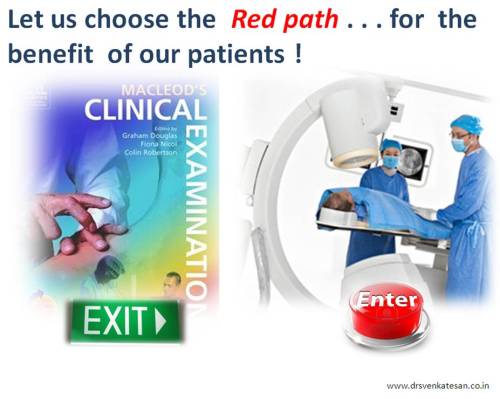
Many cardiologists  would love to do away with detailed  clinical examination because  . . .

  1. They think it is an inferior job to do  . By skipping  it , they get a false sense of superiority.
  2. It is a time killer  and eat into precious cath-lab  time
  3. They no longer believe in  these “perceived – primitive” medical methods.
  4. Fear of colleagues making  fun of hem if they  indulge  in detailed clinical examination.( At-least in India ! )
  5. To give more job opportunities  to para medics.
  6. They are no longer confident about making a good clinical examination as they  are neither  trained  adequately nor interested in it !

Answer :  All of the above can be true .  The 6th response is  likely to be  more  correct !

While cath labs can prevent few deaths occasionally . . . it is the general wards and OPDs that add life every day

Read Full Post »

 Hypertension  ranks  number one  in the risk for future  stroke . Surprisingly this is true  for ischemic  as well as  hemorrhagic strokes.

 What  causes  thrombosis or  rupture of small cerebral arterioles ?

 It is somewhat similar to coronary events . ( With one major exception,  coronary vesels  are   not prone for rupture ) .It is  believed   sudden spikes of   blood pressure  and the resultant endothelial injury are responsible. Atherosclerotic plaque fissure and inflammation  also  contribute. 

Is embolic stroke related to hypertension ?

The vast majority of embolic stroke are believed to  arise from heart .This belief is getting gradually eroded , as we now know aortic arch and carotid arteries vie for this honour . .(This was indirectly proved in AFFIRM trial  when rhythm control failed  to reduce the incidence of  stroke inpateints with AF ,   implying much of the strokes arise  in the upstream rather than within the cardiac chambers )  

Meanwhile , there is no controversy  in  SHT  promoting  both cardiac  and non cardiac embolus to brain

Systolic ,  Diastolic or Mean pressure   which is  important  in the genesis of stroke  ?

All parameters  are  important , but the   systolic blood pressure  is vested with more  vigour  to damage the  cerebral arterioles. The reason  systolic pressure is more important lies  in the  fact ,  it  can  attain  high pressure peaks instantly ,  unlike diastolic or pulse pressure which  slowly builds up. Further , systolic BP  carries  leading edge of the pressure  curve with high Dp/Dt and hits  the target  first !

At what pressure the cerebral artery becomes  uncomfortable ?

We do not know  the answer as yet , but any systolic pressure above 180 mmhg is a huge stress for the cerebral arterioles.The rapidity with which the BP  raises  (Dp/Dt) also becomes  important  . High blood pressure increases the shearing stress .It  interferes with nitric oxide synthesis and promotes endothelin release which precipitates  cerebro vascular event.

How do you identify people who are at risk for stroke ?

While  cardiac physicians are obsessed with exercise stress test to predict CAD  very  few  are worried about  stroke . In fact the same exercise stress test can be used to stratify stroke risk. The exercise induced systolic blood pressure  raise  is a useful risk stratifying  tool. This concept is there for more than a decade without reaching the clinical domain.

The following paper was  published in stroke journal (2001)  from the picturesque university of  Kupio Finland.(See below )  It is a wonderfully done study and throws great insight into the  new  emerging  science of  Intra cerebral hypertension .

 

The following can be summed up as risk factors for stroke during EST  (Derived from   various sources  and  . . .  with   liberal dose of personal  logic !)

  • Raise of 20 mmhg  SBP  at  2  minutes .
  • Increment of >  20mmhg in SBP any subsequent minute.   
  • Any  SBP  above 200mmhg during  EST
  • Failure to  reach baseline SBP  at 6 minutes recovery .
  • SBP  or DBP remaining high  even  after  the heart rate reaches baseline.


 Final message

For the kind attention  of all  cardiac physicians . . .  whenever you do an  EST for a cardiac indication ,  please spend the first  few  minutes  carefully ,and   look at the  blood pressure response . It is encouraged ,  to  specifically mention about the  behavior of  SBP  and write a remark about the propensity for  stroke in  every EST/TMT report .   Let us grow our brain  sense as well   . . .  for   the sake of our patients !

Thanks again  to Dr S.Kurl et all from Finland  for their  nice article which  stimulated  me to write  this post .

Reference

http://stroke.ahajournals.org/cgi/reprint/32/9/2036

http://heart.bmj.com/content/95/13/1072.abstract

Further queries

How common is stroke following a EST procedure ?  Can high blood pressure dislodge a carotid plaque during a stress test ?

The answers will be posted soon once I  get it . ( Of course you can do it if you know !)

Read Full Post »
What do you advice a patient with single vessel  CAD  with milder forms of angina or no angina ?

Medical management ?  May be you are right . But most of us do not  follow this  correct advice.  Why ?  We have a inherent bias against  medical management  . Cath labs exude  unmatched glamor and  attraction in various forms  to both cardiologists and their patients.   Now , here is a   surprise  finding  , unpalatable though , for many of  us !  Simple jogging or bicycling can have equal if not  more relief  than even a angioplasty . This study which came in 2004  was made sure , not to  gain a prominent place in cardiology literature.

http://circ.ahajournals.org/cgi/content/full/109/11/1371?linkType=FULL&resid=109/11/1371&journalCode=circulationaha

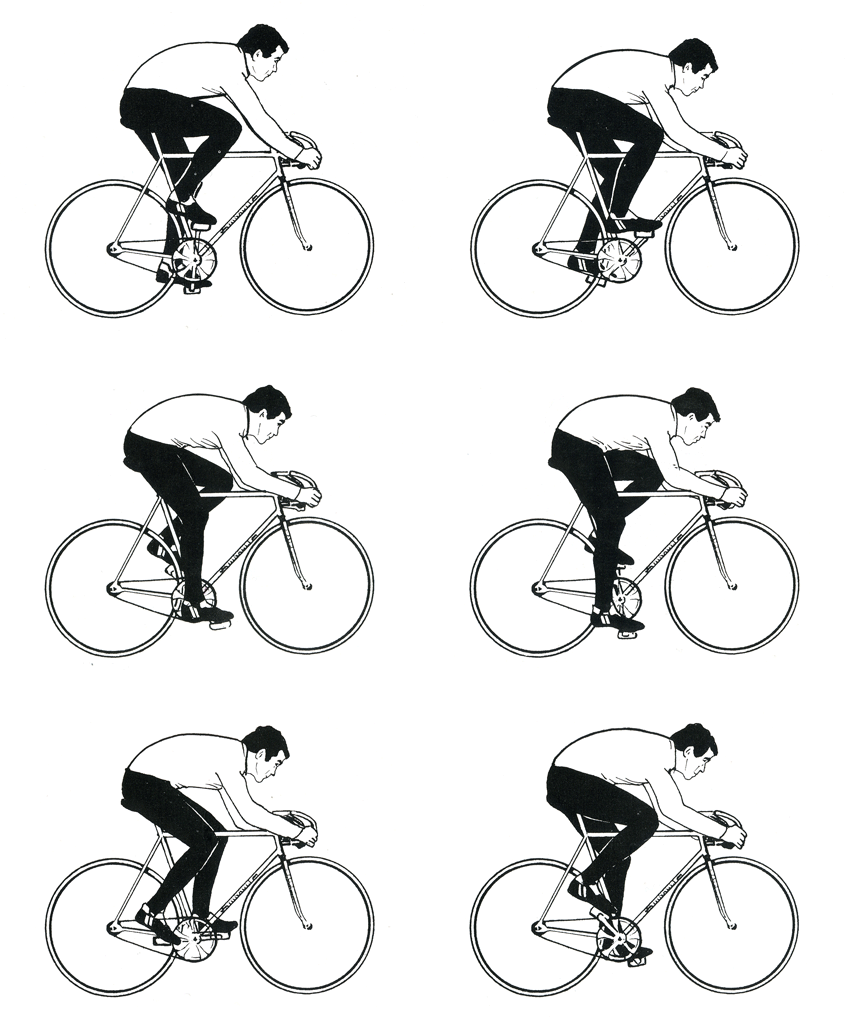
Let me pedal faster . . . cardiologists are after me !

The circulation article

How does exercise help in reversing CAD  ?

We know the prerequisite for plaque formation is the endothelial  injury along with lipid accumulation. Further ,  high local adrenergic(vasomotor) tone ,   growth factors and inflammatory activity would accelerate the plaque formation.

Regular exercise  has been  convincingly  shown to improve  the endothelial function. It  restores  the optimal adrenegric tone in the coronary micro circulation so the blood flow is brisk and pro-coagulant  activity is reduced .

It is easy to accept  the fact ,   exercise  can  prevent   progression of plaque   . . .A question that lingers in many including  many  cardiologists is this   . . .How  is it possible   for exercise to  regress well  established plaques ?

When   exercise  can   dissolve  huge  fat loaded  abdominal  tummy  in matter of weeks ,   there need not be any doubt  about the efficacy  of   exercise  in regressing   minute  lipid laden  coronary tummies (also called as plaques) .

(Of course , the  above statement  is supported by  documented  angiographic evidence  as well !)  Read below and  also the AVERT study .

Final message

Attention  all CAD patients ,  empower yourself , you  can become your own  cardiologist . You can perform angioplasties with bicycle  at zero  cost ,  of course  you have to pay for the bicycle !

This article “hypes up” the importance of physical activity in the management of CAD. But , it has to be  combined with optimal anti anginal drugs, good lipid control , blood pressure and diabetes  control  if present  , stress reduction  and good  sleep  to keep the CAD and cardiologists  at bay !

Read Full Post »

A well researched article on a difficult topic. By Kim et all from Cornell university , New york.

A must read by all cardiologists . The link is placed with the courtesy of Jacconline

http://content.onlinejacc.org/cgi/reprint/49/20/2035.pdf

After reading this article   one  should be able to answer the following questions.

  1. What is Gallavardin VT ?
  2. Classification of RVOT VT
  3. How a non sustained VT becomes a sustained one ?
  4. Why some VTs cause syncope ?
  5. What is the association  between idiopathic VT and Idiopathic VF ?
  6. How does exercise  trigger a  VT ?
  7. What do we mean by structurally normal heart ?

Readers are encouraged to post link to good articles on this topic.

Read Full Post »

This is one of the wonderful corporate initiatives to assess the coronary angiogram and reporting . This calculator and teaching material was created by Boston scientific and Syntax study team . This  was used primarily during the  SYNTAX study.  This scoring system ,  though  appear  elaborate,  is a very  useful ,  objective way to assess coronary angiogram.

http://www.syntaxscore.com/calc/start.htm

Final message

It is encouraged to use this scoring system liberally . This will help us  to take more scientific decisions .

Read Full Post »

« Newer Posts - Older Posts »