Feeds:
Posts
Comments

Archive for the ‘Cardiology -unresolved questions’ Category

When a culprit thrombus keep the  myocardium as hostage . . . don’t storm the coronary artery  indiscriminately   !

When a single gun men  keeps 100 innocent people as hostages , threatening their  lives, rescue mission should start .No can can afford to wait. But, without knowing  the  culprit’s true nature the process of rescue mission is always going to be tricky .There are so many instances Newton’s third law  was reversed , when reactions  evoke more chaos  than the index action.

In the recent world terrorist events ,  the  rescue missions  were so delicate and  it was very  unfortunate we  lost  many   innocent hostages !  The reasoning is ,there  is no way we can avoid these. I wonder is it really true ? !

rescue missionNot all culprit lesions  are true ones.They simply threaten  our myocardium with  thrombus and plaques  in various forms .Don’t show aggression to pseudo threats  you may  ultimately end up with more damage.(What I call as crazy culprits!)

(  Read here , why unstable angina even though thrombus is sitting right inside the coronary artery attempting to lyse it causes more  damage !)

After thought

Iam sure ,bulk of  the Interventionists wouldn’t agree with this thought . They would decry , watching a person  silently when the myocardium  is on  fire is a serious crime !

But . . . we  need to  remember the process of extinguishing  the fire  with some more fire arms is a delicate game played in undefined  philosophical turf.

The only way to introspect  such events in life is , to accept any eventuality    arising out of “not pursuing”  a  presumed rescue mission with vigor. No need to be guilty about that,after all , it can be a myth !

Modern human cognition , growing with a staple  scientific  feed  on a 24/7  basis  is  unlikely to realise , restraint can be an effective tool  even in critical moments !

Oh,is all that I have  scribbled so far  is just a repetition  of 1000 year concept of  “Primum non nocere”
Read Full Post »

Every one talks about  coronary excesses ! It happens  both  in acute and chronic  fashion , not withstanding the inappropriately  understood  . . .   appropriately  released  guidelines  on inappropriateness ! The  burden  of coronary syndromes of the humanity, I am afraid would  include these man made excess as well !

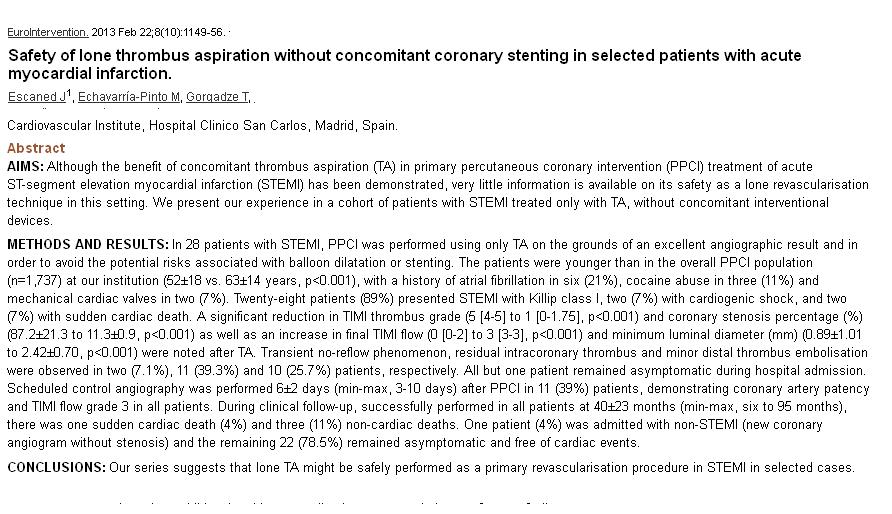
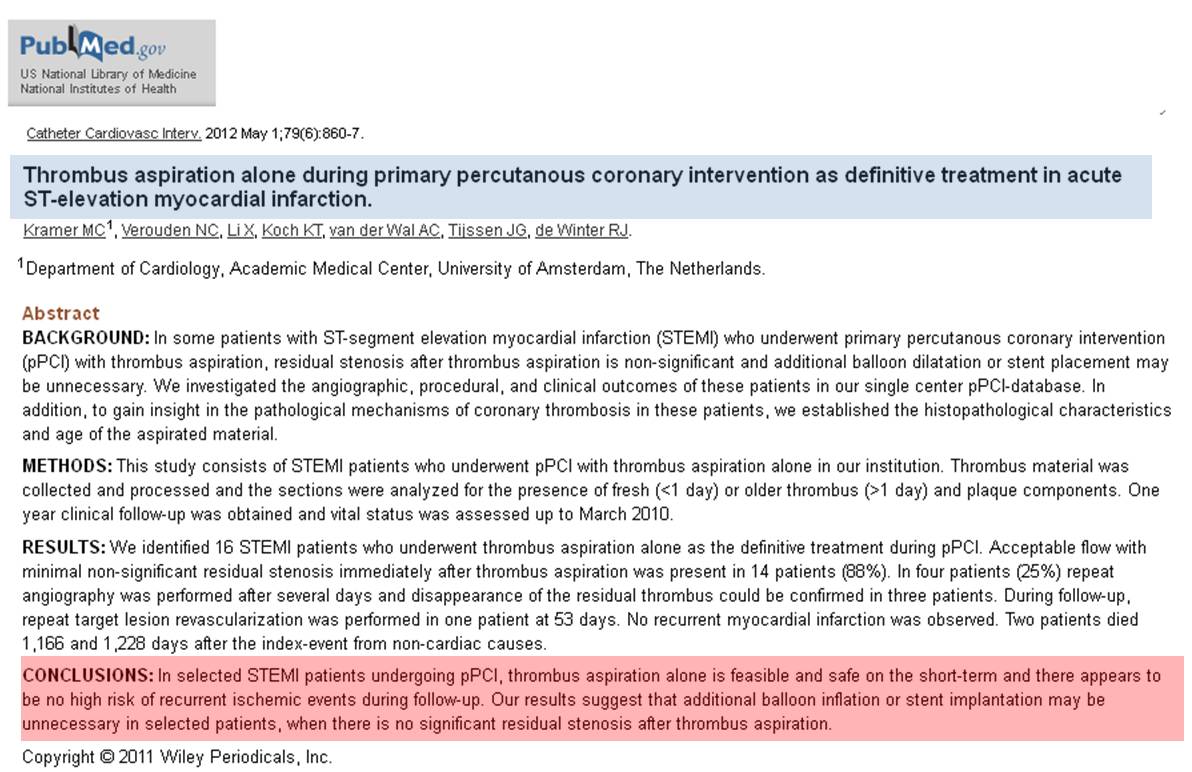
I stumbled upon two  small  “gems ” in this other wise wild dark  cardiology literature  .One from Kamaer , Netherlands and other from  Escaned from Spain.

Both  talk about a  simple and logical modality in the management of STEMI . If bulk of the STEMI events are due to coronary thrombosis just tackle it  . No more  . . . no less” Stent only , if there is tight residual lesion.

1. From Amsterdam , Holland.

krammer thrombus aspiration alone priamry poba for stemi no stent

2.This one is from Spain.These studies I am sure , only a fraction of the interventional community would have read .Reason ? We are always hijacked by the moments of glamor ! I am just sharing them .hope few are benefited

primary POBA thrombus aspiration alone for stemi no stent stemithrombus aspiration alone for stemi no stent priamry pobaThese two studies with total number of 44 patients has a potential to redefine  the entire practice pattern of acute interventional coronary care.(Of course , if only , we are ready to make sense out of it !)

But , the concept will be heavily banished by strong visible and invisible forces   for the simple reason it suggests a true possibility  of knocking  out the role of  stent from acute STEMI arena.

When I discussed with my colleagues  for a large scale study  on isolated thrombus aspiration in STEMI , they told it  is not possible for ethical reasons !

I was amused , denying such a study is biggest ethical blow to the field interventional  cardiology !

Final message

Proof of concept does not require numbers .A study with less than 50 subjects  can be far superior than multi-centre ,multi-blinded , self steered ,peer reviewed largesse ! The truth of the study lies in the core consciousness  of people who do it , not in the numbers and exotic statistical methods !.

After all , one of the greatest medical study  was  done by James Lind  (Father of RCT) who discovered vitamin c as an antidote for scurvy,  with a hand full of sailors  while they crossed the Atlantic many centuries ago !

After thought

You say , thrombus aspiration is great , Why the hell , TAPAS , INFUSE AMI, and TASTE studies  confuse us regarding thrombus aspiration  ?

Don’t blame it on thrombus aspiration .We do it perfectly . It is because of what  we do after that ! We decorate the coronary lumen finally with a piece of metal cherry  undoing all the goodness of a great pudding !

Read Full Post »

The success of primary PCI  is defined on the basis of acute vessel opening and deployment of stent and wheeling out the patient out of the cath lab. Most PCI cath report promptly mentions TIMI 3 flow with Grade 3 myocardial blush.

I recently encountered 3 patients over a period of 2 months in my echo lab. All three had a recent primary PCI for STEMI found to have scarred IAS with moderate LV dysfunction.

These patients were medically savvy and asked a simple question after glancing at the report signed by me.

Doctor , If my myocardium has  been allowed to die a silent death  in a matter of 30 days and replaced by a  whitish scar , what is the point in calling the much hyped  primary PCI successful and charging me about 4 Lakh Rs . They wanted to know ?

I told them you have to direct this query o the supposed state of the cardiac Intervention team.I also told them it may not be proper to criticize anyone. The science of myocardial revascularisation is yet to be fully understood.

Why the myocardium goes for long-term scarring in spite of prompt early revascularization?

  1. Time window errors (What you think is early PCI may be in fact a late one!)
  2. Intermittent patency
  3. Re- occlusion
  4. Individual variation in hypoxia resistance
  5. Contra-lateral significant CAD.
  6. Recurrent  coronary events
  7. Poor compliance with medications.

Final message

Just because your patient has received a state-of-the-art primary PCI  in a high-end hospital does not negate the possibility of myocardium going in for scarring and resulting in significant LV dysfunction. There is something more hidden in coronary hemodynamics than it appears!

The so-called acutely successful PCI in your discharge summary actually may mean nothing. Unfortunately, we the pundits of cardiologists never bothered to include myocardial status as one of the criteria to define the success of the procedure.

Ideally, we may defer calling a primary PCI successful or not by at least a few months, when the true story unfolds ie how your myocardium has responded to the treatment and the after-effects of a stent.

Read Full Post »

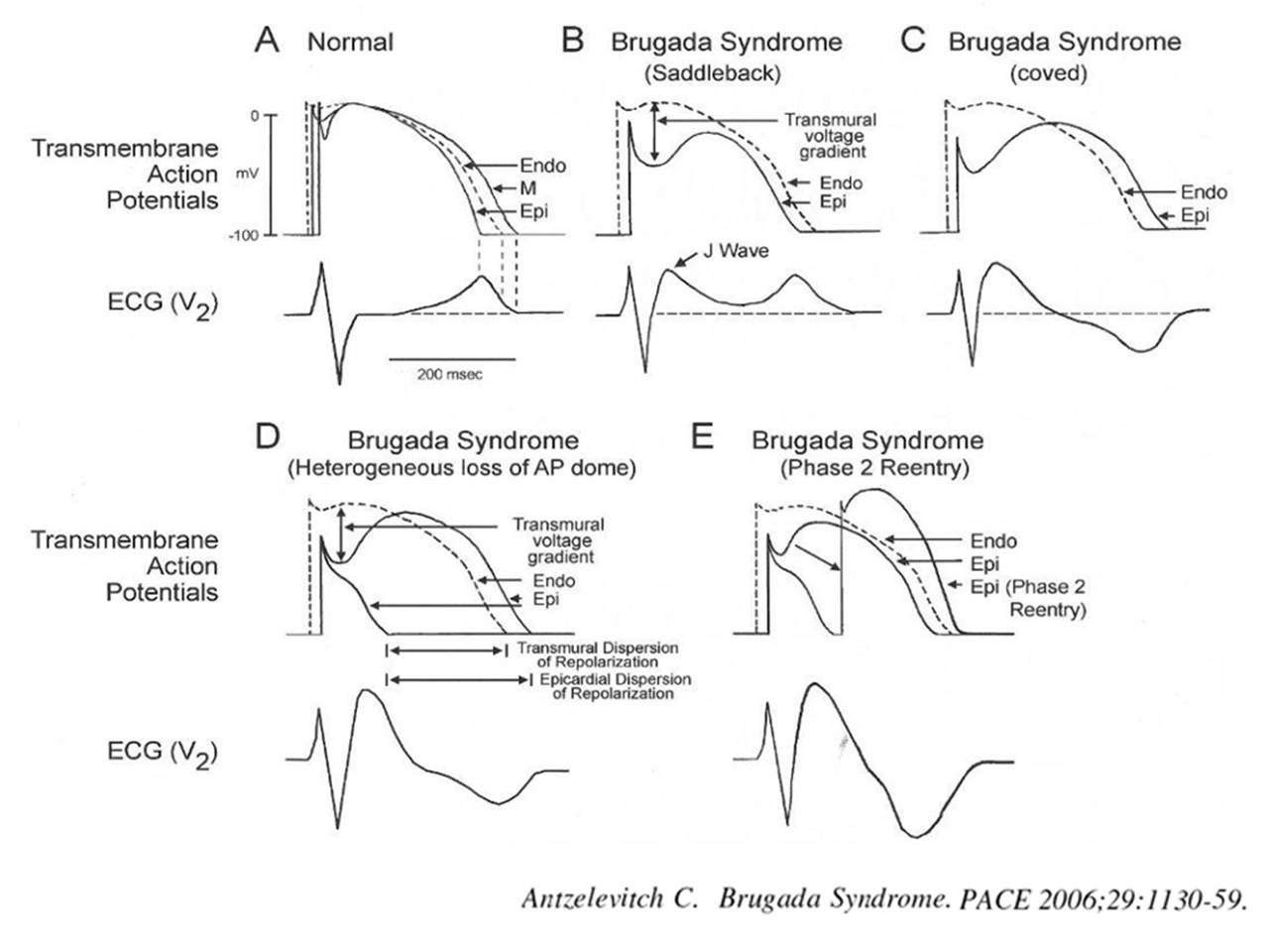
Brugada syndrome is due to a genetically  impaired  sodium channel activity  ( SCN5A)  in phase o, of action potential .This results in phase 1 (Ito channel) failing to inscribe the transition between phase 0 and  1 that result in loss of  dome .This loss of dome is dominant in epicardial cells compared to endocardial cells.This result in  electrical heterogeneity and a hence a voltage gradient in repolarisation phase  that can trigger a Phase 2  reentry mediated  VT /VF.The above said defects are either dormant, manifest, self extinguishing , dynamic  subjected to autonomic tone , ambient myocardial temperature (Febrile VTs) making this a complex entity.

There are three distinct types according to surface ECG.It can be either spontaneous or induced. The arrhythmic events and prognosis and hence management differs according to the types.

mechanism of brugada syndrome three types of ecg 2All types carry  a minimal risk of SCD , variable though . Of course  syncope  has to be  much more  common. Curiously every episode of syncope is seen as naturally aborted SCD by physicians ! (No one  to be blamed for this .The definition of syncope is like that !If the patient doesn’t wake from syncope it becomes death !).

When a patient with Brugada  has a  syncope , it  doesn’t  imply  he  experienced a dreaded VT or VF.While SCD is invariably due to ventricular fibrillation , a spontaneously terminating VF  as a cause for syncope is rare in Brugada . (Ref 2 : ILRs have documented though in few)

So what exactly is the cause for syncope in Brugada ? The issue is  real  and critical in clinical decision-making. We are beginning to document variety of mechanisms. Following are the possible causes

  1. Sustained  VT or NSVT with
  2. Non sustained self terminating  VF
  3. Extreme bradycardias (Vaso vagal )
  4. AV blocks
  5. Unrelated neurogenic

Final message

It is to be strongly emphasised a significant subset of Brugada patients especially in Type 1   Brugada (spontaneous or drug induced )  the mechanism of syncope is often not related to the dreaded VT/VF. It can simply represent high vagal tone and unexplained dynamism of autonomic activity .ICD is not a default indication for all those with syncope in Brugada syndrome.Think , pause and decide when you deal with such patients. ICDs are true revolutionary devices  . . . no two thoughts about it,but it can make a hell out of heaven if used in an inappropriate situation !

Reference

Read Full Post »

Aorto ostial  stenting requires extra caution and special technique. It always  worry us  what if  few mm of  metal might project into Aorta when we stent a RCA or left main ostium.

To  prevent this ,Merit- medical  has innovated a catheter that help us position the stent exactly at the ostial level .It is  done  with a help of an octopus like buttressing arm that support the aortic wall when the stent is deployed .

Watch the video.


Reference

Merit-medical 

Read Full Post »

Inserting an ICD  for  DCM  may a be great therapeutic success  for the physician  as well as the patient . But there is one big truth hidden behind the statistical screen.

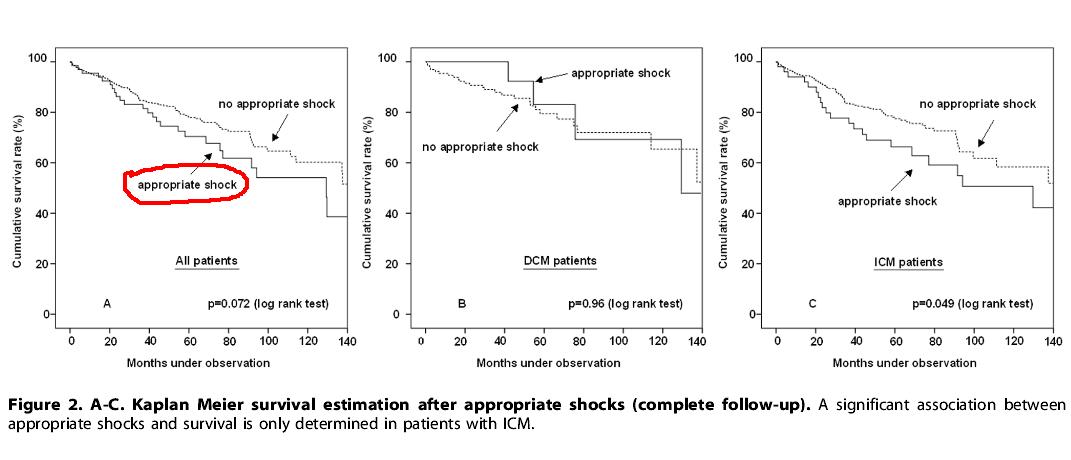
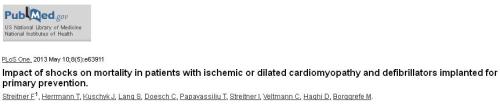
Following  study  provides dramatic data from Maanhiem in Germany in about 561 patients who had ICD .The long term patient outcome after appropriate shocks were much worse  than those without    shocks .This was more pronounced in Ischemic DCM .

appropriate and inappropriate shocks ICD

Source : Streitner et al ,University Medical Centre Mannheim, Mannheim, Germany PLoS One. 2013 May 10;8(5):e6391

The fact that these patients continue to throw VT , some thing is wrong in the cellular  milieu or a fresh scar / fibrosis / ischemia is progressing .Further , the VTs and the  subsequent  shocks  set in temporary  hemodynamic instability .We have evidence , EF can be depressed for days  worsening the long-term out come.

While it is easy  to blame it on natural course of DCM , there are  solid reasons to believe  , shock induced myocardial damage is definitely contributing to this  excess mortality.

One important  clinical tip is to screen  all  these so called Idiopathic DCM  patients  who  had appropriate shocks.  They should be monitored for fresh signs of any systemic illness  , like a  connective tissue disorder , chronic granulomatous lesions  like sarcoid etc .To our surprise  some specific  myocardial disease may unmask themselves in the natural history. Identifying them may offer a dramatic cure .

Final message

Some where along our EP mind-set  we are conditioned to think  , as along as there is an ICD in situ and it appropriately  shocks, every thing is bliss ! Blame it  on semantics . The  word “appropriate”  inappropriately  soothes  our nerves.

The fact of the mater is , every appropriate shock is a  grim reminder  that the heart  in question  is restless electrically and VT continue to emanate  from diseased  myocardium  . It could  mean either the LV   is destabilising  , or the original  disease  is   progressing  or a new disease  is evolving .

Mean while, paradoxically , inappropriate shocks give us a quixotic comfort , since the  heart is not really  throwing any dangerous arrhythmia, after all it is  the device related  false alarm   that  could be easily  reprogrammed!

Reference

ICD appropriate and inappropriate shocks

Read Full Post »

Your clock starts  now !


clock gif  dr s venkatesan002

Chronic stable angina : Most can be effectively managed  by  optimal /intensive medicines and life style Interventions .About 10% will require PCI/CABG.

ACS – STEMI:  Primarily  managed  with  rapid and competent  pre-hospital care with prompt thrombolysis in or out of hospital .Patients  with  large STEMI who develop complications (Again about 10 %)   require PCI and few additional  lives can be saved.

ACS-NSTEMI : This is  the group that demand  an  important role for PCI . All true high risk UA/NSTEMI patients  should receive urgent coronary  angiogram and critical lesions  should either be stented or  sent for CABG  (If the lesions are multiple and complex ) The field of interventional  cardiology  is  expected  to play a major  role in  this category of  patients for the simple reason , we  not only give dramatic  relief from angina and also prevent a  potentially a huge MI that is waiting to happen !

* It is vital to emphasise  the “Aim and  objective” in  NSTEMI  management  is critically different from other two. We know ,  in CSA   the aim is to give relief  symptoms  and improve excercise capacity . Both PCI/CABG  are  unlikely  to prevent a future MI in CSA..In STEMI it has already occurred .The aim is to salvage myocardium  and prevent  future events. While PCI can do the former , it can’t do the later . In STEMI scenerio ,we have very good  alternate  modality called thrombolysis which can easily beat the  pPCI  in , cost , availability and time  (and  hence efficiency as well  in  most  countries !)

Counter thought

The above suggestion  is too simplified ,generalized , misleading , and  unscientific, should   strongly be disagreed. For those people who disagree , I provide an alternate scheme  .It is ultra short ,comes in  5 lines .Very practical  and  scientific too  !

In any  patient , who is  suspected to have either  acute or chronic  coronary syndromes ,take them to the cath lab in an  urgent or semi urgent fashion .Do an angiogram and stent all lesions  that you feel important . If  stenting is not possible  manage  with optimal medicines and /or send them to the surgeons.

Final message

The essence of catheter based coronary care is simple.We complicate it. To understand this concept  100’s of cardiology  journals  and as many conferences and infinite  number of books are churned out every year !


Read Full Post »

Current guidelines advice us to wait for 40 days following STEMI to implant ICD in most high risk patients.

Why this  cool off period.? *

  • Essentially  we are waiting for the Infarct healing process to be completed.
  • By this time electrical stability may be restored. The  risk of VT/VF  declines per naturalis.
  • LV function recovery  is possible. As stunned and hibernating myocardium resumes its mechanical function and patient might  jump out of the MADIT-2  cutoff point. (EF< 30%)
  • Introducing  ICD very early  after STEMI may be a myocardial irritant and that it self can generate  arrhythmias.
  • There is a possible interference by the leads in the physiological remodeling  process.

Final message

So the cool off period is  not only to reduce  the unnecessary  ICD implantation  but also to  avoid lead related issues .

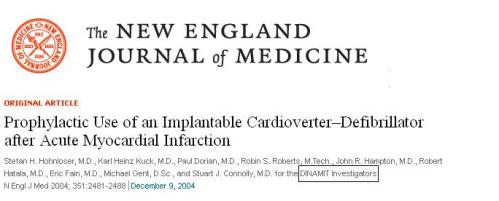
*  This 40 day rule is based on one  large study from Germany. (DINAMIT, 2004  ) . However  few believe  the rule is not absolute. There can be individual   exceptions in high risk patients with critical LV dysfunction .

Other  wise   . . . How do you digest  a death occurring on  35th day  in a patient  who is waiting for an ICD scheduled one week later ?

Reference

DINAMIT trial ICD nejm

Link to  ACC/AHA  Guidelines for ICD Implantation 2013

New development

How to bridge the 40 day gap in really high risk post MI patient ?

We can’t keep him in CCU. Here comes the role of WCD (Wearable cardiovertor defibrillator.) Life vest is  from Zoll . WCD can act like a bridge till the 40 days when the patient becomes eligible for ICD.

http://lifevest.zoll.com/


Read Full Post »

As the medical care advances  human care  has taken the back seat. It is said super specialists  read more and more about less and less ! In the  process they  fail to see the  patients  as a single biological unit  instead as collection of organs .

While  organs in turn are looked as  pile of data.Hence the  treatment they provide lack the soul !

In the prevailing circumstances , how do we ensure  modern medicine  does not interfere with  these vulnerable souls,either to live in peace or leave in peace ?

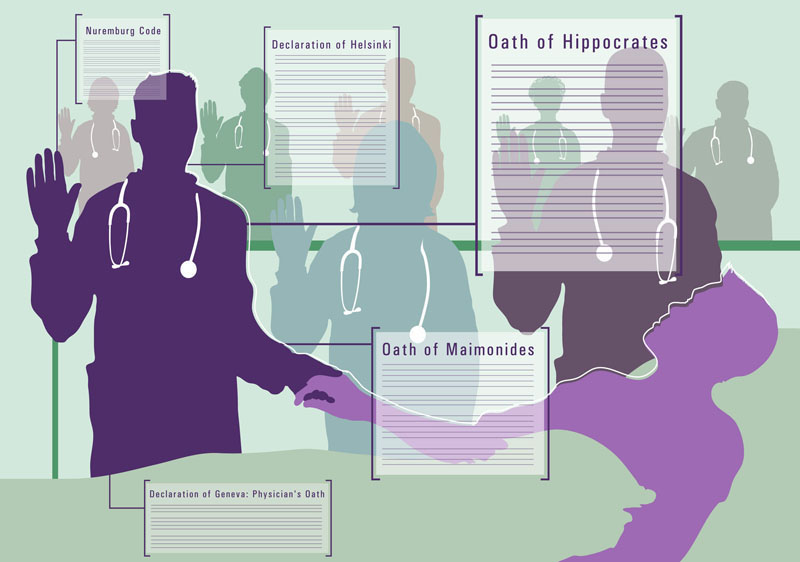
Medical Ethics

Image : Source and Courtesy of http://illuminationstudios.com

It appears doctors are not at fault . The system is  biased towards raw science .Highly trained  doctors are tied down by  both  true and pseudo  scientific Intellect .Often  times they are compelled to do some procedure or interventions  just to  justify  the  premier status of the hospital  .While few do it  to show off  their expertise or  to impress  their peers   others are simply bound by rigid and obsessive  protocols and guidelines . Few others do it  for the burning  desire  of  scientific accomplishment .

One can offer hundred reasons for doing a procedure . . . but we always struggle to justify  with a valid reason for not doing a investigation or  procedure !

In fact , the  concept of appropriateness  criteria came out with good intention .But , it had failed miserably.

The irony is  . . . we need to indulge in something to avoid something.

Example 1 If homocystiene and  hsCRP vanish from the CAD screening industry   Adiponectin and Vitamin D3 comes in with a thunderous applause like a new Hollywood movie  !

Example 2: In cath lab  for leaving alone an insignificant  coronary stenosis , we have to do  another procedure  called FFR to satisfy  scientific ego ! (I know one senior doctor , who left a 80% LAD  lesion for medical management without FFR ( with all his clinical acumen )  was ridiculed for being unscientific !)

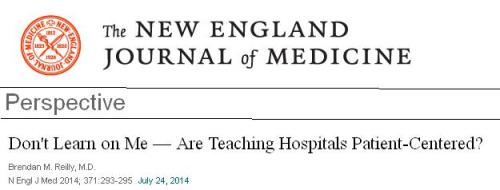
Here is a recent perspective article NEJM has discussed  this  important issue that plague us

Why should big  Tertiary  teaching hospital  are  flooded  with super specialists  which by default shun basic human care ?

Read this article*

Super specialist tertiary care hospital NEJM

*The article I have quoted  may  not  be completely relevant here  . . . It  answers  few of the queries raised!

Read Full Post »

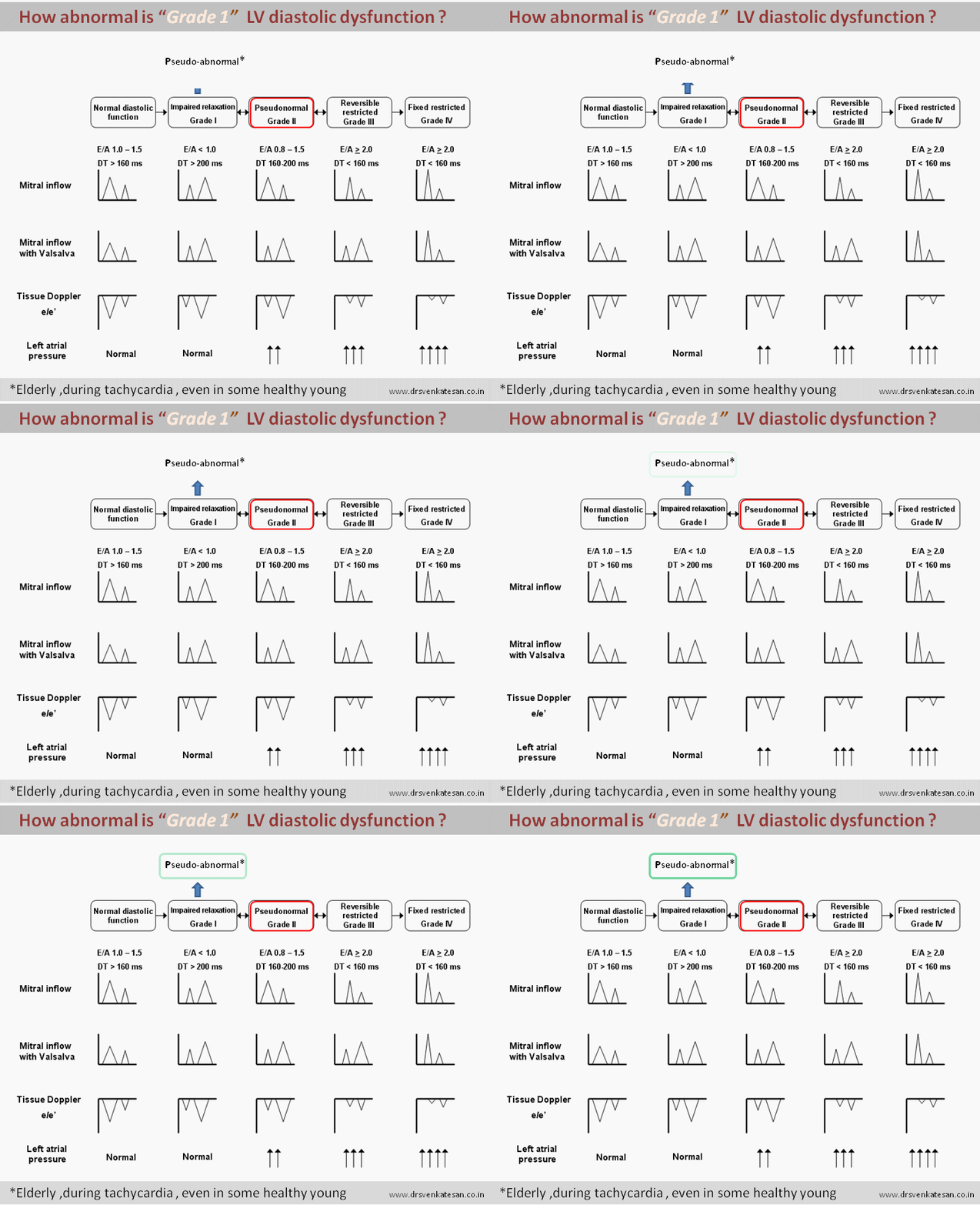
The diastolic mitral filling pattern has been  named and  graded  umpteen times in the last  decade. We believe it has  reached some semblance of clarity.I beg to differ.

pseudo abnormal relaxation grade 1 003

Image template taken  from  http://www.learntheheart.com

There need to be one more  grade between Grade 1 and grade 2 .Grade 1  is defined as A velocity > E velocity . This is the  commonest abnormal pattern and is often  man made.We can’t help it . We have to report it  anyway. Significant number of elderly show this pattern  without any pathology. It simply represents augmented atrial contribution  at times of apparent ventricular stress .

I wish a good chunk  of  grade 1  pattern ,  especially  in elderly or during tachycardia should be labelled  as physiological  grade 1 pattern  (or simply as  normal variant ) . However I would prefer it to be named as  pseudo abnormal pattern* !

* In my experience , currently medicine is taught in a complex manner .Facts that are told  in simple terms are rejected  straightaway . It would seem,too much clarity is not good for  science So,let us get confused one more  time  for the sake of our patients !

Read Full Post »

« Newer Posts - Older Posts »