Feeds:
Posts
Comments

Archive for the ‘STEMI-Primary PCI’ Category

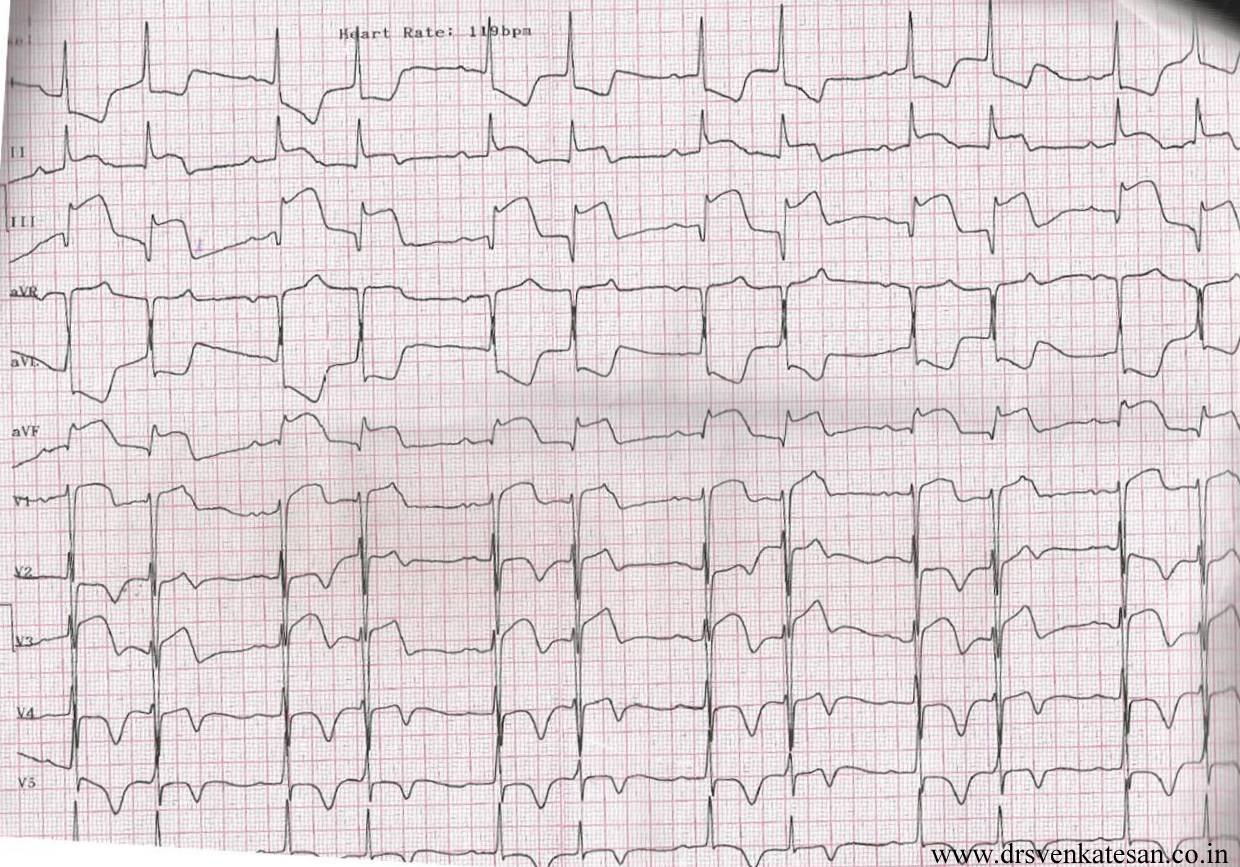
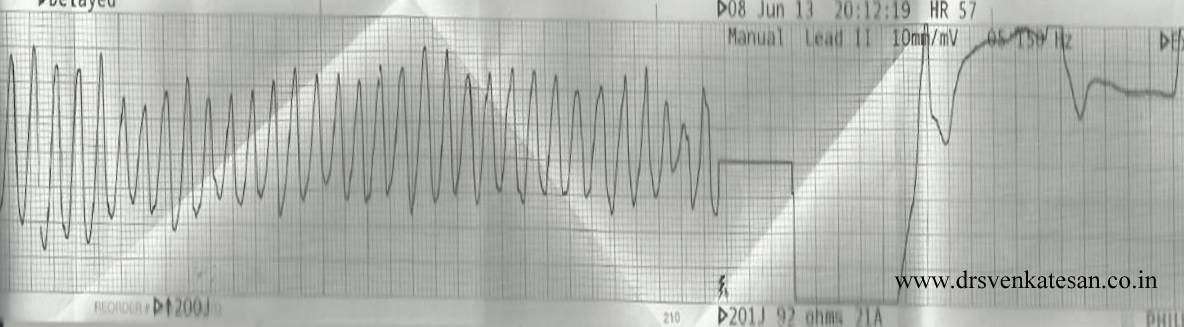
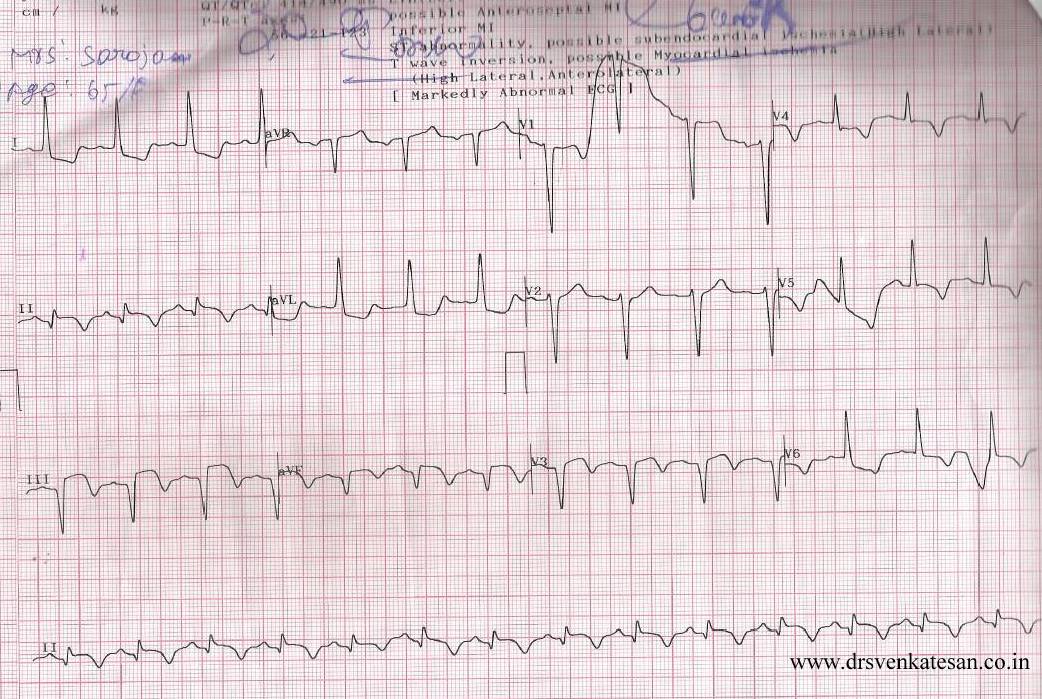
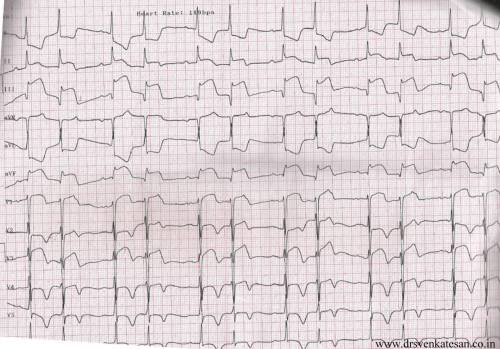
This  is the story of a 55 year old  women ,  who was received  in our CCU  with a  dramatic STEMI (ECG looked like an action potential ) ,  LV  S 3  and  hypotension.    It was impending cardiogenic shock.Since we do not have full fledged primary PCI  program  , thrombolysis was planned. She had  cardiac arrest   immediately after  starting streptokinase infusion . She  was  promptly shocked  and  revived .  The ECG changes rapidly  reversed(ECG -3) . Every other  hemodynamic parameter got stabilised as well . To our surprise   ( few hours later ) this patient  was  so comfortable , sat up on her bed ,  demanded a discharge . (Which was refused of course !)  One week  later coronary angiogram was done, a near complete recannalisation of RCA was documented.

ECG 1 on arrival
Inferior MI 2  

ECG -2 Developed cardiac arrest  10 minutes  after  starting the Streptokinase Infusion

primary VF 2

ECG -3 .Taken few minutes following   the VF

inferior MI evolved 2


Acute myocardial infarction (STEMI)  kills more than a million life every year . Majority of death  happens within an hour of onset of symptoms. Ventricular fibrillation  is the arrhythmia of death. Why this occurs  only in  few , while  many are  immune to it ?

God keeps  this secret  close to his chest ,  how and why  he selects   candidates for this arrhythmia !

Scientists are still  far away  in finding the truth . But , one thing  is obvious .The  moment   coronary artery is totally occluded  , the heart begins a fight  and try  to  get rid of this obstruction . In the process ,  it  goes into convulsion (VF)  with a foolish belief  , it  can shrug of the thrombotic insult . Death often   ensues if  not intervened . (Very rarely  VF can be a non sustained one  and patient survives cardiac arrest !)

VF  as  a electrical  response  to  reperfusion injury .

Often times ,  we witness patients  to  go  for  VF  very early following thrombolysis . The  thrombus in situ is an irritant , it  triggers the inherent fibrinolytic system (Natural TPA included) If it is successful  it opens the occlusion ( atleast partially )  and salvages the myocardium .If the fate is against  the patient , very early reperfusion of IRA triggers  VF  .  If this occurs at home   survival  is  low .If  the VF occur at hospital the probability of survival is near 100 % .

               The  intensity of  natural lytic mechanism  is the major determinant  of   early reperfusion . Ironically  the same  factor   determines  occurrence of the deadly  VF .

I would believe  , the STEMI patients  who die early (even before reaching  the hospital ) are (un) blessed with a  fighting  heart  ! Ironically , the lazy hearts  reach the hospital  alive ! (slow &  steady win the race !) .  Of course , reperfusion  injury is not the only mechanism of VF . Other common suspect is  left main STEMI .

Link to related video “Ignorance based  cardiology ”

https://www.youtube.com/watch?v=J9DH6Vr04es

Final message

While , VF  is  referred  to as arrhythmia  of death , it may  in-fact , represent  a common form  of  reperfusion arrhythmia in  the setting of  STEMI !  .  . .  Hence , it can  Initiate  a new lease of life in  many   lucky ones !  I hope the title of this article  makes sense  !

Read Full Post »

Primary PCI is presumed to be the ultimate  , undisputed reperfusion  strategy  in STEMI .  Still , time and again one study or  other strips down  this   “Numero Uno”  status of pPCI  .  If it is really supreme ,  such awkward  situation shouldn’t arise  too often . More importantly , the  major reason for  dubious real world record of  pPCI  goes beyond  the time and logistic factors (which is considered the only issue  for pPCI by most interventionist ! ) There is something more to it that is invisible ! (Is it the no reflow ?)

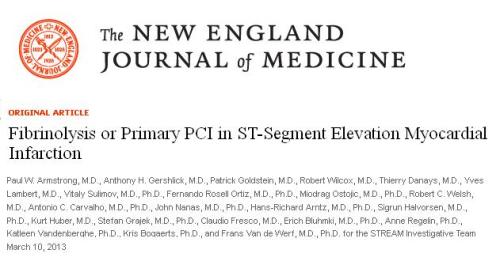
The nearly flawless study from Belgium ( STREAM Just released in ACC 2013/Sanfransisco ) , pre-hopsital or early fibrinolysis has proven to be superior in the prevention major end points at 30 days .

  1. Death
  2. Re-infarction
  3. CHF

STREAM STUDY NEJM PRIMARY PCI VS FIBRINOLYSIS

The major surprise was pre-hospital  fibrinolysis  showed less  incidence of cardiogenic shock . ( pPCI

group had more of this ( 4.4 VS 5.9 %  in STREAM )

Now . . .  shall I make a provocative statement ?

while pPCI may be treatment of choice for cardiogenic shock . . . but it may  also confer a risk of cardiogenic shock in otherwise low risk MI !

Caution  and  conclusion

STREAM population applies strictly to 1 to 3 hour time window . It does not apply to either before or after that ! Simply put,we do not have  guts to compare fibrinolysis and pPCI  in patients who arrive  within one hour into a facility where 24 hour cath lab facility is available .  We call it unethical to do a study like that !  I personally feel it is really unethical  if we do not do a study in this time frame . The reasoning is  simple and very personal .In a  large  Government  hospital   where  we do not have primary PCI program  our net mortality for STEMI never exceeded 7-8 %  over a period of 10 years  , Which  is almost at par with global data on pPCI. (Our door to needle time is an unbelivebale  8-12 minutes ! that  too only streptokinase !)

Adding Further controversy

pPCI  is indeed a superior reperfusion strategy . No one can dispute that .But its superiority  is not  realised  in  every patient  who gets it.  The benefits are accrued if and only if it is  used most judiciously . In Low risk , small regional  , branch vessel STEMI ,  pPCI has never been  shown superior . It is well recognised ,  upto 15 % of STEMI is likely to spontaneously abort or experience very good spontaneous recannalisation . By rushing these  patients very early into cath lab pPCI   meddles with the natural anti fibrinolytic mechanisms . It is this population who  invite all the procedural hazards. .

Is this the reason STREAM had  more  cardiogenic shocks in pPCI limb ?

I think STREAM has  strengthened the case in favor of fibrinolysis in this  ever ending debate .

I would  seriously believe  pPCI is hanging it’s superiority over fibrinolysis with a wafer thin mortality advantage . pPCI may  not be recommended in a routine fashion to all STEMI  population even if they arrive within 6 hours and able to perform the plasty fast .  Science is   . . .  after all . . .  continuing  confrontations with our  assumptions !

Counter point

STREAM is not an exclusive study comparing fibrinolysis and PCI . It is a  study comparing   Pharmaco Invasive approach vs  pure invasive approach . 80 %  of patients in the  fibrinolytic limb ultimately received PCI and  stenting . It simply doesnot make sense to conclude fibrinolysis is superior to PCI . Most of the beneficial  effects on 30 day outcome may reflect the timely PCI  in the lytic group.

//

Read Full Post »

Soft skills in pPCI 

Experience  would tell  us only about 70-80 % of STEMI are truly eligible for a  good  quality pPCI .(Multivessel CAD, Complex bifurcation lesion, difficulty in identifying IRA, No IRA-sapsms , complete spontaneous reperfusion )  The remaining 20-30 %  should , logically  be included in the failed pPCI category .This fact is largely concealed in the literature .

Beware of huge thrombus load in every patient with STEMI .The  contribution of  mechanical occlusion  vs thrombus  (in the total occlusion )  is the single most important factor in determining the intervention strategy.

Deploying a stent in a poorly  prepared (debrided of thrombus  ) lesion confers  further continuous  risk of a STEMI .Stents smartly jail  even large thrombus against the coronary vessels and they release it into the lumen in a controlled fashion  and prolong  the  acute coronary  risk phases

If thrombus aspiration  does a neat job and establishes a good   flow , if the   lumen  appear   good , think twice or even thrice before deploying a stent .It is akin to stent a  zero % lesion and we know it is foolish to do that at any stretch of imagination .(Stenting has never been proven to convert a vulnerable ulcerated lesion into stable one )

IVUS, OCT are not the answer in the above situations  as we are dealing with  emergency coronary  fire fighting !

Of course the intensive anti-platelet   protocols , will take care of  potential after effects of the intra coronary contact sport we play  !    . But . . . there is a limit for every thing. So spend as little time as possible when attempting catheter based reperfusion during STEMI.

Read Full Post »

Dear Cardiologist, why don’t you spare that extra minute in cath lab?

clock

Suddenly  . . .  a primitive ,  common sense based question is asked!  How many seconds are required to optimally dilate and deploy the coronary stent ?

This simple and elegant study from the prestigious CCI journal tries to answer.

cci journal ptca pci balooln inflation time

Highlights

  • 105 patients, 150 lesions , Three different stents were used
  • Cypher Select (55%)  , Xience V (30.%), Taxus Liberté (15.%)
  • Three  balloon inflation timing
  • 5, 15, 25 seconds
  • Complex lesion (B2) formed 26 %

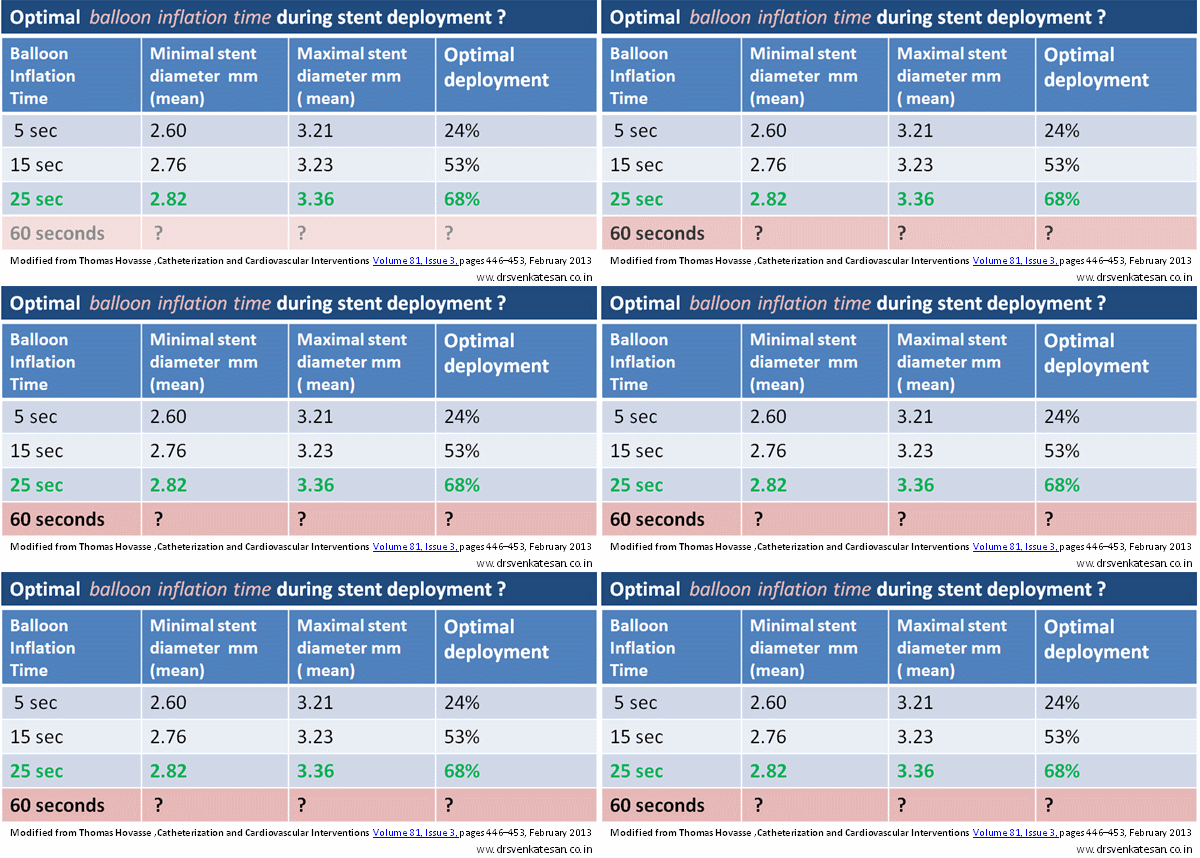
balloon inflation time pci ptca


This paper concludes, duration of stent balloon inflation has a significant impact on stent expansion. Stent deployment for >25 sec is recommended.

It again keeps the vital answer to our guess! Can we inflate it for 60 seconds  ?

Final message

This seemingly simple paper conveys a strong message.

Time is every thing , . . . we have to be fast . . . where we need to  (Time is muscle)  and we have to be slow where we  need to*  

Reference

http://onlinelibrary.wiley.com/doi/10.1002/ccd.23343/abstract

Further questions ?

  1. Can post dilatation be as  efficacious   as that of  stent- balloon  dilatation ?
  2. In difficult lesions  , the sum of  “Pre  / Per / Post”  balloon dilatation  gives  us net inflation  time(NIT)  Does it  add any sense to our understanding of optimal stent deployment  ?

Read Full Post »

Guidelines are meant for simplifying  cardiologist’s life  as well as  ameliorating   patient suffering  . It should also  ensure  improving overall  outcome   with  efficient  use of human resources and  economy .

acc aha guidlines stemi 2013

These guidelines  are written from sophisticated centers  mainly for consumption  in developed countries .Though core  concepts will be same , many recommendations are neither possible nor desirable  at the exact point of delivery  in  less developed countries . Please remember these guidelines are not binding on you .Physician discretion is the ultimate principle in medicine.

So ,  let us read these guidelines apply our mind and try to  indigenise . Get maximum out of it  for the respective population .

Some  of the highlights in this 2013  guidelines
1. Therapeutic hypothermia should be started as soon as possible in comatose patients with STEMI and out-of-hospital cardiac arrest caused by ventricular fibrillation or pulseless ventricular tachycardia, including patients who undergo primary PCI.31–33
(Level of Evidence: B)

2 . Presumed or New onset  LBBB is no longer a Indication for emergency reperfusion

3 . Indication of Primary PCI has the following modification

Primary  pci Guideline in  2013 aha guidelines

Reference

http://circ.ahajournals.org/content/early/2012/12/17/CIR.0b013e3182742cf6.full.pdf+html

Read Full Post »

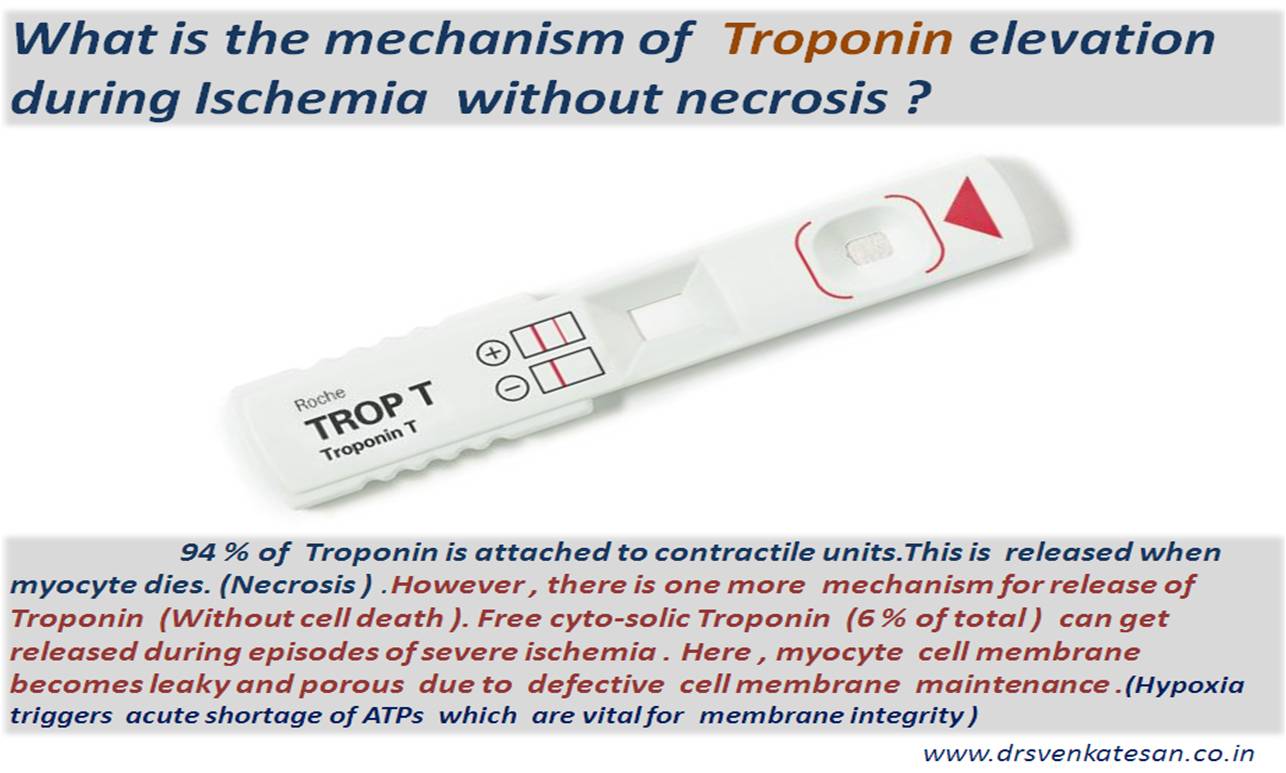
Does Troponin release during  Ischemia  ? (Without myocyte necrosis )

How often this happens ?   . Some believe , it is rare . Here is a possible explanation for it .I feel the mechanism is still not clear . It all depends upon the degree of ischemia.


Read Full Post »

Top 5 conditions that closely mimic and often mistaken for STEMI !

  1. Early repolarisation syndrome
  2. Left bundle branch block(LBBB)/ Left ventricular hypertrophy(LVH)
  3. Hyperkalemia
  4. Pericarditis
  5. Brugada syndrome

ERS

The repolarisation is due to  K + efflux . The  K channel porosity  is subjected to high degree of genetic  variations .If the repolarisation starts even by 10 milli- second earlier,  it would have early take off from descending  limb of R wave  and  the J point  ST segment appear elevated.

  • Common  in young  males . Especially in vago-tonic persons with relative baseline bradycardia
  • The ST elevation in ERS is often global .
  • Concavity is upwards .
  • ST elevation can be dynamic ( Further  confusing the picture ! )
  • On EST it  is expected to the  touch the baseline .
  • Benign entity in most . ( False alarm of STEMI is the major risk !)
  • There is some evidence ERS may confer a risk  of  primary VF ,  if they  experience a true STEMI  (Michel Haïssaguerre 2008  NEJM )

* STEMI in ERS :  The issue becomes too delicate ,  if  a  patient with ERS  develops  a true ACS .   ERS being a common ECG pattern in general population , it is not wise to label  every  chest pain in  ERS patient as benign . Suspicious  ones demand observation in step down units , at least !

LBBB

 “Any patient with  LBBB & chest pain . . . suspect  MI”  .

Unfortunately,  this rule is  too reverently followed by  physician community.  In fact ,  ACC/AHA guidelines  reinforced this behavior ,  as it  added a key word  in  their STEMI guidelines   “New onset”  or   “presumably new onset ”  LBBB is  an  indication for PCI/Thrombolysis    .( Physician presumption is a too delicate thread  to hang  our concepts !   )

               Every LBBB is new onset unless you have  a  documented proof otherwise  . . .   it seems to suggest !

Probably , this  is the reason many of the LBBBs are thrombolysed when they present to ER in an acute fashion . Of course , we can apply criteria of  Sgarbossa  to differentiate !  however flimsy it may appear . It  help us to exclude few benign LBBBs. Still ,  Sgarbossa will  struggle to  differentiate  an acute STEMI  in Chronic LBBB  from an  acute LBBB in  old AWMI .

Simply put . . . even old MIs  are at risk of  acute intervention if they have LBBB  and vague chest pain !

How to overcome this ?  Always rely on clinical  features  . If  STEMI is causing the LBBB ,  it  should be a large extensive one and you can not  expect the patient to be  comfortable .(Logic  would suggest necrosis of  large  parts of IVS is necessary to cause LBBB ) Chronic  LBBBs  are relatively comfortable  .

Of course , there  is one another  issue to comprehend  ie  transient ischemic LBBB .We do not know the true incidence  and long-term significance of this entity . Here , LBBB is  not due to necrosis of  the bundle but due to ischemia . (Almost impossible to differentiate it from  rate dependent LBBB  with  aberrancy  )

Role of enzymes and Echocardiogram in LBBB  and suspected STEMI .

You can always ask  for   Troponin  T / CPK MB .(They are helpful only  if 3 hours have elapsed , can we afford to wait ? ) . LBBB  due to STEMI  will  purge  a large quantum of cardiac enzymes from the infarcted zone . (So a marginal elevation is not going to help!)

Unfortunately,  LBBB  can induce wall motion defect in septum that may awkwardly simulate an ischemic wall motion. Even experts have erred in this . One clue  is,  the motion defects  can  not  extend   into anterior wall . It  is confined to septum ,the second clue  is a little delayed  post QRS  thickening of IVS (Septal beaking sign will vouch  for benign LBBB with fair degree of success  )

LVH

  • LVH can mimic a STEMI due to secondary ST/T changes . (Secondary to tall R wave )
  • LVH with incomplete LBBB  – A very common association that can further elevate ST segment in v1 to v3 .
  • Left ventricular hypertrophy  mimics old MI as poor R wave progression in V1 to  V3.
  • Contrary to our belief even Inferior  leads can  show q waves due to  inferior  septal hypertrophy.

Hyperkalemia.

With aging population and rampant  acute and chronic renal disorders it is becoming  a daily affair to get calls from medical units for ECG changes .We know  the rapidity of  efflux  potassium is responsible for ventricular re-polarisation .Phase 2, and 3 are K + exit zones. This is the same phase ST segment and T wave are inscribed.In hyperkalemia  K + accumulates inside the cell and keep  ST/T  segment  elevated .T wave also  becomes tall . It can mimic  both as hyper acute  STEMI .

Read a related article (Dialyisable current of Injury )

Pericarditis

  • ST elevation is not confined to an arterial territory
  • Can be global .(Regional ST elevation  does not exclude pericarditis)
  • ST elevation is concave upwards as in ERS

Link to Read regional pericarditis
Brugada syndrome

Brugada syndrome  is  an ECG -Clinical complex in which ST elevation in pre-cardial leads is associated with  ventricular arrhythmia. The defect lies in sodium channel . It reflects  a mis -match between RV and LV epicardial repolarisation forces .It keeps the RV epi-cardial current afloat and  the pre-cardial leads  facing the RV records ST elevation that  mimics  STEMI. It often  shows  a RBBB pattern and varying patterns of ST morphology  . The  ST segment is  also  subjected to dynamism  , due to change in autonomic tone and myocardial temperature  .(Febrile VTs)

After thoughts

Other close contenders for the top 5 slots

Myocarditis

Acute pulmonary embolism

Dissection of aorta

More

  • Acute stroke (Neurogenic ST elevation )
  • Stress cardiomyopathy (Takot Subo )
  • Acute abdominal conditions mimicking inferior STEMI.
  • Panic attacks /Anxiety states / chronic anti psychotic  medications which are known to elevate ST segments.
  • Contusion chest

(Cocaine hearts / Coronary arterial spasm / LV dyskinetic segments  and  LV aneurysms  were not nominees ! )

Read Full Post »

Failed thrombolysis is a well debated concept, while failed primary PCI is a conveniently neglected phenomenon .

How to assess successful reperfusion following PCI or thrombolysis?

I do not know how many  of us know this vital fact !

Coronary angiogram is squarely beaten by the humble  ECG in assessing the effectiveness of myocardial  reperfusion . This is not hard to understand as  coronary angiogram *  can  tell us only  about epicardial  patency ,  while ECG  sends vital perfusion  data from within the  myocytes ! Which do you  think is superior ?

And now  interventional cardiologist have realised this fact . they  measure the ST segment  regression instantly once the primary  PCI is  completed . How ?  An ECG is recorded from  right inside the infarct  related artery .

*Of course myocardial blush score , TIMI frame count are poor alternatives !

This paper just published in CCI is  a fascinating revelation .

http://onlinelibrary.wiley.com/doi/10.1002/ccd.23455/abstract

Read Full Post »

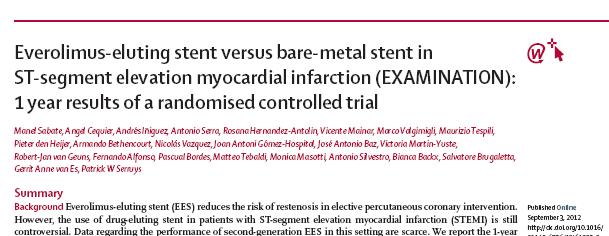
DES is  a revolutionary coronary support device ,   but it was always a suspect  when it came to STEMI and primary PCI .

How good and safe is DES in STEMI ?

Cardiologist were always beating around the bush for a specific answer to this question.

The general  principles and background

DES was thought to be unsafe in a thrombotic milieu .(DES was notorious for acute stent thrombosis) .Still ,first generation DES ( Sirolimus and Paclitaxel ) were thought to be unsafe in STEMI .However anecdotal evidence suggested DES reduced stent thrombosis  . .Then came the 2nd generation DES (Zotarolimus and Everolimus ) . There was a  excitement every where .The logic  was   “If first generation of DES is not good . 2nd generation  must be good”   What a way to think scientifically .Wisdom  did not prevail  . Many started using ZOTA /EVERO  in STEMI  .(Medtronic and Abbot were silently enjoying the scenario !)  And now finally Everolimus was tested with BMS in  STEMI .

That is EXAMINATION trial for you  . . . Published in Lancet  September 2012

It  has found  2nd Generation DES are not superior to BMS in STEMI in terms of  patient outcome . The study broadly concluded  that  the patient related parameter did not show any significant difference  while  stent related outcome seemed  fare better.

Why this patient – stent dissociation ?

How can large group of patient who  have more stent thrombosis and TVR ,  still  no correspondingly increased ACS or deaths

Does this mean  these stent thrombosis are safe events ?

The answer lies in the fundamentals. The  stents  represent  anatomical  correction  , while  the patient  outcome depend   more on physiology ( flow )  so we are back to square one  to the fundamental  coronary conflict  ie  improving anatomy need not impact physiology.

Critical comments

After reading the EXAMINATION  trial  I asked my third year fellow .

What was  the re-stenosis rate  in DES vs BMS  at 6 months ?

He said this study never analysed the issue of re-stenosis  .

I asked him , Are you sure ?

He confirmed it with a firm Yes.   And then , I found this

                                   A shocking omission for a study which is supposed to answer a   critical question whether
                                   DES is good for   STEMI in the long term
Final message
What a way to conduct a large  land mark study ?
This  study   never bothered to find out the re-stenosis rate  with DES  after  primary PCI and compare it with BMS  .
In fact they have conveniently mentioned ,  follow up angiogram was not part of the study protocol .
I concluded  at the end of journal  review meet   , that  this  EXAMINATION  was not properly conducted   and DES may come back with a vengeance   in the near future !

Read Full Post »

.The  forgotten “Gem of a study” from lancet 2002 .

The fight between Primary angioplasty and thrombolysis was actually over in 2002 itself. But the cardiology community failed to ,( rather reluctant ) to accept the truth. The issue is being dragged without any useful purpose (for the patient !)  still trying to keep up the non existing superiority of pPCI.

A bolus thrombolytic agent (TPA/RPA) or even streptokinase  can do almost the same if not better than a highly complex procedure called  Primary PCI with lots of logistics issues and most important an unacceptable early procedure related  hazard.

Timely lysis can kick pPCI out of the ring . . . in three aspects with 100% certainty !

1.If symptom to TIMI 2/3 flow in IRA is the true parameter of success .pPCI can never ever come closer to pre hospital lysis.

2.The poor lytics do not differentiate in the efficacy . It simply acts whoever administer it. While results of pPCI are never reproducible and lots of expertise involved.

3.Thrombolytic agents never need to bother  about the complexity of lesions , (or  where is the IRA dilemma ? Is it a CTO or ATO confusion etc ) for the simple reason it doesn’t need to think before acting. It does its job fast.

What did CAPTIM prove ?

  • It proved pPCI has no mortality advantage over pre hospital lysis.
  • Perhaps the most Important conclusion from CAPTIM is pre hospital lysis significantly reduced  number of new onset cardiogenic shock . This alone nullifies the self inflicted pseudoscientific delay wasting the golden hour in the process ! (By the way who fixed the arbitrary acceptable delay conferred to pPCI of I hour .The whole evidence base for this delay to be scrutinised in view of CAPTIM !)

Final message

It is an irony,  a simple intravenous push of a drug (Thrombolytic agent)  very early after an STEMI can save many patients and reduce complication rate .But because it is simple ,it is considered  inferior .

Probably the only role for pPCI is high risk complicated STEMI at presentation or after an attempt of lysis has not stabilised the patient.(Where its referred to as Pharamco Invasive strategy )

2018 update

This post was originally posted in 2008. Now as I see this in 2018 . It is shocking  to know we haven’t  learnt any lesson from this study for 16 years since its published.

In this era of medical  commerce and  simple ,cheap ,and effective treatment can never compete with  sophisticated , glamorous , less effective  treatment modalities !

Read the full version of CAPTIM and comments

Comparison of Angioplasty and Prehospital Thrombolysis in Acute Myocardial Infarction (CAPTIM) study group, are published in the September 14, 2002 issue of theLancet.

Primary angioplasty “no better” than prehospital fibrinolysis: CAPTIM

London, UK – In a finding that would appear to go against the swelling tide of support for primary angioplasty as the treatment of choice for acute MI, investigators comparing primary angioplasty with prehospital administration of alteplase with rescue angioplasty have concluded that the 2 strategies are comparable. The results, from the Comparison of Angioplasty and Prehospital Thrombolysis in Acute Myocardial Infarction(CAPTIM) study group, are published in the September 14, 2002 issue of theLancet.1

“Our findings indicate that primary angioplasty is no better than prehospital fibrinolysis followed by transfer for possible emergency coronary angioplasty in patients presenting within 6 hours of an acute myocardial infarction,” the researchers, led by Dr Eric Bonnefoy and Dr Paul Touboul(Hopital Louis Pradel, Hospices Civils de Lyon, Lyon, France), write.

However, they point out that cessation of funding during the trial resulted in a lower-than-expected enrollment, 840 of 1200 planned patients, reducing their statistical power. “The CI (confidence interval) for the primary end point shows that there could be a real difference in the treatment effects,” they write.

Still, the researchers feel their conclusion is valid. “This was and is for us a very pragmatic question for our care system in France,” Bonnefoy told heartwire. “Is our current management, with prehospital thrombolysis with transfer, in a time when primary angioplasty is promoted as the best-of-the-best treatment, still sufficient? Even if the power of the study is lower than expected, we think that we have our answer, and we can go on with that practice.”

The strategy also means less strain on their cath labs, Bonnefoy added, since only 1 in 4 patients underwent rescue angioplasty. A cost analysis comparing the 2 strategies is currently being carried out.

Earlier thrombolysisPrevious studies comparing primary angioplasty with in-hospital thrombolysis have shown a “definite, albeit modest” benefit of angioplasty over thrombolysis, with lower rates of recurrent infarction and higher patency rates, Bonnefoy et al write. However, it does impose additional treatment delays, and “delay to treatment is an essential consideration for any revascularization strategy.”
In France, where this multicenter trial was carried out, ambulance crews include a physician, and so thrombolysis with intravenous tPA is possible in the prehospital setting. In this trial, they randomized MI patients to either prehospital administration of accelerated alteplase or primary angioplasty and transferred all of the patients to a center where emergency angioplasty could be carried out if it were determined that thrombolysis had not been successful.
The primary end point was a composite of death, nonfatal reinfarction, and nonfatal disabling stroke at 30 days, with analysis by intention to treat.
Of the 840 patients, 419 were randomized to prehospital fibrinolysis and 421 to primary angioplasty. Rescue angioplasty was used “liberally,” they write, in 26% of patients assigned to fibrinolysis.

Time to treatment, as expected, was longer in the primary angioplasty group: the median delay between onset of symptoms and treatment was 130 minutes in the prehospital fibrinolysis group, and time to first balloon inflation was 190 minutes in the angioplasty group.

At 30 days, there was no significant difference in the primary end point between groups. Overall mortality was lower than expected, they note. Deaths were fewer in the prehospital thrombolysis group, but mortality was not significantly different between groups. There was a trend toward less reinfarction and less disabling stroke favoring the primary angioplasty strategy.

CAPTIM: Primary end point

Outcome    


Prehospital fibrinolysis    


Primary angioplasty    


Risk difference (95% CI)    


p    


Composite end point 8.2% 6.2% 1.96
(-1.53-5.46)
0.29
Mortality 3.8% 4.8% -0.93
(-3.67-1.81)
0.61
Reinfarction 3.7% 1.7% 1.99
(-0.27-4.24)
0.13
Disabling stroke 1.0% 0 1.00
(0.02-1.97
0.12

To download table as a slide, click on slide logo below

Among secondary end points, the researchers noted a nonsignificant trend toward a higher frequency of cardiogenic shockthe most common cause of death in this studyin the primary angioplasty group, noting that cardiogenic shock between randomization and hospital admission occurred only in that group.

The CAPTIM results were first presented at the European Society of Cardiology Congress in September 2001 and reported by heartwire.


Strong wordsIn an accompanying commentary, Dr Gregg W Stone (Lenox Hill Heart and Vascular Institute, New York, NY) calls the CAPTIM results “the latest salvo in the ‘primary PTCA vs thrombolytic therapy wars’,” a “well-designed and carried out” trial.2
“Unfortunately,” because of funding issues and slow enrollment, the trial ended before the planned recruitment of 1200 patients that would have been required to show a 40% reduction in the primary end point with primary PTCA, he writes. “Nonetheless, the results demonstrate a trend toward a 24% relative reduction in the occurrence of adverse events favoring the interventional strategy, driven by strong reductions in reinfarction and stroke (which would be expected, after all, to be largely independent of reperfusion time),” Stone notes.
He attributes the lack of mortality benefit from primary angioplasty to the lower-than-expected mortality risk in this population, since the survival benefit of primary angioplasty is seen primarily in the highest-risk patients, the elderly and those with anterior MIs or shock. The lack of mortality benefit, though, “does not diminish the clinical relevance of fewer strokes, reinfarctions, a reduction in urgent revascularization procedures, and the shorter hospital stay” seen with the interventional strategy in this and other studies, he writes.
Perhaps the most novel finding is the reduction in early-onset cardiogenic shock with prehospital thrombolysis, a result that “adds fuel to the fire calling for facilitated primary PTCA trials.” However, several trials of the combined approach to date have shown it to be either inferior to or no better than primary PTCA, he notes. Even in CAPTIM, prehospital thrombolysis was supported by rescue angioplasty in 26% of patients, and Stone speculates these patients may have been “better off” if they had simply been transferred for routine immediate primary PTCA.

“Thus, until the large trials of facilitated PTCA are completed (none of which have even begun enrolling), the best therapy for most patients with evolving AMI should no longer be debated; administer antiplatelet therapy (aspirin, a thienopyridine, and possibly abciximab), withhold thrombolytic therapy, and transfer the patient for primary PTCA, regardless of whether the nearest catheterization suite is 3 floors or 3 hours away,” Stone concludes.

“To do less should no longer be considered standard care. Strong words, yes, but it is time for a wake-up call.”


CAPTIM researchers respondAsked to respond, Bonnefoy pointed out that “Dr Stone is surely a primary angioplastician and very convinced, but it’s quite ideological. CAPTIM is quite pragmatic. His arguments are acceptable, but they are not convincing; that is his opinion rather than scientific data.”
Bonnefoy asserts that no study has clearly demonstrated the superiority in terms of mortality of primary angioplasty over prehospital thrombolysis. “And in CAPTIM, we have the surprise and intriguing observation to have lower mortality in the prehospital thrombolysis groupit may be hazard, but it is present.”
Moreover, while high-risk patients may benefit from primary angioplasty, high-risk patients do not represent the majority of the MI population. In patients such as those in the CAPTIM study, he said, “our conclusions are quite valid.”


Sources
  1. Primary angioplasty versus prehospital fibrinolysis in acute myocardial infarction: a randomized study2002; 360:825-829
  2. Primary angioplasty versus “earlier” thrombolysis–time for a wake-up call2002; 360:814-815
Read Full Post »

« Newer Posts