Feeds:
Posts
Comments

Preamble

The much published TRANSFER -AMI study  has few important queries to ponder about.It was supposed to test the role of routine PCI following  thrombolysis. In other words it compared  rescue only strategy with routine strategy.The caveat is , even among  failed thrombolysis, the   rescue strategy has not convincingly proven superior to medical management  (if the time is lapsed ) as much of the damage is done .

In essence , Acute MI is  more about time management than drug or cath lab management

  1. Why the 67 % of  standard therapy cohort underwent PCI. Technically , you are supposed to transfer for rescue only if there is a  failed thrombolysis ?That is the standard approach , if  most of the cases are any way land up in cath lab , then you are trying to compare two similar groups .
  2. Why the rate of   failed thrombolyis with TNK-TPA in both arms not disclosed ?
  3. How can a 92% of study population be in class 1 Killip still considered to be high risk group ?
  4. Why the recurrent ischemia  was very vaguely  defined and still included and clubbed with primary end point along with deaths. If only recurrent ischemia was removed from primary end point . . .this study will straight away land in a regret bin.
  5. Why there were 6 additional deaths at 30 days  in routine early  PCI group ,  What was he cause of death ? Mind you these deaths have happened in a 92 %  Killip class  one cohort . Is it  not important ? The trend looks vitally   significant .We can not afford take refuge under a false  statistical roof .
  6. How many patients died or  developed MI  because of the early PCI in-spite of having  successful thrombolysis.This again could be vital . Complications during intervention  for a failed thrombolysis may be acceptable. While ,complications , when we try to  improve upon the already  successful thrombolysis is simply not acceptable .

Will the investigators share their experience ?

Finally

Why the title of the paper says it is about “Routine angioplasty” and  the conclusion emphasizes  it is indeed   “high risk subsets ofangioplasty” (While the study itself involves a 92 %  least risk Killip class 1 ) .  Why this double dose of confusion ?  (Is it deliberate  ! Which i think is unlikely )

NEJM please take note of this  . . .

All that glitters  are  not natural glitter . . .some are made to glitter !

NSTEMI is a  common clinical problems in CCU.

When we say  NSTEMI it can mean any of the following

  • NSTEMI with ST depression
  • NSTEMI with T  wave Inversion
  • NSTEMI with Biphasic T wave
  • NSTEMI with normal ECG
  • The irony   called STEMI evolving as  NSTEMI**

By default most of  us think ,  if it is NSTEMI  . . . there  must be ST depression. This thinking is  not logical but traditional. Still,   ST depression may be the  common presentation. NSTEMI with ST depression  has much worse outcome than other forms.

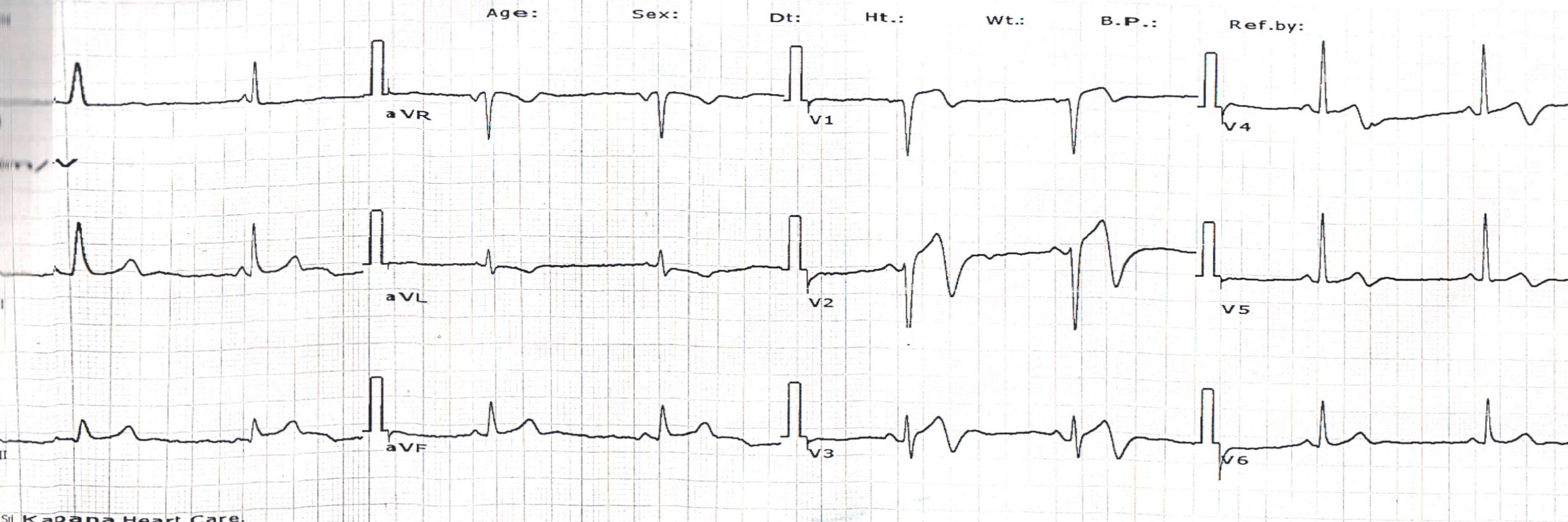
The following ECG is from a 45 year old man with a vague mid sternal  chest pain for 48 hours.

The unusual type of NSTEMI with Bi-phasic T waves

His echo showed wall motion defect in LCX territory .A diagnosis of NSTEMI was made.The predominant finding was biphasic T waves .

**One may wonder  why can’t we call this ECG as a  Classical STEMI ?

There is a 2mm  ST elevation ,  with a infarct as well  ? But , the point  here  is there is no business for T waves to get bi-phasic or inverted in the early hours  of  a  classical STEMI .

This  exactly has happened here. Hence we can not call  the above event as  STEMI . Instead it  is ,  STEMI   evolving into NSTEMI . So  a combination of  features of STEMI/NSTEMI occur together. The best description for above  entity is  STEMI in transition to Non Q MI

Read the related article in my site  Is the terminology of Non Q MI still relevant or obsolete ?

What happens to vegetation following  successful therapy ?

  1. It regresses almost completely  and become sterile
  2. It regresses about 50 % volume   but continue to harbor  live  viable bacteria
  3. Gets sterile   but  does not regress ,
  4. Vegetation vanishes completely .Gets dissolved circulation as micro particles.
  5. Appears slightly bulky.

Answer.

Each of the above statement can be true in different patients  at  / different times.  However No  1, is generally the dominant theme.

  • Most of the small vegetations disappear fully.
  • Large vegetations (>2 cm) almost never disappear fully .
  • Fungal vegetation is notoriously known  for a long haul battle
  • Systemic embolism is an important mode of  vegetation clearance from heart.
  • Size of vegetation is an independent indication for surgery .
  • Combination of vegetation with super added layer of  thrombus is common.The thrombus lyses in due course , mimicking thrombus regression.
  • Paradoxically healed vegetations may appear dense in  2 D echocadiography ,which may be wrongly interpreted as a growing vegetation.
  • The risk of recurrent vegetation formation remains till the raw area is completely endothelised.Hence antibiotics are given up to 4-6 weeks.

Persistent  culture negativity may be a  good index  for  successful management . But a negative blood culture  does not in any – way imply  absence of vegetation.

http://www.ncbi.nlm.nih.gov/sites/entrez?Db=pubmed&Cmd=Retrieve&list_uids=7985602&dopt=abstractplus

T waves attract less  attention in STEMI ,except for the  fact   tall T waves  implies   hyper acute phase of  STEMI.

What is the duration of hyper acute phase ?

  1. Few seconds
  2. Few minutes
  3. An hour
  4. Few hours
  5. Any of the above

Answer

No one exactly knows  .It can  be highly variable .  So , 5  could be  the correct answer .  

 * Most importantly  hyper acute phase  need not occur in all patients with STEMI as suggested in experimental models.

Some  observations in T wave behavior in STEMI

Mechanism of hyper acute  T waves

It is the pottsium channel dynamics.Transient intracellular hyperkalemia  is thought to be responsible.

T wave as marker of  reperfusion

Inverted T wave in precordial leads are a good marker of IRA patency  especially in LAD

Slowly evolving STEMI

This is relatively  new concept . STEMI with a prolonged hyper acute phase  ,  ie ,  T waves ” dilly dallying”  for hours or even few days have been recognised. (This was  refered  to pre-infarction angina in the past )

This sort of T wave behavior makes it difficult to diagnose STEMI.Enzymes will help , still  thrombolytic guidelines  demand us to wait till ST elevation to occur. This is  unfortunate .But as physicians we are  justified to thrombolyse tall T waves with a clinical ACS .The other simple solution is to shift the patient to cath lab to find what exactly is happening in the LAD ! 

Now , what is new about  T waves in STEMI ?

It is  the localizing value  in LAD infarct

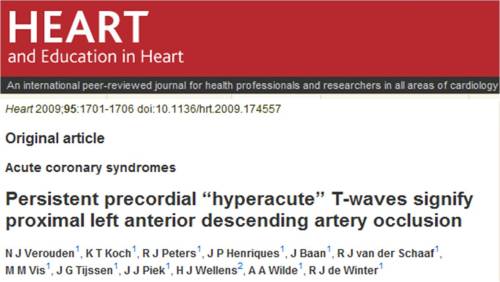
A tall persistent  hyper acute T wave  helps us to localise a LAD lesion .This paper from Netherlands ,  clearly  confirms this observation. The study was done from a primary PCI cohort,   a perfect setting to assess the  T wave behavior  in the early minutes /hours of  STEMI .
Other mysteries about T waves in STEMI

Does hyperacute T waves  occur in infero-posterior STEMI ?

I would believe it is very rare .Our CCU has not seen any tall T waves in inferior lead. Further analysis of the  data from the  above study could answer this question .

How often a  hyperacute T waves transform into NSTEMI ?

This again is not clear.Most of the hyper acute T will evolve as STEMI .But  , nothing prevents it to evolve as NSTEMI a well . After all , a hyper acute T   MI can  spontaneously lyse in a lucky few , ( Who has that critical  mass of natural  circulating TPA )  .If  these natural lytic forces are only partially successful , it may evolve into de nova NSTEMI.

Bi-phasic T waves in ACS.

A benign looking T waves with terminal negativity in precordial leads  can some times be a deadly marker of critical LAD disease.This has been notorious to cause deaths in young men which often correlates with the widow maker lesion in LAD.

What is a slowly evolving STEMI ?

Prolonged tall T wave phase  possibly   indicate , the myocardium is relatively resistant to hypoxic damage .

The most bizarre aspect in our understanding about ACS pathophysiology  is the concept of  time window , based on which , all our  ACS therapeutics revolve !

Does all myocardial   cells  have a same ischemic shelf  life ?  Can some patients  be  blessed with  resistant myocardial cells   when confronted with hypoxia or ischemia ?

                                 It is well-known  , in some hearts ,  the  muscles go for necrosis within  30 minutes of  ischemia,  while some hearts can not be infarcted even after 24 hours of occlusion .So , slowly evolving STEMI is a feature of  myocardial ischemic resistance .This is not  a new phenomenon as we have extensively studied about the concept   ischemic preconditioning .

We wonder there is something more to it . . .  the quantum of preconditioning  can be inherited .Further  , we are grossly ignorant about  the molecular secrets of  non ischemic metabolic  preconditioning  .

Final message

                         T waves attract less  attention in STEMI . Cardiologists are often tuned to look only the ST segment , after all ,  ACS  itself is classified based on  the behavior of this segment.(STEMI/NSTEMI) . We need to recognise ,there is a significant subset of ACS   affecting exclusively T waves.  Shall we call T elevation  MI ? ( TEMI )

Do not ignore T waves in STEMI. It has more hidden electrophysiological  treasures that  is waiting to be explored .
Great things happen in India nowadays  .Economy is growing    at  9% , the growth of  automobile industry is  fastest in the world. But in  scientific  research and development  it   has  been traditionally lagging behind . Things are set to change. The medical science , (If you want to call it as industry it is fine !)  especially  the imaging science is making rapid strides. The proliferation of  private and corporate hospitals and institutes   has helped us practice the latest .

Pulmonary atresia with VSD is a rare congenital disease where  there is partial or  total (chaotic  )pulmonary arterial blood supply .

When the pulmonary  artery becomes atretic , what will the lung do ?

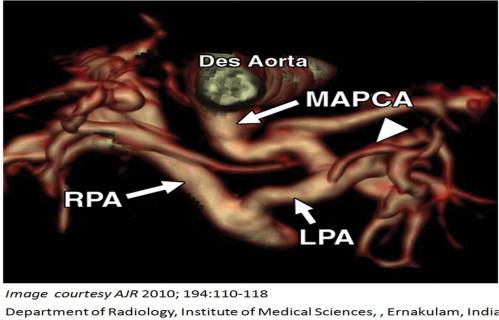
It has to get perfused somehow ! It tries to snatch the  blood from the aorta  in whatever  possible manner . Depending on the severity of pulmonary atresia  , there  can be  a total anomalous pulmonary  arterial supply (Type 4 ) .Here , few twigs directly originate  from Aorta, few from branches of  Aorta  and sometimes bilateral  PDA etc .These are collectively called major arotopulmonary collateral  (MAPCAS) .In fact differentiating a PDA from a MAPCA can be extremely difficult .(It has only academic purpose though !)

Hither to ,  visualising  the  MAPCAS was a  huge  task . Aortogram with selective cannulation of MAPCA  was  neccessary.Now,  with the advent of  MDCT we can get some stunning  images  of these collaterals non invasively.

Why is visualizing and delineating MAPCA anatomy important ?

This will facilitate the surgeon to plan  the  unification of pulmonary  arterial flow    and reenginnering the pulmonary circulation  (with or with  out  conduits)

Here is a rare  publication originating from India  in  American journal of radiology  . An  exclusive   article  with  CT scan  images of the  defect .

Amrita  Institute , from  the southern   Indian  state of  Kerala (  also known as God’s  own country )  is doing a phenomenal  cardiology  work  especially  in pediatric cardiology.

Three cheers to the team which published this  master piece . With the courtesy of   AJR the link to the article is placed here.

Rheumatic heart disease is rampant in India.  Advanced forms of mitral stenosis are  still common.

Critical mitral stenosis with LA clot formation is often seen.

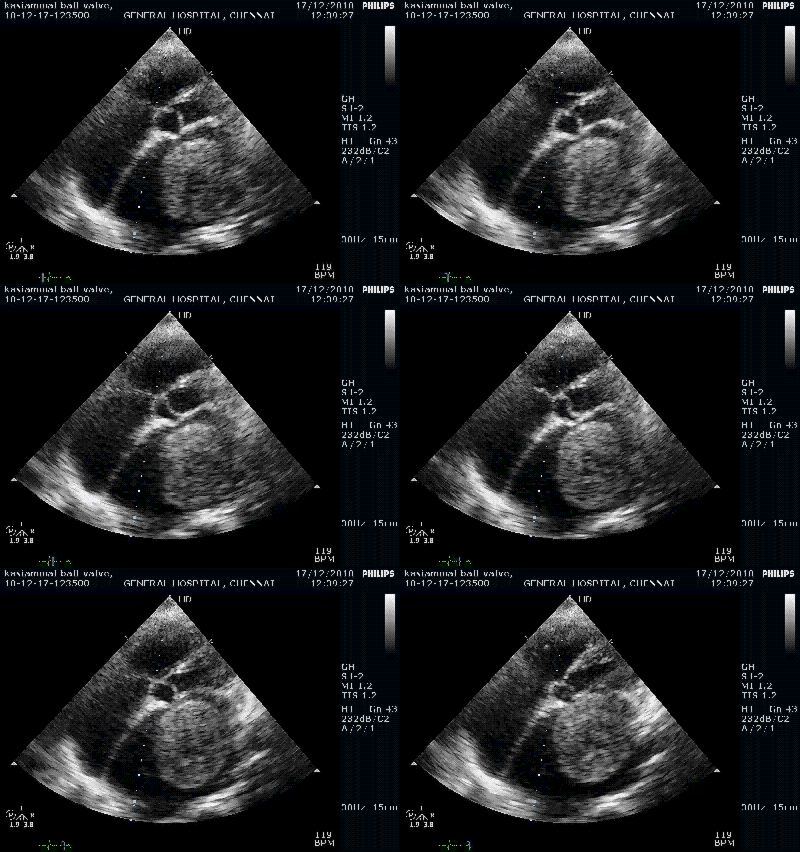
But here is a  women in late twenties  presenting for the first time with syncope .

And what  you see inside is  not a fiction  . . .

Left atrial clot occupying the whole cavity ! Where is the blood bound for left ventricle ?

4 chamber view

Luckily the clot is   so  big and MVO is less than 1 sq cm. It is highly unlikely the LA clot can negotiate the orifice.

Small fragments can dislodge .This patient developed syncope whenever she bends and lie down at a particular position.

What needs to be done in this patient  ?

Can it be lysed ? No ,Emergency surgery is required with concomitant mitral valvotomy or mitral valve replacement.

Is there a temporary aortic filter available to prevent systemic emboli from heart  ?

Distal protection devices are  available only temporarily in the coronaries and  carotids during interventional procedures.There is no aortic protection devices  for LA,LV clots in high risk patients .  When IVC filters  are used  block a potential pulmonary   clot why not aortic filters  for preventing systemic emboli  ?

Why we have not thought about  this  . . . is  surprising . May be intensive anti coagulation is as effective .

Some say medicine is a funny science . . .  it is true  at times. It will remain so , as long as we convert  a fact into a myth and a myth into a fact at our convenience . It  is  often   fueled  by the  whims and fancies of modern research  ! This phenomenon is happening in a regular  fashion  for  many decades now.

The number one killer disease of heart  is  the atherosclerosis  . Atherosclerosis means hardening  of arteries. The advent of coronary  calcium score with CT scans ,  it became a craze among many physicians . (It was   replaced later  by 64 /128 slice MDCT with unprecedented  commercial over tones !)

How can we  conquer the atherosclerosis ?   when the enigma of calcium in coronary artery is yet  to be solved.

The next few decades will be crucial   as  we are  trying to find answer to the following question .

Is  coronary calcium  good ,  bad or neutral   in CAD  ?

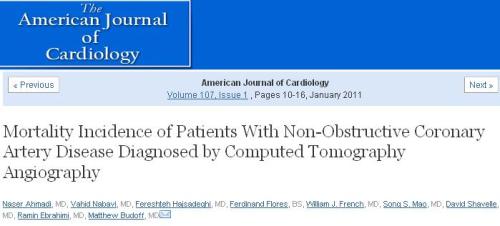
This article in American journal article begins the new year 2011  with good news for people , who show some calcium in their plaques.

What makes a plaque vulnerable ?

Plaque contents , it’s distribution and consistency make it vulnerable. Soft spots  formed by   lipids   may  result in  plaque cracks and fissure.   Semi solid  , mixed  ,  gel like soft  plaques   are dangerously prone for  rupture . Oxidation of LDL,  LDL  liquefaction and tissue metalloprotinase , thickness of fibrin caps , all promote softening.  If none of above  mechanism is operative in a given patient , the   plaque becomes  stiff and hard.

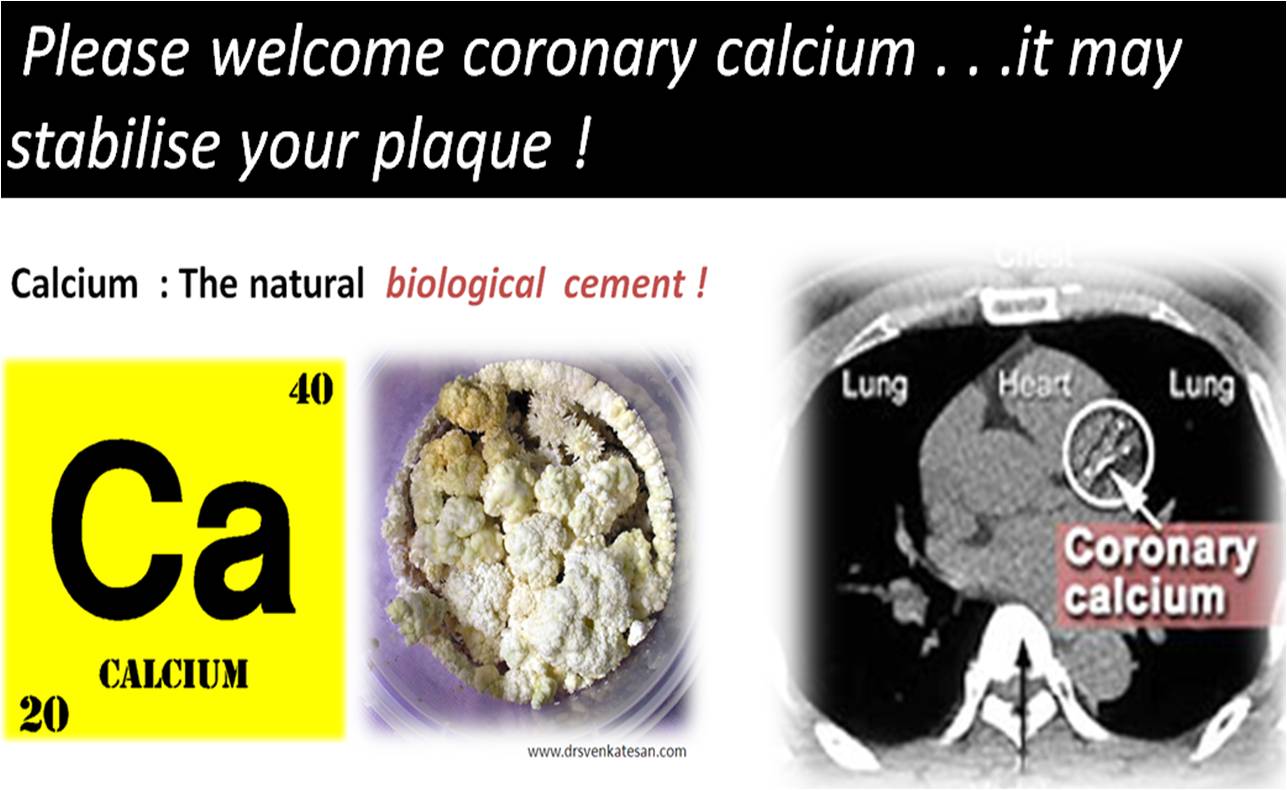
Calcification is the ultimate in hardening . Calcified plaque  is resistant to mechanical deformation.If  stiff  plaques   are less vulnerable , hard plaques ( ie calcified  plaques ) must be least  vulnerable . Calcification   can be called an end result of coronary atherosclerosis.

So , calcified  coronary artery  can be referred to as  a failed  mission of  atherosclerosis .It is  equivalent to  death  of atherosclerosis and denotes the end process of this dreaded disease process.

Calcification tames atherosclerosis  in it’s own den

What is the implication of a stiff hard, sharp calcified plaque lining  (or even projecting ) in the coronary lumen ?

As this study has shown , calcium in the walls of coronary artery is innocuous  . Of course , calcium should not be dense and obstruct the blood flow . This will  require  intervention. Many  consider , calcium as  a foreign body in the coronary artery . But the prevalent understanding is ,  presence of non obstructive calcium  is often  a  non issue or in fact a welcome issue in some.

After all , millions of  human beings  happily roam around  with the hardest possible substance  lining their  coronary artery called  stents.

Caution about calcium

This article does not portray calcium as a healing molecule in  CAD . In  the realistic senseit is  too complex to make such a generalization.  The  message is  , calcified lesions are less likely to result in acute coronary  events than soft , non calcified lesions.

It is well known ,  calcium can be problematic for the interventional  cardiologists  .It makes life tough for them in deploying  stents. Calcium rich lesions exerts  radial force in a diagonally opposite direction and interferes with stent approximation.

It is also believed localised , sharp calcium crystals may tear a plaque  and cause   plaque dissections. This  happens if the calcium is lying in an eccentric fashion overhanging the shoulder region of the plaque   abutting a soft spot.

Final message

It is now clear ,  why calcium  score in CT scans  failed miserably to predict  high risk subsets of CAD. In spite of repeated studies  the researchers failed  to show a positive correlation .  The studies are flawed  as they  were trying to look for a positive correlation  which is non existent . In fact , the above study seems to suggest calcium  score may indeed  predict low risk individuals!

LVH is supposed to produce tall R waves . But , we know  often LVH is misdiagnosed as   myocardial infarction especially  anterior MI.  (With deep q waves*  in v1 to v3 and sometimes q in inferior leads as well)

Infarct tissue  is a  cluster of dead cells  , while  LVH is a bundle of live cells . How can the ECG produce similar changes  in both ?

One need to realise ,  ECG does not function  as  a tissue identifying  machine.  It’s job is to simply  tell which direction the current  is traveling with reference to the  recording electrode .

If it comes towards  the electrode ,  R  wave is recorded and  if it goes away Q is recorded.

In infarction it is obvious the dead cells  form a distinct electrically inert  window so that the  muscle  mass located in the opposite pole  (If viable ) will record  q waves.

In LVH  how the  direction of  current get reversed ?

We know,  cardiac muscle  is made  up of not only myocytes , it is enriched with, fibroblasts, interstitial cells, collagen and other extracellular matrix .These non contractile cells have little electrical energy to show off.  In physiological LVH there is  not much proliferation of interstitium . It simply  reflects hypertrophy of  individual contractile units. It robustly produce good quality electricity and the ECG inscribes a tall r waves

Causes of  physiological LVH include

  • Athletic heart
  • Many of the hypertensive patients
  • Early stages of Aortic stenosis
  • Any LVH due to increased loading conditions( In the initial stages )

Pathological LVH

Here  LVH  is predominately  due to  proliferation of fibroblasts  and interstitial cells  .This interferes with the alignment of sarcomeres of myocytes. When the  architecture of contractile units  are  altered ,  it finds difficult to generate good quality action potentials  . Since the ECG is the summation of action potentials  ,  it gets distorted  with local delay,   notch ,slur etc . Ultimately it many  cases q waves are inscribed .

Th  q waves ,  gets amplified by the fibrotic process which is  technically dead cells for the ECG machine at least !.

Note: Pathological LVH grows well with excellent nourishment from ACE gene dependent growth factors. In fact , who will develop pathological LVH  (and who will not  )  is  predetermined by our ancestral genes.  (Other wise called fate or destiny  !)

Conditions  causing pathological q waves

  • About 10% of  LVH due HT can manifest q waves
  • HOCM
  • Late stages of Aortic stenosis
  • Some cases of Diabetic HT combination
  • HT with CKD

* There is one more cause for q in LVH .This is technical .   As  the  heart rotates counterclockwise ,  septal activity instead of  recording a r wave  ,  merges  with the s wave mimicking q waves. In fact this could be very common cause for labeling LVH as MI.

Final message

Q waves are not sacred to diagnose MI.It can be generated  even by live myocytes  when it behaves like an  electrically dead ones.

Calculating the pulmonary vascular  resistance (PVR)  has been a  big head ache for all those involved in pediatric and (for many )in adult cardiology as well  . The complex formulas , the delicate  oximeter samples, the catheters, a sick child , an arrhythmia prone right ventricle , restless staff  nurses , and  finally the mathematics  !  all make it a dreaded exercise .

Echo is a great physiological tool  . . . It is now been used  over 50 years . It is our earnest belief ,   Doppler can measure the flow and pressure any where within the heart   however dynamic  the chambers may be !

Then ,why can’t  we have a simple formula  by  this  non invasive method  to calculate PVR  ?

Yes ,  Dr Abbas et all  from the desert hospital  of Arizona  raised  this question and  reported a new equation to calculate PVR.

Their  hypothesis is as simple as this . . .

  • Pressure     =    Resistance X Flow
  • Resistance = Pressure /Flow

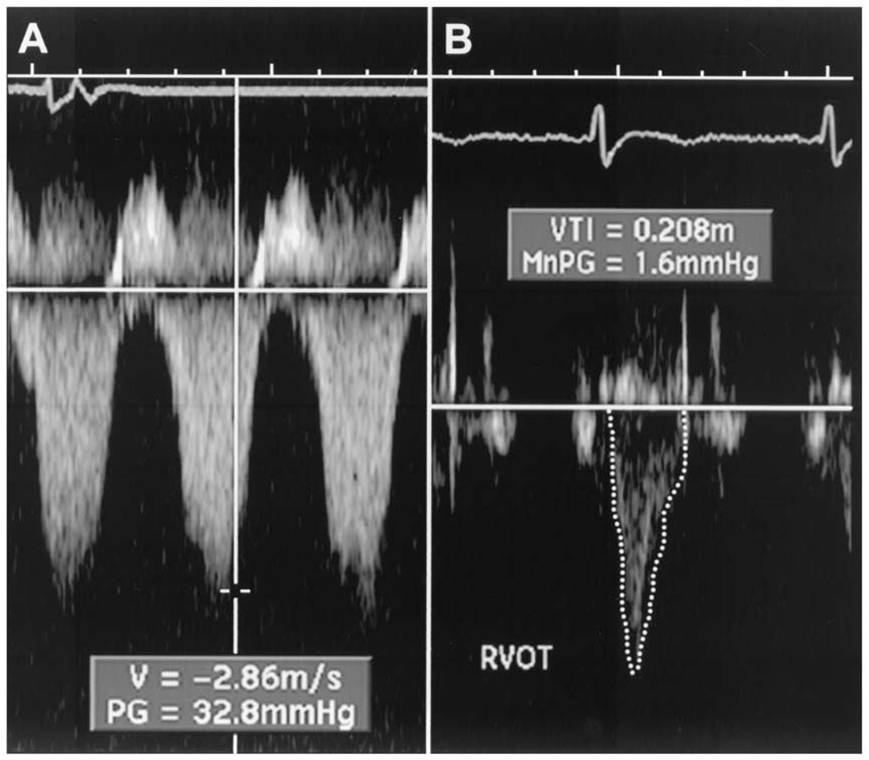
Pulmonary vascular resistance = PA Pressure/PA FLOW

Substitute PA pressure with TR jet

Substitute PA flow by   RVOT VTI (  Velocity time integral )

And  we  get

PVR = TR Jet velocity/ RVOT VTI x  10

This  is the simplest way to arrive at PVR at the bedside .

An example

Is it validated ?

Yes .

Then,why it is not being followed widely ?

It is  a  too  simple  method to  use   !  That  is  the biggest excuse ! We are tuned  to  think  ,  a  complex parameter can not be measured in a  simple manner  .  Any thing simple must be  wrong !

But the reality is  . . .

Cath calculations are   much more  complex with so many variables   which  can  get terribly wrong .

The irony  about this  hypothetical  science of PVR is ,  we do not know  which is  gold the standard ?   In fact , none can be  a standard .  So ,  to label PVR  derived by echo ,  as an   inferior modality  can not be accepted  .It is all the more funny ,  as  we are  trying to  define a new  formula    with  the help of   flawed and battered   parameter  namely  the cath derived PVR .

Final message

Abbas’s  formula  is  indeed a  realistic way of arriving at PVR by echocardiogram. If only we measure it routinely  /serially in as many patients as we can , a new data base  will  be created .Which can later be  proven as a fact.It is suggested every cath lab should try to validate this formula.

Link to full text article : Courtesy of JACC

Abbas AE, Fortuin FD, Schiller NB, Appleton CP, Moreno CA, Lester SJ. A simple method for noninvasive estimation of pulmonary vascular resistance. J Am Coll Cardiol 2003;41:1021-7.

Doctors are obsessed  with science .  Science is man-made , often , the quality of which is far from perfect (Apart from scientific inaccuracies , personal and commercial conflicts creep in )  .Hence  ,  patients   may not get  the true benefits of genuine science  today . This has a huge moral and economic implications .

The entire life time savings  of  our population , is threatened to be consumed by the vagaries of modern medicine. A recent WHO  report  reveals  , the  major cause for  poverty  is attributable to  the frivolous and  greedy   modern health care delivery system. Many times,  bulk of the nation’s wealth is  being  spent on  prolonging the final   few  months  of     lives(Often unproductive ! )  of their fellow citizens.

The irony is ,  many of these expenditures have questionable benefits.

  • A simple car is prone for fewer errors but it still serves it’s purpose .A hybrid car which switches between hydrogen, petrol and electricity  is obviously vested with numerous unexpected issues.
  • An ordinary  cell phone is easy to operate,  while an Andorid 2.2 phone  is loaded with great  applications  ,  but the  original purpose of a phone  ,  namely communicating with others is often   compromised.
  • Modern medicine  is a monster machine  with  thousands of  visible and invisible switches . The funny thing is most of us do not even know jobs assigned to these switches .Worst of  all , these controls  can self ignite  or put off  on its own . One can imagine . . .  the potential errors  from this monster controlled by a  minuscule master of medicine .

Does your patient aware of all those uncertainties ! Why is it so difficult for us to communicate  the above facts to our patients ? Mankind can benefit ,    if we put across the  following  doctrine to our public domain.

A medical  non  intervention can be as safe  as  an  intervention ,  but one has to accept the occasional complications  arising out of a  non intervention . In this context  it should be  realised  ,  we never hesitate to  accept the   consequence of  a  modern  intervention.

Why and how our  mind is readily accepting even deaths  during an  inappropriate procedure , while we struggle to accept  even a temporary set back  for not doing a needy intervention.

What is the solution ? We need to uncomplicate  medicine . . . simplify them .When doctors intervene with common sense as a weapon  to tackle the  scientific excesses patient is bound to  benefit.

Don’t ask don’t tell  dogma   should be replaced by ‘”Tell  without asking” .Be transparent about the limitation  of science.

Documenting and adhering to protocols is satisfying for upholders of science , but one should realize being unscientific also   can help our patients many times.

When your hospital protocol says check for hypoxia in every patient  with dyspnea ,  mind you it may land your patient to a totally   unwarranted  ventilator assistance for a very transient hypoxia reported your fellow over phone.

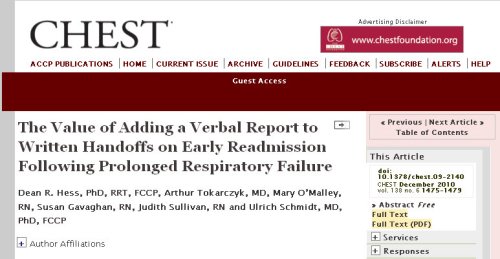
Here is an article that reveals ,   how a  few oral words of   advice could help  both financially and academically in critical care.

http://chestjournal.chestpubs.org/content/138/6/1475.abstract


Final message

William Osler said   ” Lesser is better” in medical  communication  . It may not apply today.

Did Osler  was  referring to  falsehoods in medicine ? , Then ,  probably he  is 100 %  is right . . . for the current times !