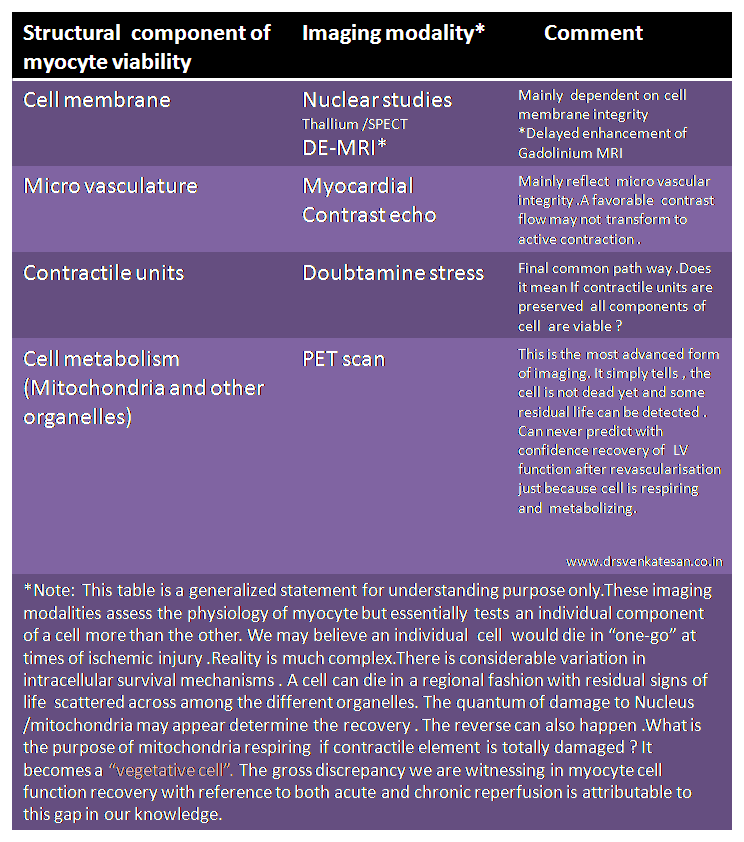
An attempt is made to look for individual components of cell viability .See the table below. It is a generalized statement for understanding purpose only. Various imaging modalities assess the overall physiology of myocyte function (however they test an individual component of a cell more than the other) We may believe an unit of cell would die in “one-go” at times of ischemic injury.Reality is much complex.There is considerable variation in intracellular survival mechanisms . A cell can die in a regional fashion with residual signs of life scattered across among the different organelles. The quantum of damage to Nucleus /mitochondria may appear determine the recovery . The reverse can also happen .What is the purpose of mitochondria respiring if contractile element is totally damaged ? It becomes a “vegetative cell”. The gross discrepancy we are witnessing in myocyte cell function recovery with reference to both acute and chronic reperfusion is attributable to this gap in our knowledge.
Posted in stress doubtamine echo, Viability assessment | Tagged doubtamine stress spect demri thallium, Hibernating vs stunned myocardium, myocyte viability, pet scan, vegetative myocyte, viable vs non viable myocardium | Leave a Comment »
It is believed (assumed ?), medical science is propelled by constant quest for knowledge and improvement in basic and clinical science that eventually would transform into better patient care and favorably impact global health standards. We know the field of medicine is growing in an unimaginable pace.It’s obvious any growth if uncontrolled or not properly guided is at risk of deviation from the main goal and ultimately turn malignant and destroy the system which it’s supposed to guard.
How many times we realise the current treatment we administer would soon become obsolete and even become dangerous ? What is the point in replacing treatment A by B , and then B is pulled over by C or D and suddenly finding A is better than either C or D (and still we hesitate to fall back on A because its an oldie!)
Still ,this is what we call as practicing ” State of the art medicine” How about a person who defies state of the art , and able to fore- see the futility which is threatening to be the norm in modern medicine. Then,who is really Ignorant ?
I stumbled upon this wonderful writing on this issue by ex BMJ editor by Richard Smith. Mind you , this was published way back in 1992, when the boom of futile ” Human Health shopping” was just about to explode !
Link to The ethics of Ignorance
Post-amble
Don’t get confused .Noble professionals are licensed to practice with whatever is published as science as long as their intentions are deemed to be genuine .Harm arising out of practicing what’s considered best as on today is acceptable in the court of law.
Meanwhile , its a tragic truth, If you do not follow the herd , you are at risk of being punished even for goodness committed by you. Wisdom and conscience can never win a legal battle ! If you have the courage try practice them !
Posted in Medical ethics | Tagged ethics of ignorance, medical ethics | 1 Comment »
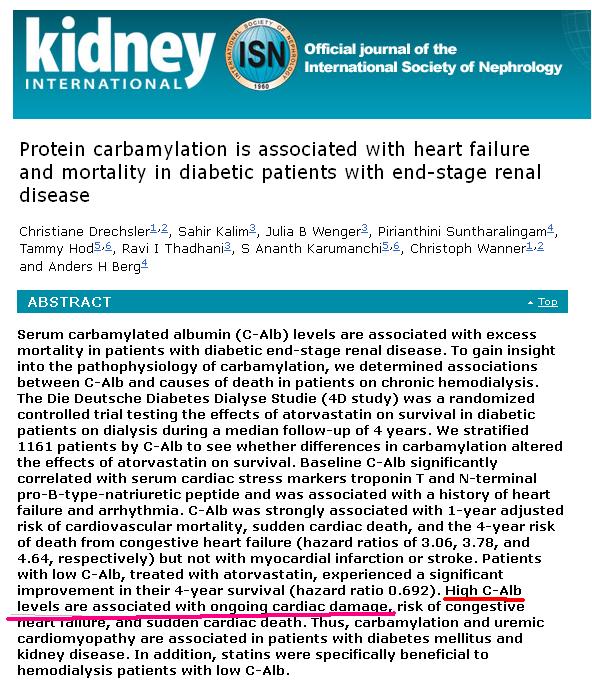
Heart and kidney work in tandem and share a close functional relationship during health and disease.Progressive cardiac failure causes kidney function to deteriorate,what we call it as cardio -renal syndrome.Similarly, progressive renal disease inflicts either a reversible /irreversible LV dysfunction .The mechanism of LV dysfunction has not been fully decoded. It is primarily biochemical mediated but at later stages it can be irreversible and structural damage can occur.
We believe uremic micro molecules leaking from plasma into cardiac Interstitium (Myocardial proteinuria ?) are somehow responsible for the progressive LV dysfunction. Now , we have new evidence for albumin – carbon interaction possibly at myocardial level due to formation of carbamino albumin (C-alb) .
This paper from Kidney International (2015) 87, 1201–1208; highlights this new finding .
Elevated C-albumin is a new marker for this unique , still not fully understood entity “Uremic cardiomyopathy”.
Further reading
Posted in Cardio Nephrology | Tagged biochemistry of cardiac failure, c-alb, c-albumin, carbamylated albumin, dialysable lv dysfunction, mechansim of lv dysfucntion in ckd, uremic cardiomyopathy, uremic lv dysfunction | Leave a Comment »
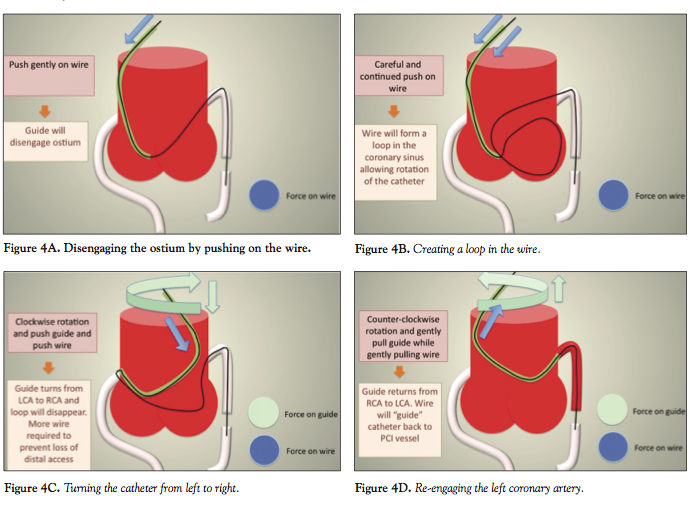
Radial coronary interventions has become a global norm .Even complex procedures are being accomplished with ease adding on to the patient comfort and low risk for access site complications.However !occasionally we need to have multiple access sites to know the detailed real time contra lateral coronary anatomy is desirable .This becomes vital in the retrograde approach for CTO.
Want to have a quick glimpse of RCA flow while one is attempting LAD PCI without additional puncture ?
How about doing a contra-lateral angiogram with the same guiding catheter and wire in-situ within the ipsilateral ostia ? Here is an Innovation.
Of course ,the same concept can be used in femoral angiogram as well.It could reduce procedural time, adds more efficiency of the hardware system handling. One can’t ignore the idea as well as the comment of the author, who says the trick is only for an advanced Interventional cardiologist.
Reference
Posted in Chronic total occlusion, Radial Interventions, Tips and tricks in cath lab | Tagged cath lab tips, contralateral coronary angiogram, radial tips and tricks, radial vs femoral angiogram, retrograde appraoch for cto | Leave a Comment »

Image modified from http://www.anatomygallery.info
That’s normal . . . what happens during pathological states ?
There are important diseases that restricts entry of blood into right heart chambers. They can occur either in an acute (Tamponade) or in chronic fashion like constrictive pericarditis and restrictive cardiomyopathy.These entities show distinctive impact on JVP and systemic pulse.
The two pathognomonic signs are Kussmaul sign and pulsus paradoxus* that go hand in hand in most situations.Inappropriate elevation of JVP with inspiration is termed as Kussmaul sign , while exaggerated fall in systemic BP with inspiration is called Pulsus paradoxus.The later is the arterial counter part of Kussmaul sign in JVP .However, there can be dissociation between these two signs occasionally.
* Pulsus paradoxus is a term originally used by Kussmaul when he noted heart sounds were retained while pulse dissappeared in patients with cardiac tamponade .Later we realised the loss of pulse was linked to inspiratory cycle of respiration. To make this sign objective sphygmomanometery criteria was formulated which measured the difference between inspiratory and expiratory korotkoff’s sounds .
Coming up next
Why Kussmaul sign is often absent in Tamponade while its arterial counterpart pulsus paradoxus may still be conspicuous ?
Posted in Clinical cardiology, Jugular venous pulse, pericardial disease | Tagged bernhiem effect, effect of inspiration on jvp, kusmals sign, kusmaul sign, kussmal's sign, Kussmaul sign, pulsus paradoxus, Reverse bernheim effect, ventricular interdependence | Leave a Comment »
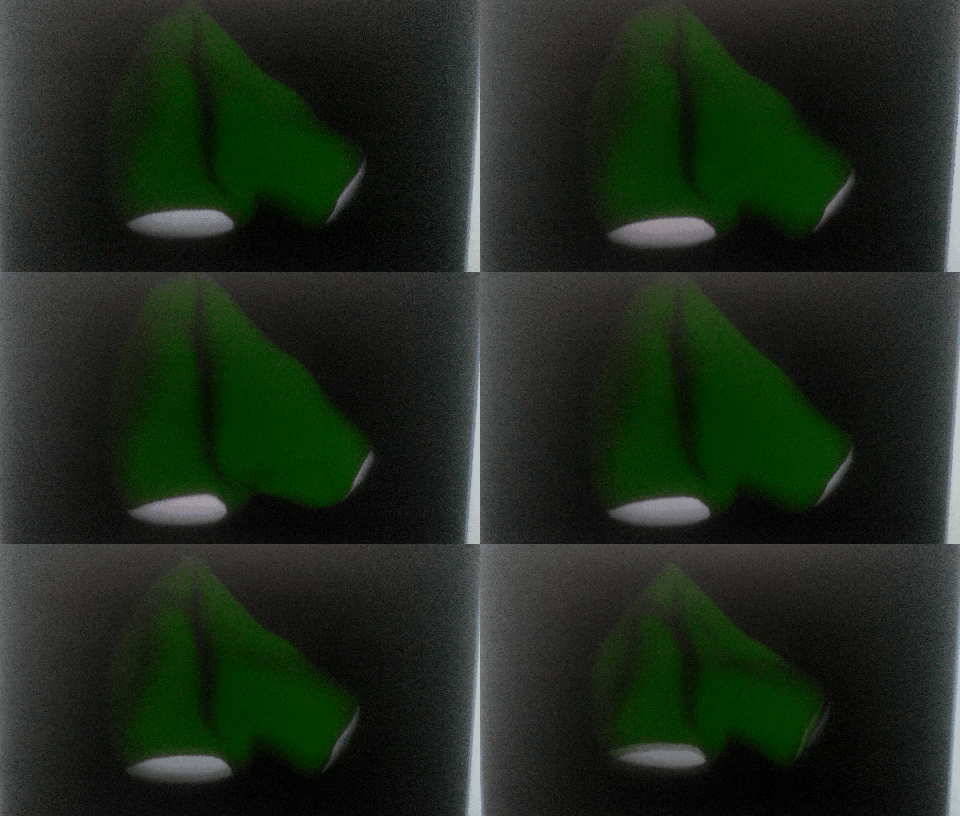
Right ventricle,being a venous chamber has distinct anatomical and physiological features to carry out this function.RV has a complex shape, its triangular in long axis and crescent like in short axis , thin (<5mm) more distendable .Contraction of RV begins slightly early but ends later than LV (30ms )
RV receives blood from RA and ejects in to PA in a sequential manner .The inflow, body and outflow contract somewhat like intestinal peristalsis. This is facilitated by the incremental delay in the electrical depolarization of right ventricle.In physiological conditions, the later half of QRS is responsible for RV activity and RVOT is the last to contract. (This intrinsic electrical and mechanical delay in RV contraction is a physiological inter ventricular desynchrony . One should be aware of this when planning cardiac resynchronisation therapy in cardiac failure. )
Click over the image for an animation of RV contraction.

Image courtesey Oxford spcialist hand book in cardiology :Echocardiography Paul Leeson , Second edition ,.Oxford university press 2012 Multi media .
Note:LV is a fairly elliptical and strongly muscular pump and contracts in a single go with maximum force.(dp/dt).
Final message
Though both right and left ventricle originate from same straight heart tube , developmentally the right ventricle evolves for a different form and function . Now,we realise there are lots of sharing of parental muscle fibers that engulfs and bonds both chambers.(Mind you ,This is the fundamental mechanism of ventricular interdependence.Of course ,IVS is a common wall shared lifelong by both chambers without any (sibling related?) hemo-dynamic dispute !
3D echocardiography and MR imaging has helped us to understand the RV morphology better and exciting articles written by pioneers are available free for those who are interested.
Reference
Posted in Anatomy of heart, Right ventricle | Tagged best articles on right ventricle, cardiac peristalsis, physiological inter ventricualr desynchrony, Right ventricle anatomy and physiology, right ventricular sequential peristaltic contraction | Leave a Comment »
These two quotes on practice of medicine are close to my heart , one from Voltaire , a non medical man (a French poet ) and the other from ,one of the greatest medical professional of our times, William Osler .
It is amazing ,how the thinking pattern of a philosopher and a true scientific professional living centuries apart are almost in sync with a great medical reality !
Posted in medical quotes, Two line sermons in cardiology | Tagged great medical quotes, medical quotes | Leave a Comment »
J point is a critical point in the ECG when the ventricles hand over the baton in the electrical relay race from depolarization to repolarization .This the time the sodium channels extinguish itself and the potassium current begins its activity from Phase 0 to 1 .
If the potassium channels activate little early and snatch the baton prematurely from sodium , we get early repolarization pattern .When this happens , the J point of ECG show a conspicuous wave called J wave , originally denoting Junctional wave between QRS/ST segment (Now perceived as Jitter waves ?) The other implication of premature K+ activity is , lifting up of ST segment , making it the most common cause of non ischemic ST elevation.
* J wave in hypothermia is referred to as Osborne wave and may not be not related to ERS(Ref.4)
The Ito current is responsible for the phase 1 of action potential (AP), where a rapid outward k + ion flux take place and draws the dome of AP . The dynamics of Ito is complex .It depends upon the density of epicardial K + channels , which are clustered in a heterogeneous manner .There seems to be a concentration gradient along the epicardium and endocardium , making the wave appear prominent in some. This is especially true in healthy, athletic male population where we have some evidence for androgen to play a role on how these channels will behave.Here comes the overlap between Brugada syndrome and ERS as well.

Image source : http://www.research.chop.edu
The subset of patients with J wave pattern were recently shown to have increased risk of primary VF due to phase 2 reentry , when they develop ACS. (Rather J wave pattern was more common in patients who had primary VF following STEMI(Ref 1).This resulted in a spate of worrying articles .Now we know , the fear is largely unfounded ,the risk is far less.
Current thinking is, persons who have asymptomatic ERS pattern with prominent J waves should not be investigated electro-physiologically . (Please remember , every human heart can be induced to VF in EP lab if appropriately stimulated ! )
In fact , I used to tell the young men who harbor prominent J wave , as a marker of healthy heart rather. Let us not fear them with a remote risk that could be as negligible as risk of intercontinental flight crashing into the ocean !
References
Posted in Brugada syndrome, cardiology -ECG, Cardiology-Arrhythmias, early repolarisation syndrome, ECG -Basics | Tagged brugada syndrome and ers pattern overlap, ers pattern, Fear of J waves in ECG, j point in ecg, j wave beingn waves, j wave syndrome, Jitter waves in ecg, junctional point in ecg | Leave a Comment »
PTMC involves a critical step , where one has to cross the IAS to reach the LA.The septal puncture remains somewhat a blind procedure in fluoroscopy .(Echo can still assist us. )
Stitch effect is a rare complication where the needle pierces the intrapericardial space from the right atrial side and re-enter the left atria .This wrong way entry into LA may not be recognised untill the sheath is withdrawn and a cardiac tamponade ensues after removal.
Where exactly the stitch occurs ? What are the anatomical planes ?
This usually happens in the superior aspects of IAS , abutting the roof of RA and LA . The alignment of IAS with reference to RA and LA is key a determinant.We know in mitral stenosis LA can outgrow the RA , bringing superior aspect of LA in a different plane with reference to IAS .The IAS puncture site may overshoot , enter the pericardial space and stitches the non IAS aspect of RA and LA together , of course still guiding us into LA through a false pericardial track (Which is not recognized )
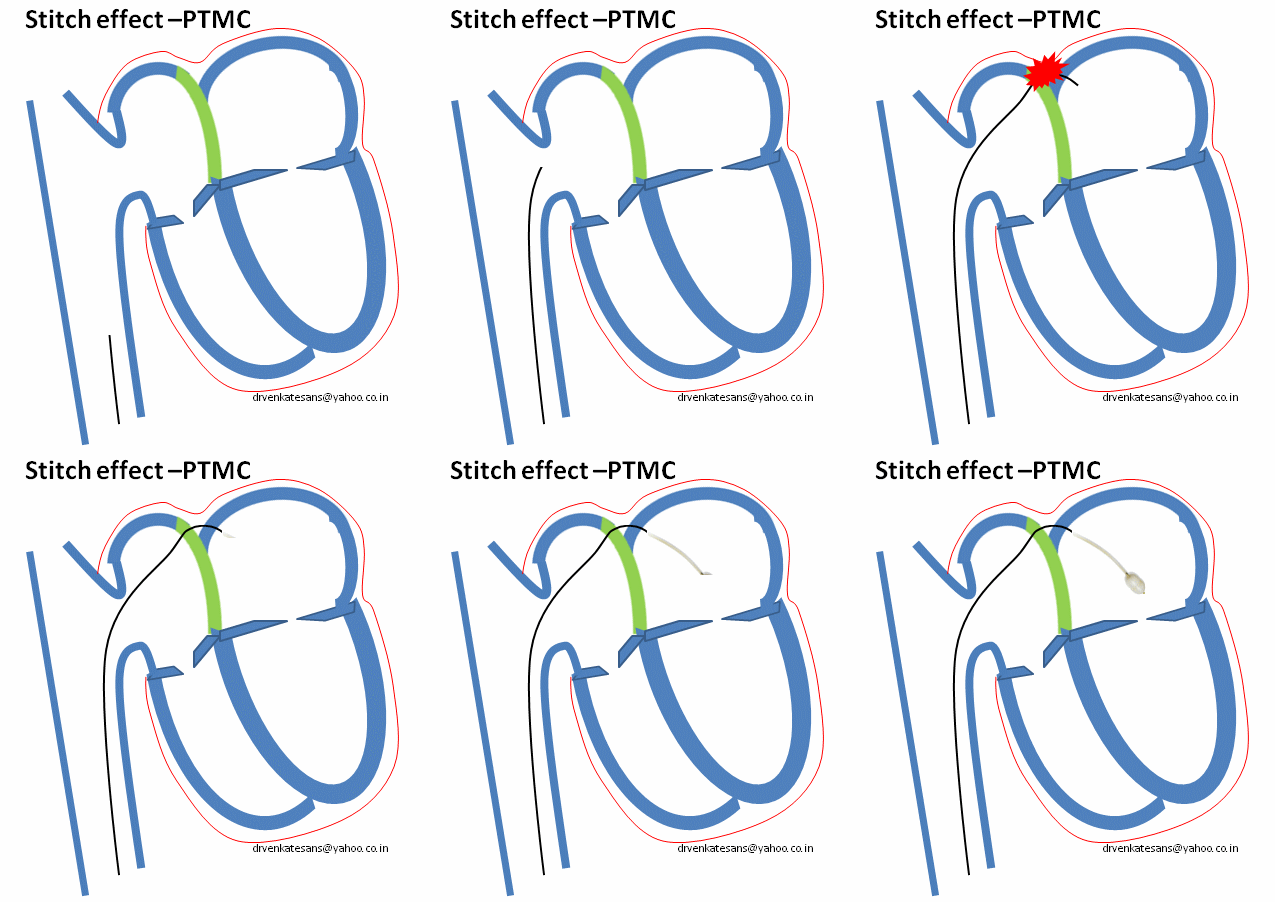
Note : The intra-pericardial track can be more complex than we realise as a significant part of posterior LA is extra-pericardial and transverse sinus of pericardium can get involved as well.
Our understanding(mis ?) suggests at least four different stitches are possible
- IAS-Pericardial space -LA roof
- RA-Pericardial space -LA roof
Other complex tracts (Based on theoretical assumptions . Please note , in some of the fatal punctures the exact route was not identified by surgeons even under direct vision . )
3.RA-Pericardial space -Extra cardiac-Reenter LA
4.RA-IAS -Pericardial space-Extracardiac -Reenter LA ?
What are the possible bleeding sites in stitch effect ?
There can be two sites of active bleeding .One from RA exit point and other from LA entry point of needle.Extra-cardiac oozing can also occur if the needle has pierced the outer pericardium before entering LA.
Management
- Recognition is the key. It requires extra anatomic acumen to diagnose the false track before we insert and withdraw the sheath.Echocardiography should be liberally used if you suspect a false track .
- Tamponade is to be drained promptly and emergency surgery is usually required if re-accumulation occurs.
- Closing the puncture site with devices has been successfully attempted in few patients .A small ASD device (or a Plug ? ) is expected to close the site of puncture . Since the anatomy can be complex ,one may need to close with two devices , one on LA side and other one RA side .The radial force that closes the tear and long term retention of these device are not known .
Related topic
Other mechanisms of cardiac tamponade during PTMC
Posted in Mitral balloon valvotomy, PTMC, PTMC -Tips and tricks | Tagged balloon mitral valvotomy, complication during ptmc, PTMC stitch effect, stitch phenomenon during ptmc mitral valvotomy | Leave a Comment »
Mconnell’s sign is a distinct echocardiographic sign that occurs in Acute pulmonary embolism , where RA and RV dilates. RV shows a distinct regional wall motion abnormality in which RV free wall shows akinesia (or severe hypokinesia ) with well-preserved RV apical contraction.This is visible in apical 4 chamber view.
This sign is explained by both anatomic and hemo-dyanmic reasons.
- RV when exposed to sudden pressure overload it not only dilates , it’s wall stress increases (Laplace law : Wall tension = P x Radius ) and end up mechanically stunned . But , since the RV has a complex shape the distribution of this stress is not uniform .As the RV assumes more spherical shape the apical part is not exposed to this stress as it tend to abut under LV.
- RV apex is anatomically tethered with LV apex and share significant amount of circumferential fibres .In patients with acute pulmonary embolism , LV usually is hyperkinteic due to tachycardia .This pulls the RV apex along with it for a proxy contraction .
- Rarely , primary RV ischemia due to RCA under perfusion* may be responsible for this unique wall motion defect . Since RV apex is mostly supplied by LAD it is free from ischemia . (*Acute elevation of RV intramural pressure due to PHT , compromising RCA perfusion pressure )
Reference
2. Rachel P. Sosland, Kamal Gupta,McConnell’s Sign circulation. 2008; 118: e517-e518
3. Link to the Echo clipping of McConnell sign in echocardiography
Posted in Echo library and gallery, echocardiography | Tagged acute pulmonary embolism, Mconnell sign pulmonary embolism, regional wall motion defect in RV, wall motion defect in right ventricle | Leave a Comment »