Feeds:
Posts
Comments

95 % of hypertension is designated as primary HT .What does it mean ?  It means  95 % of times  we do not   know what  exactly is the cause for raised blood pressure  . Simply stated  . . . it  reflects 95% ignorance .

So what is secondary hypertension ?

Secondary HT is the one,  in which we have specific reason for the raised BP.  The most important cause is Renal  ,  endocrine etc.

When will you suspect renal HT ?

https://drsvenkatesan.wordpress.com/2010/09/01/when-will-you-suspect-reno-vascular-hypertension/

How is secondary HT different ?

  • Occur at relatively at young age (<45)
  • It is generally more severe.
  • Diastolic BP is proportionately  higher ,
  • End organ damage is more.
  • It is very unlikely primary HT to present as acute LVF.  One rule of thumb is ,  if diastolic blo0d pressure is > 120 never diagnose  primary HT . Some amount of renal component is very likely.

Is stress related HT a form of secondary HT ?

https://drsvenkatesan.wordpress.com/2013/04/26/why-stress-obesity-related-hypertension-is-not-considered-as-secondary-hypertension/

Heart disease was  once considered as   rich man’s disease  . . .  It’s no longer  true .  We in India ,  are witnessing an epidemic of CAD . The reasons are  varied  . Apart from  conventional factors ,   social   factors  like changing demographic pattern  ,  life style , ethnic  risk  like  south  Asian metabolic profile are responsible .

While  Rheumatic heart disease (RHD ) continues to be a huge burden , CAD  is  the number one  cause for cardiovascular morbidity and mortality .

CAD affect the poor and rich with equal vengeance . The later is better equipped financially to tackle it . Of course ,  it has resulted in maximum inappropriate interventions. The poor (or borderline poor ) have  no  other  option  but  to knock the doors of Government  hospitals. It is heartening to note, various state  Governments   are  gradually involving insurance schemes.

Still , many struggle to find the required  finance for  a major cardiac intervention. It roughly costs 100,000 rupees  for PTCA  .While  PCI is required in all symptomatic ,  critical coronary occlusions , still . . .  majority of the  CAD in general population  do not require it . There are 675 cath labs in India performing 180000 angioplasties every year  on an average of   15000  PCI per month ( 500 /day )  This is grossly inadequate . We  have huge potential

What is the hurdle ?

  • Expertise ?
  • Hard ware ?
  • Awareness ?

No  . . . it is all about  financial resources

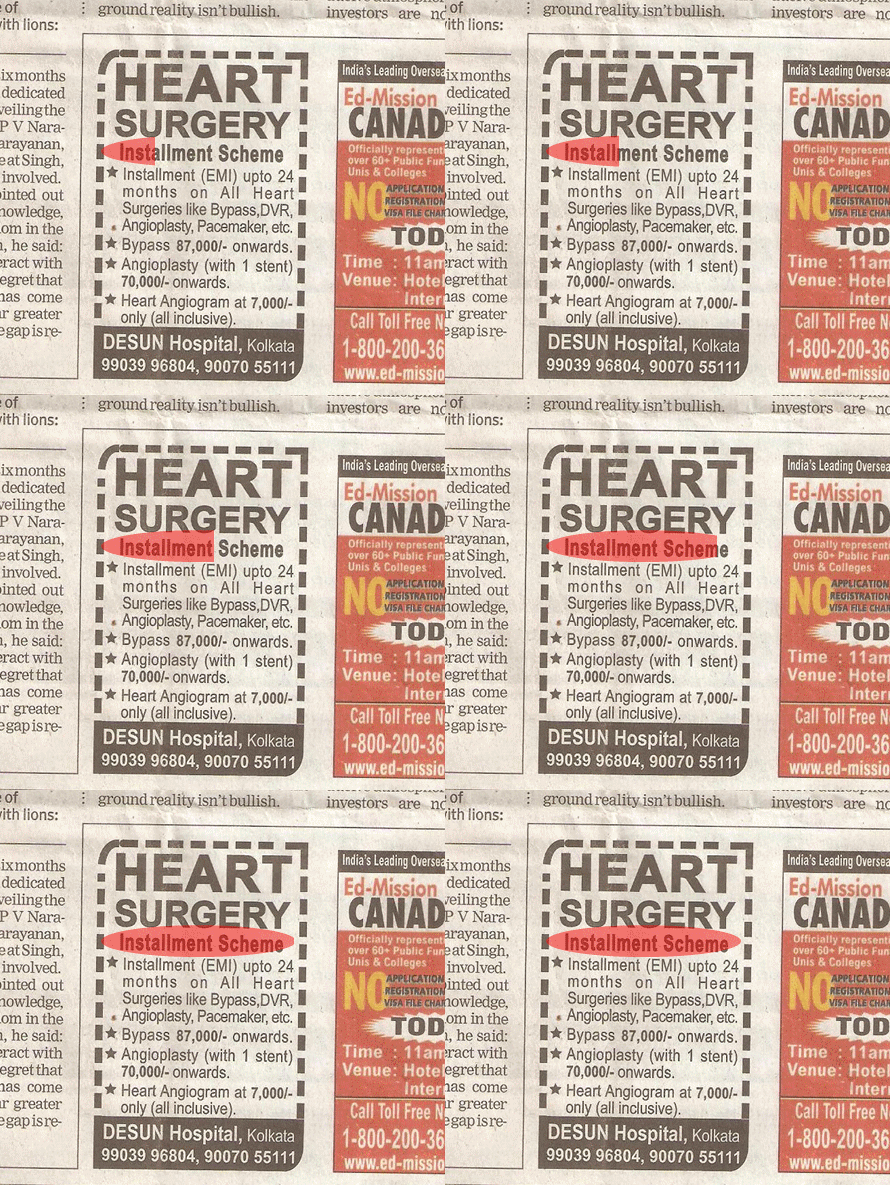
Recently I stumbled upon an  advertisement on Times of India

cardiology ad ptca

Disclaimer: This article does not in any way defame any hospital that offers the scheme.It just want to debate the concept.

Hospitals  want  to  market the procedure . Convert angiograms  to angioplasties . That’s   corporate boardroom mantra  . And one fine day ,  bankers and medical doctor sat together and brought a brilliant idea.

Why not do the procedure  on credit and  push the patient  life long  into a financial debt !

Wonderful idea  . . . many thought .Thus came the financing scheme for  cardiac procedures.

Final message

Financing a poor patient  with good intention is welcome. But, there is big caveat .In a vast country   with high  illiteracy , inappropriate  procedures   may be thrusted upon  on   the  poor  souls.

After thought

Now ,  our patients   have  one more  risk parameter to  assess   ” Number of remaining EMI( Equal monthly instalment )  and incidence of stent thrombosis”   “Accumulated  interest  and angina”   What a wonderful way to provide cardiac care !

I can recall a  patient who sold his livestock  (his sole income source ) for undergoing a open heart surgery and lost his life as well in the process  leaving the family stranded !

Solution

The only solution is  to  provide  a strictly regulated Govt sponsored  insurance scheme.  High tech procedures should be  continuously and meticulously  audited for cost effectiveness .


It happens only in India

adventure

About  150,ooo people die in road accidents in India every year . . . highest in the world !  Myocardial infarction  kills  only slightly  more !

Image courtesy : Times of India , 18th April 2013 . Picture  by  S.L. Shanth Kumar .


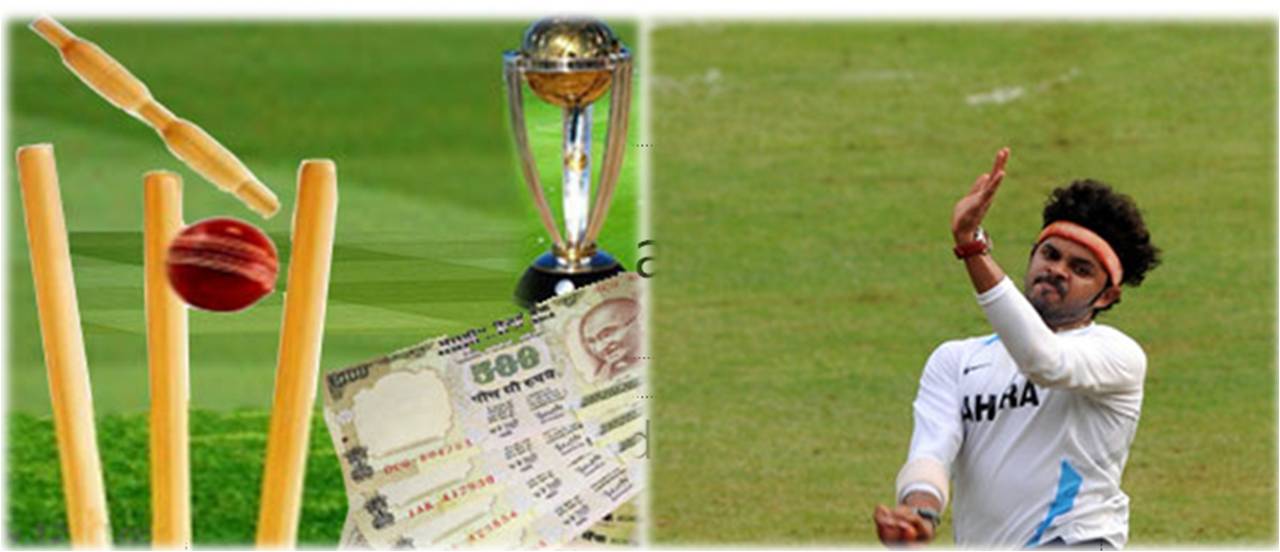
April-May is carnival time in India . . . cricket carnival. In IPL . . . Indian premier league , eight teams will fight for the cup . IPL 2013 became a smashing hit , until last week when three players were arrested for spot fixing in an over . And for the past 10 days the entire Indian media has gone into manic reaction over it !

Still , the sport was wonderful , the skills shown were extraordinary , and what happened was an aberration just like in any other aspect of life . IPL is perfect mix of sports , business , commerce and some sleaze . Actually in a successful business model , one should actually be surprised if corrupt practices does not occur !

The game of cricket can never be killed by money ! The way the issue was handled by the media and the reactions and public debates for me looks irrelevant . Is it justified ?

We the people and media has much much important things to do in India !

scandals in india

Fixing a Fix . . .

Politicians fix voters by giving money !
Media fixes news for money !
Students of the noble profession are desperate to fix examiners with money !
Finance ministry’s annual budget is fixed by business tycoons !
Private medical colleges fix entrance exams after getting money !
Super powers fix terrorists selectively for money for self benefits !
Drug companies fix doctors with money !
Doctors fix labs by getting money !
Anxious parents try to fix marks of their children for money !
Government fixes tender for money !
Live kidney donors are fixed by criminal cartels for money !
Advocates fix false evidence with money !
Innocents are fixed as criminals after getting money !
Thousands of marriages are fixed with money after hiding illicit relations !
Huge bank loans are fixed based on false affidavits and promises !
TV reality shows are fixed with mad money !
Even pilgrims fix Darshan time by paying huge money !
And finally . . . One cricketer bowled one of the balls . . .wide . . . . in one of the over after getting money !
The whole world erupted !
cricket scam India
Postamble
Can there be any justification for justifying wrong things in life ?
If life is a fight between good and evil , I thought it is absolutely absurd to justify it until recently . . . but a great epic of India , Bhagawad Gita which is considered as the ultimate guideline for living ,differs (Or is it my perception !)
The summary of the epic goes something like this
  • Whatever happened has been good.
  • Whatever happens is good
  • Whatever will happen is also good.
Bhagavad Gita has one more sermon to confuse us ( me ) completely !
“Do your duty , do not expect any returns and do not watch injustice silently , protest and fight it with your full potential” !
I welcome the experts of the Bhagawatham to clarify me on this issue !

Multivessel PCI during acute STEMI is forbidden except in cardiogenic  shock . (or in some very unstable patients without cardiogenic shock)

The reason

  • During acute MI   hemodynamics  are precariously balanced.We do not know yet how  emergency multivessel plasty alters this .
  • Our  initial aim should be   confined to myocardial salvage in the IRA . Total myocardial revascularization is niether  the  priority nor its desirable.
  • The more  time  you spend  within the inflamed coronary artery , more its  hazardous.
  • Multiple stenting  is prone for thrombus   and  migration  into side branch .
  • Stent opposition is sub optimal in many thrombus infested lesions.

Still  . . .  in real world it is extremely difficult to curtail the urge to stent  all eligible lesion during primary PCI !

multivessel angioplasy during stemi

How to avoid it ? 

If the patient is poor or the insurance limit is low , the issue  of multi vessel stenting does not arise at all  !

Always  ignore  complex  non IRA lesions  during primary  PCI. Be happy if a non IRA has a bifurcation lesion !

Still , some lovely looking lesions in non IRA  would be  tempting  and inviting .  Indulge at your own risk !

* Please remember if  the proximal  LAD  has a non IRA lesion , it may be sensible to attempt  simultaneous revascularisation even if the patient is stable !

Other unrealistic advice

  • Keep the professional fee and other benefits   fixed whether  we do a single or multiple   vessel stenting (Realise  . . .  surgeons do not charge more for a  4  vessel by-pass graft  than a single  ! )
  • Keep the current AHA/ACC/ESC guidelines pasted right next to the fluroscopy monitor .
  • Ask your subordinates to repeatedly caution   you  about the possible  excesses and ask them to wave a red flag !
  • You may  empower the   senior staff nurse   with a veto power  to shut off the cath lab once IRA plasty is  completed and the patient  is stable.
  • In extreme  situations , keep a cath  marshal ready to manually evacuate  the primary operator  from cath lab !

Reference

multivessel angioplasty during stemi

ACC GUIDELINES FOR STEMI 2013

The link between brain and the  hand  starts right from fetus .  It is a well known fact  vertebral artery   competes with hand blood flow  . In the right side , there  is one more  vascular issue !  .Bracho cephalic  artery  arises  directly  from aorta and supplies the  right  hand and  right half of brain.

It remains a mystery  why left brain  is   blessed with a  separate  origin ,  while right has to share it with blood meant for hand  .It is beyond science  . . . isn’t

It is possible the left hemisphere  of brain   has more   purpose   to be alive  ,  with bulk of the cognition work to do . Hence   God created a  separate  supply to it !  Of course , he  would   have never  thought ,  the  possibility of  his ” mean” creations   adventuring  within the   arterial tree  !

Click over the Image for animation

right radial artery coronary angiogram  pci  risk of stroke 002

Please remember  whenever  we   play with   catheters and wires  through   radial route , we  are  hugging  and scraping   the artery meant  for cerebral circulation !

Final message

Femoral Interventions  enjoys a proven  track record. Currently ,  radial route has virtually taken over with  few  advantages . However , the  overall stroke risk in the two approaches  remain  low but genuine (.4 %) .It may be true , arch manipulation is more  with  femoral but  the threat to  vertebral and brachiocephalic circulation  is more with radial .  When the available evidence are  not conclusive  and  new ones are not forth coming  . . . it is wiser to rely on common sense !

Reference

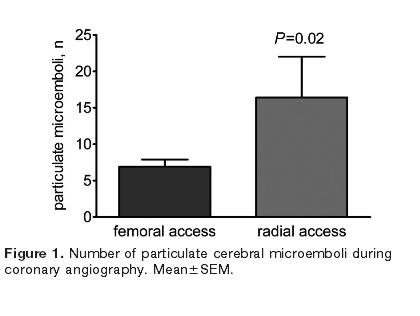
I think  this 2011  study  from the  prestigious stroke journal  has convincingly answered the issue

cholesterol and ateromatous emboli following coroanry intervention 2

cholesterol and ateromatous emboli following coroanry intervention  radial vs  femoral 2

It concludes , the right radial approach  is indeed risky  to develop cerebral  micro embolism   when compared to right femoral

A Review article in  Circulation

cholesterol and ateromatous emboli following coroanry intervention 2  radial vs  femoral 2

Other references

1.http://stroke.ahajournals.org/content/38/7/2176.full.pdf+html

2.Transient Cortical Blindness after Coronary Angiography Journal of International Medical Research. 2009;37:12461251,

3. Stroke and Cardiac Catheterization Circulation. 2008;118:678683,

ASD is  the most common acyanotic heart disease  with  left to right shunt . Highest qp/qs  are  seen  with ASDs

The shunt  begins  from left  atrium  and goes on to complete a circuit.

LA——-ASD———RA————RV———-PA———-PVs———LA

In this circuit all chambers  enlarge except the LA . (Inspite of the fact about 200-300 % cardiac output traverses this chamber )

Why ?

Post -test

The most popular answer in the above poll  is LA is  a transit chamber .

If it is so . . .  RA is equally  a transit chamber ,  why it enlarges significantly ?

For STEMI management there are  6 management protocols available

  1. Thrombolysis
  2. Primary PCI
  3. Rescue PCI
  4. Facilitated PCI
  5. Pharmaco -Invasive approach
  6. CABG

*CABG is rarely used except in  severe mechanical complication.

There is some  issues in differentiating  facilitated PCI and  Pharmaco Invasive Approach.

What do we facilitate ? How we do it ?

PCI in acute STEMI is done in a thrombotic milleu. So we get sub optimal results .Hence to facilitate it we try using

either 2B-3A antagonists, Newer Heparins, or even thrombolytic agents before submitting them for PCI

Where is this facilitation done ?

Facilitated PCI is done in small hospitals where  there  is no cath lab or cath lab is available only during office hours.

Facilitation can be done in either in same hospital or on the way to big hospital

Is there a time window to start  this ?

The main aim was to was to facilitate the PCI .Hence time window was not considered vital in few studies (Wrongly though !) ideally it should be started as early as the first contact . Since facilitation can be started earlier the time window is 0-24 hours .

What happened to the concept of f-PCI ?

It died a premature death  and  last rites were  completed when the FINNESE trial was out .

But it left behind a daughter concept ie in selected patients if the facilitation is done early , especially in those patients who are going to get the subsequent PCI late ,or in high risk individuals  , the initial  pharmacological facilitation* was indeed useful.)

*If  facilitation was with   fibrinolytic agents (Not 2a/2b )  .It is very important the benefits of facilitation is mainly  attributed to the time gain in achieving partial opening of IRA  making it more complete salvage of the subsequent PCI .

This aspect later on named as PIA .

Pharmaco- invasive approach(PIA)

We know p PCI is a race against time .We also  know fibrinolytic therapy  fares well in this race  but   pPCI  beats in   effectiveness  .

So what prevents us to combine the swiftness the fibrinolysis and the robustness of pPCI ?  That is  like getting the best of both world .( It is not that easy thing accomplish after all 1+1 in medicine is rarely 2 !)

In it’s core principle it  is same as f-PCI . But facilitation is done only with fibrinolytic agent (Not 2B-3A) . Pharmaco Invasive strategy can be started in any small hospital/ In the ambulance /. It  is routinely followed by PCI whether the initial thrombolysis is successful or not . PIA should not be done before 3 hours window if  a timely pPCI is feasible.  Hence PIA has a typical time window of 3-24 hours .

Summary

f-PCI is combining  various anti-platelet and fibrinlytic strategy prior to PCI . It was found  to be useless if it is used routinely in all cases of pPCI. (Rather 2B-3A  was useful  if  only the facilitation was done within the cath lab to prevent procedure related issues) .Time window can be between 0-24h .

Pharmaco Invasive approach (PIA)   is actually a type of f-PCI where  fibrinolytic agents are used routinely which is followed by mandatory angiogram and PCI in all deserving cases.Many still  believe the facilitation in PIA is primarily accured in  shortening the   time to reperfusion  rather than altering the thrombus load and morphology  ! Time window is usually between 3-24 hours.

Interventional   cardiology has  grown leaps and bound in the last few decades  .We are able to clip the wings of mitral valve  without surgery when it prolapses

We  can deliver a huge aortic valve and fix it with wires .

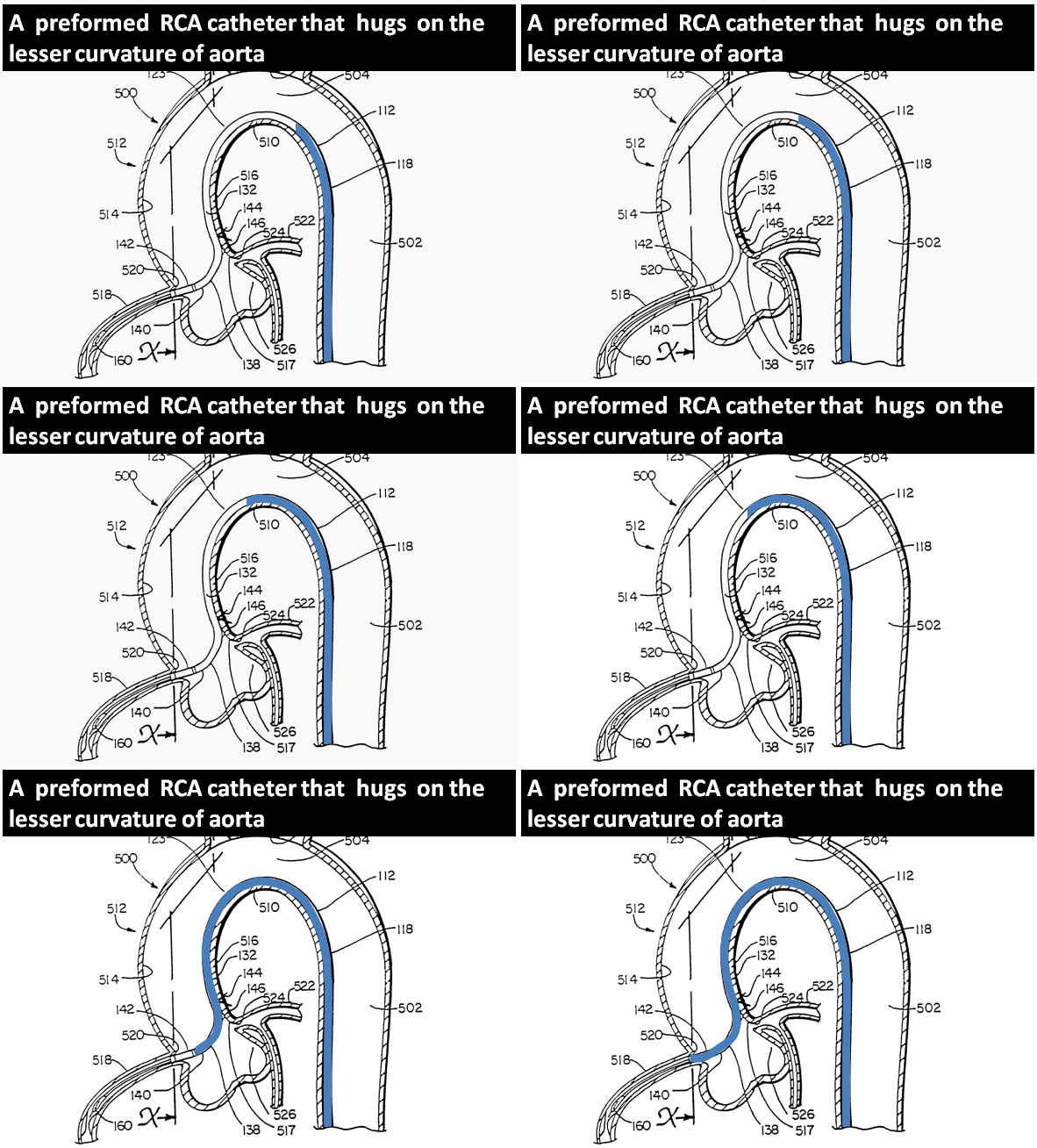
But  . . . we have no proper  preformed   guiding catheter  that can  sit into RCA ostium directly   and snugly  for a long time to enable complex RCA angioplasties !

An now try this one .


Here is  a  pending patent for  a preformed RCA catheter

preformed rca catheter

The mechanical atrial function   during atrial fibrillation remain a mystery . In fact , the general  belief  is during  AF  the mechanical function of atria is zero. This is why AF  is promotes stasis and   LA clot formation. It may appear theoretically correct  , still   AF especially coarse  still imparts some amount of  mechanical motion .But this usually does not translate to any useful hemodynamic function .

If atrial booster pump is lost (which is said to be 25 % of  LV filling )  suddenly one expects dramatic symptoms  especially if there is associated LV dysfunction or aortic valve disease .

But in real world AF is well tolerated arrhythmia in most  .  We know by land  mark trials AF  is as good as sinus rhythm  if the rate is  is under control

This is a definite evidence the AF  may not compromise  LV filling   even if   it nullifies  the  atrial contractility .

There is one  more evidence for  retention of atrial mechanical activity in spite of AF .It is well recognised , pre-systolic accentuation is preserved  in many cases of mitral stenosis with AF.

*Crazy hemodynamics : For an attached LA clot to  dislodge ,   one needs some amount of LA contraction isn’t ?  Unfortunately  a fibrillating  atria always  tend to  have this one ! This again is a senseless  proof for some  mechanical activity of LA during AF !

How is this possible ?

Is it a  purely volume dependent filling   ? ( Or )  is it  the  Intrinsic LA starling forces that do not depend electrical atrial activation .

This is definitely an  issue to ponder over . A good LV contraction makes the atria empty more completely . This would  somehow  mean , LV relaxation  is facilitating atrial function . During  AF the LV  handles effectively  the additional burden  imposed by the loss of   25  %  booster pump of atria ( Accelerated LV relaxation ? )  A  constantly  changing  RR interval makes LV diastolic function a more complex event .

Final message

Atrial fibrillation is  a well tolerated  arrhythmia in vast  majority of patients  . This  implies either of the two things.

  1. The so called  physiological atrial  booster pump is redundant  or dispensable in otherwise healthy heart
  2. The booster pump is indeed important  . . . but it is less  affected by AF as long as the rate is under control !

It is to be  strongly emphasized , Heart rate and  LV function  will ultimately determine  , how one is going to tolerate the AF  !

It is  a small gesture  from LV  to LA  at it’s hour of crisis  . . . in return  for  it’s lifetime assistance  as a booster pump ! 

Postamble

How  rate control  prevails over rhythm control in spite  zero atrial contractility in the  former  ?

Comments welcome !

//