Feeds:
Posts
Comments

Human coronary artery branching pattern is unique in every  individual . Left circumflex shows many variations.

The important ones are  a separate origin , variation in the angle of bifurcation, the number of OMs  .Further, the length of  mainstem  LCX  and its course in the AV groove are quiet unpredictable.The diameter of LCX vs are generally equal  (or LAD >LCX).

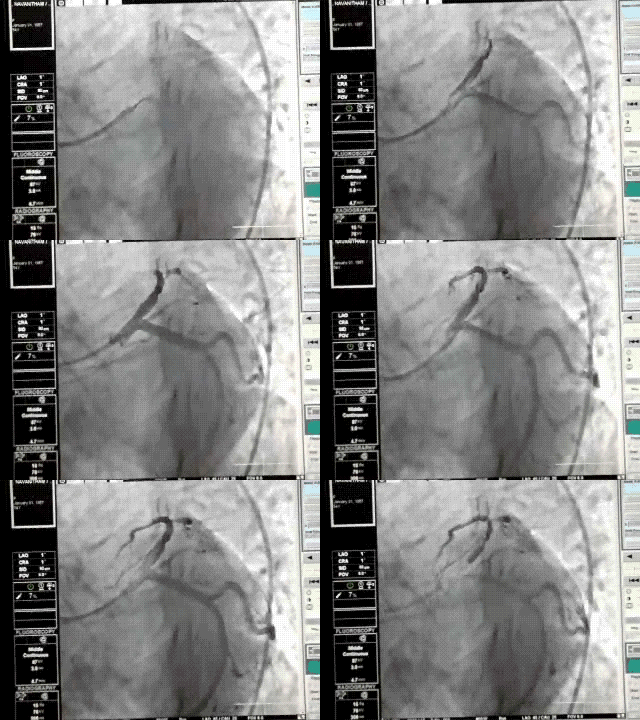
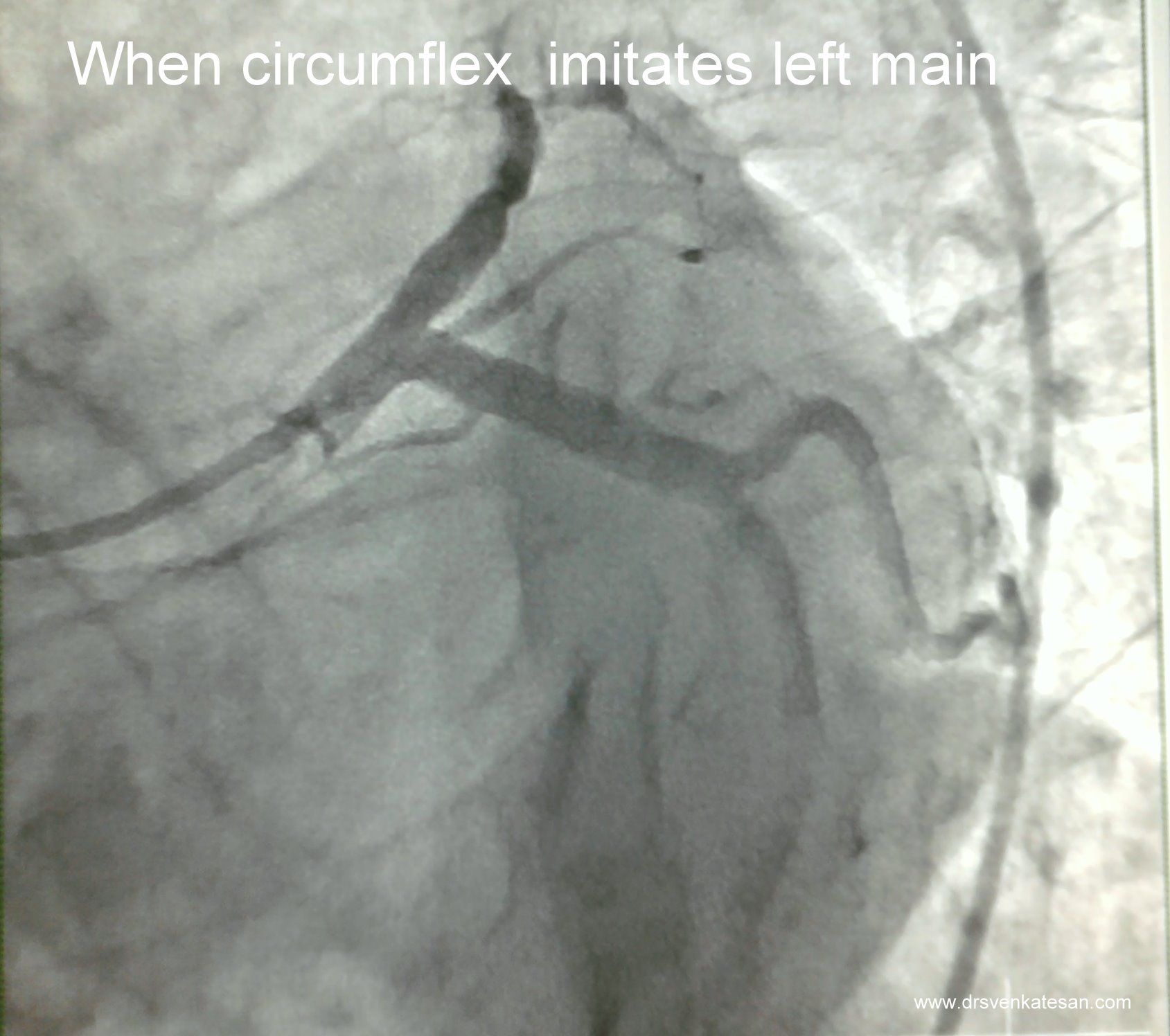
The division of  left main is such that circumflex  generally gets a lesser share  of blood flow . If  LCX is dominant this  ratio  may be little balanced. But if the LCX  is huge LAD definitely suffers !When left circumflex equals the size of left main  the pattern is distinctly  unusual.

This patient   we encountered recently had 4mm sized LCX   and  presented with a tight LAD lesion .

This man's LCX probably will never sufffer from atherosclerosis !

Other observations about large bored LCX

  • Narrow ostiums are prone for  atherosclerosis .A large mouthed  LCX rarely involves  in left main  bifurcation lesions.
  • Disproportionate size of LCX when compared to LAD  can  have hemodynamic implication of provoking LAD disease  .

The implication of  differential  sharing of left main blood flow is not fully understood .It needs further insights.

Coronary  atherosclerosis is the number one killer of mankind. Many would consider it as an  essential  process of aging .Modern  life styles and habits make this appear  very early in life . There is currently an endemic (or even  a pandemic ) of   CAD due to premature  atherosclerosis. We need to recognise CAD is not a  primary heart disease  .It is an irony, heart is an  innocent bystander  to the  biological derangement  of coronary  vascular system  when  it is infested with atherosclerotic plaques .

So , when we  are confronted  with  serious atherosclerotic lesions in a coronary artery   what shall we do ?

We have three options

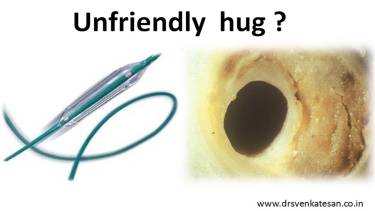
  1. Take on the enemy in a direct confrontation (Like war on terror ) : This is  some times called as Interventional cardiology .Caution is required as the battle  is within the human coronary artery ,  cross fires and collateral  damage  are unavoidable.

2 .Next  method  is to  find the basic cause  of  terrorism , identify  the perpetuates, facilitators    and try to correct the   root cause of it (CAD ) .This approach  also refered to as medical management  in cardiology community*  . It  aims  at regression of plaque  by statins, and life style modification and preventive cardiology. This modality is most ridiculed and  insulted by the main stream cardiologists.

*Comparable to  bilateral peace talks for a political solution to terror

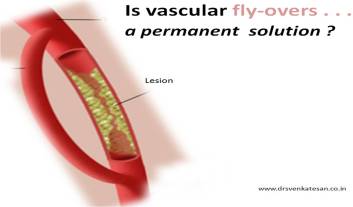
3. And third option is a  real  surprise !   This  neither  confronts   the lesion   nor does it  address the initiating factors . It   just ignores  the lesion and by pass it with a LIMA /SVG  fly over ,  as if  nothing has happened in this vital high way leaving the culprit scot-free  .This option is  executed by surgeons as  CABG surgery . . . and  for mysterious reasons  this is a  well accepted one .

CABG :Here the atherosclerotic  burden is untouched by surgery . The graft can get diseased  sooner or later , native vessel disease  shall  progress some times encroaching  the ostia of distal graft site . Incidence of acute coronary syndrome following CABG is not greatly reduced for the simple reason we are not doing anything primarily to the inflamed plaques .These issues  are left ,  to be  taken care by the  medical  management .

* This article  does not want to defame these great development in cardiology(PCI/CABG) . They have a  specific role to play. CABG AND PCI remain the only option for critical  lesions with limiting angina .But please remember without  proper  medical management  ( ie Targeting  the perpetuates of  crime )  both  PCI and CABG will be a big sham !

Final  message

Avoiding   the  lesion  or  attacking the lesion  is a  primitive  method to tackle CAD  . Passifying   the lesions  in a slow and gentle manner,   preventing  further progression  or regression  of lesions is the only  “sane” method for combating CAD   . PCI and by pass surgeries  can be termed  as  21st century’s   medical  adventure sports  which  has  limited role ,  in the overall control  of CAD  for the human kind .

And  now  answer this question . . .

Cardiologists attack the lesion and  surgeon avoids the lesion ?  Who is the winner in our fight against CAD  ?

Both of them are  clear losers .The winners are  all those  humble physicians and parmedical workers (or even the responsible lay public ) who  help recognise  the early forms  of  CAD  and  counsel properly to prevent it .

This is  what  Dean Ornish   in 1991  documented in  Lancet  which was never considered scientific   for the simple reason it has no commercial value !

Reference:

http://www.thelancet.it/journals/lancet/article/PII0140-6736(90)92230-F/fulltext

http://en.wikipedia.org/wiki/Dean_Ornish

It is a fashionable topic  in  cath meetings and workshops  to discuss  about thrombus loaded coronary arteries. Still  visualizing a  thrombus  in coronary angiogram is  never a  mean  task !  It needs  lots of  visual  acuity  and  imagination to recognise   intra coronary thrombus.

  • A lesion which looks fresh with multiple layers of  irregularity within the lumen is  often assumed to be thrombus.
  • An   intra luminal filling defect   is the  most often  used  “criteria  to suspect” a  thrombus

A long segment thombus with dye penetrating and coating the thrombus all around

Thrombus  vs plaque ?

Both are  radiolucent .  But a thrombus  or a plaque coated  with  dye  will make it radio opaque. The radio opacity of a thrombus is determined by extent of dye coating ,  the thickness of the dye layer, obliqueness to the x-ray beam . A thrombus plaque  interface can have two different  planes  of densities.

Theoretically dye can not encircle  a plaque  in its entire circumference as it will be attached to vessel wall (Unless  circumferential  dissection is present  )  Hence , dye can not coat a plaque fully ,  at best it can give  an appearance of eccentric filing defect  with over hanging edges .  While a  thrombus  can manifest with a  complete filling defect

Thrombus vs dissection

This is  still more complex   . Both can have a filling defect  .A  flap is a  line like  filling defect To complicate the issues further,  both thrombus and dissection occur together in the same spot .

How confidently  one can  identify a thrombus in coronary angiogram ?

During acute MI there is no difficulty in identifying it ,  as every acute  obstruction  must contain some thrombus* . Some interventionists  have special  ocular   sense   to   detect thrombus. Few others rely  on their intuition  rather than  solid evidence.

Sucking out a thrombus during primary angioplasty  has now become standard concept and is indeed  feasible  in most situations. It is obvious we have a task  on hand to identify thrombus correctly and quickly during primary PCI /UA .

Blind suction,  even though rewarding should be avoided.  Caution is required as blind  suction pulls a plaque with force !

A plaque debri  with a  thrombus, a dissected flap  all can combine together   to produce a complex  “masala”  of  coronary lesion especially after a difficult guidewire cross . This is refereed to as a battered coronary artery .These are the lesions which are prone for recurrent acute or sub acute thrombosis even if the lesion is  stented  properly.

During  primary PCI   thrombus coated dissected plaque  is just tucked  and  opposed behind the  gentle stent struts.The thin layers of thrombus between stent struts and the vessel wall is  missed  , 100 out of 100 times   by coronary angiogram . (IVUS very good in detecting this) .Because of this risk , Intensive anti -coagulation in complex PCI becomes mandatory

* Diagnosing thrombus in a chronic lesion is  much . . .much  difficult !

What are specific  modalities available  to  confirm thrombus

IVUS, Angioscopy, OCT are  hi tech tools to identify intra coronary  thrombus .(Which i feel  have little practical  value in real emergency situations)

Final message

Thrombus  may be a  key  finding  in acute coronary syndrome (Of course  the contribution of fissure, injured ,  plaques to the lesion can never be underestimated . ) Still , we have no simple , accurate method to identify it  ( Forget quantifying it) . Lots of assumption , guess work and gut feeling is at play in the cath lab .

We  expect better online , real time tools to improve out tentativeness inside the coronary artery  .

//

Medical  research can be divided into few  broad  categories

  1. Basic science  research  in animal models
  2. Basic science  research   in Human
  3. Clinical : Bedside-  observational
  4. Clinical:  Epidemiological
  5. Community based long term data analysis
  6. Interventional -Drug /Device/Surgical

*Logically the  top 5  should  constitute  the bulk of research  ,  in reality    last one wins the race with considerable ease . Why ?

The important issues that  confront  today’s medical research  starts  right from the  “Aim” of the research ,  methods , materials statistics,  and  goes on  to   ethical issues , conflicts, futility ,  gimmicks  0f  publication  ,  marketing and ultimately left  for human assimilation .

(Read a related article in this blog   can  Aim of a study be wrong ?)

Data(s)  won’t  lie  . . .humans do  !

Science is nothing but collection of  facts ,  rechecking  the facts , and  finally confirming ,  they are indeed  facts. So medical  data collection becomes vital .  Data,  if  properly collected ,  wont lie.   Bias is always an issue in prospective trials. Further ,  and whenever and wherever  scientifically  motivated  human  beings interact with  data  the later   becomes a vulnerable  target and  get manipulated   for various reasons . (Read the famous article on data torturing  in  NEJM : I will link it soon  ) So blinding  becomes  mandatory   and it should  be total as some studies  tend  to  gain vision half way through !

Image courtesey : Jupeter images

Simplicity of observational studies.

We  give undue importance to RCTs . What we fail to understand is RCTs are required only  in selected situations in medical research (New drugs and interventions ) Meanwhile , we can do wonders with retrospective observational  data. These  data  can not be  manipulated  as the events  have occurred already and those people who collect or record the data  wouldn’t know this data is going to be utilized  for a study (This  , in fact  is  equivalent  to 100 % natural blinding and constitute a  real world study )

Observational  study can involve  patient behavior ,    disease behavior  , community impact, drug action, investigation modality , etc  . . .etc  . Your mind is the limit . Cost of doing a observational study is less but the impact on the society can be great .

Observing skills are the  biggest causality in modern medical times , This was  only scientific weapon of  our ancestors had , which they  used in an exemplary fashion .( Recall how Heberden described angina and Harvey taught us about circulation without even ECG and X RAY chest )

Fraud in medical research

Wherever big money is flowing corruption and fraud is unavoidable . . .at the  least . . .  we  should recognize it

( Many journals  just point out this possibility by simply displaying message of conflicts .They do not bother more than that  . . . just a warning message  )

Now in the modern scientific world  ,   even as the   genuine contributions   from our ancestors  left to  stare  the back of us  , we try to indulge in all sort  of unpleasant things.

In an audit against fraud in medical  research ,  it was found most of the fraudulent research happened with drug and device trials and few in basic science involving genetics and molecular medicine . It  was  rare to identify fraud in research involving purely clinical and  epidemiological  analysis .

Drug trials  need to be prospective . Vested interest can play  havoc in prospective data .There is a  thing called steering committee in all major studies   . . . we do not know what does the  word  steering really   mean .

There has been many  occasions  even well conducted studies turn out be  fraudulent . Now we realise many such studies are struggling to prove its worthiness .

In fact  it is argued every study before getting published   should undergo a  global ,  independent  trial   monitoring  board for genuineness  of the study . (Not the customary  peer review !)

Final message ( Sorry its  a  long one !)

We have a huge problem  here . I am afraid  we  haven’t even  understood ,  what  we  mean by medical  research !

For today’s   youngsters  medical  research means doing sophisticated  tests in nano- labs  , human genome  mapping ,  space age imaging modalities  or  involving a multi- billion dolor drug trials . This is absolute  falsehood.

What we need to do is   “search” , ” search”  ,  search again (That is   why it is called re-search )  for all those elusive  problems  our patients   face .Not only in their body , in their  home , in their community,  etc . Every  patient  teach us  few points,    observing and learning new things  and  publishing is  also an important aspect of  research .One can do  a instant   research in the crowded  OPD of a hospital   , in the wards , (What is the profile  of fever pattern in a winter season in your hospital ? does it reveal a new viral epidemic ?)

An ideal research  should  identify a problem and suggest a practical solution to a given problem .There are millions of such issue waiting for our attention in the bed side.  But what is happening  currently ? Current medical research is largely direction less ,  fueled by vested interest ,  makes  sure it avoids  all genuine problem areas !

Many studies  happen  based on  flimsy scientific   basis  .We are still  wasting our time to increase human HDL levels. ( Not with standing  the famous Torcetrapib fiasco  )   .Hundreds  of thousand of dollars   are pumped into this  research even after realising  only the  endogenous HDLs generated by natural methods like  exercise   are  the really  good HDL !)

While we do million dollar research   with a dubious risk factor called  high sensitive C reactive protein  ,   there is  no takers against number one killer disease of human kind  namely  “The  poverty” (WHO ICD codeZ59.5 )*

Let us prey   God  to instill common sense to all of us  . Patients  suffer with disease and we suffer from irresponsibility  or reduced responsibility ! It  makes us happy at-least few forces  like Lancet  , British medical journal etc are fighting lone war  against this  ailment  medical science is suffering .

*Please note :  http://www.icd10data.com   WHO labeled poverty as disease many years  back without much fanfare ! It is rarely mentioned in  any  graduate student**  medical text  in whom our future lies .  I do not know whether  Wars  and terrorist acts  been included as disease  or not !

**Our students  rattle about  about the  exotic  tick borne  Lyme disease happening once a year in remote hills ,    while  most will stare blank   when asked  how to diagnose and  treat  nutritional  anemia with  which millions suffer  every day !
When you  encounter  a patient  with shock and  hypotension , the first ( instinct ) response would be to  start  an  IV line and push fluids rapidly . This is more so if  the patient is a child. This is what medicine has taught us for over a century . Now this  NEJM article surprises us with  its conclusion.

The accompanying  editorial in NEJM reiterates  a  fact . . . “In medicine there is nothing called  dictum”   , what you perceive as life saving treatment  will be doing the opposite !

Such is  the fragility of  present day  medical facts.

Please  remember , in medical science  not only  the drugs  have  expiry date even  some of the  break through  concepts suffer from it . 

This study may not have  great implications for cardiologists  but the filed of cardiology is also  infested with  many such false dictum(s ) are waiting to be damned !

In this funny world . when the  scientific methods are  imperfect  ,  we have to realise  two such U turns make  the  original path right .

Similarly ,  some of  those who do  not  make the initial   path correction ultimately  travel  in  the right path !

Message to patients

Many of my patients often wonder how two diagonally opposite  views are expressed  by doctors  for a given medical  condition .  My simple answer to them is do not ever  try to understand your medical condition beyond a point , . .  .  we  our-self  have not yet  mastered it  !

LIMA (Left internal mammary or thoracic )  is an unique  artery ,   incidentally runs close to  heart ,  has  a  privilege  of supporting   of human  heart in its hour of crises ! .  CABG  surgery was started with saphenous grafts in 1967 .  We have  since moved  on ,  from venous grafts to  total arterial grafts .  LIMA as a graft for coronary artery was a  great innovation for cardiac surgery  .Now , it can be stated  ” CABG should not be done without a LIMA graft “

Advantages of LIMA

LIMA   has good anatomical  match for LAD. The 10 year  patency  rate is very favorable (60-80%) .LIMA is also a live graft enriched with nitric oxide , as it has native  communication with subclavian artery  .

Anatomy

The internal mammary artery  originates  from the under surface of the first portion of the subclavian, opposite the thyrocervical trunk. It descends behind  the  upper six ribs at a distance of about 1.25 cm. from the margin of the sternum, and at the level of the sixth intercostal space divides into the musculophrenic and superior epigastric arteries.

The branches of the internal mammary are:
Pericardiacophrenic. Intercostal.
Anterior Mediastinal. Perforating.
Pericardial. Musculophrenic.
Sternal. Superior Epigastric.

There are few Anatomical issues for LIMA

Subclavian -LIMA ostial stenosis : Rare

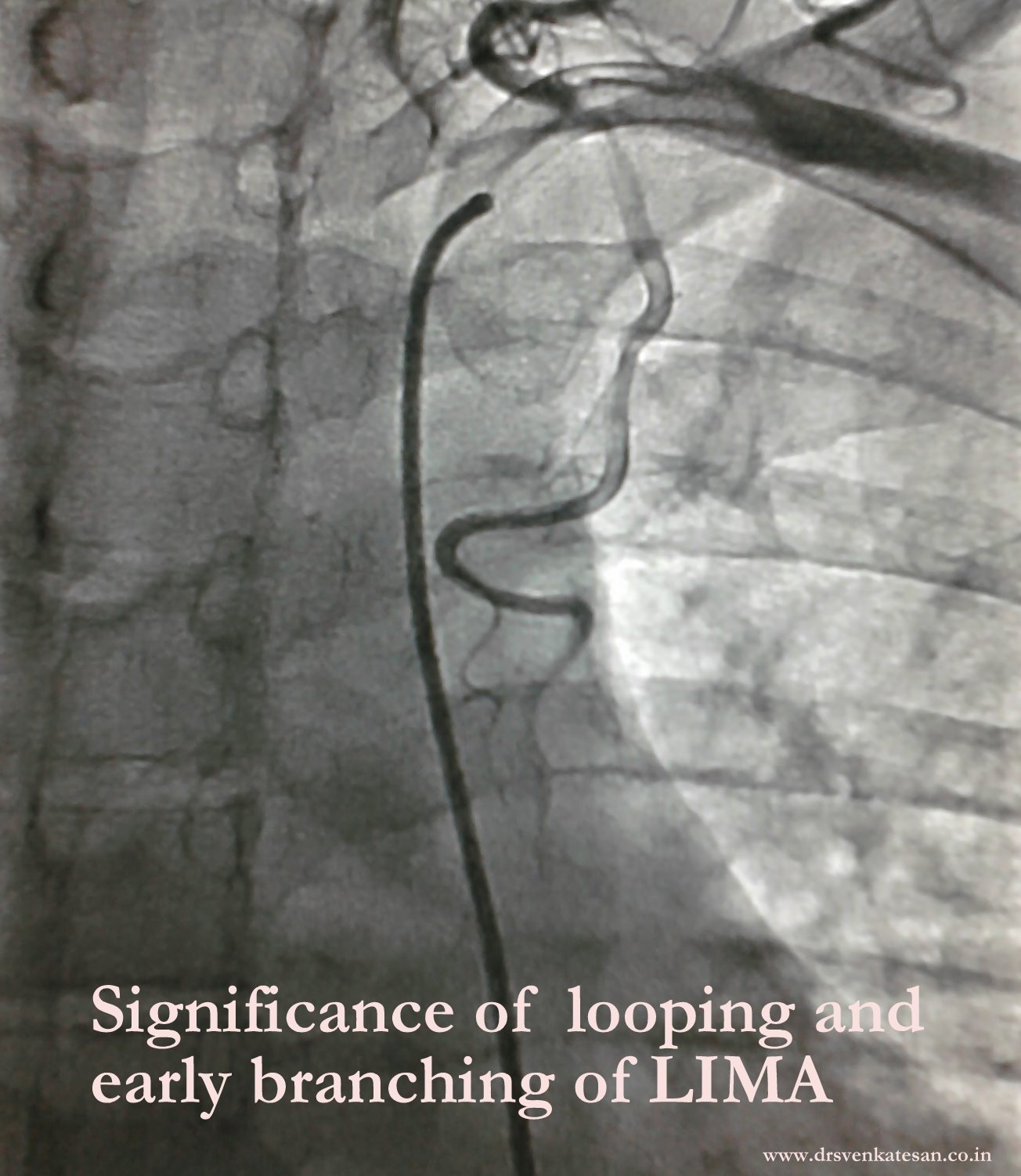
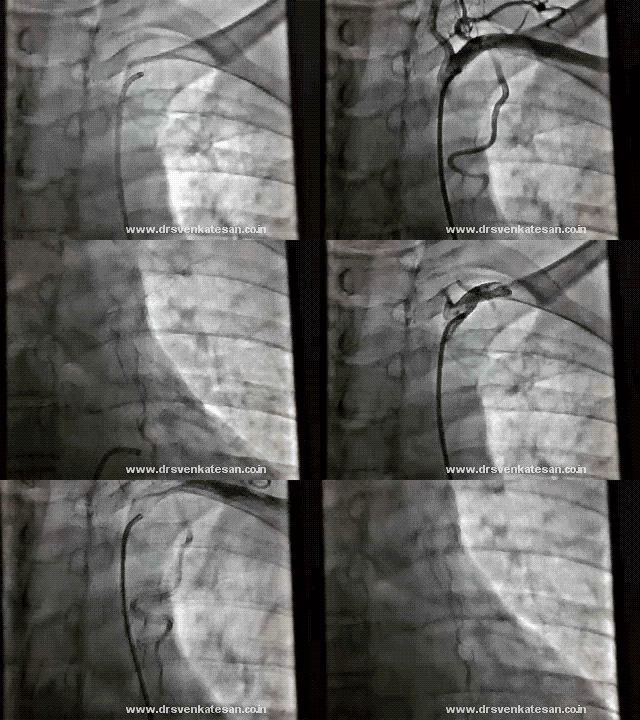
Looping of LIMA is rarely an issue in hemodynamic point of view. But some  believe  a looped up LIMA is slightly prone for graft disease.Complex looping are reported rarely.

A loop and a early branch of LIMA : What is the implication ?

Abnormal  or premature branching pattern  of LIMA  needs clipping as it may divert blood supply to LAD.Terminal branches can be used as a sequential graft to a branch of LAD  usually a diagonal. In spite of all these issues , LIMA is  rarely unsuitable either anatomically or physiologically .It is a safest vessel to graft.

Future of LIMA  graft assessment.

Currently selective LIMA angiogram is the gold standard.

MDCT (64 slice) gives stunning images of LIMA graft , but unfortunately , it has little value for functional assessment .

Functional assessment of LIMA graft By  angiographic frame count  is being attempted in our institute.Will be reported in 2012.

Is hypertension really a major risk factor for CAD ?

    1. Yes it is !
    2. No . . . it is not !
    3. May be !
    4. I don’t think so !

Ans : Any of the above can be a  right response , depending upon our basal and perceived  level of knowledge .

Answer analysis

  1. SHT  is  one of the risk factor for CAD  agreed ,  but definitely not a major one , as SHT per-se rarely precipitate a STEMI
  2. Unless SHT occurs with dyslipidemia, smoking or diabetes it is  rare to cause ACS.
  3. The only  adverse effect of SHT  is  , it has a potential  to aggravate atherosclerosis  by promoting epithelial injury and dysfunction.
  4. Hypertension is a well known  major risk factor for cerebro vascular disease while it is minor risk factor for CAD !
  5. We do not know yet why cerebral vessels are intolerant to high blood pressure while coronaries are pretty happy  with it !

Final comment

SHT is not a major risk factor  for CAD ! At worst , it can propagate chronic CAD. This sort of reasoning  may be considered a huge controversy  . . .but it is really not !

  • One evidence for the above observation is  , we  have  been struggling hard  for over a half a century  to prove a elusive  point that controlling blood pressure  to optimal levels  would  dramatically reduce  cardiac   events !
  • Further,HT’s  relationship with acute coronary syndrome especially STEMI  is vague , it is very rare for patients with accelerated hypertension or malignant hypertension to  present with STEMI *

* Caution :Young doctors should not get confused with this seemingly  controversial observation .This write-up , tries  to convey  a point  , SHT may not be that bad for coronary arteries when compared to cerebral arteries . However BP control remains  vital in  all patients who have  developed a cardiac  event or in patients with multiple risk factors .

Please note ** SHT is still  a powerful risk factor for cardiac failure.(Acute LVF to be precise ) ***SHT can aggravate unstable angina , but very  rare to precipitate unstable angina.**** SHT ./High intra-coronary  pressure can theoretically  dissect or fissure a plaque . (The fact that , HT is so prevalent in a community  but spontaneous  coronary  dissections are not !  should make us think further !)

What  is the   “secret of success”   among current generation  cardiologists ?

A . Strong foundations in cardiology with excellent clinical skills and a rational approach to the given problem.

B.  The  secret lies in the  nimble  fingers  which  acts  almost , like an extension of catheters  in cath lab !

C.  The speed with which he can mobilise a cath lab team in an ” off – office hour”  primary  PCI !

D. It is the the cunning art of  converting coronary  angiograms into angioplasties , by lucid  discussions  with patients and their   relatives  in the the silent cath lab corridors  !

Answer:

When this question was posed to a group of cardiologists ,  D  was considered  most important B,and C came close behind   and   A  was  probably least important  and few thought  “A” character  is rather an  impediment to  become a successful cardiologist !

*Unfortunately a successful cardiologist is defined in India by number of angioplasties he does per month, What  a disgrace to a great medical specialty called cardiology !

What is normal CAG to angioplasty conversion ratio ?

We presume  ECG  fails miserably against echocardiography for assessing hemodynamics , while  echocardiogram  has  little value  when it comes to studying   electrophysiology .  Ironically ,  we often  ignore  the fact  ,   ECG can  provide  important long-term   hemodynamic  data . The pattern of  chamber enlargement  give us  vital clues to the prevailing hemodynamic  stress and loading conditions. While echo  can be termed as an  anatomical and  physiologic   modality  , ECG  apart from  its unique capacity to record cardiac  electrical finger prints ,  it  provides  useful ,  anatomical ,  hemodynamic information too !

While Doppler is a  fascinating modality to measure hemodynamic data in a moment to moment fashion it can never ever tell us  , what has been going around in the preceding months or years. This  is were chamber size helps which  give us chronic physiological information (Chronic  Doppler ?)

A simple E:A reversal  in  mitral inflow doppler can be a  innocuous  finding in isolation  . If it is associated with even   minimal grades of  LAE  it gains huge importance. That is why left atrial size is  funnily referred to as HB A1C of diastolic dysfunction ( A marker of chronicity  of  diastolic dysfunction)

If LAE is so important to diagnose diastolic dysfunction , why  we are so  obsessed  with doppler filling profiles  of mitral valve ,pulmonary veins, mitral annular tissue Doppler and what not ! .Many of these sophisticated doppler methods are extremely operator dependent  and are  subjected  to technical and mathematical errors. Especially , with  tissue doppler where we  magnify the errors as we  filter  extremely  slow tissue motion .

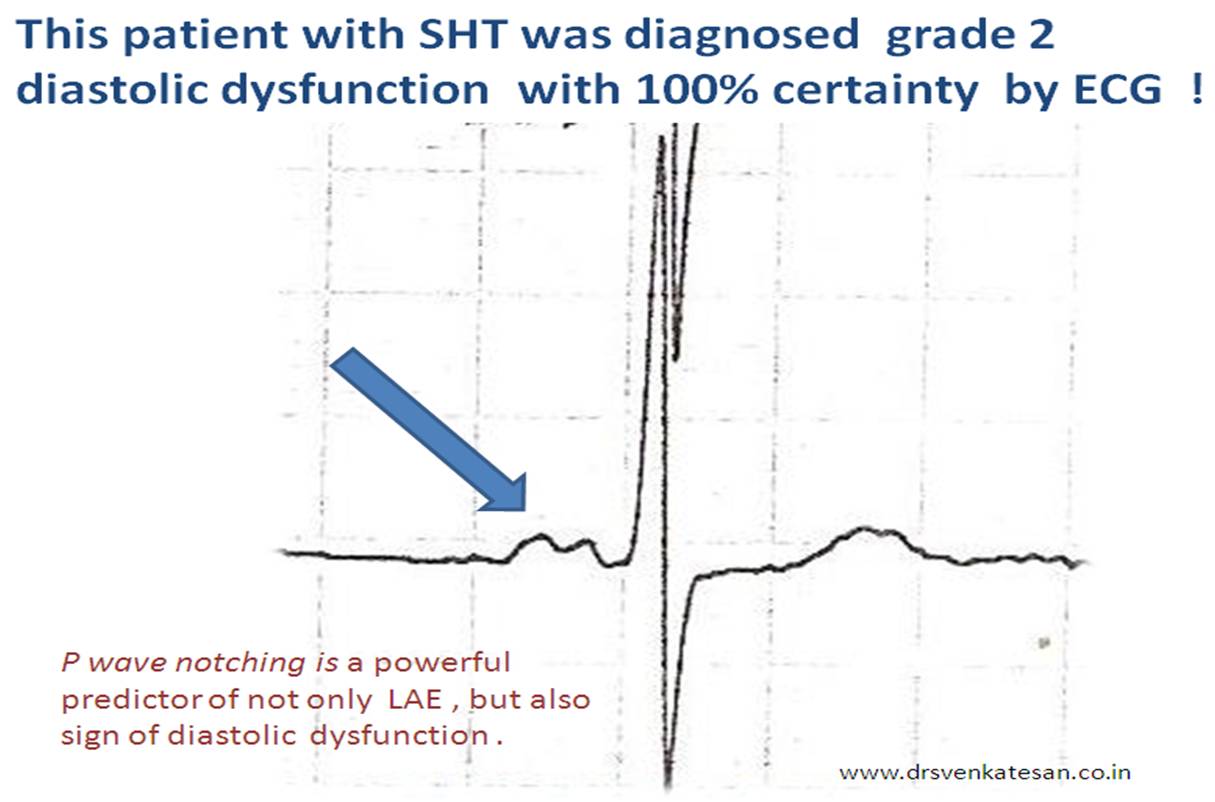
For  many  decades  we  have failed  to impress ourselves  , about the importance of subtle P wave abnormalities in the  ECGs   of  hypertensive patients.

In fact those  innocuous looking  slurs and notches   in P waves ,  suggest the left atrial  stress and a definite marker of underlying LV diastolic dysfunction .

P wave is the only electrical wave that occur in diastole .Hence there is no surprise  ,i  gives us enormous information about this phase of cardiac cycle .

If only we look  at them carefully, zoom it (Now it is made easy with so many softwares)  analyse critically we can find a wealth of information about the atrial behavior in hypertension.

Experience from our hypertension clinic  with periodic echocardiograms suggest ,  the following  ECG  findings   can be   good markers  of significant  diastolic dysfunction .

  1. Notched P wave
  2. Wide  P waves
  3. Slurred  P wave
  4. Bi-phasic P waves

* Surprisingly  , these abnormalities correlated with at least grade 1 diastolic dysfunction even in the absence of  for LAE or LVH by echocardiogram.

** In an  occasional patient  P waves  can widen due to inter atrial block or conduction delay. This a rare exception for wide P waves without LAE.

Final message

A well recorded and   analysed   ECG can  predict diastolic dysfunction  with fair  degree of accuracy .This fact need to be emphasized  by every one  .  Next to ECG ,  LA size and volume  by 2d echo are excellent parameters  to assess diastolic function in a long term fashion. Sophisticated  but  error prone ,  momentary doppler parameters are getting too much attention  at the cost of simple ,  shrewd ECG and 2D echo  !

LVH can be diagnosed with fair degree of  accuracy  by surface ECG . We have a set criteria .The Estes  scoring is  the most popular. Very rarely we have all  the classical features of LVH in a given ECG .

With the advent of echocardiography ECG diagnosis of LVH has become redundant . Still , it is essential to  build the  foundations  in cardiology  for the current generation cardiologists.

The following are the  magnified views from the above   ECG

High Voltage

High voltage QRS is a hall mark of LVH .It increases in both chest  and  limb leads .In chest leads , both R and S wave gets amplified , while in limb leads only the R wave  is taller . We have to sum up R  from lead  V 5 and S from V2  (Practically any deep S and tall R can be added . LVH is diagnosed  if  sum qrs voltage  is  >35 mm . Voltage criterias in limb leads do not require these  addition business . An  R wave amplitude > 11mm  in limb leads by itself  would indicate an LVH (In the absence of bundle blocks )

Pit falls in voltage  criteria

It is our belief    qRS voltage  would faithfully   reflect the   quantum of cardiac muscle mass ,  but in general  to equate qRS voltage  to myocardial  mass  is   a  huge error we make ! (Of course  It  may be true in  some cases  following MI )  .

The qRS  voltage is determined by   numerous  factors (Important ones are :  chest wall thickness , age , LV cavity size ,  amount of blood inside LV cavity,  heart rate , conduction delays  etc ) This is the reason a 10-year-old boy’s   ECG will  satisfy the criteria of LVH  by 100 % .Do not ever report a ECG without knowing the age of the patient .

At high heart rates R wave amplitude increases(Broddy effect) due to high conductance of blood

Chest lead always balances RV and LV forces .One can mask the other .So be ready for surprises when you find a perfectly normal ECH in bi-ventricular  hypertrophies ) A balancing act !

Mini summary : Never diagnose LVH with high voltage alone

Left axis deviation

The axis deviation is again non specific  . The LV mass shifts the mean axis to left (Beyond -15 degrees) .The axis shift would also be contributed by mild forms of LAFB . This  fascicle  which criss crosses the LVOT  easily gets injured to hemodynamic stress ( or rather insulted ) and  lose its function . So its job is  transferred to  the posterior fascicle  which  shoots  towards  anterior and superior and left , hence the  left axis deviation) .The LAFB is generally a benign defect unless it occurs in an acute fashion as a response to ischemia.

Mini summary : Never diagnose LVH on the basis of left axis alone

Left Atrial  abnormality

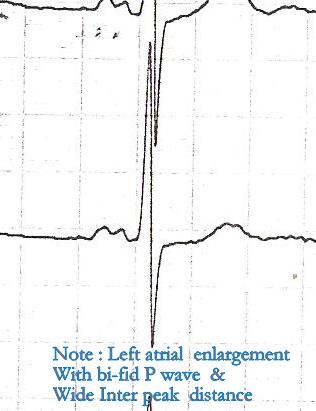
This need not be present in every one with LVH . It happens only  if  LVH  is associated with relaxation defect , when   it calls for  LA’s  assistance .(In other words , presence  of LAE in hypertensive  patients is  a  sure and simple way to confirm diastolic dysfunction ) . Similarly absence of  LAE (  with a   significant LVH )  is a good sign as the LV is able to tackle the hypertensive stress in solo fashion in all likely hood free from significant diastolic dysfunction.

Apart from LAE , note also the p wave encroaches good part of PR interval .

Mini summary : LAE can be very useful parameter to diagnose LVH . (Is it not ironical  to note   LAE is more reliable to diagnose LVH ! . This is because qrs morphology is unreliable as it influenced by many factors  while p wave  changes are  not subjected to such influence )

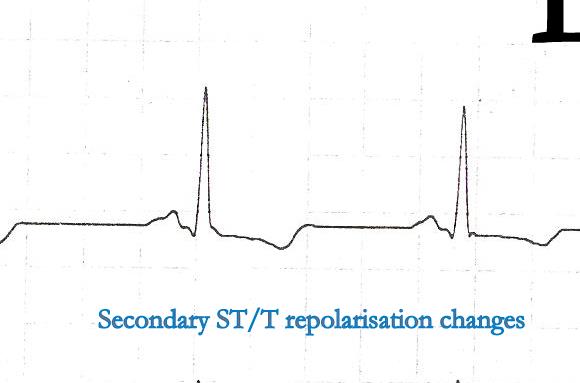
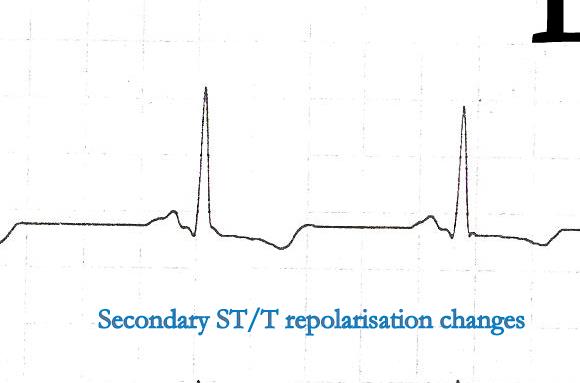
Secondary repolarization changes

We know ventricular depolarization and repolarization are interlinked phenomenon .Both  occur in  opposite directions still  , able to  record   ECG deflection  in same direction  (positive QRS/positive T)  . This is due to the fact  the epicardium and endocardium has  action potential with different velocities . At times of   LVH this epicardial  , endocardial heterogeneity in repolarization becomes void. (Note : This is a simplified statement of a complex repolarization process)

Because of this the repolarization is recorded opposite to that of depolarization .Hence we get all sorts of secondary ST /T changes. (The  term secondary is used to denote secondary to alteration  in depolarisation ).

Many times  all of the following  could   mean the same  in the bed side clinical parlance !

  • Secondary ST/T changes
  • Non specific ST/T ,
  • LV strain
  • LV systolic over load etc .

Note : Primary ST depression occurs in true ischemia without any alteration in LV Mass or conduction defect.

*** For advanced readers  only : Some of the ST depression that occur in ischemia could again be secondary changes. This  needs further reading.

Definitions

Echo is the gold standard for diagnosing LVH .There are two definitions .

  1. Based on septal thickness
  2. Based on LV mass*

LV mass > 200mg in men and 175mg in women is considered LVH . LVH based on LV mass is  ideal . But can be misleading in a dilated heart where the mass may be increased with a  relatively   thinned  out IVS .

Final message

There are numerous  ways to miss    LVH in ECG,  But the definite way  for not missing  is by echocardiogram !