Feeds:
Posts
Comments

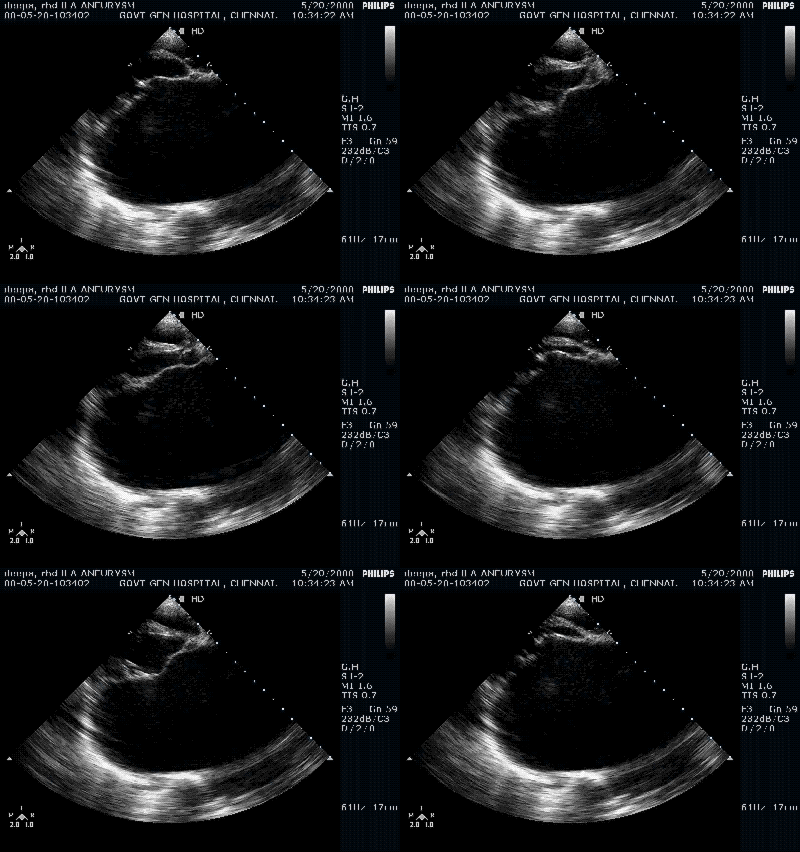
A young women  with Rheumatic heart disease .


LA aneurysm

Giant left atrium in rheumatic MS . http://www.drsvenkatesan.com

Mitral regurgitation is significant .www.drsvenkatesan.com


When do you call  a left atrium as   giant  ?  When it is referred to as  Aneurysmal dilatation ?

It is all semantics. Whenever LA becomes more than 6 cm ,  at least in two diameters  many prefer to call it giant .

In India , 6 cm LA is such a common finding , we have kept a  cut off at an  arbitrary 9 cm .

What factors determine a LA to dilate like a balloon ?

The exact mechanism is not known.It could be  the  intrinsic weakness of LA wall ,  as very few with RHD develop this. Many LAs resists dilatation even in the midst of extreme LA pressure. But , it is a well-known fact , mitral regurgitation provokes greater LA dilatation than MS alone .This implies volumetrics  play a major role than  pressure dynamics  in determining LA size. Acuteness of hemodynamic insult is  inversely proportional to LA size.

By the way, what is the purpose of  recognizing  the LA as Aneurysmal ?

  • In plain X -ray chest , LA may  form the right heart border  over shooting the RA.
  • When LA becomes huge  , there is a  chance for mechanical complications  like dysphagia, phrenic nerve , bronchial compression etc .
  • Giant LA invariably increases the chance of LA clot.

Electro-physiological Issues

  • Atrial fibrillation , a usual accompaniment of giant LA ,  is often refractory . There is no  purpose  to convert to sinus rhythm . In fact ,  one should not attempt this. There was a time when surgical incisions  ,corridors , mazes were quiet popular.Now it is believed all these are adding further injury to the ill-fated LA .Electro-physiologists should be restrained . Pulmonary vein ablation should never be attempted in such cases as the focus of AF is elsewhere .

Implication in cath lab

During PTMC LA size can be an issue  as the plane of IAS is distorted and make things difficult for septal puncture . Further the balloon , guidewire  may often slip  back into RA .

Implication for the surgeon.

For the surgeon the implication could be more. As a cardiologist I can’t comment about that .One thing we have observed is when LA becomes huge , the size of mitral annulus is too fictitious and funnily enough we have recorded up to 6 cm of mitral annulus . No valve is available for this size . We learnt from the surgeons ,   large LA  rarely pose a  problem as they suture the much  smaller valve in a larger annulus .(Which  makes the task  that easier )

Does the LA size regress after surgery ?

In many  it does regress  , in as many it doesn’t. We have seen giant LAs continuing to trouble the patient even after a successful mitral valve replacement.

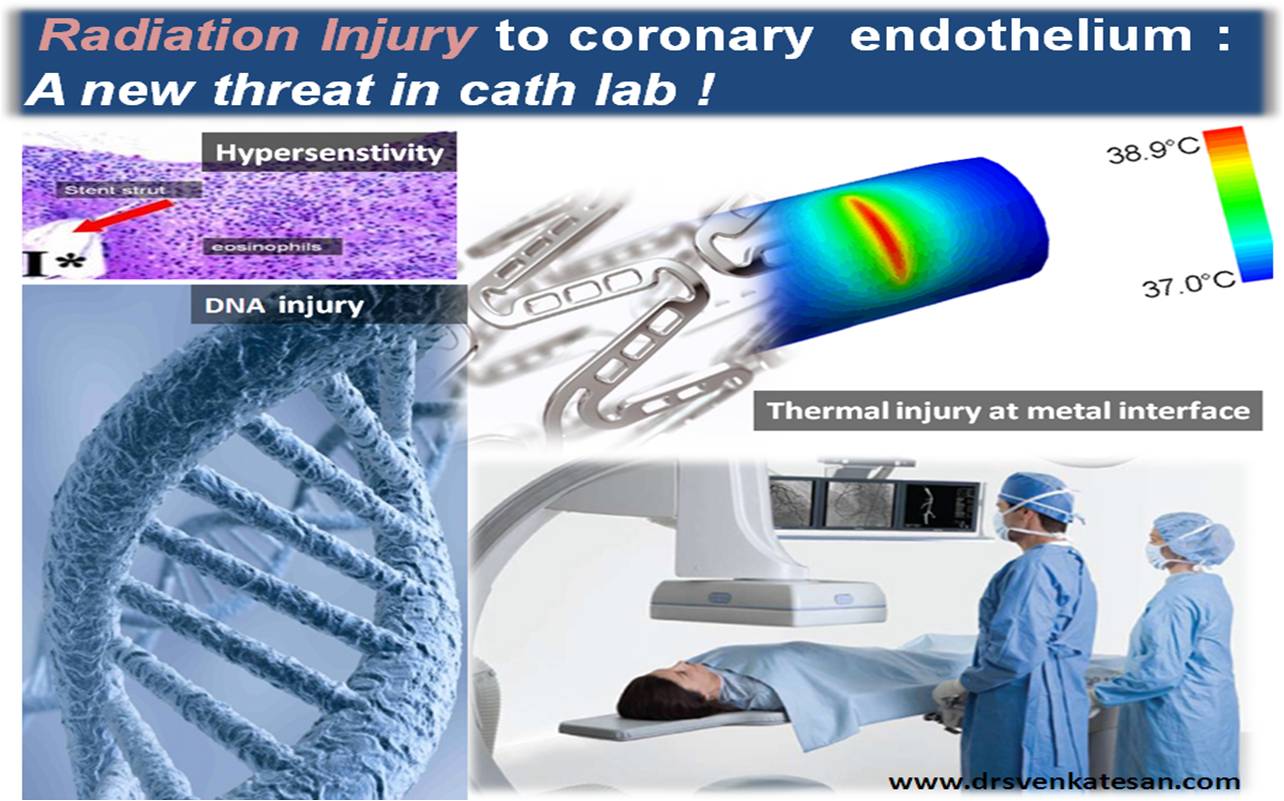
Radiation injury to coronary artery  is rarely given a thought , in spite of   prolonged fluro-scopic time  during  many complex angioplasties.While the cardiologists are fully protected the patient’s heart takes on the brunt of the attack.

What happens to the coronary endothelium -metal interface when X -rays pass through it ?

It is well known the radiation delivered to a tissue is many times  amplified if a metal interface is present. Further , the metals can produce heat on exposure to radiation . This absorption and heat varies with different metals .

The radiation injury to coronary endothelium  could be  significantly higher with DES , as the polymer in it absorbs more radiation than the bare metal stent. This could be responsible for late complications of DES.

The above  concept (unproven though !) is  proposed  by  http://circ.ahajournals.org/cgi/content/full/104/5/e23 .In this study Gold coated coronary stents were found to be less safe than conventional stent

It may take many years to know the truths  about  radiation injury caused by  of coronary stents  .

But always remember , unproven concepts are  not synonymous with wrong concepts !

Internet has revolutionsed the way we learn . Now,  you can watch experts  perfoming  complex cardiac surgries sitting at any where in the globe !

The credit not only goes to the broad-band internet , but also the greatness of   European association of cardiothoracic  surgery  which has made it available free of cost .

A must visit website for all those  physicians and surgeons ,  concerned with  cardiac care of our population .

This journal ,  dedicated to  cardiovascular  surgery from Brazil is doing a great job. Most of the articles are free.The Brazilian  progress   in cardiology and cardiac surgery  is  a   “No  mean” achievement.

Learn for yourself how the country ,  which many  think  is not yet  developed is doing pioneering  research and  perform  state of the art cardiac surgeries. Often their  concepts and techniques are so unique  and innovative , evoke criticism in other quarters.

It is ironical , some of  the mediocre journals  from affluent countries are making  waves , this one  deserves much better recognition !

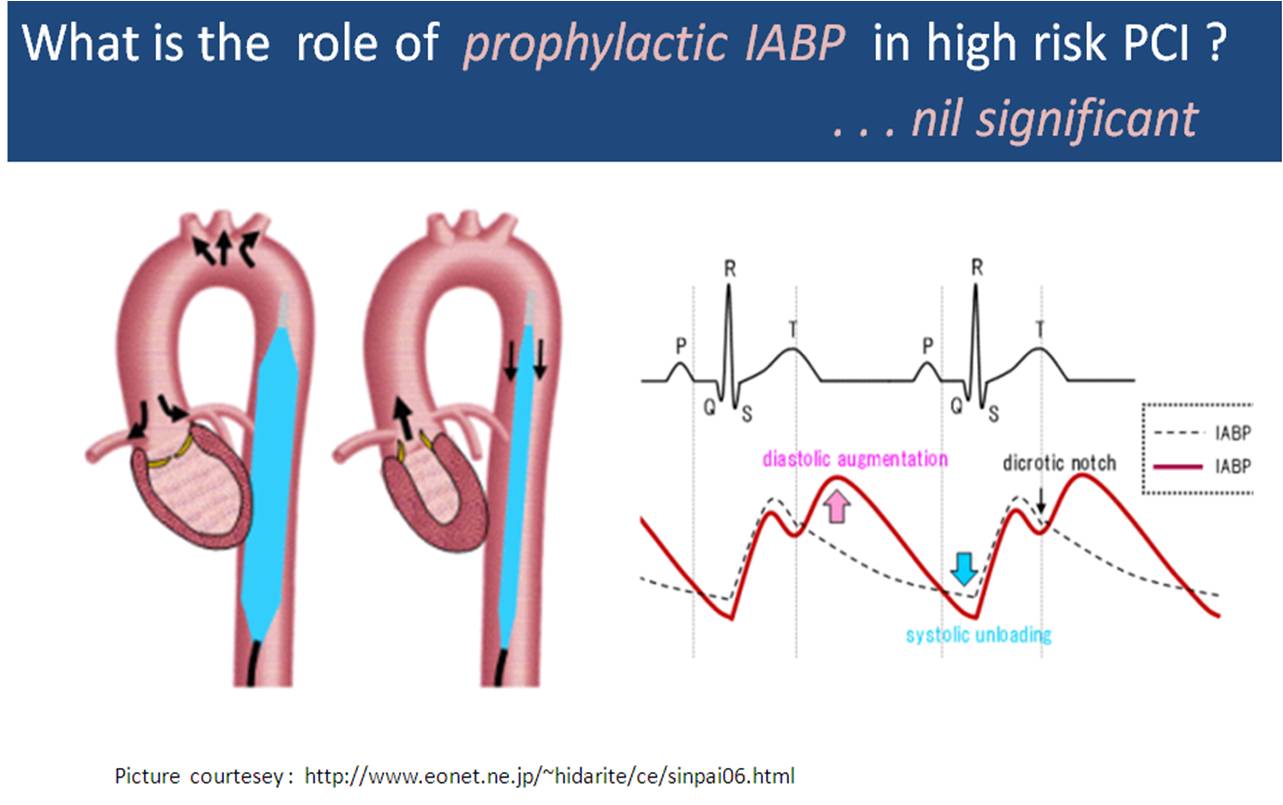
IABP is thought to be the  savior   when  PCI is done in severely compromised left ventricle and  in other  high risk angioplasties. Without verifying the facts,   routine use of this device became rampant  in cath labs around  the world in the last decade .

Everyone strongly believed , IABP  plays a major role in sustaining coronary  perfusion  during complex PCIs.  Then  the  favorable experience  started  pouring in,  from many cath labs  without IABP  support .   Common  sense struck us ,  and some one asked this question .


Should we routinely insert IABP in all  cases of high risk PCI. ?

The  study , published in  JAMA 2010  convincingly  answers  this  question


Can you do a high risk PCI without IABP back up facility ?

In academic sense “No” .

IABP service is not available in many cath labs in India for various reasons .But it does  not  become a contraindication to attempt PCI on  them .At least , we should have  facility to shift the patient  to a nearby advanced cardiac care centre  in case the need arises.

Final message

In plain language (Politeness removed !)  routine  prophylactic  IABP is not only useless ,  it could also  carry a  danger of access site ,  procedure  , expertise (Lack of  it ! ) related  hazards. Remember the Swan Ganz story !

http://jama.ama-assn.org/cgi/content/abstract/304/8/867

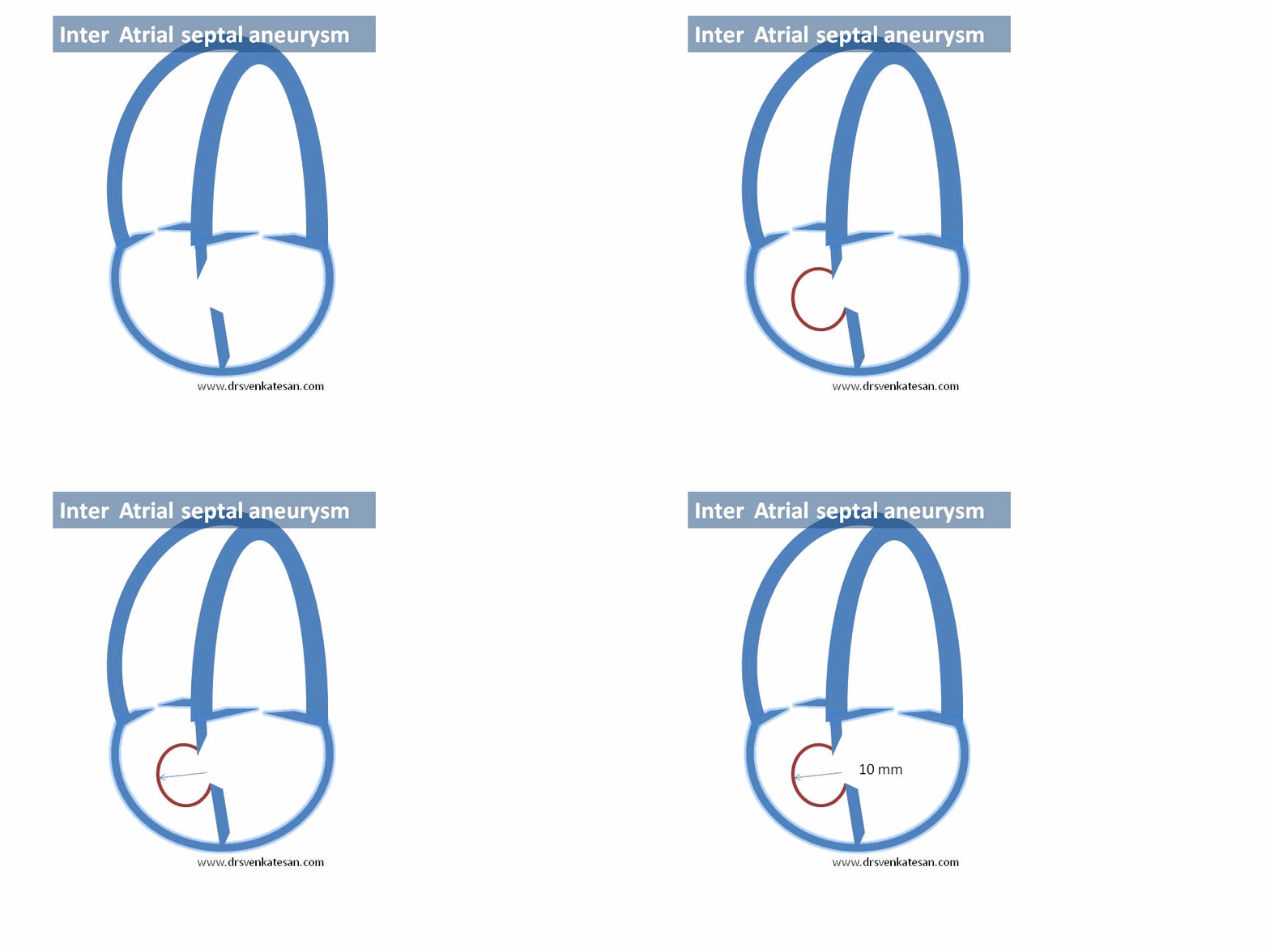
This is a relatively common abnormality of IAS. It is  often observed  as  IAS bulging  into left  or right atrium  in routine echocardiogram.If this happens without  atrial hypertension it is termed as IAS aneurysm .

This is due to valve of foramen ovale bending into the RA/LA*  cavity for various distance. By definition , the radius of curvature of  the bulge should be more than 10 mm to label it as IAS aneurysm.

*Bulging into RA more common

Click on the Image to see the animation

General features

  • Mostly a benign entity.
  • More often observed  in  association with PFOs or ostium secundum ASD.
  • When occurs in isolation does not result in any shunting across it
  • The septal bulge can be static or  dynamic . It could swing  into LA, RA, and back to LA or vice versa.
  • Anatomically 5 types are proposed.
  • Multiple fenestration in the aneurysms have been noted.
  • Aneurysm  formation may aid in spontaneous closure of ASD.

Clinical  implications

  • IAS aneurysm tend to aggravate  stasis of LA  blood flow and predispose to minute LA clots and systemic thrombo embolism .
  • IAS aneurysm can act as an arrhythmic focus , generating focal atrial tachycardias.
  • A non ejection click  may be occasionally heard as  the IAS aneurysm  bulges and tenses within LA/RA cavity .

Reference


1 . Olivares -Reyes A, et al. Atrial Septal Aneurysm: A new classification in 205 adults. J Am Soc Echocardiogr
1997;10:644-56.

2. Longhini C, et al. Atrial septal aneurysm: echocardiographic study. Am J Cardiol 1985;56:653-67.

3. Gondi B, Nanda NC. Two-dimensional echocardiographic features of atrial septal aneurysm. Circulation 1981;63:452-57

4. http://www.fac.org.ar/revista/00v29n4/congreso/premio3.PDF

Acute massive  pulmonary embolism is a dreaded medical  emergency  . In the past,  surgical embolectomy was the main option . Now , we have thrombolysis as a viable option.But , it does not work in all cases.* (90% success ?). It is critical to evaluate the success of thrombolyis , before embarking upon rescue embolectomy.

As it is often in critical care  medicine , this decision making is not easy .

The key question is how long , we shall wait before labeling  thrombolysis a failure !

In-fact , premature  assessment is the commonest cause for failed thrombolysis. True failure is different from deemed to be a  failure . This  is often related  to  , lack of patience  among  the   members of  treating team . Unlike acute MI ,there is not a  strict time window to  follow .The issue hear is ,  not lung salvage but  restoring VP/VQ and  dead space ventilation . The assessment is made , by clinical ,   MDCT ,Echo  parameters.

When there is difficulty in judging success , clinical parameters will prevail over medical images !


Key clinical parameters for monitoring

  • Heart rate
  • Saturation
  • Blood pressure

There are  four  options  available to manage in  failed pulmonary thrombolysis.

1.Emergency embolectomy in an unstable patient *

2.Elective , planned embolectomy  in a sable patient **

3.Repeat thrombolysis ***

4.Continue Intensive heparin regimen  for up to a minimum of   72hours  and up to a week .

*  Dismal outcome .

** Best option (Ironically,  these are the  patients , who improve  with medical  management , as well !)

***This is especially useful  when  partial success  is noted in a stable patient . ( For rescue thrombolysis it is  logical tom use TPA if SK was used initially and vice versa.) The logic here is the initial dose was  either insufficient or ineffective  to lyse the thrombus completely. If TPA is not available /or not affordable,  repeat SK can still be considered .It can be  safely administered within the 5 days of initial dose.

**** Least popular and considered inferior but has worked wonders in many .

How to manage a relatively  stable patient with a large thrombus load  in his pulmonary artery ?

Option number 3 could be tried. Prolonged  monitored heparin

What  are the surgeons concern about  management in failed pulmonary thromolysis ?

Every  surgeon( Especially  the  cardiac  surgeons)  loves  to operate in a stable patient . If you hand over  a case  for pulmonary  embolectomy  ,  with  sinking  O2 saturation  and  falling  blood pressure  ,the outcome can be  easily predicted !

Further, RV dysfunction  is notoriously known    for pump dependency  .  CT surgeons are vastly experienced   in  the intra operative tips and tricks of  managing  LV dysfunction (They may not be  in  so  in RV dysfunction !)

Bleeding risk  is also high especially  in the milieu of   intensive anticoagualtion and thrombolysis .

The mortality could be as high  as 30 % in many centers.


Final message

  • The incidence  of failed pulmonary thrombolysis  is  often subjected to the whims and fancies of treating physician  and the imaging modalities used.
  • Timing of assessment is critical .One need to give a long rope for medical management  , in spite of the urge , to do something more. .
  • Clinical improvement should be the main guiding force.
  • Normalisation of tachycardia   ,  improving  trend  of  o2 saturation(  >90-95%)  , regressing  RV size are useful parameters.
  • Thrombus load  detected by a repeat  CT scan  ,  need not be  the   sole guiding parameter.In -fact , mobilising these patients for CT scan by itself is fraught with a risk of  worsening the hypoxia.
  • The issue of  tackling the source of thrombus should  be addressed separately .Luckily, the same anticoagulant protocol takes care of this issue also. It is rarely a emergent issue.
  • Deploying an  IVC filter as an emergency procedure is a bigger controversy .At best , it is useful in few high risk individuals with high risk mobile ileo-femoral clots .
  • Finally, not every one can handle this  situation .Ideally such  patients  should be  to be  shifted to a well established cardiac surgical  set up .

From Chest journal

http://chestjournal.chestpubs.org/content/129/4/1043.full.pdf+html

There were days when acute pulmonary embolism(APE) was almost always  diagnosed  post-mortem. We are in the era , where we can recognise most of  the  pulmonary  embolism  without any difficulty.

Experience has taught us ,  when to suspect this dreaded  syndrome . Any  unexplained, dyspnea, hypoxia, tachycardia , syncope* with  vague chest discomfort  and  a predisposing condition (DVT , post operative  state ,etc) will make  acute PE highly likely .

*Postural dyspnea and syncope is a classical finding in many.

Pulmonary Echogram

We have  advanced  multi detector CT scans  and MR angiogram , V/P scans and pulmonary angiograms  to diagnose and confirm Acute PE .What we fail  to realise  is we also  have a simple bed side tool  called echocardiography   to  rapidly detect,  assess the pulmonary  anatomy and its hemodynamic  status.  In fact ,  we can visualize  the entire  MPA, and its  bifurcation and to  certain extent RPA,LPA. It is strange  physicians  always  ask for pulmonary  angiogram to diagnose APE , when we have a totally non invasive  pulmonary echogram available at the bedside .It can  rule out almost all cases of  massive pulmonary embolism with a good festivity and specificity .
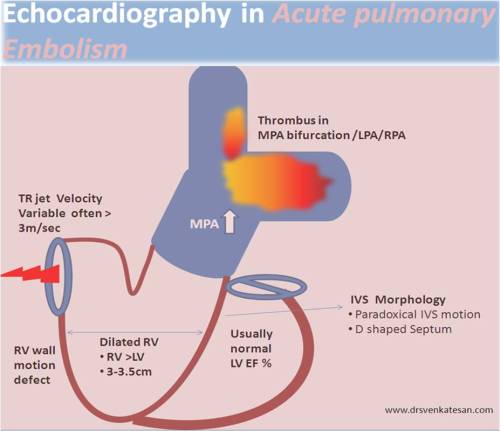
How often Echo miss a Acute PE ?

Echo may fail to image a thrombus if it is distal but it is very rare to miss a thrombus in MPA, and its bifurcation. Most of the patients with  massive pulmonary embolism , are likely  have a thrombus in the bifurcation.

Even if  echo  fails  to image a thrombus , the effects of  acute  pulmonary arterial  hypertension on the tender walled  right ventricle  is conspicuous. In fact, the  effect of Acute PE on the RV morphology and function  is  the  single most important feature to suspect APE . This is also  considered as an indication for thrombolysis.

The following  Echo features  suggest Acute Massive Pulmonary embolism.Imaging these patients may be difficult especially if they are acutely  dyspneic   .Luckily , pulmonary  artery short axis view can be obtained even in supine position  in most of the patients.

  • RV dilatation ( One popular criteria is End diastolic RV dimension > LV end diastolic dimension .It should be remembered ,  strict criterias  can not be followed in this high risk medical  emergency . Visual estimation of RV size is equally important.If in the para sternal long axis , RV is > 3cm it is significant . The only issue is, in patients with preexisting  COPD  RV size will not be useful to diagnose APE.
  • RA dilatation (this is also a usual accompaniment )
  • RV wall motion defect(Considered , as  RV SOS calls !)
  • Paradoxical septal motion
  • D shaped septum is  an absolute sign of distressed RV.
  • Tricuspid regurgitation(This depends upon the leaflet length and orientation, some may not develop in spite severe PAH )

Less common features

  • Pulmonary  regurgitation
  • RA , RA appendage , IVC ,  RV clots

Diagnosing  RV hypertension

TR jet

MPA  acceleration  time (Not useful in an emergency situation )

Other thinks to look in Echo

  • LV function (Hypoxic  dysfunction  or associated CAD )
  • IVC for  thrombus source .
  • IAS anatomy : PFO may increase the chance for stroke as these patients carry the risk of further  embolus. When the RVEDP, RA mean pressure raise to APE, the PFO becomes hemodynamcially patent and may develop propensity to shunt the incoming thrombus to left atrium rather than right ventricle  as LA pressure is considerably  less than RV

Unanswered questions

At what  pressure RV begins to dilate ?

This is not clear.The response of RV ,  to pressure overload is  not constant.  In acute raise of RV pressure ,RV tend to dilate  , while  in chronic PAH RV hypertrophies and dilates .It is  believed   , the first signs of dilation begin , even with a 30mmhg of PA pressure . So ,  even minor dilatation could become important in acute PE.

Can RV dilatation alone  , be taken  as evidence  for hemodynamic instability ?

Yes , but realise  ,  clinical , hemodynamic instability  is much more important than degree of RV dilatation  (Hypotension /hypoxia  )

The curious behavior of RV and TR jet in APE ?

Normal peak RV pressure is 25-30mmhg .In acute pulmonary  hypertension RV pressure is supposed to raise . But it does not always happen.It all depends upon how the RV respond to the sudden raise in its afterload.

Some RVs fight vigorously and take on the challenge  imposed by pulmonary  embolus.These are the  patients  who show strong TR jets which may reach 60 mmhg. More  often , the RV  is stunned and overwhelmed  by the unexpected sequence of events and  lose the battle from the beginning  .They become  flabby  and dilated.These  patients  do not  show any significant TR jet ,  in spite of raising PA pressure. This implies,  a  good TR jet > 3.5 could  virtually rule out  severe RV dysfunction.

(One  popular thought gaining ground is  , the primary determinant of   pulmonary artery  systolic  pressure  in Acute PE is the RV contractile force ,  rather  than pulmonary  impedance .)

Hypotension is common in APE .What is  the relationship  between PAH and systemic blood pressure ?

  • Inverse relationship is expected . This often result in syncope in these patients.
  • Bernhiem effect
  • Hypoxic LV dysfunction

Final message

RV  faces the brunt of the  hemodynamic attack of acute PE. .Differentiating simple RV involvement  from RV dysfunction  is a difficult and subjective  exercise. But ,  it need to be done accurately as  RV dysfunction becomes an indication  for thrombolysis  . RV dilatation  , wall motion defect, mild PAH, all  indicate RV dysfunction . Diagnosing RV dysfunction is  better  done by the  treating physician who has the  overall clinical data.
Cardiology is probably the most rapidly growing field  in medicine. Radiology is closely following .When both combine together there is  bound to be  plenty of action ! That’s what is happening with this journal .

Knowledge is power , do not bother if you do not have such  a machine in your work place.Just know what is happening in the world of cardiac imaging.

http://jcmr-online.com/

  • Endothelium is the largest vascular organ in the body .
  • It is constantly being serviced by both the circulating blood  from the luminal side as well as from the abluminal plane.

  • The discovery of nitric oxide and endothelin  was a breakthrough .
  • They are under neural, mechanical and endocrine control .
  • Negative emotions like anger and depression has a high correlation with hypertension and cardiac event
  • Positive emotions like laughter and happiness is expected to have good vascular tone

This fascinating  study from Japan and USA (Texas)  published  in American journal of cardiology , discusses how a comedy movie possibly releases nitric oxide profusely from our endothelium

Link placed with the courtesy of AJC

http://www.ajconline.org/article/S0002-9149(10)01050-7/abstract